


183 Résultats
Classification:
livres
livres
Prix:
$12.00
(disponible sur commande)
Résumé:
The documentary film "What It Takes to Make A Home" (2020, conceived by Giovanna Borasi of the CCA and directed by Daniel Schwartz) follows a conversation between two architects whose work addresses homelessness. Michael Maltzan in Los Angeles and Alexander Hagner in Vienna have both designed long-term housing, exploring and embodying various strategies for social(...)
$12.00
(disponible sur commande)
Résumé:
The documentary film "What It Takes to Make A Home" (2020, conceived by Giovanna Borasi of the CCA and directed by Daniel Schwartz) follows a conversation between two architects whose work addresses homelessness. Michael Maltzan in Los Angeles and Alexander Hagner in Vienna have both designed long-term housing, exploring and embodying various strategies for social(...)
Sujet:
L'humain et la ville
L'humain et la ville
Publication:
octobre 2020
octobre 2020
Titre:
Questions on dwelling, discourse 01: What it takes to make a home
Actions:
Prix:
$12.00
(disponible sur commande)
Résumé:
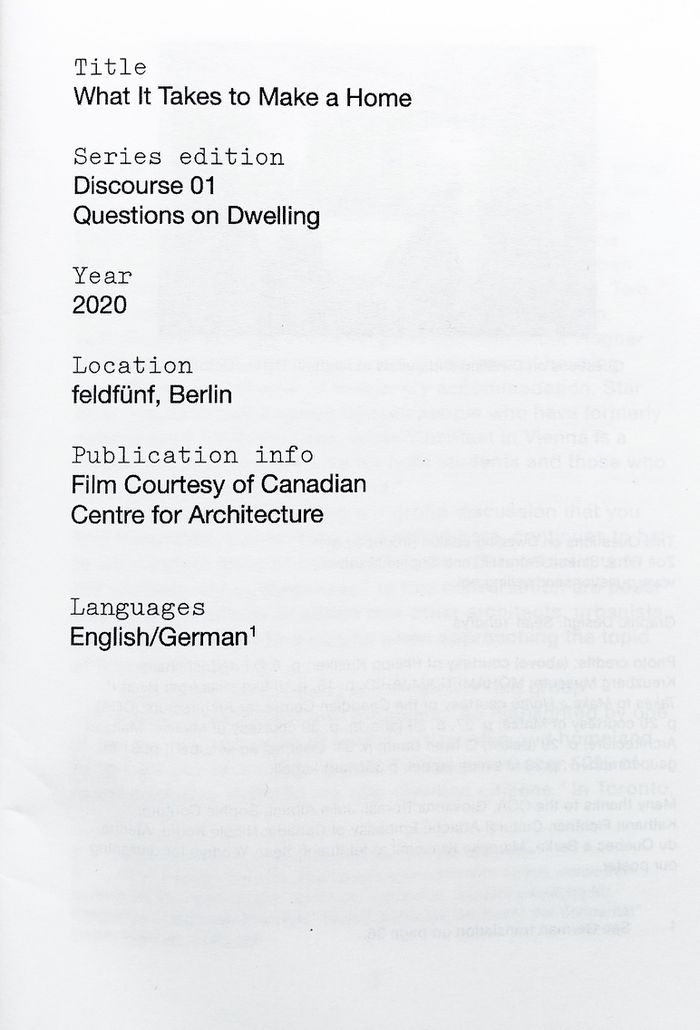
The documentary film "What It Takes to Make A Home" (2020, conceived by Giovanna Borasi of the CCA and directed by Daniel Schwartz) follows a conversation between two architects whose work addresses homelessness. Michael Maltzan in Los Angeles and Alexander Hagner in Vienna have both designed long-term housing, exploring and embodying various strategies for social integration, mental health, and inclusive architectural-urban schemes. Questions on Dwelling screened the film in full and held a conversation at feldfünf Berlin with actors engaged in homelessness in Berlin. In that conversation, they tried to address the successes and failures of the film, architecture’s role and complicity in exacerbating the financialization of housing, the criminalization of urban space, and its entanglement with the privatization of the city. The transcript of that conversation was documented in this bilingual booklet.
Questions on dwelling, discourse 01: What it takes to make a home
Actions:
Prix:
$12.00
(disponible sur commande)
Résumé:
The documentary film "What It Takes to Make A Home" (2020, conceived by Giovanna Borasi of the CCA and directed by Daniel Schwartz) follows a conversation between two architects whose work addresses homelessness. Michael Maltzan in Los Angeles and Alexander Hagner in Vienna have both designed long-term housing, exploring and embodying various strategies for social integration, mental health, and inclusive architectural-urban schemes. Questions on Dwelling screened the film in full and held a conversation at feldfünf Berlin with actors engaged in homelessness in Berlin. In that conversation, they tried to address the successes and failures of the film, architecture’s role and complicity in exacerbating the financialization of housing, the criminalization of urban space, and its entanglement with the privatization of the city. The transcript of that conversation was documented in this bilingual booklet.
Classification:
livres
livres
Publication:
octobre 2020
octobre 2020
Sujet:
L'humain et la ville
L'humain et la ville
Classification:
vidéo
vidéo
Actions:
Prix:
$19.99
(disponible sur commande)
Résumé:
Ce film est le portrait d'une canadienne d'exception, animée par une passion sans pareille pour l'architecture. Phyllis Lambert, née Bronfman, est rattachée à quelques-unes des grandes réalisations du siècle dernier : du Seagram Building, à New York, dont elle obtint de son père qu'il en confiât la conception à ce grand maître de la modernité que fut Mies van der Rohe, en(...)
$19.99
(disponible sur commande)
Résumé:
Ce film est le portrait d'une canadienne d'exception, animée par une passion sans pareille pour l'architecture. Phyllis Lambert, née Bronfman, est rattachée à quelques-unes des grandes réalisations du siècle dernier : du Seagram Building, à New York, dont elle obtint de son père qu'il en confiât la conception à ce grand maître de la modernité que fut Mies van der Rohe, en(...)
Titre:
DVD Citizen Lambert / Jeanne d'architecture
Actions:
Prix:
$19.99
(disponible sur commande)
Résumé:
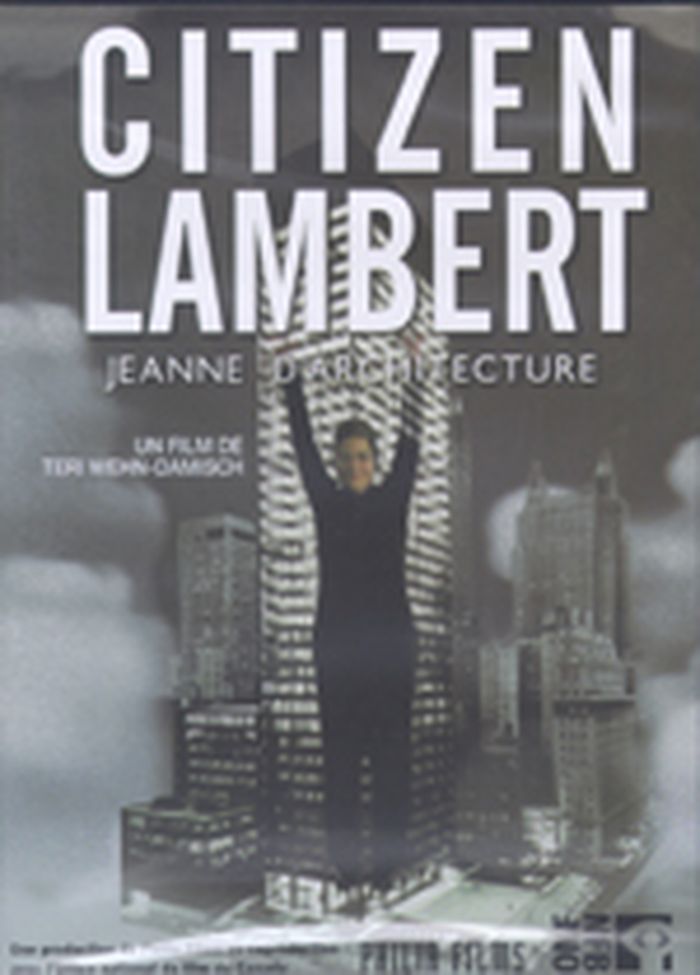
Ce film est le portrait d'une canadienne d'exception, animée par une passion sans pareille pour l'architecture. Phyllis Lambert, née Bronfman, est rattachée à quelques-unes des grandes réalisations du siècle dernier : du Seagram Building, à New York, dont elle obtint de son père qu'il en confiât la conception à ce grand maître de la modernité que fut Mies van der Rohe, en passant par le retour aux sources que représenta pour elle la guérilla qu'elle a menée pour sauver le Vieux-Montréal, jusqu'à la création de cette institution sans égale dans le monde qu'est le Centre Canadien d'Architecture. Il restait à en tirer un film : ce qu'à réussi Teri Wehn-Damisch, en suivant des voies elles-mêmes toutes de traverses.
DVD Citizen Lambert / Jeanne d'architecture
Actions:
Prix:
$19.99
(disponible sur commande)
Résumé:
Ce film est le portrait d'une canadienne d'exception, animée par une passion sans pareille pour l'architecture. Phyllis Lambert, née Bronfman, est rattachée à quelques-unes des grandes réalisations du siècle dernier : du Seagram Building, à New York, dont elle obtint de son père qu'il en confiât la conception à ce grand maître de la modernité que fut Mies van der Rohe, en passant par le retour aux sources que représenta pour elle la guérilla qu'elle a menée pour sauver le Vieux-Montréal, jusqu'à la création de cette institution sans égale dans le monde qu'est le Centre Canadien d'Architecture. Il restait à en tirer un film : ce qu'à réussi Teri Wehn-Damisch, en suivant des voies elles-mêmes toutes de traverses.
Classification:
vidéo
vidéo
Publication:
novembre 2007, Montreal
novembre 2007, Montreal
Sujet:
DVD vidéo
DVD vidéo
Classification:
livres
livres
Actions:
Prix:
$90.00
(disponible sur commande)
Résumé:
Gordon Matta-Clark, scion and rebel, died at 35 in 1978 and has since become a cult figure of late-twentieth-century art. Born in New York and trained in architecture at Cornell, he went on to question the field's conventions in vivid projects that excised holes into existing buildings or assembled deeds to New York City alleys and curbs. As the son of the Chilean-born(...)
$90.00
(disponible sur commande)
Résumé:
Gordon Matta-Clark, scion and rebel, died at 35 in 1978 and has since become a cult figure of late-twentieth-century art. Born in New York and trained in architecture at Cornell, he went on to question the field's conventions in vivid projects that excised holes into existing buildings or assembled deeds to New York City alleys and curbs. As the son of the Chilean-born(...)
Titre:
Gordon Matta-Clark: works and collected writings
Actions:
Prix:
$90.00
(disponible sur commande)
Résumé:
Gordon Matta-Clark, scion and rebel, died at 35 in 1978 and has since become a cult figure of late-twentieth-century art. Born in New York and trained in architecture at Cornell, he went on to question the field's conventions in vivid projects that excised holes into existing buildings or assembled deeds to New York City alleys and curbs. As the son of the Chilean-born Surrealist painter Roberto Matta and Anne Clark, and godson of Marcel Duchamp, with whom he played a regular game of chess in the Village, Matta-Clark had grown up inside the art world, also working an as assistant to mavericks like Dennis Oppenheim and Robert Smithson. His work and words, while sophisticated enough to make him an "artist's artist," and colossal and outgoing enough to draw public attention and affection, were always also grounded in social or political convictions. He addressed not only space and real estate (in other words, housing), but the ultimate in necessity and nourishment, food. His "Pig Roast" under the Brooklyn Bridge offered passersby 500 pork sandwiches, and Food, the artist-staffed restaurant that he opened with dancer Caroline Goodden in SoHo, became a headquarters for that nascent neighborhood in the early 70s. He consistently broke the boundaries between sculpture and architecture, photography and film, performance and installation, and above all the permanent and the transitory. Once in a while he also broke the law. This book, published in celebration of the gradual opening of Matta-Clark's archives at the Canadian Centre for Architecture in Montreal, collects previously unavailable writings, including notecards and notebooks, along with interviews and more than 100 illustrations.
Gordon Matta-Clark: works and collected writings
Actions:
Prix:
$90.00
(disponible sur commande)
Résumé:
Gordon Matta-Clark, scion and rebel, died at 35 in 1978 and has since become a cult figure of late-twentieth-century art. Born in New York and trained in architecture at Cornell, he went on to question the field's conventions in vivid projects that excised holes into existing buildings or assembled deeds to New York City alleys and curbs. As the son of the Chilean-born Surrealist painter Roberto Matta and Anne Clark, and godson of Marcel Duchamp, with whom he played a regular game of chess in the Village, Matta-Clark had grown up inside the art world, also working an as assistant to mavericks like Dennis Oppenheim and Robert Smithson. His work and words, while sophisticated enough to make him an "artist's artist," and colossal and outgoing enough to draw public attention and affection, were always also grounded in social or political convictions. He addressed not only space and real estate (in other words, housing), but the ultimate in necessity and nourishment, food. His "Pig Roast" under the Brooklyn Bridge offered passersby 500 pork sandwiches, and Food, the artist-staffed restaurant that he opened with dancer Caroline Goodden in SoHo, became a headquarters for that nascent neighborhood in the early 70s. He consistently broke the boundaries between sculpture and architecture, photography and film, performance and installation, and above all the permanent and the transitory. Once in a while he also broke the law. This book, published in celebration of the gradual opening of Matta-Clark's archives at the Canadian Centre for Architecture in Montreal, collects previously unavailable writings, including notecards and notebooks, along with interviews and more than 100 illustrations.
Classification:
livres
livres
Publication:
octobre 2006
octobre 2006


