


1981 Résultats
Classification:
audio
audio
Actions:
Description:
1 online resource.
Auteur:
Sujet:
Publication:
[Place of publication not identified] : Junior Aspirin Records, 2017.
[Place of publication not identified] : Junior Aspirin Records, 2017.
Classification:
audio
audio
Publication:
[Place of publication not identified] : Junior Aspirin Records, 2017.
[Place of publication not identified] : Junior Aspirin Records, 2017.
Auteur:
Sujet:
Classification:
livres
livres
Actions:
Prix:
$90.00
(disponible sur commande)
Résumé:
Gordon Matta-Clark, scion and rebel, died at 35 in 1978 and has since become a cult figure of late-twentieth-century art. Born in New York and trained in architecture at Cornell, he went on to question the field's conventions in vivid projects that excised holes into existing buildings or assembled deeds to New York City alleys and curbs. As the son of the Chilean-born(...)
$90.00
(disponible sur commande)
Résumé:
Gordon Matta-Clark, scion and rebel, died at 35 in 1978 and has since become a cult figure of late-twentieth-century art. Born in New York and trained in architecture at Cornell, he went on to question the field's conventions in vivid projects that excised holes into existing buildings or assembled deeds to New York City alleys and curbs. As the son of the Chilean-born(...)
Titre:
Gordon Matta-Clark: works and collected writings
Actions:
Prix:
$90.00
(disponible sur commande)
Résumé:
Gordon Matta-Clark, scion and rebel, died at 35 in 1978 and has since become a cult figure of late-twentieth-century art. Born in New York and trained in architecture at Cornell, he went on to question the field's conventions in vivid projects that excised holes into existing buildings or assembled deeds to New York City alleys and curbs. As the son of the Chilean-born Surrealist painter Roberto Matta and Anne Clark, and godson of Marcel Duchamp, with whom he played a regular game of chess in the Village, Matta-Clark had grown up inside the art world, also working an as assistant to mavericks like Dennis Oppenheim and Robert Smithson. His work and words, while sophisticated enough to make him an "artist's artist," and colossal and outgoing enough to draw public attention and affection, were always also grounded in social or political convictions. He addressed not only space and real estate (in other words, housing), but the ultimate in necessity and nourishment, food. His "Pig Roast" under the Brooklyn Bridge offered passersby 500 pork sandwiches, and Food, the artist-staffed restaurant that he opened with dancer Caroline Goodden in SoHo, became a headquarters for that nascent neighborhood in the early 70s. He consistently broke the boundaries between sculpture and architecture, photography and film, performance and installation, and above all the permanent and the transitory. Once in a while he also broke the law. This book, published in celebration of the gradual opening of Matta-Clark's archives at the Canadian Centre for Architecture in Montreal, collects previously unavailable writings, including notecards and notebooks, along with interviews and more than 100 illustrations.
Gordon Matta-Clark: works and collected writings
Actions:
Prix:
$90.00
(disponible sur commande)
Résumé:
Gordon Matta-Clark, scion and rebel, died at 35 in 1978 and has since become a cult figure of late-twentieth-century art. Born in New York and trained in architecture at Cornell, he went on to question the field's conventions in vivid projects that excised holes into existing buildings or assembled deeds to New York City alleys and curbs. As the son of the Chilean-born Surrealist painter Roberto Matta and Anne Clark, and godson of Marcel Duchamp, with whom he played a regular game of chess in the Village, Matta-Clark had grown up inside the art world, also working an as assistant to mavericks like Dennis Oppenheim and Robert Smithson. His work and words, while sophisticated enough to make him an "artist's artist," and colossal and outgoing enough to draw public attention and affection, were always also grounded in social or political convictions. He addressed not only space and real estate (in other words, housing), but the ultimate in necessity and nourishment, food. His "Pig Roast" under the Brooklyn Bridge offered passersby 500 pork sandwiches, and Food, the artist-staffed restaurant that he opened with dancer Caroline Goodden in SoHo, became a headquarters for that nascent neighborhood in the early 70s. He consistently broke the boundaries between sculpture and architecture, photography and film, performance and installation, and above all the permanent and the transitory. Once in a while he also broke the law. This book, published in celebration of the gradual opening of Matta-Clark's archives at the Canadian Centre for Architecture in Montreal, collects previously unavailable writings, including notecards and notebooks, along with interviews and more than 100 illustrations.
Classification:
livres
livres
Publication:
octobre 2006
octobre 2006
Classification:
livres
livres

Actions:
Prix:
$39.95
(disponible sur commande)
Résumé:
As we spend more and more of our time staring at the screens of movies, televisions, computers, and handheld devices--"windows" full of moving images, texts, and icons--how the world is framed has become as important as what is in the frame. In The Virtual Window, Anne Friedberg examines the window as metaphor, as architectural component, and as an opening to the(...)
$39.95
(disponible sur commande)
Résumé:
As we spend more and more of our time staring at the screens of movies, televisions, computers, and handheld devices--"windows" full of moving images, texts, and icons--how the world is framed has become as important as what is in the frame. In The Virtual Window, Anne Friedberg examines the window as metaphor, as architectural component, and as an opening to the(...)
Titre:
The virtual window : from Alberti to Microsoft
Actions:
Prix:
$39.95
(disponible sur commande)
Résumé:
As we spend more and more of our time staring at the screens of movies, televisions, computers, and handheld devices--"windows" full of moving images, texts, and icons--how the world is framed has become as important as what is in the frame. In The Virtual Window, Anne Friedberg examines the window as metaphor, as architectural component, and as an opening to the dematerialized reality we see on the screen. In De pictura (1435), Leon Battista Alberti famously instructed painters to consider the frame of the painting as an open window. Taking Alberti's metaphor as her starting point, Friedberg tracks shifts in the perspectival paradigm as she gives us histories of the architectural window, developments in glass and transparency, and the emerging apparatuses of photography, cinema, television, and digital imaging. Single-point perspective--Alberti's metaphorical window--has long been challenged by modern painting, modern architecture, and moving-image technologies. And yet, notes Friedberg, for most of the twentieth century the dominant form of the moving image was a single image in a single frame. The fractured modernism exemplified by cubist painting, for example, remained largely confined to experimental, avant-garde work. On the computer screen, however, where multiple "windows" coexist and overlap, perspective may have met its end. In this wide-ranging book, Friedberg considers such topics as the framed view of the camera obscura, Le Corbusier's mandates for the architectural window, Eisenstein's opinions on the shape of the movie screen, and the multiple images and nested windows commonly displayed on screens today. The Virtual Window proposes a new logic of visuality, framed and virtual: an architecture not only of space but of time.
The virtual window : from Alberti to Microsoft
Actions:
Prix:
$39.95
(disponible sur commande)
Résumé:
As we spend more and more of our time staring at the screens of movies, televisions, computers, and handheld devices--"windows" full of moving images, texts, and icons--how the world is framed has become as important as what is in the frame. In The Virtual Window, Anne Friedberg examines the window as metaphor, as architectural component, and as an opening to the dematerialized reality we see on the screen. In De pictura (1435), Leon Battista Alberti famously instructed painters to consider the frame of the painting as an open window. Taking Alberti's metaphor as her starting point, Friedberg tracks shifts in the perspectival paradigm as she gives us histories of the architectural window, developments in glass and transparency, and the emerging apparatuses of photography, cinema, television, and digital imaging. Single-point perspective--Alberti's metaphorical window--has long been challenged by modern painting, modern architecture, and moving-image technologies. And yet, notes Friedberg, for most of the twentieth century the dominant form of the moving image was a single image in a single frame. The fractured modernism exemplified by cubist painting, for example, remained largely confined to experimental, avant-garde work. On the computer screen, however, where multiple "windows" coexist and overlap, perspective may have met its end. In this wide-ranging book, Friedberg considers such topics as the framed view of the camera obscura, Le Corbusier's mandates for the architectural window, Eisenstein's opinions on the shape of the movie screen, and the multiple images and nested windows commonly displayed on screens today. The Virtual Window proposes a new logic of visuality, framed and virtual: an architecture not only of space but of time.
Classification:
livres
livres
Publication:
janvier 2006, Cambridge
janvier 2006, Cambridge
Sujet:
Théorie de l’architecture
Théorie de l’architecture
Classification:
livres
livres
Titre:
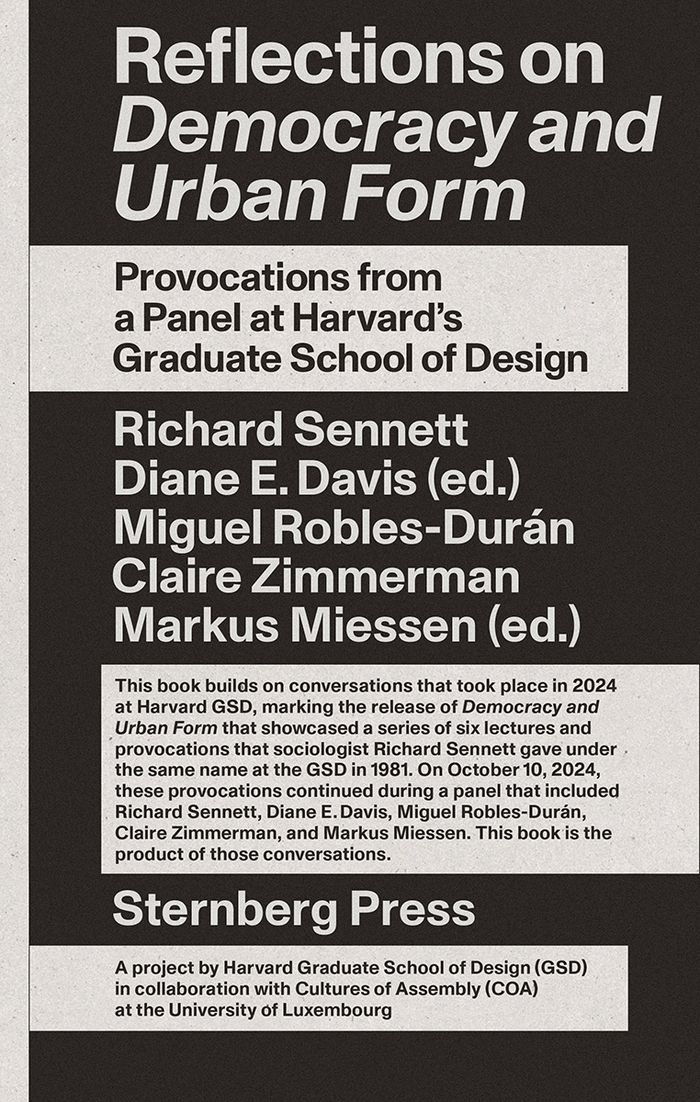
Reflections on democracy and urban form: Provocations from a panel at Harvard's Graduate School
Reflections on democracy and urban form: Provocations from a panel at Harvard's Graduate School
Actions:
Prix:
$24.95
(disponible en magasin)
Résumé:
This book builds on conversations that took place in the Fall of 2024 at Harvard’s Graduate School of Design marking the release of the book ''Democracy and Urban Form'', a co-publication by Harvard Design Press and Sternberg Press. The original book showcased a series of six lectures that the sociologist Richard Sennett gave under the same name at the GSD in the fall of(...)
$24.95
(disponible en magasin)
Résumé:
This book builds on conversations that took place in the Fall of 2024 at Harvard’s Graduate School of Design marking the release of the book ''Democracy and Urban Form'', a co-publication by Harvard Design Press and Sternberg Press. The original book showcased a series of six lectures that the sociologist Richard Sennett gave under the same name at the GSD in the fall of(...)
Titre:
Reflections on democracy and urban form: Provocations from a panel at Harvard's Graduate School
Actions:
Prix:
$24.95
(disponible en magasin)
Résumé:
This book builds on conversations that took place in the Fall of 2024 at Harvard’s Graduate School of Design marking the release of the book ''Democracy and Urban Form'', a co-publication by Harvard Design Press and Sternberg Press. The original book showcased a series of six lectures that the sociologist Richard Sennett gave under the same name at the GSD in the fall of 1981. The original lectures, which happened more than forty years ago, addressed a much different political climate. Even so, Richard’s core insights into the connections between democracy and justice, matters of architecture and urban design, the growth of cities, cosmopolitanism, inclusion, free speech, and other related matters remain just as relevant today. In the spirit of reflecting on these urgencies, the GSD invited the political philosopher Michael Sandel to deliver a lecture that drew on themes from the new edition of his book ''Democracy’s Discontent''. In his opening talk, which took place on the evening of Wednesday, October 9, Sandel encouraged the audience to consider what might account for the polarization that imperils democracy today, as well as what might be done about it? Beyond analyzing the forces that were about to decide the 2024 election, he proposed a bold project of civic renewal to reimagine the economy and empower citizens as participants in a shared public life. On Thursday, October 10, these provocations continued during a panel discussion that included Richard Sennett, Diane Davis, Claire Zimmerman, Markus Miessen, and Miguel Robles-Durán. All reflected on Sandel’s talk, as well as on the state of democracy as it related more specifically to architecture and the design and planning of cities and metropolitan regions.
Reflections on democracy and urban form: Provocations from a panel at Harvard's Graduate School
Actions:
Prix:
$24.95
(disponible en magasin)
Résumé:
This book builds on conversations that took place in the Fall of 2024 at Harvard’s Graduate School of Design marking the release of the book ''Democracy and Urban Form'', a co-publication by Harvard Design Press and Sternberg Press. The original book showcased a series of six lectures that the sociologist Richard Sennett gave under the same name at the GSD in the fall of 1981. The original lectures, which happened more than forty years ago, addressed a much different political climate. Even so, Richard’s core insights into the connections between democracy and justice, matters of architecture and urban design, the growth of cities, cosmopolitanism, inclusion, free speech, and other related matters remain just as relevant today. In the spirit of reflecting on these urgencies, the GSD invited the political philosopher Michael Sandel to deliver a lecture that drew on themes from the new edition of his book ''Democracy’s Discontent''. In his opening talk, which took place on the evening of Wednesday, October 9, Sandel encouraged the audience to consider what might account for the polarization that imperils democracy today, as well as what might be done about it? Beyond analyzing the forces that were about to decide the 2024 election, he proposed a bold project of civic renewal to reimagine the economy and empower citizens as participants in a shared public life. On Thursday, October 10, these provocations continued during a panel discussion that included Richard Sennett, Diane Davis, Claire Zimmerman, Markus Miessen, and Miguel Robles-Durán. All reflected on Sandel’s talk, as well as on the state of democracy as it related more specifically to architecture and the design and planning of cities and metropolitan regions.
Classification:
livres
livres
Publication:
août 2026
août 2026
Sujet:
Théorie de l’urbanisme
Théorie de l’urbanisme
Classification:
livres
livres
Actions:
Prix:
$56.50
(disponible sur commande)
Résumé:
At its opening on July 16, 2004, Chicago’s Millennium Park was hailed as one of the most important millennium projects in the world. “Politicians come and go; business leaders come and go,” proclaimed mayor Richard M. Daley, “but artists really define a city.” Part park, part outdoor art museum, part cultural center, and part performance space, Millennium Park is now an(...)
$56.50
(disponible sur commande)
Résumé:
At its opening on July 16, 2004, Chicago’s Millennium Park was hailed as one of the most important millennium projects in the world. “Politicians come and go; business leaders come and go,” proclaimed mayor Richard M. Daley, “but artists really define a city.” Part park, part outdoor art museum, part cultural center, and part performance space, Millennium Park is now an(...)
Publication:
avril 2006, Chicago, London
avril 2006, Chicago, London
Titre:
Millennium park : creating a Chicago landscape
Actions:
Prix:
$56.50
(disponible sur commande)
Résumé:
At its opening on July 16, 2004, Chicago’s Millennium Park was hailed as one of the most important millennium projects in the world. “Politicians come and go; business leaders come and go,” proclaimed mayor Richard M. Daley, “but artists really define a city.” Part park, part outdoor art museum, part cultural center, and part performance space, Millennium Park is now an unprecedented combination of distinctive architecture, monumental sculpture, and innovative landscaping. Including structures and works by Frank Gehry, Anish Kapoor, Jaume Plensa, and Kathryn Gustafson, the park represents the collaborative efforts of hundreds to turn an unused railroad yard in the heart of the city into a world-class civic space—and, in the process, to create an entirely new kind of cultural philanthropy. Timothy Gilfoyle here offers a biography of this phenomenal undertaking, beginning before 1850 when the site of the park, the “city’s front yard,” was part of Lake Michigan. Gilfoyle studied the history of downtown; spent years with the planners, artists, and public officials behind Millennium Park; documented it at every stage of its construction; and traced the skeins of financing through municipal government, global corporations, private foundations, and wealthy civic leaders. The result is an illustrated testament to the park, the city, and all those attempting to think and act on a monumental scale. And underlying Gilfoyle’s history is also a revealing study of the globalization of art, the use of culture as an engine of economic expansion, and the nature of political and philanthropic power. Born out of civic idealism, raised in political controversy, and maturing into a symbol of the new Chicago, Millennium Park is truly a twenty-first-century landmark, and it now has the history it deserves.
Millennium park : creating a Chicago landscape
Actions:
Prix:
$56.50
(disponible sur commande)
Résumé:
At its opening on July 16, 2004, Chicago’s Millennium Park was hailed as one of the most important millennium projects in the world. “Politicians come and go; business leaders come and go,” proclaimed mayor Richard M. Daley, “but artists really define a city.” Part park, part outdoor art museum, part cultural center, and part performance space, Millennium Park is now an unprecedented combination of distinctive architecture, monumental sculpture, and innovative landscaping. Including structures and works by Frank Gehry, Anish Kapoor, Jaume Plensa, and Kathryn Gustafson, the park represents the collaborative efforts of hundreds to turn an unused railroad yard in the heart of the city into a world-class civic space—and, in the process, to create an entirely new kind of cultural philanthropy. Timothy Gilfoyle here offers a biography of this phenomenal undertaking, beginning before 1850 when the site of the park, the “city’s front yard,” was part of Lake Michigan. Gilfoyle studied the history of downtown; spent years with the planners, artists, and public officials behind Millennium Park; documented it at every stage of its construction; and traced the skeins of financing through municipal government, global corporations, private foundations, and wealthy civic leaders. The result is an illustrated testament to the park, the city, and all those attempting to think and act on a monumental scale. And underlying Gilfoyle’s history is also a revealing study of the globalization of art, the use of culture as an engine of economic expansion, and the nature of political and philanthropic power. Born out of civic idealism, raised in political controversy, and maturing into a symbol of the new Chicago, Millennium Park is truly a twenty-first-century landmark, and it now has the history it deserves.
Classification:
livres
livres
Publication:
avril 2006, Chicago, London
avril 2006, Chicago, London
Classification:
livres
livres
Titre:
Judging architectural value
Judging architectural value
Actions:
Prix:
$24.95
(disponible sur commande)
Résumé:
When it comes to determining the relative quality of architecture, who is best equipped to make the distinctions? Is it the public who lives in and among the buildings? The people who commission and pay for the buildings? Art historians? Or architects themselves? These provocative essays take up the questions of what people value in architecture and how changing(...)
$24.95
(disponible sur commande)
Résumé:
When it comes to determining the relative quality of architecture, who is best equipped to make the distinctions? Is it the public who lives in and among the buildings? The people who commission and pay for the buildings? Art historians? Or architects themselves? These provocative essays take up the questions of what people value in architecture and how changing(...)
Sujet:
Théorie de l’architecture
Théorie de l’architecture
Publication:
avril 2007, Mineapolis London
avril 2007, Mineapolis London
Titre:
Judging architectural value
Actions:
Prix:
$24.95
(disponible sur commande)
Résumé:
When it comes to determining the relative quality of architecture, who is best equipped to make the distinctions? Is it the public who lives in and among the buildings? The people who commission and pay for the buildings? Art historians? Or architects themselves? These provocative essays take up the questions of what people value in architecture and how changing values influence opinions about it. In the intriguing opening essay, Michael Benedikt makes an argument for the role of architects in the delineation of value in architecture. He discusses the differences between icon and canon, a theme threaded through many of the essays. In addition to unexpected analyses of buildings such as Eero Saarinen’s Gateway Arch in St. Louis, Paul Rudolph’s Art and Architecture Building at Yale University, and the work of Antoni Gaudí and Frank Gehry, the collection includes a clear-eyed look at the role of architecture in addressing social problems. Ultimately, these essays assert that judging architecture requires more than a refined sensibility. Buildings also need to be evaluated by their impact on the people living within and around them. Contributors: John Beardsley, Harvard Design School; Michael Benedikt, U of Texas, Austin; Tim Culvahouse, California College of the Arts; Lisa Finley, California College of the Arts; Kurt W. Forster, Bauhaus-Universität, Weimar, Germany; Kenneth Frampton, Columbia U; Diane Ghirardo, U of Southern California; Charles Jencks; David Leatherbarrow, U of Pennsylvania; Nancy Levinson; Hélène Lipstadt; Juhani Pallasmaa, Helsinki U of Technology; Timothy M. Rohan, U of Massachusetts, Amherst; Roger Scruton; Daniel Willis, Pennsylvania State U. William S. Saunders is editor of Harvard Design Magazine and assistant dean for external relations at Harvard University’s Graduate School of Design. He is the author of Modern Architecture: Photographs by Ezra Stoller and editor of three other Harvard Design Magazine Readers. Michael Benedikt is Hal Box Chair in Urbanism and director of the Center for American Architecture and Design at the School of Architecture at the University of Texas at Austin.
Judging architectural value
Actions:
Prix:
$24.95
(disponible sur commande)
Résumé:
When it comes to determining the relative quality of architecture, who is best equipped to make the distinctions? Is it the public who lives in and among the buildings? The people who commission and pay for the buildings? Art historians? Or architects themselves? These provocative essays take up the questions of what people value in architecture and how changing values influence opinions about it. In the intriguing opening essay, Michael Benedikt makes an argument for the role of architects in the delineation of value in architecture. He discusses the differences between icon and canon, a theme threaded through many of the essays. In addition to unexpected analyses of buildings such as Eero Saarinen’s Gateway Arch in St. Louis, Paul Rudolph’s Art and Architecture Building at Yale University, and the work of Antoni Gaudí and Frank Gehry, the collection includes a clear-eyed look at the role of architecture in addressing social problems. Ultimately, these essays assert that judging architecture requires more than a refined sensibility. Buildings also need to be evaluated by their impact on the people living within and around them. Contributors: John Beardsley, Harvard Design School; Michael Benedikt, U of Texas, Austin; Tim Culvahouse, California College of the Arts; Lisa Finley, California College of the Arts; Kurt W. Forster, Bauhaus-Universität, Weimar, Germany; Kenneth Frampton, Columbia U; Diane Ghirardo, U of Southern California; Charles Jencks; David Leatherbarrow, U of Pennsylvania; Nancy Levinson; Hélène Lipstadt; Juhani Pallasmaa, Helsinki U of Technology; Timothy M. Rohan, U of Massachusetts, Amherst; Roger Scruton; Daniel Willis, Pennsylvania State U. William S. Saunders is editor of Harvard Design Magazine and assistant dean for external relations at Harvard University’s Graduate School of Design. He is the author of Modern Architecture: Photographs by Ezra Stoller and editor of three other Harvard Design Magazine Readers. Michael Benedikt is Hal Box Chair in Urbanism and director of the Center for American Architecture and Design at the School of Architecture at the University of Texas at Austin.
Classification:
livres
livres
Publication:
avril 2007, Mineapolis London
avril 2007, Mineapolis London
Sujet:
Théorie de l’architecture
Théorie de l’architecture
Classification:
livres
livres
Titre:
Japan-ness in architecture
Japan-ness in architecture
Actions:
Prix:
$35.95
(disponible sur commande)
Résumé:
Japanese architect Arata Isozaki sees buildings not as dead objects but as events that encompass the social and historical context -- not to be defined forever by their "everlasting materiality" but as texts to be interpreted and reread continually. In "Japan-ness in architecture", he identifies what is essentially Japanese in architecture from the seventh to the(...)
$35.95
(disponible sur commande)
Résumé:
Japanese architect Arata Isozaki sees buildings not as dead objects but as events that encompass the social and historical context -- not to be defined forever by their "everlasting materiality" but as texts to be interpreted and reread continually. In "Japan-ness in architecture", he identifies what is essentially Japanese in architecture from the seventh to the(...)
Sujet:
Histoire jusqu'à 1900, Asie
Histoire jusqu'à 1900, Asie
Publication:
janvier 1900, Cambridge / London
janvier 1900, Cambridge / London
Titre:
Japan-ness in architecture
Actions:
Prix:
$35.95
(disponible sur commande)
Résumé:
Japanese architect Arata Isozaki sees buildings not as dead objects but as events that encompass the social and historical context -- not to be defined forever by their "everlasting materiality" but as texts to be interpreted and reread continually. In "Japan-ness in architecture", he identifies what is essentially Japanese in architecture from the seventh to the twentieth century. In the opening essay, Isozaki analyzes the struggles of modern Japanese architects, including himself, to create something uniquely Japanese out of modernity. He then circles back in history to find what he calls Japan-ness in the seventh-century Ise shrine, reconstruction of the twelfth-century Todai-ji Temple, and the seventeenth-century Katsura Imperial Villa. He finds the periodic ritual relocation of Ise's precincts a counter to the West's concept of architectural permanence, and the repetition of the ritual an alternative to modernity's anxious quest for origins. He traces the "constructive power" of the Todai-ji Temple to the vision of the director of its reconstruction, the monk Chogen, whose imaginative power he sees as corresponding to the revolutionary turmoil of the times. The Katsura Imperial Villa, with its chimerical spaces, achieved its own Japan-ness as it reinvented the traditional shoin style. And yet, writes Isozaki, what others consider to be the Japanese aesthetic is often the opposite of that essential Japan-ness born in moments of historic self-definition; the purified stylization -- what Isozaki calls "Japanesquization" -- lacks the energy of cultural transformation and reflects an island retrenchment in response to the pressure of other cultures. Combining historical survey, critical analysis, theoretical reflection, and autobiographical account, these essays, written over a period of twenty years, demonstrate Isozaki's standing as one of the world's leading architects and preeminent architectural thinkers. Arata Isosaki is a leading Japanese architect. His works include the Museum of Contemporary Art, Los Angeles, the Olympic Stadium in Barcelona, the Volksbank Center am Postdamer Platz in Berlin, the Team Disney Building in Orlando, and the Tokyo University of Art and Design. Translated by Sabu Kohso. Foreword by Toshiko Mori.
Japan-ness in architecture
Actions:
Prix:
$35.95
(disponible sur commande)
Résumé:
Japanese architect Arata Isozaki sees buildings not as dead objects but as events that encompass the social and historical context -- not to be defined forever by their "everlasting materiality" but as texts to be interpreted and reread continually. In "Japan-ness in architecture", he identifies what is essentially Japanese in architecture from the seventh to the twentieth century. In the opening essay, Isozaki analyzes the struggles of modern Japanese architects, including himself, to create something uniquely Japanese out of modernity. He then circles back in history to find what he calls Japan-ness in the seventh-century Ise shrine, reconstruction of the twelfth-century Todai-ji Temple, and the seventeenth-century Katsura Imperial Villa. He finds the periodic ritual relocation of Ise's precincts a counter to the West's concept of architectural permanence, and the repetition of the ritual an alternative to modernity's anxious quest for origins. He traces the "constructive power" of the Todai-ji Temple to the vision of the director of its reconstruction, the monk Chogen, whose imaginative power he sees as corresponding to the revolutionary turmoil of the times. The Katsura Imperial Villa, with its chimerical spaces, achieved its own Japan-ness as it reinvented the traditional shoin style. And yet, writes Isozaki, what others consider to be the Japanese aesthetic is often the opposite of that essential Japan-ness born in moments of historic self-definition; the purified stylization -- what Isozaki calls "Japanesquization" -- lacks the energy of cultural transformation and reflects an island retrenchment in response to the pressure of other cultures. Combining historical survey, critical analysis, theoretical reflection, and autobiographical account, these essays, written over a period of twenty years, demonstrate Isozaki's standing as one of the world's leading architects and preeminent architectural thinkers. Arata Isosaki is a leading Japanese architect. His works include the Museum of Contemporary Art, Los Angeles, the Olympic Stadium in Barcelona, the Volksbank Center am Postdamer Platz in Berlin, the Team Disney Building in Orlando, and the Tokyo University of Art and Design. Translated by Sabu Kohso. Foreword by Toshiko Mori.
Classification:
livres
livres
Publication:
janvier 1900, Cambridge / London
janvier 1900, Cambridge / London
Sujet:
Histoire jusqu'à 1900, Asie
Histoire jusqu'à 1900, Asie
Classification:
livres
livres
Actions:
Prix:
$58.50
(disponible sur commande)
Résumé:
One of the premier institutions of contemporary art in the country, the Walker Art Center also holds an important collection of over 11,000 objects from the early 20th century to the present. These holdings reflect the Center's renowned multidisciplinary program, and include paintings, sculpture, prints, photography, film, video, installations, and digital arts that range(...)
$58.50
(disponible sur commande)
Résumé:
One of the premier institutions of contemporary art in the country, the Walker Art Center also holds an important collection of over 11,000 objects from the early 20th century to the present. These holdings reflect the Center's renowned multidisciplinary program, and include paintings, sculpture, prints, photography, film, video, installations, and digital arts that range(...)
Publication:
avril 2005, Minneapolis
avril 2005, Minneapolis
Titre:
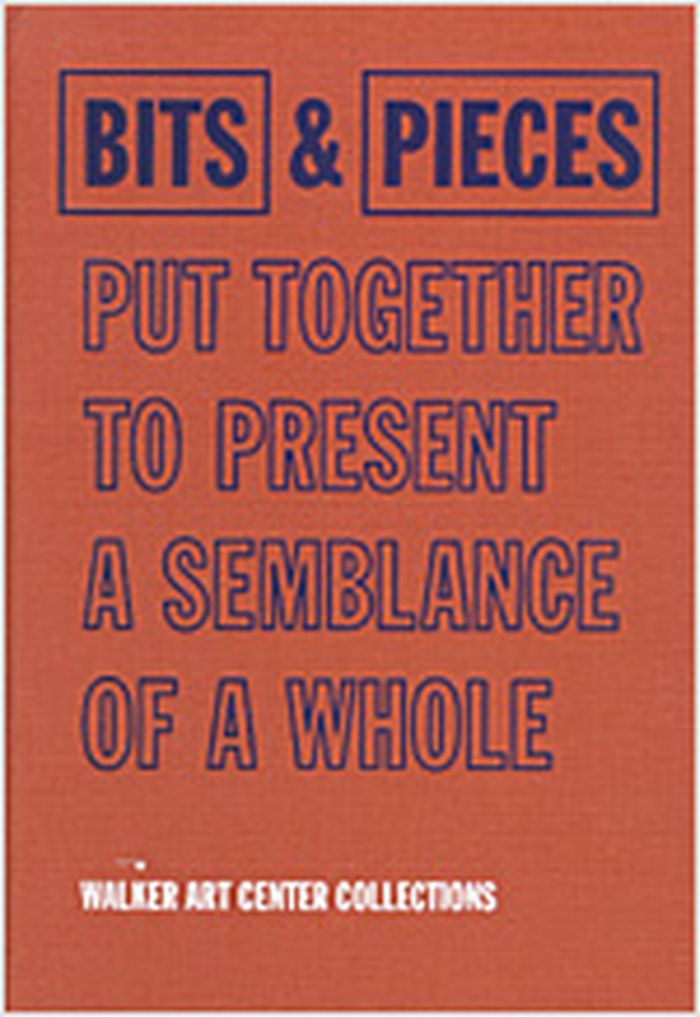
Bits & pieces put together to present a semblance of a whole : Walker Art Center collections
Actions:
Prix:
$58.50
(disponible sur commande)
Résumé:
One of the premier institutions of contemporary art in the country, the Walker Art Center also holds an important collection of over 11,000 objects from the early 20th century to the present. These holdings reflect the Center's renowned multidisciplinary program, and include paintings, sculpture, prints, photography, film, video, installations, and digital arts that range in date from classic early modernist to cutting edge contemporary. While aiming to represent the immense diversity in art-making around the world, the collection also is known for several areas of specialty including Minimalism, Arte Povera, Fluxus, and contemporary printmaking. In-depth representations of work by individual artists, including Matthew Barney, Joseph Beuys, Merce Cunningham, Jasper Johns, William Klein, Robert Motherwell, and Kara Walker reflect the Center's long and close relationships with many of the century's most creative minds. Showcased in this stunning, expansive, well-designed volume are more than 650 beautifully reproduced works of art. Co-authored by the Walker's curators and staff, and more than 30 Walker alumni, this book draws heavily on Walker archival material to serve as both a history of the institution and a primer on modern and contemporary art. Adding further dimension to the polyvocal, multifaceted rendition of this dynamic public art centre are contributions from a select group of acclaimed writers including, A.S. Byatt, Joshua Clover, Arthur Danto, Dave Eggers, Darby English, Annie Proulx, David Shapiro, and others. The catalogue is published in conjunction with the Spring 2005 re-opening of the newly expanded Walker Art Center. Artists include Matthew Barney, Chuck Close, Bruce Conner, Joseph Cornell, Merce Cummingham, Dan Flavin, Robert Gober, Dan Graham, David Hockney, Donald Judd, Ellsworth Kelly, William Klein, Sherrie Levine, Sol Lewitt, Roy Lichtenstein, Sharon Lockhart, Kerry James Marshall, Bruce Nauman, Isamu Noguchi, Claes Oldenburg, Raymond Pettibon, Richard Prince, Charles Ray, Edward Ruscha, Cindy Sherman, Lorna Simpson, Kiki Smith, Frank Stella, Kara Walker, Andy Warhol, and many others. Edited by Joan Rothfuss and Elizabeth Carpenter. Essays by Elizabeth Alexander, A.S. Byatt, Dave Eggers, Arthur C. Danto, Wayne Koestenbaum, James Lingwood, Linda Nochlin, Annie Proulx, David Shapiro, Charles Simic, Howard Singerman, Hamza Walker et al.
Bits & pieces put together to present a semblance of a whole : Walker Art Center collections
Actions:
Prix:
$58.50
(disponible sur commande)
Résumé:
One of the premier institutions of contemporary art in the country, the Walker Art Center also holds an important collection of over 11,000 objects from the early 20th century to the present. These holdings reflect the Center's renowned multidisciplinary program, and include paintings, sculpture, prints, photography, film, video, installations, and digital arts that range in date from classic early modernist to cutting edge contemporary. While aiming to represent the immense diversity in art-making around the world, the collection also is known for several areas of specialty including Minimalism, Arte Povera, Fluxus, and contemporary printmaking. In-depth representations of work by individual artists, including Matthew Barney, Joseph Beuys, Merce Cunningham, Jasper Johns, William Klein, Robert Motherwell, and Kara Walker reflect the Center's long and close relationships with many of the century's most creative minds. Showcased in this stunning, expansive, well-designed volume are more than 650 beautifully reproduced works of art. Co-authored by the Walker's curators and staff, and more than 30 Walker alumni, this book draws heavily on Walker archival material to serve as both a history of the institution and a primer on modern and contemporary art. Adding further dimension to the polyvocal, multifaceted rendition of this dynamic public art centre are contributions from a select group of acclaimed writers including, A.S. Byatt, Joshua Clover, Arthur Danto, Dave Eggers, Darby English, Annie Proulx, David Shapiro, and others. The catalogue is published in conjunction with the Spring 2005 re-opening of the newly expanded Walker Art Center. Artists include Matthew Barney, Chuck Close, Bruce Conner, Joseph Cornell, Merce Cummingham, Dan Flavin, Robert Gober, Dan Graham, David Hockney, Donald Judd, Ellsworth Kelly, William Klein, Sherrie Levine, Sol Lewitt, Roy Lichtenstein, Sharon Lockhart, Kerry James Marshall, Bruce Nauman, Isamu Noguchi, Claes Oldenburg, Raymond Pettibon, Richard Prince, Charles Ray, Edward Ruscha, Cindy Sherman, Lorna Simpson, Kiki Smith, Frank Stella, Kara Walker, Andy Warhol, and many others. Edited by Joan Rothfuss and Elizabeth Carpenter. Essays by Elizabeth Alexander, A.S. Byatt, Dave Eggers, Arthur C. Danto, Wayne Koestenbaum, James Lingwood, Linda Nochlin, Annie Proulx, David Shapiro, Charles Simic, Howard Singerman, Hamza Walker et al.
Classification:
livres
livres
Publication:
avril 2005, Minneapolis
avril 2005, Minneapolis
Classification:
livres
livres

Prix:
$39.99
(disponible sur commande)
Résumé:
The National Mall in Washington, D.C., has held an important place in the American psyche since the early nineteenth century. Home to monuments and museums dedicated to the ideals upon which the United States rests, the Mall serves as a gathering place for public protest and celebration. But as the nation ages and the population diversifies, demands for additional(...)
$39.99
(disponible sur commande)
Résumé:
The National Mall in Washington, D.C., has held an important place in the American psyche since the early nineteenth century. Home to monuments and museums dedicated to the ideals upon which the United States rests, the Mall serves as a gathering place for public protest and celebration. But as the nation ages and the population diversifies, demands for additional(...)
Sujet:
Théorie de l’urbanisme
Théorie de l’urbanisme
Publication:
avril 2008, Baltimore
avril 2008, Baltimore
Titre:
The national mail: rethinking Washington's monumental core
Actions:
Prix:
$39.99
(disponible sur commande)
Résumé:
The National Mall in Washington, D.C., has held an important place in the American psyche since the early nineteenth century. Home to monuments and museums dedicated to the ideals upon which the United States rests, the Mall serves as a gathering place for public protest and celebration. But as the nation ages and the population diversifies, demands for additional structures and uses have sparked debates over the Mall's future and the necessity of preserving its legacy and the vision of its designers. The National Mall addresses these issues with a novel and compelling collection of essays, the work of leading design professionals, historians, and social scientists. Supplemented by eye-catching illustrations and photographs, this cross-disciplinary examination follows the discussion over the Mall's design and use, from its conceptual origins as part of Pierre Charles L'Enfant's vision for the capital to the 1902 McMillan Plan to the present day and beyond. It assesses how architectural, societal, and political changes have altered the park-like space between the Capitol and the Lincoln Memorial and explores the influence that disparate interest groups and creeping corporatism have already had on -- and are likely to exert upon -- America's public square. The National Mall presents an overarching account of how a democratic society plans, creates, and expands a national ceremonial space, opening the way for a broadly based inquiry into the Mall as it was, is, and will become. Urban planners, architectural and design historians, and engaged citizens will be challenged and well served by the thoughtful essays collected by Nathan Glazer and Cynthia R. Field. Nathan Glazer is an emeritus professor of sociology and education at Harvard University. He is the author or editor of many books on public policy and urban problems, among them The Public Face of Architecture and From a Cause to a Style: Modernist Architecture's Encounter with the American City. Cynthia R. Field is the architectural historian emerita at the Smithsonian Institution and a faculty member at the Corcoran College of Art. She is the coauthor of The Castle: An Illustrated History of the Smithsonian Building.
The national mail: rethinking Washington's monumental core
Actions:
Prix:
$39.99
(disponible sur commande)
Résumé:
The National Mall in Washington, D.C., has held an important place in the American psyche since the early nineteenth century. Home to monuments and museums dedicated to the ideals upon which the United States rests, the Mall serves as a gathering place for public protest and celebration. But as the nation ages and the population diversifies, demands for additional structures and uses have sparked debates over the Mall's future and the necessity of preserving its legacy and the vision of its designers. The National Mall addresses these issues with a novel and compelling collection of essays, the work of leading design professionals, historians, and social scientists. Supplemented by eye-catching illustrations and photographs, this cross-disciplinary examination follows the discussion over the Mall's design and use, from its conceptual origins as part of Pierre Charles L'Enfant's vision for the capital to the 1902 McMillan Plan to the present day and beyond. It assesses how architectural, societal, and political changes have altered the park-like space between the Capitol and the Lincoln Memorial and explores the influence that disparate interest groups and creeping corporatism have already had on -- and are likely to exert upon -- America's public square. The National Mall presents an overarching account of how a democratic society plans, creates, and expands a national ceremonial space, opening the way for a broadly based inquiry into the Mall as it was, is, and will become. Urban planners, architectural and design historians, and engaged citizens will be challenged and well served by the thoughtful essays collected by Nathan Glazer and Cynthia R. Field. Nathan Glazer is an emeritus professor of sociology and education at Harvard University. He is the author or editor of many books on public policy and urban problems, among them The Public Face of Architecture and From a Cause to a Style: Modernist Architecture's Encounter with the American City. Cynthia R. Field is the architectural historian emerita at the Smithsonian Institution and a faculty member at the Corcoran College of Art. She is the coauthor of The Castle: An Illustrated History of the Smithsonian Building.
Classification:
livres
livres
Publication:
avril 2008, Baltimore
avril 2008, Baltimore
Sujet:
Théorie de l’urbanisme
Théorie de l’urbanisme
Classification:
livres
livres
Prix:
$59.95
(disponible sur commande)
Résumé:
The book reproduces a series of the collages made by David Wild. Their subject is modern architecture in the first half of the twentieth century: in the Netherlands, in Russia, and in the work of Le Corbusier. The method of the book is to show a collage on a right-hand page; then on the facing page is a (...)
$59.95
(disponible sur commande)
Résumé:
The book reproduces a series of the collages made by David Wild. Their subject is modern architecture in the first half of the twentieth century: in the Netherlands, in Russia, and in the work of Le Corbusier. The method of the book is to show a collage on a right-hand page; then on the facing page is a (...)
Titre:
Fragments of utopia: collage reflections of heroic modernism
Actions:
Prix:
$59.95
(disponible sur commande)
Résumé:
The book reproduces a series of the collages made by David Wild. Their subject is modern architecture in the first half of the twentieth century: in the Netherlands, in Russia, and in the work of Le Corbusier. The method of the book is to show a collage on a right-hand page; then on the facing page is a prose commentary by Wild and supporting smaller images. Introducing the book, David Wild explains that the impulse for this work lies in the aftermath of a fire in his house: his scorched books lent themselves to collage. He goes on to sketch the cultural-political climate in Britain over the last 40 years: the backdrop to his work as an architect and (less directly) to this book. In the opening section on the Netherlands, the leading theme is an architecture of social equity and continuity. Rooted in old cultural traditions, and in the particular ‘football-pitch’ landscape of the country, modern architecture could realise some of its dreams in everyday buildings. Postage stamps play an active part in many of the book’s collages, and especially in this section: the design of stamps flourished in the Netherlands, through the enlightened patronage of the Dutch post office — with several architects designing stamps too. Politics and history come to prominence in the Russian section, as a motivating force in the work of the early 1920s, and then as a heavy burden — with the onset of totalitarian control and repression. At the centre of the discussion here is the architecture of constructivism: formally brilliant, but with a clear social programme. Flight and the exploration of space are recurring topics in this section, as another and particularly Russian dimension of utopian striving The work of Le Corbusier, in Europe, North and South America, Russia and India, is treated in the third section. Le Corbusier is presented as a brilliant artist, a master architect of the greatest skill and the greatest ambition — and without scruple in pursuing commissions. The images and text follow him into the years after the Second World War, culminating in the work in India. Here there is a vision of another kind of politics, of co-operation and non-violence.
Fragments of utopia: collage reflections of heroic modernism
Actions:
Prix:
$59.95
(disponible sur commande)
Résumé:
The book reproduces a series of the collages made by David Wild. Their subject is modern architecture in the first half of the twentieth century: in the Netherlands, in Russia, and in the work of Le Corbusier. The method of the book is to show a collage on a right-hand page; then on the facing page is a prose commentary by Wild and supporting smaller images. Introducing the book, David Wild explains that the impulse for this work lies in the aftermath of a fire in his house: his scorched books lent themselves to collage. He goes on to sketch the cultural-political climate in Britain over the last 40 years: the backdrop to his work as an architect and (less directly) to this book. In the opening section on the Netherlands, the leading theme is an architecture of social equity and continuity. Rooted in old cultural traditions, and in the particular ‘football-pitch’ landscape of the country, modern architecture could realise some of its dreams in everyday buildings. Postage stamps play an active part in many of the book’s collages, and especially in this section: the design of stamps flourished in the Netherlands, through the enlightened patronage of the Dutch post office — with several architects designing stamps too. Politics and history come to prominence in the Russian section, as a motivating force in the work of the early 1920s, and then as a heavy burden — with the onset of totalitarian control and repression. At the centre of the discussion here is the architecture of constructivism: formally brilliant, but with a clear social programme. Flight and the exploration of space are recurring topics in this section, as another and particularly Russian dimension of utopian striving The work of Le Corbusier, in Europe, North and South America, Russia and India, is treated in the third section. Le Corbusier is presented as a brilliant artist, a master architect of the greatest skill and the greatest ambition — and without scruple in pursuing commissions. The images and text follow him into the years after the Second World War, culminating in the work in India. Here there is a vision of another kind of politics, of co-operation and non-violence.
Classification:
livres
livres
Publication:
janvier 1900, London
janvier 1900, London


