


2173 Résultats
Classification:
livres
livres
Actions:
Prix:
$70.95
(disponible sur commande)
Résumé:
Why does a newspaper look different than a magazine or a book? What effect does using a certain typeface or a specific grid have? And why do some layouts just seem right, and others seem simply wrong? This handbook aims to convey the essential principles that will enable the reader to acquire the skills necessary to be independently creative in the field of graphic(...)
$70.95
(disponible sur commande)
Résumé:
Why does a newspaper look different than a magazine or a book? What effect does using a certain typeface or a specific grid have? And why do some layouts just seem right, and others seem simply wrong? This handbook aims to convey the essential principles that will enable the reader to acquire the skills necessary to be independently creative in the field of graphic(...)
Publication:
décembre 2017
décembre 2017
Titre:
Design, typography etc. A handbook
Actions:
Prix:
$70.95
(disponible sur commande)
Résumé:
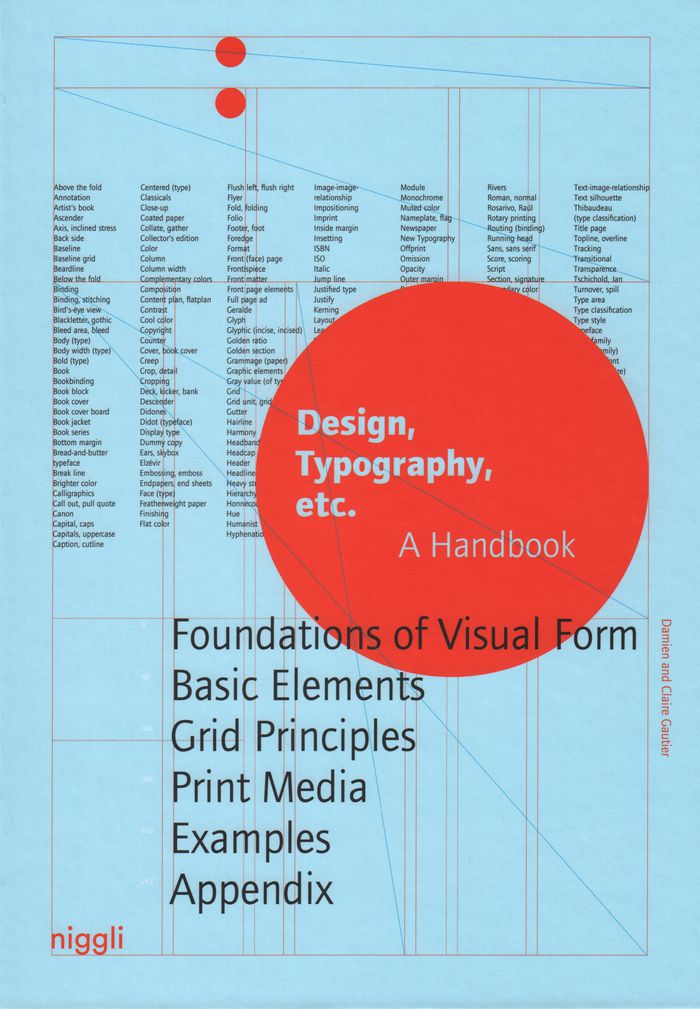
Why does a newspaper look different than a magazine or a book? What effect does using a certain typeface or a specific grid have? And why do some layouts just seem right, and others seem simply wrong? This handbook aims to convey the essential principles that will enable the reader to acquire the skills necessary to be independently creative in the field of graphic design. Richly illustrated with numerous examples from around the world, this volume addresses the most important aspects of good book, poster and advert design, offering guidance on everything from the correct use of colors and fonts through to column width and line spacing. Sketches and clarifying text serve to explain technical terms that are indispensable to understanding the interface of designing and producing print media.
Design, typography etc. A handbook
Actions:
Prix:
$70.95
(disponible sur commande)
Résumé:
Why does a newspaper look different than a magazine or a book? What effect does using a certain typeface or a specific grid have? And why do some layouts just seem right, and others seem simply wrong? This handbook aims to convey the essential principles that will enable the reader to acquire the skills necessary to be independently creative in the field of graphic design. Richly illustrated with numerous examples from around the world, this volume addresses the most important aspects of good book, poster and advert design, offering guidance on everything from the correct use of colors and fonts through to column width and line spacing. Sketches and clarifying text serve to explain technical terms that are indispensable to understanding the interface of designing and producing print media.
Classification:
livres
livres
Publication:
décembre 2017
décembre 2017
Classification:
livres
livres

Titre:
Geomancy
Geomancy
Actions:
Prix:
$42.00
(disponible en magasin)
Résumé:
The photographs in Geomancy were taken from October 2007 to November 2008, using an Olympus Stylus with color film. I had left New York for Beijing, where I lived on Xindong Lu, sometimes tutored English, and occasionally wrote a column called "Raw China" for Vice. The city embodied an almost too good to be true clichéd "otherness" with an overabundance of literally(...)
$42.00
(disponible en magasin)
Résumé:
The photographs in Geomancy were taken from October 2007 to November 2008, using an Olympus Stylus with color film. I had left New York for Beijing, where I lived on Xindong Lu, sometimes tutored English, and occasionally wrote a column called "Raw China" for Vice. The city embodied an almost too good to be true clichéd "otherness" with an overabundance of literally(...)
Sujet:
Monographies photo
Monographies photo
Publication:
novembre 2025
novembre 2025
Titre:
Geomancy
Actions:
Prix:
$42.00
(disponible en magasin)
Résumé:
The photographs in Geomancy were taken from October 2007 to November 2008, using an Olympus Stylus with color film. I had left New York for Beijing, where I lived on Xindong Lu, sometimes tutored English, and occasionally wrote a column called "Raw China" for Vice. The city embodied an almost too good to be true clichéd "otherness" with an overabundance of literally foreign colors, textures, shapes, and structures. Put another way, China, and Beijing in particular, is extremely photogenic. The title comes from a reference to the Forbidden City in the accompanying story "The First Bus of Beijing" about riding the No. 1 bus. It couldn’t be more appropriate, as Geomancy is a concept taken very seriously in China that means "the art of placing or arranging buildings or other sites auspiciously."
Geomancy
Actions:
Prix:
$42.00
(disponible en magasin)
Résumé:
The photographs in Geomancy were taken from October 2007 to November 2008, using an Olympus Stylus with color film. I had left New York for Beijing, where I lived on Xindong Lu, sometimes tutored English, and occasionally wrote a column called "Raw China" for Vice. The city embodied an almost too good to be true clichéd "otherness" with an overabundance of literally foreign colors, textures, shapes, and structures. Put another way, China, and Beijing in particular, is extremely photogenic. The title comes from a reference to the Forbidden City in the accompanying story "The First Bus of Beijing" about riding the No. 1 bus. It couldn’t be more appropriate, as Geomancy is a concept taken very seriously in China that means "the art of placing or arranging buildings or other sites auspiciously."
Classification:
livres
livres
Publication:
novembre 2025
novembre 2025
Sujet:
Monographies photo
Monographies photo
Classification:
livres
livres
Actions:
Prix:
$12.00
(disponible en magasin)
Résumé:
A magic square is a grid of numbers, arranged in such a way that the sum along any row, column, or corner to corner diagonal is the same. Magic squares are found throughout antiquity and by the time they had arrived in Renaissance Europe, by way of the translation of Arabic magical texts, 7 magic squares were known, starting with a 3x3 and ending with a 9x9 square. Due to(...)
$12.00
(disponible en magasin)
Résumé:
A magic square is a grid of numbers, arranged in such a way that the sum along any row, column, or corner to corner diagonal is the same. Magic squares are found throughout antiquity and by the time they had arrived in Renaissance Europe, by way of the translation of Arabic magical texts, 7 magic squares were known, starting with a 3x3 and ending with a 9x9 square. Due to(...)
Titre:
Magic squares: Some notes on the tables of Agrippa
Actions:
Prix:
$12.00
(disponible en magasin)
Résumé:
A magic square is a grid of numbers, arranged in such a way that the sum along any row, column, or corner to corner diagonal is the same. Magic squares are found throughout antiquity and by the time they had arrived in Renaissance Europe, by way of the translation of Arabic magical texts, 7 magic squares were known, starting with a 3x3 and ending with a 9x9 square. Due to their numerical balance, these squares were seen as reflective of an inherent balance in the cosmos, and were linked to the 7 known planetary bodies of the time: Saturn, Jupiter, Mars, the Sun, Venus, Mercury, and the Moon. Through the magic of the numbers in each square, radiating forces associated with each planet could be accessed and directed by way of a talismanic sigil.
Magic squares: Some notes on the tables of Agrippa
Actions:
Prix:
$12.00
(disponible en magasin)
Résumé:
A magic square is a grid of numbers, arranged in such a way that the sum along any row, column, or corner to corner diagonal is the same. Magic squares are found throughout antiquity and by the time they had arrived in Renaissance Europe, by way of the translation of Arabic magical texts, 7 magic squares were known, starting with a 3x3 and ending with a 9x9 square. Due to their numerical balance, these squares were seen as reflective of an inherent balance in the cosmos, and were linked to the 7 known planetary bodies of the time: Saturn, Jupiter, Mars, the Sun, Venus, Mercury, and the Moon. Through the magic of the numbers in each square, radiating forces associated with each planet could be accessed and directed by way of a talismanic sigil.
Classification:
livres
livres
Publication:
janvier 2025
janvier 2025
Sujet:
Zines
Zines
Classification:
livres
livres
Actions:
Prix:
$16.95
(disponible sur commande)
Résumé:
This book documents the experiences of Montrealers past and present, creating a portrait of the storied city unlike any other. Drawn from the celebrated column in Maisonneuve magazine, this anthology features Canadian writers chronicling a quintessential part of local life. Narrated with the intimacy of journal entries, each letter bridges the playful and profound. In(...)
$16.95
(disponible sur commande)
Résumé:
This book documents the experiences of Montrealers past and present, creating a portrait of the storied city unlike any other. Drawn from the celebrated column in Maisonneuve magazine, this anthology features Canadian writers chronicling a quintessential part of local life. Narrated with the intimacy of journal entries, each letter bridges the playful and profound. In(...)
Titre:
Letters from Montréal: Tales of an exceptional city
Actions:
Prix:
$16.95
(disponible sur commande)
Résumé:
This book documents the experiences of Montrealers past and present, creating a portrait of the storied city unlike any other. Drawn from the celebrated column in Maisonneuve magazine, this anthology features Canadian writers chronicling a quintessential part of local life. Narrated with the intimacy of journal entries, each letter bridges the playful and profound. In early dispatches, Melissa Bull ditches a boyfriend over pétanque in Parc Laurier; Sean Michaels watches Arcade Fire lose Battle of the Bands; Deborah Ostrovsky frets over the sublime sophistication of the Plateau’s French children. More recently, Ziya Jones spends a summer herding sheep through Parc du Pélican; Eva Crocker performs in a “fake orgasm choir” at the Rialto Theatre; and André Picard takes a pause from the pandemic by running up Mount Royal.
Letters from Montréal: Tales of an exceptional city
Actions:
Prix:
$16.95
(disponible sur commande)
Résumé:
This book documents the experiences of Montrealers past and present, creating a portrait of the storied city unlike any other. Drawn from the celebrated column in Maisonneuve magazine, this anthology features Canadian writers chronicling a quintessential part of local life. Narrated with the intimacy of journal entries, each letter bridges the playful and profound. In early dispatches, Melissa Bull ditches a boyfriend over pétanque in Parc Laurier; Sean Michaels watches Arcade Fire lose Battle of the Bands; Deborah Ostrovsky frets over the sublime sophistication of the Plateau’s French children. More recently, Ziya Jones spends a summer herding sheep through Parc du Pélican; Eva Crocker performs in a “fake orgasm choir” at the Rialto Theatre; and André Picard takes a pause from the pandemic by running up Mount Royal.
Classification:
livres
livres
Publication:
octobre 2022
octobre 2022
Sujet:
Architecture de Montréal
Architecture de Montréal
Classification:
livres
livres
Actions:
Exemplaires:
Description:
volumes <1-2> : illustrations ; 28 cm
Description:
volumes <1-2> : illustrations ; 28 cm
Auteur:
Sujet:
Publication:
New Haven, Conn : Yale University Press, ©1996-©2001.
New Haven, Conn : Yale University Press, ©1996-©2001.
Titre:
Sebastiano Serlio on architecture / by Sebastiano Serlio ; translated from the Italian with an introduction and commentary by Vaughan Hart and Peter Hicks.
Actions:
Exemplaires:
Description:
volumes <1-2> : illustrations ; 28 cm
Sebastiano Serlio on architecture / by Sebastiano Serlio ; translated from the Italian with an introduction and commentary by Vaughan Hart and Peter Hicks.
Actions:
Exemplaires:
Description:
volumes <1-2> : illustrations ; 28 cm
Classification:
livres
livres
Publication:
New Haven, Conn : Yale University Press, ©1996-©2001.
New Haven, Conn : Yale University Press, ©1996-©2001.
Auteur:
Sujet:
Classification:
livres
livres
Actions:
Prix:
$28.00
(disponible sur commande)
Résumé:
These essays, expanded versions of a selection of the Habitats column published in the Real Estate section of The New York Times, take readers to both familiar and remote sections of the city—to history-rich townhouses, to low-income housing projects, to out-of-the-way places far from the beaten track, to every corner of the five boroughs—and introduces them to a wide(...)
$28.00
(disponible sur commande)
Résumé:
These essays, expanded versions of a selection of the Habitats column published in the Real Estate section of The New York Times, take readers to both familiar and remote sections of the city—to history-rich townhouses, to low-income housing projects, to out-of-the-way places far from the beaten track, to every corner of the five boroughs—and introduces them to a wide(...)
Titre:
Habitats: private lives in the big city
Actions:
Prix:
$28.00
(disponible sur commande)
Résumé:
These essays, expanded versions of a selection of the Habitats column published in the Real Estate section of The New York Times, take readers to both familiar and remote sections of the city—to history-rich townhouses, to low-income housing projects, to out-of-the-way places far from the beaten track, to every corner of the five boroughs—and introduces them to a wide variety of families and individuals who call New York home. These pieces reveal a great deal about the city’s past and its rich store of historic dwellings. Along with exploring the deep and even mystical connections people feel to the place where they live, these pieces, taken as a whole, offer a mosaic of domestic life in one of the world’s most fascinating cities and a vivid portrait of the true meaning of home in the 21st-century metropolis.
Habitats: private lives in the big city
Actions:
Prix:
$28.00
(disponible sur commande)
Résumé:
These essays, expanded versions of a selection of the Habitats column published in the Real Estate section of The New York Times, take readers to both familiar and remote sections of the city—to history-rich townhouses, to low-income housing projects, to out-of-the-way places far from the beaten track, to every corner of the five boroughs—and introduces them to a wide variety of families and individuals who call New York home. These pieces reveal a great deal about the city’s past and its rich store of historic dwellings. Along with exploring the deep and even mystical connections people feel to the place where they live, these pieces, taken as a whole, offer a mosaic of domestic life in one of the world’s most fascinating cities and a vivid portrait of the true meaning of home in the 21st-century metropolis.
Classification:
livres
livres
Publication:
avril 2013
avril 2013
Sujet:
Théorie de l’urbanisme
Théorie de l’urbanisme
Classification:
livres
livres
Titre:
Cabinet 45: Games
Cabinet 45: Games
Actions:
Prix:
$12.00
(disponible sur commande)
Résumé:
In the nineteenth century, Marx rejected the notion of homo sapiens, offering instead homo faber to indicate how consciousness follows from the primary activity of making. Against this, a certain ludic tradition has imagined a homo ludens, humans defined through their relationship with games and play. Cabinet 45 features Joshua Glenn on H.G. Wells’ “Floor Games”; D.(...)
$12.00
(disponible sur commande)
Résumé:
In the nineteenth century, Marx rejected the notion of homo sapiens, offering instead homo faber to indicate how consciousness follows from the primary activity of making. Against this, a certain ludic tradition has imagined a homo ludens, humans defined through their relationship with games and play. Cabinet 45 features Joshua Glenn on H.G. Wells’ “Floor Games”; D.(...)
Titre:
Cabinet 45: Games
Actions:
Prix:
$12.00
(disponible sur commande)
Résumé:
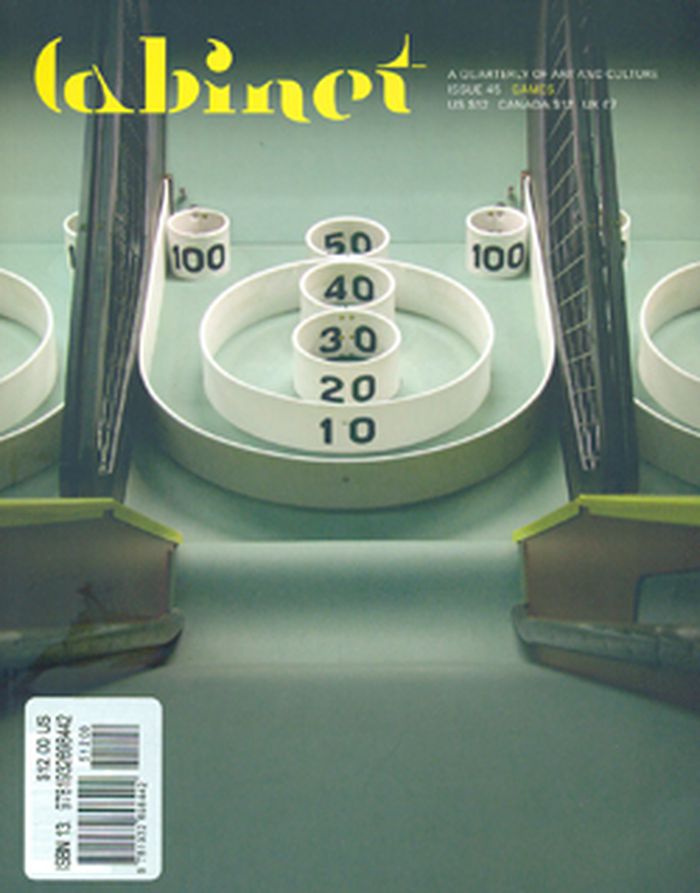
In the nineteenth century, Marx rejected the notion of homo sapiens, offering instead homo faber to indicate how consciousness follows from the primary activity of making. Against this, a certain ludic tradition has imagined a homo ludens, humans defined through their relationship with games and play. Cabinet 45 features Joshua Glenn on H.G. Wells’ “Floor Games”; D. Graham Burnett on games played by game theorists; Barbara Levine and Jessica Helfand on dexterity games; James Trainor on the lost world of “adventure” playgrounds; Dana Katz on Brian Eno and Peter Schmidt’s “Oblique Strategies”; an interview with Bertell Ollman, inventor of the board game “Class Struggle”; and Jeff Dolven on poems as games. Elsewhere in the issue: Helen Larsson on the history of applause; Wayne Koestenbaum’s legendary “Legend” column; Naomi Muller on eating the zoo animals in Berlin during World War II; Jeremy Crichton on “spite” houses; and much more.
Cabinet 45: Games
Actions:
Prix:
$12.00
(disponible sur commande)
Résumé:
In the nineteenth century, Marx rejected the notion of homo sapiens, offering instead homo faber to indicate how consciousness follows from the primary activity of making. Against this, a certain ludic tradition has imagined a homo ludens, humans defined through their relationship with games and play. Cabinet 45 features Joshua Glenn on H.G. Wells’ “Floor Games”; D. Graham Burnett on games played by game theorists; Barbara Levine and Jessica Helfand on dexterity games; James Trainor on the lost world of “adventure” playgrounds; Dana Katz on Brian Eno and Peter Schmidt’s “Oblique Strategies”; an interview with Bertell Ollman, inventor of the board game “Class Struggle”; and Jeff Dolven on poems as games. Elsewhere in the issue: Helen Larsson on the history of applause; Wayne Koestenbaum’s legendary “Legend” column; Naomi Muller on eating the zoo animals in Berlin during World War II; Jeremy Crichton on “spite” houses; and much more.
Classification:
livres
livres
Publication:
juin 2012
juin 2012
Sujet:
Revues
Revues
Classification:
livres
livres
Actions:
Exemplaires:
Description:
[2], xii, [6], 488 [i.e. 500], [8] pages, [1], XX leaves of plates : illustrations ; 21 cm (8vo)
Description:
[2], xii, [6], 488 [i.e. 500], [8] pages, [1], XX leaves of plates : illustrations ; 21 cm (8vo)
Auteur:
Sujet:
Publication:
London : Printed for Benj. Tooke ..., 1706.
London : Printed for Benj. Tooke ..., 1706.
Titre:
Le jardinier solitaire : the solitary or Carthusian gard'ner : being dialogues between a gentleman and a gard'ner : containing the method to make and cultivate all sorts of gardens ; with many new experiments therein ; and reflections on the culture of trees / written in French by Francis Gentil, lay-brother of the order of Carthusians, and above thirty years gard'ner to the Charter-House at Paris ... Also, the compleat florist, or, The universal culture of flowers, trees and shrubs : proper to imbellish gardens : with the way of raising all sorts of parterres, greens, knots, porticoes, columns and other ornaments : the whole illustrated with many cuts, and with the fable and moral of each plant / by the Sieur Louis Liger d'Auxerre ... newly done into English.
Actions:
Exemplaires:
Description:
[2], xii, [6], 488 [i.e. 500], [8] pages, [1], XX leaves of plates : illustrations ; 21 cm (8vo)
Le jardinier solitaire : the solitary or Carthusian gard'ner : being dialogues between a gentleman and a gard'ner : containing the method to make and cultivate all sorts of gardens ; with many new experiments therein ; and reflections on the culture of trees / written in French by Francis Gentil, lay-brother of the order of Carthusians, and above thirty years gard'ner to the Charter-House at Paris ... Also, the compleat florist, or, The universal culture of flowers, trees and shrubs : proper to imbellish gardens : with the way of raising all sorts of parterres, greens, knots, porticoes, columns and other ornaments : the whole illustrated with many cuts, and with the fable and moral of each plant / by the Sieur Louis Liger d'Auxerre ... newly done into English.
Actions:
Exemplaires:
Description:
[2], xii, [6], 488 [i.e. 500], [8] pages, [1], XX leaves of plates : illustrations ; 21 cm (8vo)
Classification:
livres
livres
Publication:
London : Printed for Benj. Tooke ..., 1706.
London : Printed for Benj. Tooke ..., 1706.
Auteur:
Sujet:
Classification:
livres
livres

Actions:
Prix:
$38.99
(disponible sur commande)
Résumé:
Effective layout is essential to communication and enables the end user to not only be drawn in with an innovative design, but to digest information easily. Making and Breaking the Grid is a comprehensive layout design workshop that assumes that in order to effectively break the rules of grid-based design, one must first understand those rules and see them applied to(...)
$38.99
(disponible sur commande)
Résumé:
Effective layout is essential to communication and enables the end user to not only be drawn in with an innovative design, but to digest information easily. Making and Breaking the Grid is a comprehensive layout design workshop that assumes that in order to effectively break the rules of grid-based design, one must first understand those rules and see them applied to(...)
Titre:
Making and breaking the grid:a graphic design layout workshop. Revised edition
Actions:
Prix:
$38.99
(disponible sur commande)
Résumé:
Effective layout is essential to communication and enables the end user to not only be drawn in with an innovative design, but to digest information easily. Making and Breaking the Grid is a comprehensive layout design workshop that assumes that in order to effectively break the rules of grid-based design, one must first understand those rules and see them applied to real-world projects. Basics include composing typographic space, format determination, and sequencing and systemization. Various types of grids manuscript, column, modular, hierarchical are also covered. Text reveals top designers' work in process and rationale. Projects with similar characteristics are linked through a simple notational system that encourages exploration and comparison of structure ideas. Each project is shown comprehensively so readers can see its structure revealed over several pages, at a size that allows for inspection of detail. Also included are historical overviews that summarize the development of layout concepts, both grid-based and non-grid based, in modern design practice.
Making and breaking the grid:a graphic design layout workshop. Revised edition
Actions:
Prix:
$38.99
(disponible sur commande)
Résumé:
Effective layout is essential to communication and enables the end user to not only be drawn in with an innovative design, but to digest information easily. Making and Breaking the Grid is a comprehensive layout design workshop that assumes that in order to effectively break the rules of grid-based design, one must first understand those rules and see them applied to real-world projects. Basics include composing typographic space, format determination, and sequencing and systemization. Various types of grids manuscript, column, modular, hierarchical are also covered. Text reveals top designers' work in process and rationale. Projects with similar characteristics are linked through a simple notational system that encourages exploration and comparison of structure ideas. Each project is shown comprehensively so readers can see its structure revealed over several pages, at a size that allows for inspection of detail. Also included are historical overviews that summarize the development of layout concepts, both grid-based and non-grid based, in modern design practice.
Classification:
livres
livres
Publication:
juillet 2017
juillet 2017
Classification:
livres
livres
Prix:
$49.95
(disponible sur commande)
Résumé:
Andy Warhol, Susan Sontag, John Lennon & Yoko Ono — Jonas Mekas was well acquainted with a great many New York artists. Born in Lithuania, he came to Brooklyn via Germany in 1949 and began shooting his first experimental films there. Mekas developed a form of film diary in which he recorded his daily observations. He became the barometer of the New York art scene and a(...)
$49.95
(disponible sur commande)
Résumé:
Andy Warhol, Susan Sontag, John Lennon & Yoko Ono — Jonas Mekas was well acquainted with a great many New York artists. Born in Lithuania, he came to Brooklyn via Germany in 1949 and began shooting his first experimental films there. Mekas developed a form of film diary in which he recorded his daily observations. He became the barometer of the New York art scene and a(...)
Titre:
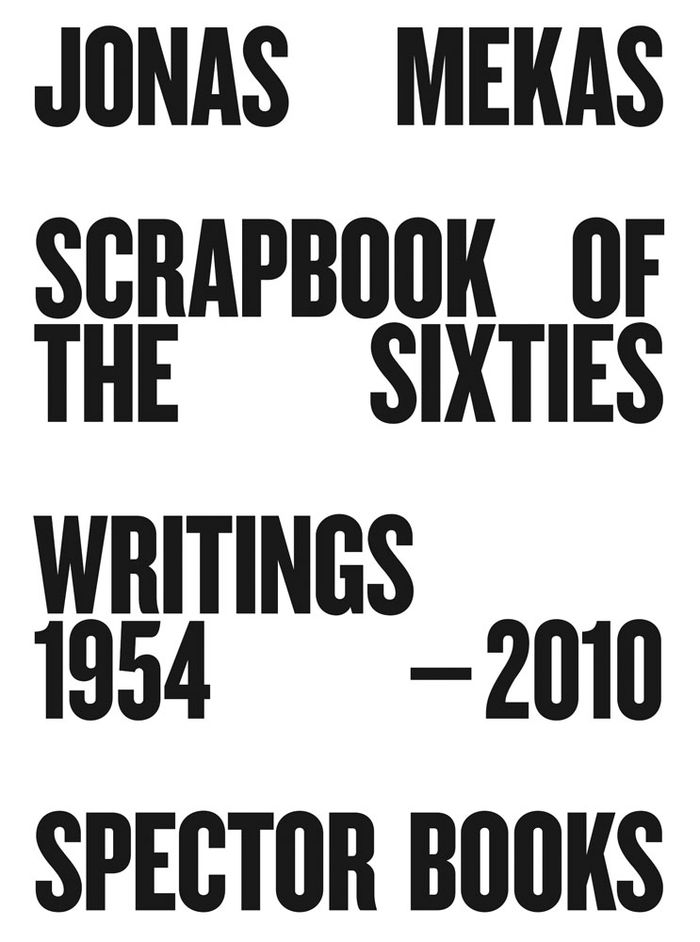
Jonas Mekas: Scrapbook of the sixties, writings 1954-2010
Actions:
Prix:
$49.95
(disponible sur commande)
Résumé:
Andy Warhol, Susan Sontag, John Lennon & Yoko Ono — Jonas Mekas was well acquainted with a great many New York artists. Born in Lithuania, he came to Brooklyn via Germany in 1949 and began shooting his first experimental films there. Mekas developed a form of film diary in which he recorded his daily observations. He became the barometer of the New York art scene and a pioneer of American avant-garde cinema. Every week, starting in 1958 he published his legendary Movie Journal column in the Village Voice, writing on a range of subjects that were by no means restricted to the world of film. He conducted numerous interviews with artists, some of which will now appear for the first time in his Scrapbook of a Diarist. The book contains published and unpublished texts that reveal Mekas as a thoughtful diarist and an unparalleled chronicler of the day — a phenomenon that has continued now for over fifty years.
Jonas Mekas: Scrapbook of the sixties, writings 1954-2010
Actions:
Prix:
$49.95
(disponible sur commande)
Résumé:
Andy Warhol, Susan Sontag, John Lennon & Yoko Ono — Jonas Mekas was well acquainted with a great many New York artists. Born in Lithuania, he came to Brooklyn via Germany in 1949 and began shooting his first experimental films there. Mekas developed a form of film diary in which he recorded his daily observations. He became the barometer of the New York art scene and a pioneer of American avant-garde cinema. Every week, starting in 1958 he published his legendary Movie Journal column in the Village Voice, writing on a range of subjects that were by no means restricted to the world of film. He conducted numerous interviews with artists, some of which will now appear for the first time in his Scrapbook of a Diarist. The book contains published and unpublished texts that reveal Mekas as a thoughtful diarist and an unparalleled chronicler of the day — a phenomenon that has continued now for over fifty years.
Classification:
livres
livres
Publication:
avril 2020
avril 2020
Sujet:
Théorie de l’art
Théorie de l’art


