


8451 Résultats
Classification:
vidéo
vidéo
Titre:
ABC:MTL : Audiotopie.
ABC:MTL : Audiotopie.
Actions:
Exemplaires:
Description:
1 streaming video file (54 sec.) : sound, colour
Description:
1 streaming video file (54 sec.) : sound, colour
Auteur:
Sujet:
Publication:
[Montréal] : CCA, [2012]
[Montréal] : CCA, [2012]
Titre:
ABC:MTL : Audiotopie.
Actions:
Exemplaires:
Description:
1 streaming video file (54 sec.) : sound, colour
ABC:MTL : Audiotopie.
Actions:
Exemplaires:
Description:
1 streaming video file (54 sec.) : sound, colour
Classification:
vidéo
vidéo
Publication:
[Montréal] : CCA, [2012]
[Montréal] : CCA, [2012]
Auteur:
Sujet:
Classification:
vidéo
vidéo
Titre:
ABC:MTL : Neil Clavin.
ABC:MTL : Neil Clavin.
Actions:
Exemplaires:
Description:
1 streaming video file (1 min., 5 sec.) : sound, colour
Description:
1 streaming video file (1 min., 5 sec.) : sound, colour
Auteur:
Sujet:
Publication:
[Montréal] : CCA, [2012]
[Montréal] : CCA, [2012]
Titre:
ABC:MTL : Neil Clavin.
Actions:
Exemplaires:
Description:
1 streaming video file (1 min., 5 sec.) : sound, colour
ABC:MTL : Neil Clavin.
Actions:
Exemplaires:
Description:
1 streaming video file (1 min., 5 sec.) : sound, colour
Classification:
vidéo
vidéo
Publication:
[Montréal] : CCA, [2012]
[Montréal] : CCA, [2012]
Auteur:
Sujet:
Classification:
vidéo
vidéo
Titre:
ABC:MTL : Christine Renaud.
ABC:MTL : Christine Renaud.
Actions:
Exemplaires:
Description:
1 streaming video file (1 min., 24 sec.) : sound, colour
Description:
1 streaming video file (1 min., 24 sec.) : sound, colour
Auteur:
Sujet:
Publication:
[Montréal] : CCA, [2013]
[Montréal] : CCA, [2013]
Titre:
ABC:MTL : Christine Renaud.
Actions:
Exemplaires:
Description:
1 streaming video file (1 min., 24 sec.) : sound, colour
ABC:MTL : Christine Renaud.
Actions:
Exemplaires:
Description:
1 streaming video file (1 min., 24 sec.) : sound, colour
Classification:
vidéo
vidéo
Publication:
[Montréal] : CCA, [2013]
[Montréal] : CCA, [2013]
Auteur:
Sujet:
Classification:
audio
audio
Actions:
Description:
1 online resource.
Auteur:
Sujet:
Publication:
[Place of publication not identified] : Secession, 2023.
[Place of publication not identified] : Secession, 2023.
Titre:
Artists: Karrabing Film Collective in conversation with Bettina Spörr.
Actions:
Description:
1 online resource.
Artists: Karrabing Film Collective in conversation with Bettina Spörr.
Actions:
Description:
1 online resource.
Classification:
audio
audio
Publication:
[Place of publication not identified] : Secession, 2023.
[Place of publication not identified] : Secession, 2023.
Auteur:
Sujet:
Classification:
livres
livres
Actions:
Prix:
$41.95
(disponible sur commande)
Résumé:
Although a few among us are intrepid architectural tourists, visiting buildings and landscapes our cameras at the ready, most of us experience architecture through the windshield of a moving vehicle, the architectural experience reduced to a blurry and momentary drive-by. And the rest of our architectural "tourism" is through the images of cameras, movies, and television(...)
Publication:
mai 2004, New York
mai 2004, New York
Titre:
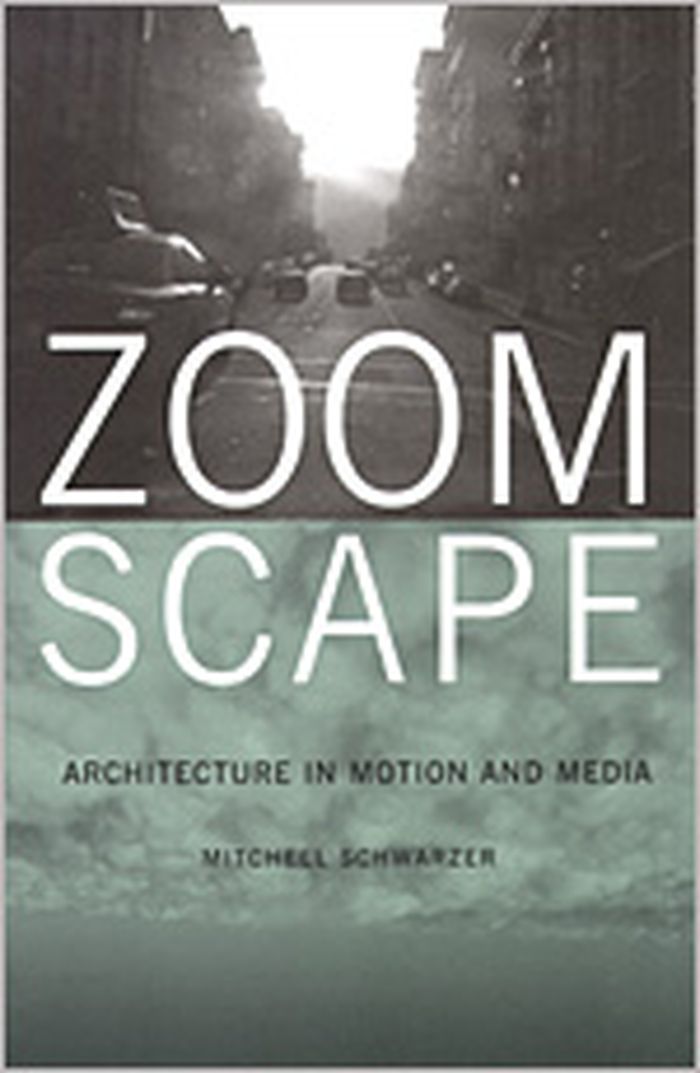
Zoomscape : architecture and motion in media
Actions:
Prix:
$41.95
(disponible sur commande)
Résumé:
Although a few among us are intrepid architectural tourists, visiting buildings and landscapes our cameras at the ready, most of us experience architecture through the windshield of a moving vehicle, the architectural experience reduced to a blurry and momentary drive-by. And the rest of our architectural "tourism" is through the images of cameras, movies, and television programs—that is, through the lens of another's eye. Architectural historian Mitchell Schwarzer calls this new mediated architectural experience the "zoomscape." In this thought-provoking book, he argues that the perception of architecture has been fundamentally altered by the technologies of transportation and the camera - we now look at buildings, neighborhoods, cities, and even entire continents as we ride in trains, cars, and planes, and/or as we view photographs, movies, and television. "Zoomscape" shows how we now perceive buildings and places at high speeds, across great distances, through edited and multiple reproductions. Nowadays, our views of the architectural landscape are modulated by the accelerator pedal and the remote control, by studio production techniques and airplane flight paths. Using examples from high art and popular culture - from the novels of Don DeLillo to the opening credits of "The Sopranos" - Mitchell Schwarzer shows that the zoomscape has brought about unprecedented and often marvelous new ways of perceiving the built environment.
Classification:
livres
livres
Publication:
mai 2004, New York
mai 2004, New York
Classification:
livres
livres
Titre:
meier + associés architectes / Herausgeber: Heinz Wirz ; Textbeiträge: Renato Salvi, [and 3 others].
meier + associés architectes / Herausgeber: Heinz Wirz ; Textbeiträge: Renato Salvi, [and 3 others].
Actions:
Exemplaires:
Description:
126 pages : coor illustrations, plans ; 29 cm.
Description:
126 pages : coor illustrations, plans ; 29 cm.
Auteur:
Sujet:
Publication:
Luzern : Quart Verlag, [2019]
Luzern : Quart Verlag, [2019]
Titre:
meier + associés architectes / Herausgeber: Heinz Wirz ; Textbeiträge: Renato Salvi, [and 3 others].
Actions:
Exemplaires:
Description:
126 pages : coor illustrations, plans ; 29 cm.
meier + associés architectes / Herausgeber: Heinz Wirz ; Textbeiträge: Renato Salvi, [and 3 others].
Actions:
Exemplaires:
Description:
126 pages : coor illustrations, plans ; 29 cm.
Classification:
livres
livres
Publication:
Luzern : Quart Verlag, [2019]
Luzern : Quart Verlag, [2019]
Auteur:
Sujet:
Classification:
livres
livres
Actions:
Description:
1 online resource
Sujet:
Publication:
London : Repeater Books, an imprint of Watkins Media Ltd., 2017.
London : Repeater Books, an imprint of Watkins Media Ltd., 2017.
Titre:
Futures and fictions / edited by Henriette Gunkel, Ayesha Hameed and Simon O'Sullivan.
Actions:
Description:
1 online resource
Futures and fictions / edited by Henriette Gunkel, Ayesha Hameed and Simon O'Sullivan.
Actions:
Description:
1 online resource
Classification:
livres
livres
Publication:
London : Repeater Books, an imprint of Watkins Media Ltd., 2017.
London : Repeater Books, an imprint of Watkins Media Ltd., 2017.
Sujet:
Classification:
livres
livres

Actions:
Prix:
$59.95
(disponible en magasin)
Résumé:
Following the Second World War, Montreal earned a reputation as a North American hotbed of eroticism due to its red-light district, nightclub scene, and pornography industry. Although this erotic environment had a significant presence in the art and media of the period, the topic has been neglected by scholars. "The pornographic delicatessen" offers an important(...)
Titre:
The pornographic delicatessen: Midcentury Montreal's erotic art, media, and spaces
Actions:
Prix:
$59.95
(disponible en magasin)
Résumé:
Following the Second World War, Montreal earned a reputation as a North American hotbed of eroticism due to its red-light district, nightclub scene, and pornography industry. Although this erotic environment had a significant presence in the art and media of the period, the topic has been neglected by scholars. "The pornographic delicatessen" offers an important examination of the development of erotic art and design in the city’s postwar and Quiet Revolution era. Matthew Purvis surveys a range of erotic materials to rediscover nearly forgotten artworks in a period that expanded definitions of what could be considered art. He stresses the confluence of visual art and film, magazines, and journalism during the period as formal models passed from surrealism and automatism into the evolution of a Quebec-specific variation of Pop Art called "ti-pop."
Classification:
livres
livres
Publication:
décembre 2025
décembre 2025
Sujet:
Architecture de Montréal
Architecture de Montréal
Classification:
vidéo
vidéo
Actions:
Exemplaires:
Description:
1 streaming video file (1 min., 35 sec.) : sound, colour
Description:
1 streaming video file (1 min., 35 sec.) : sound, colour
Auteur:
Sujet:
Publication:
[Montréal] : CCA, [2013]
[Montréal] : CCA, [2013]
Titre:
ABC:MTL : André Éric Létourneau.
Actions:
Exemplaires:
Description:
1 streaming video file (1 min., 35 sec.) : sound, colour
ABC:MTL : André Éric Létourneau.
Actions:
Exemplaires:
Description:
1 streaming video file (1 min., 35 sec.) : sound, colour
Classification:
vidéo
vidéo
Publication:
[Montréal] : CCA, [2013]
[Montréal] : CCA, [2013]
Auteur:
Sujet:
Classification:
livres
livres

Actions:
Prix:
$51.95
(disponible sur commande)
Résumé:
The Media House Project is the fruit of a strategic alliance between the Metapolis Group from Barcelona, the MIT Media Lab, and the Fundacio Politecnica de Catalunya, with the collaboration of the Consortium I2CAT and the Elisava Design School, in order to build a prototype of an informational house. This project enables the testing of the progression of information(...)
Publication:
janvier 1900, Barcelona
janvier 1900, Barcelona
Titre:
Media house project : the house is the computer, the structure is the network
Actions:
Prix:
$51.95
(disponible sur commande)
Résumé:
The Media House Project is the fruit of a strategic alliance between the Metapolis Group from Barcelona, the MIT Media Lab, and the Fundacio Politecnica de Catalunya, with the collaboration of the Consortium I2CAT and the Elisava Design School, in order to build a prototype of an informational house. This project enables the testing of the progression of information technologies beyond that of computers and integrates them into everyday life, literally looking to build computers from the components of buildings, in such a way that the logical intelligence of a structure can grow with its physical form.
Classification:
livres
livres
Publication:
janvier 1900, Barcelona
janvier 1900, Barcelona


