


44178 Résultats
Classification:
archives
Niveau de description archivistique:
Fonds
archives
Niveau de description archivistique:
Fonds
Numéro de référence:
AP002
Résumé:
The Ludger and Paul M. Lemieux fonds, 1897-1966, documents the built projects of Québec architectural firm, Ludger & Paul M. Lemieux. The 500 projects that are represented in this fonds are divided by the architectural works of Macduff & Lemieux (1897-1917), Ludger Lemieux (1910-1950), Ludger & Paul M. Lemieux (1929-1951), and Paul M. Lemieux (1934-1966). Materials in this fonds consist of 4988 drawings (including reprographic prints), 320 photographic materials and 5 l.m. of textual records.
AP002
Résumé:
The Ludger and Paul M. Lemieux fonds, 1897-1966, documents the built projects of Québec architectural firm, Ludger & Paul M. Lemieux. The 500 projects that are represented in this fonds are divided by the architectural works of Macduff & Lemieux (1897-1917), Ludger Lemieux (1910-1950), Ludger & Paul M. Lemieux (1929-1951), and Paul M. Lemieux (1934-1966). Materials in this fonds consist of 4988 drawings (including reprographic prints), 320 photographic materials and 5 l.m. of textual records.
Personnes et institutions:
Date:
1897-1966
1897-1966
Titre:
Fonds Ludger et Paul M. Lemieux
Actions:
AP002
Résumé:
The Ludger and Paul M. Lemieux fonds, 1897-1966, documents the built projects of Québec architectural firm, Ludger & Paul M. Lemieux. The 500 projects that are represented in this fonds are divided by the architectural works of Macduff & Lemieux (1897-1917), Ludger Lemieux (1910-1950), Ludger & Paul M. Lemieux (1929-1951), and Paul M. Lemieux (1934-1966). Materials in this fonds consist of 4988 drawings (including reprographic prints), 320 photographic materials and 5 l.m. of textual records.
Fonds Ludger et Paul M. Lemieux
Actions:
AP002
Résumé:
The Ludger and Paul M. Lemieux fonds, 1897-1966, documents the built projects of Québec architectural firm, Ludger & Paul M. Lemieux. The 500 projects that are represented in this fonds are divided by the architectural works of Macduff & Lemieux (1897-1917), Ludger Lemieux (1910-1950), Ludger & Paul M. Lemieux (1929-1951), and Paul M. Lemieux (1934-1966). Materials in this fonds consist of 4988 drawings (including reprographic prints), 320 photographic materials and 5 l.m. of textual records.
Classification:
archives
Niveau de description archivistique:
Fonds
archives
Niveau de description archivistique:
Fonds
Date:
1897-1966
1897-1966
Personnes et institutions:
Actions:
Numéro de référence:
PH1979:0508
Description:
This album depicts photographs, plans, sketches of Stonehenge and texts. Preface is signed by Sir Henry James, 29th May 1867, Southhampton. Album has appendix and List of Books inserted at the end. "Col. Sir Henry James, Director-General of the Ordnance Survey, was a strong believer that photography had to be utilized as a major tool for mapping and survey work and he employed the Royal Engineers for that purpose. Colonel James appears in several of the Stonehenge photographs published by the Ordnance Survey. [...] Stonehenge is the world's most famous, large megalithic stone circle and is usually designated as a site used for religious worship in Neolithic Britain. However, the first use of this locality for documented ritual activity goes back to the Mesolithic and the erection of several large totem poles perhaps as early as 8,000 BC (Stonehenge O). Lunar observations preceded the construction of a causeway c.3200 BC, followed by an earth circle and Heel Stones c.3100 BC (Stonehenge 1a) and the Aubrey Holes (Stonehenge 1b). The Stonehenge site was then abandoned for about 1,000 years when large bluestones quarried in Wales were brought to the site and made into the Double Bluestone Circle with Avenue. 2150 BC (Stonehenge II). Soon thereafter sarsen stones were brought in from Avebury to build the great Sarsen Circle and Trilithon Horseshoe, 2100 BC (Stonehenge IIIz). Bluestones were brought back and added as the Bluestone Circle and Bluestone Horseshoe to the sarsen monument, 1800 BC (Stonehenge IIId). The sacred avenue was extended to the River Avon, 1100 BC (Stonehenge IV), the last phase of megalithic construction at this site. Note that the great stone circle and all construction at the Stonehenge site was completed several hundred years before we can postulate Celtic druids in the vicinity. We can only mention in passing that Stonehenge was embedded within a large ritual complex, where several of the ten megalithic constructions were also monumental in scale. Integration between these structures may not have been well planned in advance, but assuredly was articulated as each was built." Neolithic Britian Online.
PH1979:0508
Description:
This album depicts photographs, plans, sketches of Stonehenge and texts. Preface is signed by Sir Henry James, 29th May 1867, Southhampton. Album has appendix and List of Books inserted at the end. "Col. Sir Henry James, Director-General of the Ordnance Survey, was a strong believer that photography had to be utilized as a major tool for mapping and survey work and he employed the Royal Engineers for that purpose. Colonel James appears in several of the Stonehenge photographs published by the Ordnance Survey. [...] Stonehenge is the world's most famous, large megalithic stone circle and is usually designated as a site used for religious worship in Neolithic Britain. However, the first use of this locality for documented ritual activity goes back to the Mesolithic and the erection of several large totem poles perhaps as early as 8,000 BC (Stonehenge O). Lunar observations preceded the construction of a causeway c.3200 BC, followed by an earth circle and Heel Stones c.3100 BC (Stonehenge 1a) and the Aubrey Holes (Stonehenge 1b). The Stonehenge site was then abandoned for about 1,000 years when large bluestones quarried in Wales were brought to the site and made into the Double Bluestone Circle with Avenue. 2150 BC (Stonehenge II). Soon thereafter sarsen stones were brought in from Avebury to build the great Sarsen Circle and Trilithon Horseshoe, 2100 BC (Stonehenge IIIz). Bluestones were brought back and added as the Bluestone Circle and Bluestone Horseshoe to the sarsen monument, 1800 BC (Stonehenge IIId). The sacred avenue was extended to the River Avon, 1100 BC (Stonehenge IV), the last phase of megalithic construction at this site. Note that the great stone circle and all construction at the Stonehenge site was completed several hundred years before we can postulate Celtic druids in the vicinity. We can only mention in passing that Stonehenge was embedded within a large ritual complex, where several of the ten megalithic constructions were also monumental in scale. Integration between these structures may not have been well planned in advance, but assuredly was articulated as each was built." Neolithic Britian Online.
Personnes et institutions:
Sujet:
sculpture, topographique
sculpture, topographique
Date:
1867
1867
Titre:
Plans and Photographs of Stonehenge, and of Turusachan in the Island of Lewis; with Notes Relating to the Druids and Sketches of Cromlechs in Ireland
Actions:
PH1979:0508
Description:
This album depicts photographs, plans, sketches of Stonehenge and texts. Preface is signed by Sir Henry James, 29th May 1867, Southhampton. Album has appendix and List of Books inserted at the end. "Col. Sir Henry James, Director-General of the Ordnance Survey, was a strong believer that photography had to be utilized as a major tool for mapping and survey work and he employed the Royal Engineers for that purpose. Colonel James appears in several of the Stonehenge photographs published by the Ordnance Survey. [...] Stonehenge is the world's most famous, large megalithic stone circle and is usually designated as a site used for religious worship in Neolithic Britain. However, the first use of this locality for documented ritual activity goes back to the Mesolithic and the erection of several large totem poles perhaps as early as 8,000 BC (Stonehenge O). Lunar observations preceded the construction of a causeway c.3200 BC, followed by an earth circle and Heel Stones c.3100 BC (Stonehenge 1a) and the Aubrey Holes (Stonehenge 1b). The Stonehenge site was then abandoned for about 1,000 years when large bluestones quarried in Wales were brought to the site and made into the Double Bluestone Circle with Avenue. 2150 BC (Stonehenge II). Soon thereafter sarsen stones were brought in from Avebury to build the great Sarsen Circle and Trilithon Horseshoe, 2100 BC (Stonehenge IIIz). Bluestones were brought back and added as the Bluestone Circle and Bluestone Horseshoe to the sarsen monument, 1800 BC (Stonehenge IIId). The sacred avenue was extended to the River Avon, 1100 BC (Stonehenge IV), the last phase of megalithic construction at this site. Note that the great stone circle and all construction at the Stonehenge site was completed several hundred years before we can postulate Celtic druids in the vicinity. We can only mention in passing that Stonehenge was embedded within a large ritual complex, where several of the ten megalithic constructions were also monumental in scale. Integration between these structures may not have been well planned in advance, but assuredly was articulated as each was built." Neolithic Britian Online.
Plans and Photographs of Stonehenge, and of Turusachan in the Island of Lewis; with Notes Relating to the Druids and Sketches of Cromlechs in Ireland
Actions:
PH1979:0508
Description:
This album depicts photographs, plans, sketches of Stonehenge and texts. Preface is signed by Sir Henry James, 29th May 1867, Southhampton. Album has appendix and List of Books inserted at the end. "Col. Sir Henry James, Director-General of the Ordnance Survey, was a strong believer that photography had to be utilized as a major tool for mapping and survey work and he employed the Royal Engineers for that purpose. Colonel James appears in several of the Stonehenge photographs published by the Ordnance Survey. [...] Stonehenge is the world's most famous, large megalithic stone circle and is usually designated as a site used for religious worship in Neolithic Britain. However, the first use of this locality for documented ritual activity goes back to the Mesolithic and the erection of several large totem poles perhaps as early as 8,000 BC (Stonehenge O). Lunar observations preceded the construction of a causeway c.3200 BC, followed by an earth circle and Heel Stones c.3100 BC (Stonehenge 1a) and the Aubrey Holes (Stonehenge 1b). The Stonehenge site was then abandoned for about 1,000 years when large bluestones quarried in Wales were brought to the site and made into the Double Bluestone Circle with Avenue. 2150 BC (Stonehenge II). Soon thereafter sarsen stones were brought in from Avebury to build the great Sarsen Circle and Trilithon Horseshoe, 2100 BC (Stonehenge IIIz). Bluestones were brought back and added as the Bluestone Circle and Bluestone Horseshoe to the sarsen monument, 1800 BC (Stonehenge IIId). The sacred avenue was extended to the River Avon, 1100 BC (Stonehenge IV), the last phase of megalithic construction at this site. Note that the great stone circle and all construction at the Stonehenge site was completed several hundred years before we can postulate Celtic druids in the vicinity. We can only mention in passing that Stonehenge was embedded within a large ritual complex, where several of the ten megalithic constructions were also monumental in scale. Integration between these structures may not have been well planned in advance, but assuredly was articulated as each was built." Neolithic Britian Online.
Date:
1867
1867
Personnes et institutions:
Sujet:
sculpture, topographique
sculpture, topographique
Classification:
photographies
photographies
Actions:
Numéro de référence:
PH1980:1130
Description:
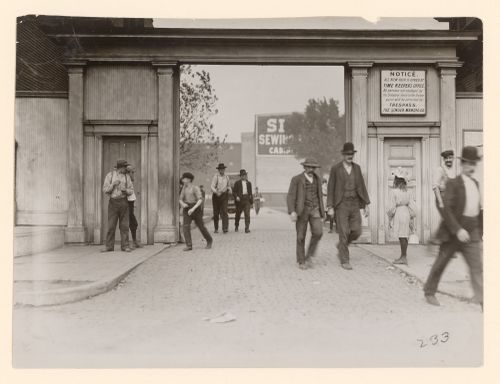
On the right, a girl holding a food container stands facing the entrance to the factory yard. Photograph taken while Lewis Wickes Hine was working for the National Child Labor Committee. Caption from NCLC caption card: "Lunch hour. Singer Mfg. Co. : the boys [sic] works there: girl carries lunch".
PH1980:1130
Description:
On the right, a girl holding a food container stands facing the entrance to the factory yard. Photograph taken while Lewis Wickes Hine was working for the National Child Labor Committee. Caption from NCLC caption card: "Lunch hour. Singer Mfg. Co. : the boys [sic] works there: girl carries lunch".
Personnes et institutions:
Date:
October 1908
October 1908
Titre:
View of workers, including a boy, exiting grounds of Singer Manufacturing Co. at lunch hour, and a girl carrying lunch, South Bend, Indiana, United States
Actions:
PH1980:1130
Description:
On the right, a girl holding a food container stands facing the entrance to the factory yard. Photograph taken while Lewis Wickes Hine was working for the National Child Labor Committee. Caption from NCLC caption card: "Lunch hour. Singer Mfg. Co. : the boys [sic] works there: girl carries lunch".
View of workers, including a boy, exiting grounds of Singer Manufacturing Co. at lunch hour, and a girl carrying lunch, South Bend, Indiana, United States
Actions:
PH1980:1130
Description:
On the right, a girl holding a food container stands facing the entrance to the factory yard. Photograph taken while Lewis Wickes Hine was working for the National Child Labor Committee. Caption from NCLC caption card: "Lunch hour. Singer Mfg. Co. : the boys [sic] works there: girl carries lunch".
Classification:
photographies
photographies
Date:
October 1908
October 1908
Personnes et institutions:
Classification:
dessins, documents textuels
dessins, documents textuels
Numéro de référence:
AP142.S1.D186.P3
Description:
sketches, drawings, a map, photographs, correspondence, architects' statements, proposals, building programmes, specifications, regulations, estimates, calculations, administrative records, a technical report, brochures, leaflets, clippings, labels for drawings, agendas, notes, exhibition layouts, Triennale catalogues, lists of exhibited works, and lists of participants in the Triennale
AP142.S1.D186.P3
Description:
sketches, drawings, a map, photographs, correspondence, architects' statements, proposals, building programmes, specifications, regulations, estimates, calculations, administrative records, a technical report, brochures, leaflets, clippings, labels for drawings, agendas, notes, exhibition layouts, Triennale catalogues, lists of exhibited works, and lists of participants in the Triennale
Personnes et institutions:
Titre:
Sketches, drawings, a map, photographs, correspondence
Actions:
AP142.S1.D186.P3
Description:
sketches, drawings, a map, photographs, correspondence, architects' statements, proposals, building programmes, specifications, regulations, estimates, calculations, administrative records, a technical report, brochures, leaflets, clippings, labels for drawings, agendas, notes, exhibition layouts, Triennale catalogues, lists of exhibited works, and lists of participants in the Triennale
Sketches, drawings, a map, photographs, correspondence
Actions:
AP142.S1.D186.P3
Description:
sketches, drawings, a map, photographs, correspondence, architects' statements, proposals, building programmes, specifications, regulations, estimates, calculations, administrative records, a technical report, brochures, leaflets, clippings, labels for drawings, agendas, notes, exhibition layouts, Triennale catalogues, lists of exhibited works, and lists of participants in the Triennale
Classification:
dessins, documents textuels
dessins, documents textuels
Personnes et institutions:
Classification:
documents textuels, photographies
documents textuels, photographies
Numéro de référence:
AP197.S2.029
Description:
The box contains various research files organized in alphabetical order by either author's last name or subject, from R to S. The main sections are divided between writings on Carlo Scarpa and Louis Sullivan. The slides and photographs illustrate various works by Carlo Scarpa.
AP197.S2.029
Description:
The box contains various research files organized in alphabetical order by either author's last name or subject, from R to S. The main sections are divided between writings on Carlo Scarpa and Louis Sullivan. The slides and photographs illustrate various works by Carlo Scarpa.
Personnes et institutions:
Date:
circa 1965- 2011
circa 1965- 2011
Titre:
Research files organized by author's last name or subject from R-S
Actions:
AP197.S2.029
Description:
The box contains various research files organized in alphabetical order by either author's last name or subject, from R to S. The main sections are divided between writings on Carlo Scarpa and Louis Sullivan. The slides and photographs illustrate various works by Carlo Scarpa.
Research files organized by author's last name or subject from R-S
Actions:
AP197.S2.029
Description:
The box contains various research files organized in alphabetical order by either author's last name or subject, from R to S. The main sections are divided between writings on Carlo Scarpa and Louis Sullivan. The slides and photographs illustrate various works by Carlo Scarpa.
Classification:
documents textuels, photographies
documents textuels, photographies
Date:
circa 1965- 2011
circa 1965- 2011
Personnes et institutions:
Classification:
documents textuels
documents textuels
Numéro de référence:
ARCH277000
Description:
Group contains Architectural Specifications Volume 1, Outline Specification, Reports, Design Standards & Schedules Volume 4A, Volume 4B, Electrical Specifications Volume 3 and Mechanical Specifications Volume 2 for 1151 West Georgia Street, Vancouver and Outline Specification, Reports, Design Standards & Schedules for 1133 West Georgia Street, Vancouver on which Arthur Erickson worked as a design consultant.
ARCH277000
Description:
Group contains Architectural Specifications Volume 1, Outline Specification, Reports, Design Standards & Schedules Volume 4A, Volume 4B, Electrical Specifications Volume 3 and Mechanical Specifications Volume 2 for 1151 West Georgia Street, Vancouver and Outline Specification, Reports, Design Standards & Schedules for 1133 West Georgia Street, Vancouver on which Arthur Erickson worked as a design consultant.
Personnes et institutions:
Date:
January 2008
January 2008
Titre:
Specifications and working files on various projects
Actions:
ARCH277000
Description:
Group contains Architectural Specifications Volume 1, Outline Specification, Reports, Design Standards & Schedules Volume 4A, Volume 4B, Electrical Specifications Volume 3 and Mechanical Specifications Volume 2 for 1151 West Georgia Street, Vancouver and Outline Specification, Reports, Design Standards & Schedules for 1133 West Georgia Street, Vancouver on which Arthur Erickson worked as a design consultant.
Specifications and working files on various projects
Actions:
ARCH277000
Description:
Group contains Architectural Specifications Volume 1, Outline Specification, Reports, Design Standards & Schedules Volume 4A, Volume 4B, Electrical Specifications Volume 3 and Mechanical Specifications Volume 2 for 1151 West Georgia Street, Vancouver and Outline Specification, Reports, Design Standards & Schedules for 1133 West Georgia Street, Vancouver on which Arthur Erickson worked as a design consultant.
Classification:
documents textuels
documents textuels
Date:
January 2008
January 2008
Personnes et institutions:
Classification:
documents textuels
documents textuels
Numéro de référence:
AP142.S2.D5.P1
Description:
drawings, photographs of drawings and models, correspondence, an architect's statement, a proposal, estimates, appraisals, administrative records, financial records, flyers, exhibition plans and layouts, lists of exhibited works, and photocopies of views of drawings and models, of pages of a book, and of an exhibition
AP142.S2.D5.P1
Description:
drawings, photographs of drawings and models, correspondence, an architect's statement, a proposal, estimates, appraisals, administrative records, financial records, flyers, exhibition plans and layouts, lists of exhibited works, and photocopies of views of drawings and models, of pages of a book, and of an exhibition
Personnes et institutions:
Titre:
Drawings, photographs of drawings and models, correspondence
Actions:
AP142.S2.D5.P1
Description:
drawings, photographs of drawings and models, correspondence, an architect's statement, a proposal, estimates, appraisals, administrative records, financial records, flyers, exhibition plans and layouts, lists of exhibited works, and photocopies of views of drawings and models, of pages of a book, and of an exhibition
Drawings, photographs of drawings and models, correspondence
Actions:
AP142.S2.D5.P1
Description:
drawings, photographs of drawings and models, correspondence, an architect's statement, a proposal, estimates, appraisals, administrative records, financial records, flyers, exhibition plans and layouts, lists of exhibited works, and photocopies of views of drawings and models, of pages of a book, and of an exhibition
Classification:
documents textuels
documents textuels
Personnes et institutions:
Classification:
documents textuels
documents textuels
Numéro de référence:
ARCH257199
Description:
newspapers and magazines featuring articles on various projects - Hosptals 1977, Construction Sightlines 1979, Canadian Architect Yearbook 1978, Western Living 1971, Time 1967, Canadian Interiors 1970, SFU Review, UBC Reports Jan. 1973, Journal of Commerce 1978, Wood World 1972, Erickson/Massey and Their Works, Canadian Architect 1957.
ARCH257199
Description:
newspapers and magazines featuring articles on various projects - Hosptals 1977, Construction Sightlines 1979, Canadian Architect Yearbook 1978, Western Living 1971, Time 1967, Canadian Interiors 1970, SFU Review, UBC Reports Jan. 1973, Journal of Commerce 1978, Wood World 1972, Erickson/Massey and Their Works, Canadian Architect 1957.
Personnes et institutions:
Titre:
Newspapers and magazines featuring articles on various projects
Actions:
ARCH257199
Description:
newspapers and magazines featuring articles on various projects - Hosptals 1977, Construction Sightlines 1979, Canadian Architect Yearbook 1978, Western Living 1971, Time 1967, Canadian Interiors 1970, SFU Review, UBC Reports Jan. 1973, Journal of Commerce 1978, Wood World 1972, Erickson/Massey and Their Works, Canadian Architect 1957.
Newspapers and magazines featuring articles on various projects
Actions:
ARCH257199
Description:
newspapers and magazines featuring articles on various projects - Hosptals 1977, Construction Sightlines 1979, Canadian Architect Yearbook 1978, Western Living 1971, Time 1967, Canadian Interiors 1970, SFU Review, UBC Reports Jan. 1973, Journal of Commerce 1978, Wood World 1972, Erickson/Massey and Their Works, Canadian Architect 1957.
Classification:
documents textuels
documents textuels
Personnes et institutions:
Classification:
documents textuels
documents textuels
Numéro de référence:
ARCH276901
Description:
Group contains printed documents related to awards, honours and professional organizations, including Heritage Canada Laureat Awards 1974, the Canadian Housing Design Council Awards for Residential Design (1974), International Academy of Architecture publication, exhibition of works in XIX International Congress of UIA in Barcelona (1996).
ARCH276901
Description:
Group contains printed documents related to awards, honours and professional organizations, including Heritage Canada Laureat Awards 1974, the Canadian Housing Design Council Awards for Residential Design (1974), International Academy of Architecture publication, exhibition of works in XIX International Congress of UIA in Barcelona (1996).
Personnes et institutions:
Date:
1974-1996
1974-1996
Titre:
Documents related to various awards and honours
Actions:
ARCH276901
Description:
Group contains printed documents related to awards, honours and professional organizations, including Heritage Canada Laureat Awards 1974, the Canadian Housing Design Council Awards for Residential Design (1974), International Academy of Architecture publication, exhibition of works in XIX International Congress of UIA in Barcelona (1996).
Documents related to various awards and honours
Actions:
ARCH276901
Description:
Group contains printed documents related to awards, honours and professional organizations, including Heritage Canada Laureat Awards 1974, the Canadian Housing Design Council Awards for Residential Design (1974), International Academy of Architecture publication, exhibition of works in XIX International Congress of UIA in Barcelona (1996).
Classification:
documents textuels
documents textuels
Date:
1974-1996
1974-1996
Personnes et institutions:
Classification:
documents textuels, photographies
documents textuels, photographies
Titre:
Architect files
Architect files
Numéro de référence:
AP197.S2.014
Description:
The the box is comprised of architect files that include writings by or about Le Corbusier, Frank Lloyd Wright, Antoine Predock, Ben Kelly, Tadao Ando, Massimo Scolari, James Stirling, Dimitrios Pikionis, Moshe Safdie, Alvaro Siza (including photographs of Alvaro Siza and his works) and Carlo Scarpa.
AP197.S2.014
Description:
The the box is comprised of architect files that include writings by or about Le Corbusier, Frank Lloyd Wright, Antoine Predock, Ben Kelly, Tadao Ando, Massimo Scolari, James Stirling, Dimitrios Pikionis, Moshe Safdie, Alvaro Siza (including photographs of Alvaro Siza and his works) and Carlo Scarpa.
Personnes et institutions:
Date:
circa 1963-1990
circa 1963-1990
Titre:
Architect files
Actions:
AP197.S2.014
Description:
The the box is comprised of architect files that include writings by or about Le Corbusier, Frank Lloyd Wright, Antoine Predock, Ben Kelly, Tadao Ando, Massimo Scolari, James Stirling, Dimitrios Pikionis, Moshe Safdie, Alvaro Siza (including photographs of Alvaro Siza and his works) and Carlo Scarpa.
Architect files
Actions:
AP197.S2.014
Description:
The the box is comprised of architect files that include writings by or about Le Corbusier, Frank Lloyd Wright, Antoine Predock, Ben Kelly, Tadao Ando, Massimo Scolari, James Stirling, Dimitrios Pikionis, Moshe Safdie, Alvaro Siza (including photographs of Alvaro Siza and his works) and Carlo Scarpa.
Classification:
documents textuels, photographies
documents textuels, photographies
Date:
circa 1963-1990
circa 1963-1990
Personnes et institutions:


