


364 Résultats
Classification:
archives
archives
Actions:
Exemplaires:
Description:
19,402 digital files (1.93 GB), 493 photographic material, approximately 386 reprographic copies, approximately 55 drawings, 39 audio cassettes, 36 VHSes, 31 ephemera, 11...
Description:
19,402 digital files (1.93 GB), 493 photographic material, approximately 386 reprographic copies, approximately 55 drawings, 39 audio cassettes, 36 VHSes, 31 ephemera, 11...
Auteur:
Sujet:
Titre:
Brian Boigon fonds, 1981-2015
Actions:
Exemplaires:
Description:
19,402 digital files (1.93 GB), 493 photographic material, approximately 386 reprographic copies, approximately 55 drawings, 39 audio cassettes, 36 VHSes, 31 ephemera, 11...
Brian Boigon fonds, 1981-2015
Actions:
Exemplaires:
Description:
19,402 digital files (1.93 GB), 493 photographic material, approximately 386 reprographic copies, approximately 55 drawings, 39 audio cassettes, 36 VHSes, 31 ephemera, 11...
Classification:
archives
archives
Auteur:
Sujet:
Classification:
vidéo
vidéo
Actions:
Description:
1 online resource (1 video file (34 minutes)) : sound, color
Auteur:
Sujet:
Publication:
London, England : Pidgeon Digital, 2011.
London, England : Pidgeon Digital, 2011.
Titre:
Habitat & Beyond / [presented by] Moshe Safdie.
Actions:
Description:
1 online resource (1 video file (34 minutes)) : sound, color
Habitat & Beyond / [presented by] Moshe Safdie.
Actions:
Description:
1 online resource (1 video file (34 minutes)) : sound, color
Classification:
vidéo
vidéo
Publication:
London, England : Pidgeon Digital, 2011.
London, England : Pidgeon Digital, 2011.
Auteur:
Sujet:
Classification:
vidéo
vidéo
Actions:
Description:
1 online resource (1 video file (41 minutes)) : sound, color
Auteur:
Sujet:
Publication:
London, England : Pidgeon Digital, 1992.
London, England : Pidgeon Digital, 1992.
Titre:
Tradition & Invention / [presented by] Robert Adam (Adam Architecture).
Actions:
Description:
1 online resource (1 video file (41 minutes)) : sound, color
Tradition & Invention / [presented by] Robert Adam (Adam Architecture).
Actions:
Description:
1 online resource (1 video file (41 minutes)) : sound, color
Classification:
vidéo
vidéo
Publication:
London, England : Pidgeon Digital, 1992.
London, England : Pidgeon Digital, 1992.
Auteur:
Sujet:
Classification:
vidéo
vidéo
Description:
1 online resource (1 video file (41 minutes)) : sound, color
Auteur:
Sujet:
Publication:
London, England : Pidgeon Digital, 2013.
London, England : Pidgeon Digital, 2013.
Titre:
Life & Work / [presented by] James Gowan (Gowan & Sterling).
Actions:
Description:
1 online resource (1 video file (41 minutes)) : sound, color
Life & Work / [presented by] James Gowan (Gowan & Sterling).
Actions:
Description:
1 online resource (1 video file (41 minutes)) : sound, color
Classification:
vidéo
vidéo
Publication:
London, England : Pidgeon Digital, 2013.
London, England : Pidgeon Digital, 2013.
Auteur:
Sujet:
Classification:
vidéo
vidéo
Description:
1 online resource (1 video file (27 minutes)) : sound, color
Auteur:
Sujet:
Publication:
London, England : Pidgeon Digital, 1987.
London, England : Pidgeon Digital, 1987.
Titre:
Space Activated by Technology / [presented by] Craig Hodgetts.
Actions:
Description:
1 online resource (1 video file (27 minutes)) : sound, color
Space Activated by Technology / [presented by] Craig Hodgetts.
Actions:
Description:
1 online resource (1 video file (27 minutes)) : sound, color
Classification:
vidéo
vidéo
Publication:
London, England : Pidgeon Digital, 1987.
London, England : Pidgeon Digital, 1987.
Auteur:
Sujet:
Classification:
livres
livres
Exemplaires:
Description:
382 pages : illustrations (chiefly color) ; 22 cm
Description:
382 pages : illustrations (chiefly color) ; 22 cm
Auteur:
Sujet:
Publication:
[Cambridge, Massachusetts] : Harvard University Graduate School of Design, 2020., © 2020
[Cambridge, Massachusetts] : Harvard University Graduate School of Design, 2020., © 2020
Titre:
Projective ecologies / edited by Chris Reed, Nina-Marie Lister.
Actions:
Exemplaires:
Description:
382 pages : illustrations (chiefly color) ; 22 cm
Projective ecologies / edited by Chris Reed, Nina-Marie Lister.
Actions:
Exemplaires:
Description:
382 pages : illustrations (chiefly color) ; 22 cm
Classification:
livres
livres
Publication:
[Cambridge, Massachusetts] : Harvard University Graduate School of Design, 2020., © 2020
[Cambridge, Massachusetts] : Harvard University Graduate School of Design, 2020., © 2020
Auteur:
Sujet:
Classification:
vidéo
vidéo
Actions:
Description:
1 online resource (1 video file (30 minutes)) : sound, color
Auteur:
Sujet:
Publication:
London, England : Pidgeon Digital, 1981.
London, England : Pidgeon Digital, 1981.
Titre:
Counter Statements / [presented by] Frank Gehry (Gehry Partners LLP).
Actions:
Description:
1 online resource (1 video file (30 minutes)) : sound, color
Counter Statements / [presented by] Frank Gehry (Gehry Partners LLP).
Actions:
Description:
1 online resource (1 video file (30 minutes)) : sound, color
Classification:
vidéo
vidéo
Publication:
London, England : Pidgeon Digital, 1981.
London, England : Pidgeon Digital, 1981.
Auteur:
Sujet:
Classification:
livres
livres
Prix:
$33.95
(disponible sur commande)
Résumé:
Increasingly we live through our personal screens; we work, play, socialize, and learn digitally. The shift to remote everything during the pandemic was another step in a decades-long march toward the digitization of everyday life made possible by innovations in media, information, and communication technology. In "The Digital Environment," Pablo Boczkowski and Eugenia(...)
$33.95
(disponible sur commande)
Résumé:
Increasingly we live through our personal screens; we work, play, socialize, and learn digitally. The shift to remote everything during the pandemic was another step in a decades-long march toward the digitization of everyday life made possible by innovations in media, information, and communication technology. In "The Digital Environment," Pablo Boczkowski and Eugenia(...)
Titre:
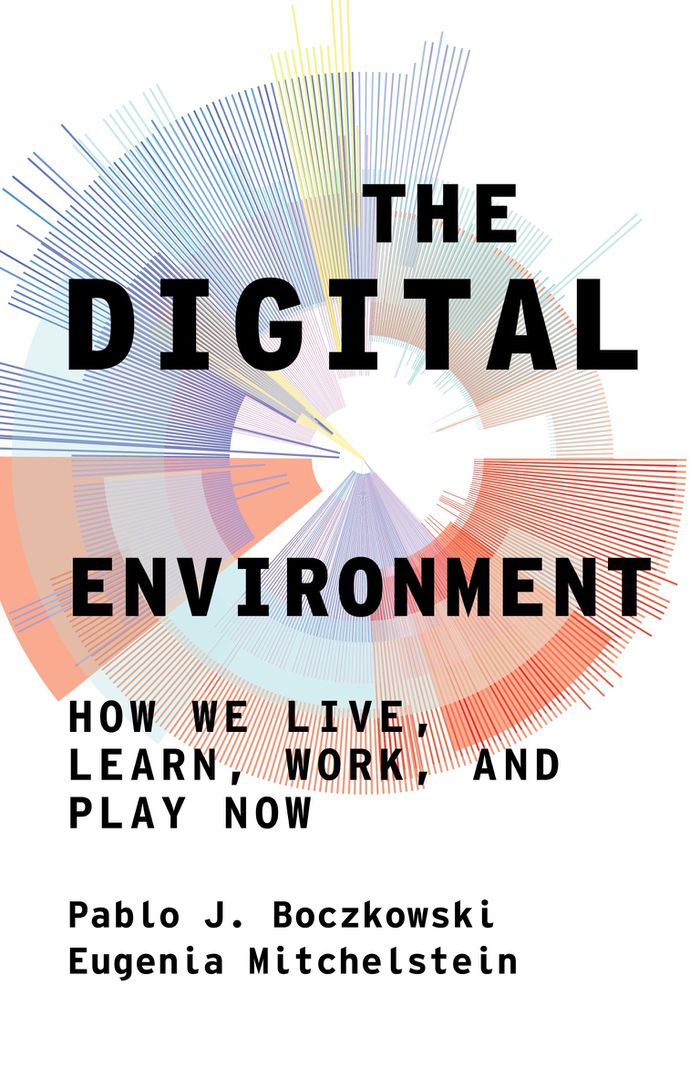
The digital environment: How we live, learn, work and play now
Actions:
Prix:
$33.95
(disponible sur commande)
Résumé:
Increasingly we live through our personal screens; we work, play, socialize, and learn digitally. The shift to remote everything during the pandemic was another step in a decades-long march toward the digitization of everyday life made possible by innovations in media, information, and communication technology. In "The Digital Environment," Pablo Boczkowski and Eugenia Mitchelstein offer a new way to understand the role of the digital in our daily lives, calling on us to turn our attention from our discrete devices and apps to the array of artifacts and practices that make up the digital environment that envelops every aspect of our social experience. Boczkowski and Mitchelstein explore a series of issues raised by the digital takeover of everyday life, drawing on interviews with a variety of experts. They show how existing inequities of gender, race, ethnicity, education, and class are baked into the design and deployment of technology, and describe emancipatory practices that counter this–including the use of Twitter as a platform for activism through such hashtags as #BlackLivesMatter and #MeToo. They discuss the digitization of parenting, schooling, and dating–noting, among other things, that today we can both begin and end relationships online. They describe how digital media shape our consumption of sports, entertainment, and news, and consider the dynamics of political campaigns, disinformation, and social activism. Finally, they report on developments in three areas that will be key to our digital future: data science, virtual reality, and space exploration.
The digital environment: How we live, learn, work and play now
Actions:
Prix:
$33.95
(disponible sur commande)
Résumé:
Increasingly we live through our personal screens; we work, play, socialize, and learn digitally. The shift to remote everything during the pandemic was another step in a decades-long march toward the digitization of everyday life made possible by innovations in media, information, and communication technology. In "The Digital Environment," Pablo Boczkowski and Eugenia Mitchelstein offer a new way to understand the role of the digital in our daily lives, calling on us to turn our attention from our discrete devices and apps to the array of artifacts and practices that make up the digital environment that envelops every aspect of our social experience. Boczkowski and Mitchelstein explore a series of issues raised by the digital takeover of everyday life, drawing on interviews with a variety of experts. They show how existing inequities of gender, race, ethnicity, education, and class are baked into the design and deployment of technology, and describe emancipatory practices that counter this–including the use of Twitter as a platform for activism through such hashtags as #BlackLivesMatter and #MeToo. They discuss the digitization of parenting, schooling, and dating–noting, among other things, that today we can both begin and end relationships online. They describe how digital media shape our consumption of sports, entertainment, and news, and consider the dynamics of political campaigns, disinformation, and social activism. Finally, they report on developments in three areas that will be key to our digital future: data science, virtual reality, and space exploration.
Classification:
livres
livres
Publication:
août 2021
août 2021
Sujet:
Social
Social
Classification:
vidéo
vidéo
Actions:
Description:
1 online resource (1 video file (29 minutes)) : sound, color
Auteur:
Sujet:
Publication:
London, England : Pidgeon Digital, 1988.
London, England : Pidgeon Digital, 1988.
Titre:
Layering & Change / [presented by] Peter Cook (Cook-Robotham Architectural Bureau).
Actions:
Description:
1 online resource (1 video file (29 minutes)) : sound, color
Layering & Change / [presented by] Peter Cook (Cook-Robotham Architectural Bureau).
Actions:
Description:
1 online resource (1 video file (29 minutes)) : sound, color
Classification:
vidéo
vidéo
Publication:
London, England : Pidgeon Digital, 1988.
London, England : Pidgeon Digital, 1988.
Auteur:
Sujet:
Classification:
livres
livres
Sujet:
Publication:
Ethereum Foundation 2024
Ethereum Foundation 2024
Classification:
livres
livres
Publication:
Ethereum Foundation 2024
Ethereum Foundation 2024
Sujet:


