


2435 Résultats
Classification:
livres
livres
Prix:
$49.95
(disponible sur commande)
Résumé:
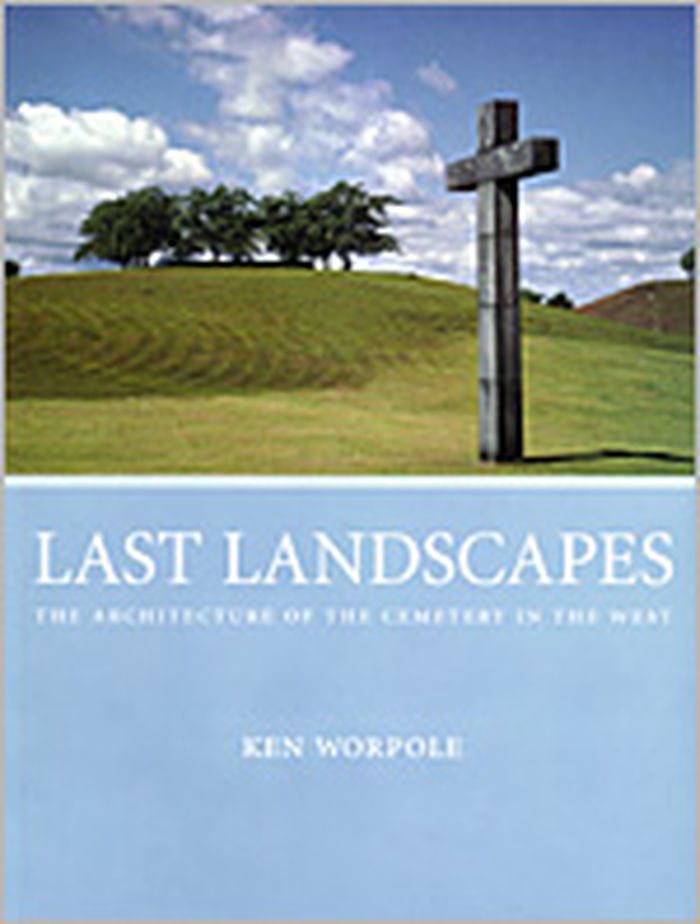
"Last Landscapes" is an exploration of the cult and celebration of death, loss and memory. It traces the history and design of burial places throughout Europe and the USA, ranging from the picturesque tradition of the village churchyard to tightly packed ‘cities of the dead’, such as the Jewish Cemetery in Prague and Père Lachaise in Paris. Other landscapes that feature(...)
Titre:
Last landscapes : the architecture of the cemetery in the west
Actions:
Prix:
$49.95
(disponible sur commande)
Résumé:
"Last Landscapes" is an exploration of the cult and celebration of death, loss and memory. It traces the history and design of burial places throughout Europe and the USA, ranging from the picturesque tradition of the village churchyard to tightly packed ‘cities of the dead’, such as the Jewish Cemetery in Prague and Père Lachaise in Paris. Other landscapes that feature in this book include the war cemeteries of northern France, Viking burial islands in central Sweden, Etruscan tombs and early Christian catacombs in Italy, the 17th-century Portuguese–Jewish cemetery 'Beth Haim' at Ouderkerk in the Netherlands, Forest Lawns in California, Derek Jarman’s garden in Kent and the Stockholm Woodland Cemetery. It is a fact that architecture ‘began with the tomb', yet, as Ken Worpole shows us in Last Landscapes, many historic cemeteries have been demolished or abandoned in recent times (notably the case with Jewish cemeteries in Eastern Europe), and there has been an increasing loss of inscription and memorialization in the modern urban cemetery. Too often cemeteries today are both poorly designed and physically and culturally marginalized. Worse, cremation denies a full architectural response to the mystery and solemnity of death. The author explores how modes of disposal – burial, cremation, inhumation in mausoleums and wall tombs – vary across Europe and North America, according to religious and other cultural influences. And Last Landscapes raises profound questions as to how, in an age of mass cremation, architects and landscape designers might create meaningful structures and settings in the absence of a body, since for most of history the human body itself has provided the fundamental structural scale. This evocative book also contemplates other forms of memorialization within modern societies, from sculptures to parks, most notably the extraordinary Duisberg Park, set in a former giant steelworks in Germany’s Ruhr Valley.
Classification:
livres
livres
Publication:
juin 2003, London
juin 2003, London
Sujet:
Jardins
Jardins
Classification:
livres
livres
Actions:
Prix:
$37.50
(disponible sur commande)
Résumé:
Although the seemingly apocalyptic scale of the World Trade Center disaster continues to haunt people across the globe, it is only the most recent example of a city tragically wounded. Cities are, in fact, perpetually caught up in cycles of degeneration and renewal. As with the WTC, from time to time these cycles are severely ruptured by a sudden, unpredictable event.(...)
Titre:
Wounded cities : destruction and reconstruction in a globalized world
Actions:
Prix:
$37.50
(disponible sur commande)
Résumé:
Although the seemingly apocalyptic scale of the World Trade Center disaster continues to haunt people across the globe, it is only the most recent example of a city tragically wounded. Cities are, in fact, perpetually caught up in cycles of degeneration and renewal. As with the WTC, from time to time these cycles are severely ruptured by a sudden, unpredictable event. In the wake of recent terrorist activities, this timely book explores how urban populations are affected by "wounds" inflicted through violence, civil wars, overbuilding, drug trafficking, and the collapse of infrastructures, as well as "natural" disasters such as earthquakes. Mexico City, New York, Beirut, Belfast, Bangkok and Baghdad are just a few examples of cities riddled with problems that undermine, on a daily basis, the quality of urban life. What does it mean for urban dwellers when the infrastructure of a city collapses – transport, communication grids, heat, light, roads, water, and sanitation? What are the effects of foreign investment and huge construction projects on urban populations and how does this change the "look" and character of a city? How does drug trafficking intersect with class, race, and gender, and what impact does it have on vulnerable urban communities? How do political corruption and mafia networks distort the built environment? Drawing on in-depth case studies from across the globe, this book answers these intriguing questions through its rigorous consideration of changing global and national contexts, social movements, and corrosive urban events. Adopting a "grass roots up" approach, it places emphasis on people’s experiences of uneven development and inequality, their engagement with memory in the face of continual change, and the relevance of political activism to bettering their lives. It is especially attentive to the historical interaction of particular cities with wider political and economic forces, as these interactions have shaped local governance over time. Imagining each city as a "body politic", the authors consider its capacity both to mediate local conflict and to broach the healing of wounds.
Classification:
livres
livres
Publication:
août 2003, Oxford
août 2003, Oxford
Sujet:
Théorie de l’urbanisme
Théorie de l’urbanisme
Classification:
livres
livres
Actions:
Prix:
$59.25
(disponible sur commande)
Résumé:
From Vaux-le-Vicomte to Versailles, the buildings of Louis Le Vau shaped the image of French court society. None, however, has had as dramatic an effect as Mazarin's Collège (1661-70), the Parisian landmark that now houses the Institut de France. In this first English-language book on Louis XIV's celebrated architect, Hilary Ballon deftly portrays the brilliance and(...)
Titre:
Louis Le Vau : Mazarin's Collège, Colbert's revenge
Actions:
Prix:
$59.25
(disponible sur commande)
Résumé:
From Vaux-le-Vicomte to Versailles, the buildings of Louis Le Vau shaped the image of French court society. None, however, has had as dramatic an effect as Mazarin's Collège (1661-70), the Parisian landmark that now houses the Institut de France. In this first English-language book on Louis XIV's celebrated architect, Hilary Ballon deftly portrays the brilliance and controversy of Le Vau's late career through an exploration of this masterpiece, a hybrid of baroque and classical styles. She tracks the design and construction of the Collège on the basis of splendid drawings, fully illustrated here, integrating into this account previously unknown dimensions of Le Vau's creative personality, his financial entanglements, and his feuds with government leaders. The story of the Collège begins in 1661 with the death of Cardinal Mazarin, who left an extravagant sum of money for a school to be built in his memory. Le Vau responded with an ambitious architectural tribute intended to launch the development of Paris in a new artistic direction. As Ballon shows, many personal factors figured into the final product, including Le Vau's activities as a real estate developer and entrepreneur, and his explosive response to the Italian baroque master Gianlorenzo Bernini, who visited Paris in 1665. The project ended up significantly over budget, and officials charged Le Vau shortly after his death with embezzling funds. The chief minister, Jean-Baptiste Colbert, led the attack on Le Vau, turning the ethical scandal into an aesthetic crusade to maintain a "classical" look for central Paris. By relating the intriguing context in which the Collège was created, Ballon explains why traditional definitions of the baroque and classical styles have failed to offer a cohesive understanding of the building. Her examination of the elements informing Le Vau's personal style and his relationship with Colbert brings into sharper focus the phenomenon of royal patronage and opens a new perspective on the development of French classicism at a turning point in Parisian architectural history.
Classification:
livres
livres
Publication:
janvier 1900, Princeton
janvier 1900, Princeton
Sujet:
Architecture, monographies
Architecture, monographies
Classification:
livres
livres
Titre:
Breathless
Breathless
Actions:
Prix:
$25.00
(disponible en magasin)
Résumé:
''Breathless'' is published as part of an upcoming exhibition taking place within a pavilion on The Power Plant’s South Terrace Summer 2022. ''Breathless'' shares contributions on the paradoxes of air, atmosphere and the breath with key texts and artworks. The book begins in the smog of our current predicament, with philosopher Dehlia Hannah proposing a new vocabulary(...)
Titre:
Breathless
Actions:
Prix:
$25.00
(disponible en magasin)
Résumé:
''Breathless'' is published as part of an upcoming exhibition taking place within a pavilion on The Power Plant’s South Terrace Summer 2022. ''Breathless'' shares contributions on the paradoxes of air, atmosphere and the breath with key texts and artworks. The book begins in the smog of our current predicament, with philosopher Dehlia Hannah proposing a new vocabulary for air in her text, ''Inversion Layer''. Following the flow of air, Flaka Haliti’s installation ''Speculating on the Blue'' opens a portal to an artificial atmosphere that defines boundaries of a closed reality. Connecting to parallel worlds, philosopher Achille Mbembe’s ''The Universal Right to Breathe'' captures a global perspective on breathing, offering alternative trajectories beyond suffocation. Marguerite Humeau’s speculative sculpture imagines a species that survives suffocation and evolves exclusively to breathe. Charles Stankievech exhumes the voices of Clarice Lispector and Lygia Clark as an interconnected mystical encounter in a text titled ''Breath with Me, A Breath of Life''. In ''Twilight of Sighs'', psychoanalyst and philosopher Alireza Taheri analyzes the sigh with a set of propositions. With the same intensity, Donna Kukama re-narrates history with her performance ''Chapter Q: Dem Short-Short-Falls'' as she breathes the memory of an invisible event. Invisibility of viral and virtual particles are positioned in the context of other historical times in Ala Roushan’s text ''Air of Our Closed World'', articulating the inversion experienced today within the domestic bubble/bunker. ''The Air Without'' by Kate Whiteway connects illness and metaphor to consider contradictions in the air that both oxygenates the lung while breathing diamond dust. With a granularity greater than dust, Heather Davis’s text ''Molecular Intimacy'' situates us at the nanoscale to position bodies within the atmosphere they breathe. This final text loops back to the start of the book in considering the air of our contemporary sky and the breath that exists in its precarious state. Under this arched sky, the book ends with ''Fire with Fire'', engulfed in the smoky aftermath of forest fires in the work of Julius von Bismarck.
Classification:
livres
livres
Publication:
décembre 2021
décembre 2021
Sujet:
Expositions collectives
Expositions collectives
Classification:
livres
livres
Actions:
Exemplaires:
Description:
x, 305 pages : illustrations (some color) ; 31 cm
Description:
x, 305 pages : illustrations (some color) ; 31 cm
Auteur:
Sujet:
Publication:
New York : PPP Editions in association with Roth Horowitz, LLC, 2001., New York, NY : D.A.P./Distributed Art Publishers, Inc.
New York : PPP Editions in association with Roth Horowitz, LLC, 2001., New York, NY : D.A.P./Distributed Art Publishers, Inc.
Titre:
The book of 101 books : seminal photographic books of the twentieth century / edited by Andrew Roth ; essays by Richard Benson, May Castleberry, Jeffrey Fraenkel, Daido Moriyama, Shelley Rice, Neville Wakefield ; catalogue by Vince Aletti and David Levi Strauss.
Actions:
Exemplaires:
Description:
x, 305 pages : illustrations (some color) ; 31 cm
Classification:
livres
livres
Publication:
New York : PPP Editions in association with Roth Horowitz, LLC, 2001., New York, NY : D.A.P./Distributed Art Publishers, Inc.
New York : PPP Editions in association with Roth Horowitz, LLC, 2001., New York, NY : D.A.P./Distributed Art Publishers, Inc.
Auteur:
Sujet:


