


2677 Résultats
Classification:
livres
livres
Actions:
Prix:
$33.50
(disponible sur commande)
Résumé:
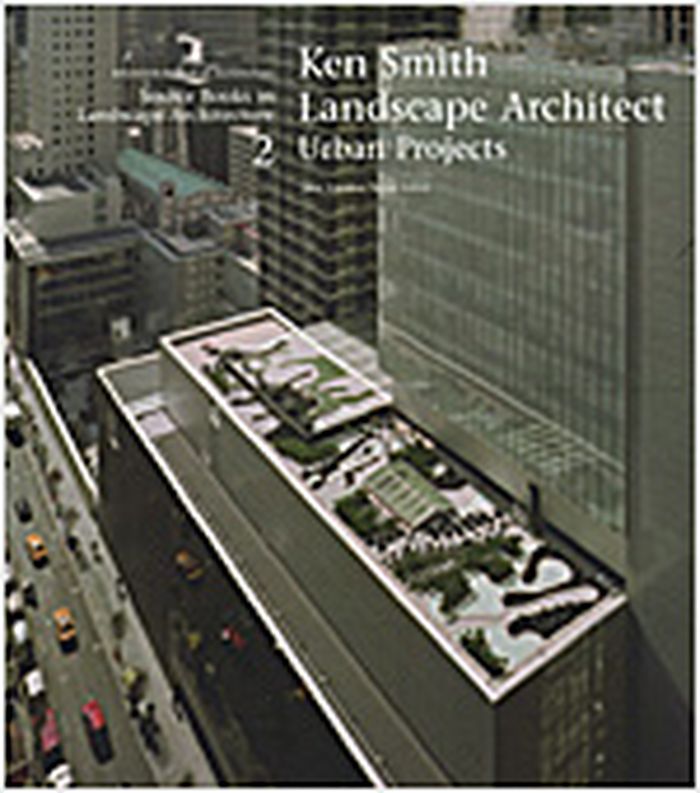
"Ken Smith landscape architect / urban projects" focuses on three prominent works in New York City : the East River Ferry Landings, P.S. 19, and a roof garden for the Museum of Modern Art. Featuring an interview with Ken Smith and extensive photographic documentation and drawings, as well as an essay by Nina Rappaport and a foreword by Peter Reed. The book reveals how(...)
Publication:
décembre 2005, New York
décembre 2005, New York
Titre:
Ken Smith, landscape architect : urban projects 2
Actions:
Prix:
$33.50
(disponible sur commande)
Résumé:
"Ken Smith landscape architect / urban projects" focuses on three prominent works in New York City : the East River Ferry Landings, P.S. 19, and a roof garden for the Museum of Modern Art. Featuring an interview with Ken Smith and extensive photographic documentation and drawings, as well as an essay by Nina Rappaport and a foreword by Peter Reed. The book reveals how each project espresses new relationships between landscape and place within the city.
Classification:
livres
livres
Publication:
décembre 2005, New York
décembre 2005, New York
Classification:
livres
livres
Titre:
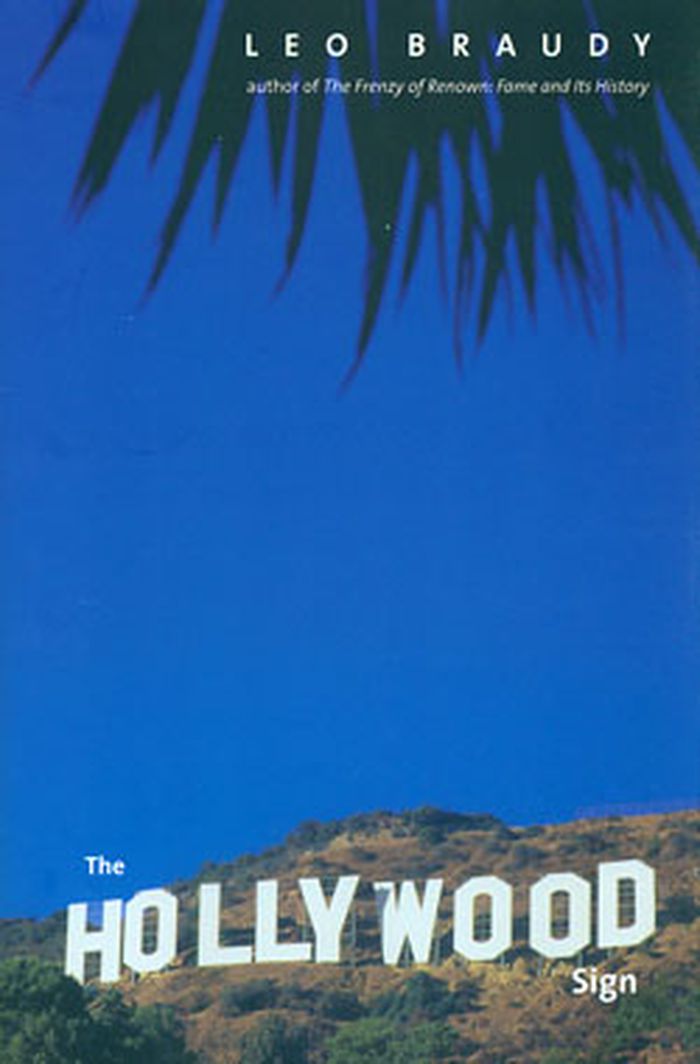
The Hollywood sign
The Hollywood sign
Actions:
Prix:
$27.95
(disponible sur commande)
Résumé:
Hollywood's famous sign, constructed of massive white block letters set into a steep hillside, is an emblem of the movie capital it looms over and an international symbol of glamour and star power. To so many who see its image, the sign represents the earthly home of that otherwise ethereal world of fame, stardom, and celebrity -the goal of American and worldwide(...)
Titre:
The Hollywood sign
Actions:
Prix:
$27.95
(disponible sur commande)
Résumé:
Hollywood's famous sign, constructed of massive white block letters set into a steep hillside, is an emblem of the movie capital it looms over and an international symbol of glamour and star power. To so many who see its image, the sign represents the earthly home of that otherwise ethereal world of fame, stardom, and celebrity -the goal of American and worldwide aspiration to be in the limelight, to be, like the Hollywood sign itself, instantly recognizable. How an advertisement erected in 1923, touting the real estate development Hollywoodland, took on a life of its own is a story worthy of the entertainment world that is its focus. Leo Braudy traces the remarkable history of this distinctly American landmark, which has been saved over the years by a disparate group of fans and supporters, among them Alice Cooper and Hugh Hefner, who spearheaded its reconstruction in the 1970s. He also uses the sign's history to offer an intriguing look at the rise of the movie business from its earliest, silent days through the development of the studio system that helped define modern Hollywood. Mixing social history, urban studies, literature, and film, along with forays into such topics as the lure of Hollywood for utopian communities and the development of domestic architecture in Los Angeles, The Hollywood Sign is a fascinating account of how a temporary structure has become a permanent icon of American culture.
Classification:
livres
livres
Publication:
mars 2011
mars 2011
Sujet:
Signalétique
Signalétique
Classification:
livres
livres
Titre:
London : bread and circuses
London : bread and circuses
Actions:
Prix:
$29.00
(disponible sur commande)
Résumé:
Wherever and whenever state and church, state and autocracy, political and architectural ambition have met and loved one another hungrily, domes have raised their imperious, lofty heads. At once magnificent and messy, old-fashioned and ultra-modern, opulent and squalid, London is something of a mongrel city, cross-bred over the centuries from cut-throat commerce, high(...)
Titre:
London : bread and circuses
Actions:
Prix:
$29.00
(disponible sur commande)
Résumé:
Wherever and whenever state and church, state and autocracy, political and architectural ambition have met and loved one another hungrily, domes have raised their imperious, lofty heads. At once magnificent and messy, old-fashioned and ultra-modern, opulent and squalid, London is something of a mongrel city, cross-bred over the centuries from cut-throat commerce, high finance and unrestrained creativity. For all its inventiveness, however, it is now also a city unable to provide its citizens with decent public transport, housing or services, beset and betrayed by governments who take from it but refuse to give back. In the lead-up to the much-hyped Millennium, a fortune was spent on lavish building projects—giant wheels, great courts, titanic art galleries, ambitious museums, a Brobdingnagian dome—but little in the way of public services, intelligent urban planning and infrastructure except by default. Has the right kind of money been spent on the wrong sort of projects? Who, in this pluralistic age, will cut through the layers of bureaucracy to restore some of the city’s unruly splendour? In this elegant and polemical book, the architecture critic Jonathan Glancey explores London’s Millennial follies and asks how and where London might now channel its energies. Combining anecdote and analysis with a sustained critique of the way the city is governed and financed, he draws a detailed picture of the state London’s in and speculates on how it might be transformed.
Classification:
livres
livres
Publication:
novembre 2001, London
novembre 2001, London
Classification:
livres
livres
Actions:
Prix:
$15.00
(disponible sur commande)
Résumé:
How are you involved in the art world? Are you related to any specific scene? What would be the most productive place to present your work? What kind of curators do you like to work with, and why? What does the art market mean for your work? These are some of the questions that have been presented to every artist who has worked with Witte de With, the respected Rotterdam(...)
Publication:
mars 2008, Rotterdam
mars 2008, Rotterdam
Titre:
Changing roles artists' personal views and wishes
Actions:
Prix:
$15.00
(disponible sur commande)
Résumé:
How are you involved in the art world? Are you related to any specific scene? What would be the most productive place to present your work? What kind of curators do you like to work with, and why? What does the art market mean for your work? These are some of the questions that have been presented to every artist who has worked with Witte de With, the respected Rotterdam contemporary art center, over the past two years. This publication reflects on the ideas behind the works that the center has shown, and allows artists to voice concerns that are rarely discussed as part of a public initiative. The participants' answers serve as a model, suggesting what roles they need institutions, curators and programs to play. Contributors include Jesper Just, Erik van Lieshout, Sarah Morris and Robin Rhode. Liam Gillick was born in Aylesbury, Great Britain, in 1964 and studied at Hertfordshire College of Art, and Goldsmiths College, London. Often combining text and installation, Gillickis work frequently investigates economics and aesthetics in modern society. A finalist for the Turner Prize in 2002, his work has appeared at Documenta in 1997 and at The Museum of Modern Art, New York in 2003, as well as in numerous solo shows worldwide. He lives and works in London and New York.
Classification:
livres
livres
Publication:
mars 2008, Rotterdam
mars 2008, Rotterdam
Classification:
livres
livres
Titre:
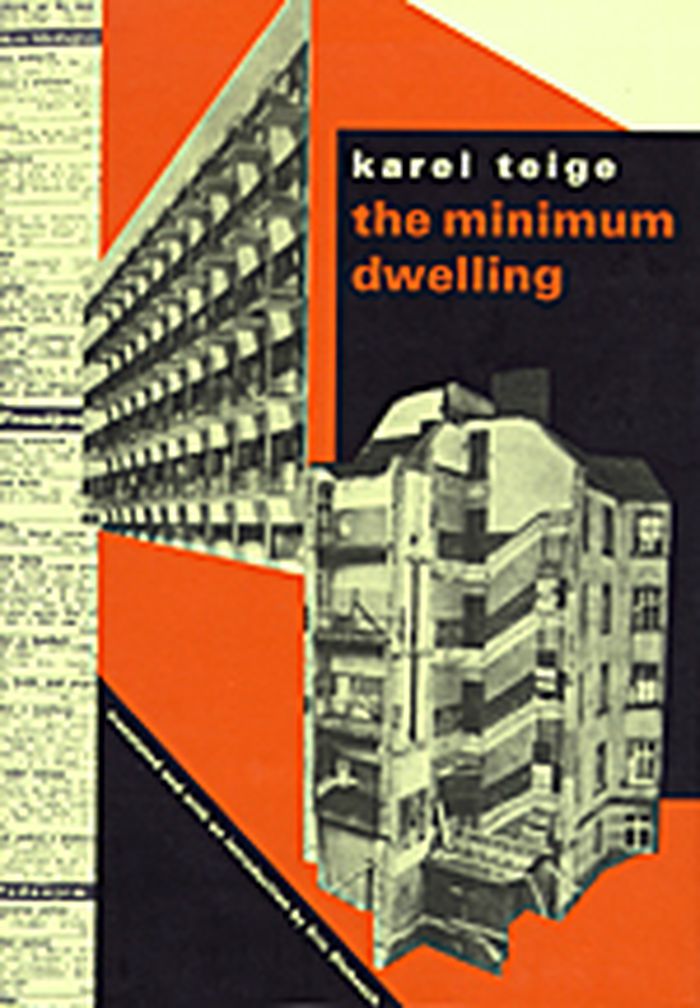
The minimum dwelling
The minimum dwelling
Actions:
Prix:
$96.00
(disponible en magasin)
Résumé:
Karel Teige (1900–1951), one of the most important figures of avant-garde modernism of the 1920s and 1930s, influenced virtually every area of art, design, and urban thinking in his native Czechoslovakia. His "Minimum dwelling", originally published in Czech in 1932, and appearing now for the first time in English, is one of the landmark architectural books of the(...)
Titre:
The minimum dwelling
Actions:
Prix:
$96.00
(disponible en magasin)
Résumé:
Karel Teige (1900–1951), one of the most important figures of avant-garde modernism of the 1920s and 1930s, influenced virtually every area of art, design, and urban thinking in his native Czechoslovakia. His "Minimum dwelling", originally published in Czech in 1932, and appearing now for the first time in English, is one of the landmark architectural books of the twentieth century. "The minimum dwelling" is not just a book on architecture, but also a blueprint for a new way of living. It calls for a radical rethinking of domestic space and of the role of modern architecture in the planning, design, and construction of new dwelling types for the proletariat. Teige shows how Gropius, Le Corbusier, Mies van der Rohe, and others designed little more than new versions of baroque palaces, mainly for the new financial aristocracy. Teige envisioned the minimum dwelling not as a reduced version of a bourgeois apartment or rural cottage, but as a wholly new dwelling type built on the cooperation of architects, sociologists, economists, health officials, physicians, social workers, politicians, and trade unionists. The book covers many subjects that are still of great relevance. Of particular interest are Teige’s rejection of traditional notions of the kitchen as the core of family-centered plans and of marriage as the foundation of modern cohabitation. He describes alternative lifestyles and new ways of cohabitation of sexes, generations, and classes. The detailed programmatic chapters on collective housing remain far ahead of current thinking, and his comments on collective dwelling presage communal living experiments of the 1960s and 1970s, as well as the communal facilities in contemporary condominium buildings and retirement communities. Translated and introduced by Eric Dluhosch.
Classification:
livres
livres
Publication:
mai 2002, Cambridge, Mass.
mai 2002, Cambridge, Mass.
Sujet:
Théorie de l’architecture
Théorie de l’architecture
Classification:
livres
livres
Actions:
Prix:
$65.95
(disponible sur commande)
Résumé:
Studies in Tectonic Culture is nothing less than a rethinking of the entire modern architectural tradition. The notion of tectonics as employed by Frampton -- the focus on architecture as a constructional craft -- constitutes a direct challenge to current mainstream thinking on the artistic limits of postmodernism, and suggests a convincing alternative. Indeed, Frampton(...)
Sujet:
Théorie de l’architecture
Théorie de l’architecture
Publication:
octobre 2001, Cambridge, Mass.
octobre 2001, Cambridge, Mass.
Titre:
Studies in tectonic culture: the poetics of construction in nineteenth and twentieth century architecture
Actions:
Prix:
$65.95
(disponible sur commande)
Résumé:
Studies in Tectonic Culture is nothing less than a rethinking of the entire modern architectural tradition. The notion of tectonics as employed by Frampton -- the focus on architecture as a constructional craft -- constitutes a direct challenge to current mainstream thinking on the artistic limits of postmodernism, and suggests a convincing alternative. Indeed, Frampton argues, modern architecture is invariably as much about structure and construction as it is about space and abstract form. Composed of ten essays and an epilogue that trace the history of contemporary form as an evolving poetic of structure and construction, the book's analytical framework rests on Frampton's close readings of key French and German, and English sources from the eighteenth century to the present. He clarifies the various turns that structural engineering and tectonic imagination have taken in the work of such architects as Perret, Wright, Kahn, Scarpa, and Mies, and shows how both constructional form and material character were integral to an evolving architectural expression of their work. Frampton also demonstrates that the way in which these elements are articulated from one work to the next provides a basis upon which to evaluate the works as a whole. This is especially evident in his consideration of the work of Perret, Mies, and Kahn and the continuities in their thought and attitudes that linked them to the past. Frampton considers the conscious cultivation of the tectonic tradition in architecture as an essential element in the future development of architectural form, casting a critical new light on the entire issue of modernity and on the place of much work that has passed as "avant-garde."
Classification:
livres
livres
Publication:
octobre 2001, Cambridge, Mass.
octobre 2001, Cambridge, Mass.
Sujet:
Théorie de l’architecture
Théorie de l’architecture
Classification:
livres
livres

Actions:
Prix:
$39.95
(disponible sur commande)
Résumé:
As we spend more and more of our time staring at the screens of movies, televisions, computers, and handheld devices--"windows" full of moving images, texts, and icons--how the world is framed has become as important as what is in the frame. In The Virtual Window, Anne Friedberg examines the window as metaphor, as architectural component, and as an opening to the(...)
Titre:
The virtual window : from Alberti to Microsoft
Actions:
Prix:
$39.95
(disponible sur commande)
Résumé:
As we spend more and more of our time staring at the screens of movies, televisions, computers, and handheld devices--"windows" full of moving images, texts, and icons--how the world is framed has become as important as what is in the frame. In The Virtual Window, Anne Friedberg examines the window as metaphor, as architectural component, and as an opening to the dematerialized reality we see on the screen. In De pictura (1435), Leon Battista Alberti famously instructed painters to consider the frame of the painting as an open window. Taking Alberti's metaphor as her starting point, Friedberg tracks shifts in the perspectival paradigm as she gives us histories of the architectural window, developments in glass and transparency, and the emerging apparatuses of photography, cinema, television, and digital imaging. Single-point perspective--Alberti's metaphorical window--has long been challenged by modern painting, modern architecture, and moving-image technologies. And yet, notes Friedberg, for most of the twentieth century the dominant form of the moving image was a single image in a single frame. The fractured modernism exemplified by cubist painting, for example, remained largely confined to experimental, avant-garde work. On the computer screen, however, where multiple "windows" coexist and overlap, perspective may have met its end. In this wide-ranging book, Friedberg considers such topics as the framed view of the camera obscura, Le Corbusier's mandates for the architectural window, Eisenstein's opinions on the shape of the movie screen, and the multiple images and nested windows commonly displayed on screens today. The Virtual Window proposes a new logic of visuality, framed and virtual: an architecture not only of space but of time.
Classification:
livres
livres
Publication:
janvier 2006, Cambridge
janvier 2006, Cambridge
Sujet:
Théorie de l’architecture
Théorie de l’architecture
Classification:
livres
livres
Prix:
$44.95
(disponible sur commande)
Résumé:
The objects of architecture are not simply inert assemblies of material - they are complex entities that unfold their potential agencies (whether political, social, or environmental) in equally complex ways. Exploring these forms of architectural agency has in recent years been a central aspect of the work of Andrés Jaque and the Office for Political Innovation, who, in(...)
Titre:
Superpowers of scale: Office for Political Innovation
Actions:
Prix:
$44.95
(disponible sur commande)
Résumé:
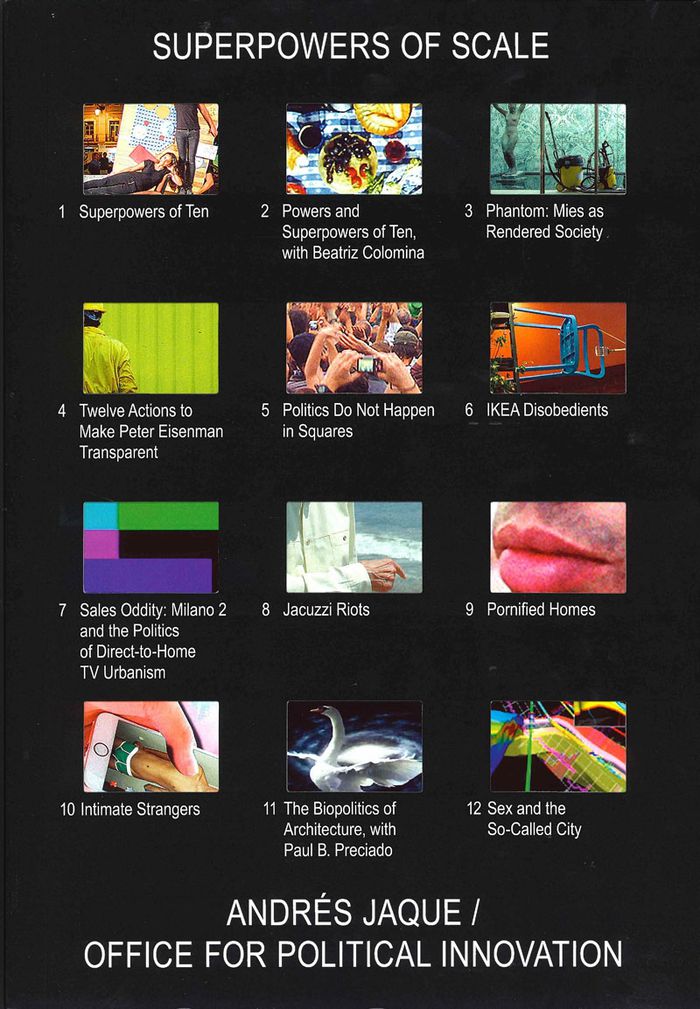
The objects of architecture are not simply inert assemblies of material - they are complex entities that unfold their potential agencies (whether political, social, or environmental) in equally complex ways. Exploring these forms of architectural agency has in recent years been a central aspect of the work of Andrés Jaque and the Office for Political Innovation, who, in addition to their built works, pursue a research practice through the many other media of architectural production. Their projects are reactive, intervening on what already exists to demonstrate how design, politics, and criticality operate across different scales and at the intersection of multiple realities. Jaque’s performances, videos, and installations—and this book, which collects a range of recent research projects—bring new subjects into the fold of architecture, focusing on alternative actors, distributions of power and representation, and the sociocultural effects of architecture. These episodes address ideas like genetic manipulation, the necessary requeering of dequeered spaces of online interaction, and the selling of modern architectural comforts in order to subvert the field from within and to contest capitalism's flattening-out of public life.
Classification:
livres
livres
Publication:
mars 2020
mars 2020
Sujet:
Architecture, monographies
Architecture, monographies
Classification:
livres
livres
Actions:
Prix:
$27.95
(disponible sur commande)
Résumé:
In this publication, Caleb Kelly explores how the deliberate utilization of the normally undesirable (a crack, a break) has become the site of productive creation. Cracked media, Kelly writes, slides across disciplines, through music, sound, and noise. Cracked media encompasses everything from Cage's silences and indeterminacies, to Paik's often humorous tape works, to(...)
Titre:
Cracked media : the sound of malfunction
Actions:
Prix:
$27.95
(disponible sur commande)
Résumé:
In this publication, Caleb Kelly explores how the deliberate utilization of the normally undesirable (a crack, a break) has become the site of productive creation. Cracked media, Kelly writes, slides across disciplines, through music, sound, and noise. Cracked media encompasses everything from Cage's silences and indeterminacies, to Paik's often humorous tape works, to the cold and clean sounds of digital glitch in the work of Tone and Oval. Kelly offers a detailed historical account of these practices, arguing that they can be read as precursors to contemporary new media. Kelly looks at the nature of recording technology and the music industry in relation to the crack and the break, and discusses the various manifestations of noise, concluding that neither theories of recording nor theories of noise offer an adequate framework for understanding cracked media. Connecting the historical avant-garde to modern-day turntablism, and predigital destructive techniques to the digital ticks, pops, and clicks of the glitch, Kelly proposes new media theorizations of cracked media that focus on materiality and the everyday.
Classification:
livres
livres
Publication:
septembre 2009
septembre 2009
Sujet:
Acoustique
Acoustique
Classification:
livres
livres
Titre:
Naked architecture
Naked architecture
Actions:
Prix:
$51.00
(disponible sur commande)
Résumé:
An account of one of the most interesting phenomena of contemporary architecture: the return to the structure. Over the last ten years architecture would seem to have rediscovered engineering. Now that the post modern period has passed—in which the structure of buildings was camouflaged by coverings of every kind—architecture today seems to have undressed, almost as(...)
Titre:
Naked architecture
Actions:
Prix:
$51.00
(disponible sur commande)
Résumé:
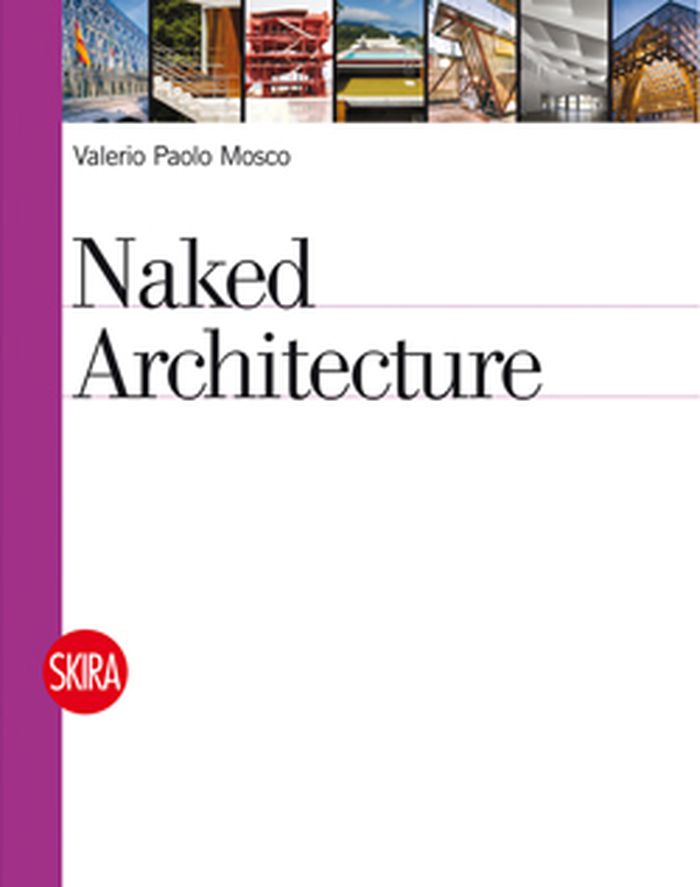
An account of one of the most interesting phenomena of contemporary architecture: the return to the structure. Over the last ten years architecture would seem to have rediscovered engineering. Now that the post modern period has passed—in which the structure of buildings was camouflaged by coverings of every kind—architecture today seems to have undressed, almost as though wishing to show how it is made. The rediscovery in recent years of plastic form has brought about a closer relationship between architects and engineers. To this we must add the rise of new issues, such as that of environmental engineering, which has changed from being solely a technical and aesthetic practice into a movement in environmentally conscious architecture. If there is a phenomenon today that is able to hold together the various expressions of contemporary architecture, it is this return to the structure and the methods with which it is realized. Through its six thematic categories, this book provides an account of one of the most interesting phenomena of contemporary construction—the laying bare of architecture.
Classification:
livres
livres
Publication:
novembre 2012
novembre 2012
Sujet:
Structures d’ingénierie
Structures d’ingénierie


