


11503 Résultats
Classification:
dessins
dessins
Numéro de référence:
AP140.S2.SS1.D63.P24
Description:
Early conceptual and design development drawings, including sketches and schematic maps, site plans, floor plans, elevations, sections, perspectives and axonometrics for the Performing Arts Centre, housing and hotel scheme and the Collegetown urban design study
AP140.S2.SS1.D63.P24
Description:
Early conceptual and design development drawings, including sketches and schematic maps, site plans, floor plans, elevations, sections, perspectives and axonometrics for the Performing Arts Centre, housing and hotel scheme and the Collegetown urban design study
Personnes et institutions:
Date:
circa 1971-1989
circa 1971-1989
Titre:
Early conceptual and design development drawings, Performing Arts Centre, Cornell University, Ithaca, New York
Actions:
AP140.S2.SS1.D63.P24
Description:
Early conceptual and design development drawings, including sketches and schematic maps, site plans, floor plans, elevations, sections, perspectives and axonometrics for the Performing Arts Centre, housing and hotel scheme and the Collegetown urban design study
Early conceptual and design development drawings, Performing Arts Centre, Cornell University, Ithaca, New York
Actions:
AP140.S2.SS1.D63.P24
Description:
Early conceptual and design development drawings, including sketches and schematic maps, site plans, floor plans, elevations, sections, perspectives and axonometrics for the Performing Arts Centre, housing and hotel scheme and the Collegetown urban design study
Classification:
dessins
dessins
Date:
circa 1971-1989
circa 1971-1989
Personnes et institutions:
Classification:
dessins
dessins
Numéro de référence:
AP178.S2.1993.003
Description:
This sketchbook contains sketches and notes of the Baixa Chiado Metropolitan Station, Chiado in Lisbon, Portugal, and the Dimensione Fuocco Laboratory, showroom and housing in San Donà di Piave, Italy. It also includes sketches of furniture.
AP178.S2.1993.003
Description:
This sketchbook contains sketches and notes of the Baixa Chiado Metropolitan Station, Chiado in Lisbon, Portugal, and the Dimensione Fuocco Laboratory, showroom and housing in San Donà di Piave, Italy. It also includes sketches of furniture.
Personnes et institutions:
Date:
July 1993
July 1993
Titre:
Sketchbook 348: Famaliçao ( mob.)- Santiago - Metro - Fun. Cargaleiro - Veneza
Actions:
AP178.S2.1993.003
Description:
This sketchbook contains sketches and notes of the Baixa Chiado Metropolitan Station, Chiado in Lisbon, Portugal, and the Dimensione Fuocco Laboratory, showroom and housing in San Donà di Piave, Italy. It also includes sketches of furniture.
Sketchbook 348: Famaliçao ( mob.)- Santiago - Metro - Fun. Cargaleiro - Veneza
Actions:
AP178.S2.1993.003
Description:
This sketchbook contains sketches and notes of the Baixa Chiado Metropolitan Station, Chiado in Lisbon, Portugal, and the Dimensione Fuocco Laboratory, showroom and housing in San Donà di Piave, Italy. It also includes sketches of furniture.
Classification:
dessins
dessins
Date:
July 1993
July 1993
Personnes et institutions:
Classification:
dessins
dessins
Numéro de référence:
AP178.S2.1991.004
Description:
This sketchbook includes sketches and notes for the Housing and Offices Complex on Avenida da Boavista in Porto, Portugal. It also contains a self portrait, sketches of people, notes and sketches from a trip to Rio de Janeiro.
AP178.S2.1991.004
Description:
This sketchbook includes sketches and notes for the Housing and Offices Complex on Avenida da Boavista in Porto, Portugal. It also contains a self portrait, sketches of people, notes and sketches from a trip to Rio de Janeiro.
Personnes et institutions:
Date:
May 1991
May 1991
Titre:
Sketchbook 317: Fac. Arq ra - Boavista - Rio de Janeiro
Actions:
AP178.S2.1991.004
Description:
This sketchbook includes sketches and notes for the Housing and Offices Complex on Avenida da Boavista in Porto, Portugal. It also contains a self portrait, sketches of people, notes and sketches from a trip to Rio de Janeiro.
Sketchbook 317: Fac. Arq ra - Boavista - Rio de Janeiro
Actions:
AP178.S2.1991.004
Description:
This sketchbook includes sketches and notes for the Housing and Offices Complex on Avenida da Boavista in Porto, Portugal. It also contains a self portrait, sketches of people, notes and sketches from a trip to Rio de Janeiro.
Classification:
dessins
dessins
Date:
May 1991
May 1991
Personnes et institutions:
Classification:
dessins
Quantité:
15 design development drawing(s)
dessins
Quantité:
15 design development drawing(s)
Numéro de référence:
DR1995:0216:174-188
Description:
perspective sketch, sketch plans, elevations, and sections of Meir and Pitts Hill transfer areas, perspective sketch, axonometric drawings, plans and sections of housing schemes, including 5 stapled note pages of thumbnail sketches with annotations and calculations
DR1995:0216:174-188
Description:
perspective sketch, sketch plans, elevations, and sections of Meir and Pitts Hill transfer areas, perspective sketch, axonometric drawings, plans and sections of housing schemes, including 5 stapled note pages of thumbnail sketches with annotations and calculations
Personnes et institutions:
Titre:
Perspective sketch, sketch plans, elevations, and sections of Meir and Pitts Hill transfer areas
Actions:
DR1995:0216:174-188
Description:
perspective sketch, sketch plans, elevations, and sections of Meir and Pitts Hill transfer areas, perspective sketch, axonometric drawings, plans and sections of housing schemes, including 5 stapled note pages of thumbnail sketches with annotations and calculations
Perspective sketch, sketch plans, elevations, and sections of Meir and Pitts Hill transfer areas
Actions:
DR1995:0216:174-188
Description:
perspective sketch, sketch plans, elevations, and sections of Meir and Pitts Hill transfer areas, perspective sketch, axonometric drawings, plans and sections of housing schemes, including 5 stapled note pages of thumbnail sketches with annotations and calculations
Classification:
dessins
Quantité:
15 design development drawing(s)
dessins
Quantité:
15 design development drawing(s)
Personnes et institutions:
Classification:
photographies
photographies
Numéro de référence:
ARCH275902
Description:
2 binders - miscellaneous project slides many of which are unlabeled. Includes Roy Thomson Hall and Man in the Community Pavilion, Expo '67, Montreal, the Canadian Pavilion, Expo '70 Osaka, Fintas Town Centre and Sawaber Housing Development.
ARCH275902
Description:
2 binders - miscellaneous project slides many of which are unlabeled. Includes Roy Thomson Hall and Man in the Community Pavilion, Expo '67, Montreal, the Canadian Pavilion, Expo '70 Osaka, Fintas Town Centre and Sawaber Housing Development.
Personnes et institutions:
Date:
ca. 1965-1980
ca. 1965-1980
Titre:
Documentation slides for various projects
Actions:
ARCH275902
Description:
2 binders - miscellaneous project slides many of which are unlabeled. Includes Roy Thomson Hall and Man in the Community Pavilion, Expo '67, Montreal, the Canadian Pavilion, Expo '70 Osaka, Fintas Town Centre and Sawaber Housing Development.
Documentation slides for various projects
Actions:
ARCH275902
Description:
2 binders - miscellaneous project slides many of which are unlabeled. Includes Roy Thomson Hall and Man in the Community Pavilion, Expo '67, Montreal, the Canadian Pavilion, Expo '70 Osaka, Fintas Town Centre and Sawaber Housing Development.
Classification:
photographies
photographies
Date:
ca. 1965-1980
ca. 1965-1980
Personnes et institutions:
Classification:
dessins
dessins
Numéro de référence:
AP178.S2.1980.001
Description:
This sketchbook includes notes and sketches of Kreuzberg, Berlin, Germany and the Bouça housing complex in Porto, Portugal. Notes mention Brigitte Fleck, Dr. Braga, B. Borges, and include a schedule of meetings regarding work in Évora, Portugal.
AP178.S2.1980.001
Description:
This sketchbook includes notes and sketches of Kreuzberg, Berlin, Germany and the Bouça housing complex in Porto, Portugal. Notes mention Brigitte Fleck, Dr. Braga, B. Borges, and include a schedule of meetings regarding work in Évora, Portugal.
Personnes et institutions:
Date:
May 1980
May 1980
Titre:
Sketchbook 55: Évora Casa Garagens - Berlim (Pequeno)
Actions:
AP178.S2.1980.001
Description:
This sketchbook includes notes and sketches of Kreuzberg, Berlin, Germany and the Bouça housing complex in Porto, Portugal. Notes mention Brigitte Fleck, Dr. Braga, B. Borges, and include a schedule of meetings regarding work in Évora, Portugal.
Sketchbook 55: Évora Casa Garagens - Berlim (Pequeno)
Actions:
AP178.S2.1980.001
Description:
This sketchbook includes notes and sketches of Kreuzberg, Berlin, Germany and the Bouça housing complex in Porto, Portugal. Notes mention Brigitte Fleck, Dr. Braga, B. Borges, and include a schedule of meetings regarding work in Évora, Portugal.
Classification:
dessins
dessins
Date:
May 1980
May 1980
Personnes et institutions:
Classification:
documents textuels
documents textuels
Numéro de référence:
AP206.S2.074
Description:
File was originally housed in a binder along with content arranged in AP206.S2.072 and AP206.S2.073. This file includes the following papers: "Le Corbusier's Chandigarh: Architecture in the Cultural Context," symposium talk, 1990 "Why not Ruralisation," paper outline "Growing Problems of Cities," book review of "The Politics of Urban Redevelopment: A Study of Old Delhi by Ajay K. Mehra," 1991 "Housing as Consumer Commodity," book review of "Housing and Urbanisation: A Study of India by Cedric Pugh," 1991 "Air Pollution and Conservation of the Environment," speech
AP206.S2.074
Description:
File was originally housed in a binder along with content arranged in AP206.S2.072 and AP206.S2.073. This file includes the following papers: "Le Corbusier's Chandigarh: Architecture in the Cultural Context," symposium talk, 1990 "Why not Ruralisation," paper outline "Growing Problems of Cities," book review of "The Politics of Urban Redevelopment: A Study of Old Delhi by Ajay K. Mehra," 1991 "Housing as Consumer Commodity," book review of "Housing and Urbanisation: A Study of India by Cedric Pugh," 1991 "Air Pollution and Conservation of the Environment," speech
Personnes et institutions:
Date:
1986-1998
1986-1998
Titre:
Published and unpublished papers (folder 3 of 3)
Actions:
AP206.S2.074
Description:
File was originally housed in a binder along with content arranged in AP206.S2.072 and AP206.S2.073. This file includes the following papers: "Le Corbusier's Chandigarh: Architecture in the Cultural Context," symposium talk, 1990 "Why not Ruralisation," paper outline "Growing Problems of Cities," book review of "The Politics of Urban Redevelopment: A Study of Old Delhi by Ajay K. Mehra," 1991 "Housing as Consumer Commodity," book review of "Housing and Urbanisation: A Study of India by Cedric Pugh," 1991 "Air Pollution and Conservation of the Environment," speech
Published and unpublished papers (folder 3 of 3)
Actions:
AP206.S2.074
Description:
File was originally housed in a binder along with content arranged in AP206.S2.072 and AP206.S2.073. This file includes the following papers: "Le Corbusier's Chandigarh: Architecture in the Cultural Context," symposium talk, 1990 "Why not Ruralisation," paper outline "Growing Problems of Cities," book review of "The Politics of Urban Redevelopment: A Study of Old Delhi by Ajay K. Mehra," 1991 "Housing as Consumer Commodity," book review of "Housing and Urbanisation: A Study of India by Cedric Pugh," 1991 "Air Pollution and Conservation of the Environment," speech
Classification:
documents textuels
documents textuels
Date:
1986-1998
1986-1998
Personnes et institutions:
Niveau de description archivistique:
Série(s)
Série(s)
Numéro de référence:
AP162.S9
Description:
Series documents the contribution of architect Max Taut to the correspondence circle of Die gläserne Kette, with Max Taut writing under the pseudonym Kein Name. Born in 1884 in Königsberg, Germany, Max Taut trained in carpentry and building before working in an architectural firm in Karlsruhe, Germany. In 1911, he worked independently, and later shared a practice with his brother Bruno Taut and Franz Hoffman (who joined them after 1914). His first architectural projects consisted primarily of schools. After his military service from 1914 to 1918, Max Taut joined the Arbeisrat für Kunst and the Novembersgruppe. After the First World War, he undertook several architectural projects, both private and public commissions such as housing and office buildings (mainly in Berlin), and also worked on projects for exhibitions. Unable to pratice during the Nazi Regime and the Second World War, Max Taut return to his architectural practice after the war and taught as a professor of architecture at the Hochschule für bildende Kunst in Berlin from 1945 to 1954. He undertook mainly housing development projects during this period. He died in Berlin in 1967. (Source: Ian Boyd Whyte, Bruno Taut and the Architecture of Activism. Cambridge: Cambridge University Press, 1982) The series comprises part of the correspondence of Max Taut to the Die gläserne Kette circle and related drawings. The series also includes photographic materials of some of his architectural projects.
AP162.S9
Description:
Series documents the contribution of architect Max Taut to the correspondence circle of Die gläserne Kette, with Max Taut writing under the pseudonym Kein Name. Born in 1884 in Königsberg, Germany, Max Taut trained in carpentry and building before working in an architectural firm in Karlsruhe, Germany. In 1911, he worked independently, and later shared a practice with his brother Bruno Taut and Franz Hoffman (who joined them after 1914). His first architectural projects consisted primarily of schools. After his military service from 1914 to 1918, Max Taut joined the Arbeisrat für Kunst and the Novembersgruppe. After the First World War, he undertook several architectural projects, both private and public commissions such as housing and office buildings (mainly in Berlin), and also worked on projects for exhibitions. Unable to pratice during the Nazi Regime and the Second World War, Max Taut return to his architectural practice after the war and taught as a professor of architecture at the Hochschule für bildende Kunst in Berlin from 1945 to 1954. He undertook mainly housing development projects during this period. He died in Berlin in 1967. (Source: Ian Boyd Whyte, Bruno Taut and the Architecture of Activism. Cambridge: Cambridge University Press, 1982) The series comprises part of the correspondence of Max Taut to the Die gläserne Kette circle and related drawings. The series also includes photographic materials of some of his architectural projects.
Personnes et institutions:
Date:
circa 1919 -1920
circa 1919 -1920
Titre:
Max Taut
Actions:
AP162.S9
Description:
Series documents the contribution of architect Max Taut to the correspondence circle of Die gläserne Kette, with Max Taut writing under the pseudonym Kein Name. Born in 1884 in Königsberg, Germany, Max Taut trained in carpentry and building before working in an architectural firm in Karlsruhe, Germany. In 1911, he worked independently, and later shared a practice with his brother Bruno Taut and Franz Hoffman (who joined them after 1914). His first architectural projects consisted primarily of schools. After his military service from 1914 to 1918, Max Taut joined the Arbeisrat für Kunst and the Novembersgruppe. After the First World War, he undertook several architectural projects, both private and public commissions such as housing and office buildings (mainly in Berlin), and also worked on projects for exhibitions. Unable to pratice during the Nazi Regime and the Second World War, Max Taut return to his architectural practice after the war and taught as a professor of architecture at the Hochschule für bildende Kunst in Berlin from 1945 to 1954. He undertook mainly housing development projects during this period. He died in Berlin in 1967. (Source: Ian Boyd Whyte, Bruno Taut and the Architecture of Activism. Cambridge: Cambridge University Press, 1982) The series comprises part of the correspondence of Max Taut to the Die gläserne Kette circle and related drawings. The series also includes photographic materials of some of his architectural projects.
Max Taut
Actions:
AP162.S9
Description:
Series documents the contribution of architect Max Taut to the correspondence circle of Die gläserne Kette, with Max Taut writing under the pseudonym Kein Name. Born in 1884 in Königsberg, Germany, Max Taut trained in carpentry and building before working in an architectural firm in Karlsruhe, Germany. In 1911, he worked independently, and later shared a practice with his brother Bruno Taut and Franz Hoffman (who joined them after 1914). His first architectural projects consisted primarily of schools. After his military service from 1914 to 1918, Max Taut joined the Arbeisrat für Kunst and the Novembersgruppe. After the First World War, he undertook several architectural projects, both private and public commissions such as housing and office buildings (mainly in Berlin), and also worked on projects for exhibitions. Unable to pratice during the Nazi Regime and the Second World War, Max Taut return to his architectural practice after the war and taught as a professor of architecture at the Hochschule für bildende Kunst in Berlin from 1945 to 1954. He undertook mainly housing development projects during this period. He died in Berlin in 1967. (Source: Ian Boyd Whyte, Bruno Taut and the Architecture of Activism. Cambridge: Cambridge University Press, 1982) The series comprises part of the correspondence of Max Taut to the Die gläserne Kette circle and related drawings. The series also includes photographic materials of some of his architectural projects.
Niveau de description archivistique:
series
series
Date:
circa 1919 -1920
circa 1919 -1920
Personnes et institutions:
Classification:
dessins
dessins
Titre:
Détails divers
Détails divers
Numéro de référence:
ARCH275691
Description:
Plans et détails des étages, des fondations, de la toiture, des façades, des portes, des fenêtres, des escaliers, des foyers, de l'électricité, de la plomberie et du chauffage. Coupes des différentes sections du bâtiment. Produits par Wartime Housing Limited de Toronto.
ARCH275691
Description:
Plans et détails des étages, des fondations, de la toiture, des façades, des portes, des fenêtres, des escaliers, des foyers, de l'électricité, de la plomberie et du chauffage. Coupes des différentes sections du bâtiment. Produits par Wartime Housing Limited de Toronto.
Personnes et institutions:
Date:
1941
1941
Titre:
Détails divers
Actions:
ARCH275691
Description:
Plans et détails des étages, des fondations, de la toiture, des façades, des portes, des fenêtres, des escaliers, des foyers, de l'électricité, de la plomberie et du chauffage. Coupes des différentes sections du bâtiment. Produits par Wartime Housing Limited de Toronto.
Détails divers
Actions:
ARCH275691
Description:
Plans et détails des étages, des fondations, de la toiture, des façades, des portes, des fenêtres, des escaliers, des foyers, de l'électricité, de la plomberie et du chauffage. Coupes des différentes sections du bâtiment. Produits par Wartime Housing Limited de Toronto.
Classification:
dessins
dessins
Date:
1941
1941
Personnes et institutions:
Classification:
dessins
dessins
Numéro de référence:
ARCH281730
Description:
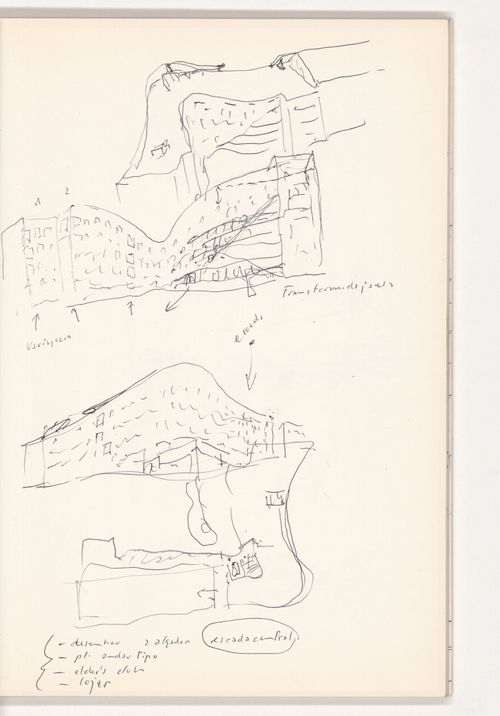
This sketchbook includes notes and sketches for Blocke 121, Schlesisches Tor in Berlin, Germany (including Bonjour Tristesse and Kita) and for the Quinta da Malagueira housing estate in Évora, Portugal. The sketchbook also includes notes and sketches of people.
ARCH281730
Description:
This sketchbook includes notes and sketches for Blocke 121, Schlesisches Tor in Berlin, Germany (including Bonjour Tristesse and Kita) and for the Quinta da Malagueira housing estate in Évora, Portugal. The sketchbook also includes notes and sketches of people.
Personnes et institutions:
Date:
October 1981
October 1981
Titre:
Sketchbook 95: Évora (Remates) - Berlim
Actions:
ARCH281730
Description:
This sketchbook includes notes and sketches for Blocke 121, Schlesisches Tor in Berlin, Germany (including Bonjour Tristesse and Kita) and for the Quinta da Malagueira housing estate in Évora, Portugal. The sketchbook also includes notes and sketches of people.
Sketchbook 95: Évora (Remates) - Berlim
Actions:
ARCH281730
Description:
This sketchbook includes notes and sketches for Blocke 121, Schlesisches Tor in Berlin, Germany (including Bonjour Tristesse and Kita) and for the Quinta da Malagueira housing estate in Évora, Portugal. The sketchbook also includes notes and sketches of people.
Classification:
dessins
dessins
Date:
October 1981
October 1981
Personnes et institutions:


