


31721 Résultats
Classification:
dessins, documents textuels, photographies
dessins, documents textuels, photographies
Numéro de référence:
AP178.S1.1999.PR03.003
AP178.S1.1999.PR03.003
Personnes et institutions:
Date:
1999-2003
1999-2003
Classification:
dessins, documents textuels, photographies
dessins, documents textuels, photographies
Date:
1999-2003
1999-2003
Personnes et institutions:
Classification:
dessins, né numérique
dessins, né numérique
Numéro de référence:
ap196.s2.065
Description:
Original directory name: "Images". Most common file formats: Exchangeable Image File Format (Compressed), JPEG File Interchange Format, Acrobat PDF 1.3 - Portable Document Format, Nikon Digital SLR Camera Raw Image File, Acrobat PDF 1.4 - Portable Document Format
ap196.s2.065
Description:
Original directory name: "Images". Most common file formats: Exchangeable Image File Format (Compressed), JPEG File Interchange Format, Acrobat PDF 1.3 - Portable Document Format, Nikon Digital SLR Camera Raw Image File, Acrobat PDF 1.4 - Portable Document Format
Personnes et institutions:
Date:
2000 - 2017
2000 - 2017
Titre:
Reference sketches, physical model photographs, renderings, and digital drawings used for design development, Ford Calumet Environmental Center, Chicago
Actions:
ap196.s2.065
Description:
Original directory name: "Images". Most common file formats: Exchangeable Image File Format (Compressed), JPEG File Interchange Format, Acrobat PDF 1.3 - Portable Document Format, Nikon Digital SLR Camera Raw Image File, Acrobat PDF 1.4 - Portable Document Format
Reference sketches, physical model photographs, renderings, and digital drawings used for design development, Ford Calumet Environmental Center, Chicago
Actions:
ap196.s2.065
Description:
Original directory name: "Images". Most common file formats: Exchangeable Image File Format (Compressed), JPEG File Interchange Format, Acrobat PDF 1.3 - Portable Document Format, Nikon Digital SLR Camera Raw Image File, Acrobat PDF 1.4 - Portable Document Format
Classification:
dessins, né numérique
dessins, né numérique
Date:
2000 - 2017
2000 - 2017
Personnes et institutions:
Classification:
photographies
photographies
Numéro de référence:
AP178.S1.2001.PR07.017.1
Description:
Original file title: Fotografias 1 Lleida
AP178.S1.2001.PR07.017.1
Description:
Original file title: Fotografias 1 Lleida
Personnes et institutions:
Date:
2002-2005
2002-2005
Titre:
Photographs of construction work, Faculdade Ciências da Educação do Campus Universidade de Cappont, Lérida (folder 1 of 3)
Actions:
AP178.S1.2001.PR07.017.1
Description:
Original file title: Fotografias 1 Lleida
Photographs of construction work, Faculdade Ciências da Educação do Campus Universidade de Cappont, Lérida (folder 1 of 3)
Actions:
AP178.S1.2001.PR07.017.1
Description:
Original file title: Fotografias 1 Lleida
Classification:
photographies
photographies
Date:
2002-2005
2002-2005
Personnes et institutions:
Classification:
photographies
photographies
Numéro de référence:
AP178.S1.2001.PR07.017.2
Description:
Original file title: Fotografias 1 Lleida
AP178.S1.2001.PR07.017.2
Description:
Original file title: Fotografias 1 Lleida
Personnes et institutions:
Date:
2002-2005
2002-2005
Titre:
Photographs of construction work, Faculdade Ciências da Educação do Campus Universidade de Cappont, Lérida (folder 2 of 3)
Actions:
AP178.S1.2001.PR07.017.2
Description:
Original file title: Fotografias 1 Lleida
Photographs of construction work, Faculdade Ciências da Educação do Campus Universidade de Cappont, Lérida (folder 2 of 3)
Actions:
AP178.S1.2001.PR07.017.2
Description:
Original file title: Fotografias 1 Lleida
Classification:
photographies
photographies
Date:
2002-2005
2002-2005
Personnes et institutions:
Classification:
photographies
photographies
Numéro de référence:
AP178.S1.2001.PR07.017.3
Description:
Original file title: Fotografias 1 Lleida
AP178.S1.2001.PR07.017.3
Description:
Original file title: Fotografias 1 Lleida
Personnes et institutions:
Date:
2002-2005
2002-2005
Titre:
Photographs of construction work, Faculdade Ciências da Educação do Campus Universidade de Cappont, Lérida (folder 3 of 3)
Actions:
AP178.S1.2001.PR07.017.3
Description:
Original file title: Fotografias 1 Lleida
Photographs of construction work, Faculdade Ciências da Educação do Campus Universidade de Cappont, Lérida (folder 3 of 3)
Actions:
AP178.S1.2001.PR07.017.3
Description:
Original file title: Fotografias 1 Lleida
Classification:
photographies
photographies
Date:
2002-2005
2002-2005
Personnes et institutions:
Classification:
photographies
photographies
Numéro de référence:
AP178.S1.1996.PR05.007
Description:
Original file title: Horta da Torrinha fotografias
AP178.S1.1996.PR05.007
Description:
Original file title: Horta da Torrinha fotografias
Personnes et institutions:
Date:
circa 1997
circa 1997
Titre:
Photographs and negatives of models, Complexo de Habitação, Comércio e Serviços Horta da Torrinha Rotunda do Raimundo, Evora
Actions:
AP178.S1.1996.PR05.007
Description:
Original file title: Horta da Torrinha fotografias
Photographs and negatives of models, Complexo de Habitação, Comércio e Serviços Horta da Torrinha Rotunda do Raimundo, Evora
Actions:
AP178.S1.1996.PR05.007
Description:
Original file title: Horta da Torrinha fotografias
Classification:
photographies
photographies
Date:
circa 1997
circa 1997
Personnes et institutions:
Classification:
dessins, photographies
dessins, photographies
Numéro de référence:
AP178.S1.2002.PR06.SS1.019.1
Description:
Original file title: Edificio dos Parques Pedras Salgadass Levantamentos, Propostas e Fotos This file includes details and photographs for the casino and edifício sociais.
AP178.S1.2002.PR06.SS1.019.1
Description:
Original file title: Edificio dos Parques Pedras Salgadass Levantamentos, Propostas e Fotos This file includes details and photographs for the casino and edifício sociais.
Personnes et institutions:
Date:
2004-2006
2004-2006
Titre:
Details and photographs, Parque de Pedras Salgadas, Hotel Avelames, Spa e Casa de Chá, Pedras Salgadas (folder 1 of 3)
Actions:
AP178.S1.2002.PR06.SS1.019.1
Description:
Original file title: Edificio dos Parques Pedras Salgadass Levantamentos, Propostas e Fotos This file includes details and photographs for the casino and edifício sociais.
Details and photographs, Parque de Pedras Salgadas, Hotel Avelames, Spa e Casa de Chá, Pedras Salgadas (folder 1 of 3)
Actions:
AP178.S1.2002.PR06.SS1.019.1
Description:
Original file title: Edificio dos Parques Pedras Salgadass Levantamentos, Propostas e Fotos This file includes details and photographs for the casino and edifício sociais.
Classification:
dessins, photographies
dessins, photographies
Date:
2004-2006
2004-2006
Personnes et institutions:
Actions:
Numéro de référence:
PH1979:0508
Description:
This album depicts photographs, plans, sketches of Stonehenge and texts. Preface is signed by Sir Henry James, 29th May 1867, Southhampton. Album has appendix and List of Books inserted at the end. "Col. Sir Henry James, Director-General of the Ordnance Survey, was a strong believer that photography had to be utilized as a major tool for mapping and survey work and he employed the Royal Engineers for that purpose. Colonel James appears in several of the Stonehenge photographs published by the Ordnance Survey. [...] Stonehenge is the world's most famous, large megalithic stone circle and is usually designated as a site used for religious worship in Neolithic Britain. However, the first use of this locality for documented ritual activity goes back to the Mesolithic and the erection of several large totem poles perhaps as early as 8,000 BC (Stonehenge O). Lunar observations preceded the construction of a causeway c.3200 BC, followed by an earth circle and Heel Stones c.3100 BC (Stonehenge 1a) and the Aubrey Holes (Stonehenge 1b). The Stonehenge site was then abandoned for about 1,000 years when large bluestones quarried in Wales were brought to the site and made into the Double Bluestone Circle with Avenue. 2150 BC (Stonehenge II). Soon thereafter sarsen stones were brought in from Avebury to build the great Sarsen Circle and Trilithon Horseshoe, 2100 BC (Stonehenge IIIz). Bluestones were brought back and added as the Bluestone Circle and Bluestone Horseshoe to the sarsen monument, 1800 BC (Stonehenge IIId). The sacred avenue was extended to the River Avon, 1100 BC (Stonehenge IV), the last phase of megalithic construction at this site. Note that the great stone circle and all construction at the Stonehenge site was completed several hundred years before we can postulate Celtic druids in the vicinity. We can only mention in passing that Stonehenge was embedded within a large ritual complex, where several of the ten megalithic constructions were also monumental in scale. Integration between these structures may not have been well planned in advance, but assuredly was articulated as each was built." Neolithic Britian Online.
PH1979:0508
Description:
This album depicts photographs, plans, sketches of Stonehenge and texts. Preface is signed by Sir Henry James, 29th May 1867, Southhampton. Album has appendix and List of Books inserted at the end. "Col. Sir Henry James, Director-General of the Ordnance Survey, was a strong believer that photography had to be utilized as a major tool for mapping and survey work and he employed the Royal Engineers for that purpose. Colonel James appears in several of the Stonehenge photographs published by the Ordnance Survey. [...] Stonehenge is the world's most famous, large megalithic stone circle and is usually designated as a site used for religious worship in Neolithic Britain. However, the first use of this locality for documented ritual activity goes back to the Mesolithic and the erection of several large totem poles perhaps as early as 8,000 BC (Stonehenge O). Lunar observations preceded the construction of a causeway c.3200 BC, followed by an earth circle and Heel Stones c.3100 BC (Stonehenge 1a) and the Aubrey Holes (Stonehenge 1b). The Stonehenge site was then abandoned for about 1,000 years when large bluestones quarried in Wales were brought to the site and made into the Double Bluestone Circle with Avenue. 2150 BC (Stonehenge II). Soon thereafter sarsen stones were brought in from Avebury to build the great Sarsen Circle and Trilithon Horseshoe, 2100 BC (Stonehenge IIIz). Bluestones were brought back and added as the Bluestone Circle and Bluestone Horseshoe to the sarsen monument, 1800 BC (Stonehenge IIId). The sacred avenue was extended to the River Avon, 1100 BC (Stonehenge IV), the last phase of megalithic construction at this site. Note that the great stone circle and all construction at the Stonehenge site was completed several hundred years before we can postulate Celtic druids in the vicinity. We can only mention in passing that Stonehenge was embedded within a large ritual complex, where several of the ten megalithic constructions were also monumental in scale. Integration between these structures may not have been well planned in advance, but assuredly was articulated as each was built." Neolithic Britian Online.
Personnes et institutions:
Sujet:
sculpture, topographique
sculpture, topographique
Date:
1867
1867
Titre:
Plans and Photographs of Stonehenge, and of Turusachan in the Island of Lewis; with Notes Relating to the Druids and Sketches of Cromlechs in Ireland
Actions:
PH1979:0508
Description:
This album depicts photographs, plans, sketches of Stonehenge and texts. Preface is signed by Sir Henry James, 29th May 1867, Southhampton. Album has appendix and List of Books inserted at the end. "Col. Sir Henry James, Director-General of the Ordnance Survey, was a strong believer that photography had to be utilized as a major tool for mapping and survey work and he employed the Royal Engineers for that purpose. Colonel James appears in several of the Stonehenge photographs published by the Ordnance Survey. [...] Stonehenge is the world's most famous, large megalithic stone circle and is usually designated as a site used for religious worship in Neolithic Britain. However, the first use of this locality for documented ritual activity goes back to the Mesolithic and the erection of several large totem poles perhaps as early as 8,000 BC (Stonehenge O). Lunar observations preceded the construction of a causeway c.3200 BC, followed by an earth circle and Heel Stones c.3100 BC (Stonehenge 1a) and the Aubrey Holes (Stonehenge 1b). The Stonehenge site was then abandoned for about 1,000 years when large bluestones quarried in Wales were brought to the site and made into the Double Bluestone Circle with Avenue. 2150 BC (Stonehenge II). Soon thereafter sarsen stones were brought in from Avebury to build the great Sarsen Circle and Trilithon Horseshoe, 2100 BC (Stonehenge IIIz). Bluestones were brought back and added as the Bluestone Circle and Bluestone Horseshoe to the sarsen monument, 1800 BC (Stonehenge IIId). The sacred avenue was extended to the River Avon, 1100 BC (Stonehenge IV), the last phase of megalithic construction at this site. Note that the great stone circle and all construction at the Stonehenge site was completed several hundred years before we can postulate Celtic druids in the vicinity. We can only mention in passing that Stonehenge was embedded within a large ritual complex, where several of the ten megalithic constructions were also monumental in scale. Integration between these structures may not have been well planned in advance, but assuredly was articulated as each was built." Neolithic Britian Online.
Plans and Photographs of Stonehenge, and of Turusachan in the Island of Lewis; with Notes Relating to the Druids and Sketches of Cromlechs in Ireland
Actions:
PH1979:0508
Description:
This album depicts photographs, plans, sketches of Stonehenge and texts. Preface is signed by Sir Henry James, 29th May 1867, Southhampton. Album has appendix and List of Books inserted at the end. "Col. Sir Henry James, Director-General of the Ordnance Survey, was a strong believer that photography had to be utilized as a major tool for mapping and survey work and he employed the Royal Engineers for that purpose. Colonel James appears in several of the Stonehenge photographs published by the Ordnance Survey. [...] Stonehenge is the world's most famous, large megalithic stone circle and is usually designated as a site used for religious worship in Neolithic Britain. However, the first use of this locality for documented ritual activity goes back to the Mesolithic and the erection of several large totem poles perhaps as early as 8,000 BC (Stonehenge O). Lunar observations preceded the construction of a causeway c.3200 BC, followed by an earth circle and Heel Stones c.3100 BC (Stonehenge 1a) and the Aubrey Holes (Stonehenge 1b). The Stonehenge site was then abandoned for about 1,000 years when large bluestones quarried in Wales were brought to the site and made into the Double Bluestone Circle with Avenue. 2150 BC (Stonehenge II). Soon thereafter sarsen stones were brought in from Avebury to build the great Sarsen Circle and Trilithon Horseshoe, 2100 BC (Stonehenge IIIz). Bluestones were brought back and added as the Bluestone Circle and Bluestone Horseshoe to the sarsen monument, 1800 BC (Stonehenge IIId). The sacred avenue was extended to the River Avon, 1100 BC (Stonehenge IV), the last phase of megalithic construction at this site. Note that the great stone circle and all construction at the Stonehenge site was completed several hundred years before we can postulate Celtic druids in the vicinity. We can only mention in passing that Stonehenge was embedded within a large ritual complex, where several of the ten megalithic constructions were also monumental in scale. Integration between these structures may not have been well planned in advance, but assuredly was articulated as each was built." Neolithic Britian Online.
Date:
1867
1867
Personnes et institutions:
Sujet:
sculpture, topographique
sculpture, topographique
Classification:
photographies
photographies
Actions:
Numéro de référence:
PH1988:0261
Description:
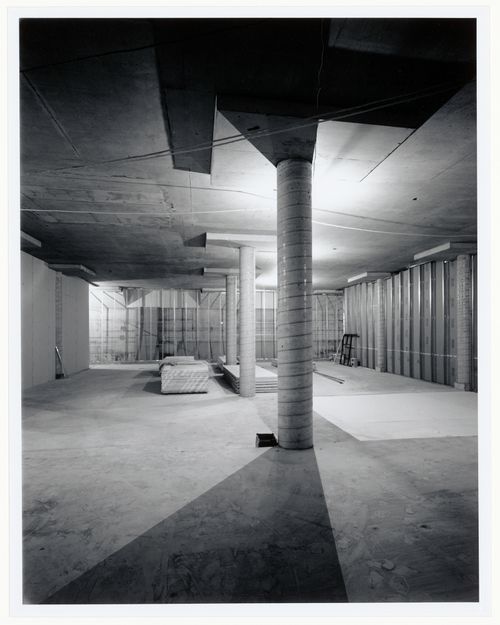
Commissioned by the Canadian Centre for Architecture, Montréal, for "CCA Building and Shaughnessy House," 1985-1989.
PH1988:0261
Description:
Commissioned by the Canadian Centre for Architecture, Montréal, for "CCA Building and Shaughnessy House," 1985-1989.
Personnes et institutions:
Sujet:
architecture
architecture
Date:
11 January 1987
11 January 1987
Titre:
Interior view of the Photographs Collection storage vault on level 2 showing columns, Canadian Centre for Architecture under construction, Montréal, Québec
Actions:
PH1988:0261
Description:
Commissioned by the Canadian Centre for Architecture, Montréal, for "CCA Building and Shaughnessy House," 1985-1989.
Interior view of the Photographs Collection storage vault on level 2 showing columns, Canadian Centre for Architecture under construction, Montréal, Québec
Actions:
PH1988:0261
Description:
Commissioned by the Canadian Centre for Architecture, Montréal, for "CCA Building and Shaughnessy House," 1985-1989.
Classification:
photographies
photographies
Date:
11 January 1987
11 January 1987
Personnes et institutions:
Sujet:
architecture
architecture
Classification:
documents textuels, photographies
documents textuels, photographies
Numéro de référence:
ARCH219175
ARCH219175
Personnes et institutions:
Classification:
documents textuels, photographies
documents textuels, photographies
Personnes et institutions:


