


3189 Résultats
Classification:
livres
livres
Actions:
Prix:
$35.95
(disponible sur commande)
Résumé:
The book serves as a histirical survey of architectural lighting throughout the twentieth century and also examines the cultural, social, and artistic issues surrounding this phenomenon. During the 1920's and 1930's architectural floodlighting was at its most intense, considered an essentially modern abstract art form that crossed the boundaries between film,(...)
$35.95
(disponible sur commande)
Résumé:
The book serves as a histirical survey of architectural lighting throughout the twentieth century and also examines the cultural, social, and artistic issues surrounding this phenomenon. During the 1920's and 1930's architectural floodlighting was at its most intense, considered an essentially modern abstract art form that crossed the boundaries between film,(...)
Titre:
Architecture of the night : the illuminated building
Actions:
Prix:
$35.95
(disponible sur commande)
Résumé:
The book serves as a histirical survey of architectural lighting throughout the twentieth century and also examines the cultural, social, and artistic issues surrounding this phenomenon. During the 1920's and 1930's architectural floodlighting was at its most intense, considered an essentially modern abstract art form that crossed the boundaries between film, architecture, and painting. "Architecture of the Night" explores this dynamic period in depth, considers its impact today, and addresses the new issues that confront contemporary lighting, such as "light pollution", conservation, and aesthetics. The book features close to 200 illustrations and examines 100 examples of building illumination, including the Paris Opera House (1880), the Gas and Electric Building, Denver (1910), the Empire State Building, New York (1931), the Seagram Building, New York (1958), the Lloyds Building, London (1988) and the Anzeiger Hochhaus, Hanover (2000).
Architecture of the night : the illuminated building
Actions:
Prix:
$35.95
(disponible sur commande)
Résumé:
The book serves as a histirical survey of architectural lighting throughout the twentieth century and also examines the cultural, social, and artistic issues surrounding this phenomenon. During the 1920's and 1930's architectural floodlighting was at its most intense, considered an essentially modern abstract art form that crossed the boundaries between film, architecture, and painting. "Architecture of the Night" explores this dynamic period in depth, considers its impact today, and addresses the new issues that confront contemporary lighting, such as "light pollution", conservation, and aesthetics. The book features close to 200 illustrations and examines 100 examples of building illumination, including the Paris Opera House (1880), the Gas and Electric Building, Denver (1910), the Empire State Building, New York (1931), the Seagram Building, New York (1958), the Lloyds Building, London (1988) and the Anzeiger Hochhaus, Hanover (2000).
Classification:
livres
livres
Publication:
février 2002, Munich
février 2002, Munich
Sujet:
livres soldés
livres soldés
Classification:
livres
livres

Actions:
Prix:
$44.95
(disponible sur commande)
Résumé:
The Villa Tugendhat, designed by Mies van der Rohe in 1928, is an icon of architectural modernism and a UNESCO World Heritage site. This book tells the true story of the large family connected to it, who rose to prominence through industrial textile manufacturing. It traces the transformations in the life of the family, from their roots in a Jewish ghetto to part of the(...)
$44.95
(disponible sur commande)
Résumé:
The Villa Tugendhat, designed by Mies van der Rohe in 1928, is an icon of architectural modernism and a UNESCO World Heritage site. This book tells the true story of the large family connected to it, who rose to prominence through industrial textile manufacturing. It traces the transformations in the life of the family, from their roots in a Jewish ghetto to part of the(...)
Titre:
Behind the glass: The Villa Tugendhat and its family
Actions:
Prix:
$44.95
(disponible sur commande)
Résumé:
The Villa Tugendhat, designed by Mies van der Rohe in 1928, is an icon of architectural modernism and a UNESCO World Heritage site. This book tells the true story of the large family connected to it, who rose to prominence through industrial textile manufacturing. It traces the transformations in the life of the family, from their roots in a Jewish ghetto to part of the wealthy bourgeoisie in the Austro-Hungarian Empire to adaptation in interwar independent Czechoslovakia and flight in the face of Nazi invasion. Michael Lambek examines the generation born in the first decade of the twentieth century, especially Grete Tugendhat – Lambek’s maternal grandmother – who commissioned, inhabited, championed, and relinquished the distinctive modern house.The book also provides unpublished correspondence between Martin Heidegger and Ernst Tugendhat, Grete’s son, as well as a description of the impact of a 2017 family reunion.
Behind the glass: The Villa Tugendhat and its family
Actions:
Prix:
$44.95
(disponible sur commande)
Résumé:
The Villa Tugendhat, designed by Mies van der Rohe in 1928, is an icon of architectural modernism and a UNESCO World Heritage site. This book tells the true story of the large family connected to it, who rose to prominence through industrial textile manufacturing. It traces the transformations in the life of the family, from their roots in a Jewish ghetto to part of the wealthy bourgeoisie in the Austro-Hungarian Empire to adaptation in interwar independent Czechoslovakia and flight in the face of Nazi invasion. Michael Lambek examines the generation born in the first decade of the twentieth century, especially Grete Tugendhat – Lambek’s maternal grandmother – who commissioned, inhabited, championed, and relinquished the distinctive modern house.The book also provides unpublished correspondence between Martin Heidegger and Ernst Tugendhat, Grete’s son, as well as a description of the impact of a 2017 family reunion.
Classification:
livres
livres
Publication:
novembre 2022
novembre 2022
Sujet:
Théorie de l’architecture
Théorie de l’architecture
Classification:
livres
livres
Actions:
Prix:
$42.00
(disponible sur commande)
Résumé:
Rather than look only at the physical development of Rome - its buildings, monuments, and urban spaces - Dyson also explores its social, economic, and cultural histories. This approach situates Rome against a background of comparative urban history and theory, allowing Dyson to examine the dynamic society that once thrived there. Dyson follows Rome as it developed(...)
$42.00
(disponible sur commande)
Résumé:
Rather than look only at the physical development of Rome - its buildings, monuments, and urban spaces - Dyson also explores its social, economic, and cultural histories. This approach situates Rome against a background of comparative urban history and theory, allowing Dyson to examine the dynamic society that once thrived there. Dyson follows Rome as it developed(...)
Titre:
Rome: A living portrait of an ancient city
Actions:
Prix:
$42.00
(disponible sur commande)
Résumé:
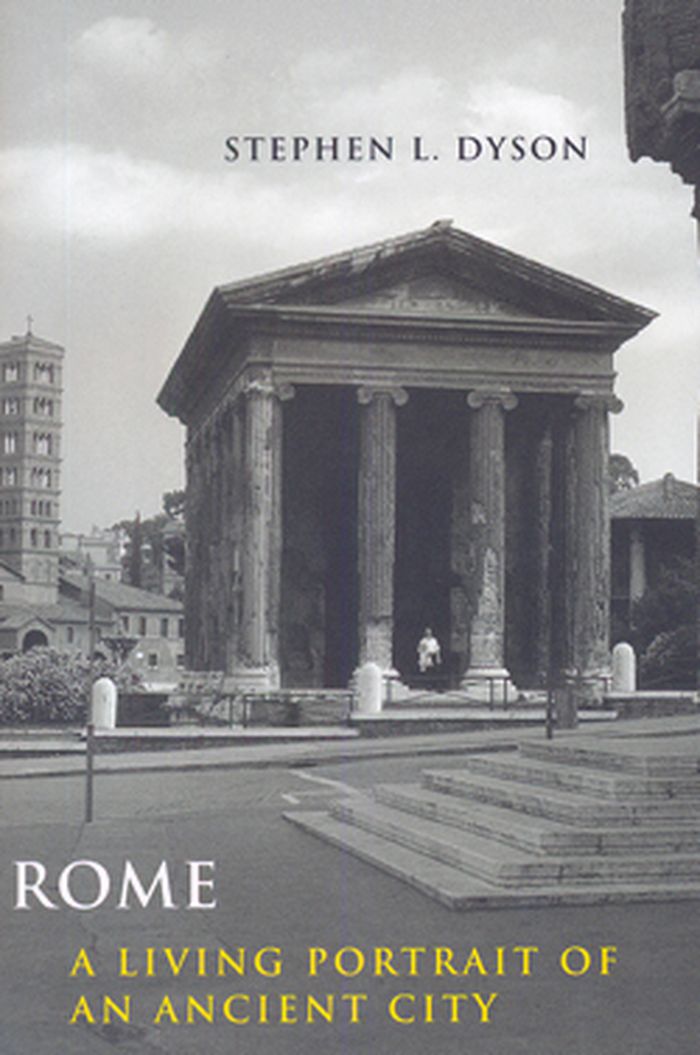
Rather than look only at the physical development of Rome - its buildings, monuments, and urban spaces - Dyson also explores its social, economic, and cultural histories. This approach situates Rome against a background of comparative urban history and theory, allowing Dyson to examine the dynamic society that once thrived there. Dyson follows Rome as it developed between the third century BC and the fourth century AD, dividing the megalopolis into distinct neighborhoods and locales. He shows how these communities, each with its own unique customs and colorful inhabitants, eventually grew into the great imperial capital of the Italian Empire. Dyson integrates the full range of sources available -- literary, artistic, epigraphic, and archaeological -- to create a comprehensive history of the monumental city. In doing so, he offers a dramatic picture of a complex and changing urban center that, despite its flaws, flourished for centuries.
Rome: A living portrait of an ancient city
Actions:
Prix:
$42.00
(disponible sur commande)
Résumé:
Rather than look only at the physical development of Rome - its buildings, monuments, and urban spaces - Dyson also explores its social, economic, and cultural histories. This approach situates Rome against a background of comparative urban history and theory, allowing Dyson to examine the dynamic society that once thrived there. Dyson follows Rome as it developed between the third century BC and the fourth century AD, dividing the megalopolis into distinct neighborhoods and locales. He shows how these communities, each with its own unique customs and colorful inhabitants, eventually grew into the great imperial capital of the Italian Empire. Dyson integrates the full range of sources available -- literary, artistic, epigraphic, and archaeological -- to create a comprehensive history of the monumental city. In doing so, he offers a dramatic picture of a complex and changing urban center that, despite its flaws, flourished for centuries.
Classification:
livres
livres
Publication:
juin 2010
juin 2010
Classification:
livres
livres

Titre:
Charles Garnier
Charles Garnier
Actions:
Prix:
$81.95
(disponible sur commande)
Résumé:
Architecte immense et prolifique, Charles Garnier est resté très mal connu jusqu'à ce jour. Celui qui, par la construction de l'Opéra, a mieux qu'un autre symbolisé la civilisation brillante du Second Empire, a subi la même défaveur que le régime de Napoléon III, si bien que de rares études rendent compte des bâtiments qu'il a construits. Cet ouvrage en présente la(...)
$81.95
(disponible sur commande)
Résumé:
Architecte immense et prolifique, Charles Garnier est resté très mal connu jusqu'à ce jour. Celui qui, par la construction de l'Opéra, a mieux qu'un autre symbolisé la civilisation brillante du Second Empire, a subi la même défaveur que le régime de Napoléon III, si bien que de rares études rendent compte des bâtiments qu'il a construits. Cet ouvrage en présente la(...)
Titre:
Charles Garnier
Actions:
Prix:
$81.95
(disponible sur commande)
Résumé:
Architecte immense et prolifique, Charles Garnier est resté très mal connu jusqu'à ce jour. Celui qui, par la construction de l'Opéra, a mieux qu'un autre symbolisé la civilisation brillante du Second Empire, a subi la même défaveur que le régime de Napoléon III, si bien que de rares études rendent compte des bâtiments qu'il a construits. Cet ouvrage en présente la biographie et l'œuvre complet, depuis son grand prix de Rome jusqu'au casino de Monte-Carlo, aux thermes de Vittel, aux villas de Bordighera et à l'église de La Capelle-en-Thiérache. Par cette évocation, c'est tout le monde des financiers, promoteurs immobiliers, constructeurs de chemins de fer et même éditeurs qui se profile, mais aussi celui de cette pléiade d'artistes dont Garnier avait fait ses collaborateurs. Richement illustré, l'ouvrage comprend en annexe un catalogue de l'œuvre.
Charles Garnier
Actions:
Prix:
$81.95
(disponible sur commande)
Résumé:
Architecte immense et prolifique, Charles Garnier est resté très mal connu jusqu'à ce jour. Celui qui, par la construction de l'Opéra, a mieux qu'un autre symbolisé la civilisation brillante du Second Empire, a subi la même défaveur que le régime de Napoléon III, si bien que de rares études rendent compte des bâtiments qu'il a construits. Cet ouvrage en présente la biographie et l'œuvre complet, depuis son grand prix de Rome jusqu'au casino de Monte-Carlo, aux thermes de Vittel, aux villas de Bordighera et à l'église de La Capelle-en-Thiérache. Par cette évocation, c'est tout le monde des financiers, promoteurs immobiliers, constructeurs de chemins de fer et même éditeurs qui se profile, mais aussi celui de cette pléiade d'artistes dont Garnier avait fait ses collaborateurs. Richement illustré, l'ouvrage comprend en annexe un catalogue de l'œuvre.
Classification:
livres
livres
Publication:
juillet 2003, Paris
juillet 2003, Paris
Sujet:
Architecture, monographies
Architecture, monographies
Classification:
livres
livres

Prix:
$32.95
(disponible sur commande)
Résumé:
Published to coincide with an exhibition at Chicago’s Newberry Library, Mapping Manifest Destiny: Chicago and the American West charts the historic role maps have played in imagining, understanding, promoting, and exploiting the Western frontier of North America. Featuring more than sixty full-color maps and views from the sixteenth through the twentieth centuries, this(...)
$32.95
(disponible sur commande)
Résumé:
Published to coincide with an exhibition at Chicago’s Newberry Library, Mapping Manifest Destiny: Chicago and the American West charts the historic role maps have played in imagining, understanding, promoting, and exploiting the Western frontier of North America. Featuring more than sixty full-color maps and views from the sixteenth through the twentieth centuries, this(...)
Publication:
août 2008, Chicago
août 2008, Chicago
Titre:
Mapping manifest destiny: Chicago and the American West
Actions:
Prix:
$32.95
(disponible sur commande)
Résumé:
Published to coincide with an exhibition at Chicago’s Newberry Library, Mapping Manifest Destiny: Chicago and the American West charts the historic role maps have played in imagining, understanding, promoting, and exploiting the Western frontier of North America. Featuring more than sixty full-color maps and views from the sixteenth through the twentieth centuries, this fascinating book documents how maps encouraged Euro-Americans to see the West as a land of promise. Maps helped visualize a nation destined to expand across the continent to the Pacific Ocean. Curators Michael P. Conzen and Diane Dillon present an interpretively rich, carefully researched selection of items drawing on the Newberry’s superb collections of historic maps and Western Americana. They have organized the book into four sections: maps for empire, maps for building a new nation, maps for enlightenment, and maps for business.
Mapping manifest destiny: Chicago and the American West
Actions:
Prix:
$32.95
(disponible sur commande)
Résumé:
Published to coincide with an exhibition at Chicago’s Newberry Library, Mapping Manifest Destiny: Chicago and the American West charts the historic role maps have played in imagining, understanding, promoting, and exploiting the Western frontier of North America. Featuring more than sixty full-color maps and views from the sixteenth through the twentieth centuries, this fascinating book documents how maps encouraged Euro-Americans to see the West as a land of promise. Maps helped visualize a nation destined to expand across the continent to the Pacific Ocean. Curators Michael P. Conzen and Diane Dillon present an interpretively rich, carefully researched selection of items drawing on the Newberry’s superb collections of historic maps and Western Americana. They have organized the book into four sections: maps for empire, maps for building a new nation, maps for enlightenment, and maps for business.
Classification:
livres
livres
Publication:
août 2008, Chicago
août 2008, Chicago
Classification:
livres
livres
Prix:
$20.00
(disponible en magasin)
Résumé:
Ce sont les nouveaux grands seigneurs de notre temps. Les GAFAM (Google, Apple, Facebook, Amazon, Microsoft) et autres plateformes (Airbnb, Uber et Netflix) règnent sans partage sur un empire numérique qui transcende les frontières nationales, au mépris de la souveraineté des États et de leurs législations. Épidémie de fausses nouvelles, polarisation des débats, contrôle(...)
$20.00
(disponible en magasin)
Résumé:
Ce sont les nouveaux grands seigneurs de notre temps. Les GAFAM (Google, Apple, Facebook, Amazon, Microsoft) et autres plateformes (Airbnb, Uber et Netflix) règnent sans partage sur un empire numérique qui transcende les frontières nationales, au mépris de la souveraineté des États et de leurs législations. Épidémie de fausses nouvelles, polarisation des débats, contrôle(...)
Publication:
avril 2022
avril 2022
Titre:
Les barbares numériques : Résister à l'invasion des GAFAM
Actions:
Prix:
$20.00
(disponible en magasin)
Résumé:
Ce sont les nouveaux grands seigneurs de notre temps. Les GAFAM (Google, Apple, Facebook, Amazon, Microsoft) et autres plateformes (Airbnb, Uber et Netflix) règnent sans partage sur un empire numérique qui transcende les frontières nationales, au mépris de la souveraineté des États et de leurs législations. Épidémie de fausses nouvelles, polarisation des débats, contrôle des données personnelles, surconsommation énergétique et pollution atmosphérique… Ces barbares numériques représentent une véritable menace pour la démocratie. Devant la passivité de nos gouvernements, à Québec comme à Ottawa, Alain Saulnier lance un appel à la résistance. Pour l’ancien directeur de l’information de Radio-Canada, il est urgent d’établir l’équité fiscale, de protéger les droits d’auteur et de moderniser tout l’écosystème numérique. Il en va de la survie de nos médias, de notre langue et de notre culture françaises en Amérique du Nord.
Les barbares numériques : Résister à l'invasion des GAFAM
Actions:
Prix:
$20.00
(disponible en magasin)
Résumé:
Ce sont les nouveaux grands seigneurs de notre temps. Les GAFAM (Google, Apple, Facebook, Amazon, Microsoft) et autres plateformes (Airbnb, Uber et Netflix) règnent sans partage sur un empire numérique qui transcende les frontières nationales, au mépris de la souveraineté des États et de leurs législations. Épidémie de fausses nouvelles, polarisation des débats, contrôle des données personnelles, surconsommation énergétique et pollution atmosphérique… Ces barbares numériques représentent une véritable menace pour la démocratie. Devant la passivité de nos gouvernements, à Québec comme à Ottawa, Alain Saulnier lance un appel à la résistance. Pour l’ancien directeur de l’information de Radio-Canada, il est urgent d’établir l’équité fiscale, de protéger les droits d’auteur et de moderniser tout l’écosystème numérique. Il en va de la survie de nos médias, de notre langue et de notre culture françaises en Amérique du Nord.
Classification:
livres
livres
Publication:
avril 2022
avril 2022
Classification:
livres
livres
Prix:
$85.00
(disponible sur commande)
Résumé:
Depuis plus de trois siècles, se pose la question de la place de la nature dans l'aménagement des villes. Des premiers jardins ouverts au public à la fin du XVIe siècle, comme les Tuileries à Paris ou Hyde Park à Londres, aux forêts urbaines contemporaines, les réponses apportées par les architectes, ingénieurs, paysagistes et leurs commanditaires sont inséparables de(...)
$85.00
(disponible sur commande)
Résumé:
Depuis plus de trois siècles, se pose la question de la place de la nature dans l'aménagement des villes. Des premiers jardins ouverts au public à la fin du XVIe siècle, comme les Tuileries à Paris ou Hyde Park à Londres, aux forêts urbaines contemporaines, les réponses apportées par les architectes, ingénieurs, paysagistes et leurs commanditaires sont inséparables de(...)
Titre:
Natures urbaines : Une histoire technique et sociale 1600-2030
Actions:
Prix:
$85.00
(disponible sur commande)
Résumé:
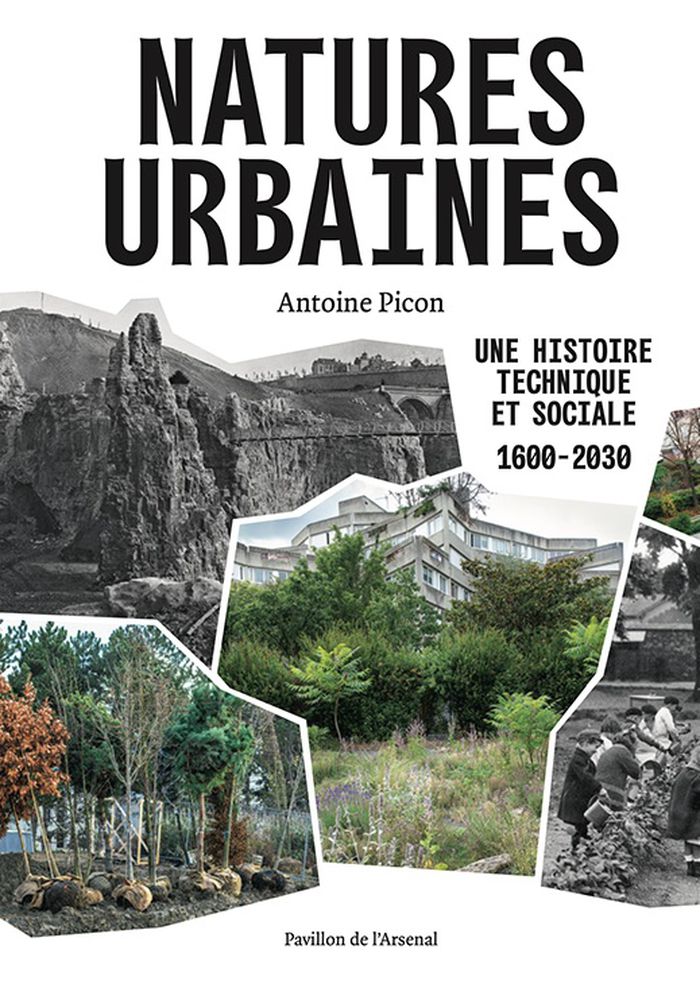
Depuis plus de trois siècles, se pose la question de la place de la nature dans l'aménagement des villes. Des premiers jardins ouverts au public à la fin du XVIe siècle, comme les Tuileries à Paris ou Hyde Park à Londres, aux forêts urbaines contemporaines, les réponses apportées par les architectes, ingénieurs, paysagistes et leurs commanditaires sont inséparables de préoccupations sociales. En même temps qu'elle contribue à l'hygiène publique, la nature participe à créer des liens entre les citadins. L'histoire révèle également la dimension technique de ces jardins et parcs urbains, inséparable par exemple des plantations de Paris sous le Second Empire ou de la création de Central Park à New York à la même époque. Face à la crise climatique actuelle, la nature joue un rôle central. Etudier l'évolution de la ou des natures urbaines, c'est aussi s'interroger sur le devenir des villes.
Natures urbaines : Une histoire technique et sociale 1600-2030
Actions:
Prix:
$85.00
(disponible sur commande)
Résumé:
Depuis plus de trois siècles, se pose la question de la place de la nature dans l'aménagement des villes. Des premiers jardins ouverts au public à la fin du XVIe siècle, comme les Tuileries à Paris ou Hyde Park à Londres, aux forêts urbaines contemporaines, les réponses apportées par les architectes, ingénieurs, paysagistes et leurs commanditaires sont inséparables de préoccupations sociales. En même temps qu'elle contribue à l'hygiène publique, la nature participe à créer des liens entre les citadins. L'histoire révèle également la dimension technique de ces jardins et parcs urbains, inséparable par exemple des plantations de Paris sous le Second Empire ou de la création de Central Park à New York à la même époque. Face à la crise climatique actuelle, la nature joue un rôle central. Etudier l'évolution de la ou des natures urbaines, c'est aussi s'interroger sur le devenir des villes.
Classification:
livres
livres
Publication:
mai 2024
mai 2024
Sujet:
Paysages urbains
Paysages urbains
Classification:
livres
livres
Prix:
$59.00
(disponible sur commande)
Résumé:
Les numéros 42 à 45 de la revue critique consacrée au graphisme : nº 42, 12 ou 13 choses que je sais d'elle : F.R.DAVID, Victoire Le Bars et Benjamin Thorel; nº 43, Un caractère : L'« écriture typographiée »,Thierry Chancogne; nº 44, Une énigme : la communication visuelle des neurosciences, James Langdon; nº 45, Fabrique de la redondance (4 gabarits de mise en page),(...)
$59.00
(disponible sur commande)
Résumé:
Les numéros 42 à 45 de la revue critique consacrée au graphisme : nº 42, 12 ou 13 choses que je sais d'elle : F.R.DAVID, Victoire Le Bars et Benjamin Thorel; nº 43, Un caractère : L'« écriture typographiée »,Thierry Chancogne; nº 44, Une énigme : la communication visuelle des neurosciences, James Langdon; nº 45, Fabrique de la redondance (4 gabarits de mise en page),(...)
Titre:
Faire : Regarder le graphisme, volume 12 (n° 42-43-44-45)
Actions:
Prix:
$59.00
(disponible sur commande)
Résumé:
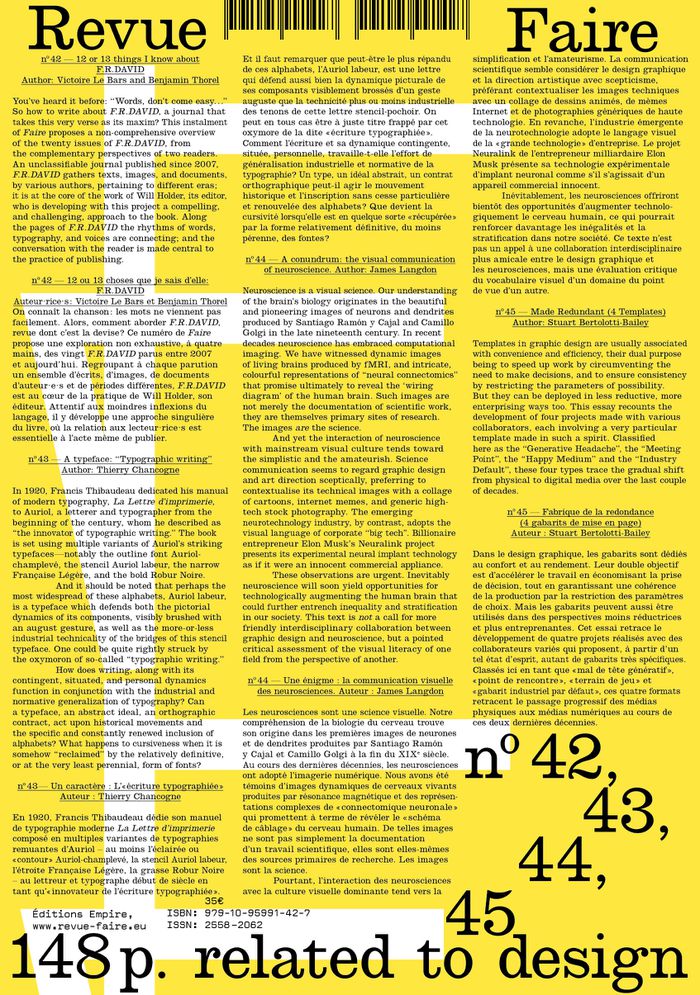
Les numéros 42 à 45 de la revue critique consacrée au graphisme : nº 42, 12 ou 13 choses que je sais d'elle : F.R.DAVID, Victoire Le Bars et Benjamin Thorel; nº 43, Un caractère : L'« écriture typographiée »,Thierry Chancogne; nº 44, Une énigme : la communication visuelle des neurosciences, James Langdon; nº 45, Fabrique de la redondance (4 gabarits de mise en page), Stuart Bertolotti-Bailey. ''Faire – Regarder le graphisme'' est une revue critique bimensuelle consacrée au design graphique, qui paraît en librairie tous les deux mois sous la forme de recueils de trois ou quatre numéros. Editée par Empire, la maison d'édition du studio Syndicat, elle parait d'octobre à juin et s'adresse aussi bien aux étudiants qu'aux chercheurs et aux professionnels, en documentant les pratiques contemporaines et internationales du graphisme ainsi que l'histoire et la grammaire des styles. Chaque numéro propose un sujet unique et tentaculaire, traité par un auteur reconnu.
Faire : Regarder le graphisme, volume 12 (n° 42-43-44-45)
Actions:
Prix:
$59.00
(disponible sur commande)
Résumé:
Les numéros 42 à 45 de la revue critique consacrée au graphisme : nº 42, 12 ou 13 choses que je sais d'elle : F.R.DAVID, Victoire Le Bars et Benjamin Thorel; nº 43, Un caractère : L'« écriture typographiée »,Thierry Chancogne; nº 44, Une énigme : la communication visuelle des neurosciences, James Langdon; nº 45, Fabrique de la redondance (4 gabarits de mise en page), Stuart Bertolotti-Bailey. ''Faire – Regarder le graphisme'' est une revue critique bimensuelle consacrée au design graphique, qui paraît en librairie tous les deux mois sous la forme de recueils de trois ou quatre numéros. Editée par Empire, la maison d'édition du studio Syndicat, elle parait d'octobre à juin et s'adresse aussi bien aux étudiants qu'aux chercheurs et aux professionnels, en documentant les pratiques contemporaines et internationales du graphisme ainsi que l'histoire et la grammaire des styles. Chaque numéro propose un sujet unique et tentaculaire, traité par un auteur reconnu.
Classification:
livres
livres
Publication:
février 2023
février 2023
Sujet:
Revues
Revues
Classification:
livres
livres
Prix:
$44.95
(disponible en magasin)
Résumé:
With the development of the first skyscrapers in the 1880s, urban built environments could expand vertically as well as horizontally. Tall buildings emerged in growing cities to house and manage the large and racially diverse populations of migrants and immigrants flocking to their centers following Reconstruction. Beginning with Chicago's early 10-story towers and(...)
$44.95
(disponible en magasin)
Résumé:
With the development of the first skyscrapers in the 1880s, urban built environments could expand vertically as well as horizontally. Tall buildings emerged in growing cities to house and manage the large and racially diverse populations of migrants and immigrants flocking to their centers following Reconstruction. Beginning with Chicago's early 10-story towers and(...)
Titre:
Black skyscraper: architecture and the perception of race
Actions:
Prix:
$44.95
(disponible en magasin)
Résumé:
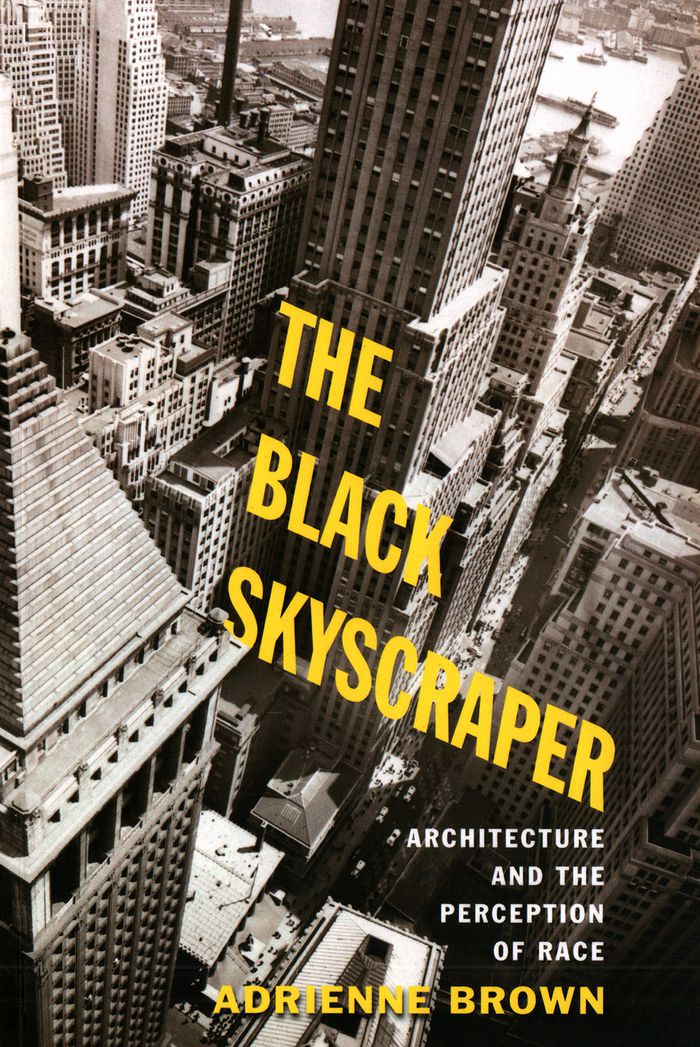
With the development of the first skyscrapers in the 1880s, urban built environments could expand vertically as well as horizontally. Tall buildings emerged in growing cities to house and manage the large and racially diverse populations of migrants and immigrants flocking to their centers following Reconstruction. Beginning with Chicago's early 10-story towers and concluding with the 1931 erection of the 102-story Empire State Building, Adrienne Brown's ''The Black Skyscraper'' provides a detailed account of how scale and proximity shape our understanding of race. Over the next half-century, as city skylines grew, American writers imagined the new urban backdrop as an obstacle to racial differentiation. Examining works produced by writers, painters, architects, and laborers who grappled with the early skyscraper's outsized and disorienting dimensions, Brown explores this architecture's effects on how race was seen, read, and sensed at the turn of the twentieth century.
Black skyscraper: architecture and the perception of race
Actions:
Prix:
$44.95
(disponible en magasin)
Résumé:
With the development of the first skyscrapers in the 1880s, urban built environments could expand vertically as well as horizontally. Tall buildings emerged in growing cities to house and manage the large and racially diverse populations of migrants and immigrants flocking to their centers following Reconstruction. Beginning with Chicago's early 10-story towers and concluding with the 1931 erection of the 102-story Empire State Building, Adrienne Brown's ''The Black Skyscraper'' provides a detailed account of how scale and proximity shape our understanding of race. Over the next half-century, as city skylines grew, American writers imagined the new urban backdrop as an obstacle to racial differentiation. Examining works produced by writers, painters, architects, and laborers who grappled with the early skyscraper's outsized and disorienting dimensions, Brown explores this architecture's effects on how race was seen, read, and sensed at the turn of the twentieth century.
Classification:
livres
livres
Publication:
mai 2019
mai 2019
Sujet:
L'humain et la ville
L'humain et la ville
Classification:
livres
livres
Titre:
Brutal bloc postcards
Brutal bloc postcards
Actions:
Prix:
$42.50
(disponible sur commande)
Résumé:
Brutal concrete hotels, futurist TV towers, heroic statues of workers—this collection of Soviet-era postcards documents the uncompromising landscape of the Eastern Bloc through its buildings and monuments. These are interspersed with quotes from prominent figures of the time, which both support and confound the ideologies presented in the images. In contrast to the(...)
$42.50
(disponible sur commande)
Résumé:
Brutal concrete hotels, futurist TV towers, heroic statues of workers—this collection of Soviet-era postcards documents the uncompromising landscape of the Eastern Bloc through its buildings and monuments. These are interspersed with quotes from prominent figures of the time, which both support and confound the ideologies presented in the images. In contrast to the(...)
Publication:
août 2018
août 2018
Titre:
Brutal bloc postcards
Actions:
Prix:
$42.50
(disponible sur commande)
Résumé:
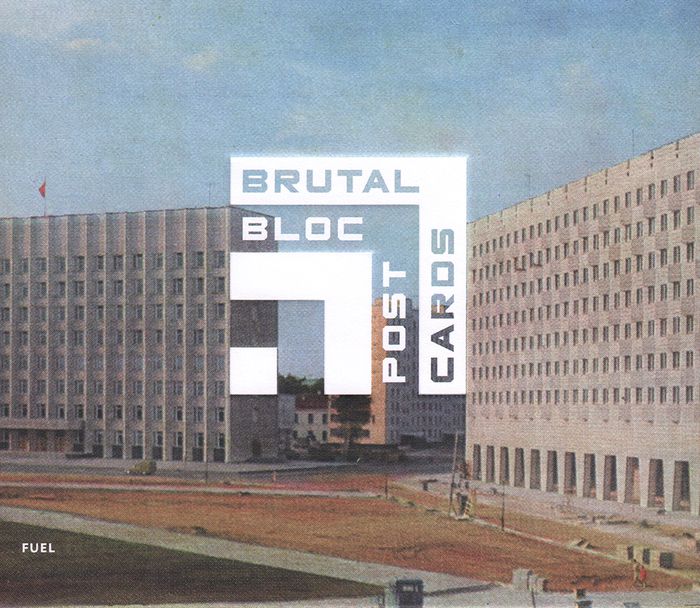
Brutal concrete hotels, futurist TV towers, heroic statues of workers—this collection of Soviet-era postcards documents the uncompromising landscape of the Eastern Bloc through its buildings and monuments. These are interspersed with quotes from prominent figures of the time, which both support and confound the ideologies presented in the images. In contrast to the photographs of a ruined and abandoned Soviet empire we are accustomed to seeing today, the scenes depicted here publicize the bright future of communism: social housing blocks, palaces of culture and monuments to comradeship. Dating from the 1960s to the 1980s, they offer a nostalgic yet revealing insight into social and architectural values of the time, acting as a window through which we can examine cars, people and, of course, buildings. These postcards, sanctioned by the authorities, were intended to show the world what living in communism looked like.
Brutal bloc postcards
Actions:
Prix:
$42.50
(disponible sur commande)
Résumé:
Brutal concrete hotels, futurist TV towers, heroic statues of workers—this collection of Soviet-era postcards documents the uncompromising landscape of the Eastern Bloc through its buildings and monuments. These are interspersed with quotes from prominent figures of the time, which both support and confound the ideologies presented in the images. In contrast to the photographs of a ruined and abandoned Soviet empire we are accustomed to seeing today, the scenes depicted here publicize the bright future of communism: social housing blocks, palaces of culture and monuments to comradeship. Dating from the 1960s to the 1980s, they offer a nostalgic yet revealing insight into social and architectural values of the time, acting as a window through which we can examine cars, people and, of course, buildings. These postcards, sanctioned by the authorities, were intended to show the world what living in communism looked like.
Classification:
livres
livres
Publication:
août 2018
août 2018


