


4065 Résultats
Classification:
dessins
dessins
Actions:
Numéro de référence:
DR1989:0015:062
Description:
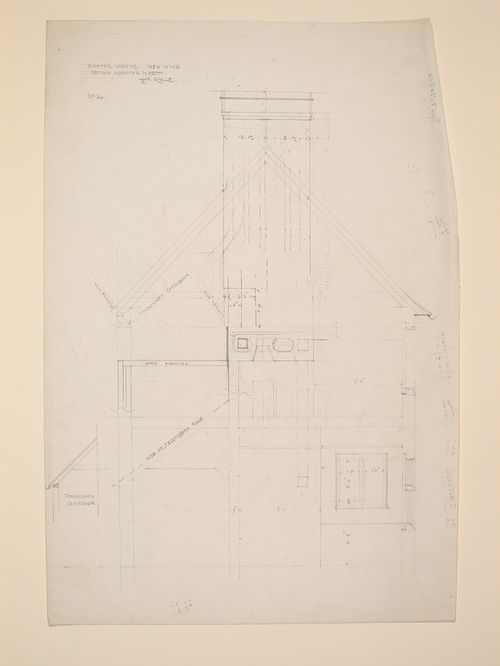
- This drawing shows a section through the kitchen of the main building for the new wing, identified in comparison with the plan DR1989:0015:049. This drawing also shows a superimposed plan for the chimney at the first-floor level, c. and temporary corridors for use during the construction, l.l. - This work is part of a group of drawings and reprographic prints of drawings for St. Peter's Home, Woking, and St. Peter's Convent, Woking, from the offices of John Loughborough Pearson and Frank Loughborough Pearson (DR1989:0015:011 - DR1989:0015:085 R/V). Composed of contract and working drawings including plans, site plans, sections, and elevations dated between 1881 and 1936, these drawings were sold at auction by the convent along with those for the older institution of St. Peter's Home, Kilburn (DR1989:0015:001 - DR1989:0015:010). Both St. Peter's Home, Kilburn, and St. Peter's Home, Woking were commissioned from John Loughborough Pearson by Benjamin Lancaster. The alterations to the Home at Kilburn were commissioned on behalf of Lancaster's wife, who founded the home and a lay nursing order which ran it. The institution at Woking was founded by Lancaster as a home for incurables in 1882 and dedicated to the memory of his deceased wife (Quiney 67-68, 254-255, and 284). It was probably first known as St. Peter's Home, Woking, not becoming a convent until ca. 1934.
DR1989:0015:062
Description:
- This drawing shows a section through the kitchen of the main building for the new wing, identified in comparison with the plan DR1989:0015:049. This drawing also shows a superimposed plan for the chimney at the first-floor level, c. and temporary corridors for use during the construction, l.l. - This work is part of a group of drawings and reprographic prints of drawings for St. Peter's Home, Woking, and St. Peter's Convent, Woking, from the offices of John Loughborough Pearson and Frank Loughborough Pearson (DR1989:0015:011 - DR1989:0015:085 R/V). Composed of contract and working drawings including plans, site plans, sections, and elevations dated between 1881 and 1936, these drawings were sold at auction by the convent along with those for the older institution of St. Peter's Home, Kilburn (DR1989:0015:001 - DR1989:0015:010). Both St. Peter's Home, Kilburn, and St. Peter's Home, Woking were commissioned from John Loughborough Pearson by Benjamin Lancaster. The alterations to the Home at Kilburn were commissioned on behalf of Lancaster's wife, who founded the home and a lay nursing order which ran it. The institution at Woking was founded by Lancaster as a home for incurables in 1882 and dedicated to the memory of his deceased wife (Quiney 67-68, 254-255, and 284). It was probably first known as St. Peter's Home, Woking, not becoming a convent until ca. 1934.
Personnes et institutions:
Sujet:
architecture
architecture
Date:
1926 ?
1926 ?
Titre:
St. Peter's Home, Woking: Section for the main portion of the new wing, looking north, with a plan for the chimney flues
Actions:
DR1989:0015:062
Description:
- This drawing shows a section through the kitchen of the main building for the new wing, identified in comparison with the plan DR1989:0015:049. This drawing also shows a superimposed plan for the chimney at the first-floor level, c. and temporary corridors for use during the construction, l.l. - This work is part of a group of drawings and reprographic prints of drawings for St. Peter's Home, Woking, and St. Peter's Convent, Woking, from the offices of John Loughborough Pearson and Frank Loughborough Pearson (DR1989:0015:011 - DR1989:0015:085 R/V). Composed of contract and working drawings including plans, site plans, sections, and elevations dated between 1881 and 1936, these drawings were sold at auction by the convent along with those for the older institution of St. Peter's Home, Kilburn (DR1989:0015:001 - DR1989:0015:010). Both St. Peter's Home, Kilburn, and St. Peter's Home, Woking were commissioned from John Loughborough Pearson by Benjamin Lancaster. The alterations to the Home at Kilburn were commissioned on behalf of Lancaster's wife, who founded the home and a lay nursing order which ran it. The institution at Woking was founded by Lancaster as a home for incurables in 1882 and dedicated to the memory of his deceased wife (Quiney 67-68, 254-255, and 284). It was probably first known as St. Peter's Home, Woking, not becoming a convent until ca. 1934.
St. Peter's Home, Woking: Section for the main portion of the new wing, looking north, with a plan for the chimney flues
Actions:
DR1989:0015:062
Description:
- This drawing shows a section through the kitchen of the main building for the new wing, identified in comparison with the plan DR1989:0015:049. This drawing also shows a superimposed plan for the chimney at the first-floor level, c. and temporary corridors for use during the construction, l.l. - This work is part of a group of drawings and reprographic prints of drawings for St. Peter's Home, Woking, and St. Peter's Convent, Woking, from the offices of John Loughborough Pearson and Frank Loughborough Pearson (DR1989:0015:011 - DR1989:0015:085 R/V). Composed of contract and working drawings including plans, site plans, sections, and elevations dated between 1881 and 1936, these drawings were sold at auction by the convent along with those for the older institution of St. Peter's Home, Kilburn (DR1989:0015:001 - DR1989:0015:010). Both St. Peter's Home, Kilburn, and St. Peter's Home, Woking were commissioned from John Loughborough Pearson by Benjamin Lancaster. The alterations to the Home at Kilburn were commissioned on behalf of Lancaster's wife, who founded the home and a lay nursing order which ran it. The institution at Woking was founded by Lancaster as a home for incurables in 1882 and dedicated to the memory of his deceased wife (Quiney 67-68, 254-255, and 284). It was probably first known as St. Peter's Home, Woking, not becoming a convent until ca. 1934.
Classification:
dessins
dessins
Date:
1926 ?
1926 ?
Personnes et institutions:
Sujet:
architecture
architecture
Niveau de description archivistique:
Projet
Projet
Titre:
Inter-Action Centre
Inter-Action Centre
Numéro de référence:
AP144.S2.D82
Description:
File documents Inter-Action Centre, a completed project for a community centre commissioned by Ed Berman and the Inter-Action Trust, for a disused site at Talacre Public Open Space in Kentish Town, Camden, London. The construction was divided into two phases. Foundations, steel frame and trusses were constructed first and could be used for open-air community events while funds were being raised for the second phase. Phase II included cladding, fittings, finishes, services prefabricated units, and log cabins. The building was intended as a flexible short life-span building in which the interior spaces would be independent of the roof and exterior walls. Functional areas suggested by Cedric Price include: assembly halls, classrooms, rehearsal rooms, studios, areas for performance, media resources, lounging and dining, and a gym and a nursery. Cedric Price had been engaged by the concepts of flexible architecture, indeterminacy, impermanence, and the fusion of information technology, entertainment, and educational activities in earlier unrealized projects such as Fun Palace (AP144.S2.D46) and Oxford Corner House (AP144.S2.D59). Existing conditions drawings include photographs of the site; reprographic copies of electrical and drainage systems; ordinance surveys of Kentish Town; and landscape and playground layout. Conceptual drawings include sketches of overall massing; diagrammatic plans; drawings and diagrams of site conditions; notes for the structural framework; rendered interior elevations; plans showing impact of site context on building design; diagrammatic sketches of relationship between functional requirements and structural form. Schematic drawings include diagrammatic plans; sections of structural system and exterior wall; cladding details; and axonometric views of supports. Design development drawings and working drawings include plans, elevations, sections, details and axonometric views. Presentation drawings include watercolours and other renderings; reprographic copies, possibly for publication; and perspectives drawings. Some material from this file was published in "Inter-action Centre." 'RIBA Journal'. (November 1977), 458-465; "Intervista A Cedric Price: London Interaction Centre." 'Domus'. (April 1978), 17-21; "Kentish Town West Amalgam, London." 'Architectural Record'. (January 1973), 19; Lyall, Sutherland. 'The State of British Architecture'. (London: Architectural Press, 1980), 107-109; 130 and 'Cedric Price-Works II' (London: Architectural Press, 1984), 54, 62-63. Material in this file was produced between 1964 and 1992, but predominantly between 1970 and 1981. File contains technical drawings that are attributed to the following consultants, contractors, and manufacturers: Coseley Buildings Ltd; H.G. Deacon Ltd; Kayanson Engineers; H.J. Knights & Co. Ltd; Woodcemair; Metal Sections Ltd; Spaceway; Gascoigne, Gush & Dent (Engineering Ltd); UBM Engineering; J. Murphy & Sons Ltd; Maurice Pickering Associates, Architects & Landscape Consultants; David Lee Architect & Landscape Architect; J. Starkie Gardner Ltd; Dibben Structural Engineers; Zisman, Bowyer & Partners; Felix J. Samuely and Partners; Ruberoid Contracts Ltd; Whitbread London Limited; and Portakabin. Paul Hyett and Will Alsop were Cedric Price's main assistants for this project. 'Inter-Action Trust Limited', 'Inter-Action Centre', and 'Talacre Centre Limited' appear as the client(s) at various stages of this project. File contains cartographic materials, conceptual drawings, consultant drawings, design development drawings, models, panels, photographic materials, presentation drawings, an illustration, textual records, and working drawings.
AP144.S2.D82
Description:
File documents Inter-Action Centre, a completed project for a community centre commissioned by Ed Berman and the Inter-Action Trust, for a disused site at Talacre Public Open Space in Kentish Town, Camden, London. The construction was divided into two phases. Foundations, steel frame and trusses were constructed first and could be used for open-air community events while funds were being raised for the second phase. Phase II included cladding, fittings, finishes, services prefabricated units, and log cabins. The building was intended as a flexible short life-span building in which the interior spaces would be independent of the roof and exterior walls. Functional areas suggested by Cedric Price include: assembly halls, classrooms, rehearsal rooms, studios, areas for performance, media resources, lounging and dining, and a gym and a nursery. Cedric Price had been engaged by the concepts of flexible architecture, indeterminacy, impermanence, and the fusion of information technology, entertainment, and educational activities in earlier unrealized projects such as Fun Palace (AP144.S2.D46) and Oxford Corner House (AP144.S2.D59). Existing conditions drawings include photographs of the site; reprographic copies of electrical and drainage systems; ordinance surveys of Kentish Town; and landscape and playground layout. Conceptual drawings include sketches of overall massing; diagrammatic plans; drawings and diagrams of site conditions; notes for the structural framework; rendered interior elevations; plans showing impact of site context on building design; diagrammatic sketches of relationship between functional requirements and structural form. Schematic drawings include diagrammatic plans; sections of structural system and exterior wall; cladding details; and axonometric views of supports. Design development drawings and working drawings include plans, elevations, sections, details and axonometric views. Presentation drawings include watercolours and other renderings; reprographic copies, possibly for publication; and perspectives drawings. Some material from this file was published in "Inter-action Centre." 'RIBA Journal'. (November 1977), 458-465; "Intervista A Cedric Price: London Interaction Centre." 'Domus'. (April 1978), 17-21; "Kentish Town West Amalgam, London." 'Architectural Record'. (January 1973), 19; Lyall, Sutherland. 'The State of British Architecture'. (London: Architectural Press, 1980), 107-109; 130 and 'Cedric Price-Works II' (London: Architectural Press, 1984), 54, 62-63. Material in this file was produced between 1964 and 1992, but predominantly between 1970 and 1981. File contains technical drawings that are attributed to the following consultants, contractors, and manufacturers: Coseley Buildings Ltd; H.G. Deacon Ltd; Kayanson Engineers; H.J. Knights & Co. Ltd; Woodcemair; Metal Sections Ltd; Spaceway; Gascoigne, Gush & Dent (Engineering Ltd); UBM Engineering; J. Murphy & Sons Ltd; Maurice Pickering Associates, Architects & Landscape Consultants; David Lee Architect & Landscape Architect; J. Starkie Gardner Ltd; Dibben Structural Engineers; Zisman, Bowyer & Partners; Felix J. Samuely and Partners; Ruberoid Contracts Ltd; Whitbread London Limited; and Portakabin. Paul Hyett and Will Alsop were Cedric Price's main assistants for this project. 'Inter-Action Trust Limited', 'Inter-Action Centre', and 'Talacre Centre Limited' appear as the client(s) at various stages of this project. File contains cartographic materials, conceptual drawings, consultant drawings, design development drawings, models, panels, photographic materials, presentation drawings, an illustration, textual records, and working drawings.
Personnes et institutions:
Date:
1964-1992, predominant 1970-1981
1964-1992, predominant 1970-1981
Titre:
Inter-Action Centre
Actions:
AP144.S2.D82
Description:
File documents Inter-Action Centre, a completed project for a community centre commissioned by Ed Berman and the Inter-Action Trust, for a disused site at Talacre Public Open Space in Kentish Town, Camden, London. The construction was divided into two phases. Foundations, steel frame and trusses were constructed first and could be used for open-air community events while funds were being raised for the second phase. Phase II included cladding, fittings, finishes, services prefabricated units, and log cabins. The building was intended as a flexible short life-span building in which the interior spaces would be independent of the roof and exterior walls. Functional areas suggested by Cedric Price include: assembly halls, classrooms, rehearsal rooms, studios, areas for performance, media resources, lounging and dining, and a gym and a nursery. Cedric Price had been engaged by the concepts of flexible architecture, indeterminacy, impermanence, and the fusion of information technology, entertainment, and educational activities in earlier unrealized projects such as Fun Palace (AP144.S2.D46) and Oxford Corner House (AP144.S2.D59). Existing conditions drawings include photographs of the site; reprographic copies of electrical and drainage systems; ordinance surveys of Kentish Town; and landscape and playground layout. Conceptual drawings include sketches of overall massing; diagrammatic plans; drawings and diagrams of site conditions; notes for the structural framework; rendered interior elevations; plans showing impact of site context on building design; diagrammatic sketches of relationship between functional requirements and structural form. Schematic drawings include diagrammatic plans; sections of structural system and exterior wall; cladding details; and axonometric views of supports. Design development drawings and working drawings include plans, elevations, sections, details and axonometric views. Presentation drawings include watercolours and other renderings; reprographic copies, possibly for publication; and perspectives drawings. Some material from this file was published in "Inter-action Centre." 'RIBA Journal'. (November 1977), 458-465; "Intervista A Cedric Price: London Interaction Centre." 'Domus'. (April 1978), 17-21; "Kentish Town West Amalgam, London." 'Architectural Record'. (January 1973), 19; Lyall, Sutherland. 'The State of British Architecture'. (London: Architectural Press, 1980), 107-109; 130 and 'Cedric Price-Works II' (London: Architectural Press, 1984), 54, 62-63. Material in this file was produced between 1964 and 1992, but predominantly between 1970 and 1981. File contains technical drawings that are attributed to the following consultants, contractors, and manufacturers: Coseley Buildings Ltd; H.G. Deacon Ltd; Kayanson Engineers; H.J. Knights & Co. Ltd; Woodcemair; Metal Sections Ltd; Spaceway; Gascoigne, Gush & Dent (Engineering Ltd); UBM Engineering; J. Murphy & Sons Ltd; Maurice Pickering Associates, Architects & Landscape Consultants; David Lee Architect & Landscape Architect; J. Starkie Gardner Ltd; Dibben Structural Engineers; Zisman, Bowyer & Partners; Felix J. Samuely and Partners; Ruberoid Contracts Ltd; Whitbread London Limited; and Portakabin. Paul Hyett and Will Alsop were Cedric Price's main assistants for this project. 'Inter-Action Trust Limited', 'Inter-Action Centre', and 'Talacre Centre Limited' appear as the client(s) at various stages of this project. File contains cartographic materials, conceptual drawings, consultant drawings, design development drawings, models, panels, photographic materials, presentation drawings, an illustration, textual records, and working drawings.
Inter-Action Centre
Actions:
AP144.S2.D82
Description:
File documents Inter-Action Centre, a completed project for a community centre commissioned by Ed Berman and the Inter-Action Trust, for a disused site at Talacre Public Open Space in Kentish Town, Camden, London. The construction was divided into two phases. Foundations, steel frame and trusses were constructed first and could be used for open-air community events while funds were being raised for the second phase. Phase II included cladding, fittings, finishes, services prefabricated units, and log cabins. The building was intended as a flexible short life-span building in which the interior spaces would be independent of the roof and exterior walls. Functional areas suggested by Cedric Price include: assembly halls, classrooms, rehearsal rooms, studios, areas for performance, media resources, lounging and dining, and a gym and a nursery. Cedric Price had been engaged by the concepts of flexible architecture, indeterminacy, impermanence, and the fusion of information technology, entertainment, and educational activities in earlier unrealized projects such as Fun Palace (AP144.S2.D46) and Oxford Corner House (AP144.S2.D59). Existing conditions drawings include photographs of the site; reprographic copies of electrical and drainage systems; ordinance surveys of Kentish Town; and landscape and playground layout. Conceptual drawings include sketches of overall massing; diagrammatic plans; drawings and diagrams of site conditions; notes for the structural framework; rendered interior elevations; plans showing impact of site context on building design; diagrammatic sketches of relationship between functional requirements and structural form. Schematic drawings include diagrammatic plans; sections of structural system and exterior wall; cladding details; and axonometric views of supports. Design development drawings and working drawings include plans, elevations, sections, details and axonometric views. Presentation drawings include watercolours and other renderings; reprographic copies, possibly for publication; and perspectives drawings. Some material from this file was published in "Inter-action Centre." 'RIBA Journal'. (November 1977), 458-465; "Intervista A Cedric Price: London Interaction Centre." 'Domus'. (April 1978), 17-21; "Kentish Town West Amalgam, London." 'Architectural Record'. (January 1973), 19; Lyall, Sutherland. 'The State of British Architecture'. (London: Architectural Press, 1980), 107-109; 130 and 'Cedric Price-Works II' (London: Architectural Press, 1984), 54, 62-63. Material in this file was produced between 1964 and 1992, but predominantly between 1970 and 1981. File contains technical drawings that are attributed to the following consultants, contractors, and manufacturers: Coseley Buildings Ltd; H.G. Deacon Ltd; Kayanson Engineers; H.J. Knights & Co. Ltd; Woodcemair; Metal Sections Ltd; Spaceway; Gascoigne, Gush & Dent (Engineering Ltd); UBM Engineering; J. Murphy & Sons Ltd; Maurice Pickering Associates, Architects & Landscape Consultants; David Lee Architect & Landscape Architect; J. Starkie Gardner Ltd; Dibben Structural Engineers; Zisman, Bowyer & Partners; Felix J. Samuely and Partners; Ruberoid Contracts Ltd; Whitbread London Limited; and Portakabin. Paul Hyett and Will Alsop were Cedric Price's main assistants for this project. 'Inter-Action Trust Limited', 'Inter-Action Centre', and 'Talacre Centre Limited' appear as the client(s) at various stages of this project. File contains cartographic materials, conceptual drawings, consultant drawings, design development drawings, models, panels, photographic materials, presentation drawings, an illustration, textual records, and working drawings.
Niveau de description archivistique:
File 82
File 82
Date:
1964-1992, predominant 1970-1981
1964-1992, predominant 1970-1981
Personnes et institutions:
Classification:
archives
Niveau de description archivistique:
Fonds
archives
Niveau de description archivistique:
Fonds
Titre:
Fonds John Bird
Fonds John Bird
Numéro de référence:
AP108
Résumé:
The John Bird fonds documents the professional practice of the Westmount-based architect, and includes drawings and photographs of 24 architectural projects carried out in and around Montréal, Québec between 1954 and 1992. The fonds also contains a number of published articles that document John Bird's professional activities. Key projects that are represented include the Canadian Technical Tape Building, St. Laurent (1955-1963), Saint Gabriel's Church, Montréal (1959-1960), and Saint John Brebeuf Church, Lasalle (1962-1966). The fonds also includes numerous projects for Toronto-Dominion Bank buildings (1959-1992) as well as residential designs completed for the Central Mortgage and Housing Corporation (1956-1969).
AP108
Résumé:
The John Bird fonds documents the professional practice of the Westmount-based architect, and includes drawings and photographs of 24 architectural projects carried out in and around Montréal, Québec between 1954 and 1992. The fonds also contains a number of published articles that document John Bird's professional activities. Key projects that are represented include the Canadian Technical Tape Building, St. Laurent (1955-1963), Saint Gabriel's Church, Montréal (1959-1960), and Saint John Brebeuf Church, Lasalle (1962-1966). The fonds also includes numerous projects for Toronto-Dominion Bank buildings (1959-1992) as well as residential designs completed for the Central Mortgage and Housing Corporation (1956-1969).
Personnes et institutions:
Date:
1942 - 1992
1942 - 1992
Titre:
Fonds John Bird
Actions:
AP108
Résumé:
The John Bird fonds documents the professional practice of the Westmount-based architect, and includes drawings and photographs of 24 architectural projects carried out in and around Montréal, Québec between 1954 and 1992. The fonds also contains a number of published articles that document John Bird's professional activities. Key projects that are represented include the Canadian Technical Tape Building, St. Laurent (1955-1963), Saint Gabriel's Church, Montréal (1959-1960), and Saint John Brebeuf Church, Lasalle (1962-1966). The fonds also includes numerous projects for Toronto-Dominion Bank buildings (1959-1992) as well as residential designs completed for the Central Mortgage and Housing Corporation (1956-1969).
Fonds John Bird
Actions:
AP108
Résumé:
The John Bird fonds documents the professional practice of the Westmount-based architect, and includes drawings and photographs of 24 architectural projects carried out in and around Montréal, Québec between 1954 and 1992. The fonds also contains a number of published articles that document John Bird's professional activities. Key projects that are represented include the Canadian Technical Tape Building, St. Laurent (1955-1963), Saint Gabriel's Church, Montréal (1959-1960), and Saint John Brebeuf Church, Lasalle (1962-1966). The fonds also includes numerous projects for Toronto-Dominion Bank buildings (1959-1992) as well as residential designs completed for the Central Mortgage and Housing Corporation (1956-1969).
Classification:
archives
Niveau de description archivistique:
Fonds
archives
Niveau de description archivistique:
Fonds
Date:
1942 - 1992
1942 - 1992
Personnes et institutions:
Classification:
dessins, documents textuels
dessins, documents textuels
Actions:
Numéro de référence:
DR1986:0767:001-473
Description:
- The Fonds Monadnock comprises over 500 drawings, blueprints, hectographs and manuscripts, mostly for the Monadnock Building, Chicago, and a few drawings and reprographic copies for other buildings by Burnham and Root: the Rookery Building, the Herald Building, and the Chemical Bank Building, all in Chicago, and the Fidelity Trust Building, Tacoma, Washington. Drawings and prints for the Monadnock Building include the earliest known conceptual drawings illustrating the initial development of the design, presentation drawings for a twelve-storey Egyptian-inspired design, design development drawings for a sixteen-storey steel frame project, and design, design development and working drawings for the final built work. - The first design phase for the Monadnock Building is known as the Quamquisset Building (1884). Drawings for this phase include five conceptual elevations for Richardsonian Romanesque and Gothic proposals (DR1986:0767:003, DR1986:0767:062 - DR1986:0767:064 and DR1986:0767:087) , and a presentation drawing for a façade with Eygptian-inspired ornament (DR1986:0767:085). Drawings for the second design phase, the Monadnock Block (1885), include two preliminary plans, twenty presentation drawings showing two variant designs, two structural drawings for the foundations, one design development drawing, and seven working drawings for the steel frame. Drawings for the third design phase, the sixteen-storey steel frame project (1889), include twenty design development drawings - elevations, sections and plans - four of which are stamped by the commissioner of buildings, and one structural drawing, a plan with load calculations (DR1986:0767:026). The majority of the drawings, reprographic copies and manuscripts are for the fourth and final design phase of the Monadnock Building (1889-1892) which incorporates the Kearsarge Building (1890). Drawings for the fourth design phase include mostly working drawings, many design and design development drawings, some contract drawings and a few preliminary and presentation drawings. The working drawings, design and design development drawings for the fourth design phase include general plans, sections and elevations, structural drawings and building systems drawings (plumbing, heating, electrical, elevators) and detail drawings. Most of the contract drawings for the fourth design phase are working drawings which were apparently used on site during the construction of the building. Contract drawings also include detail, construction, mechanical, and a few shop drawings. There are many plans and elevations for office and commercial space interiors, including construction drawings for built-in furniture. Some of these drawings have been approved (signed) by future tenants. There are two later drawings related to the Monadnock Building: a printed plan for the Monadnock addition by Holabird & Roche (DR1986:0767:131) and a plan dated 1895, showing the settlement of the piers of the "Old Monadnock Building" (DR1986:0767:192). All nineteen manuscripts, with the exception of one lighting fixture schedule, concern the calculation of the structural loads for the Monadnock Building. The fonds Monadnock also contains miscellaneous fragmentary execution drawings, pieces of execution drawings, blueprints, staples and metal ties for drawings, for the Monadnock Building, Chicago, Illinois (DR1986:0767:473:001-023). - The fonds Monadnock contains a few drawings for other buildings designed by Burnham and Root in Chicago: two graphite plans for the Herald Building, 1889-1891 (DR1986:0767:173 and DR1986:0767:174); two pen and ink structural drawings showing the steel frame for the Rookery Building, 1885-1887 (DR1986:0767:037 and DR1986:0767:038); a hectograph showing a riser diagram and drawings for the plumbing fixtures for the Chemical Bank Building 1889 (DR1986:0767:358); and six presentation drawings - elevations, sections and plans - and one preliminary drawing for an unbuilt office building designed by Burnham and Root for the corner of Clark and Van Buren Streets in Chicago (DR1986:0767:002, DR1986:0767:089, DR1986:0767:090 R and DR1986:0767:093 - DR1986:0767:095, and DR1986:0767:111). There is a plan and two sections for the steel frame, and a plan for a commercial space for the Fidelity Trust Building, Tacoma, Washington, 1889-1891,(DR1986:0767:163 - DR1986:0767:165, DR1986:0767:184). The elevation for teller wickets is probably also for this building (DR1986:0767:185). Drawings for unidentified buildings include an elevation for a house, an excavation plan, and several miscellaneous sheets of drawings and calculations (DR1986:0767:141 V, DR1986:0767:130, DR1986:0767:090 V, DR1986:0767:158, DR1986:0767:159, DR1986:0767:183 and DR1986:0767:189).
DR1986:0767:001-473
Description:
- The Fonds Monadnock comprises over 500 drawings, blueprints, hectographs and manuscripts, mostly for the Monadnock Building, Chicago, and a few drawings and reprographic copies for other buildings by Burnham and Root: the Rookery Building, the Herald Building, and the Chemical Bank Building, all in Chicago, and the Fidelity Trust Building, Tacoma, Washington. Drawings and prints for the Monadnock Building include the earliest known conceptual drawings illustrating the initial development of the design, presentation drawings for a twelve-storey Egyptian-inspired design, design development drawings for a sixteen-storey steel frame project, and design, design development and working drawings for the final built work. - The first design phase for the Monadnock Building is known as the Quamquisset Building (1884). Drawings for this phase include five conceptual elevations for Richardsonian Romanesque and Gothic proposals (DR1986:0767:003, DR1986:0767:062 - DR1986:0767:064 and DR1986:0767:087) , and a presentation drawing for a façade with Eygptian-inspired ornament (DR1986:0767:085). Drawings for the second design phase, the Monadnock Block (1885), include two preliminary plans, twenty presentation drawings showing two variant designs, two structural drawings for the foundations, one design development drawing, and seven working drawings for the steel frame. Drawings for the third design phase, the sixteen-storey steel frame project (1889), include twenty design development drawings - elevations, sections and plans - four of which are stamped by the commissioner of buildings, and one structural drawing, a plan with load calculations (DR1986:0767:026). The majority of the drawings, reprographic copies and manuscripts are for the fourth and final design phase of the Monadnock Building (1889-1892) which incorporates the Kearsarge Building (1890). Drawings for the fourth design phase include mostly working drawings, many design and design development drawings, some contract drawings and a few preliminary and presentation drawings. The working drawings, design and design development drawings for the fourth design phase include general plans, sections and elevations, structural drawings and building systems drawings (plumbing, heating, electrical, elevators) and detail drawings. Most of the contract drawings for the fourth design phase are working drawings which were apparently used on site during the construction of the building. Contract drawings also include detail, construction, mechanical, and a few shop drawings. There are many plans and elevations for office and commercial space interiors, including construction drawings for built-in furniture. Some of these drawings have been approved (signed) by future tenants. There are two later drawings related to the Monadnock Building: a printed plan for the Monadnock addition by Holabird & Roche (DR1986:0767:131) and a plan dated 1895, showing the settlement of the piers of the "Old Monadnock Building" (DR1986:0767:192). All nineteen manuscripts, with the exception of one lighting fixture schedule, concern the calculation of the structural loads for the Monadnock Building. The fonds Monadnock also contains miscellaneous fragmentary execution drawings, pieces of execution drawings, blueprints, staples and metal ties for drawings, for the Monadnock Building, Chicago, Illinois (DR1986:0767:473:001-023). - The fonds Monadnock contains a few drawings for other buildings designed by Burnham and Root in Chicago: two graphite plans for the Herald Building, 1889-1891 (DR1986:0767:173 and DR1986:0767:174); two pen and ink structural drawings showing the steel frame for the Rookery Building, 1885-1887 (DR1986:0767:037 and DR1986:0767:038); a hectograph showing a riser diagram and drawings for the plumbing fixtures for the Chemical Bank Building 1889 (DR1986:0767:358); and six presentation drawings - elevations, sections and plans - and one preliminary drawing for an unbuilt office building designed by Burnham and Root for the corner of Clark and Van Buren Streets in Chicago (DR1986:0767:002, DR1986:0767:089, DR1986:0767:090 R and DR1986:0767:093 - DR1986:0767:095, and DR1986:0767:111). There is a plan and two sections for the steel frame, and a plan for a commercial space for the Fidelity Trust Building, Tacoma, Washington, 1889-1891,(DR1986:0767:163 - DR1986:0767:165, DR1986:0767:184). The elevation for teller wickets is probably also for this building (DR1986:0767:185). Drawings for unidentified buildings include an elevation for a house, an excavation plan, and several miscellaneous sheets of drawings and calculations (DR1986:0767:141 V, DR1986:0767:130, DR1986:0767:090 V, DR1986:0767:158, DR1986:0767:159, DR1986:0767:183 and DR1986:0767:189).
Personnes et institutions:
Sujet:
architecture, design d'intérieur, ingénierie
architecture, design d'intérieur, ingénierie
Date:
most reprographic copies printed between 1889 and 1892
most reprographic copies printed between 1889 and 1892
Titre:
Drawings, prints, reprographic copies and documents for the Monadnock Building, Chicago
Actions:
DR1986:0767:001-473
Description:
- The Fonds Monadnock comprises over 500 drawings, blueprints, hectographs and manuscripts, mostly for the Monadnock Building, Chicago, and a few drawings and reprographic copies for other buildings by Burnham and Root: the Rookery Building, the Herald Building, and the Chemical Bank Building, all in Chicago, and the Fidelity Trust Building, Tacoma, Washington. Drawings and prints for the Monadnock Building include the earliest known conceptual drawings illustrating the initial development of the design, presentation drawings for a twelve-storey Egyptian-inspired design, design development drawings for a sixteen-storey steel frame project, and design, design development and working drawings for the final built work. - The first design phase for the Monadnock Building is known as the Quamquisset Building (1884). Drawings for this phase include five conceptual elevations for Richardsonian Romanesque and Gothic proposals (DR1986:0767:003, DR1986:0767:062 - DR1986:0767:064 and DR1986:0767:087) , and a presentation drawing for a façade with Eygptian-inspired ornament (DR1986:0767:085). Drawings for the second design phase, the Monadnock Block (1885), include two preliminary plans, twenty presentation drawings showing two variant designs, two structural drawings for the foundations, one design development drawing, and seven working drawings for the steel frame. Drawings for the third design phase, the sixteen-storey steel frame project (1889), include twenty design development drawings - elevations, sections and plans - four of which are stamped by the commissioner of buildings, and one structural drawing, a plan with load calculations (DR1986:0767:026). The majority of the drawings, reprographic copies and manuscripts are for the fourth and final design phase of the Monadnock Building (1889-1892) which incorporates the Kearsarge Building (1890). Drawings for the fourth design phase include mostly working drawings, many design and design development drawings, some contract drawings and a few preliminary and presentation drawings. The working drawings, design and design development drawings for the fourth design phase include general plans, sections and elevations, structural drawings and building systems drawings (plumbing, heating, electrical, elevators) and detail drawings. Most of the contract drawings for the fourth design phase are working drawings which were apparently used on site during the construction of the building. Contract drawings also include detail, construction, mechanical, and a few shop drawings. There are many plans and elevations for office and commercial space interiors, including construction drawings for built-in furniture. Some of these drawings have been approved (signed) by future tenants. There are two later drawings related to the Monadnock Building: a printed plan for the Monadnock addition by Holabird & Roche (DR1986:0767:131) and a plan dated 1895, showing the settlement of the piers of the "Old Monadnock Building" (DR1986:0767:192). All nineteen manuscripts, with the exception of one lighting fixture schedule, concern the calculation of the structural loads for the Monadnock Building. The fonds Monadnock also contains miscellaneous fragmentary execution drawings, pieces of execution drawings, blueprints, staples and metal ties for drawings, for the Monadnock Building, Chicago, Illinois (DR1986:0767:473:001-023). - The fonds Monadnock contains a few drawings for other buildings designed by Burnham and Root in Chicago: two graphite plans for the Herald Building, 1889-1891 (DR1986:0767:173 and DR1986:0767:174); two pen and ink structural drawings showing the steel frame for the Rookery Building, 1885-1887 (DR1986:0767:037 and DR1986:0767:038); a hectograph showing a riser diagram and drawings for the plumbing fixtures for the Chemical Bank Building 1889 (DR1986:0767:358); and six presentation drawings - elevations, sections and plans - and one preliminary drawing for an unbuilt office building designed by Burnham and Root for the corner of Clark and Van Buren Streets in Chicago (DR1986:0767:002, DR1986:0767:089, DR1986:0767:090 R and DR1986:0767:093 - DR1986:0767:095, and DR1986:0767:111). There is a plan and two sections for the steel frame, and a plan for a commercial space for the Fidelity Trust Building, Tacoma, Washington, 1889-1891,(DR1986:0767:163 - DR1986:0767:165, DR1986:0767:184). The elevation for teller wickets is probably also for this building (DR1986:0767:185). Drawings for unidentified buildings include an elevation for a house, an excavation plan, and several miscellaneous sheets of drawings and calculations (DR1986:0767:141 V, DR1986:0767:130, DR1986:0767:090 V, DR1986:0767:158, DR1986:0767:159, DR1986:0767:183 and DR1986:0767:189).
Drawings, prints, reprographic copies and documents for the Monadnock Building, Chicago
Actions:
DR1986:0767:001-473
Description:
- The Fonds Monadnock comprises over 500 drawings, blueprints, hectographs and manuscripts, mostly for the Monadnock Building, Chicago, and a few drawings and reprographic copies for other buildings by Burnham and Root: the Rookery Building, the Herald Building, and the Chemical Bank Building, all in Chicago, and the Fidelity Trust Building, Tacoma, Washington. Drawings and prints for the Monadnock Building include the earliest known conceptual drawings illustrating the initial development of the design, presentation drawings for a twelve-storey Egyptian-inspired design, design development drawings for a sixteen-storey steel frame project, and design, design development and working drawings for the final built work. - The first design phase for the Monadnock Building is known as the Quamquisset Building (1884). Drawings for this phase include five conceptual elevations for Richardsonian Romanesque and Gothic proposals (DR1986:0767:003, DR1986:0767:062 - DR1986:0767:064 and DR1986:0767:087) , and a presentation drawing for a façade with Eygptian-inspired ornament (DR1986:0767:085). Drawings for the second design phase, the Monadnock Block (1885), include two preliminary plans, twenty presentation drawings showing two variant designs, two structural drawings for the foundations, one design development drawing, and seven working drawings for the steel frame. Drawings for the third design phase, the sixteen-storey steel frame project (1889), include twenty design development drawings - elevations, sections and plans - four of which are stamped by the commissioner of buildings, and one structural drawing, a plan with load calculations (DR1986:0767:026). The majority of the drawings, reprographic copies and manuscripts are for the fourth and final design phase of the Monadnock Building (1889-1892) which incorporates the Kearsarge Building (1890). Drawings for the fourth design phase include mostly working drawings, many design and design development drawings, some contract drawings and a few preliminary and presentation drawings. The working drawings, design and design development drawings for the fourth design phase include general plans, sections and elevations, structural drawings and building systems drawings (plumbing, heating, electrical, elevators) and detail drawings. Most of the contract drawings for the fourth design phase are working drawings which were apparently used on site during the construction of the building. Contract drawings also include detail, construction, mechanical, and a few shop drawings. There are many plans and elevations for office and commercial space interiors, including construction drawings for built-in furniture. Some of these drawings have been approved (signed) by future tenants. There are two later drawings related to the Monadnock Building: a printed plan for the Monadnock addition by Holabird & Roche (DR1986:0767:131) and a plan dated 1895, showing the settlement of the piers of the "Old Monadnock Building" (DR1986:0767:192). All nineteen manuscripts, with the exception of one lighting fixture schedule, concern the calculation of the structural loads for the Monadnock Building. The fonds Monadnock also contains miscellaneous fragmentary execution drawings, pieces of execution drawings, blueprints, staples and metal ties for drawings, for the Monadnock Building, Chicago, Illinois (DR1986:0767:473:001-023). - The fonds Monadnock contains a few drawings for other buildings designed by Burnham and Root in Chicago: two graphite plans for the Herald Building, 1889-1891 (DR1986:0767:173 and DR1986:0767:174); two pen and ink structural drawings showing the steel frame for the Rookery Building, 1885-1887 (DR1986:0767:037 and DR1986:0767:038); a hectograph showing a riser diagram and drawings for the plumbing fixtures for the Chemical Bank Building 1889 (DR1986:0767:358); and six presentation drawings - elevations, sections and plans - and one preliminary drawing for an unbuilt office building designed by Burnham and Root for the corner of Clark and Van Buren Streets in Chicago (DR1986:0767:002, DR1986:0767:089, DR1986:0767:090 R and DR1986:0767:093 - DR1986:0767:095, and DR1986:0767:111). There is a plan and two sections for the steel frame, and a plan for a commercial space for the Fidelity Trust Building, Tacoma, Washington, 1889-1891,(DR1986:0767:163 - DR1986:0767:165, DR1986:0767:184). The elevation for teller wickets is probably also for this building (DR1986:0767:185). Drawings for unidentified buildings include an elevation for a house, an excavation plan, and several miscellaneous sheets of drawings and calculations (DR1986:0767:141 V, DR1986:0767:130, DR1986:0767:090 V, DR1986:0767:158, DR1986:0767:159, DR1986:0767:183 and DR1986:0767:189).
Classification:
dessins, documents textuels
dessins, documents textuels
Date:
most reprographic copies printed between 1889 and 1892
most reprographic copies printed between 1889 and 1892
Personnes et institutions:
Sujet:
architecture, design d'intérieur, ingénierie
architecture, design d'intérieur, ingénierie
Classification:
archives
Niveau de description archivistique:
Fonds
archives
Niveau de description archivistique:
Fonds
Numéro de référence:
AP177
Résumé:
The RUR Architecture Kansai-kan of the National Diet Library project records, circa 1996, document the New York based firm’s competition entry for the Kansai Science City branch of Japan’s National Diet Library. Records show integration of landscape in the building’s design, exploration of the relationship between structure and surface, and a multimedia approach to building design. Records include 169 digital files, mostly CAD models and images; 42 drawings and printed renderings; and 5 models and casts.
AP177
Résumé:
The RUR Architecture Kansai-kan of the National Diet Library project records, circa 1996, document the New York based firm’s competition entry for the Kansai Science City branch of Japan’s National Diet Library. Records show integration of landscape in the building’s design, exploration of the relationship between structure and surface, and a multimedia approach to building design. Records include 169 digital files, mostly CAD models and images; 42 drawings and printed renderings; and 5 models and casts.
Personnes et institutions:
Date:
1996-2015
1996-2015
Titre:
Documents d’archives de RUR Architecture pour le projet Kansai-kan, National Diet Library
Actions:
AP177
Résumé:
The RUR Architecture Kansai-kan of the National Diet Library project records, circa 1996, document the New York based firm’s competition entry for the Kansai Science City branch of Japan’s National Diet Library. Records show integration of landscape in the building’s design, exploration of the relationship between structure and surface, and a multimedia approach to building design. Records include 169 digital files, mostly CAD models and images; 42 drawings and printed renderings; and 5 models and casts.
Documents d’archives de RUR Architecture pour le projet Kansai-kan, National Diet Library
Actions:
AP177
Résumé:
The RUR Architecture Kansai-kan of the National Diet Library project records, circa 1996, document the New York based firm’s competition entry for the Kansai Science City branch of Japan’s National Diet Library. Records show integration of landscape in the building’s design, exploration of the relationship between structure and surface, and a multimedia approach to building design. Records include 169 digital files, mostly CAD models and images; 42 drawings and printed renderings; and 5 models and casts.
Classification:
archives
Niveau de description archivistique:
Fonds
archives
Niveau de description archivistique:
Fonds
Date:
1996-2015
1996-2015
Personnes et institutions:
Classification:
livres
livres
Titre:
The Marble-workers manual : designed for the use of marble-workers, builders, and owners of houses.
The Marble-workers manual : designed for the use of marble-workers, builders, and owners of houses.
Actions:
Exemplaires:
Description:
254 pages ; 19 cm
Description:
254 pages ; 19 cm
Sujet:
Publication:
Philadephia : Henry Carey Baird & Co., 1886.
Philadephia : Henry Carey Baird & Co., 1886.
Titre:
The Marble-workers manual : designed for the use of marble-workers, builders, and owners of houses.
Actions:
Exemplaires:
Description:
254 pages ; 19 cm
The Marble-workers manual : designed for the use of marble-workers, builders, and owners of houses.
Actions:
Exemplaires:
Description:
254 pages ; 19 cm
Classification:
livres
livres
Publication:
Philadephia : Henry Carey Baird & Co., 1886.
Philadephia : Henry Carey Baird & Co., 1886.
Sujet:
Classification:
livres
livres
Actions:
Exemplaires:
Description:
xii, 317 pages frontispiece illustrations 22 cm
Description:
xii, 317 pages frontispiece illustrations 22 cm
Auteur:
Sujet:
Publication:
London, H. Milford, Oxford University Press, 1929.
London, H. Milford, Oxford University Press, 1929.
Titre:
Brickwork and its construction; a text-book for all workers in brick, by Walter R. Jaggard, with a preface by F.E. Drury.
Actions:
Exemplaires:
Description:
xii, 317 pages frontispiece illustrations 22 cm
Brickwork and its construction; a text-book for all workers in brick, by Walter R. Jaggard, with a preface by F.E. Drury.
Actions:
Exemplaires:
Description:
xii, 317 pages frontispiece illustrations 22 cm
Classification:
livres
livres
Publication:
London, H. Milford, Oxford University Press, 1929.
London, H. Milford, Oxford University Press, 1929.
Auteur:
Sujet:
Classification:
livres
livres
Actions:
Exemplaires:
Description:
2 volumes : illustrations, plates, maps, plans, tables, diagrams (some folded), forms ; 30-31 cm
Description:
2 volumes : illustrations, plates, maps, plans, tables, diagrams (some folded), forms ; 30-31 cm
Auteur:
Sujet:
Publication:
Washington : Govt. Print. Off., 1919-1920.
Washington : Govt. Print. Off., 1919-1920.
Titre:
War emergency construction : (housing war workers) / Report of the United States Housing Corporation.
Actions:
Exemplaires:
Description:
2 volumes : illustrations, plates, maps, plans, tables, diagrams (some folded), forms ; 30-31 cm
War emergency construction : (housing war workers) / Report of the United States Housing Corporation.
Actions:
Exemplaires:
Description:
2 volumes : illustrations, plates, maps, plans, tables, diagrams (some folded), forms ; 30-31 cm
Classification:
livres
livres
Publication:
Washington : Govt. Print. Off., 1919-1920.
Washington : Govt. Print. Off., 1919-1920.
Auteur:
Sujet:
Classification:
livres
livres
Actions:
Exemplaires:
Description:
399 pages : chiefly illustrations ; 34 cm + 1 pamphlet (23 pages ; 29 cm)
Description:
399 pages : chiefly illustrations ; 34 cm + 1 pamphlet (23 pages ; 29 cm)
Auteur:
Sujet:
Publication:
New York : Aperture, [1993], ©1993
New York : Aperture, [1993], ©1993
Titre:
Workers : an archaeology of the industrial age / photographs, texts, and captions by Sebastião Salgado ; introduction text by Sebastião Salgado and Eric Nepomuceno ; translation by Alan Riding ; conception and design by Lélia Wanick Salgado.
Actions:
Exemplaires:
Description:
399 pages : chiefly illustrations ; 34 cm + 1 pamphlet (23 pages ; 29 cm)
Workers : an archaeology of the industrial age / photographs, texts, and captions by Sebastião Salgado ; introduction text by Sebastião Salgado and Eric Nepomuceno ; translation by Alan Riding ; conception and design by Lélia Wanick Salgado.
Actions:
Exemplaires:
Description:
399 pages : chiefly illustrations ; 34 cm + 1 pamphlet (23 pages ; 29 cm)
Classification:
livres
livres
Publication:
New York : Aperture, [1993], ©1993
New York : Aperture, [1993], ©1993
Auteur:
Sujet:
Classification:
livres
livres
Actions:
Exemplaires:
Description:
12, 3 leaves, 32 leaves of plates : illustrations, plans ; 28 cm
Description:
12, 3 leaves, 32 leaves of plates : illustrations, plans ; 28 cm
Auteur:
Sujet:
Publication:
Laguna : Republic of the Philippines, National Science Development Board, Forest Products Research & Industries, Development Commission, September 1974.
Laguna : Republic of the Philippines, National Science Development Board, Forest Products Research & Industries, Development Commission, September 1974.
Titre:
Manual of construction for low-cost house / by J.C. Soipongco [and 4 others].
Actions:
Exemplaires:
Description:
12, 3 leaves, 32 leaves of plates : illustrations, plans ; 28 cm
Manual of construction for low-cost house / by J.C. Soipongco [and 4 others].
Actions:
Exemplaires:
Description:
12, 3 leaves, 32 leaves of plates : illustrations, plans ; 28 cm
Classification:
livres
livres
Publication:
Laguna : Republic of the Philippines, National Science Development Board, Forest Products Research & Industries, Development Commission, September 1974.
Laguna : Republic of the Philippines, National Science Development Board, Forest Products Research & Industries, Development Commission, September 1974.
Auteur:
Sujet:


