


4226 Résultats
Classification:
livres
livres

Titre:
Reviving America's forgotten neighborhoods : an investigation of inner city revitalization efforts
Reviving America's forgotten neighborhoods : an investigation of inner city revitalization efforts
Actions:
Prix:
$32.95
(disponible sur commande)
Résumé:
"Reviving America's forgotten neighborhoods" brings a new angle to the urban redevelopment discussion by expanding the definition of successful revitalization beyond higher property values and income levels. In this important work, Elise Bright argues for a more holistic approach to measuring community development. In-depth case studies on a range of American(...)
Titre:
Reviving America's forgotten neighborhoods : an investigation of inner city revitalization efforts
Actions:
Prix:
$32.95
(disponible sur commande)
Résumé:
"Reviving America's forgotten neighborhoods" brings a new angle to the urban redevelopment discussion by expanding the definition of successful revitalization beyond higher property values and income levels. In this important work, Elise Bright argues for a more holistic approach to measuring community development. In-depth case studies on a range of American cities--including Seattle, Milwaukee, the Twin Cities, Boston, and Pittsburgh--examine both successes and failures of inner city revitalization efforts. Drawing on field research and interviews with a variety of subject-city officials, planners, community activists and residents, Bright shows how factors such as communication between residents, shelter, and a feeling of safety can help save even the most devastated neighbourhoods.
Classification:
livres
livres
Publication:
mars 2003, New York
mars 2003, New York
Sujet:
Théorie de l’urbanisme
Théorie de l’urbanisme
Classification:
livres
livres
Prix:
$24.95
(disponible sur commande)
Résumé:
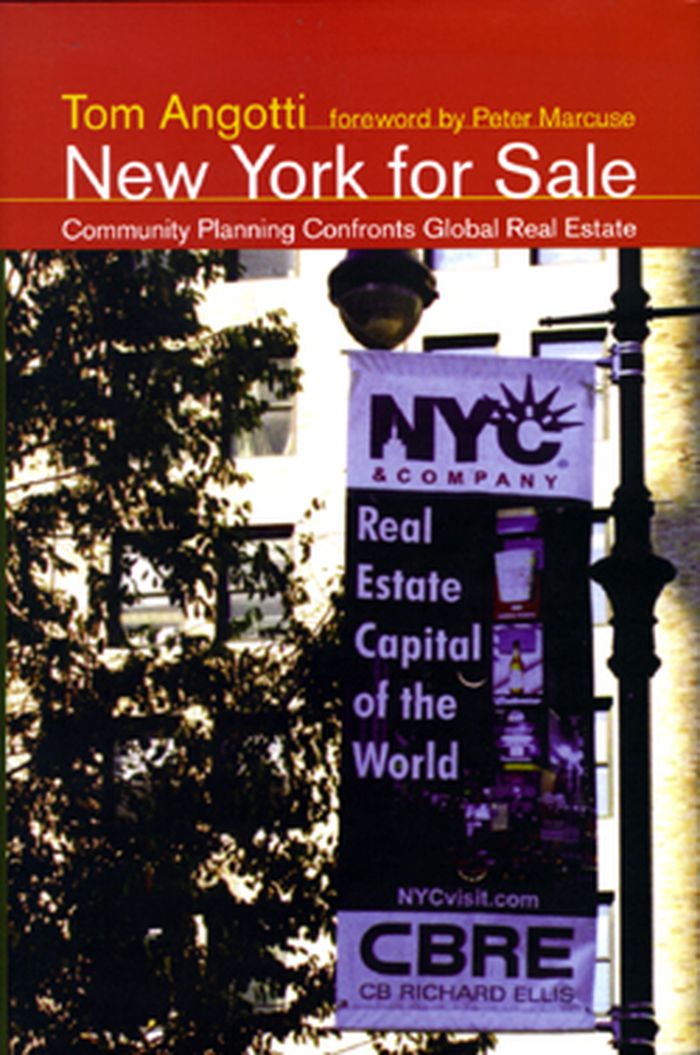
In New York for Sale, Tom Angotti tells some of the stories of community planning in New York City: how activists moved beyond simple protests and began to formulate community plans to protect neighborhoods against urban renewal, real estate mega-projects, gentrification, and environmental hazards. Angotti, both observer of and longtime participant in New York community(...)
Titre:
New York for sale: community planning confronts global real estate
Actions:
Prix:
$24.95
(disponible sur commande)
Résumé:
In New York for Sale, Tom Angotti tells some of the stories of community planning in New York City: how activists moved beyond simple protests and began to formulate community plans to protect neighborhoods against urban renewal, real estate mega-projects, gentrification, and environmental hazards. Angotti, both observer of and longtime participant in New York community planning, focuses on the close relationships among community planning, political strategy, and control over land. After describing the political economy of New York City real estate, its close ties to global financial capital, and the roots of community planning in social movements and community organizing, Angotti turns to specifics. He tells of two pioneering plans forged in reaction to urban renewal plans (including the first community plan in the city, the 1961 Cooper Square Alternate Plan—a response to a Robert Moses urban renewal scheme); struggles for environmental justice, including battles over incinerators, sludge, and garbage; plans officially adopted by the city; and plans dominated by powerful real estate interests. Finally, Angotti proposes strategies for progressive, inclusive community planning not only for New York City but for anywhere that neighborhoods want to protect themselves and their land. New York for Sale teaches the empowering lesson that community plans can challenge market-driven development even in global cities with powerful real estate industries.
Classification:
livres
livres
Publication:
novembre 2008, Cambridge, London
novembre 2008, Cambridge, London
Sujet:
Théorie de l’urbanisme
Théorie de l’urbanisme
Classification:
livres
livres
Actions:
Exemplaires:
Description:
320 pages : illustrations ; 29 cm
Description:
320 pages : illustrations ; 29 cm
Auteur:
Sujet:
Publication:
New York : Thames & Hudson, 2026., ©2026
New York : Thames & Hudson, 2026., ©2026
Titre:
The iconic Nordic house : modern masterworks since 1900 / Dominic Bradbury ; photography by Richard Powers.
Actions:
Exemplaires:
Description:
320 pages : illustrations ; 29 cm
The iconic Nordic house : modern masterworks since 1900 / Dominic Bradbury ; photography by Richard Powers.
Actions:
Exemplaires:
Description:
320 pages : illustrations ; 29 cm
Classification:
livres
livres
Publication:
New York : Thames & Hudson, 2026., ©2026
New York : Thames & Hudson, 2026., ©2026
Auteur:
Sujet:
Classification:
livres
livres
Prix:
$63.00
(disponible sur commande)
Résumé:
In this book, Larry Ford casts a critical and practiced eye on sixteen contemporary urban centers to offer an expert's view of the best--and worst--of downtown America. Ford begins with a brief history of U.S. urban development. He then explains his criteria for evaluating downtowns before proceeding with an on-the-street examination of the featured sixteen cities.(...)
Titre:
America's new downtown : revitalization or reinvention ?
Actions:
Prix:
$63.00
(disponible sur commande)
Résumé:
In this book, Larry Ford casts a critical and practiced eye on sixteen contemporary urban centers to offer an expert's view of the best--and worst--of downtown America. Ford begins with a brief history of U.S. urban development. He then explains his criteria for evaluating downtowns before proceeding with an on-the-street examination of the featured sixteen cities. Each is rated based on use of physical site, particularly for housing (unlike suburbs, Ford notes, most downtowns are located in challenging physical locales, such as harbors, rivers, hills, or peninsulas), street morphology, civic space, functional aspects (office space, retail stores, and convention centers), and the support districts in the fringe areas surrounding the downtown core. Ford concludes with a suggested model of downtown structure based upon the case studies and with a look at the possible effects of increasing globalization on the downtowns of the late twenty-first century. Featured cities: Atlanta, Baltimore, Charlotte, Cleveland, Columbus, Denver, Indianapolis, Minneapolis, Phoenix, Pittsburgh, Portland, Providence, San Antonio, San Diego, Seattle, and St. Louis.
Classification:
livres
livres
Publication:
juillet 2003, Baltimore / London
juillet 2003, Baltimore / London
Sujet:
Théorie de l’urbanisme
Théorie de l’urbanisme
Classification:
livres
livres

Actions:
Prix:
$41.99
(disponible sur commande)
Résumé:
In Nairobi’s underserved neighborhoods, “hustle” has emerged as both a vital survival strategy and a way of life for youth. Exploring the multiple meanings and manifestations of the hustle economy across different scenarios of provisioning, distribution, exchange, learning, and mobilizing, ''Hustle Urbanism'' draws on more than a decade of ethnographic engagement to(...)
Titre:
Hustle urbanism: Making life work in Nairobi
Actions:
Prix:
$41.99
(disponible sur commande)
Résumé:
In Nairobi’s underserved neighborhoods, “hustle” has emerged as both a vital survival strategy and a way of life for youth. Exploring the multiple meanings and manifestations of the hustle economy across different scenarios of provisioning, distribution, exchange, learning, and mobilizing, ''Hustle Urbanism'' draws on more than a decade of ethnographic engagement to center the logics, perspectives, and inventive strategies of a group of youth who constantly navigate job scarcity, inadequate basic services, and climate-induced harms. Tatiana Thieme shows how young people develop tools of resistance against the legacies of colonial violence and uneven urban development while carving out spaces of opportunity for themselves and their peers. The stories she includes bring thick ethnographic detail and longitudinal perspective to the lives and livelihoods of youth whose diverse skill sets and knowledges span from circular economies and eco-activism to hip hop and local leadership. Filling a significant gap in both existing scholarship and popular discussion, ''Hustle Urbanism'' offers critical theorization of precarious urban environments and the affirmative modes of making life work in the city against the odds.
Classification:
livres
livres
Publication:
juin 2025
juin 2025
Sujet:
Théorie de l’urbanisme
Théorie de l’urbanisme
Classification:
livres
livres
Actions:
Prix:
$34.95
(disponible sur commande)
Résumé:
Urban gambling, linked to poverty, crime and corruption, was once considered a blight on U.S. cities. Gambling then followed the exodus of Americans into the suburbs after World War II, and now most Americans live within a four-hour drive of a casino. What explains the success of places like Las Vegas? The self-contained casino resort removes gambling and its social(...)
Sujet:
Théorie de l’urbanisme
Théorie de l’urbanisme
Publication:
juillet 2003, New York / London
juillet 2003, New York / London
Titre:
Suburban Xanadu : the casino resort on the Las Vegas strip and beyond
Actions:
Prix:
$34.95
(disponible sur commande)
Résumé:
Urban gambling, linked to poverty, crime and corruption, was once considered a blight on U.S. cities. Gambling then followed the exodus of Americans into the suburbs after World War II, and now most Americans live within a four-hour drive of a casino. What explains the success of places like Las Vegas? The self-contained casino resort removes gambling and its social problems from cities and provides Americans the comfort of gambling in a setting matched to their suburban lifestyle. In a detailed look at the growth of the earliest casino resorts to the "pleasure palaces" and riverboat casinos of today, "Suburban Xanadu" locates the rise of the casino resort in suburbanization and the significance of this development for today.
Classification:
livres
livres
Publication:
juillet 2003, New York / London
juillet 2003, New York / London
Sujet:
Théorie de l’urbanisme
Théorie de l’urbanisme
Classification:
livres
livres
Titre:
Sprawl : a compact history
Sprawl : a compact history
Actions:
Prix:
$34.50
(disponible sur commande)
Résumé:
As anyone who has flown into Los Angeles at dusk or Houston at midday knows, urban areas today defy traditional notions of what a city is. Our old definitions of urban, suburban, and rural fail to capture the complexity of these vast regions with their superhighways, subdivisions, industrial areas, office parks, and resort areas pushing far out into the countryside.(...)
Titre:
Sprawl : a compact history
Actions:
Prix:
$34.50
(disponible sur commande)
Résumé:
As anyone who has flown into Los Angeles at dusk or Houston at midday knows, urban areas today defy traditional notions of what a city is. Our old definitions of urban, suburban, and rural fail to capture the complexity of these vast regions with their superhighways, subdivisions, industrial areas, office parks, and resort areas pushing far out into the countryside. Detractors call it sprawl and assert that it is economically inefficient, socially inequitable, environmentally irresponsible, and aesthetically ugly. Robert Bruegmann calls it a logical consequence of economic growth and the democratization of society, with benefits that urban planners have failed to recognize. In his history of the expanded city, Bruegmann overturns every assumption we have about sprawl. Taking a long view of urban development, he demonstrates that sprawl is neither recent nor particularly American but as old as cities themselves, just as characteristic of ancient Rome and eighteenth-century Paris as it is of Atlanta or Los Angeles. Nor is sprawl the disaster claimed by many contemporary observers. Although sprawl, like any settlement pattern, has undoubtedly produced problems that must be addressed, it has also provided millions of people with the kinds of mobility, privacy, and choice that were once the exclusive prerogatives of the rich and powerful. The first major book to strip urban sprawl of its pejorative connotations, Sprawl offers a completely new vision of the city and its growth. Bruegmann leads readers to the powerful conclusion that ''in its immense complexity and constant change, the city-whether dense and concentrated at its core, looser and more sprawling in suburbia, or in the vast tracts of exurban penumbra that extend dozens, even hundreds, of miles-is the grandest and most marvelous work of mankind.''
Classification:
livres
livres
Publication:
octobre 2005, Chicago, London
octobre 2005, Chicago, London
Sujet:
Théorie de l’urbanisme
Théorie de l’urbanisme
Classification:
livres
livres
Actions:
Prix:
$37.50
(disponible sur commande)
Résumé:
Although the seemingly apocalyptic scale of the World Trade Center disaster continues to haunt people across the globe, it is only the most recent example of a city tragically wounded. Cities are, in fact, perpetually caught up in cycles of degeneration and renewal. As with the WTC, from time to time these cycles are severely ruptured by a sudden, unpredictable event.(...)
Titre:
Wounded cities : destruction and reconstruction in a globalized world
Actions:
Prix:
$37.50
(disponible sur commande)
Résumé:
Although the seemingly apocalyptic scale of the World Trade Center disaster continues to haunt people across the globe, it is only the most recent example of a city tragically wounded. Cities are, in fact, perpetually caught up in cycles of degeneration and renewal. As with the WTC, from time to time these cycles are severely ruptured by a sudden, unpredictable event. In the wake of recent terrorist activities, this timely book explores how urban populations are affected by "wounds" inflicted through violence, civil wars, overbuilding, drug trafficking, and the collapse of infrastructures, as well as "natural" disasters such as earthquakes. Mexico City, New York, Beirut, Belfast, Bangkok and Baghdad are just a few examples of cities riddled with problems that undermine, on a daily basis, the quality of urban life. What does it mean for urban dwellers when the infrastructure of a city collapses – transport, communication grids, heat, light, roads, water, and sanitation? What are the effects of foreign investment and huge construction projects on urban populations and how does this change the "look" and character of a city? How does drug trafficking intersect with class, race, and gender, and what impact does it have on vulnerable urban communities? How do political corruption and mafia networks distort the built environment? Drawing on in-depth case studies from across the globe, this book answers these intriguing questions through its rigorous consideration of changing global and national contexts, social movements, and corrosive urban events. Adopting a "grass roots up" approach, it places emphasis on people’s experiences of uneven development and inequality, their engagement with memory in the face of continual change, and the relevance of political activism to bettering their lives. It is especially attentive to the historical interaction of particular cities with wider political and economic forces, as these interactions have shaped local governance over time. Imagining each city as a "body politic", the authors consider its capacity both to mediate local conflict and to broach the healing of wounds.
Classification:
livres
livres
Publication:
août 2003, Oxford
août 2003, Oxford
Sujet:
Théorie de l’urbanisme
Théorie de l’urbanisme
Classification:
livres
livres
Actions:
Exemplaires:
Description:
271 pages : color illustrations, plans ; 31 cm + 1 CD-ROM (4 3/4 in.)
Description:
271 pages : color illustrations, plans ; 31 cm + 1 CD-ROM (4 3/4 in.)
Auteur:
Sujet:
Publication:
Washington, DC : Grayson Pub., 2002.
Washington, DC : Grayson Pub., 2002.
Titre:
David M. Schwarz/Architectural Services / preface by Vincent Scully ; introduction by Robert A.M. Stern ; project text by Bradford McKee.
Actions:
Exemplaires:
Description:
271 pages : color illustrations, plans ; 31 cm + 1 CD-ROM (4 3/4 in.)
David M. Schwarz/Architectural Services / preface by Vincent Scully ; introduction by Robert A.M. Stern ; project text by Bradford McKee.
Actions:
Exemplaires:
Description:
271 pages : color illustrations, plans ; 31 cm + 1 CD-ROM (4 3/4 in.)
Classification:
livres
livres
Publication:
Washington, DC : Grayson Pub., 2002.
Washington, DC : Grayson Pub., 2002.
Auteur:
Sujet:
Classification:
livres
livres
Actions:
Prix:
$67.95
(disponible en magasin)
Résumé:
Munich, notorious in recent history as the capital of the Nazi movement, is the site of Gavriel Rosenfeld's inquiry into the German collective memory of the Third Reich. Rosenfeld shows, with how the city's urban form developed after 1945 in direct reflection of its inhabitants'(...)
Titre:
Munich and memory : architecture, monuments, and the legacy of the third Reich
Actions:
Prix:
$67.95
(disponible en magasin)
Résumé:
Munich, notorious in recent history as the capital of the Nazi movement, is the site of Gavriel Rosenfeld's inquiry into the German collective memory of the Third Reich. Rosenfeld shows, with how the city's urban form developed after 1945 in direct reflection of its inhabitants' evolving memory of the Second World War and the Nazi dictatorship. In the second half of the twentieth century, the German people's struggle to come to terms with the legacy of Nazism has dramatically shaped nearly all dimensions of their political, social, and cultural life. The area of urban development and the built environment, little explored until now, offers visible evidence of the struggle. By examining the ways in which the people of Munich reconstructed the ruins of their historic buildings, created new works of architecture, dealt with surviving Nazi buildings, and erected new monuments to commemorate the horrors of the recent past, Rosenfeld identifies a spectrum of competing memories of the Nazi experience. Examining the debates between traditionalists, modernists, postmodernists, and critical preservationists, Rosenfeld shows that the memory of Nazism in Munich has never been "repressed" but has rather been defined by constant dissension and evolution. On balance, however, he concludes that Munich came to embody in its urban form a conservative view of the past that was inclined to diminish local responsibility for the Third Reich.
Classification:
livres
livres
Publication:
avril 2000, Berkeley
avril 2000, Berkeley
Sujet:
Théorie de l’urbanisme
Théorie de l’urbanisme


