


471 Résultats
Classification:
livres
livres
Actions:
Prix:
$71.95
(disponible sur commande)
Résumé:
It was at Black Mountain College that Merce Cunningham formed his dance company, John Cage staged his first "happening," and Buckminster Fuller built his first dome. Although it lasted only twenty-four years (1933-1957) and enrolled fewer than 1,200 students, Black Mountain College launched a remarkable number of the artists who spearheaded the avant-garde in America of(...)
Publication:
mai 2002, Cambridge, Mass.
mai 2002, Cambridge, Mass.
Titre:
The arts at Black Mountain College
Actions:
Prix:
$71.95
(disponible sur commande)
Résumé:
It was at Black Mountain College that Merce Cunningham formed his dance company, John Cage staged his first "happening," and Buckminster Fuller built his first dome. Although it lasted only twenty-four years (1933-1957) and enrolled fewer than 1,200 students, Black Mountain College launched a remarkable number of the artists who spearheaded the avant-garde in America of the 1960s. The faculty included such diverse talents as Anni and Josef Albers, Eric Bentley, Ilya Bolotowsky, Robert Creeley, Willem de Kooning, Robert Duncan, Lyonel Feininger, Paul Goodman, Walter Gropius, Franz Kline, Robert Motherwell, and Charles Olson. Among the students were Ruth Asawa, John Chamberlain, Francine du Plessix Gray, Kenneth Noland, Arthur Penn, Robert Rauschenberg, Kenneth Snelson, Cy Twombly, Stan Vanderbeek, and Jose Yglesias. In this definitive account of the arts at Black Mountain College, back in print after many years, Mary Emma Harris describes a unique educational experiment and the artists and writers who conducted it. She replaces the myth of the college as a haphazardly conceived venture with a portrait of a consciously directed liberal arts school that grew out of the progressive education movement. Proceeding chronologically through the four major periods of the college’s history, Harris covers every aspect of its extraordinary curriculum in the visual, literary, and performing arts.
Classification:
livres
livres
Publication:
mai 2002, Cambridge, Mass.
mai 2002, Cambridge, Mass.
Classification:
livres
livres

Actions:
Prix:
$48.00
(disponible sur commande)
Résumé:
In a sweeping panorama, Weatherland allows us to witness England’s cultural climates across the centuries. Before the Norman Conquest, Anglo-Saxons living in a wintry world wrote about the coldness of exile or the shelters they had to defend against enemies outside. The Middle Ages brought the warmth of spring; the new lyrics were sung in praise of blossoms and cuckoos.(...)
Titre:
Weatherland: writers and artists under English skies
Actions:
Prix:
$48.00
(disponible sur commande)
Résumé:
In a sweeping panorama, Weatherland allows us to witness England’s cultural climates across the centuries. Before the Norman Conquest, Anglo-Saxons living in a wintry world wrote about the coldness of exile or the shelters they had to defend against enemies outside. The Middle Ages brought the warmth of spring; the new lyrics were sung in praise of blossoms and cuckoos. Descriptions of a rainy night are rare before 1700, but by the end of the eighteenth century the Romantics had adopted the squall as a fit subject for their most probing thoughts. The weather is vast and yet we experience it intimately, and Alexandra Harris builds her story from small evocative details. There is the drawing of a twelfth-century man in February, warming bare toes by the fire. There is the tiny glass left behind from the Frost Fair of 1684, and the Sunspan house in Angmering that embodies the bright ambitions of the 1930s. Harris catches the distinct voices of compelling individuals. “Bloody cold,” says Jonathan Swift in the “slobbery” January of 1713. Percy Shelley wants to become a cloud and John Ruskin wants to bottle one. Weatherland is a celebration of English air and a life story of those who have lived in it.
Classification:
livres
livres
Publication:
mars 2016
mars 2016
Sujet:
Théorie de l’art
Théorie de l’art
Classification:
livres
livres
Actions:
Exemplaires:
Description:
xii, 375 pages : illustrations (some color), color maps ; 26 cm.
Description:
xii, 375 pages : illustrations (some color), color maps ; 26 cm.
Auteur:
Sujet:
Publication:
Philadelphia : University of Pennsylvania Press, ©2006.
Philadelphia : University of Pennsylvania Press, ©2006.
Titre:
Rebuilding urban places after disaster : lessons from Hurricane Katrina / edited by Eugenie L. Birch and Susan M. Wachter.
Actions:
Exemplaires:
Description:
xii, 375 pages : illustrations (some color), color maps ; 26 cm.
Rebuilding urban places after disaster : lessons from Hurricane Katrina / edited by Eugenie L. Birch and Susan M. Wachter.
Actions:
Exemplaires:
Description:
xii, 375 pages : illustrations (some color), color maps ; 26 cm.
Classification:
livres
livres
Publication:
Philadelphia : University of Pennsylvania Press, ©2006.
Philadelphia : University of Pennsylvania Press, ©2006.
Auteur:
Sujet:
Classification:
livres
livres
Actions:
Exemplaires:
Description:
238 pages ; 21 cm.
Description:
238 pages ; 21 cm.
Auteur:
Sujet:
Publication:
London : Whitechapel Gallery ; Cambridge, Massachusetts : MIT Press, [2009]
London : Whitechapel Gallery ; Cambridge, Massachusetts : MIT Press, [2009]
Classification:
livres
livres
Publication:
London : Whitechapel Gallery ; Cambridge, Massachusetts : MIT Press, [2009]
London : Whitechapel Gallery ; Cambridge, Massachusetts : MIT Press, [2009]
Auteur:
Sujet:
Classification:
livres
livres

Actions:
Prix:
$39.95
(disponible en magasin)
Résumé:
En 1726, Lord Burlington, fervent admirateur d'Andrea Palladio, architecte italien du XVIe siècle, entrepris de transformer radicalement une modeste demeure du XVIIe siècle donnant sur la Tamise à l'ouest de Londres. Il a voulu édifier une "villa" dans le sens plein du terme. Dix ans auparavant, Lord Burlington avait entièrement rénové son hôtel particulier(...)
Titre:
Le Renouveau Palladien : la villa et les jardins de Lord Burlington à Chiswick
Actions:
Prix:
$39.95
(disponible en magasin)
Résumé:
En 1726, Lord Burlington, fervent admirateur d'Andrea Palladio, architecte italien du XVIe siècle, entrepris de transformer radicalement une modeste demeure du XVIIe siècle donnant sur la Tamise à l'ouest de Londres. Il a voulu édifier une "villa" dans le sens plein du terme. Dix ans auparavant, Lord Burlington avait entièrement rénové son hôtel particulier à Londres en s'inspirant également de Palladio. Cette résidence, Burlington House, a contribué à lancer, avec Chiswick, un goût nouveau en architecture qui devait par la suite s'étendre à toute l'Angleterre et à l'Amérique du nord. Cette exposition, tout comme le catalogue qui l'accompagne, retrace l'élaboration d'un tout nouveau style architectural.
Classification:
livres
livres
Publication:
juillet 1994, Montréal / New Haven
juillet 1994, Montréal / New Haven
Sujet:
Publications du CCA
Publications du CCA
Classification:
livres
livres

Actions:
Prix:
$39.95
(disponible en magasin)
Résumé:
In 1726, Lord Burlington, informed by a profound admiration for the architecture of the sixteenth-century Italian, Andrea Palladio, proceeded to raise a free standing "villa" on the outskirts of London. Together with his own town house in Piccadilly, which ten years earlier had undergone major alterations similarly inspired by Palladio, this building(...)
Titre:
The Palladian revival: Lord Burlington, his villa and garden at Chiswick
Actions:
Prix:
$39.95
(disponible en magasin)
Résumé:
In 1726, Lord Burlington, informed by a profound admiration for the architecture of the sixteenth-century Italian, Andrea Palladio, proceeded to raise a free standing "villa" on the outskirts of London. Together with his own town house in Piccadilly, which ten years earlier had undergone major alterations similarly inspired by Palladio, this building launched a new taste in architecture which was to spread throughout Britain and North America. This exhibition catalogue traces the establishment of a radical new style in architecture.
Classification:
livres
livres
Publication:
juillet 1994, Montréal / New Haven
juillet 1994, Montréal / New Haven
Sujet:
Publications du CCA
Publications du CCA
Classification:
livres
livres
Actions:
Prix:
$67.50
(disponible sur commande)
Résumé:
In 1726, Lord Burlington, informed by a profound admiration for the architecture of the sixteenth-century Italian, Andrea Palladio, proceeded to raise a free standing "villa" on the outskirts of London. Together with his own town house in Piccadilly, which ten years earlier had undergone major alterations similarly inspired by Palladio, this building(...)
Titre:
The Palladian Revival : Lord Burlington, his villa and garden at Chiswick
Actions:
Prix:
$67.50
(disponible sur commande)
Résumé:
In 1726, Lord Burlington, informed by a profound admiration for the architecture of the sixteenth-century Italian, Andrea Palladio, proceeded to raise a free standing "villa" on the outskirts of London. Together with his own town house in Piccadilly, which ten years earlier had undergone major alterations similarly inspired by Palladio, this building launched a new taste in architecture which was to spread throughout Britain and North America. This exhibition catalogue traces the establishment of a radical new style in architecture.
Classification:
livres
livres
Publication:
juin 1994, Montréal / New Haven
juin 1994, Montréal / New Haven
Sujet:
Histoire jusqu’à 1900
Histoire jusqu’à 1900
Classification:
livres
livres
Actions:
Exemplaires:
Description:
[8], 372 p., [5] leaves of plates (4 folded) : ill., map, plan ; 20 cm. (8vo)
Description:
[8], 372 p., [5] leaves of plates (4 folded) : ill., map, plan ; 20 cm. (8vo)
Auteur:
Sujet:
Publication:
London : Printed for Robert Gosling, at the Middle Temple Gate in Fleet-street, MDCCXXI. [1721]
London : Printed for Robert Gosling, at the Middle Temple Gate in Fleet-street, MDCCXXI. [1721]
Titre:
A survey of the Cathedral Church. of Bangor; and the edifices belonging to it : Containing, an account of all the inscriptions on the monuments and gravestones: the history of the bishops, deans, and other dignitaries: their several preferments, times of decease, burial, and epitaphs. Together with a large appendix of records, and other curious matters relating to Bangor Church and bishoprick: as namely, the dedications of all the churches and chapels in the diocess on Bangor; and descriptions of Clynocfawr church and Bodowen chapel. To which is also subjoined several supplementary additions and records to the like history of St. Asaph Cathedral, some time since published: the dedications of the churches and chapels in that diocess; and descriptions of Gresford and Mould Churches / Collected by Browne Willis, Esq; illustrated with draughts of the ichnography and upright of Bangor cathedral, and view of Bodowen chapel.
Actions:
Exemplaires:
Description:
[8], 372 p., [5] leaves of plates (4 folded) : ill., map, plan ; 20 cm. (8vo)
Classification:
livres
livres
Publication:
London : Printed for Robert Gosling, at the Middle Temple Gate in Fleet-street, MDCCXXI. [1721]
London : Printed for Robert Gosling, at the Middle Temple Gate in Fleet-street, MDCCXXI. [1721]
Auteur:
Sujet:
Classification:
livres
livres
Exemplaires:
Description:
xvii, 297 pages : illustrations ; 24 cm
Description:
xvii, 297 pages : illustrations ; 24 cm
Auteur:
Sujet:
Publication:
Princeton, New Jersey : Princeton University Press, [2020], ©2020
Princeton, New Jersey : Princeton University Press, [2020], ©2020
Titre:
Lives of houses / edited by Kate Kennedy and Hermione Lee.
Actions:
Exemplaires:
Description:
xvii, 297 pages : illustrations ; 24 cm
Lives of houses / edited by Kate Kennedy and Hermione Lee.
Actions:
Exemplaires:
Description:
xvii, 297 pages : illustrations ; 24 cm
Classification:
livres
livres
Publication:
Princeton, New Jersey : Princeton University Press, [2020], ©2020
Princeton, New Jersey : Princeton University Press, [2020], ©2020
Auteur:
Sujet:
Classification:
livres
livres
Actions:
Prix:
$80.50
(disponible sur commande)
Résumé:
Brought up in Sweden by Scottish parents, trained in France, a regular visitor to China and India, Sir William Chambers (1726-1796) was by far the most internationally minded British architect of his time. Settling in London in 1755, Chambers became a favorite of King George III and went on to hold the highest official architectural offices and to build public and private(...)
Sujet:
livres soldés
livres soldés
Publication:
octobre 1996, New Haven, London
octobre 1996, New Haven, London
Titre:
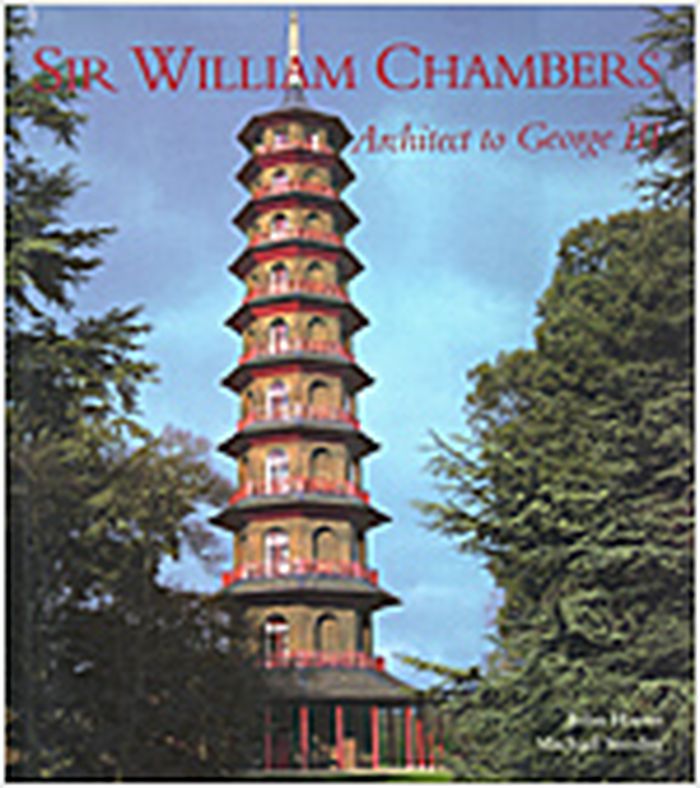
Sir William Chambers : architect to George III
Actions:
Prix:
$80.50
(disponible sur commande)
Résumé:
Brought up in Sweden by Scottish parents, trained in France, a regular visitor to China and India, Sir William Chambers (1726-1796) was by far the most internationally minded British architect of his time. Settling in London in 1755, Chambers became a favorite of King George III and went on to hold the highest official architectural offices and to build public and private commissions throughout the British Isles. Because of his eclectic neo-Palladian style, seminal Treatise on Civil Architecture (1759), and longterm influence through his numerous pupils, Chambers was regarded as one of the two greatest architects of late eighteenth-century Britain, sharing the honor with the more prolific Robert Adam. In this wide-ranging book, leading scholars of the period present current research on Chambers' Scandinavian and French connections; his Italian studies and projects; his relationship with British royalty; his commissioned buildings, interiors, and gardens; his furniture and metalwork designs; and his Treatise. Chambers designed and commanded works at Buckingham House, Kew, Richmond, and Windsor Castle, and was commissioned in 1774 to design the public offices at Somerset House in London. Charged with creating "an object of national splendour as well as convenience," Chambers met the challenge with a building equal to the best of those created by the French architects with whom he had trained. Selecting the highest quality materials, ornamentation, and painted decoration for Somerset House, Chambers' building showcased the best in British craftsmanship. This book was the catalogue for a William Chambers exhibition mounted in fall 1996 by the Courtauld Institute Galleries at Somerset House, their new home.
Classification:
livres
livres
Publication:
octobre 1996, New Haven, London
octobre 1996, New Haven, London
Sujet:
livres soldés
livres soldés


