


5194 Résultats
Classification:
livres
livres
Actions:
Prix:
$19.95
(disponible sur commande)
Résumé:
Where do we come from? What are we? Where are we going? Few expressions in the culture of human thought have the iconic stature, and emotive power, that the word "evolution" entails. Though commonly relegated to modern-day science, the concept of evolution is ingrained in representations of life and nature in the visual arts, and artists and scientists have much to share(...)
$19.95
(disponible sur commande)
Résumé:
Where do we come from? What are we? Where are we going? Few expressions in the culture of human thought have the iconic stature, and emotive power, that the word "evolution" entails. Though commonly relegated to modern-day science, the concept of evolution is ingrained in representations of life and nature in the visual arts, and artists and scientists have much to share(...)
Titre:
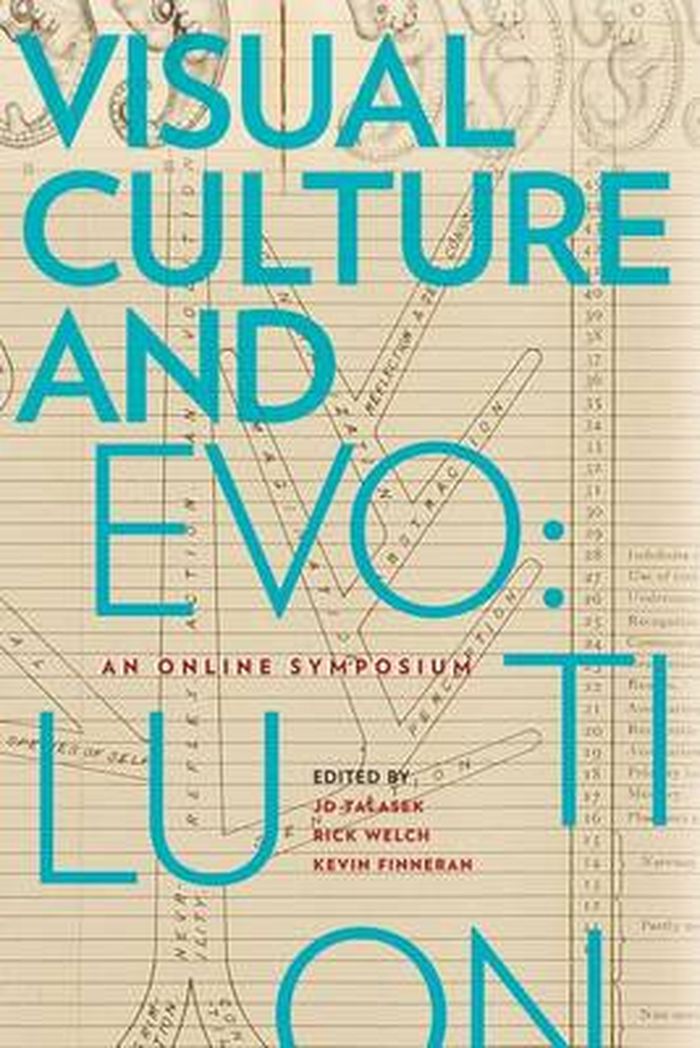
Visual culture and evolution : an online symposium
Actions:
Prix:
$19.95
(disponible sur commande)
Résumé:
Where do we come from? What are we? Where are we going? Few expressions in the culture of human thought have the iconic stature, and emotive power, that the word "evolution" entails. Though commonly relegated to modern-day science, the concept of evolution is ingrained in representations of life and nature in the visual arts, and artists and scientists have much to share on the meaning of human origin, human existence and human fate. The present volume documents an online symposium, Visual Culture and Evolution, in which a distinguished panel of artists, curators, scientists, historians, educators, media theorists and critics participated in a lively, informative conversation on the interface of art and science.
Visual culture and evolution : an online symposium
Actions:
Prix:
$19.95
(disponible sur commande)
Résumé:
Where do we come from? What are we? Where are we going? Few expressions in the culture of human thought have the iconic stature, and emotive power, that the word "evolution" entails. Though commonly relegated to modern-day science, the concept of evolution is ingrained in representations of life and nature in the visual arts, and artists and scientists have much to share on the meaning of human origin, human existence and human fate. The present volume documents an online symposium, Visual Culture and Evolution, in which a distinguished panel of artists, curators, scientists, historians, educators, media theorists and critics participated in a lively, informative conversation on the interface of art and science.
Classification:
livres
livres
Publication:
mars 2012
mars 2012
Sujet:
Théorie de l’art
Théorie de l’art
Classification:
livres
livres

Titre:
Economic science fictions
Economic science fictions
Actions:
Prix:
$29.00
(disponible sur commande)
Résumé:
From the libertarian economics of Ayn Rand to Aldous Huxley’s consumerist dystopias, economics and science fiction have often orbited each other. In "Economic Science Fictions", editor William Davies has deliberately merged the two worlds, asking how we might harness the power of the utopian imagination to revitalise economic thinking. Rooted in the sense that our current(...)
$29.00
(disponible sur commande)
Résumé:
From the libertarian economics of Ayn Rand to Aldous Huxley’s consumerist dystopias, economics and science fiction have often orbited each other. In "Economic Science Fictions", editor William Davies has deliberately merged the two worlds, asking how we might harness the power of the utopian imagination to revitalise economic thinking. Rooted in the sense that our current(...)
Titre:
Economic science fictions
Actions:
Prix:
$29.00
(disponible sur commande)
Résumé:
From the libertarian economics of Ayn Rand to Aldous Huxley’s consumerist dystopias, economics and science fiction have often orbited each other. In "Economic Science Fictions", editor William Davies has deliberately merged the two worlds, asking how we might harness the power of the utopian imagination to revitalise economic thinking. Rooted in the sense that our current economic reality is no longer credible or viable, this collection treats our economy as a series of fictions and science fiction as a means of anticipating different economic futures. It asks how science fiction can motivate new approaches to economics and provides surprising new syntheses, merging social science with fiction, design with politics, scholarship with experimental forms.
Economic science fictions
Actions:
Prix:
$29.00
(disponible sur commande)
Résumé:
From the libertarian economics of Ayn Rand to Aldous Huxley’s consumerist dystopias, economics and science fiction have often orbited each other. In "Economic Science Fictions", editor William Davies has deliberately merged the two worlds, asking how we might harness the power of the utopian imagination to revitalise economic thinking. Rooted in the sense that our current economic reality is no longer credible or viable, this collection treats our economy as a series of fictions and science fiction as a means of anticipating different economic futures. It asks how science fiction can motivate new approaches to economics and provides surprising new syntheses, merging social science with fiction, design with politics, scholarship with experimental forms.
Classification:
livres
livres
Publication:
mars 2019
mars 2019
Sujet:
Théorie/ philosophie
Théorie/ philosophie
Classification:
livres
livres

Actions:
Prix:
$25.00
(disponible sur commande)
Résumé:
Published in 1872, ''The Expression of the Emotions in Man and Animals'' was a book at the very heart of Darwin's research interests - a central pillar of his 'human' series. This book engaged some of the hardest questions in the evolution debate, and it showed the ever-cautious Darwin at his boldest. If Darwin had one goal with ''Expression,'' it was to demonstrate the(...)
$25.00
(disponible sur commande)
Résumé:
Published in 1872, ''The Expression of the Emotions in Man and Animals'' was a book at the very heart of Darwin's research interests - a central pillar of his 'human' series. This book engaged some of the hardest questions in the evolution debate, and it showed the ever-cautious Darwin at his boldest. If Darwin had one goal with ''Expression,'' it was to demonstrate the(...)
Titre:
The expression of the emotions in man and animals
Actions:
Prix:
$25.00
(disponible sur commande)
Résumé:
Published in 1872, ''The Expression of the Emotions in Man and Animals'' was a book at the very heart of Darwin's research interests - a central pillar of his 'human' series. This book engaged some of the hardest questions in the evolution debate, and it showed the ever-cautious Darwin at his boldest. If Darwin had one goal with ''Expression,'' it was to demonstrate the power of his theories for explaining the origin of our most cherished human qualities: morality and intellect. As Darwin explained, "He who admits, on general grounds, that the structure and habits of all animals have been gradually evolved, will look at the whole subject of 'Expression' in a new and interesting light."
The expression of the emotions in man and animals
Actions:
Prix:
$25.00
(disponible sur commande)
Résumé:
Published in 1872, ''The Expression of the Emotions in Man and Animals'' was a book at the very heart of Darwin's research interests - a central pillar of his 'human' series. This book engaged some of the hardest questions in the evolution debate, and it showed the ever-cautious Darwin at his boldest. If Darwin had one goal with ''Expression,'' it was to demonstrate the power of his theories for explaining the origin of our most cherished human qualities: morality and intellect. As Darwin explained, "He who admits, on general grounds, that the structure and habits of all animals have been gradually evolved, will look at the whole subject of 'Expression' in a new and interesting light."
Classification:
livres
livres
Publication:
mars 2009
mars 2009
Sujet:
Expositions en cours
Expositions en cours
Classification:
livres
livres
Actions:
Prix:
$37.95
(disponible sur commande)
Résumé:
Le Louvre à Abu Dhabi, Art Basel à Miami, les tulipes de Jeff Koons à Paris sont autant de manifestations de l'art contemporain comme outil d'influence. Marqueur de puissance, l'art mesure le degré d'émancipation d'un pays, son pouvoir d'attraction et sa place dans le monde. Très largement dominée par les États-Unis et, plus largement, le monde occidental depuis le(...)
$37.95
(disponible sur commande)
Résumé:
Le Louvre à Abu Dhabi, Art Basel à Miami, les tulipes de Jeff Koons à Paris sont autant de manifestations de l'art contemporain comme outil d'influence. Marqueur de puissance, l'art mesure le degré d'émancipation d'un pays, son pouvoir d'attraction et sa place dans le monde. Très largement dominée par les États-Unis et, plus largement, le monde occidental depuis le(...)
Titre:
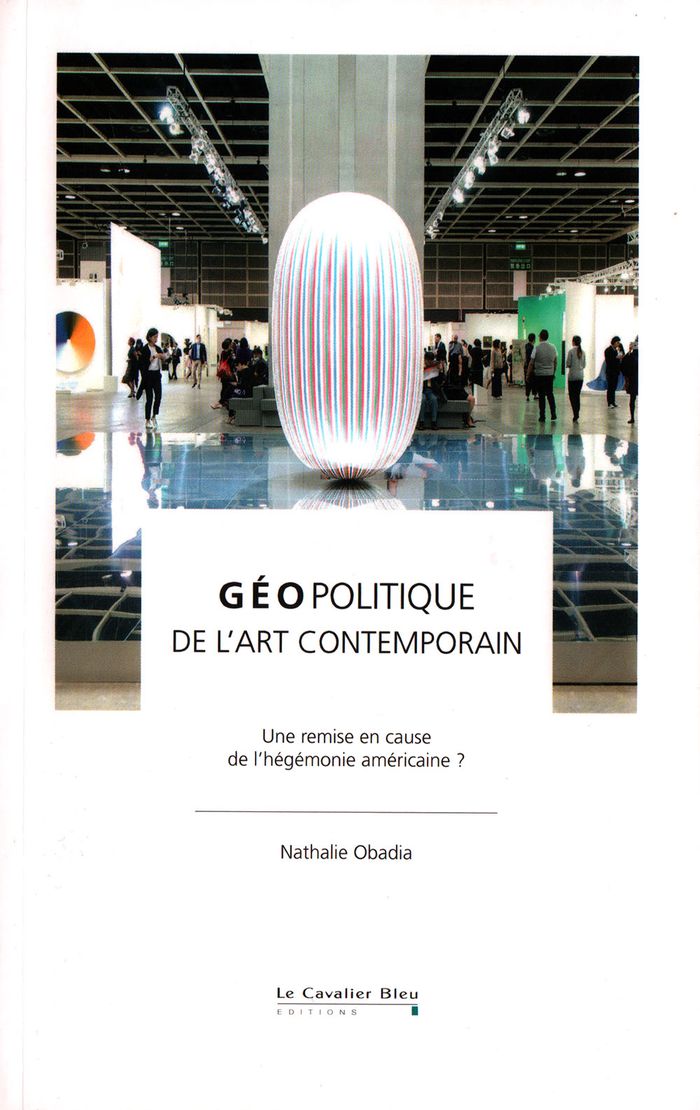
Géopolitique de l'art contemporain
Actions:
Prix:
$37.95
(disponible sur commande)
Résumé:
Le Louvre à Abu Dhabi, Art Basel à Miami, les tulipes de Jeff Koons à Paris sont autant de manifestations de l'art contemporain comme outil d'influence. Marqueur de puissance, l'art mesure le degré d'émancipation d'un pays, son pouvoir d'attraction et sa place dans le monde. Très largement dominée par les États-Unis et, plus largement, le monde occidental depuis le milieu du XXe siècle, la scène artistique s'ouvre peu à peu à de nouvelles puissances, notamment la Chine aux ambitions mondiales déclarées. Étudiant le rôle des différents acteurs, artistes, collectionneurs et musées, Nathalie Obadia analyse l'évolution des liens entre arts plastiques et géopolitique, en questionnant notamment la domination du 'soft power' américain et occidental.
Géopolitique de l'art contemporain
Actions:
Prix:
$37.95
(disponible sur commande)
Résumé:
Le Louvre à Abu Dhabi, Art Basel à Miami, les tulipes de Jeff Koons à Paris sont autant de manifestations de l'art contemporain comme outil d'influence. Marqueur de puissance, l'art mesure le degré d'émancipation d'un pays, son pouvoir d'attraction et sa place dans le monde. Très largement dominée par les États-Unis et, plus largement, le monde occidental depuis le milieu du XXe siècle, la scène artistique s'ouvre peu à peu à de nouvelles puissances, notamment la Chine aux ambitions mondiales déclarées. Étudiant le rôle des différents acteurs, artistes, collectionneurs et musées, Nathalie Obadia analyse l'évolution des liens entre arts plastiques et géopolitique, en questionnant notamment la domination du 'soft power' américain et occidental.
Classification:
livres
livres
Publication:
mars 2019
mars 2019
Sujet:
Théorie de l’art
Théorie de l’art
Classification:
livres
livres

Prix:
$80.00
(disponible en magasin)
Résumé:
Solar energy needs a new narrative - one that says goodbye to old perspectives and only talks about the efficiency and the payback time of blue solar panels. This book is divided into three parts: the first part explains how we designed with the sun in the past, providing a visual timeline of the historical development of solar power. The second part discusses the(...)
$80.00
(disponible en magasin)
Résumé:
Solar energy needs a new narrative - one that says goodbye to old perspectives and only talks about the efficiency and the payback time of blue solar panels. This book is divided into three parts: the first part explains how we designed with the sun in the past, providing a visual timeline of the historical development of solar power. The second part discusses the(...)
Titre:
Solar Futures: How to design a post-fossil world with the sun
Actions:
Prix:
$80.00
(disponible en magasin)
Résumé:
Solar energy needs a new narrative - one that says goodbye to old perspectives and only talks about the efficiency and the payback time of blue solar panels. This book is divided into three parts: the first part explains how we designed with the sun in the past, providing a visual timeline of the historical development of solar power. The second part discusses the present: Where are we now and what is solar design? It provides examples of innovative solar design in architecture, fashion, mobility and product design. Finally, the last part looks at the future and asks how we can ensure solar energy does not become the asbestos of the 21st century.
Solar Futures: How to design a post-fossil world with the sun
Actions:
Prix:
$80.00
(disponible en magasin)
Résumé:
Solar energy needs a new narrative - one that says goodbye to old perspectives and only talks about the efficiency and the payback time of blue solar panels. This book is divided into three parts: the first part explains how we designed with the sun in the past, providing a visual timeline of the historical development of solar power. The second part discusses the present: Where are we now and what is solar design? It provides examples of innovative solar design in architecture, fashion, mobility and product design. Finally, the last part looks at the future and asks how we can ensure solar energy does not become the asbestos of the 21st century.
Classification:
livres
livres
Publication:
octobre 2022
octobre 2022
Sujet:
Architecture écologique
Architecture écologique
Classification:
livres
livres

Prix:
$39.95
(disponible en magasin)
Résumé:
Newspaper articles, speeches, and essays show Sunil Gupta’s crucial role at the center of grassroots queer and postcolonial organizing throughout an artistic career lived between Canada, the UK, and India. In his pieces about homosexuality in Indian cities, the AIDS crisis, the Black Arts Movement, or key figures including Joy Gregory and Robert Mapplethorpe, Gupta(...)
$39.95
(disponible en magasin)
Résumé:
Newspaper articles, speeches, and essays show Sunil Gupta’s crucial role at the center of grassroots queer and postcolonial organizing throughout an artistic career lived between Canada, the UK, and India. In his pieces about homosexuality in Indian cities, the AIDS crisis, the Black Arts Movement, or key figures including Joy Gregory and Robert Mapplethorpe, Gupta(...)
Publication:
novembre 2022
novembre 2022
Titre:
We were here: Sexuality, photography, and cultural difference
Actions:
Prix:
$39.95
(disponible en magasin)
Résumé:
Newspaper articles, speeches, and essays show Sunil Gupta’s crucial role at the center of grassroots queer and postcolonial organizing throughout an artistic career lived between Canada, the UK, and India. In his pieces about homosexuality in Indian cities, the AIDS crisis, the Black Arts Movement, or key figures including Joy Gregory and Robert Mapplethorpe, Gupta foregrounds the power of cultural activism in the politically fraught contexts of London and Delhi, and illuminates the essential connections between queer migration and self-discovery. Continually questioning given forms of identity, Gupta offers artists and curators multiple strategies of resistance, carving out space for new ways of imagining what it might mean to live, love, and create.
We were here: Sexuality, photography, and cultural difference
Actions:
Prix:
$39.95
(disponible en magasin)
Résumé:
Newspaper articles, speeches, and essays show Sunil Gupta’s crucial role at the center of grassroots queer and postcolonial organizing throughout an artistic career lived between Canada, the UK, and India. In his pieces about homosexuality in Indian cities, the AIDS crisis, the Black Arts Movement, or key figures including Joy Gregory and Robert Mapplethorpe, Gupta foregrounds the power of cultural activism in the politically fraught contexts of London and Delhi, and illuminates the essential connections between queer migration and self-discovery. Continually questioning given forms of identity, Gupta offers artists and curators multiple strategies of resistance, carving out space for new ways of imagining what it might mean to live, love, and create.
Classification:
livres
livres
Publication:
novembre 2022
novembre 2022
Classification:
périodiques
périodiques
Actions:
Prix:
$20.00
(disponible sur commande)
Résumé:
Errant’s 4th issue tackles the imaginary nature of the nation state, and looks into alternative forms of solidarity, community and belonging that are disconnected from or even antagonistic to this form of governance and in which a migrant or otherwise marginalised position can be seen as one of power and resistance. ''States of statelessness'' delves into the diverse(...)
$20.00
(disponible sur commande)
Résumé:
Errant’s 4th issue tackles the imaginary nature of the nation state, and looks into alternative forms of solidarity, community and belonging that are disconnected from or even antagonistic to this form of governance and in which a migrant or otherwise marginalised position can be seen as one of power and resistance. ''States of statelessness'' delves into the diverse(...)
Titre:
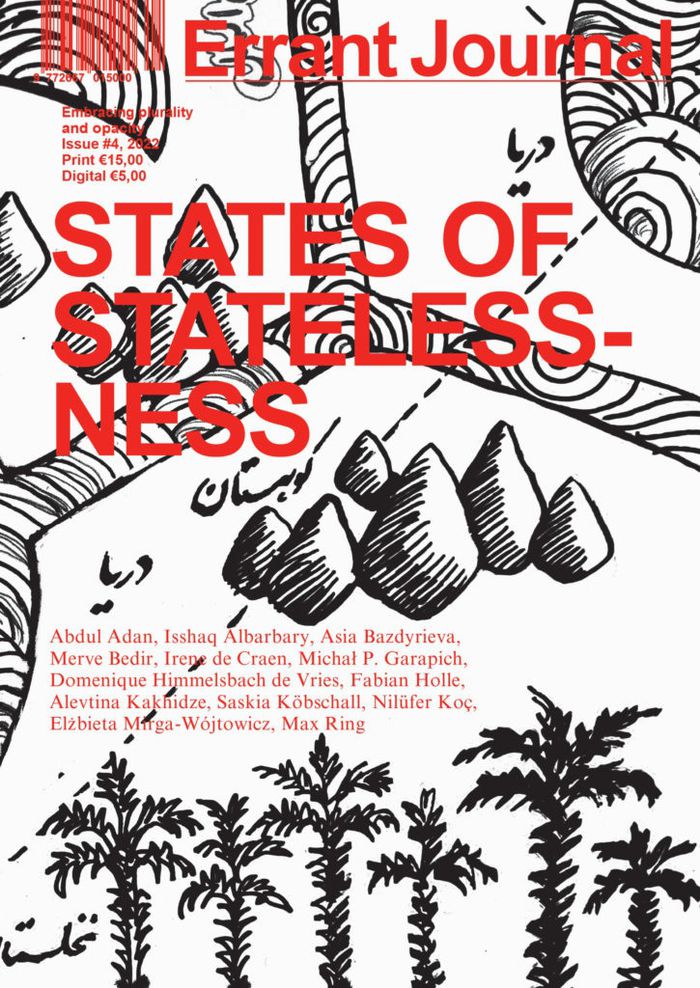
Errant Journal #4: States of statelessness
Actions:
Prix:
$20.00
(disponible sur commande)
Résumé:
Errant’s 4th issue tackles the imaginary nature of the nation state, and looks into alternative forms of solidarity, community and belonging that are disconnected from or even antagonistic to this form of governance and in which a migrant or otherwise marginalised position can be seen as one of power and resistance. ''States of statelessness'' delves into the diverse manners in which people respond to their precarious relations to nation and nationality in practical, poetic and community-based ways. But more than that, this issue is a celebration of the ways in which people are able to stand their ground, to exist in fluidity, and a commemoration of those before us that have shown that other ‘states’ are possible.
Errant Journal #4: States of statelessness
Actions:
Prix:
$20.00
(disponible sur commande)
Résumé:
Errant’s 4th issue tackles the imaginary nature of the nation state, and looks into alternative forms of solidarity, community and belonging that are disconnected from or even antagonistic to this form of governance and in which a migrant or otherwise marginalised position can be seen as one of power and resistance. ''States of statelessness'' delves into the diverse manners in which people respond to their precarious relations to nation and nationality in practical, poetic and community-based ways. But more than that, this issue is a celebration of the ways in which people are able to stand their ground, to exist in fluidity, and a commemoration of those before us that have shown that other ‘states’ are possible.
Classification:
périodiques
périodiques
Publication:
décembre 2022
décembre 2022
Sujet:
Revues
Revues
Classification:
livres
livres

Actions:
Prix:
$39.95
(disponible sur commande)
Résumé:
"Protest" takes a wide-ranging approach to the practice of protest, bringing together contributors from different disciplines and from around the globe. Social, historical, sociological and political-scientific perspectives play as much of a role in this publication as approaches that draw on image theory, popular culture, cultural studies and the arts. Simultaneously(...)
$39.95
(disponible sur commande)
Résumé:
"Protest" takes a wide-ranging approach to the practice of protest, bringing together contributors from different disciplines and from around the globe. Social, historical, sociological and political-scientific perspectives play as much of a role in this publication as approaches that draw on image theory, popular culture, cultural studies and the arts. Simultaneously(...)
Publication:
juin 2018
juin 2018
Titre:
Protest: the aesthetics of resistance
Actions:
Prix:
$39.95
(disponible sur commande)
Résumé:
"Protest" takes a wide-ranging approach to the practice of protest, bringing together contributors from different disciplines and from around the globe. Social, historical, sociological and political-scientific perspectives play as much of a role in this publication as approaches that draw on image theory, popular culture, cultural studies and the arts. Simultaneously historical and contemporary, the book also explores such present-day developments as the virtualization of activism, the relationship of the virtual and the fictional, and the exploitation of these trends in politics by power-holders of all shades. A timely publication, "Protest: The Aesthetics of Resistance" explores marginalized communities' practices of resistance and reflects on the past, present and future of protest.
Protest: the aesthetics of resistance
Actions:
Prix:
$39.95
(disponible sur commande)
Résumé:
"Protest" takes a wide-ranging approach to the practice of protest, bringing together contributors from different disciplines and from around the globe. Social, historical, sociological and political-scientific perspectives play as much of a role in this publication as approaches that draw on image theory, popular culture, cultural studies and the arts. Simultaneously historical and contemporary, the book also explores such present-day developments as the virtualization of activism, the relationship of the virtual and the fictional, and the exploitation of these trends in politics by power-holders of all shades. A timely publication, "Protest: The Aesthetics of Resistance" explores marginalized communities' practices of resistance and reflects on the past, present and future of protest.
Classification:
livres
livres
Publication:
juin 2018
juin 2018
Classification:
livres
livres

Actions:
Prix:
$43.50
(disponible sur commande)
Résumé:
Dorothea Lange’s photographs define how we remember the Depression generation. In this biography, renowned historian Linda Gordon charts Lange’s journey from polio-ridden child to wife and mother, to San Francisco portrait photographer, to chronicler of the Great Depression and World War II. Gordon uses Lange’s life to anchor a moving social history of twentieth-century(...)
$43.50
(disponible sur commande)
Résumé:
Dorothea Lange’s photographs define how we remember the Depression generation. In this biography, renowned historian Linda Gordon charts Lange’s journey from polio-ridden child to wife and mother, to San Francisco portrait photographer, to chronicler of the Great Depression and World War II. Gordon uses Lange’s life to anchor a moving social history of twentieth-century(...)
Titre:
Dorothea Lange: life beyond limits
Actions:
Prix:
$43.50
(disponible sur commande)
Résumé:
Dorothea Lange’s photographs define how we remember the Depression generation. In this biography, renowned historian Linda Gordon charts Lange’s journey from polio-ridden child to wife and mother, to San Francisco portrait photographer, to chronicler of the Great Depression and World War II. Gordon uses Lange’s life to anchor a moving social history of twentieth-century America, re-creating the bohemian world of San Francisco, the Dust Bowl, and the Japanese American internment camps. She explores Lange’s growing radicalization as she embraced the democratic power of the camera, and she examines Lange’s entire body of work, reproducing more than one hundred images, many of them previously unseen and some of them formerly suppressed.
Dorothea Lange: life beyond limits
Actions:
Prix:
$43.50
(disponible sur commande)
Résumé:
Dorothea Lange’s photographs define how we remember the Depression generation. In this biography, renowned historian Linda Gordon charts Lange’s journey from polio-ridden child to wife and mother, to San Francisco portrait photographer, to chronicler of the Great Depression and World War II. Gordon uses Lange’s life to anchor a moving social history of twentieth-century America, re-creating the bohemian world of San Francisco, the Dust Bowl, and the Japanese American internment camps. She explores Lange’s growing radicalization as she embraced the democratic power of the camera, and she examines Lange’s entire body of work, reproducing more than one hundred images, many of them previously unseen and some of them formerly suppressed.
Classification:
livres
livres
Publication:
décembre 2009
décembre 2009
Sujet:
Théorie de la photographie
Théorie de la photographie
Classification:
livres
livres
Actions:
Prix:
$42.50
(disponible sur commande)
Résumé:
Bringing together leading researchers from geography, political science, sociology, public policy and technology studies, this publication exposes the politics of well-known disruptions such as devastation of New Orleans in 2005, the global SARS outbreak in 2002-3, and the great power collapse in the North Eastern US in 2003. But the book also excavates the politics of(...)
$42.50
(disponible sur commande)
Résumé:
Bringing together leading researchers from geography, political science, sociology, public policy and technology studies, this publication exposes the politics of well-known disruptions such as devastation of New Orleans in 2005, the global SARS outbreak in 2002-3, and the great power collapse in the North Eastern US in 2003. But the book also excavates the politics of(...)
Titre:
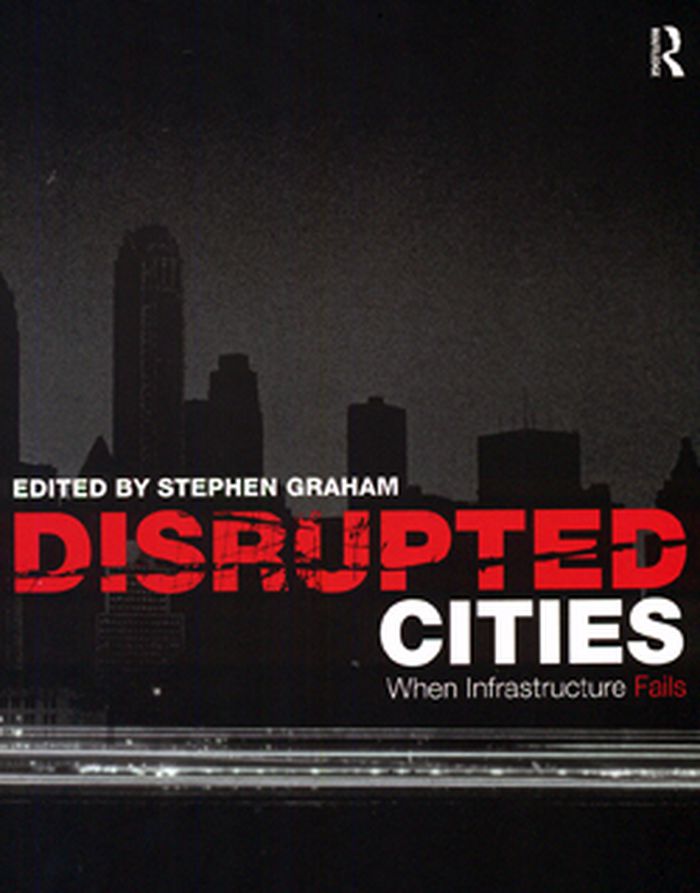
Disrupted cities : when infrastructure fails
Actions:
Prix:
$42.50
(disponible sur commande)
Résumé:
Bringing together leading researchers from geography, political science, sociology, public policy and technology studies, this publication exposes the politics of well-known disruptions such as devastation of New Orleans in 2005, the global SARS outbreak in 2002-3, and the great power collapse in the North Eastern US in 2003. But the book also excavates the politics of more hidden disruptions : the clogging of city sewers with fat; the day-to-day infrastructural collapses which dominate urban life in much of the global south; the deliberate devastation of urban infrastructure by state militaries; and the ways in which alleged threats of infrastructural disruption have been used to radically reorganise cities as part of the ‘war on terror’.
Disrupted cities : when infrastructure fails
Actions:
Prix:
$42.50
(disponible sur commande)
Résumé:
Bringing together leading researchers from geography, political science, sociology, public policy and technology studies, this publication exposes the politics of well-known disruptions such as devastation of New Orleans in 2005, the global SARS outbreak in 2002-3, and the great power collapse in the North Eastern US in 2003. But the book also excavates the politics of more hidden disruptions : the clogging of city sewers with fat; the day-to-day infrastructural collapses which dominate urban life in much of the global south; the deliberate devastation of urban infrastructure by state militaries; and the ways in which alleged threats of infrastructural disruption have been used to radically reorganise cities as part of the ‘war on terror’.
Classification:
livres
livres
Publication:
octobre 2009
octobre 2009
Sujet:
Théorie de l’urbanisme
Théorie de l’urbanisme


