


476 Résultats
Classification:
livres
livres
Prix:
$33.95
(disponible sur commande)
Résumé:
Judith Butler’s new book shows how an ethic of nonviolence must be connected to a broader political struggle for social equality. Further, it argues that nonviolence is often misunderstood as a passive practice that emanates from a calm region of the soul, or as an individualist ethical relation to existing forms of power. But, in fact, nonviolence is an ethical position(...)
$33.95
(disponible sur commande)
Résumé:
Judith Butler’s new book shows how an ethic of nonviolence must be connected to a broader political struggle for social equality. Further, it argues that nonviolence is often misunderstood as a passive practice that emanates from a calm region of the soul, or as an individualist ethical relation to existing forms of power. But, in fact, nonviolence is an ethical position(...)
Titre:
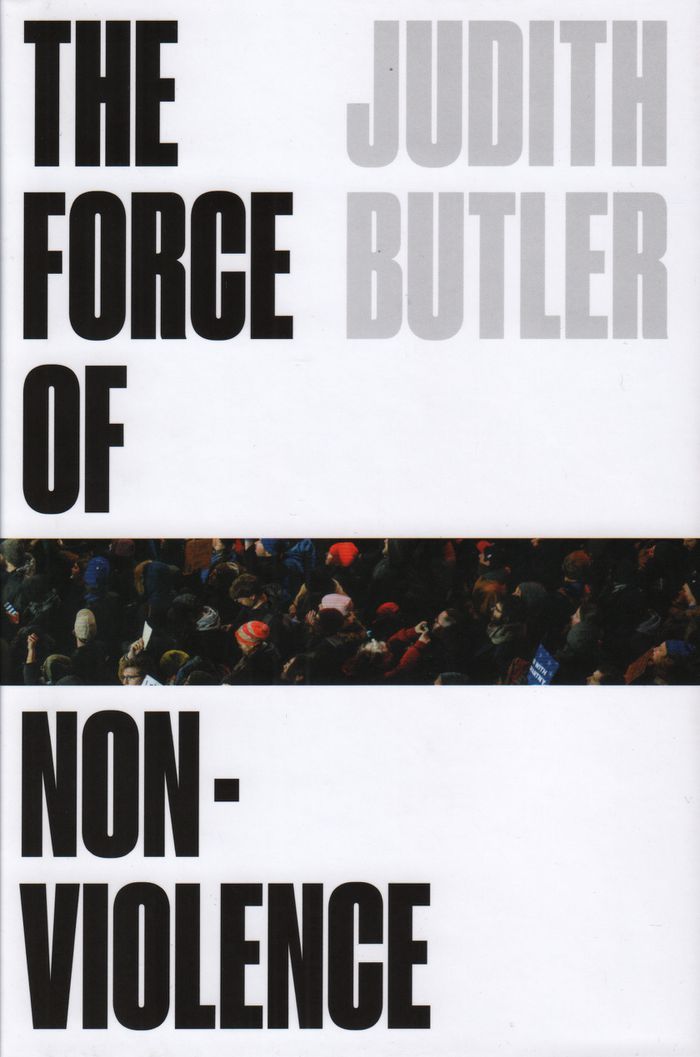
The force of non violence: the ethical in the political
Actions:
Prix:
$33.95
(disponible sur commande)
Résumé:
Judith Butler’s new book shows how an ethic of nonviolence must be connected to a broader political struggle for social equality. Further, it argues that nonviolence is often misunderstood as a passive practice that emanates from a calm region of the soul, or as an individualist ethical relation to existing forms of power. But, in fact, nonviolence is an ethical position found in the midst of the political field. An aggressive form of nonviolence accepts that hostility is part of our psychic constitution, but values ambivalence as a way of checking the conversion of aggression into violence. One contemporary challenge to a politics of nonviolence points out that there is a difference of opinion on what counts as violence and nonviolence. The distinction between them can be mobilized in the service of ratifying the state’s monopoly on violence. Considering nonviolence as an ethical problem within a political philosophy requires a critique of individualism as well as an understanding of the psychosocial dimensions of violence. Butler draws upon Foucault, Fanon, Freud, and Benjamin to consider how the interdiction against violence fails to include lives regarded as ungrievable. By considering how “racial phantasms” inform justifications of state and administrative violence, Butler tracks how violence is often attributed to those who are most severely exposed to its lethal effects. The struggle for nonviolence is found in movements for social transformation that reframe the grievability of lives in light of social equality and whose ethical claims follow from an insight into the interdependency of life as the basis of social and political equality.
The force of non violence: the ethical in the political
Actions:
Prix:
$33.95
(disponible sur commande)
Résumé:
Judith Butler’s new book shows how an ethic of nonviolence must be connected to a broader political struggle for social equality. Further, it argues that nonviolence is often misunderstood as a passive practice that emanates from a calm region of the soul, or as an individualist ethical relation to existing forms of power. But, in fact, nonviolence is an ethical position found in the midst of the political field. An aggressive form of nonviolence accepts that hostility is part of our psychic constitution, but values ambivalence as a way of checking the conversion of aggression into violence. One contemporary challenge to a politics of nonviolence points out that there is a difference of opinion on what counts as violence and nonviolence. The distinction between them can be mobilized in the service of ratifying the state’s monopoly on violence. Considering nonviolence as an ethical problem within a political philosophy requires a critique of individualism as well as an understanding of the psychosocial dimensions of violence. Butler draws upon Foucault, Fanon, Freud, and Benjamin to consider how the interdiction against violence fails to include lives regarded as ungrievable. By considering how “racial phantasms” inform justifications of state and administrative violence, Butler tracks how violence is often attributed to those who are most severely exposed to its lethal effects. The struggle for nonviolence is found in movements for social transformation that reframe the grievability of lives in light of social equality and whose ethical claims follow from an insight into the interdependency of life as the basis of social and political equality.
Classification:
livres
livres
Publication:
février 2020
février 2020
Sujet:
Social
Social
Classification:
livres
livres
Actions:
Prix:
$42.00
(disponible en magasin)
Résumé:
When is the digital in architecture? What are the conditions that led architects to integrate digital tools into their practices? Over the course of the Archaeology of the Digital research program, the CCA has collected the archival records of twenty-five projects realized between the late 1980s and the early 2000s in order to understand this moment as a point of origin(...)
$42.00
(disponible en magasin)
Résumé:
When is the digital in architecture? What are the conditions that led architects to integrate digital tools into their practices? Over the course of the Archaeology of the Digital research program, the CCA has collected the archival records of twenty-five projects realized between the late 1980s and the early 2000s in order to understand this moment as a point of origin(...)
Titre:
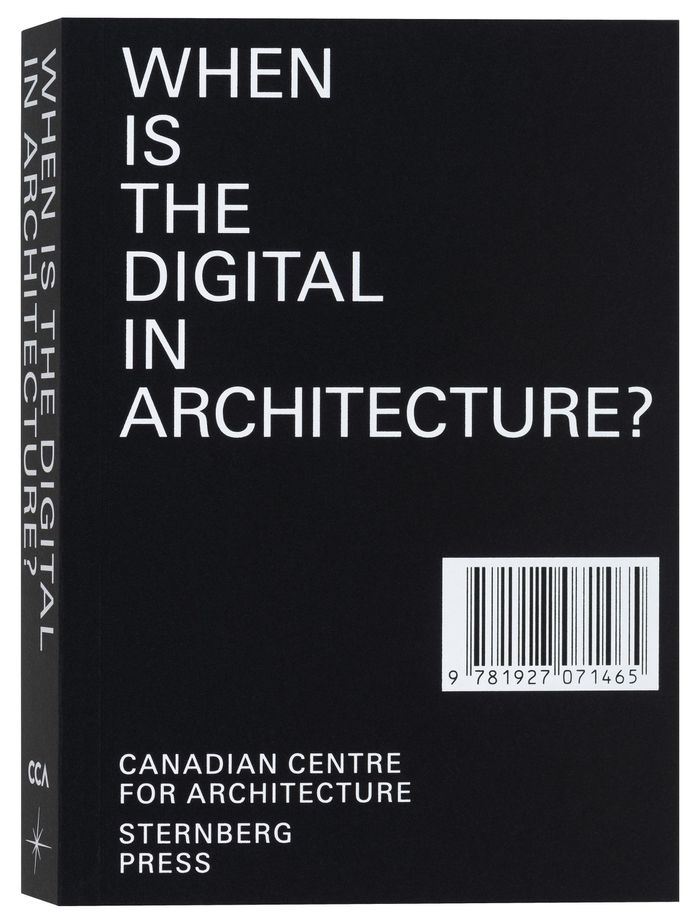
When is the digital in architecture?
Actions:
Prix:
$42.00
(disponible en magasin)
Résumé:
When is the digital in architecture? What are the conditions that led architects to integrate digital tools into their practices? Over the course of the Archaeology of the Digital research program, the CCA has collected the archival records of twenty-five projects realized between the late 1980s and the early 2000s in order to understand this moment as a point of origin for the digital. But if we take care to identify the digital as a condition that is made possible by the conceptual foundations of digital media and not necessarily by digital media itself, the boundaries of the digital moment—when it began and under what circumstances—become less clear. There are eight million stories of the origins of the digital in architecture, and this book brings together fourteen of them in a chronology of responses to the question of when the digital is in architecture. The arguments address specific changes in ways of thinking about architecture, building, and cities, as well as the shifts in technology that resulted from these changes, marking both a capstone to Archaeology of the Digital and the beginning of an investigation of other beginnings of the digital in architecture. Asking a question like When is the digital in architecture? can produce eight million stories in response, and eight million digressions and redirections that narrow in focus and change geographies, producing a Tristram Shandy of the digital as the CCA continues to build its digital archive and makes it increasingly accessible to researchers. If this novel of digressions is distributed across future research projects and extended with studies of new archival material, so much the better for the reader, in our opinion.
When is the digital in architecture?
Actions:
Prix:
$42.00
(disponible en magasin)
Résumé:
When is the digital in architecture? What are the conditions that led architects to integrate digital tools into their practices? Over the course of the Archaeology of the Digital research program, the CCA has collected the archival records of twenty-five projects realized between the late 1980s and the early 2000s in order to understand this moment as a point of origin for the digital. But if we take care to identify the digital as a condition that is made possible by the conceptual foundations of digital media and not necessarily by digital media itself, the boundaries of the digital moment—when it began and under what circumstances—become less clear. There are eight million stories of the origins of the digital in architecture, and this book brings together fourteen of them in a chronology of responses to the question of when the digital is in architecture. The arguments address specific changes in ways of thinking about architecture, building, and cities, as well as the shifts in technology that resulted from these changes, marking both a capstone to Archaeology of the Digital and the beginning of an investigation of other beginnings of the digital in architecture. Asking a question like When is the digital in architecture? can produce eight million stories in response, and eight million digressions and redirections that narrow in focus and change geographies, producing a Tristram Shandy of the digital as the CCA continues to build its digital archive and makes it increasingly accessible to researchers. If this novel of digressions is distributed across future research projects and extended with studies of new archival material, so much the better for the reader, in our opinion.
Classification:
livres
livres
Publication:
juin 2017
juin 2017
Sujet:
Publications du CCA
Publications du CCA
Classification:
livres
livres
Actions:
Prix:
$44.95
(disponible sur commande)
Résumé:
Essays, plans and projects by various artists,including Max Bill, Heinrich Dunst, Helmut Federle, Per Kirkeby, Katarina Fritsch, Erwin Heerich, Gerhard Merz, Gottfried Honegger, Walther Pichler, Ulrich Rückriem, Bernar Venet, Daniel Buren, Christoph Haerle, Peter Wigglesworth, Donald Judd, Markus Lüpertz, Arnulf Rainer, Richard Serra among others showing their ideas for(...)
$44.95
(disponible sur commande)
Résumé:
Essays, plans and projects by various artists,including Max Bill, Heinrich Dunst, Helmut Federle, Per Kirkeby, Katarina Fritsch, Erwin Heerich, Gerhard Merz, Gottfried Honegger, Walther Pichler, Ulrich Rückriem, Bernar Venet, Daniel Buren, Christoph Haerle, Peter Wigglesworth, Donald Judd, Markus Lüpertz, Arnulf Rainer, Richard Serra among others showing their ideas for(...)
Titre:
Museum architecture : texts and projects by artists
Actions:
Prix:
$44.95
(disponible sur commande)
Résumé:
Essays, plans and projects by various artists,including Max Bill, Heinrich Dunst, Helmut Federle, Per Kirkeby, Katarina Fritsch, Erwin Heerich, Gerhard Merz, Gottfried Honegger, Walther Pichler, Ulrich Rückriem, Bernar Venet, Daniel Buren, Christoph Haerle, Peter Wigglesworth, Donald Judd, Markus Lüpertz, Arnulf Rainer, Richard Serra among others showing their ideas for how museums should be constructed. When discussing the increasing number of museums and exhibition spaces for modern art which have come into being in recent years, the deep-seated differences of opinion between architects and artists keep coming to the fore. The discussion seems to be almost exclusively dominated by the point of view of the architect and defined by his/her interests. The needs of the art itself are being widely neglected and the voice of the artist is simply not being heard. Donald Judd, the American sculptor and minimalist artist, once noted that museums are so rarely built on functional lines these days, the trend being more towards the creation of a showpiece for the architect. Why are painters and sculptors not asked for their input? The very obvious question was addressed by the Espace de l’art concret when in 1997, it asked a number of well-known artists to come up with ideas and projects for a museum for concrete art. They were invited to submit their ideal utopian suggestions as well as very concrete and architectural proposals and written statements. These are documented in this publication, supplemented with the material for the collection owned by the Kunsthaus in Bregenz and expanded with an extensive anthology of texts by artists on this subject. The résumé of the contributions presents a searing criticism of contemporary museum architecture by its most important users. Their voice will at last find an ear in the current architectural discussion about the new cathedrals of the post-industrial society.
Museum architecture : texts and projects by artists
Actions:
Prix:
$44.95
(disponible sur commande)
Résumé:
Essays, plans and projects by various artists,including Max Bill, Heinrich Dunst, Helmut Federle, Per Kirkeby, Katarina Fritsch, Erwin Heerich, Gerhard Merz, Gottfried Honegger, Walther Pichler, Ulrich Rückriem, Bernar Venet, Daniel Buren, Christoph Haerle, Peter Wigglesworth, Donald Judd, Markus Lüpertz, Arnulf Rainer, Richard Serra among others showing their ideas for how museums should be constructed. When discussing the increasing number of museums and exhibition spaces for modern art which have come into being in recent years, the deep-seated differences of opinion between architects and artists keep coming to the fore. The discussion seems to be almost exclusively dominated by the point of view of the architect and defined by his/her interests. The needs of the art itself are being widely neglected and the voice of the artist is simply not being heard. Donald Judd, the American sculptor and minimalist artist, once noted that museums are so rarely built on functional lines these days, the trend being more towards the creation of a showpiece for the architect. Why are painters and sculptors not asked for their input? The very obvious question was addressed by the Espace de l’art concret when in 1997, it asked a number of well-known artists to come up with ideas and projects for a museum for concrete art. They were invited to submit their ideal utopian suggestions as well as very concrete and architectural proposals and written statements. These are documented in this publication, supplemented with the material for the collection owned by the Kunsthaus in Bregenz and expanded with an extensive anthology of texts by artists on this subject. The résumé of the contributions presents a searing criticism of contemporary museum architecture by its most important users. Their voice will at last find an ear in the current architectural discussion about the new cathedrals of the post-industrial society.
Classification:
livres
livres
Publication:
janvier 1900, Cologne
janvier 1900, Cologne
Sujet:
Muséologie
Muséologie
Classification:
livres
livres
Actions:
Prix:
$48.00
(disponible sur commande)
Résumé:
This book introduces to an English-language audience the writings of the so-called New Vienna School of art history. In the 1930s Hans Sedlmayr (1896-1984) and Otto Pächt (1902-1988) undertook an ambitious extension of the formalist art historical project of Alois (...)
$48.00
(disponible sur commande)
Résumé:
This book introduces to an English-language audience the writings of the so-called New Vienna School of art history. In the 1930s Hans Sedlmayr (1896-1984) and Otto Pächt (1902-1988) undertook an ambitious extension of the formalist art historical project of Alois (...)
Titre:
The Vienna School reader : politics and art historical method in the 1930s
Actions:
Prix:
$48.00
(disponible sur commande)
Résumé:
This book introduces to an English-language audience the writings of the so-called New Vienna School of art history. In the 1930s Hans Sedlmayr (1896-1984) and Otto Pächt (1902-1988) undertook an ambitious extension of the formalist art historical project of Alois Riegl (1858-1905). Sedlmayr and Pächt began with an aestheticist conception of the autonomy and irreducibility of the artistic process. At the same time they believed they could read entire cultures and worldviews in the work of art. The key to this contextualist alchemy was the concept of "structure," a kind of deep formal property that the work of art shared with the world. Sedlmayr and Pächt's project immediately caught the attention of thinkers like Walter Benjamin who were similarly impatient with traditional empiricist scholarship. But the new project had its dark side. Sedlmayr used art history as a vehicle for a sweeping critique of modernity that soon escalated into nationalist and outright fascist polemic, even while Pächt, a Jew, was forced into exile. Sedlmayr and the whole scholarly project of Strukturanalyse were sharply repudiated by Meyer Schapiro and later Ernst Gombrich. After an introductory essay, the book opens with two selections from Riegl. The next section includes two essays by Sedlmayr, two by Pächt, and one each by Guido Kaschnitz-Weinberg and Fritz Novotny, all dating from the 1930s. The book closes with the divergent responses of Benjamin (1933) and Schapiro (1936). The difference of opinion between these two key voices raises again the question of the legitimacy and effectiveness of the method, and reveals the analogies between the New Vienna School project and the antiempiricist cultural histories of our own time. The book also contains an extensive bibliography.
The Vienna School reader : politics and art historical method in the 1930s
Actions:
Prix:
$48.00
(disponible sur commande)
Résumé:
This book introduces to an English-language audience the writings of the so-called New Vienna School of art history. In the 1930s Hans Sedlmayr (1896-1984) and Otto Pächt (1902-1988) undertook an ambitious extension of the formalist art historical project of Alois Riegl (1858-1905). Sedlmayr and Pächt began with an aestheticist conception of the autonomy and irreducibility of the artistic process. At the same time they believed they could read entire cultures and worldviews in the work of art. The key to this contextualist alchemy was the concept of "structure," a kind of deep formal property that the work of art shared with the world. Sedlmayr and Pächt's project immediately caught the attention of thinkers like Walter Benjamin who were similarly impatient with traditional empiricist scholarship. But the new project had its dark side. Sedlmayr used art history as a vehicle for a sweeping critique of modernity that soon escalated into nationalist and outright fascist polemic, even while Pächt, a Jew, was forced into exile. Sedlmayr and the whole scholarly project of Strukturanalyse were sharply repudiated by Meyer Schapiro and later Ernst Gombrich. After an introductory essay, the book opens with two selections from Riegl. The next section includes two essays by Sedlmayr, two by Pächt, and one each by Guido Kaschnitz-Weinberg and Fritz Novotny, all dating from the 1930s. The book closes with the divergent responses of Benjamin (1933) and Schapiro (1936). The difference of opinion between these two key voices raises again the question of the legitimacy and effectiveness of the method, and reveals the analogies between the New Vienna School project and the antiempiricist cultural histories of our own time. The book also contains an extensive bibliography.
Classification:
livres
livres
Publication:
janvier 1900, New York
janvier 1900, New York
Sujet:
Théorie de l’architecture
Théorie de l’architecture
Classification:
audio
audio
Titre:
These are They.
These are They.
Actions:
Description:
1 online resource.
Auteur:
Sujet:
Publication:
[Place of publication not identified] : Lateral Addition, 2019.
[Place of publication not identified] : Lateral Addition, 2019.
Classification:
audio
audio
Publication:
[Place of publication not identified] : Lateral Addition, 2019.
[Place of publication not identified] : Lateral Addition, 2019.
Auteur:
Sujet:
Classification:
audio
audio
Description:
1 online resource.
Auteur:
Sujet:
Publication:
[Place of publication not identified] : Lateral Addition, 2018.
[Place of publication not identified] : Lateral Addition, 2018.
Titre:
June 21, 2018 : Listening for Southwest Key in San Diego.
Actions:
Description:
1 online resource.
June 21, 2018 : Listening for Southwest Key in San Diego.
Actions:
Description:
1 online resource.
Classification:
audio
audio
Publication:
[Place of publication not identified] : Lateral Addition, 2018.
[Place of publication not identified] : Lateral Addition, 2018.
Auteur:
Sujet:


