


495 Résultats
Classification:
livres
livres
Titre:
Blue Moon Issue 9
Blue Moon Issue 9
Actions:
Prix:
$40.00
(disponible en magasin)
Résumé:
Since its inception, Blue Moon has focused on investigating mysticism and spirituality in contemporary art. In this issue, these themes surface the most densely to date. In the four interviews, Mike Brodie, Alanis Obomsawin, HVN, and Evangeline AdaLioryn discuss their practices through their own definitions of spiritual experiences and the pathways they walk down. Each(...)
$40.00
(disponible en magasin)
Résumé:
Since its inception, Blue Moon has focused on investigating mysticism and spirituality in contemporary art. In this issue, these themes surface the most densely to date. In the four interviews, Mike Brodie, Alanis Obomsawin, HVN, and Evangeline AdaLioryn discuss their practices through their own definitions of spiritual experiences and the pathways they walk down. Each(...)
Sujet:
Revues
Revues
Publication:
octobre 2025
octobre 2025
Titre:
Blue Moon Issue 9
Actions:
Prix:
$40.00
(disponible en magasin)
Résumé:
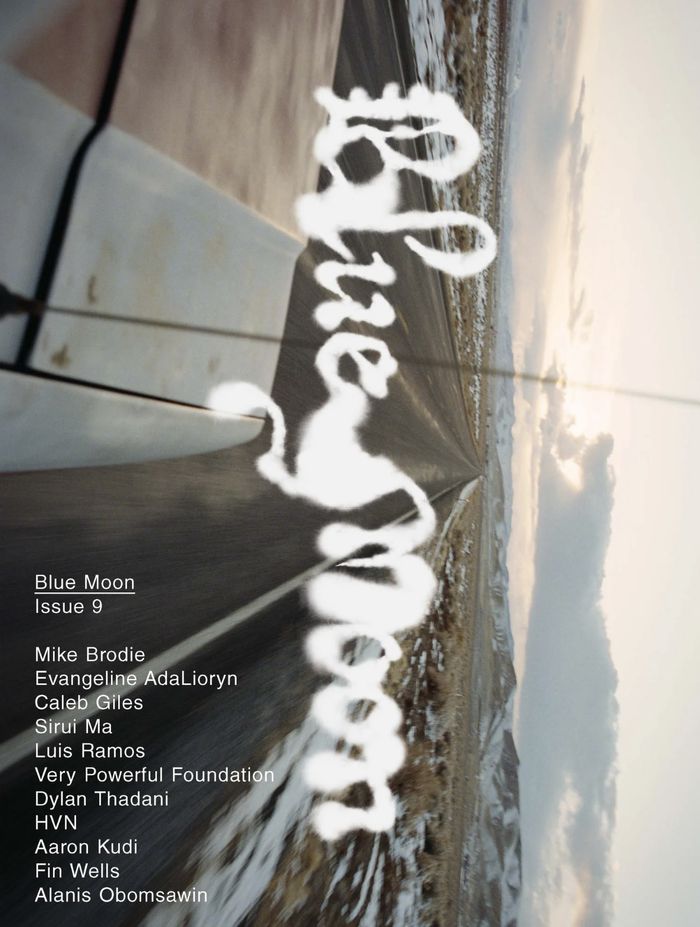
Since its inception, Blue Moon has focused on investigating mysticism and spirituality in contemporary art. In this issue, these themes surface the most densely to date. In the four interviews, Mike Brodie, Alanis Obomsawin, HVN, and Evangeline AdaLioryn discuss their practices through their own definitions of spiritual experiences and the pathways they walk down. Each and every one is different, but ties to the unseeable and otherworldly weave throughout. It is poetic to see so many perspectives on what is greater than us, or at times, what seems null and void from the human experience. The feature subjects, Aaron Kudi, Caleb Giles, Sirui Ma, Fin Wells, Dylan Thadani, Luis Ramos, and the Very Powerful Foundation, give us glimpses into their worlds pointing to their positions as seekers, noticers, feelers and helpers as they process their experiences and vulnerably let us in. The 9th issue discusses freedom, faith, perseverance, protest, magic, and a myriad of other subjects formatted in a labyrinth of photo essays, interviews, and features. *Mike Brodie section folds out with 3 full page posters
Blue Moon Issue 9
Actions:
Prix:
$40.00
(disponible en magasin)
Résumé:
Since its inception, Blue Moon has focused on investigating mysticism and spirituality in contemporary art. In this issue, these themes surface the most densely to date. In the four interviews, Mike Brodie, Alanis Obomsawin, HVN, and Evangeline AdaLioryn discuss their practices through their own definitions of spiritual experiences and the pathways they walk down. Each and every one is different, but ties to the unseeable and otherworldly weave throughout. It is poetic to see so many perspectives on what is greater than us, or at times, what seems null and void from the human experience. The feature subjects, Aaron Kudi, Caleb Giles, Sirui Ma, Fin Wells, Dylan Thadani, Luis Ramos, and the Very Powerful Foundation, give us glimpses into their worlds pointing to their positions as seekers, noticers, feelers and helpers as they process their experiences and vulnerably let us in. The 9th issue discusses freedom, faith, perseverance, protest, magic, and a myriad of other subjects formatted in a labyrinth of photo essays, interviews, and features. *Mike Brodie section folds out with 3 full page posters
Classification:
livres
livres
Publication:
octobre 2025
octobre 2025
Sujet:
Revues
Revues
Classification:
livres
livres
Actions:
Prix:
$35.95
(disponible sur commande)
Résumé:
The body is a source of pleasure and of pain, at once hopelessly vulnerable and radiant with power. In her sixth book, Olivia Laing charts a course through the long struggle for bodily freedom, using the life of the renegade psychoanalyst Wilhelm Reich to explore gay rights and sexual liberation, feminism, and the civil rights movement. Drawing on her own experiences(...)
$35.95
(disponible sur commande)
Résumé:
The body is a source of pleasure and of pain, at once hopelessly vulnerable and radiant with power. In her sixth book, Olivia Laing charts a course through the long struggle for bodily freedom, using the life of the renegade psychoanalyst Wilhelm Reich to explore gay rights and sexual liberation, feminism, and the civil rights movement. Drawing on her own experiences(...)
Titre:
Everybody: a book about freedom
Actions:
Prix:
$35.95
(disponible sur commande)
Résumé:
The body is a source of pleasure and of pain, at once hopelessly vulnerable and radiant with power. In her sixth book, Olivia Laing charts a course through the long struggle for bodily freedom, using the life of the renegade psychoanalyst Wilhelm Reich to explore gay rights and sexual liberation, feminism, and the civil rights movement. Drawing on her own experiences in protest and alternative medicine, and traveling from Weimar Berlin to the prisons of McCarthy-era America, Laing grapples with some of the most significant and complicated figures of the past century — among them Nina Simone, Christopher Isherwood, Andrea Dworkin, Sigmund Freud, Susan Sontag, and Malcolm X. Despite its many burdens, the body remains a source of power, even in an era as technologized and automated as our own. Arriving at a moment in which basic bodily rights are once again imperiled, 'Everybody' is an investigation into the forces arranged against freedom and a celebration of how ordinary human bodies can resist oppression and reshape the world.
Everybody: a book about freedom
Actions:
Prix:
$35.95
(disponible sur commande)
Résumé:
The body is a source of pleasure and of pain, at once hopelessly vulnerable and radiant with power. In her sixth book, Olivia Laing charts a course through the long struggle for bodily freedom, using the life of the renegade psychoanalyst Wilhelm Reich to explore gay rights and sexual liberation, feminism, and the civil rights movement. Drawing on her own experiences in protest and alternative medicine, and traveling from Weimar Berlin to the prisons of McCarthy-era America, Laing grapples with some of the most significant and complicated figures of the past century — among them Nina Simone, Christopher Isherwood, Andrea Dworkin, Sigmund Freud, Susan Sontag, and Malcolm X. Despite its many burdens, the body remains a source of power, even in an era as technologized and automated as our own. Arriving at a moment in which basic bodily rights are once again imperiled, 'Everybody' is an investigation into the forces arranged against freedom and a celebration of how ordinary human bodies can resist oppression and reshape the world.
Classification:
livres
livres
Publication:
mai 2021
mai 2021
Sujet:
Théorie/ philosophie
Théorie/ philosophie
Classification:
livres
livres

Actions:
Prix:
$26.00
(disponible sur commande)
Résumé:
The extensive range of posters, collages, maquettes, postcards, magazines, and books featured in this exhibition catalogue attests to the enormous influence of photomontage in politics, social protest, and advertising, while also demonstrating the popularity of the technique among avant-garde artists during these two decades. Essays in this publication examine(...)
$26.00
(disponible sur commande)
Résumé:
The extensive range of posters, collages, maquettes, postcards, magazines, and books featured in this exhibition catalogue attests to the enormous influence of photomontage in politics, social protest, and advertising, while also demonstrating the popularity of the technique among avant-garde artists during these two decades. Essays in this publication examine(...)
Titre:
Photomontage between the wars : 1918-1939
Actions:
Prix:
$26.00
(disponible sur commande)
Résumé:
The extensive range of posters, collages, maquettes, postcards, magazines, and books featured in this exhibition catalogue attests to the enormous influence of photomontage in politics, social protest, and advertising, while also demonstrating the popularity of the technique among avant-garde artists during these two decades. Essays in this publication examine contemporary texts that the practice of photomontage inspired, and explore those qualities of photomontage that led to what was arguably the most important exhibition devoted to this artistic technique at the Kunstgewerbemuseum in Berlin in 1931. The present volume includes a facsimile reproduction and translation of the catalogue published on the occasion of that exhibition. In addition to a brief chronology, the interested reader will also find a selection of text - some scarcely familiar today - by authors of various nationalities that sheds further light on the practice. Produced to accompany the exhibition in Spain and available in North America for the first time, this entirely English-language publication offers an overview of the birth of the photomontage process specifically in Germany and the Soviet Union in the 1920s.
Photomontage between the wars : 1918-1939
Actions:
Prix:
$26.00
(disponible sur commande)
Résumé:
The extensive range of posters, collages, maquettes, postcards, magazines, and books featured in this exhibition catalogue attests to the enormous influence of photomontage in politics, social protest, and advertising, while also demonstrating the popularity of the technique among avant-garde artists during these two decades. Essays in this publication examine contemporary texts that the practice of photomontage inspired, and explore those qualities of photomontage that led to what was arguably the most important exhibition devoted to this artistic technique at the Kunstgewerbemuseum in Berlin in 1931. The present volume includes a facsimile reproduction and translation of the catalogue published on the occasion of that exhibition. In addition to a brief chronology, the interested reader will also find a selection of text - some scarcely familiar today - by authors of various nationalities that sheds further light on the practice. Produced to accompany the exhibition in Spain and available in North America for the first time, this entirely English-language publication offers an overview of the birth of the photomontage process specifically in Germany and the Soviet Union in the 1920s.
Classification:
livres
livres
Publication:
octobre 2012
octobre 2012
Sujet:
Photographie- collections
Photographie- collections
Classification:
livres
livres

Actions:
Prix:
$25.00
(disponible sur commande)
Résumé:
New York City is home to some of the most recognizable places in the world. As familiar as the sight of New Year’s Eve in Times Square or a protest in front of City Hall may be to us, do we understand who controls what happens there? Kristine Miller delves into six of New York’s most important public spaces to trace how design influences their complicated lives. Miller(...)
$25.00
(disponible sur commande)
Résumé:
New York City is home to some of the most recognizable places in the world. As familiar as the sight of New Year’s Eve in Times Square or a protest in front of City Hall may be to us, do we understand who controls what happens there? Kristine Miller delves into six of New York’s most important public spaces to trace how design influences their complicated lives. Miller(...)
Titre:
Designs on the Public : The private lives of New York's public spaces
Actions:
Prix:
$25.00
(disponible sur commande)
Résumé:
New York City is home to some of the most recognizable places in the world. As familiar as the sight of New Year’s Eve in Times Square or a protest in front of City Hall may be to us, do we understand who controls what happens there? Kristine Miller delves into six of New York’s most important public spaces to trace how design influences their complicated lives. Miller chronicles controversies in the histories of New York locations including Times Square, Trump Tower, the IBM Atrium, and Sony Plaza. The story of each location reveals that public space is not a concrete or fixed reality, but rather a constantly changing situation open to the forces of law, corporations, bureaucracy, and government. The qualities of public spaces we consider essential, including accessibility, public ownership, and ties to democratic life, are, at best, temporary conditions and often completely absent. Design is, in Miller’s view, complicit in regulation of public spaces in New York City to exclude undesirables, restrict activities, and privilege commercial interests, and in this work she shows how design can reactivate public space and public life.
Designs on the Public : The private lives of New York's public spaces
Actions:
Prix:
$25.00
(disponible sur commande)
Résumé:
New York City is home to some of the most recognizable places in the world. As familiar as the sight of New Year’s Eve in Times Square or a protest in front of City Hall may be to us, do we understand who controls what happens there? Kristine Miller delves into six of New York’s most important public spaces to trace how design influences their complicated lives. Miller chronicles controversies in the histories of New York locations including Times Square, Trump Tower, the IBM Atrium, and Sony Plaza. The story of each location reveals that public space is not a concrete or fixed reality, but rather a constantly changing situation open to the forces of law, corporations, bureaucracy, and government. The qualities of public spaces we consider essential, including accessibility, public ownership, and ties to democratic life, are, at best, temporary conditions and often completely absent. Design is, in Miller’s view, complicit in regulation of public spaces in New York City to exclude undesirables, restrict activities, and privilege commercial interests, and in this work she shows how design can reactivate public space and public life.
Classification:
livres
livres
Publication:
décembre 2007, Minneapolis
décembre 2007, Minneapolis
Sujet:
Théorie de l’urbanisme
Théorie de l’urbanisme
Classification:
livres
livres
Prix:
$52.00
(disponible sur commande)
Résumé:
A unique look at how popular music and culture have influenced the evolution of British design. The aesthetics and spirit of popular culture have been increasingly relevant to British graphic designers over the past several decades. “Communicate” offers a fascinating selection of this innovative work, examining closely the influence of youth culture, pop music, and new(...)
$52.00
(disponible sur commande)
Résumé:
A unique look at how popular music and culture have influenced the evolution of British design. The aesthetics and spirit of popular culture have been increasingly relevant to British graphic designers over the past several decades. “Communicate” offers a fascinating selection of this innovative work, examining closely the influence of youth culture, pop music, and new(...)
Titre:
Communicate : independent British graphic design since the sixties
Actions:
Prix:
$52.00
(disponible sur commande)
Résumé:
A unique look at how popular music and culture have influenced the evolution of British design. The aesthetics and spirit of popular culture have been increasingly relevant to British graphic designers over the past several decades. “Communicate” offers a fascinating selection of this innovative work, examining closely the influence of youth culture, pop music, and new wave aesthetics on graphic design during the 1960s and ever since. Illustrated in full colour, “Communicate” features 350 images that range from classic designs of the sixties to the work of today’s emerging design teams, including record album covers for groups including The Beatles, Led Zeppelin, and Roxy Music; political protest posters; psychedelic concert posters; typeface projects and signage; and designs for books, magazines, and film. Focusing on work from small, independent studios where creativity, rather than the bottom line, is paramount, the book includes projects by some 60 outstanding designers including Derek Birdsall, Richard Hollis, Neville Brody, Why Not Associates, and Scott King. Contributors to the volume trace how and why British graphic design has developed as it has, and interviews with ten key designers - Julian House, Ian Anderson, and Margaret Calvert among them - provide unique insider views of the design world.
Communicate : independent British graphic design since the sixties
Actions:
Prix:
$52.00
(disponible sur commande)
Résumé:
A unique look at how popular music and culture have influenced the evolution of British design. The aesthetics and spirit of popular culture have been increasingly relevant to British graphic designers over the past several decades. “Communicate” offers a fascinating selection of this innovative work, examining closely the influence of youth culture, pop music, and new wave aesthetics on graphic design during the 1960s and ever since. Illustrated in full colour, “Communicate” features 350 images that range from classic designs of the sixties to the work of today’s emerging design teams, including record album covers for groups including The Beatles, Led Zeppelin, and Roxy Music; political protest posters; psychedelic concert posters; typeface projects and signage; and designs for books, magazines, and film. Focusing on work from small, independent studios where creativity, rather than the bottom line, is paramount, the book includes projects by some 60 outstanding designers including Derek Birdsall, Richard Hollis, Neville Brody, Why Not Associates, and Scott King. Contributors to the volume trace how and why British graphic design has developed as it has, and interviews with ten key designers - Julian House, Ian Anderson, and Margaret Calvert among them - provide unique insider views of the design world.
Classification:
livres
livres
Publication:
mars 2005, New Haven
mars 2005, New Haven
Classification:
livres
livres

Prix:
$26.00
(disponible sur commande)
Résumé:
Newark's volatile past is infamous. The city has become synonymous with the Black Power movement and urban crisis. Its history reveals a vibrant and contentious political culture punctuated by traditional civic pride and an understudied tradition of protest in the black community. Newark charts this important city's place in the nation, from its founding in 1666 by a(...)
$26.00
(disponible sur commande)
Résumé:
Newark's volatile past is infamous. The city has become synonymous with the Black Power movement and urban crisis. Its history reveals a vibrant and contentious political culture punctuated by traditional civic pride and an understudied tradition of protest in the black community. Newark charts this important city's place in the nation, from its founding in 1666 by a(...)
Titre:
Newark: a history of race, rights, and riots in America
Actions:
Prix:
$26.00
(disponible sur commande)
Résumé:
Newark's volatile past is infamous. The city has become synonymous with the Black Power movement and urban crisis. Its history reveals a vibrant and contentious political culture punctuated by traditional civic pride and an understudied tradition of protest in the black community. Newark charts this important city's place in the nation, from its founding in 1666 by a dissident Puritan as a refuge from intolerance, through the days of Jim Crow and World War II civil rights activism, to the height of postwar integration and the election of its first black mayor. In this broad and balanced history of Newark, Kevin Mumford applies the concept of the public sphere to the problem of race relations, demonstrating how political ideas and print culture were instrumental in shaping African American consciousness. He draws on both public and personal archives, interpreting official documents-such as newspapers, commission testimony, and government records-alongside interviews, political flyers, meeting minutes, and rare photos. From the migration out of the south to the rise of public housing and ethnic conflict, Newark explains the impact of African Americans on the reconstruction of American cities in the twentieth century.
Newark: a history of race, rights, and riots in America
Actions:
Prix:
$26.00
(disponible sur commande)
Résumé:
Newark's volatile past is infamous. The city has become synonymous with the Black Power movement and urban crisis. Its history reveals a vibrant and contentious political culture punctuated by traditional civic pride and an understudied tradition of protest in the black community. Newark charts this important city's place in the nation, from its founding in 1666 by a dissident Puritan as a refuge from intolerance, through the days of Jim Crow and World War II civil rights activism, to the height of postwar integration and the election of its first black mayor. In this broad and balanced history of Newark, Kevin Mumford applies the concept of the public sphere to the problem of race relations, demonstrating how political ideas and print culture were instrumental in shaping African American consciousness. He draws on both public and personal archives, interpreting official documents-such as newspapers, commission testimony, and government records-alongside interviews, political flyers, meeting minutes, and rare photos. From the migration out of the south to the rise of public housing and ethnic conflict, Newark explains the impact of African Americans on the reconstruction of American cities in the twentieth century.
Classification:
livres
livres
Publication:
novembre 2008, New York
novembre 2008, New York
Sujet:
Théorie/ philosophie
Théorie/ philosophie
Classification:
livres
livres

Titre:
Movements & moments
Movements & moments
Actions:
Prix:
$34.95
(disponible sur commande)
Résumé:
In 1930s Bolivia, self-described Anarchist Cholas form a libertarian trade union. In the Northern Highlands of Vietnam, the songs of one girl’s youth lead her to a life of activism. In the Philippines, female elders from Kalinga blaze a trail when pushed into impromptu protest. Equally striking accounts from Brazil, Chile, Ecuador, India, Nepal, Peru and Thailand weave a(...)
$34.95
(disponible sur commande)
Résumé:
In 1930s Bolivia, self-described Anarchist Cholas form a libertarian trade union. In the Northern Highlands of Vietnam, the songs of one girl’s youth lead her to a life of activism. In the Philippines, female elders from Kalinga blaze a trail when pushed into impromptu protest. Equally striking accounts from Brazil, Chile, Ecuador, India, Nepal, Peru and Thailand weave a(...)
Titre:
Movements & moments
Actions:
Prix:
$34.95
(disponible sur commande)
Résumé:
In 1930s Bolivia, self-described Anarchist Cholas form a libertarian trade union. In the Northern Highlands of Vietnam, the songs of one girl’s youth lead her to a life of activism. In the Philippines, female elders from Kalinga blaze a trail when pushed into impromptu protest. Equally striking accounts from Brazil, Chile, Ecuador, India, Nepal, Peru and Thailand weave a tapestry of trauma and triumph, shedding light on not-too-distant histories otherwise overlooked. Indigenous Peoples all over the world have always had to stand their ground in the face of colonialism. While the details may differ, what these stories have in common is their commitment to resistance in a world that puts profit before respect, and western notions of progress before their own. Movements and Moments is an introductory glimpse into how Indegenous Peoples tell these stories in their own words. From Southeast Asia to South America, vibrant communities must grapple with colonial realities to assert ownership over their lands and traditions. This project was undertaken in cooperation with the Goethe-Institut Indonesien in Jakarta. These stories were selected from an open call across 42 countries to spotlight feminist movements and advocacies in the Global South.
Movements & moments
Actions:
Prix:
$34.95
(disponible sur commande)
Résumé:
In 1930s Bolivia, self-described Anarchist Cholas form a libertarian trade union. In the Northern Highlands of Vietnam, the songs of one girl’s youth lead her to a life of activism. In the Philippines, female elders from Kalinga blaze a trail when pushed into impromptu protest. Equally striking accounts from Brazil, Chile, Ecuador, India, Nepal, Peru and Thailand weave a tapestry of trauma and triumph, shedding light on not-too-distant histories otherwise overlooked. Indigenous Peoples all over the world have always had to stand their ground in the face of colonialism. While the details may differ, what these stories have in common is their commitment to resistance in a world that puts profit before respect, and western notions of progress before their own. Movements and Moments is an introductory glimpse into how Indegenous Peoples tell these stories in their own words. From Southeast Asia to South America, vibrant communities must grapple with colonial realities to assert ownership over their lands and traditions. This project was undertaken in cooperation with the Goethe-Institut Indonesien in Jakarta. These stories were selected from an open call across 42 countries to spotlight feminist movements and advocacies in the Global South.
Classification:
livres
livres
Publication:
novembre 2022
novembre 2022
Sujet:
Illustration
Illustration
Classification:
livres
livres

Titre:
Étapes : international 04
Étapes : international 04
Actions:
Prix:
$45.50
(disponible sur commande)
Résumé:
Summary in this issue : "Hot shots" - a portrait of contemporary French photography as represented by Morgane Le Gall, Léa Crespi, Grégoire Alexandre, Cindy Gravelat, Raphaël Dallaporta and Sandrine Expilly; "Brussels in focus" - low-profile but high-quality, Brussels’ graphics scene is surveyed here via five studios and a magazine; "On & roll" - wallpaper is back in(...)
$45.50
(disponible sur commande)
Résumé:
Summary in this issue : "Hot shots" - a portrait of contemporary French photography as represented by Morgane Le Gall, Léa Crespi, Grégoire Alexandre, Cindy Gravelat, Raphaël Dallaporta and Sandrine Expilly; "Brussels in focus" - low-profile but high-quality, Brussels’ graphics scene is surveyed here via five studios and a magazine; "On & roll" - wallpaper is back in(...)
Publication:
février 2006, Paris
février 2006, Paris
Titre:
Étapes : international 04
Actions:
Prix:
$45.50
(disponible sur commande)
Résumé:
Summary in this issue : "Hot shots" - a portrait of contemporary French photography as represented by Morgane Le Gall, Léa Crespi, Grégoire Alexandre, Cindy Gravelat, Raphaël Dallaporta and Sandrine Expilly; "Brussels in focus" - low-profile but high-quality, Brussels’ graphics scene is surveyed here via five studios and a magazine; "On & roll" - wallpaper is back in fashion, with graphic designers crafting limited editions and playing manipulative games with forms and adhesives; "Chaumont, Graphic-Design lab" - the 16th Chaumont festival blended genres and relocated graphic design to the land of visual exploration; "Lines of inquiry" - adapter, Juliana Russo and Brice Domingues are developing three highly expressive ways with linework in Japan, Brazil and France; "Doma" - meet an Argentinian collective that likes taking over museums and streets with its vehicles of protest; "Swiss graphic design / the brand image" - in Switzerland, posters have a heritage value explored by generations of graphic designers, and tracked by the Museum für Gestaltung in Zurich via collections and commissions; "Swiss graphic design : is there such a thing ?" - after the historical background, the players in contemporary Swiss graphics take centre-stage; "Type in space" - é:i investigates the visual virtues displayed by the typographic objects of Israeli Oded Ezer.
Étapes : international 04
Actions:
Prix:
$45.50
(disponible sur commande)
Résumé:
Summary in this issue : "Hot shots" - a portrait of contemporary French photography as represented by Morgane Le Gall, Léa Crespi, Grégoire Alexandre, Cindy Gravelat, Raphaël Dallaporta and Sandrine Expilly; "Brussels in focus" - low-profile but high-quality, Brussels’ graphics scene is surveyed here via five studios and a magazine; "On & roll" - wallpaper is back in fashion, with graphic designers crafting limited editions and playing manipulative games with forms and adhesives; "Chaumont, Graphic-Design lab" - the 16th Chaumont festival blended genres and relocated graphic design to the land of visual exploration; "Lines of inquiry" - adapter, Juliana Russo and Brice Domingues are developing three highly expressive ways with linework in Japan, Brazil and France; "Doma" - meet an Argentinian collective that likes taking over museums and streets with its vehicles of protest; "Swiss graphic design / the brand image" - in Switzerland, posters have a heritage value explored by generations of graphic designers, and tracked by the Museum für Gestaltung in Zurich via collections and commissions; "Swiss graphic design : is there such a thing ?" - after the historical background, the players in contemporary Swiss graphics take centre-stage; "Type in space" - é:i investigates the visual virtues displayed by the typographic objects of Israeli Oded Ezer.
Classification:
livres
livres
Publication:
février 2006, Paris
février 2006, Paris
Classification:
livres
livres

Actions:
Prix:
$60.00
(disponible en magasin)
Résumé:
Paul Hutchinson’s work (b. Berlin, 1987; lives and works in Berlin) conveys an intimate and unvarnished perspective, rendering the imperfections, incidental details, and human facets of urban culture. Fleeting moments and encounters often act as a base for his critical photographic practice. The central protagonists in his most recent project, titled Stadt für Alle(...)
$60.00
(disponible en magasin)
Résumé:
Paul Hutchinson’s work (b. Berlin, 1987; lives and works in Berlin) conveys an intimate and unvarnished perspective, rendering the imperfections, incidental details, and human facets of urban culture. Fleeting moments and encounters often act as a base for his critical photographic practice. The central protagonists in his most recent project, titled Stadt für Alle(...)
Titre:
Paul Hutchinson: Stadt fur alle
Actions:
Prix:
$60.00
(disponible en magasin)
Résumé:
Paul Hutchinson’s work (b. Berlin, 1987; lives and works in Berlin) conveys an intimate and unvarnished perspective, rendering the imperfections, incidental details, and human facets of urban culture. Fleeting moments and encounters often act as a base for his critical photographic practice. The central protagonists in his most recent project, titled Stadt für Alle (transl. City for All), are countless cranes, excavators, and construction signs. They are the tools that power the remaking of any city’s urban fabric – here Berlin mostly sets the example. Building pits constitute the foundation for farewells and new beginnings. Advertising banners for luxury developments vie against protest placards hanging limply on the façades of older buildings. The artist has compiled a pictorial atlas that prompts reflections on the transformation of the city and thereby gives form to the advancing gentrification, the constant feeling of threat and the increasing loss of inner-city street culture. Hutchinson’s writing complements the deft visual analysis of these processes: "The way you look at me, smiling while I’m losing my vision" is one such observation that, in conjunction with his images, opens up a space for interpretation and a probing inquiry into what urban life will mean in the future.
Paul Hutchinson: Stadt fur alle
Actions:
Prix:
$60.00
(disponible en magasin)
Résumé:
Paul Hutchinson’s work (b. Berlin, 1987; lives and works in Berlin) conveys an intimate and unvarnished perspective, rendering the imperfections, incidental details, and human facets of urban culture. Fleeting moments and encounters often act as a base for his critical photographic practice. The central protagonists in his most recent project, titled Stadt für Alle (transl. City for All), are countless cranes, excavators, and construction signs. They are the tools that power the remaking of any city’s urban fabric – here Berlin mostly sets the example. Building pits constitute the foundation for farewells and new beginnings. Advertising banners for luxury developments vie against protest placards hanging limply on the façades of older buildings. The artist has compiled a pictorial atlas that prompts reflections on the transformation of the city and thereby gives form to the advancing gentrification, the constant feeling of threat and the increasing loss of inner-city street culture. Hutchinson’s writing complements the deft visual analysis of these processes: "The way you look at me, smiling while I’m losing my vision" is one such observation that, in conjunction with his images, opens up a space for interpretation and a probing inquiry into what urban life will mean in the future.
Classification:
livres
livres
Publication:
septembre 2020
septembre 2020
Sujet:
Monographies photo
Monographies photo
Classification:
livres
livres
Actions:
Prix:
$37.95
(disponible sur commande)
Résumé:
Accelerationism is the name of a contemporary political heresy: the insistence that the only radical political response to capitalism is not to protest, disrupt, critique, or détourne it, but to accelerate and exacerbate its uprooting, alienating, decoding, abstractive tendencies. "#Accelerate" presents a genealogy of accelerationism, tracking the impulse through 90s UK(...)
$37.95
(disponible sur commande)
Résumé:
Accelerationism is the name of a contemporary political heresy: the insistence that the only radical political response to capitalism is not to protest, disrupt, critique, or détourne it, but to accelerate and exacerbate its uprooting, alienating, decoding, abstractive tendencies. "#Accelerate" presents a genealogy of accelerationism, tracking the impulse through 90s UK(...)
Titre:
#Accelerate: the accelerationist reader
Actions:
Prix:
$37.95
(disponible sur commande)
Résumé:
Accelerationism is the name of a contemporary political heresy: the insistence that the only radical political response to capitalism is not to protest, disrupt, critique, or détourne it, but to accelerate and exacerbate its uprooting, alienating, decoding, abstractive tendencies. "#Accelerate" presents a genealogy of accelerationism, tracking the impulse through 90s UK darkside cyberculture and the theory-fictions of Nick Land, Sadie Plant, Iain Grant, and CCRU, across the cultural underground of the 80s (rave, acid house, SF cinema) and back to its sources in delirious post-68 ferment, in texts whose searing nihilistic jouissance would later be disavowed by their authors and the marxist and academic establishment alike. On either side of this central sequence, the book includes texts by Marx that call attention to his own ‘Prometheanism’, and key works from recent years document the recent extraordinary emergence of new accelerationisms steeled against the onslaughts of neoliberal capitalist realism, and retooled for the twenty-first century. At the forefront of the energetic contemporary debate around this disputed, problematic term, "#Accelerate" activates a historical conversation about futurality, technology, politics, enjoyment and capital. This is a legacy shot through with contradictions, yet urgently galvanized today by the poverty of ‘reasonable’ contemporary political alternatives.
#Accelerate: the accelerationist reader
Actions:
Prix:
$37.95
(disponible sur commande)
Résumé:
Accelerationism is the name of a contemporary political heresy: the insistence that the only radical political response to capitalism is not to protest, disrupt, critique, or détourne it, but to accelerate and exacerbate its uprooting, alienating, decoding, abstractive tendencies. "#Accelerate" presents a genealogy of accelerationism, tracking the impulse through 90s UK darkside cyberculture and the theory-fictions of Nick Land, Sadie Plant, Iain Grant, and CCRU, across the cultural underground of the 80s (rave, acid house, SF cinema) and back to its sources in delirious post-68 ferment, in texts whose searing nihilistic jouissance would later be disavowed by their authors and the marxist and academic establishment alike. On either side of this central sequence, the book includes texts by Marx that call attention to his own ‘Prometheanism’, and key works from recent years document the recent extraordinary emergence of new accelerationisms steeled against the onslaughts of neoliberal capitalist realism, and retooled for the twenty-first century. At the forefront of the energetic contemporary debate around this disputed, problematic term, "#Accelerate" activates a historical conversation about futurality, technology, politics, enjoyment and capital. This is a legacy shot through with contradictions, yet urgently galvanized today by the poverty of ‘reasonable’ contemporary political alternatives.
Classification:
livres
livres
Publication:
mai 2014
mai 2014
Sujet:
Théorie/ philosophie
Théorie/ philosophie


