


4749 Résultats
Classification:
livres
livres
Actions:
Prix:
$31.50
(disponible sur commande)
Résumé:
In this long-awaited work, Dalibor Vesely proposes an alternative to the narrow vision of contemporary architecture as a discipline that can be treated as an instrument or commodity. In doing so, he offers an account of the ontological and cultural foundations of modern architecture and, consequently, of the nature and cultural role of architecture through history.(...)
$31.50
(disponible sur commande)
Résumé:
In this long-awaited work, Dalibor Vesely proposes an alternative to the narrow vision of contemporary architecture as a discipline that can be treated as an instrument or commodity. In doing so, he offers an account of the ontological and cultural foundations of modern architecture and, consequently, of the nature and cultural role of architecture through history.(...)
Sujet:
Théorie de l’architecture
Théorie de l’architecture
Publication:
octobre 2006, Cambridge (MA), London
octobre 2006, Cambridge (MA), London
Titre:
Architecture in the age of divided representation : the question of creativity in the shadow of production
Actions:
Prix:
$31.50
(disponible sur commande)
Résumé:
In this long-awaited work, Dalibor Vesely proposes an alternative to the narrow vision of contemporary architecture as a discipline that can be treated as an instrument or commodity. In doing so, he offers an account of the ontological and cultural foundations of modern architecture and, consequently, of the nature and cultural role of architecture through history. Vesely's argument, structured as a critical dialogue, discovers the first plausible anticipation of modernity in the formation of Renaissance perspective. Understanding this notion of perspective against the background of the medieval philosophy of light, he argues, leads to an understanding of architectural space as formed by typical human situations and by light before it is structured geometrically. The central part of the book addresses the question of divided representation - the tension between the instrumental and the communicative roles of architecture - in the period of the baroque, when architectural thinking was seriously challenged by the emergence of modern science. Vesely argues that to resolve the dilemma of modernity - reconciling the inventions and achievements of modern technology with the human condition and the natural world - we can turn to architecture and its latent capacity to reconcile different levels of reality, its ability to relate abstract ideas and conceptual structures to the concrete situations of everyday life. Vesely sees the restoration of this communicative role of architecture as the key to the restoration of architecture as the topological and corporeal foundation of culture; what the book is to our literacy, he argues, architecture is to culture as a whole. He concludes by proposing a new poetics of architecture that will serve as a framework for the restoration of the humanistic role of architecture in the age of technology.
Architecture in the age of divided representation : the question of creativity in the shadow of production
Actions:
Prix:
$31.50
(disponible sur commande)
Résumé:
In this long-awaited work, Dalibor Vesely proposes an alternative to the narrow vision of contemporary architecture as a discipline that can be treated as an instrument or commodity. In doing so, he offers an account of the ontological and cultural foundations of modern architecture and, consequently, of the nature and cultural role of architecture through history. Vesely's argument, structured as a critical dialogue, discovers the first plausible anticipation of modernity in the formation of Renaissance perspective. Understanding this notion of perspective against the background of the medieval philosophy of light, he argues, leads to an understanding of architectural space as formed by typical human situations and by light before it is structured geometrically. The central part of the book addresses the question of divided representation - the tension between the instrumental and the communicative roles of architecture - in the period of the baroque, when architectural thinking was seriously challenged by the emergence of modern science. Vesely argues that to resolve the dilemma of modernity - reconciling the inventions and achievements of modern technology with the human condition and the natural world - we can turn to architecture and its latent capacity to reconcile different levels of reality, its ability to relate abstract ideas and conceptual structures to the concrete situations of everyday life. Vesely sees the restoration of this communicative role of architecture as the key to the restoration of architecture as the topological and corporeal foundation of culture; what the book is to our literacy, he argues, architecture is to culture as a whole. He concludes by proposing a new poetics of architecture that will serve as a framework for the restoration of the humanistic role of architecture in the age of technology.
Classification:
livres
livres
Publication:
octobre 2006, Cambridge (MA), London
octobre 2006, Cambridge (MA), London
Sujet:
Théorie de l’architecture
Théorie de l’architecture
Classification:
périodiques
périodiques
Titre:
e-flux index #3
e-flux index #3
Actions:
Prix:
$65.00
(disponible en magasin)
Résumé:
Today we are accustomed to the apophatic gesture of free-speech fundamentalists and far-right demagogues, who use the flimsy legal cover of “just asking questions” to broadcast ever more widely the most violent and reactionary forms of hate speech. In resisting this enclosure of thought, art and theory continue to be instructive, if not essential activities. The late(...)
$65.00
(disponible en magasin)
Résumé:
Today we are accustomed to the apophatic gesture of free-speech fundamentalists and far-right demagogues, who use the flimsy legal cover of “just asking questions” to broadcast ever more widely the most violent and reactionary forms of hate speech. In resisting this enclosure of thought, art and theory continue to be instructive, if not essential activities. The late(...)
Titre:
e-flux index #3
Actions:
Prix:
$65.00
(disponible en magasin)
Résumé:
Today we are accustomed to the apophatic gesture of free-speech fundamentalists and far-right demagogues, who use the flimsy legal cover of “just asking questions” to broadcast ever more widely the most violent and reactionary forms of hate speech. In resisting this enclosure of thought, art and theory continue to be instructive, if not essential activities. The late Lawrence Weiner memorably declared that “the purpose of art is to ask questions… it doesn’t answer anybody’s question but gives them the means to answer a particular question at a particular moment.” All the better when those questions can provoke a certain illuminating friction with the contradictions of one’s environment and disrupt the automaticity of one’s learned responses, remaining themselves ambiguous or unanswered—because unanswerable. This third issue of e-flux Index, bringing together all the content commissioned and published by e-flux between April and May 2024, contains many such unexpected and unanswered (or unanswerable) questions across its 76 contributions, each of which cut across and reach beyond existing disciplines and borders: “Who is willing to care?”; “Who is the addressee at the end of the regulated pipelines of the English language?”; “Yes, but is it edible?”; “Why does everyone hate college students?”; “Is some form of suffering the condition for the emergence of an organic type of intelligence?”; “What does it mean to make a film today, in 2024, when most of our image consumption has been transferred to other (smaller) screens and other media?; “How to represent history?”; “Whose lives are worth remembering—or even, living?”; “How is it possible to speak the language of imperial renaissance and decolonization in the same breath?”; “Today is which day of the revolution?”—“Are these all just notes for a poem?”
e-flux index #3
Actions:
Prix:
$65.00
(disponible en magasin)
Résumé:
Today we are accustomed to the apophatic gesture of free-speech fundamentalists and far-right demagogues, who use the flimsy legal cover of “just asking questions” to broadcast ever more widely the most violent and reactionary forms of hate speech. In resisting this enclosure of thought, art and theory continue to be instructive, if not essential activities. The late Lawrence Weiner memorably declared that “the purpose of art is to ask questions… it doesn’t answer anybody’s question but gives them the means to answer a particular question at a particular moment.” All the better when those questions can provoke a certain illuminating friction with the contradictions of one’s environment and disrupt the automaticity of one’s learned responses, remaining themselves ambiguous or unanswered—because unanswerable. This third issue of e-flux Index, bringing together all the content commissioned and published by e-flux between April and May 2024, contains many such unexpected and unanswered (or unanswerable) questions across its 76 contributions, each of which cut across and reach beyond existing disciplines and borders: “Who is willing to care?”; “Who is the addressee at the end of the regulated pipelines of the English language?”; “Yes, but is it edible?”; “Why does everyone hate college students?”; “Is some form of suffering the condition for the emergence of an organic type of intelligence?”; “What does it mean to make a film today, in 2024, when most of our image consumption has been transferred to other (smaller) screens and other media?; “How to represent history?”; “Whose lives are worth remembering—or even, living?”; “How is it possible to speak the language of imperial renaissance and decolonization in the same breath?”; “Today is which day of the revolution?”—“Are these all just notes for a poem?”
Classification:
périodiques
périodiques
Publication:
décembre 2024
décembre 2024
Sujet:
Revues
Revues
Classification:
livres
livres
Actions:
Prix:
$62.50
(disponible sur commande)
Résumé:
Dalibor Vesely proposes an alternative to the narrow vision of contemporary architecture as a discipline that can be treated as an instrument or commodity. In doing so, he offers nothing less than an account of the ontological and cultural foundations of modern architecture and, consequently, of the nature and cultural role of architecture through history. Vesely's(...)
$62.50
(disponible sur commande)
Résumé:
Dalibor Vesely proposes an alternative to the narrow vision of contemporary architecture as a discipline that can be treated as an instrument or commodity. In doing so, he offers nothing less than an account of the ontological and cultural foundations of modern architecture and, consequently, of the nature and cultural role of architecture through history. Vesely's(...)
Titre:
Architecture in the age of divided representation : the question of creativity in the shadow of production
Actions:
Prix:
$62.50
(disponible sur commande)
Résumé:
Dalibor Vesely proposes an alternative to the narrow vision of contemporary architecture as a discipline that can be treated as an instrument or commodity. In doing so, he offers nothing less than an account of the ontological and cultural foundations of modern architecture and, consequently, of the nature and cultural role of architecture through history. Vesely's argument, structured as a critical dialogue, discovers the first plausible anticipation of modernity in the formation of Renaissance perspective. Understanding this notion of perspective against the background of the medieval philosophy of light, he argues, leads to an understanding of architectural space as formed by typical human situations and by light before it is structured geometrically. The central part of the book addresses the question of divided representation - the tension between the instrumental and the communicative roles of architecture - in the period of the baroque, when architectural thinking was seriously challenged by the emergence of modern science. Vesely argues that to resolve the dilemma of modernity - reconciling the inventions and achievements of modern technology with the human condition and the natural world - we can turn to architecture and its latent capacity to reconcile different levels of reality, its ability to relate abstract ideas and conceptual structures to the concrete situations of everyday life. Vesely sees the restoration of this communicative role of architecture as the key to the restoration of architecture as the topological and corporeal foundation of culture; what the book is to our literacy, he argues, architecture is to culture as a whole. He concludes by proposing a new poetics of architecture that will serve as a framework for the restoration of the humanistic role of architecture in the age of technology.
Architecture in the age of divided representation : the question of creativity in the shadow of production
Actions:
Prix:
$62.50
(disponible sur commande)
Résumé:
Dalibor Vesely proposes an alternative to the narrow vision of contemporary architecture as a discipline that can be treated as an instrument or commodity. In doing so, he offers nothing less than an account of the ontological and cultural foundations of modern architecture and, consequently, of the nature and cultural role of architecture through history. Vesely's argument, structured as a critical dialogue, discovers the first plausible anticipation of modernity in the formation of Renaissance perspective. Understanding this notion of perspective against the background of the medieval philosophy of light, he argues, leads to an understanding of architectural space as formed by typical human situations and by light before it is structured geometrically. The central part of the book addresses the question of divided representation - the tension between the instrumental and the communicative roles of architecture - in the period of the baroque, when architectural thinking was seriously challenged by the emergence of modern science. Vesely argues that to resolve the dilemma of modernity - reconciling the inventions and achievements of modern technology with the human condition and the natural world - we can turn to architecture and its latent capacity to reconcile different levels of reality, its ability to relate abstract ideas and conceptual structures to the concrete situations of everyday life. Vesely sees the restoration of this communicative role of architecture as the key to the restoration of architecture as the topological and corporeal foundation of culture; what the book is to our literacy, he argues, architecture is to culture as a whole. He concludes by proposing a new poetics of architecture that will serve as a framework for the restoration of the humanistic role of architecture in the age of technology.
Classification:
livres
livres
Publication:
juin 2004, Cambridge, Mass.
juin 2004, Cambridge, Mass.
Sujet:
Théorie de l’architecture
Théorie de l’architecture
Classification:
livres
livres
Titre:
The artist & the garden
The artist & the garden
Actions:
Prix:
$75.00
(disponible sur commande)
Résumé:
This extraordinarily beautiful book gathers together and examines for the first time a delightful collection of English gardens rendered by artists from 1540 to the early nineteenth century, many of which are unknown. Sir Roy Strong, widely recognized for his(...)
$75.00
(disponible sur commande)
Résumé:
This extraordinarily beautiful book gathers together and examines for the first time a delightful collection of English gardens rendered by artists from 1540 to the early nineteenth century, many of which are unknown. Sir Roy Strong, widely recognized for his(...)
Titre:
The artist & the garden
Actions:
Prix:
$75.00
(disponible sur commande)
Résumé:
This extraordinarily beautiful book gathers together and examines for the first time a delightful collection of English gardens rendered by artists from 1540 to the early nineteenth century, many of which are unknown. Sir Roy Strong, widely recognized for his expertise in both art history and garden history, surveys garden pictures ranging from Elizabethan miniatures to eighteenth-century alfresco conversation pieces, from suites of paintings of a single garden to amateur watercolors. He inquires into the origin of the English garden picture genre, its development prior to the invention of photography, its greatest exponents, its reliability as historical evidence of actual gardens, and its place within the larger European tradition of picturing the garden. The English, Strong observes, were slow in picturing the reality of their gardens. Until well into the Stuart age, the garden in art served as a symbol, and only gradually did this give way to the impulse to record the facts of contemporary garden-making. In the backgrounds of portraits of Jacobean and Caroline garden owners, the garden is no longer an emblem; it becomes instead a document demonstrating the owners' pride in their gardens made in the new Renaissance manner. By the Georgian age the garden has moved from the back to the foreground of pictures, and whole families place themselves amid the glory of their self-fashioned landscapes. Both house and garden at this point assume a separate identity, each calling for an individual record. And by the nineteenth century, the author shows, the garden detaches itself from owner and house to be recorded for its own sake, as a single image at first, and later in a series. With some 350 fully annotated illustrations, this lovely book offers a unique record of three hundred years of English gardens and what they meant to those who owned and portrayed them.
The artist & the garden
Actions:
Prix:
$75.00
(disponible sur commande)
Résumé:
This extraordinarily beautiful book gathers together and examines for the first time a delightful collection of English gardens rendered by artists from 1540 to the early nineteenth century, many of which are unknown. Sir Roy Strong, widely recognized for his expertise in both art history and garden history, surveys garden pictures ranging from Elizabethan miniatures to eighteenth-century alfresco conversation pieces, from suites of paintings of a single garden to amateur watercolors. He inquires into the origin of the English garden picture genre, its development prior to the invention of photography, its greatest exponents, its reliability as historical evidence of actual gardens, and its place within the larger European tradition of picturing the garden. The English, Strong observes, were slow in picturing the reality of their gardens. Until well into the Stuart age, the garden in art served as a symbol, and only gradually did this give way to the impulse to record the facts of contemporary garden-making. In the backgrounds of portraits of Jacobean and Caroline garden owners, the garden is no longer an emblem; it becomes instead a document demonstrating the owners' pride in their gardens made in the new Renaissance manner. By the Georgian age the garden has moved from the back to the foreground of pictures, and whole families place themselves amid the glory of their self-fashioned landscapes. Both house and garden at this point assume a separate identity, each calling for an individual record. And by the nineteenth century, the author shows, the garden detaches itself from owner and house to be recorded for its own sake, as a single image at first, and later in a series. With some 350 fully annotated illustrations, this lovely book offers a unique record of three hundred years of English gardens and what they meant to those who owned and portrayed them.
Classification:
livres
livres
Publication:
octobre 2000, New Haven
octobre 2000, New Haven
Sujet:
Jardins
Jardins
Classification:
livres
livres
Actions:
Prix:
$71.95
(disponible sur commande)
Résumé:
Although many people view virtual reality as a totally new phenomenon, it has its foundations in an unrecognized history of immersive images. Indeed, the search for illusionary visual space can be traced back to antiquity. In this book Oliver Grau shows how virtual art fits into the art history of illusion and immersion. He describes the metamorphosis of the concepts of(...)
$71.95
(disponible sur commande)
Résumé:
Although many people view virtual reality as a totally new phenomenon, it has its foundations in an unrecognized history of immersive images. Indeed, the search for illusionary visual space can be traced back to antiquity. In this book Oliver Grau shows how virtual art fits into the art history of illusion and immersion. He describes the metamorphosis of the concepts of(...)
Titre:
Virtual art from illusion to immersion
Actions:
Prix:
$71.95
(disponible sur commande)
Résumé:
Although many people view virtual reality as a totally new phenomenon, it has its foundations in an unrecognized history of immersive images. Indeed, the search for illusionary visual space can be traced back to antiquity. In this book Oliver Grau shows how virtual art fits into the art history of illusion and immersion. He describes the metamorphosis of the concepts of art and the image and relates those concepts to interactive art, interface design, agents, telepresence, and image evolution. Grau retells art history as media history, helping us to understand the phenomenon of virtual reality beyond the hype. Grau shows how each epoch used the technical means available to produce maximum illusion. He discusses frescoes such as those in the Villa dei Misteri in Pompeii and the gardens of the Villa Livia near Primaporta, Renaissance and Baroque illusion spaces, and panoramas, which were the most developed form of illusion achieved through traditional methods of painting and the mass image medium before film. Through a detailed analysis of perhaps the most important German panorama, Anton von Werner's 1883 The Battle of Sedan, Grau shows how immersion produced emotional responses. He traces immersive cinema through Cinerama, Sensorama, Expanded Cinema, 3-D, Omnimax and IMAX, and the head mounted display with its military origins. He also examines those characteristics of virtual reality that distinguish it from earlier forms of illusionary art. His analysis draws on the work of contemporary artists and groups ART+COM, Maurice Benayoun, Charlotte Davies, Monika Fleischmann, Ken Goldberg, Agnes Hegedues, Eduardo Kac, Knowbotic Research, Laurent Mignonneau, Michael Naimark, Simon Penny, Daniela Plewe, Paul Sermon, Jeffrey Shaw, Karl Sims, Christa Sommerer, and Wolfgang Strauss. Grau offers not just a history of illusionary space but also a theoretical framework for analyzing its phenomenologies, functions, and strategies throughout history and into the future.
Virtual art from illusion to immersion
Actions:
Prix:
$71.95
(disponible sur commande)
Résumé:
Although many people view virtual reality as a totally new phenomenon, it has its foundations in an unrecognized history of immersive images. Indeed, the search for illusionary visual space can be traced back to antiquity. In this book Oliver Grau shows how virtual art fits into the art history of illusion and immersion. He describes the metamorphosis of the concepts of art and the image and relates those concepts to interactive art, interface design, agents, telepresence, and image evolution. Grau retells art history as media history, helping us to understand the phenomenon of virtual reality beyond the hype. Grau shows how each epoch used the technical means available to produce maximum illusion. He discusses frescoes such as those in the Villa dei Misteri in Pompeii and the gardens of the Villa Livia near Primaporta, Renaissance and Baroque illusion spaces, and panoramas, which were the most developed form of illusion achieved through traditional methods of painting and the mass image medium before film. Through a detailed analysis of perhaps the most important German panorama, Anton von Werner's 1883 The Battle of Sedan, Grau shows how immersion produced emotional responses. He traces immersive cinema through Cinerama, Sensorama, Expanded Cinema, 3-D, Omnimax and IMAX, and the head mounted display with its military origins. He also examines those characteristics of virtual reality that distinguish it from earlier forms of illusionary art. His analysis draws on the work of contemporary artists and groups ART+COM, Maurice Benayoun, Charlotte Davies, Monika Fleischmann, Ken Goldberg, Agnes Hegedues, Eduardo Kac, Knowbotic Research, Laurent Mignonneau, Michael Naimark, Simon Penny, Daniela Plewe, Paul Sermon, Jeffrey Shaw, Karl Sims, Christa Sommerer, and Wolfgang Strauss. Grau offers not just a history of illusionary space but also a theoretical framework for analyzing its phenomenologies, functions, and strategies throughout history and into the future.
Classification:
livres
livres
Publication:
janvier 1900, Cambridge, Mass.
janvier 1900, Cambridge, Mass.
Sujet:
Épistémologie et réseau
Épistémologie et réseau
Classification:
livres
livres
Actions:
Prix:
$120.00
(disponible sur commande)
Résumé:
Whether from military necessity or unbridled curiosity, mapmakers since early antiquity have attempted to represent the configuration of the land about them. The Greeks paid homage to the landscape and struck its image on their coins. Medieval scholars viewed the (...)
$120.00
(disponible sur commande)
Résumé:
Whether from military necessity or unbridled curiosity, mapmakers since early antiquity have attempted to represent the configuration of the land about them. The Greeks paid homage to the landscape and struck its image on their coins. Medieval scholars viewed the (...)
Sujet:
Dessin d’architecture
Dessin d’architecture
Publication:
octobre 1999, New York
octobre 1999, New York
Titre:
Infinite perspectives : two thousand years of three-dimensional mapmaking
Actions:
Prix:
$120.00
(disponible sur commande)
Résumé:
Whether from military necessity or unbridled curiosity, mapmakers since early antiquity have attempted to represent the configuration of the land about them. The Greeks paid homage to the landscape and struck its image on their coins. Medieval scholars viewed the highest elevations as a boundary between the physical and the spiritual; the images they created of their sacred shrines and historic sites were drawn atop simple caricatures of mountains. Leonardo da Vinci's maps of Tuscany and other more realistic representations of landforms appeared during the Renaissance, thanks to a wealth of scientific study and new artistic methods. In the modern era, new techniques were invented as attempts to portray the three-dimensional world on a flat surface became more sophisticated. Hachuring, a system that involves shading with fine parallel or crossed lines, was developed with the use of copper plates; contour lines slowly replaced this technique in the nineteenth century. Lithography allowed for the introduction of color to the printing process, and multi-color tints were used to impart a sense of elevation. Aerial and satellite photography and the dawn of the digital era have yielded maps of unprecedented realism; today's computer technology allows planetary surfaces to be portrayed in three dimensions with a precision unimaginable to previous generations of mapmakers. "Infinite Perspectives" traces the artistic and scientific evolution of topographic representation from its origins to the present. Over 80 colour plates of some of the most significant maps ever made detail important advances in the portrayal of three dimensions in map form. The final section of the book contains 20 plates presenting a revolutionary cartographic technique that allows viewers wearing ordinary 3D glasses to view planetary surfaces without distortion. This invention, developed by the authors with Dr. Russell Ambroziak and named Infinite Perspective Projection, is currently in use by NASA and the Department of Defense. Included are maps of Mars, the Grand Canyon, and Mount McKinley, as well as one large fold-out map, suitable for framing; two pairs of the necessary 3D viewing glasses are also provided.
Infinite perspectives : two thousand years of three-dimensional mapmaking
Actions:
Prix:
$120.00
(disponible sur commande)
Résumé:
Whether from military necessity or unbridled curiosity, mapmakers since early antiquity have attempted to represent the configuration of the land about them. The Greeks paid homage to the landscape and struck its image on their coins. Medieval scholars viewed the highest elevations as a boundary between the physical and the spiritual; the images they created of their sacred shrines and historic sites were drawn atop simple caricatures of mountains. Leonardo da Vinci's maps of Tuscany and other more realistic representations of landforms appeared during the Renaissance, thanks to a wealth of scientific study and new artistic methods. In the modern era, new techniques were invented as attempts to portray the three-dimensional world on a flat surface became more sophisticated. Hachuring, a system that involves shading with fine parallel or crossed lines, was developed with the use of copper plates; contour lines slowly replaced this technique in the nineteenth century. Lithography allowed for the introduction of color to the printing process, and multi-color tints were used to impart a sense of elevation. Aerial and satellite photography and the dawn of the digital era have yielded maps of unprecedented realism; today's computer technology allows planetary surfaces to be portrayed in three dimensions with a precision unimaginable to previous generations of mapmakers. "Infinite Perspectives" traces the artistic and scientific evolution of topographic representation from its origins to the present. Over 80 colour plates of some of the most significant maps ever made detail important advances in the portrayal of three dimensions in map form. The final section of the book contains 20 plates presenting a revolutionary cartographic technique that allows viewers wearing ordinary 3D glasses to view planetary surfaces without distortion. This invention, developed by the authors with Dr. Russell Ambroziak and named Infinite Perspective Projection, is currently in use by NASA and the Department of Defense. Included are maps of Mars, the Grand Canyon, and Mount McKinley, as well as one large fold-out map, suitable for framing; two pairs of the necessary 3D viewing glasses are also provided.
Classification:
livres
livres
Publication:
octobre 1999, New York
octobre 1999, New York
Sujet:
Dessin d’architecture
Dessin d’architecture
Classification:
livres
livres
Actions:
Prix:
$54.00
(disponible sur commande)
Résumé:
German culture in the twentieth century moved quickly and intensely, bound up with the politics of the country. Paul Renner (1878—1956) lived and worked through constituent episodes of this history, both embodying the patterns of his times and providing a critical commentary on them. In this book(...)
$54.00
(disponible sur commande)
Résumé:
German culture in the twentieth century moved quickly and intensely, bound up with the politics of the country. Paul Renner (1878—1956) lived and worked through constituent episodes of this history, both embodying the patterns of his times and providing a critical commentary on them. In this book(...)
Publication:
janvier 1999, New York
janvier 1999, New York
Titre:
Paul Renner : the art of typography
Actions:
Prix:
$54.00
(disponible sur commande)
Résumé:
German culture in the twentieth century moved quickly and intensely, bound up with the politics of the country. Paul Renner (1878—1956) lived and worked through constituent episodes of this history, both embodying the patterns of his times and providing a critical commentary on them. In this book Christopher Burke provides the first extended account of an essential and still underrated figure. Beginning his career in the thick of the Munich cultural renaissance, Paul Renner worked as a ‘book artist’, applying values he had learnt as a painter to this everyday item of multiple production. An early and prominent member of the Deutscher Werkbund, he was committed to the values of quality in design, always tempered by a certain sobriety of attitude and style. In the 1920s Renner engaged with the radical modernism of that time, briefly in Frankfurt, and then in a more extended phase at the printing school at Munich. Under Renner’s leadership, and with teachers such as Georg Trump and Jan Tschichold, the school produced work of quiet significance. In those years Renner undertook the design of the now ubiquitous typeface Futura. Christopher Burke’s analysis of the design process reveals the characteristic Renner approach: he took up with current tendencies, but through an extended process of finely judged development, helped to deliver a product that has long-lasting quality. In the Nazi seizure of power of 1933, Renner was dismissed from his teaching post — in days recounted here in dramatic detail — and entered a state of ‘inner emigration’. Burke’s account of the Nazi years shows Renner negotiating events with dignity. After 1945, Renner lived in retirement, but entered public discussion of design issues as a voice of experience and sanity. "Paul Renner" is a work of discovery. As part of its fresh narrative and analysis, it includes much new illustrative material and the first full bibliography of Renner’s writings.
Paul Renner : the art of typography
Actions:
Prix:
$54.00
(disponible sur commande)
Résumé:
German culture in the twentieth century moved quickly and intensely, bound up with the politics of the country. Paul Renner (1878—1956) lived and worked through constituent episodes of this history, both embodying the patterns of his times and providing a critical commentary on them. In this book Christopher Burke provides the first extended account of an essential and still underrated figure. Beginning his career in the thick of the Munich cultural renaissance, Paul Renner worked as a ‘book artist’, applying values he had learnt as a painter to this everyday item of multiple production. An early and prominent member of the Deutscher Werkbund, he was committed to the values of quality in design, always tempered by a certain sobriety of attitude and style. In the 1920s Renner engaged with the radical modernism of that time, briefly in Frankfurt, and then in a more extended phase at the printing school at Munich. Under Renner’s leadership, and with teachers such as Georg Trump and Jan Tschichold, the school produced work of quiet significance. In those years Renner undertook the design of the now ubiquitous typeface Futura. Christopher Burke’s analysis of the design process reveals the characteristic Renner approach: he took up with current tendencies, but through an extended process of finely judged development, helped to deliver a product that has long-lasting quality. In the Nazi seizure of power of 1933, Renner was dismissed from his teaching post — in days recounted here in dramatic detail — and entered a state of ‘inner emigration’. Burke’s account of the Nazi years shows Renner negotiating events with dignity. After 1945, Renner lived in retirement, but entered public discussion of design issues as a voice of experience and sanity. "Paul Renner" is a work of discovery. As part of its fresh narrative and analysis, it includes much new illustrative material and the first full bibliography of Renner’s writings.
Classification:
livres
livres
Publication:
janvier 1999, New York
janvier 1999, New York
Classification:
livres
livres
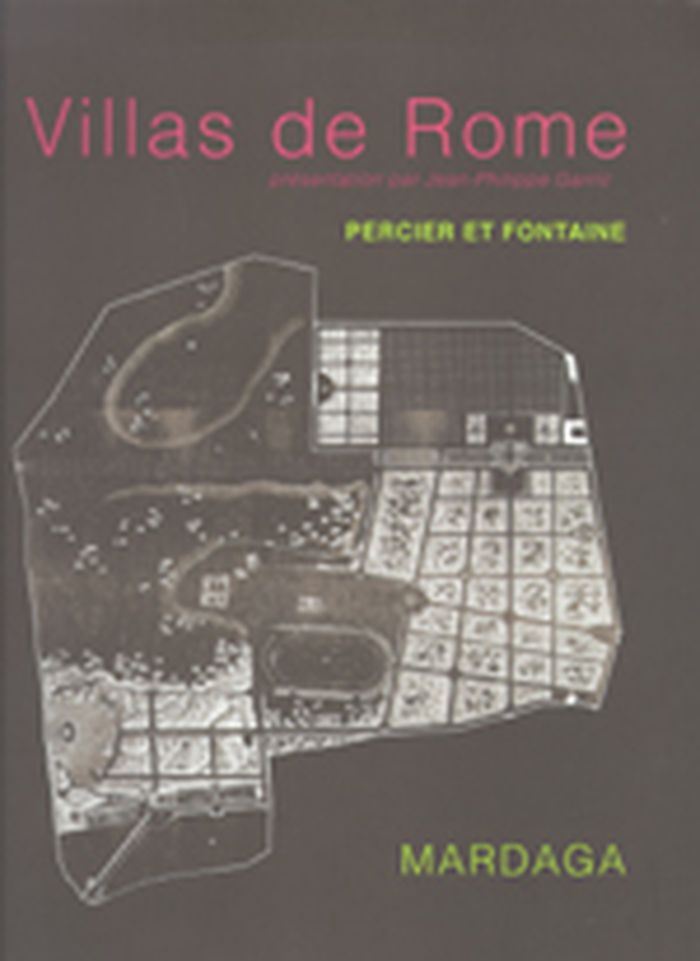
Titre:
Villa de Rome
Villa de Rome
Actions:
Prix:
$94.00
(disponible sur commande)
Résumé:
Publié à Paris à partir de 1809, le recueil de plans et de vues des villas de la Renaissance et de l'âge baroque de Percier et Fontaine a été soigneusement élaboré à partir des dessins réalisés avant la Révolution, alors qu'ils étaient pensionnaires à l'Académie de France à Rome. Bien que ses auteurs avaient déjà connu le succès avec leurs précédents ouvrages consacrés(...)
$94.00
(disponible sur commande)
Résumé:
Publié à Paris à partir de 1809, le recueil de plans et de vues des villas de la Renaissance et de l'âge baroque de Percier et Fontaine a été soigneusement élaboré à partir des dessins réalisés avant la Révolution, alors qu'ils étaient pensionnaires à l'Académie de France à Rome. Bien que ses auteurs avaient déjà connu le succès avec leurs précédents ouvrages consacrés(...)
Sujet:
Histoire jusqu’à 1900
Histoire jusqu’à 1900
Publication:
juillet 2007, Wavre
juillet 2007, Wavre
Titre:
Villa de Rome
Actions:
Prix:
$94.00
(disponible sur commande)
Résumé:
Publié à Paris à partir de 1809, le recueil de plans et de vues des villas de la Renaissance et de l'âge baroque de Percier et Fontaine a été soigneusement élaboré à partir des dessins réalisés avant la Révolution, alors qu'ils étaient pensionnaires à l'Académie de France à Rome. Bien que ses auteurs avaient déjà connu le succès avec leurs précédents ouvrages consacrés aux palais et aux maisons de Rome (1798) et aux décorations intérieures (1802), c'est dans cette nouvelle publication qu'ils plaçaient le plus d'ambitions. Car cette suite de gravures exécutées avec le plus grand soin ne vise pas seulement à garder la mémoire de l'émerveillement éprouvé dans les jardins romains, voire de la douceur du séjour ultramontain. L'information qu'elle propose, sur des édifices de tout premier plan, est là pour soutenir la position des deux architectes dans les débats contemporains et pour étayer leur dispositif théorique. II s'agit d'abord de répondre, par de nouvelles références, au développement dans les campagnes de l'empire d'un nouveau type de demeure aristocratique, tout en offrant un antidote au goût alors en plein essor pour les jardins anglais. C'est un choix esthétique et un engagement. Cette leçon d'Italie, cette alliance de vues et de plans, est là pour démontrer que les grandes ordonnances ne s'opposent pas, bien au contraire, au pittoresque, ce qui revient à soutenir les prétentions des architectes dans le domaine de l'art des jardins, face aux succès des jardiniers et des paysagistes. Après un premier livre, qui abordait l'échelle des édifices, puis un second qui traitait de celle du détail, le troisième grand recueil de Percier et Fontaine se focalise sur les grandes compositions, qui étaient alors une des bases du savoir-faire de l'architecte et le fondement du concours du Prix de Rome. Le Choix des plus célèbres maisons de plaisance de Rome et de ses environs, qui compte parmis les plus luxueux et les plus beaux livres d'architecture français, est depuis longtemps introuvable. Cette réédition intégrale de l'édition de 1809 est la première qui rende accessible cette référence majeure pour l'histoire de l'architecture du XIXe siècle, pour l'histoire de l'art des jardins et pour l'histoire de l'enseignement à l'École des beaux-Arts.
Villa de Rome
Actions:
Prix:
$94.00
(disponible sur commande)
Résumé:
Publié à Paris à partir de 1809, le recueil de plans et de vues des villas de la Renaissance et de l'âge baroque de Percier et Fontaine a été soigneusement élaboré à partir des dessins réalisés avant la Révolution, alors qu'ils étaient pensionnaires à l'Académie de France à Rome. Bien que ses auteurs avaient déjà connu le succès avec leurs précédents ouvrages consacrés aux palais et aux maisons de Rome (1798) et aux décorations intérieures (1802), c'est dans cette nouvelle publication qu'ils plaçaient le plus d'ambitions. Car cette suite de gravures exécutées avec le plus grand soin ne vise pas seulement à garder la mémoire de l'émerveillement éprouvé dans les jardins romains, voire de la douceur du séjour ultramontain. L'information qu'elle propose, sur des édifices de tout premier plan, est là pour soutenir la position des deux architectes dans les débats contemporains et pour étayer leur dispositif théorique. II s'agit d'abord de répondre, par de nouvelles références, au développement dans les campagnes de l'empire d'un nouveau type de demeure aristocratique, tout en offrant un antidote au goût alors en plein essor pour les jardins anglais. C'est un choix esthétique et un engagement. Cette leçon d'Italie, cette alliance de vues et de plans, est là pour démontrer que les grandes ordonnances ne s'opposent pas, bien au contraire, au pittoresque, ce qui revient à soutenir les prétentions des architectes dans le domaine de l'art des jardins, face aux succès des jardiniers et des paysagistes. Après un premier livre, qui abordait l'échelle des édifices, puis un second qui traitait de celle du détail, le troisième grand recueil de Percier et Fontaine se focalise sur les grandes compositions, qui étaient alors une des bases du savoir-faire de l'architecte et le fondement du concours du Prix de Rome. Le Choix des plus célèbres maisons de plaisance de Rome et de ses environs, qui compte parmis les plus luxueux et les plus beaux livres d'architecture français, est depuis longtemps introuvable. Cette réédition intégrale de l'édition de 1809 est la première qui rende accessible cette référence majeure pour l'histoire de l'architecture du XIXe siècle, pour l'histoire de l'art des jardins et pour l'histoire de l'enseignement à l'École des beaux-Arts.
Classification:
livres
livres
Publication:
juillet 2007, Wavre
juillet 2007, Wavre
Sujet:
Histoire jusqu’à 1900
Histoire jusqu’à 1900
Classification:
livres
livres
Actions:
Prix:
$7.99
(disponible sur commande)
Résumé:
The rivalry between the brilliant seventeenth-century Italian architects Gianlorenzo Bernini and Francesco Borromini is the stuff of legend. Possessed of enormous talent and ambition, these two artists -- one trained as a sculptor, the other as a stonecutter -- met as contemporaries in the building yards of St. Peter's in Rome and ended their lives as bitter enemies. Over(...)
$7.99
(disponible sur commande)
Résumé:
The rivalry between the brilliant seventeenth-century Italian architects Gianlorenzo Bernini and Francesco Borromini is the stuff of legend. Possessed of enormous talent and ambition, these two artists -- one trained as a sculptor, the other as a stonecutter -- met as contemporaries in the building yards of St. Peter's in Rome and ended their lives as bitter enemies. Over(...)
Titre:
The genius in the design : Bernini, Borromini, and the rivalry that transformed Rome
Actions:
Prix:
$7.99
(disponible sur commande)
Résumé:
The rivalry between the brilliant seventeenth-century Italian architects Gianlorenzo Bernini and Francesco Borromini is the stuff of legend. Possessed of enormous talent and ambition, these two artists -- one trained as a sculptor, the other as a stonecutter -- met as contemporaries in the building yards of St. Peter's in Rome and ended their lives as bitter enemies. Over the course of their careers they became the most celebrated architects of their era, designing some of the most beautiful buildings in the world and transforming the city of Rome. “The Genius in the Design” is an extraordinary tale of how these two men plotted, schemed, and intrigued to get the better of each other. Full of dramatic tension and great insight into personalities, acclaimed writer Jake Morrissey's engrossing and impeccably researched account also shows that this legendary rivalry defined the Baroque style that immediately succeeded the Renaissance and created the spectacular Roman cityscape of today. Almost exactly the same age -- Bernini was born at the end of 1598, Borromini nine months later -- they were as alike and as different as any two men could be, each a potent combination of passion and enterprise, energy and imperfection. Bernini was a precocious talent who as a youth caught the attention of Pope Paul V and became Rome's most celebrated artist, whose patrons included the wealthiest families in Europe. The city's greatest sculptor -- the creator of such masterpieces as Apollo and Daphne and the Ecstasy of St. Teresa -- Bernini would also have been Rome's pre-eminent architect had it not been for Francesco Borromini, the one man whose talent and virtuosity rivalled his own. In contrast to Bernini's easy grace, Borromini was an introvert with a fiery temper who bristled when anyone interfered with his vision; his temperament alienated him from prospective patrons and precipitated his tragic end. Like Mozart and Salieri, these two masters were inextricably linked, their dazzling work prodding the other to greater achievement while taking merciless advantage of each other's missteps. “The Genius in the Design” is their story, a fascinating narrative of beauty and tragedy marked at turns by personal animosity and astonishing artistic achievement.
The genius in the design : Bernini, Borromini, and the rivalry that transformed Rome
Actions:
Prix:
$7.99
(disponible sur commande)
Résumé:
The rivalry between the brilliant seventeenth-century Italian architects Gianlorenzo Bernini and Francesco Borromini is the stuff of legend. Possessed of enormous talent and ambition, these two artists -- one trained as a sculptor, the other as a stonecutter -- met as contemporaries in the building yards of St. Peter's in Rome and ended their lives as bitter enemies. Over the course of their careers they became the most celebrated architects of their era, designing some of the most beautiful buildings in the world and transforming the city of Rome. “The Genius in the Design” is an extraordinary tale of how these two men plotted, schemed, and intrigued to get the better of each other. Full of dramatic tension and great insight into personalities, acclaimed writer Jake Morrissey's engrossing and impeccably researched account also shows that this legendary rivalry defined the Baroque style that immediately succeeded the Renaissance and created the spectacular Roman cityscape of today. Almost exactly the same age -- Bernini was born at the end of 1598, Borromini nine months later -- they were as alike and as different as any two men could be, each a potent combination of passion and enterprise, energy and imperfection. Bernini was a precocious talent who as a youth caught the attention of Pope Paul V and became Rome's most celebrated artist, whose patrons included the wealthiest families in Europe. The city's greatest sculptor -- the creator of such masterpieces as Apollo and Daphne and the Ecstasy of St. Teresa -- Bernini would also have been Rome's pre-eminent architect had it not been for Francesco Borromini, the one man whose talent and virtuosity rivalled his own. In contrast to Bernini's easy grace, Borromini was an introvert with a fiery temper who bristled when anyone interfered with his vision; his temperament alienated him from prospective patrons and precipitated his tragic end. Like Mozart and Salieri, these two masters were inextricably linked, their dazzling work prodding the other to greater achievement while taking merciless advantage of each other's missteps. “The Genius in the Design” is their story, a fascinating narrative of beauty and tragedy marked at turns by personal animosity and astonishing artistic achievement.
Classification:
livres
livres
Publication:
mars 2005, New York
mars 2005, New York
Sujet:
livres soldés
livres soldés


