


5088 Résultats
Classification:
périodiques
périodiques
Actions:
Auteur:
Sujet:
Publication:
Hamilton, N.Z. : Dept. of English, University of Waikato
Hamilton, N.Z. : Dept. of English, University of Waikato
Classification:
périodiques
périodiques
Publication:
Hamilton, N.Z. : Dept. of English, University of Waikato
Hamilton, N.Z. : Dept. of English, University of Waikato
Auteur:
Sujet:
Classification:
périodiques
périodiques
Titre:
The Gaskell Journal.
The Gaskell Journal.
Actions:
Description:
1 online resource
Auteur:
Sujet:
Publication:
[England] : Gaskell Society, 2008-
[England] : Gaskell Society, 2008-
Classification:
périodiques
périodiques
Publication:
[England] : Gaskell Society, 2008-
[England] : Gaskell Society, 2008-
Auteur:
Sujet:
Classification:
livres
livres
Actions:
Prix:
$77.00
(disponible sur commande)
Résumé:
Inspired by Chekhov's short stories--and by his own contagious joy in the book form--photographer Paul Graham has created A Shimmer of Possibility, comprised of 12 individual books, each a photographic short story of everyday life. Some are simple and linear--a man smokes a cigarette while he waits for a bus in Las Vegas, or the camera tracks an autumn walk in Boston.(...)
Titre:
Paul Graham: a shimmer of possibility
Actions:
Prix:
$77.00
(disponible sur commande)
Résumé:
Inspired by Chekhov's short stories--and by his own contagious joy in the book form--photographer Paul Graham has created A Shimmer of Possibility, comprised of 12 individual books, each a photographic short story of everyday life. Some are simple and linear--a man smokes a cigarette while he waits for a bus in Las Vegas, or the camera tracks an autumn walk in Boston. Some entwine two, three or four scenes--while a couple carry their shopping home in Texas, a small child dances with a plastic bag in a garden. Some watch a quiet narrative break unexpectedly into a sublime moment--as a man cuts the grass in Pittsburgh it begins to rain, until the low sun breaks through and illuminates each drop. Graham's filmic haikus shun any forceful summation or tidy packaging. Instead, they create the impression of life flowing around and past us while we stand and stare, and make it hard not to share the artist's quiet astonishment with its beauty and grace. The 12 books gathered here are identical in trim size, but vary in length from just a single photograph to 60 pages of images made at one street corner. Paul Graham's work has been widely exhibited and published for 25 years, most recently in the book American Night.
Classification:
livres
livres
Publication:
janvier 2009
janvier 2009
Sujet:
Monographies photo
Monographies photo
Classification:
périodiques
périodiques
Titre:
New England review.
New England review.
Actions:
Description:
1 online resource
Auteur:
Sujet:
Publication:
Middlebury, VT : Middlebury College Publications, 1990-
Middlebury, VT : Middlebury College Publications, 1990-
Classification:
périodiques
périodiques
Publication:
Middlebury, VT : Middlebury College Publications, 1990-
Middlebury, VT : Middlebury College Publications, 1990-
Auteur:
Sujet:
Classification:
livres
livres
Titre:
The subversive seventies
The subversive seventies
Actions:
Prix:
$33.95
(disponible en magasin)
Résumé:
A thought-provoking reconsideration of how the revolutionary movements of the 1970s set the mold for today's activism. The 1970s was a decade of "subversives". Faced with various progressive and revolutionary social movements, the forces of order--politicians, law enforcement, journalists, and conservative intellectuals--saw subversives everywhere. From indigenous peasant(...)
Titre:
The subversive seventies
Actions:
Prix:
$33.95
(disponible en magasin)
Résumé:
A thought-provoking reconsideration of how the revolutionary movements of the 1970s set the mold for today's activism. The 1970s was a decade of "subversives". Faced with various progressive and revolutionary social movements, the forces of order--politicians, law enforcement, journalists, and conservative intellectuals--saw subversives everywhere. From indigenous peasant armies and gay liberation organizations, to anti-nuclear activists and Black liberation militants, subversives challenged authority, laid siege to the established order, and undermined time-honored ways of life. Every corner of the left was fertile ground for subversive elements, which the forces of order had to root out and destroy--a project they pursued with zeal and brutality. In "The subversive seventies", Michael Hardt sets out to show that popular understandings of the political movements of the seventies--often seen as fractious, violent, and largely unsuccessful--are not just inaccurate, but foreclose valuable lessons for the political struggles of today. While many accounts of the 1970s have been written about the regimes of domination that emerged throughout the decade, Hardt approaches the subversive from the perspectives of those who sought to undermine the base of established authority and transform the fundamental structures of society. In so doing, he provides a novel account of the theoretical and practical projects of liberation that still speak to us today, too many of which have been all but forgotten.
Classification:
livres
livres
Publication:
septembre 2023
septembre 2023
Sujet:
Social
Social
Classification:
livres
livres
Titre:
e-flux Index #2
e-flux Index #2
Actions:
Prix:
$65.00
(disponible en magasin)
Résumé:
"It’s always too late, whenever you take a photograph." This laconic remark, which I heard during a recent artist’s talk in Berlin, bubbled up from a discussion upon the often-tragic indexicality or nonindexicality of contemporary photographic practice. JPEGs taken for wonders. Smoke plumes without embers. Footprints crossing the beaches of abandoned resorts. Hands that(...)
Titre:
e-flux Index #2
Actions:
Prix:
$65.00
(disponible en magasin)
Résumé:
"It’s always too late, whenever you take a photograph." This laconic remark, which I heard during a recent artist’s talk in Berlin, bubbled up from a discussion upon the often-tragic indexicality or nonindexicality of contemporary photographic practice. JPEGs taken for wonders. Smoke plumes without embers. Footprints crossing the beaches of abandoned resorts. Hands that point at nothing in particular, and the gullible eyes that follow the lead of pointing index fingers. There is indeed something awkward to the snapshot’s belatedness. Its untimeliness. The ways in which, the second the shutter clicks—or that our thumb melds with the appropriate region of our phone’s liquid plasma displays and the resultant file is uploaded to a distant server—the instant we sought to "capture" has passed by and something else enters the frame. Someone blinks, the rubble dust envelopes the scene, the light changes, the hoodie we saw underground bearing the phrase "THEIR DESTINIES WOULD INTERTWINE" disappears behind an arriving subway’s blur, the wind cajoles a neighboring branch we hadn’t before noticed into the family portrait. Photography then remains, contrary to the terms in which it is sold to us by Silicon Valley manufacturers who stress its total immediacy as an instrument for perceiving the world, a stubbornly untimely pursuit. Can we not also say, "It’s always too late, whenever you start to index"?
Classification:
livres
livres
Publication:
juillet 2024
juillet 2024
Sujet:
Revues
Revues
Classification:
livres
livres
Titre:
Infinity and perspective
Infinity and perspective
Actions:
Prix:
$36.95
(disponible sur commande)
Résumé:
Much postmodern rhetoric, suggests Karsten Harries, can be understood as a symptom of our civilization's discontent, born of regret that we are no longer able to experience our world as a cosmos that assigns us our place. But dissatisfaction with the modern world may also spring from a conviction that modernism has failed to confront the challenge of an inevitably open(...)
Sujet:
Théorie de l’architecture
Théorie de l’architecture
Publication:
octobre 2002, Cambridge, Mass.
octobre 2002, Cambridge, Mass.
Titre:
Infinity and perspective
Actions:
Prix:
$36.95
(disponible sur commande)
Résumé:
Much postmodern rhetoric, suggests Karsten Harries, can be understood as a symptom of our civilization's discontent, born of regret that we are no longer able to experience our world as a cosmos that assigns us our place. But dissatisfaction with the modern world may also spring from a conviction that modernism has failed to confront the challenge of an inevitably open future. Such conviction has frequently led to a critique of modernity's founding heroes. Challenging that critique, Harries insists that modernity is supported by nothing other than human freedom. But more important to Harries is to show how modernist self-assertion is shadowed by nihilism and what it might mean to step out of that shadow. Looking at a small number of medieval and Renaissance texts, as well as some paintings, he uncovers the threshold that separates the modern from the premodern world. At the same time, he illuminates that other, more questionable threshold, between the modern and the postmodern. Two spirits preside over the book: Alberti, the Renaissance author on art and architecture, whose passionate interest in perspective and point of view offers a key to modernity; and Nicolaus Cusanus, the fifteenth-century cardinal, whose work shows that such interest cannot be divorced from speculations on the infinity of God. The title Infinity and Perspective connects the two to each other and to the shape of modernity.
Classification:
livres
livres
Publication:
octobre 2002, Cambridge, Mass.
octobre 2002, Cambridge, Mass.
Sujet:
Théorie de l’architecture
Théorie de l’architecture
Classification:
livres
livres

Actions:
Prix:
$29.95
(disponible sur commande)
Résumé:
Las Vegas, an artificial city brought to life in the heart of the Mojave desert, is the ultimate urban temptation: its shopping malls, theme parks and casinos offer an unceasing parade of entertainments and diversions. Its architecture combines slick, commercial seduction with a childish, cartoon-like appearance; its streets and arcades are constantly animated with(...)
Titre:
Zeropolis : the experience of Las Vegas
Actions:
Prix:
$29.95
(disponible sur commande)
Résumé:
Las Vegas, an artificial city brought to life in the heart of the Mojave desert, is the ultimate urban temptation: its shopping malls, theme parks and casinos offer an unceasing parade of entertainments and diversions. Its architecture combines slick, commercial seduction with a childish, cartoon-like appearance; its streets and arcades are constantly animated with visitors and residents willingly submitting to the opium of this spectacular place. Las Vegas has always fascinated those who write about the American malaise, from Tom Wolfe to J. G. Ballard, but Bégout reveals the city’s other side, adding a valuable philosophical dimension to the nightmarish, fantastic visions that haunt the imagination of novelists and film-makers. The author draws minutely detailed portraits in the form of city scenes – portraits that are often tragic and sometimes extremely comic. Bégout lets himself be dragged into this party, this ‘paradise for bastards’, as Nick Tosches calls it. For Bégout, Las Vegas is the consummation of the modern city, the ultimate destination of our urban experiments, the great supermarket of the global village. "Neither near nor far, neither here nor elsewhere, Las Vegas is distinguished by nothingness. For us it is zeropolis, the non-city that is the very first city, just as zero is the very first number." Bruce Bégout is lecturer in philosophy at the University of Picardie, Amiens, France.
Classification:
livres
livres
Publication:
novembre 2003, London
novembre 2003, London
Sujet:
Théorie de l’urbanisme
Théorie de l’urbanisme
Classification:
livres
livres
Actions:
Prix:
$37.50
(disponible sur commande)
Résumé:
"Maps of the imagination" takes us on a magic carpet ride over terrain both familiar and exotic. Using the map as metaphor, Peter Turchi considers writing as a combination of exploration and presentation. He compares the way a writer leads a reader through the imaginary world of a story, novel, or poem to the way a mapmaker charts the physical world. "To ask for a map,"(...)
Titre:
Maps of the imagination : the writer as cartographer
Actions:
Prix:
$37.50
(disponible sur commande)
Résumé:
"Maps of the imagination" takes us on a magic carpet ride over terrain both familiar and exotic. Using the map as metaphor, Peter Turchi considers writing as a combination of exploration and presentation. He compares the way a writer leads a reader through the imaginary world of a story, novel, or poem to the way a mapmaker charts the physical world. "To ask for a map," says Turchi, "is to say, 'Tell me a story.' " The author looks at how mapmakers and writers deal with blank space and the blank page; the conventions they use (both the ones readers recognize and those that often go unnoticed) or consciously disregard; the role of geometry in maps and the parallel role of form in writing; how both maps and writing serve to re-create an individual's view of the world; and the artist's delicate balance of intuition with intention. The ancient Greeks, German globe makers, and British cartographers join forces with the Marx Brothers, NASA, and Roadrunner cartoons to shed light on the strategies of writers as diverse as Sappho, Ernest Hemingway, Virginia Woolf, Vladimir Nabokov, Italo Calvino, Don DeLillo, and Heather McHugh. A combination of history, critical cartography, personal essay, and practical guide to writing, "Maps of the imagination" is a book for writers, for readers, and for anyone interested in creativity.
Classification:
livres
livres
Publication:
octobre 2004, San Antonio
octobre 2004, San Antonio
Sujet:
Architecture et l'imaginaire
Architecture et l'imaginaire
Classification:
livres
livres
Prix:
$27.00
(disponible sur commande)
Résumé:
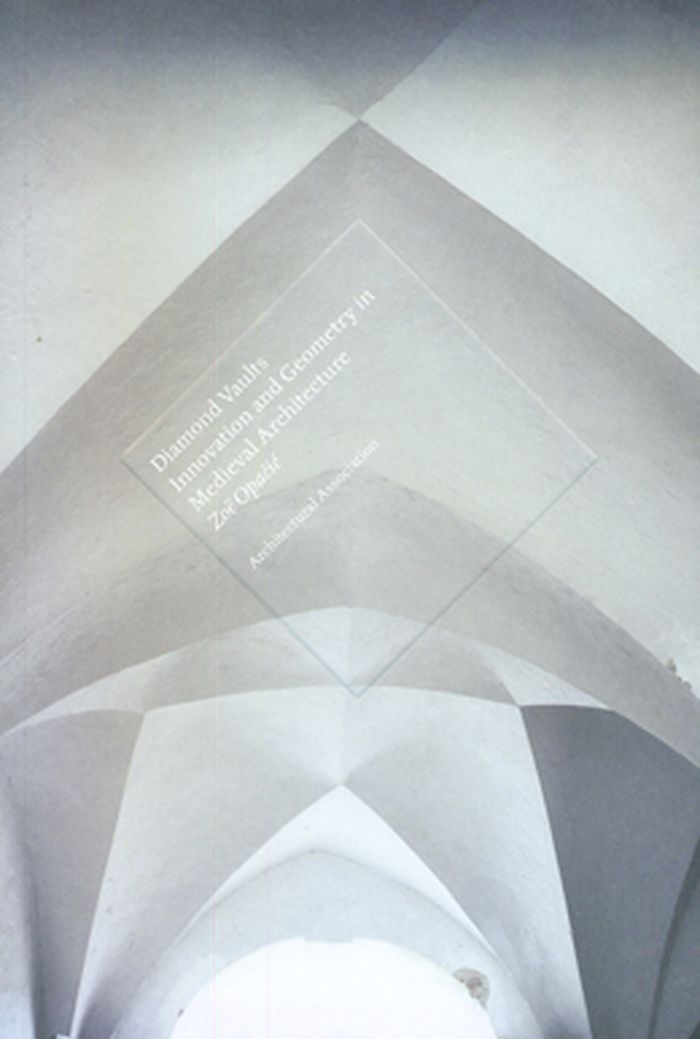
The diamond vaults of Central Europe are among the most original yet little-known creations of medieval architecture : ceilings so complex that, as their name suggests, they recall the facets of a cut gemstone. First appearing in 1471 at the palace of Albrechtsburg in Meissen, Germany, they were employed for almost a century in locations as far apart as Gdansk on the(...)
Titre:
Diamond vaults : innovation and geometry in medieval architecture
Actions:
Prix:
$27.00
(disponible sur commande)
Résumé:
The diamond vaults of Central Europe are among the most original yet little-known creations of medieval architecture : ceilings so complex that, as their name suggests, they recall the facets of a cut gemstone. First appearing in 1471 at the palace of Albrechtsburg in Meissen, Germany, they were employed for almost a century in locations as far apart as Gdansk on the Baltic to Bechyne in southern Bohemia (today’s Czech Republic). From a historical point of view, diamond vaults show the continuing vitality of Gothic architecture in Central Europe, at a time when the rediscovery of the classical past in Renaissance Italy was changing the course of building. Architecturally, they offer some of the most impressive examples of geometrical experimentation and versatility in both secular and sacred spaces. But perhaps their greatest appeal is visual. The stark, concave–convex shapes of diamond vaults, with their lyrical play of the effects of light and shade, strike us today as incredibly modern. "Diamond vaults" explores this singular phenomenon. A text by Zoë Opacic explores the vault’s origins, topography, structure and design, as well as function and context, focusing primarily on the Czech Republic, which boasts some of the best examples, and contrasting them with those in Germany and Gdansk. One of the chief aims is to demonstrate the undoubted aesthetic appeal of this form, which has continued to inspire generations of architects.
Classification:
livres
livres
Publication:
janvier 2006, London
janvier 2006, London


