


1315 Résultats
Classification:
documents textuels
documents textuels
Numéro de référence:
ARCH174243
Description:
Contient un document télécopié concernant les révisions apportées aux garde-corps et aux lampadaires (3 sept. 91), facture no 1: de Luc Laporte à la Société du Vieux-Port de Montréal (15 octobre 1991), devis de 91 pages 8.5” x 11” non reliées, 28 janvier 1992 , un document concernant les honoraires professionnels de l'équipe de Luc Laporte (6 mars 1992) et une lettre concernant la membrane de toit Hydrotech (8 juillet 1992).
ARCH174243
Description:
Contient un document télécopié concernant les révisions apportées aux garde-corps et aux lampadaires (3 sept. 91), facture no 1: de Luc Laporte à la Société du Vieux-Port de Montréal (15 octobre 1991), devis de 91 pages 8.5” x 11” non reliées, 28 janvier 1992 , un document concernant les honoraires professionnels de l'équipe de Luc Laporte (6 mars 1992) et une lettre concernant la membrane de toit Hydrotech (8 juillet 1992).
Personnes et institutions:
Date:
1991-1992
1991-1992
Titre:
Devis, documents financiers, correspondance de chantier, et correspondance avec consultants et fournisseurs, Pavillon du Bassin Bonsecours, Montréal, Québec
Actions:
ARCH174243
Description:
Contient un document télécopié concernant les révisions apportées aux garde-corps et aux lampadaires (3 sept. 91), facture no 1: de Luc Laporte à la Société du Vieux-Port de Montréal (15 octobre 1991), devis de 91 pages 8.5” x 11” non reliées, 28 janvier 1992 , un document concernant les honoraires professionnels de l'équipe de Luc Laporte (6 mars 1992) et une lettre concernant la membrane de toit Hydrotech (8 juillet 1992).
Devis, documents financiers, correspondance de chantier, et correspondance avec consultants et fournisseurs, Pavillon du Bassin Bonsecours, Montréal, Québec
Actions:
ARCH174243
Description:
Contient un document télécopié concernant les révisions apportées aux garde-corps et aux lampadaires (3 sept. 91), facture no 1: de Luc Laporte à la Société du Vieux-Port de Montréal (15 octobre 1991), devis de 91 pages 8.5” x 11” non reliées, 28 janvier 1992 , un document concernant les honoraires professionnels de l'équipe de Luc Laporte (6 mars 1992) et une lettre concernant la membrane de toit Hydrotech (8 juillet 1992).
Classification:
documents textuels
documents textuels
Date:
1991-1992
1991-1992
Personnes et institutions:
Classification:
documents textuels
documents textuels
Numéro de référence:
ARCH158261
Description:
Cette chemise contient de la correspondance relative au matériel de l'exposition tenue à Montréal en décembre 1958, telle une lettre du Montreal Construction Centre relative à la participation de Roger D'Astous à Exhibit of 1958 Planned Homes, des documents relatifs à d'autres expositions sur Frank Lloyd Wright qui se tinrent au Musée des Arts décoratifs de Montréal ainsi qu'un exemplaire du catalogue du Tribute to the United Nations - International Festival of Art, October 24 to November 23, 1958.
ARCH158261
Description:
Cette chemise contient de la correspondance relative au matériel de l'exposition tenue à Montréal en décembre 1958, telle une lettre du Montreal Construction Centre relative à la participation de Roger D'Astous à Exhibit of 1958 Planned Homes, des documents relatifs à d'autres expositions sur Frank Lloyd Wright qui se tinrent au Musée des Arts décoratifs de Montréal ainsi qu'un exemplaire du catalogue du Tribute to the United Nations - International Festival of Art, October 24 to November 23, 1958.
Personnes et institutions:
Date:
1958-1995
1958-1995
Titre:
Correspondance relative au matériel de l'exposition
Actions:
ARCH158261
Description:
Cette chemise contient de la correspondance relative au matériel de l'exposition tenue à Montréal en décembre 1958, telle une lettre du Montreal Construction Centre relative à la participation de Roger D'Astous à Exhibit of 1958 Planned Homes, des documents relatifs à d'autres expositions sur Frank Lloyd Wright qui se tinrent au Musée des Arts décoratifs de Montréal ainsi qu'un exemplaire du catalogue du Tribute to the United Nations - International Festival of Art, October 24 to November 23, 1958.
Correspondance relative au matériel de l'exposition
Actions:
ARCH158261
Description:
Cette chemise contient de la correspondance relative au matériel de l'exposition tenue à Montréal en décembre 1958, telle une lettre du Montreal Construction Centre relative à la participation de Roger D'Astous à Exhibit of 1958 Planned Homes, des documents relatifs à d'autres expositions sur Frank Lloyd Wright qui se tinrent au Musée des Arts décoratifs de Montréal ainsi qu'un exemplaire du catalogue du Tribute to the United Nations - International Festival of Art, October 24 to November 23, 1958.
Classification:
documents textuels
documents textuels
Date:
1958-1995
1958-1995
Personnes et institutions:
Classification:
documents textuels, photographies
documents textuels, photographies
Numéro de référence:
ARCH169200
Description:
5 feuillets: Correspondance relative à une demande de subvention au Ministère des affaires culturelles du Québec 6 au 13 mai 1988 28 feuillets: Demande de bourse 35,5 x 21,5 cm 21 feuillets: Présentation de l'exposition "À table" 2 dessins conceptuels encre sur papier calque jaune 18 x 25 cm 2 montages d'illustrations photocopies, montés sur papier format lettre et colorié au crayon de couleur par Jacques Rousseau 6 factures 1 carte d'affaire
ARCH169200
Description:
5 feuillets: Correspondance relative à une demande de subvention au Ministère des affaires culturelles du Québec 6 au 13 mai 1988 28 feuillets: Demande de bourse 35,5 x 21,5 cm 21 feuillets: Présentation de l'exposition "À table" 2 dessins conceptuels encre sur papier calque jaune 18 x 25 cm 2 montages d'illustrations photocopies, montés sur papier format lettre et colorié au crayon de couleur par Jacques Rousseau 6 factures 1 carte d'affaire
Personnes et institutions:
Titre:
Correspondance relative à une demande de subvention au Ministère des affaires culturelles du Québec, et vue de l'installation à table
Actions:
ARCH169200
Description:
5 feuillets: Correspondance relative à une demande de subvention au Ministère des affaires culturelles du Québec 6 au 13 mai 1988 28 feuillets: Demande de bourse 35,5 x 21,5 cm 21 feuillets: Présentation de l'exposition "À table" 2 dessins conceptuels encre sur papier calque jaune 18 x 25 cm 2 montages d'illustrations photocopies, montés sur papier format lettre et colorié au crayon de couleur par Jacques Rousseau 6 factures 1 carte d'affaire
Correspondance relative à une demande de subvention au Ministère des affaires culturelles du Québec, et vue de l'installation à table
Actions:
ARCH169200
Description:
5 feuillets: Correspondance relative à une demande de subvention au Ministère des affaires culturelles du Québec 6 au 13 mai 1988 28 feuillets: Demande de bourse 35,5 x 21,5 cm 21 feuillets: Présentation de l'exposition "À table" 2 dessins conceptuels encre sur papier calque jaune 18 x 25 cm 2 montages d'illustrations photocopies, montés sur papier format lettre et colorié au crayon de couleur par Jacques Rousseau 6 factures 1 carte d'affaire
Classification:
documents textuels, photographies
documents textuels, photographies
Personnes et institutions:
Classification:
documents textuels, photographies
documents textuels, photographies
Numéro de référence:
ARCH167031
Description:
5 photographies couleur: Site et maquette jusqu'à 10 x 15 cm 8 feuillets: Correspondance relative au projet janvier à juin 1993 2 photocopies laser noir et blanc: Vues de l'édifice existant 21, 5 x 28 cm 3 photocopies couleurs: Vues de la maquette format lettre 2 factures 3 feuillets: Notes et adresses 21, 5 x 28 cm 5 feuillets: Documentation relative à l'histoire et la structure administrative des Jeunesses Musicales du Canada 21, 5 x 28 cm 1 feuillet: publicité des Jeunesses Musicales du Canada
ARCH167031
Description:
5 photographies couleur: Site et maquette jusqu'à 10 x 15 cm 8 feuillets: Correspondance relative au projet janvier à juin 1993 2 photocopies laser noir et blanc: Vues de l'édifice existant 21, 5 x 28 cm 3 photocopies couleurs: Vues de la maquette format lettre 2 factures 3 feuillets: Notes et adresses 21, 5 x 28 cm 5 feuillets: Documentation relative à l'histoire et la structure administrative des Jeunesses Musicales du Canada 21, 5 x 28 cm 1 feuillet: publicité des Jeunesses Musicales du Canada
Personnes et institutions:
Titre:
Site et maquette
Actions:
ARCH167031
Description:
5 photographies couleur: Site et maquette jusqu'à 10 x 15 cm 8 feuillets: Correspondance relative au projet janvier à juin 1993 2 photocopies laser noir et blanc: Vues de l'édifice existant 21, 5 x 28 cm 3 photocopies couleurs: Vues de la maquette format lettre 2 factures 3 feuillets: Notes et adresses 21, 5 x 28 cm 5 feuillets: Documentation relative à l'histoire et la structure administrative des Jeunesses Musicales du Canada 21, 5 x 28 cm 1 feuillet: publicité des Jeunesses Musicales du Canada
Site et maquette
Actions:
ARCH167031
Description:
5 photographies couleur: Site et maquette jusqu'à 10 x 15 cm 8 feuillets: Correspondance relative au projet janvier à juin 1993 2 photocopies laser noir et blanc: Vues de l'édifice existant 21, 5 x 28 cm 3 photocopies couleurs: Vues de la maquette format lettre 2 factures 3 feuillets: Notes et adresses 21, 5 x 28 cm 5 feuillets: Documentation relative à l'histoire et la structure administrative des Jeunesses Musicales du Canada 21, 5 x 28 cm 1 feuillet: publicité des Jeunesses Musicales du Canada
Classification:
documents textuels, photographies
documents textuels, photographies
Personnes et institutions:
Classification:
documents textuels
documents textuels
Numéro de référence:
ARCH168143
Description:
1 coupure de presse: non identifiée, Résultats du concours 12 x 28 cm 5 feuillets: Description du concours et fiche d'inscription jusqu'à 23 x 34 cm 4 feuillets: Rapport sur la participation du Concours format lettre 8 pages: Brochure intitulée: "Concours l'Art de vivre en vill-Annexes" 16 feuillets: Photocopie de la brochure:"Concours l'Art de vivre en vill-Annexes" 11 feuillets: Plan du site et réponses aux questions des participants, photocopies 21,5 x 28 cm 36 feuillets: Texte liminaire, notes manuscrites et texte soumis au concours, photocopies jusqu'à 21,5 x 25,5 cm
ARCH168143
Description:
1 coupure de presse: non identifiée, Résultats du concours 12 x 28 cm 5 feuillets: Description du concours et fiche d'inscription jusqu'à 23 x 34 cm 4 feuillets: Rapport sur la participation du Concours format lettre 8 pages: Brochure intitulée: "Concours l'Art de vivre en vill-Annexes" 16 feuillets: Photocopie de la brochure:"Concours l'Art de vivre en vill-Annexes" 11 feuillets: Plan du site et réponses aux questions des participants, photocopies 21,5 x 28 cm 36 feuillets: Texte liminaire, notes manuscrites et texte soumis au concours, photocopies jusqu'à 21,5 x 25,5 cm
Personnes et institutions:
Date:
septembre-novembre 1991
septembre-novembre 1991
Titre:
"Concours l'Art de vivre en vill-Annexes"
Actions:
ARCH168143
Description:
1 coupure de presse: non identifiée, Résultats du concours 12 x 28 cm 5 feuillets: Description du concours et fiche d'inscription jusqu'à 23 x 34 cm 4 feuillets: Rapport sur la participation du Concours format lettre 8 pages: Brochure intitulée: "Concours l'Art de vivre en vill-Annexes" 16 feuillets: Photocopie de la brochure:"Concours l'Art de vivre en vill-Annexes" 11 feuillets: Plan du site et réponses aux questions des participants, photocopies 21,5 x 28 cm 36 feuillets: Texte liminaire, notes manuscrites et texte soumis au concours, photocopies jusqu'à 21,5 x 25,5 cm
"Concours l'Art de vivre en vill-Annexes"
Actions:
ARCH168143
Description:
1 coupure de presse: non identifiée, Résultats du concours 12 x 28 cm 5 feuillets: Description du concours et fiche d'inscription jusqu'à 23 x 34 cm 4 feuillets: Rapport sur la participation du Concours format lettre 8 pages: Brochure intitulée: "Concours l'Art de vivre en vill-Annexes" 16 feuillets: Photocopie de la brochure:"Concours l'Art de vivre en vill-Annexes" 11 feuillets: Plan du site et réponses aux questions des participants, photocopies 21,5 x 28 cm 36 feuillets: Texte liminaire, notes manuscrites et texte soumis au concours, photocopies jusqu'à 21,5 x 25,5 cm
Classification:
documents textuels
documents textuels
Date:
septembre-novembre 1991
septembre-novembre 1991
Personnes et institutions:
Classification:
documents textuels, photographies
documents textuels, photographies
Titre:
Documentation et intentions
Documentation et intentions
Numéro de référence:
ARCH167188
Description:
Documentation et intentions 4 feuillets: "Projet de l'esplanade du Faubourg Québec" texte de Jacques Rousseau 1 feuillet: Lettre de Pierre-Luc Dumas (SHDM), 24 août 1994 1 feuillet: Notes manuscrites d'une réunion avec Pierre-Luc Dumas 9 feuillets: Documentation préparatoire pour un document intitulé: "Possibilités ouvertes par le plan; Aménagement du front maritime" 4 photographies couleurs: Vues de la maquette, 10 x 15 cm 34 pages: Rapport préparé pour la SHDM intitulé: "Le paysage du Faubourg Québec, Énoncé du projet d'espace public: secteur ouest" par Ph. Poullaouec-Gonidec & als. mars 1994 1 enveloppe scellée avec notes manuscrites à l'endos
ARCH167188
Description:
Documentation et intentions 4 feuillets: "Projet de l'esplanade du Faubourg Québec" texte de Jacques Rousseau 1 feuillet: Lettre de Pierre-Luc Dumas (SHDM), 24 août 1994 1 feuillet: Notes manuscrites d'une réunion avec Pierre-Luc Dumas 9 feuillets: Documentation préparatoire pour un document intitulé: "Possibilités ouvertes par le plan; Aménagement du front maritime" 4 photographies couleurs: Vues de la maquette, 10 x 15 cm 34 pages: Rapport préparé pour la SHDM intitulé: "Le paysage du Faubourg Québec, Énoncé du projet d'espace public: secteur ouest" par Ph. Poullaouec-Gonidec & als. mars 1994 1 enveloppe scellée avec notes manuscrites à l'endos
Personnes et institutions:
Date:
août 1994 - mars 1995
août 1994 - mars 1995
Titre:
Documentation et intentions
Actions:
ARCH167188
Description:
Documentation et intentions 4 feuillets: "Projet de l'esplanade du Faubourg Québec" texte de Jacques Rousseau 1 feuillet: Lettre de Pierre-Luc Dumas (SHDM), 24 août 1994 1 feuillet: Notes manuscrites d'une réunion avec Pierre-Luc Dumas 9 feuillets: Documentation préparatoire pour un document intitulé: "Possibilités ouvertes par le plan; Aménagement du front maritime" 4 photographies couleurs: Vues de la maquette, 10 x 15 cm 34 pages: Rapport préparé pour la SHDM intitulé: "Le paysage du Faubourg Québec, Énoncé du projet d'espace public: secteur ouest" par Ph. Poullaouec-Gonidec & als. mars 1994 1 enveloppe scellée avec notes manuscrites à l'endos
Documentation et intentions
Actions:
ARCH167188
Description:
Documentation et intentions 4 feuillets: "Projet de l'esplanade du Faubourg Québec" texte de Jacques Rousseau 1 feuillet: Lettre de Pierre-Luc Dumas (SHDM), 24 août 1994 1 feuillet: Notes manuscrites d'une réunion avec Pierre-Luc Dumas 9 feuillets: Documentation préparatoire pour un document intitulé: "Possibilités ouvertes par le plan; Aménagement du front maritime" 4 photographies couleurs: Vues de la maquette, 10 x 15 cm 34 pages: Rapport préparé pour la SHDM intitulé: "Le paysage du Faubourg Québec, Énoncé du projet d'espace public: secteur ouest" par Ph. Poullaouec-Gonidec & als. mars 1994 1 enveloppe scellée avec notes manuscrites à l'endos
Classification:
documents textuels, photographies
documents textuels, photographies
Date:
août 1994 - mars 1995
août 1994 - mars 1995
Personnes et institutions:
Niveau de description archivistique:
Sous-série
Sous-série
Titre:
Opera Houses
Opera Houses
Numéro de référence:
CI001.S2.D3
Description:
Charles Rohault de Fleury's sustained involvement with the design of opera houses began with his appointment in 1846 as official architect of the existing Salle Le Pelletier, home to the *Paris Opera, and continued until an open competition was called in 1860 (Charles Garnier won this competition). During this period Rohault de Fleury submitted numerous proposals to replace theprovisional Salle Le Pelletier with a structure more appropriate to the grandeur and importance of France's national opera company. The CCA collection contains four projects related to his work for the Paris opera: two early projects (1846 and 1847) and one later one (1859) for a newopera house, and a portfolio of lithographs and drawings related to alterations and repairs to Salle Le Pelletier (1850-1854). The collection also includes Charles' earliest theatre project, a comprehensive plan for an opera house and surrounding infrastructure for the Theatre Royal Italien opera company (1838-1840), and an album containing drawings and prints of antique and contemporary theatres (1839-1854?). Charles' first project was for the Theatre Royal Italien opera company whose previous home, the Salle Favart, had burned down on the night of January 14 1838. The CCA collection contains an album of presentation drawings for a new theatre located on rue de la Paix with boutiques in the adjacent 'passages' (DR1974:0002:019:001-023). A second album consists of site plans including proposed 'maisons à loyers' (apartment buildings) and documents relating to the cost estimates and rental income for the entire project (DR1974:0002:036:001-016). The architectural style and interior arrangement of the theatre is heavily indebted to Francois Debret's Salle Le Pelletier. Charles' originality lies more in his conception of the social and economic role of the theatre in relation and integration, to its surrounding urban fabric. An explanation of the entire Theatre Royal Italien project, and Charles' role as architect in it, is found in two proposal letters (located in the Avery Library, Columbia University, NY) written by the entrepreneur Eugene Lecomte to the Minister of the Interior, Comte Duchatel, on May 15 and October 31 1839 (1). Charles' album of drawings at the CCA for the theatre and some of the cost and rental estimates are probably presentation copies directly related to the first letter, and most likely submitted to the Minister of the Interior. Charles' project was never executed, and the Italian opera company eventualy found a permanent home in the existing Salle Ventadour (1841). However, the inclusive nature of the Théâtre Royal Italien proposal, with its stress on urban development and contextuality, continued to play a seminal role in his later Paris Opera projects. Upon replacing Francois Debret as architect of Salle Le Pelletier in 1846, Charles proposed nine possible locations (site plans) for a new opera house for the Paris Opera (*Academie Royale de Musique) and, in the following year (1847) prepared a portfolio of drawings for the actual structure with an accompanying seven-page manuscript describing the project. Although executed in successive years, the site plans and 1847 drawings are conceptually related. Both components were undertaken in response to offical interest in a public competition that was never implemented (2)(3). The CCA has two sets of the nine site plans proposed in 1846 (DR1974:0002:036:001-016), one containing transfer lithographed site plans with a written analysis and cost estimate for each of the proposed locations, and the other with only the site plans (similar sets are located in the 'Archives Nationales' in France). They indicate that Charles, (heavily influenced by his Théâtre Royal Italien project) preferred the Rue de la Paix location (siteplan #3) for the new opera house. Although site plan number six, Boulevard des Capucines, was not favoured at this date, it is highly prophetic as it was the location officially chosen in 1860 for the new opera house. Apparently unique to the CCA collection is the 1847 manuscript and portfolio of drawings for the proposed opera house (DR1974:0002:036:001-016). The manuscript is both an indepth review of the requirements for a national opera house and a guide to his portfolio of drawings. Charles' conception and design continued to be strongly influenced by Debret's Salle Lepelletier, as well as his own Théâtre Italien project, and various antique and contemporary opera houses and theatres. Many of the French and Italian sources mentioned in the manuscript are collected in an album (DR1974:0002:010:001-048) as references for his own designs (4). As official architect of Salle Le pelletier, Charles was also responsible for repairs, restorations, and alterations to the existing structure. The drawings and transfer lithographs in the CCA collection (DR1974:0002:036:001-016) are primarily dated 1854, and relate to documented repair and restoration projects undertaken during this period (5)(6). The CCA collection has the presentation drawings and lithographs for the later 1859 project (DR1974:0002:027:001-027) for the Paris opera (*Theatre Imperiale de l'opera) that were sent to Achille Fould, the Minister of State. This project is probably a counterpart to a similiar one that he submitted to the Prefect of the Seine, Baron Haussmann, in the same year (7). Site plans show the opera house on an irregular polygonal site facing Boulevard des Capucines. The placement of the 'maisons à loyers' on the rear of the site reflects Charles' continued emphasis on integrating his opera projects into the surrounding urban context. In 1859, it appeared that Charles was favoured to build the new opera house. But late in the following year, a public competition was called in which Charles Garnier emerged as the victor. Although Charles did not build the final structure, his numerous projects, as exemplified in the CCA collection, were of prime importance in determining the location, configuration, and plan of the Place de l'Opera (8). * The 'Paris Opera' was France's national opera, and thus its name changed numerous times throughout its history according to altering perceptions of its role in French culture and/or changes in political regimes. For reasons of clarity, the national opera will be referred to as the Paris Opera. The names indicated in brackets with a star refer to the proper name of the opera company at the date of the project. (1) Eugene Le Comte, "Projet de Salle rue de la Paix, pour le Théâtre Royal Italien: Lettres à Monsieur le Ministre de l'Intérieur, en date des 15 mai et 31octobre 1839" (Paris: P. Dupont, 1839). (2) Christopher Curtis Mead, "Charles Garnier's Paris Opera and the Renaissance of Classicism in Nineteenth century French Architecture", 3 vols. (PhD thesis; Philadelphia: University of Pennsylvania, 1986), p. 234 and p. 956, fn. 30. (3) Monika Steinhauser, "Die Architektur des Pariser Oper" (Munich: Prestel Verlag, 1969), p. 45, fns. 143 and 144. (4) Barry Bergdoll, "Charles Rohault de Fleury: Part Three: Theatres and the Opera house", 'CCA Research Report', n.d., p. 3. (5) Larousse XIXth Century, s.v. "Rohault de Fleury, Charles". (6) Mead, p. 238. (7) Oeuvres de C. Rohault de Fleury, architecte" (Paris: Librarie centrale d'architecture, 1884).. (8) Macmillan, s.v. "Rohault de Fleury Familly".
CI001.S2.D3
Description:
Charles Rohault de Fleury's sustained involvement with the design of opera houses began with his appointment in 1846 as official architect of the existing Salle Le Pelletier, home to the *Paris Opera, and continued until an open competition was called in 1860 (Charles Garnier won this competition). During this period Rohault de Fleury submitted numerous proposals to replace theprovisional Salle Le Pelletier with a structure more appropriate to the grandeur and importance of France's national opera company. The CCA collection contains four projects related to his work for the Paris opera: two early projects (1846 and 1847) and one later one (1859) for a newopera house, and a portfolio of lithographs and drawings related to alterations and repairs to Salle Le Pelletier (1850-1854). The collection also includes Charles' earliest theatre project, a comprehensive plan for an opera house and surrounding infrastructure for the Theatre Royal Italien opera company (1838-1840), and an album containing drawings and prints of antique and contemporary theatres (1839-1854?). Charles' first project was for the Theatre Royal Italien opera company whose previous home, the Salle Favart, had burned down on the night of January 14 1838. The CCA collection contains an album of presentation drawings for a new theatre located on rue de la Paix with boutiques in the adjacent 'passages' (DR1974:0002:019:001-023). A second album consists of site plans including proposed 'maisons à loyers' (apartment buildings) and documents relating to the cost estimates and rental income for the entire project (DR1974:0002:036:001-016). The architectural style and interior arrangement of the theatre is heavily indebted to Francois Debret's Salle Le Pelletier. Charles' originality lies more in his conception of the social and economic role of the theatre in relation and integration, to its surrounding urban fabric. An explanation of the entire Theatre Royal Italien project, and Charles' role as architect in it, is found in two proposal letters (located in the Avery Library, Columbia University, NY) written by the entrepreneur Eugene Lecomte to the Minister of the Interior, Comte Duchatel, on May 15 and October 31 1839 (1). Charles' album of drawings at the CCA for the theatre and some of the cost and rental estimates are probably presentation copies directly related to the first letter, and most likely submitted to the Minister of the Interior. Charles' project was never executed, and the Italian opera company eventualy found a permanent home in the existing Salle Ventadour (1841). However, the inclusive nature of the Théâtre Royal Italien proposal, with its stress on urban development and contextuality, continued to play a seminal role in his later Paris Opera projects. Upon replacing Francois Debret as architect of Salle Le Pelletier in 1846, Charles proposed nine possible locations (site plans) for a new opera house for the Paris Opera (*Academie Royale de Musique) and, in the following year (1847) prepared a portfolio of drawings for the actual structure with an accompanying seven-page manuscript describing the project. Although executed in successive years, the site plans and 1847 drawings are conceptually related. Both components were undertaken in response to offical interest in a public competition that was never implemented (2)(3). The CCA has two sets of the nine site plans proposed in 1846 (DR1974:0002:036:001-016), one containing transfer lithographed site plans with a written analysis and cost estimate for each of the proposed locations, and the other with only the site plans (similar sets are located in the 'Archives Nationales' in France). They indicate that Charles, (heavily influenced by his Théâtre Royal Italien project) preferred the Rue de la Paix location (siteplan #3) for the new opera house. Although site plan number six, Boulevard des Capucines, was not favoured at this date, it is highly prophetic as it was the location officially chosen in 1860 for the new opera house. Apparently unique to the CCA collection is the 1847 manuscript and portfolio of drawings for the proposed opera house (DR1974:0002:036:001-016). The manuscript is both an indepth review of the requirements for a national opera house and a guide to his portfolio of drawings. Charles' conception and design continued to be strongly influenced by Debret's Salle Lepelletier, as well as his own Théâtre Italien project, and various antique and contemporary opera houses and theatres. Many of the French and Italian sources mentioned in the manuscript are collected in an album (DR1974:0002:010:001-048) as references for his own designs (4). As official architect of Salle Le pelletier, Charles was also responsible for repairs, restorations, and alterations to the existing structure. The drawings and transfer lithographs in the CCA collection (DR1974:0002:036:001-016) are primarily dated 1854, and relate to documented repair and restoration projects undertaken during this period (5)(6). The CCA collection has the presentation drawings and lithographs for the later 1859 project (DR1974:0002:027:001-027) for the Paris opera (*Theatre Imperiale de l'opera) that were sent to Achille Fould, the Minister of State. This project is probably a counterpart to a similiar one that he submitted to the Prefect of the Seine, Baron Haussmann, in the same year (7). Site plans show the opera house on an irregular polygonal site facing Boulevard des Capucines. The placement of the 'maisons à loyers' on the rear of the site reflects Charles' continued emphasis on integrating his opera projects into the surrounding urban context. In 1859, it appeared that Charles was favoured to build the new opera house. But late in the following year, a public competition was called in which Charles Garnier emerged as the victor. Although Charles did not build the final structure, his numerous projects, as exemplified in the CCA collection, were of prime importance in determining the location, configuration, and plan of the Place de l'Opera (8). * The 'Paris Opera' was France's national opera, and thus its name changed numerous times throughout its history according to altering perceptions of its role in French culture and/or changes in political regimes. For reasons of clarity, the national opera will be referred to as the Paris Opera. The names indicated in brackets with a star refer to the proper name of the opera company at the date of the project. (1) Eugene Le Comte, "Projet de Salle rue de la Paix, pour le Théâtre Royal Italien: Lettres à Monsieur le Ministre de l'Intérieur, en date des 15 mai et 31octobre 1839" (Paris: P. Dupont, 1839). (2) Christopher Curtis Mead, "Charles Garnier's Paris Opera and the Renaissance of Classicism in Nineteenth century French Architecture", 3 vols. (PhD thesis; Philadelphia: University of Pennsylvania, 1986), p. 234 and p. 956, fn. 30. (3) Monika Steinhauser, "Die Architektur des Pariser Oper" (Munich: Prestel Verlag, 1969), p. 45, fns. 143 and 144. (4) Barry Bergdoll, "Charles Rohault de Fleury: Part Three: Theatres and the Opera house", 'CCA Research Report', n.d., p. 3. (5) Larousse XIXth Century, s.v. "Rohault de Fleury, Charles". (6) Mead, p. 238. (7) Oeuvres de C. Rohault de Fleury, architecte" (Paris: Librarie centrale d'architecture, 1884).. (8) Macmillan, s.v. "Rohault de Fleury Familly".
Personnes et institutions:
Date:
1717-1868
1717-1868
Titre:
Opera Houses
CI001.S2.D3
Description:
Charles Rohault de Fleury's sustained involvement with the design of opera houses began with his appointment in 1846 as official architect of the existing Salle Le Pelletier, home to the *Paris Opera, and continued until an open competition was called in 1860 (Charles Garnier won this competition). During this period Rohault de Fleury submitted numerous proposals to replace theprovisional Salle Le Pelletier with a structure more appropriate to the grandeur and importance of France's national opera company. The CCA collection contains four projects related to his work for the Paris opera: two early projects (1846 and 1847) and one later one (1859) for a newopera house, and a portfolio of lithographs and drawings related to alterations and repairs to Salle Le Pelletier (1850-1854). The collection also includes Charles' earliest theatre project, a comprehensive plan for an opera house and surrounding infrastructure for the Theatre Royal Italien opera company (1838-1840), and an album containing drawings and prints of antique and contemporary theatres (1839-1854?). Charles' first project was for the Theatre Royal Italien opera company whose previous home, the Salle Favart, had burned down on the night of January 14 1838. The CCA collection contains an album of presentation drawings for a new theatre located on rue de la Paix with boutiques in the adjacent 'passages' (DR1974:0002:019:001-023). A second album consists of site plans including proposed 'maisons à loyers' (apartment buildings) and documents relating to the cost estimates and rental income for the entire project (DR1974:0002:036:001-016). The architectural style and interior arrangement of the theatre is heavily indebted to Francois Debret's Salle Le Pelletier. Charles' originality lies more in his conception of the social and economic role of the theatre in relation and integration, to its surrounding urban fabric. An explanation of the entire Theatre Royal Italien project, and Charles' role as architect in it, is found in two proposal letters (located in the Avery Library, Columbia University, NY) written by the entrepreneur Eugene Lecomte to the Minister of the Interior, Comte Duchatel, on May 15 and October 31 1839 (1). Charles' album of drawings at the CCA for the theatre and some of the cost and rental estimates are probably presentation copies directly related to the first letter, and most likely submitted to the Minister of the Interior. Charles' project was never executed, and the Italian opera company eventualy found a permanent home in the existing Salle Ventadour (1841). However, the inclusive nature of the Théâtre Royal Italien proposal, with its stress on urban development and contextuality, continued to play a seminal role in his later Paris Opera projects. Upon replacing Francois Debret as architect of Salle Le Pelletier in 1846, Charles proposed nine possible locations (site plans) for a new opera house for the Paris Opera (*Academie Royale de Musique) and, in the following year (1847) prepared a portfolio of drawings for the actual structure with an accompanying seven-page manuscript describing the project. Although executed in successive years, the site plans and 1847 drawings are conceptually related. Both components were undertaken in response to offical interest in a public competition that was never implemented (2)(3). The CCA has two sets of the nine site plans proposed in 1846 (DR1974:0002:036:001-016), one containing transfer lithographed site plans with a written analysis and cost estimate for each of the proposed locations, and the other with only the site plans (similar sets are located in the 'Archives Nationales' in France). They indicate that Charles, (heavily influenced by his Théâtre Royal Italien project) preferred the Rue de la Paix location (siteplan #3) for the new opera house. Although site plan number six, Boulevard des Capucines, was not favoured at this date, it is highly prophetic as it was the location officially chosen in 1860 for the new opera house. Apparently unique to the CCA collection is the 1847 manuscript and portfolio of drawings for the proposed opera house (DR1974:0002:036:001-016). The manuscript is both an indepth review of the requirements for a national opera house and a guide to his portfolio of drawings. Charles' conception and design continued to be strongly influenced by Debret's Salle Lepelletier, as well as his own Théâtre Italien project, and various antique and contemporary opera houses and theatres. Many of the French and Italian sources mentioned in the manuscript are collected in an album (DR1974:0002:010:001-048) as references for his own designs (4). As official architect of Salle Le pelletier, Charles was also responsible for repairs, restorations, and alterations to the existing structure. The drawings and transfer lithographs in the CCA collection (DR1974:0002:036:001-016) are primarily dated 1854, and relate to documented repair and restoration projects undertaken during this period (5)(6). The CCA collection has the presentation drawings and lithographs for the later 1859 project (DR1974:0002:027:001-027) for the Paris opera (*Theatre Imperiale de l'opera) that were sent to Achille Fould, the Minister of State. This project is probably a counterpart to a similiar one that he submitted to the Prefect of the Seine, Baron Haussmann, in the same year (7). Site plans show the opera house on an irregular polygonal site facing Boulevard des Capucines. The placement of the 'maisons à loyers' on the rear of the site reflects Charles' continued emphasis on integrating his opera projects into the surrounding urban context. In 1859, it appeared that Charles was favoured to build the new opera house. But late in the following year, a public competition was called in which Charles Garnier emerged as the victor. Although Charles did not build the final structure, his numerous projects, as exemplified in the CCA collection, were of prime importance in determining the location, configuration, and plan of the Place de l'Opera (8). * The 'Paris Opera' was France's national opera, and thus its name changed numerous times throughout its history according to altering perceptions of its role in French culture and/or changes in political regimes. For reasons of clarity, the national opera will be referred to as the Paris Opera. The names indicated in brackets with a star refer to the proper name of the opera company at the date of the project. (1) Eugene Le Comte, "Projet de Salle rue de la Paix, pour le Théâtre Royal Italien: Lettres à Monsieur le Ministre de l'Intérieur, en date des 15 mai et 31octobre 1839" (Paris: P. Dupont, 1839). (2) Christopher Curtis Mead, "Charles Garnier's Paris Opera and the Renaissance of Classicism in Nineteenth century French Architecture", 3 vols. (PhD thesis; Philadelphia: University of Pennsylvania, 1986), p. 234 and p. 956, fn. 30. (3) Monika Steinhauser, "Die Architektur des Pariser Oper" (Munich: Prestel Verlag, 1969), p. 45, fns. 143 and 144. (4) Barry Bergdoll, "Charles Rohault de Fleury: Part Three: Theatres and the Opera house", 'CCA Research Report', n.d., p. 3. (5) Larousse XIXth Century, s.v. "Rohault de Fleury, Charles". (6) Mead, p. 238. (7) Oeuvres de C. Rohault de Fleury, architecte" (Paris: Librarie centrale d'architecture, 1884).. (8) Macmillan, s.v. "Rohault de Fleury Familly".
Opera Houses
CI001.S2.D3
Description:
Charles Rohault de Fleury's sustained involvement with the design of opera houses began with his appointment in 1846 as official architect of the existing Salle Le Pelletier, home to the *Paris Opera, and continued until an open competition was called in 1860 (Charles Garnier won this competition). During this period Rohault de Fleury submitted numerous proposals to replace theprovisional Salle Le Pelletier with a structure more appropriate to the grandeur and importance of France's national opera company. The CCA collection contains four projects related to his work for the Paris opera: two early projects (1846 and 1847) and one later one (1859) for a newopera house, and a portfolio of lithographs and drawings related to alterations and repairs to Salle Le Pelletier (1850-1854). The collection also includes Charles' earliest theatre project, a comprehensive plan for an opera house and surrounding infrastructure for the Theatre Royal Italien opera company (1838-1840), and an album containing drawings and prints of antique and contemporary theatres (1839-1854?). Charles' first project was for the Theatre Royal Italien opera company whose previous home, the Salle Favart, had burned down on the night of January 14 1838. The CCA collection contains an album of presentation drawings for a new theatre located on rue de la Paix with boutiques in the adjacent 'passages' (DR1974:0002:019:001-023). A second album consists of site plans including proposed 'maisons à loyers' (apartment buildings) and documents relating to the cost estimates and rental income for the entire project (DR1974:0002:036:001-016). The architectural style and interior arrangement of the theatre is heavily indebted to Francois Debret's Salle Le Pelletier. Charles' originality lies more in his conception of the social and economic role of the theatre in relation and integration, to its surrounding urban fabric. An explanation of the entire Theatre Royal Italien project, and Charles' role as architect in it, is found in two proposal letters (located in the Avery Library, Columbia University, NY) written by the entrepreneur Eugene Lecomte to the Minister of the Interior, Comte Duchatel, on May 15 and October 31 1839 (1). Charles' album of drawings at the CCA for the theatre and some of the cost and rental estimates are probably presentation copies directly related to the first letter, and most likely submitted to the Minister of the Interior. Charles' project was never executed, and the Italian opera company eventualy found a permanent home in the existing Salle Ventadour (1841). However, the inclusive nature of the Théâtre Royal Italien proposal, with its stress on urban development and contextuality, continued to play a seminal role in his later Paris Opera projects. Upon replacing Francois Debret as architect of Salle Le Pelletier in 1846, Charles proposed nine possible locations (site plans) for a new opera house for the Paris Opera (*Academie Royale de Musique) and, in the following year (1847) prepared a portfolio of drawings for the actual structure with an accompanying seven-page manuscript describing the project. Although executed in successive years, the site plans and 1847 drawings are conceptually related. Both components were undertaken in response to offical interest in a public competition that was never implemented (2)(3). The CCA has two sets of the nine site plans proposed in 1846 (DR1974:0002:036:001-016), one containing transfer lithographed site plans with a written analysis and cost estimate for each of the proposed locations, and the other with only the site plans (similar sets are located in the 'Archives Nationales' in France). They indicate that Charles, (heavily influenced by his Théâtre Royal Italien project) preferred the Rue de la Paix location (siteplan #3) for the new opera house. Although site plan number six, Boulevard des Capucines, was not favoured at this date, it is highly prophetic as it was the location officially chosen in 1860 for the new opera house. Apparently unique to the CCA collection is the 1847 manuscript and portfolio of drawings for the proposed opera house (DR1974:0002:036:001-016). The manuscript is both an indepth review of the requirements for a national opera house and a guide to his portfolio of drawings. Charles' conception and design continued to be strongly influenced by Debret's Salle Lepelletier, as well as his own Théâtre Italien project, and various antique and contemporary opera houses and theatres. Many of the French and Italian sources mentioned in the manuscript are collected in an album (DR1974:0002:010:001-048) as references for his own designs (4). As official architect of Salle Le pelletier, Charles was also responsible for repairs, restorations, and alterations to the existing structure. The drawings and transfer lithographs in the CCA collection (DR1974:0002:036:001-016) are primarily dated 1854, and relate to documented repair and restoration projects undertaken during this period (5)(6). The CCA collection has the presentation drawings and lithographs for the later 1859 project (DR1974:0002:027:001-027) for the Paris opera (*Theatre Imperiale de l'opera) that were sent to Achille Fould, the Minister of State. This project is probably a counterpart to a similiar one that he submitted to the Prefect of the Seine, Baron Haussmann, in the same year (7). Site plans show the opera house on an irregular polygonal site facing Boulevard des Capucines. The placement of the 'maisons à loyers' on the rear of the site reflects Charles' continued emphasis on integrating his opera projects into the surrounding urban context. In 1859, it appeared that Charles was favoured to build the new opera house. But late in the following year, a public competition was called in which Charles Garnier emerged as the victor. Although Charles did not build the final structure, his numerous projects, as exemplified in the CCA collection, were of prime importance in determining the location, configuration, and plan of the Place de l'Opera (8). * The 'Paris Opera' was France's national opera, and thus its name changed numerous times throughout its history according to altering perceptions of its role in French culture and/or changes in political regimes. For reasons of clarity, the national opera will be referred to as the Paris Opera. The names indicated in brackets with a star refer to the proper name of the opera company at the date of the project. (1) Eugene Le Comte, "Projet de Salle rue de la Paix, pour le Théâtre Royal Italien: Lettres à Monsieur le Ministre de l'Intérieur, en date des 15 mai et 31octobre 1839" (Paris: P. Dupont, 1839). (2) Christopher Curtis Mead, "Charles Garnier's Paris Opera and the Renaissance of Classicism in Nineteenth century French Architecture", 3 vols. (PhD thesis; Philadelphia: University of Pennsylvania, 1986), p. 234 and p. 956, fn. 30. (3) Monika Steinhauser, "Die Architektur des Pariser Oper" (Munich: Prestel Verlag, 1969), p. 45, fns. 143 and 144. (4) Barry Bergdoll, "Charles Rohault de Fleury: Part Three: Theatres and the Opera house", 'CCA Research Report', n.d., p. 3. (5) Larousse XIXth Century, s.v. "Rohault de Fleury, Charles". (6) Mead, p. 238. (7) Oeuvres de C. Rohault de Fleury, architecte" (Paris: Librarie centrale d'architecture, 1884).. (8) Macmillan, s.v. "Rohault de Fleury Familly".
Niveau de description archivistique:
File 3
File 3
Date:
1717-1868
1717-1868
Personnes et institutions:
Classification:
dessins, documents textuels
dessins, documents textuels
Numéro de référence:
ARCH174273
Description:
Correspondance de chantier acheminée par télécopieur entre l'atelier de Luc Laporte et la S.V.P.M. relative aux travaux d'agrandissement du pavillon. Contient aussi des dessins et des photocopies de détails, et une lettre de Luc Laporte à un intervenant à Gidev construction concernant les modifications à apporter aux panneaux grillagés. Documents et sujets du dossier inclus : dessins des garde-corps, poignées de porte et métaux ouvrés, décompte progressifs, évaluation de la portée des travaux, verre des fenêtres, reconstruction des cloisons grillagées, agrandissement du local de la polisseuse à glace (Zamboni), corrections aux fondations, aménagement du restaurant, dessins de structure Soprin, déficience mur d'acier, ventilation et gargouilles, modification du vestibule, programme et aménagement du restaurant avec devis technique, ferme-porte, et détail d'acier perforé.
ARCH174273
Description:
Correspondance de chantier acheminée par télécopieur entre l'atelier de Luc Laporte et la S.V.P.M. relative aux travaux d'agrandissement du pavillon. Contient aussi des dessins et des photocopies de détails, et une lettre de Luc Laporte à un intervenant à Gidev construction concernant les modifications à apporter aux panneaux grillagés. Documents et sujets du dossier inclus : dessins des garde-corps, poignées de porte et métaux ouvrés, décompte progressifs, évaluation de la portée des travaux, verre des fenêtres, reconstruction des cloisons grillagées, agrandissement du local de la polisseuse à glace (Zamboni), corrections aux fondations, aménagement du restaurant, dessins de structure Soprin, déficience mur d'acier, ventilation et gargouilles, modification du vestibule, programme et aménagement du restaurant avec devis technique, ferme-porte, et détail d'acier perforé.
Personnes et institutions:
Date:
1992
1992
Titre:
Correspondance avec client et contractant, Pavillon du Bassin Bonsecours, Montréal, Québec
Actions:
ARCH174273
Description:
Correspondance de chantier acheminée par télécopieur entre l'atelier de Luc Laporte et la S.V.P.M. relative aux travaux d'agrandissement du pavillon. Contient aussi des dessins et des photocopies de détails, et une lettre de Luc Laporte à un intervenant à Gidev construction concernant les modifications à apporter aux panneaux grillagés. Documents et sujets du dossier inclus : dessins des garde-corps, poignées de porte et métaux ouvrés, décompte progressifs, évaluation de la portée des travaux, verre des fenêtres, reconstruction des cloisons grillagées, agrandissement du local de la polisseuse à glace (Zamboni), corrections aux fondations, aménagement du restaurant, dessins de structure Soprin, déficience mur d'acier, ventilation et gargouilles, modification du vestibule, programme et aménagement du restaurant avec devis technique, ferme-porte, et détail d'acier perforé.
Correspondance avec client et contractant, Pavillon du Bassin Bonsecours, Montréal, Québec
Actions:
ARCH174273
Description:
Correspondance de chantier acheminée par télécopieur entre l'atelier de Luc Laporte et la S.V.P.M. relative aux travaux d'agrandissement du pavillon. Contient aussi des dessins et des photocopies de détails, et une lettre de Luc Laporte à un intervenant à Gidev construction concernant les modifications à apporter aux panneaux grillagés. Documents et sujets du dossier inclus : dessins des garde-corps, poignées de porte et métaux ouvrés, décompte progressifs, évaluation de la portée des travaux, verre des fenêtres, reconstruction des cloisons grillagées, agrandissement du local de la polisseuse à glace (Zamboni), corrections aux fondations, aménagement du restaurant, dessins de structure Soprin, déficience mur d'acier, ventilation et gargouilles, modification du vestibule, programme et aménagement du restaurant avec devis technique, ferme-porte, et détail d'acier perforé.
Classification:
dessins, documents textuels
dessins, documents textuels
Date:
1992
1992
Personnes et institutions:
Classification:
dessins
dessins
Titre:
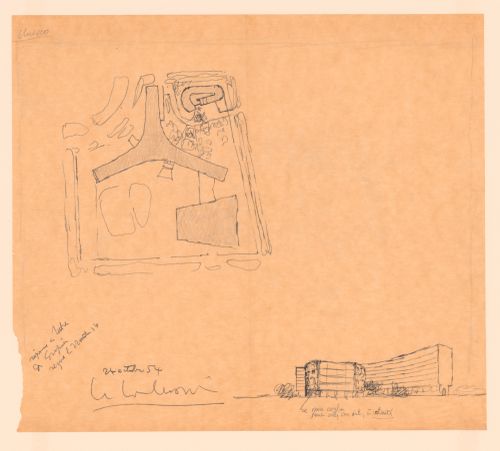
Sketch site plan and sketch view of an alternative proposal for the pavilion at UNESCO Headquarters
Sketch site plan and sketch view of an alternative proposal for the pavilion at UNESCO Headquarters
Actions:
Numéro de référence:
DR1988:0425
Description:
- Le Corbusier prepared this drawing inscribed "reponse a lettre / de Gropius / recue le 22 Octobre 54" in response to Walter Gropius' suggestion that he too reply to a letter addressed only to Gropius by Eugene Callison, Chief engineer at UNESCO Headquarters, Paris. Callison had requested that Gropius comment on a proposal by the Zehrfuss-Breuer-Nervi team to add a pavilion to the existing UNESCO building. Le Corbusier was dissatisfied with the team's pavilion, which shows a narrow, glazed oblong raised on pilotis (Shapiro, fig. 219). He proposed instead this sketch for a detached pavilion consisting of a roughly-finished, curving wall enclosing a garden, which he sent to Callison, along with a critique of the Zehrfuss-Breuer-Nervi team's proposition. On 26 October 1954, he also sent copies of his proposal to all of the project advisors.
DR1988:0425
Description:
- Le Corbusier prepared this drawing inscribed "reponse a lettre / de Gropius / recue le 22 Octobre 54" in response to Walter Gropius' suggestion that he too reply to a letter addressed only to Gropius by Eugene Callison, Chief engineer at UNESCO Headquarters, Paris. Callison had requested that Gropius comment on a proposal by the Zehrfuss-Breuer-Nervi team to add a pavilion to the existing UNESCO building. Le Corbusier was dissatisfied with the team's pavilion, which shows a narrow, glazed oblong raised on pilotis (Shapiro, fig. 219). He proposed instead this sketch for a detached pavilion consisting of a roughly-finished, curving wall enclosing a garden, which he sent to Callison, along with a critique of the Zehrfuss-Breuer-Nervi team's proposition. On 26 October 1954, he also sent copies of his proposal to all of the project advisors.
Personnes et institutions:
Sujet:
architecture
architecture
Date:
1954
1954
Titre:
Sketch site plan and sketch view of an alternative proposal for the pavilion at UNESCO Headquarters
Actions:
DR1988:0425
Description:
- Le Corbusier prepared this drawing inscribed "reponse a lettre / de Gropius / recue le 22 Octobre 54" in response to Walter Gropius' suggestion that he too reply to a letter addressed only to Gropius by Eugene Callison, Chief engineer at UNESCO Headquarters, Paris. Callison had requested that Gropius comment on a proposal by the Zehrfuss-Breuer-Nervi team to add a pavilion to the existing UNESCO building. Le Corbusier was dissatisfied with the team's pavilion, which shows a narrow, glazed oblong raised on pilotis (Shapiro, fig. 219). He proposed instead this sketch for a detached pavilion consisting of a roughly-finished, curving wall enclosing a garden, which he sent to Callison, along with a critique of the Zehrfuss-Breuer-Nervi team's proposition. On 26 October 1954, he also sent copies of his proposal to all of the project advisors.
Sketch site plan and sketch view of an alternative proposal for the pavilion at UNESCO Headquarters
Actions:
DR1988:0425
Description:
- Le Corbusier prepared this drawing inscribed "reponse a lettre / de Gropius / recue le 22 Octobre 54" in response to Walter Gropius' suggestion that he too reply to a letter addressed only to Gropius by Eugene Callison, Chief engineer at UNESCO Headquarters, Paris. Callison had requested that Gropius comment on a proposal by the Zehrfuss-Breuer-Nervi team to add a pavilion to the existing UNESCO building. Le Corbusier was dissatisfied with the team's pavilion, which shows a narrow, glazed oblong raised on pilotis (Shapiro, fig. 219). He proposed instead this sketch for a detached pavilion consisting of a roughly-finished, curving wall enclosing a garden, which he sent to Callison, along with a critique of the Zehrfuss-Breuer-Nervi team's proposition. On 26 October 1954, he also sent copies of his proposal to all of the project advisors.
Classification:
dessins
dessins
Date:
1954
1954
Personnes et institutions:
Sujet:
architecture
architecture
Classification:
documents textuels
documents textuels
Numéro de référence:
ARCH168735
Description:
12 feuilelts: Dossier de présentation photocopies annotées, jusqu'à 28 x 43 cm 22 feuillets: Réponses aux questions des concurrents et demande de modfication du règlement de concours 21,5 x 28 cm 18 feuillets: Schéma d'aménagement de l'École des Hautes Études Commerciales par Peter Jacobs et als avril 1991 46 feuillets: Ébauche du texte de présentation, lettre d'invitation à participer au concours et notes manuscrites 21,5 x 28 cm 6 feuillets: Enquête par Jacques Rousseau auprès de l'Université de Montréal concernant le projet de réaménagement de la Faculté de l'Aménagement 21 feuillets: Télécopie contenant une copie de l'article de Luc Noppen et Lucie K. Morisset intitulé: "Édifier une mémoire des lieux en recyclant l'histoire..." 21,5 x 28 cm 10 feuillets: Résumé des composantes générales et critères d'aménagement du projet format légal 1 dépliant du jardin botanique de Montréal
ARCH168735
Description:
12 feuilelts: Dossier de présentation photocopies annotées, jusqu'à 28 x 43 cm 22 feuillets: Réponses aux questions des concurrents et demande de modfication du règlement de concours 21,5 x 28 cm 18 feuillets: Schéma d'aménagement de l'École des Hautes Études Commerciales par Peter Jacobs et als avril 1991 46 feuillets: Ébauche du texte de présentation, lettre d'invitation à participer au concours et notes manuscrites 21,5 x 28 cm 6 feuillets: Enquête par Jacques Rousseau auprès de l'Université de Montréal concernant le projet de réaménagement de la Faculté de l'Aménagement 21 feuillets: Télécopie contenant une copie de l'article de Luc Noppen et Lucie K. Morisset intitulé: "Édifier une mémoire des lieux en recyclant l'histoire..." 21,5 x 28 cm 10 feuillets: Résumé des composantes générales et critères d'aménagement du projet format légal 1 dépliant du jardin botanique de Montréal
Personnes et institutions:
Date:
mars-novembre 1994
mars-novembre 1994
Titre:
Dossier de présentation
Actions:
ARCH168735
Description:
12 feuilelts: Dossier de présentation photocopies annotées, jusqu'à 28 x 43 cm 22 feuillets: Réponses aux questions des concurrents et demande de modfication du règlement de concours 21,5 x 28 cm 18 feuillets: Schéma d'aménagement de l'École des Hautes Études Commerciales par Peter Jacobs et als avril 1991 46 feuillets: Ébauche du texte de présentation, lettre d'invitation à participer au concours et notes manuscrites 21,5 x 28 cm 6 feuillets: Enquête par Jacques Rousseau auprès de l'Université de Montréal concernant le projet de réaménagement de la Faculté de l'Aménagement 21 feuillets: Télécopie contenant une copie de l'article de Luc Noppen et Lucie K. Morisset intitulé: "Édifier une mémoire des lieux en recyclant l'histoire..." 21,5 x 28 cm 10 feuillets: Résumé des composantes générales et critères d'aménagement du projet format légal 1 dépliant du jardin botanique de Montréal
Dossier de présentation
Actions:
ARCH168735
Description:
12 feuilelts: Dossier de présentation photocopies annotées, jusqu'à 28 x 43 cm 22 feuillets: Réponses aux questions des concurrents et demande de modfication du règlement de concours 21,5 x 28 cm 18 feuillets: Schéma d'aménagement de l'École des Hautes Études Commerciales par Peter Jacobs et als avril 1991 46 feuillets: Ébauche du texte de présentation, lettre d'invitation à participer au concours et notes manuscrites 21,5 x 28 cm 6 feuillets: Enquête par Jacques Rousseau auprès de l'Université de Montréal concernant le projet de réaménagement de la Faculté de l'Aménagement 21 feuillets: Télécopie contenant une copie de l'article de Luc Noppen et Lucie K. Morisset intitulé: "Édifier une mémoire des lieux en recyclant l'histoire..." 21,5 x 28 cm 10 feuillets: Résumé des composantes générales et critères d'aménagement du projet format légal 1 dépliant du jardin botanique de Montréal
Classification:
documents textuels
documents textuels
Date:
mars-novembre 1994
mars-novembre 1994
Personnes et institutions:


