


6673 Résultats
Classification:
livres
livres

Titre:
Louise Nevelson
Louise Nevelson
Actions:
Prix:
$53.95
(disponible sur commande)
Résumé:
Louise Nevelson (1899–1988) was, with Calder, Noguchi and David Smith, one of the great American sculptors of the 20th century. She created extraordinary work, from room-size installations composed of boxes to gnarled and majestic steel structures. Her life story is no less interesting. She was born in Tsarist Russia, but her family emigrated to the States and she grew up(...)
$53.95
(disponible sur commande)
Résumé:
Louise Nevelson (1899–1988) was, with Calder, Noguchi and David Smith, one of the great American sculptors of the 20th century. She created extraordinary work, from room-size installations composed of boxes to gnarled and majestic steel structures. Her life story is no less interesting. She was born in Tsarist Russia, but her family emigrated to the States and she grew up(...)
Titre:
Louise Nevelson
Actions:
Prix:
$53.95
(disponible sur commande)
Résumé:
Louise Nevelson (1899–1988) was, with Calder, Noguchi and David Smith, one of the great American sculptors of the 20th century. She created extraordinary work, from room-size installations composed of boxes to gnarled and majestic steel structures. Her life story is no less interesting. She was born in Tsarist Russia, but her family emigrated to the States and she grew up in Maine. Nevelson endured a repressive marriage to a New York millionaire, whom she escaped to pursue the life of an artist. She gained recognition as an abstract sculptor at the age of 59, and spent the next 30 years taking the art world by storm, becoming a colourful New York personality and minor celebrity. Laurie Wilson, who knew Nevelson personally, draws extensively on her own research in this crisp new biography. She conducted interviews not just with Nevelson but with her siblings, son, and gallery owner Arne Glimcher. Wilson has also had complete access to Glimcher’s archives, Nevelson’s personal assistant, Diana MacKown, and Lippincott studios, where much of Nevelson’s work was cast, among others.
Louise Nevelson
Actions:
Prix:
$53.95
(disponible sur commande)
Résumé:
Louise Nevelson (1899–1988) was, with Calder, Noguchi and David Smith, one of the great American sculptors of the 20th century. She created extraordinary work, from room-size installations composed of boxes to gnarled and majestic steel structures. Her life story is no less interesting. She was born in Tsarist Russia, but her family emigrated to the States and she grew up in Maine. Nevelson endured a repressive marriage to a New York millionaire, whom she escaped to pursue the life of an artist. She gained recognition as an abstract sculptor at the age of 59, and spent the next 30 years taking the art world by storm, becoming a colourful New York personality and minor celebrity. Laurie Wilson, who knew Nevelson personally, draws extensively on her own research in this crisp new biography. She conducted interviews not just with Nevelson but with her siblings, son, and gallery owner Arne Glimcher. Wilson has also had complete access to Glimcher’s archives, Nevelson’s personal assistant, Diana MacKown, and Lippincott studios, where much of Nevelson’s work was cast, among others.
Classification:
livres
livres
Publication:
septembre 2016
septembre 2016
Classification:
livres
livres
Titre:
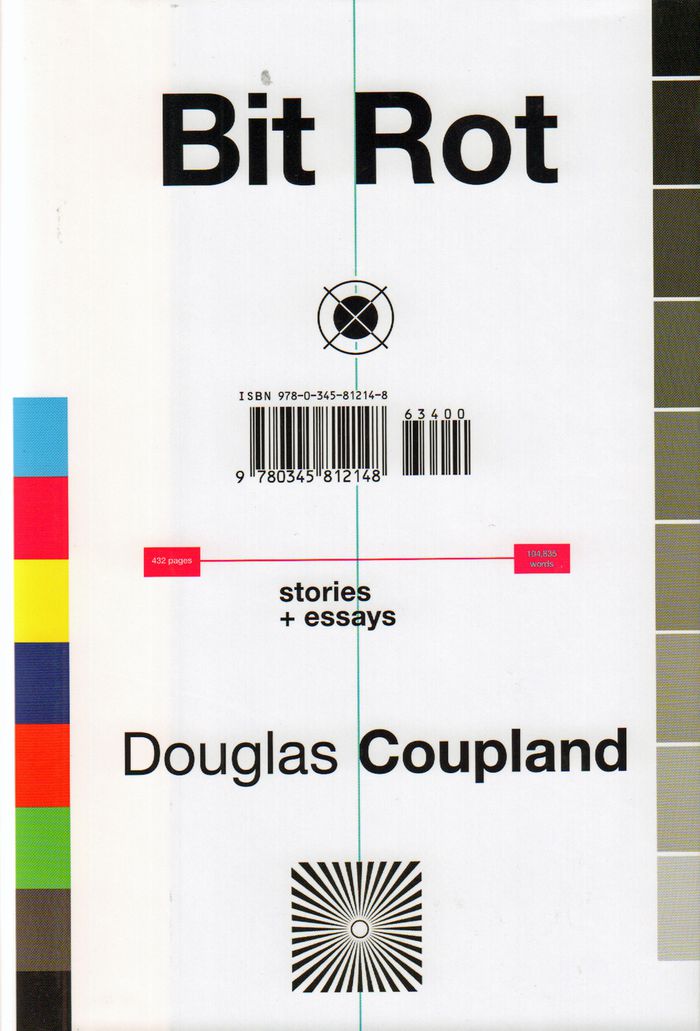
Bit Rot: stories and essays
Bit Rot: stories and essays
Actions:
Prix:
$34.00
(disponible sur commande)
Résumé:
A thought-provoking, binge-worthy new collection of essays, stories, and musings from Douglas Coupland, Bit Rot explores the different ways in which twentieth-century notions of the future are being shredded, and it is a literary gem of the digital age. “Bit rot” is a term used in digital archiving to describe the way digital files can spontaneously and quickly decompose.(...)
$34.00
(disponible sur commande)
Résumé:
A thought-provoking, binge-worthy new collection of essays, stories, and musings from Douglas Coupland, Bit Rot explores the different ways in which twentieth-century notions of the future are being shredded, and it is a literary gem of the digital age. “Bit rot” is a term used in digital archiving to describe the way digital files can spontaneously and quickly decompose.(...)
Titre:
Bit Rot: stories and essays
Actions:
Prix:
$34.00
(disponible sur commande)
Résumé:
A thought-provoking, binge-worthy new collection of essays, stories, and musings from Douglas Coupland, Bit Rot explores the different ways in which twentieth-century notions of the future are being shredded, and it is a literary gem of the digital age. “Bit rot” is a term used in digital archiving to describe the way digital files can spontaneously and quickly decompose. As Douglas Coupland writes, “Bit rot also describes the way my brain has been feeling since 2000, as I shed older and weaker neurons and connections and enhance new and unexpected ones.” "Bit Rot" the book is a fascinating meditation on the ways in which humanity tries to make sense of our shifting consciousness. Coupland, just like the Internet, mixes forms to achieve his ends. Short fiction is interspersed with essays on all aspects of modern life. The result is addictively satisfying for Coupland’s established fanbase hungry for his observations about our world, and a revelation to new readers of his work. For almost three decades, his unique pattern recognition has powered his fiction, his phrase-making, and his visual art.
Bit Rot: stories and essays
Actions:
Prix:
$34.00
(disponible sur commande)
Résumé:
A thought-provoking, binge-worthy new collection of essays, stories, and musings from Douglas Coupland, Bit Rot explores the different ways in which twentieth-century notions of the future are being shredded, and it is a literary gem of the digital age. “Bit rot” is a term used in digital archiving to describe the way digital files can spontaneously and quickly decompose. As Douglas Coupland writes, “Bit rot also describes the way my brain has been feeling since 2000, as I shed older and weaker neurons and connections and enhance new and unexpected ones.” "Bit Rot" the book is a fascinating meditation on the ways in which humanity tries to make sense of our shifting consciousness. Coupland, just like the Internet, mixes forms to achieve his ends. Short fiction is interspersed with essays on all aspects of modern life. The result is addictively satisfying for Coupland’s established fanbase hungry for his observations about our world, and a revelation to new readers of his work. For almost three decades, his unique pattern recognition has powered his fiction, his phrase-making, and his visual art.
Classification:
livres
livres
Publication:
mars 2017
mars 2017
Sujet:
Architecture et l'imaginaire
Architecture et l'imaginaire
Classification:
livres
livres
Titre:
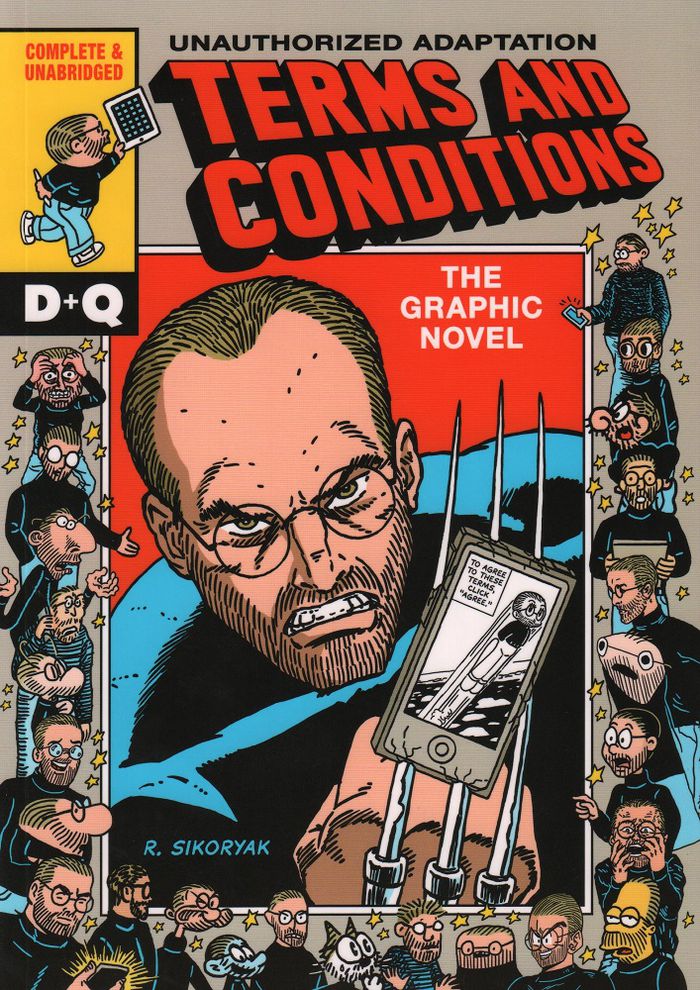
Terms and conditions
Terms and conditions
Actions:
Prix:
$16.95
(disponible sur commande)
Résumé:
For his newest project, R. Sikoryak tackles the monstrously and infamously dense legal document, iTunes Terms and Conditions, the contract everyone agrees to but no one reads. In a word for word 94-page adaptation, Sikoryak hilariously turns the agreement on its head—each page features an avatar of Apple cofounder and legendary visionary Steve Jobs juxtaposed with a(...)
$16.95
(disponible sur commande)
Résumé:
For his newest project, R. Sikoryak tackles the monstrously and infamously dense legal document, iTunes Terms and Conditions, the contract everyone agrees to but no one reads. In a word for word 94-page adaptation, Sikoryak hilariously turns the agreement on its head—each page features an avatar of Apple cofounder and legendary visionary Steve Jobs juxtaposed with a(...)
Titre:
Terms and conditions
Actions:
Prix:
$16.95
(disponible sur commande)
Résumé:
For his newest project, R. Sikoryak tackles the monstrously and infamously dense legal document, iTunes Terms and Conditions, the contract everyone agrees to but no one reads. In a word for word 94-page adaptation, Sikoryak hilariously turns the agreement on its head—each page features an avatar of Apple cofounder and legendary visionary Steve Jobs juxtaposed with a different classic strip such as Mort Walker’s Beetle Bailey, or a contemporary graphic novel such as Craig Thompson’s Blankets or Marjane Satrapi’s Persepolis . Adapting the legalese of the iTunes Terms and Conditions into another medium seems like an unfathomable undertaking, yet Sikoryak creates a surprisingly readable document, far different from its original, purely textual incarnation and thus proving the accessibility and flexibility of comics. When Sikoryak parodies Kate Beaton’s Hark A Vagrant peasant comics with Steve Jobs discussing objectionable material or Homer Simpson as Steve Jobs warning of the penalties of copyright infringement, Terms and Conditions serves as a surreal record of our modern digital age where technology competes with enduringly ironclad mediums.
Terms and conditions
Actions:
Prix:
$16.95
(disponible sur commande)
Résumé:
For his newest project, R. Sikoryak tackles the monstrously and infamously dense legal document, iTunes Terms and Conditions, the contract everyone agrees to but no one reads. In a word for word 94-page adaptation, Sikoryak hilariously turns the agreement on its head—each page features an avatar of Apple cofounder and legendary visionary Steve Jobs juxtaposed with a different classic strip such as Mort Walker’s Beetle Bailey, or a contemporary graphic novel such as Craig Thompson’s Blankets or Marjane Satrapi’s Persepolis . Adapting the legalese of the iTunes Terms and Conditions into another medium seems like an unfathomable undertaking, yet Sikoryak creates a surprisingly readable document, far different from its original, purely textual incarnation and thus proving the accessibility and flexibility of comics. When Sikoryak parodies Kate Beaton’s Hark A Vagrant peasant comics with Steve Jobs discussing objectionable material or Homer Simpson as Steve Jobs warning of the penalties of copyright infringement, Terms and Conditions serves as a surreal record of our modern digital age where technology competes with enduringly ironclad mediums.
Classification:
livres
livres
Publication:
mars 2017
mars 2017
Sujet:
Illustration
Illustration
Classification:
livres
livres

Actions:
Prix:
$49.95
(disponible sur commande)
Résumé:
“How are we to live in a way that is healthy and economical?” One answer to this question was provided by Ernst Jahn’s film of the same name Wie wohnen wir gesund und wirtschaftlich? (1926–28), which showed the kitchen in the Gropius House complete with all the latest domestic appliances it was equipped with. The Dessau Masters’ Houses were not only showcases of “new(...)
$49.95
(disponible sur commande)
Résumé:
“How are we to live in a way that is healthy and economical?” One answer to this question was provided by Ernst Jahn’s film of the same name Wie wohnen wir gesund und wirtschaftlich? (1926–28), which showed the kitchen in the Gropius House complete with all the latest domestic appliances it was equipped with. The Dessau Masters’ Houses were not only showcases of “new(...)
Titre:
In reserve: the household. Historic models and contemporary positions from the Bauhaus
Actions:
Prix:
$49.95
(disponible sur commande)
Résumé:
“How are we to live in a way that is healthy and economical?” One answer to this question was provided by Ernst Jahn’s film of the same name Wie wohnen wir gesund und wirtschaftlich? (1926–28), which showed the kitchen in the Gropius House complete with all the latest domestic appliances it was equipped with. The Dessau Masters’ Houses were not only showcases of “new living” (Neues Wohnen) but also places where modern methods of housekeeping could be demonstrated. The topical relevance of this question was discussed at the 2015 Haushaltsmesse, an international trade fair on the art of housekeeping and budgeting. The publication Housekeeping in the Modern Age, which takes a documentary approach to this subject, now brings together these different viewpoints eyeing the question through the prism of the problems we face today. In the face of climate change and dwindling resources, the externalized costs of running a modern household are back on the (kitchen) table. The book is a compilation of essays by anthropologists, economists, artists, architects, historians, and cultural studies experts and also contains historical documents and photographs.
In reserve: the household. Historic models and contemporary positions from the Bauhaus
Actions:
Prix:
$49.95
(disponible sur commande)
Résumé:
“How are we to live in a way that is healthy and economical?” One answer to this question was provided by Ernst Jahn’s film of the same name Wie wohnen wir gesund und wirtschaftlich? (1926–28), which showed the kitchen in the Gropius House complete with all the latest domestic appliances it was equipped with. The Dessau Masters’ Houses were not only showcases of “new living” (Neues Wohnen) but also places where modern methods of housekeeping could be demonstrated. The topical relevance of this question was discussed at the 2015 Haushaltsmesse, an international trade fair on the art of housekeeping and budgeting. The publication Housekeeping in the Modern Age, which takes a documentary approach to this subject, now brings together these different viewpoints eyeing the question through the prism of the problems we face today. In the face of climate change and dwindling resources, the externalized costs of running a modern household are back on the (kitchen) table. The book is a compilation of essays by anthropologists, economists, artists, architects, historians, and cultural studies experts and also contains historical documents and photographs.
Classification:
livres
livres
Publication:
mai 2017
mai 2017
Sujet:
Modernisme
Modernisme
Classification:
périodiques
périodiques
Actions:
Prix:
$11.00
(disponible sur commande)
Résumé:
Cabinet is an award-winning quarterly magazine of art and culture that confounds expectations of what is typically meant by the words "art," "culture," and sometimes even "magazine." Like the 17th-century cabinet of curiosities to which its name alludes, Cabinet is as interested in the margins of culture as its center. Presenting wide-ranging, multi-disciplinary content(...)
$11.00
(disponible sur commande)
Résumé:
Cabinet is an award-winning quarterly magazine of art and culture that confounds expectations of what is typically meant by the words "art," "culture," and sometimes even "magazine." Like the 17th-century cabinet of curiosities to which its name alludes, Cabinet is as interested in the margins of culture as its center. Presenting wide-ranging, multi-disciplinary content(...)
Titre:
Cabinet 18 : fictional states, 2005
Actions:
Prix:
$11.00
(disponible sur commande)
Résumé:
Cabinet is an award-winning quarterly magazine of art and culture that confounds expectations of what is typically meant by the words "art," "culture," and sometimes even "magazine." Like the 17th-century cabinet of curiosities to which its name alludes, Cabinet is as interested in the margins of culture as its center. Presenting wide-ranging, multi-disciplinary content in each issue through the varied formats of regular columns, essays, interviews, and special artist projects, Cabinet's hybrid sensibility merges the popular appeal of an arts periodical, the visually engaging style of a design magazine, and the in-depth exploration of a scholarly journal. Playful and serious, exuberant and committed, Cabinet's omnivorous appetite for understanding the world makes each of its issues a valuable sourcebook of ideas for a wide range of readers, from artists and designers to scientists and historians. In an age of increasing specialization, Cabinet looks to previous models of the well-rounded thinker to forge a new type of magazine for the intellectually curious reader of the future.
Cabinet 18 : fictional states, 2005
Actions:
Prix:
$11.00
(disponible sur commande)
Résumé:
Cabinet is an award-winning quarterly magazine of art and culture that confounds expectations of what is typically meant by the words "art," "culture," and sometimes even "magazine." Like the 17th-century cabinet of curiosities to which its name alludes, Cabinet is as interested in the margins of culture as its center. Presenting wide-ranging, multi-disciplinary content in each issue through the varied formats of regular columns, essays, interviews, and special artist projects, Cabinet's hybrid sensibility merges the popular appeal of an arts periodical, the visually engaging style of a design magazine, and the in-depth exploration of a scholarly journal. Playful and serious, exuberant and committed, Cabinet's omnivorous appetite for understanding the world makes each of its issues a valuable sourcebook of ideas for a wide range of readers, from artists and designers to scientists and historians. In an age of increasing specialization, Cabinet looks to previous models of the well-rounded thinker to forge a new type of magazine for the intellectually curious reader of the future.
Classification:
périodiques
périodiques
Publication:
octobre 2005, New York
octobre 2005, New York
Sujet:
Revues
Revues
Classification:
périodiques
périodiques
Actions:
Prix:
$12.00
(disponible sur commande)
Résumé:
Cabinet is an award-winning quarterly magazine of art and culture that confounds expectations of what is typically meant by the words "art," "culture," and sometimes even "magazine." Like the 17th-century cabinet of curiosities to which its name alludes, Cabinet is as interested in the margins of culture as its center. Presenting wide-ranging, multi-disciplinary content(...)
$12.00
(disponible sur commande)
Résumé:
Cabinet is an award-winning quarterly magazine of art and culture that confounds expectations of what is typically meant by the words "art," "culture," and sometimes even "magazine." Like the 17th-century cabinet of curiosities to which its name alludes, Cabinet is as interested in the margins of culture as its center. Presenting wide-ranging, multi-disciplinary content(...)
Titre:
Cabinet 15: the average, fall 2004
Actions:
Prix:
$12.00
(disponible sur commande)
Résumé:
Cabinet is an award-winning quarterly magazine of art and culture that confounds expectations of what is typically meant by the words "art," "culture," and sometimes even "magazine." Like the 17th-century cabinet of curiosities to which its name alludes, Cabinet is as interested in the margins of culture as its center. Presenting wide-ranging, multi-disciplinary content in each issue through the varied formats of regular columns, essays, interviews, and special artist projects, Cabinet's hybrid sensibility merges the popular appeal of an arts periodical, the visually engaging style of a design magazine, and the in-depth exploration of a scholarly journal. Playful and serious, exuberant and committed, Cabinet's omnivorous appetite for understanding the world makes each of its issues a valuable sourcebook of ideas for a wide range of readers, from artists and designers to scientists and historians. In an age of increasing specialization, Cabinet looks to previous models of the well-rounded thinker to forge a new type of magazine for the intellectually curious reader of the future.
Cabinet 15: the average, fall 2004
Actions:
Prix:
$12.00
(disponible sur commande)
Résumé:
Cabinet is an award-winning quarterly magazine of art and culture that confounds expectations of what is typically meant by the words "art," "culture," and sometimes even "magazine." Like the 17th-century cabinet of curiosities to which its name alludes, Cabinet is as interested in the margins of culture as its center. Presenting wide-ranging, multi-disciplinary content in each issue through the varied formats of regular columns, essays, interviews, and special artist projects, Cabinet's hybrid sensibility merges the popular appeal of an arts periodical, the visually engaging style of a design magazine, and the in-depth exploration of a scholarly journal. Playful and serious, exuberant and committed, Cabinet's omnivorous appetite for understanding the world makes each of its issues a valuable sourcebook of ideas for a wide range of readers, from artists and designers to scientists and historians. In an age of increasing specialization, Cabinet looks to previous models of the well-rounded thinker to forge a new type of magazine for the intellectually curious reader of the future.
Classification:
périodiques
périodiques
Publication:
février 2004, New York
février 2004, New York
Sujet:
Revues
Revues
Classification:
périodiques
périodiques
Actions:
Prix:
$12.00
(disponible sur commande)
Résumé:
Cabinet is an award-winning quarterly magazine of art and culture that confounds expectations of what is typically meant by the words "art," "culture," and sometimes even "magazine." Like the 17th-century cabinet of curiosities to which its name alludes, Cabinet is as interested in the margins of culture as its center. Presenting wide-ranging, multi-disciplinary content(...)
$12.00
(disponible sur commande)
Résumé:
Cabinet is an award-winning quarterly magazine of art and culture that confounds expectations of what is typically meant by the words "art," "culture," and sometimes even "magazine." Like the 17th-century cabinet of curiosities to which its name alludes, Cabinet is as interested in the margins of culture as its center. Presenting wide-ranging, multi-disciplinary content(...)
Titre:
Cabinet 12: the enemy, fall 2003 - winter 2004
Actions:
Prix:
$12.00
(disponible sur commande)
Résumé:
Cabinet is an award-winning quarterly magazine of art and culture that confounds expectations of what is typically meant by the words "art," "culture," and sometimes even "magazine." Like the 17th-century cabinet of curiosities to which its name alludes, Cabinet is as interested in the margins of culture as its center. Presenting wide-ranging, multi-disciplinary content in each issue through the varied formats of regular columns, essays, interviews, and special artist projects, Cabinet's hybrid sensibility merges the popular appeal of an arts periodical, the visually engaging style of a design magazine, and the in-depth exploration of a scholarly journal. Playful and serious, exuberant and committed, Cabinet's omnivorous appetite for understanding the world makes each of its issues a valuable sourcebook of ideas for a wide range of readers, from artists and designers to scientists and historians. In an age of increasing specialization, Cabinet looks to previous models of the well-rounded thinker to forge a new type of magazine for the intellectually curious reader of the future.
Cabinet 12: the enemy, fall 2003 - winter 2004
Actions:
Prix:
$12.00
(disponible sur commande)
Résumé:
Cabinet is an award-winning quarterly magazine of art and culture that confounds expectations of what is typically meant by the words "art," "culture," and sometimes even "magazine." Like the 17th-century cabinet of curiosities to which its name alludes, Cabinet is as interested in the margins of culture as its center. Presenting wide-ranging, multi-disciplinary content in each issue through the varied formats of regular columns, essays, interviews, and special artist projects, Cabinet's hybrid sensibility merges the popular appeal of an arts periodical, the visually engaging style of a design magazine, and the in-depth exploration of a scholarly journal. Playful and serious, exuberant and committed, Cabinet's omnivorous appetite for understanding the world makes each of its issues a valuable sourcebook of ideas for a wide range of readers, from artists and designers to scientists and historians. In an age of increasing specialization, Cabinet looks to previous models of the well-rounded thinker to forge a new type of magazine for the intellectually curious reader of the future.
Classification:
périodiques
périodiques
Publication:
février 2004, New York
février 2004, New York
Sujet:
Revues
Revues
Classification:
périodiques
périodiques
Titre:
Cabinet 23: fruits
Cabinet 23: fruits
Actions:
Prix:
$11.00
(disponible en magasin)
Résumé:
Cabinet is an award-winning quarterly magazine of art and culture that confounds expectations of what is typically meant by the words "art," "culture," and sometimes even "magazine." Like the 17th-century cabinet of curiosities to which its name alludes, Cabinet is as interested in the margins of culture as its center. Presenting wide-ranging, multi-disciplinary content(...)
$11.00
(disponible en magasin)
Résumé:
Cabinet is an award-winning quarterly magazine of art and culture that confounds expectations of what is typically meant by the words "art," "culture," and sometimes even "magazine." Like the 17th-century cabinet of curiosities to which its name alludes, Cabinet is as interested in the margins of culture as its center. Presenting wide-ranging, multi-disciplinary content(...)
Titre:
Cabinet 23: fruits
Actions:
Prix:
$11.00
(disponible en magasin)
Résumé:
Cabinet is an award-winning quarterly magazine of art and culture that confounds expectations of what is typically meant by the words "art," "culture," and sometimes even "magazine." Like the 17th-century cabinet of curiosities to which its name alludes, Cabinet is as interested in the margins of culture as its center. Presenting wide-ranging, multi-disciplinary content in each issue through the varied formats of regular columns, essays, interviews, and special artist projects, Cabinet's hybrid sensibility merges the popular appeal of an arts periodical, the visually engaging style of a design magazine, and the in-depth exploration of a scholarly journal. Playful and serious, exuberant and committed, Cabinet's omnivorous appetite for understanding the world makes each of its issues a valuable sourcebook of ideas for a wide range of readers, from artists and designers to scientists and historians. In an age of increasing specialization, Cabinet looks to previous models of the well-rounded thinker to forge a new type of magazine for the intellectually curious reader of the future.
Cabinet 23: fruits
Actions:
Prix:
$11.00
(disponible en magasin)
Résumé:
Cabinet is an award-winning quarterly magazine of art and culture that confounds expectations of what is typically meant by the words "art," "culture," and sometimes even "magazine." Like the 17th-century cabinet of curiosities to which its name alludes, Cabinet is as interested in the margins of culture as its center. Presenting wide-ranging, multi-disciplinary content in each issue through the varied formats of regular columns, essays, interviews, and special artist projects, Cabinet's hybrid sensibility merges the popular appeal of an arts periodical, the visually engaging style of a design magazine, and the in-depth exploration of a scholarly journal. Playful and serious, exuberant and committed, Cabinet's omnivorous appetite for understanding the world makes each of its issues a valuable sourcebook of ideas for a wide range of readers, from artists and designers to scientists and historians. In an age of increasing specialization, Cabinet looks to previous models of the well-rounded thinker to forge a new type of magazine for the intellectually curious reader of the future.
Classification:
périodiques
périodiques
Publication:
novembre 2006, New York
novembre 2006, New York
Sujet:
Revues
Revues
Classification:
périodiques
périodiques
Actions:
Prix:
$12.00
(disponible sur commande)
Résumé:
Cabinet is an award-winning quarterly magazine of art and culture that confounds expectations of what is typically meant by the words "art," "culture," and sometimes even "magazine." Like the 17th-century cabinet of curiosities to which its name alludes, Cabinet is as interested in the margins of culture as its center. Presenting wide-ranging, multi-disciplinary content(...)
$12.00
(disponible sur commande)
Résumé:
Cabinet is an award-winning quarterly magazine of art and culture that confounds expectations of what is typically meant by the words "art," "culture," and sometimes even "magazine." Like the 17th-century cabinet of curiosities to which its name alludes, Cabinet is as interested in the margins of culture as its center. Presenting wide-ranging, multi-disciplinary content(...)
Titre:
Cabinet 19: chance, fall 2005
Actions:
Prix:
$12.00
(disponible sur commande)
Résumé:
Cabinet is an award-winning quarterly magazine of art and culture that confounds expectations of what is typically meant by the words "art," "culture," and sometimes even "magazine." Like the 17th-century cabinet of curiosities to which its name alludes, Cabinet is as interested in the margins of culture as its center. Presenting wide-ranging, multi-disciplinary content in each issue through the varied formats of regular columns, essays, interviews, and special artist projects, Cabinet's hybrid sensibility merges the popular appeal of an arts periodical, the visually engaging style of a design magazine, and the in-depth exploration of a scholarly journal. Playful and serious, exuberant and committed, Cabinet's omnivorous appetite for understanding the world makes each of its issues a valuable sourcebook of ideas for a wide range of readers, from artists and designers to scientists and historians. In an age of increasing specialization, Cabinet looks to previous models of the well-rounded thinker to forge a new type of magazine for the intellectually curious reader of the future.
Cabinet 19: chance, fall 2005
Actions:
Prix:
$12.00
(disponible sur commande)
Résumé:
Cabinet is an award-winning quarterly magazine of art and culture that confounds expectations of what is typically meant by the words "art," "culture," and sometimes even "magazine." Like the 17th-century cabinet of curiosities to which its name alludes, Cabinet is as interested in the margins of culture as its center. Presenting wide-ranging, multi-disciplinary content in each issue through the varied formats of regular columns, essays, interviews, and special artist projects, Cabinet's hybrid sensibility merges the popular appeal of an arts periodical, the visually engaging style of a design magazine, and the in-depth exploration of a scholarly journal. Playful and serious, exuberant and committed, Cabinet's omnivorous appetite for understanding the world makes each of its issues a valuable sourcebook of ideas for a wide range of readers, from artists and designers to scientists and historians. In an age of increasing specialization, Cabinet looks to previous models of the well-rounded thinker to forge a new type of magazine for the intellectually curious reader of the future.
Classification:
périodiques
périodiques
Publication:
janvier 2006, New York
janvier 2006, New York
Sujet:
Revues
Revues
Classification:
périodiques
périodiques
Actions:
Prix:
$11.00
(disponible sur commande)
Résumé:
Cabinet is an award-winning quarterly magazine of art and culture that confounds expectations of what is typically meant by the words "art," "culture," and sometimes even "magazine." Like the 17th-century cabinet of curiosities to which its name alludes, Cabinet is as interested in the margins of culture as its center. Presenting wide-ranging, multi-disciplinary content(...)
$11.00
(disponible sur commande)
Résumé:
Cabinet is an award-winning quarterly magazine of art and culture that confounds expectations of what is typically meant by the words "art," "culture," and sometimes even "magazine." Like the 17th-century cabinet of curiosities to which its name alludes, Cabinet is as interested in the margins of culture as its center. Presenting wide-ranging, multi-disciplinary content(...)
Titre:
Cabinet 17: laughter, spring 2005
Actions:
Prix:
$11.00
(disponible sur commande)
Résumé:
Cabinet is an award-winning quarterly magazine of art and culture that confounds expectations of what is typically meant by the words "art," "culture," and sometimes even "magazine." Like the 17th-century cabinet of curiosities to which its name alludes, Cabinet is as interested in the margins of culture as its center. Presenting wide-ranging, multi-disciplinary content in each issue through the varied formats of regular columns, essays, interviews, and special artist projects, Cabinet's hybrid sensibility merges the popular appeal of an arts periodical, the visually engaging style of a design magazine, and the in-depth exploration of a scholarly journal. Playful and serious, exuberant and committed, Cabinet's omnivorous appetite for understanding the world makes each of its issues a valuable sourcebook of ideas for a wide range of readers, from artists and designers to scientists and historians. In an age of increasing specialization, Cabinet looks to previous models of the well-rounded thinker to forge a new type of magazine for the intellectually curious reader of the future.
Cabinet 17: laughter, spring 2005
Actions:
Prix:
$11.00
(disponible sur commande)
Résumé:
Cabinet is an award-winning quarterly magazine of art and culture that confounds expectations of what is typically meant by the words "art," "culture," and sometimes even "magazine." Like the 17th-century cabinet of curiosities to which its name alludes, Cabinet is as interested in the margins of culture as its center. Presenting wide-ranging, multi-disciplinary content in each issue through the varied formats of regular columns, essays, interviews, and special artist projects, Cabinet's hybrid sensibility merges the popular appeal of an arts periodical, the visually engaging style of a design magazine, and the in-depth exploration of a scholarly journal. Playful and serious, exuberant and committed, Cabinet's omnivorous appetite for understanding the world makes each of its issues a valuable sourcebook of ideas for a wide range of readers, from artists and designers to scientists and historians. In an age of increasing specialization, Cabinet looks to previous models of the well-rounded thinker to forge a new type of magazine for the intellectually curious reader of the future.
Classification:
périodiques
périodiques
Publication:
avril 2005, New York
avril 2005, New York
Sujet:
Revues
Revues


