


666 Résultats
Classification:
livres
livres
Actions:
Prix:
$65.00
(disponible sur commande)
Résumé:
The volume, realized in co-operation with the Vitra Design Museum is both the catalogue of an internationally travelling exhibition and one of the first monographical studies entirely devoted to the subject of children’s games and furniture. Furniture and games for children, irrespective of culture or period, can be perceived as vehicles for communicating society’s(...)
Sujet:
Zines
Zines
Publication:
décembre 1998, Milano
décembre 1998, Milano
Titre:
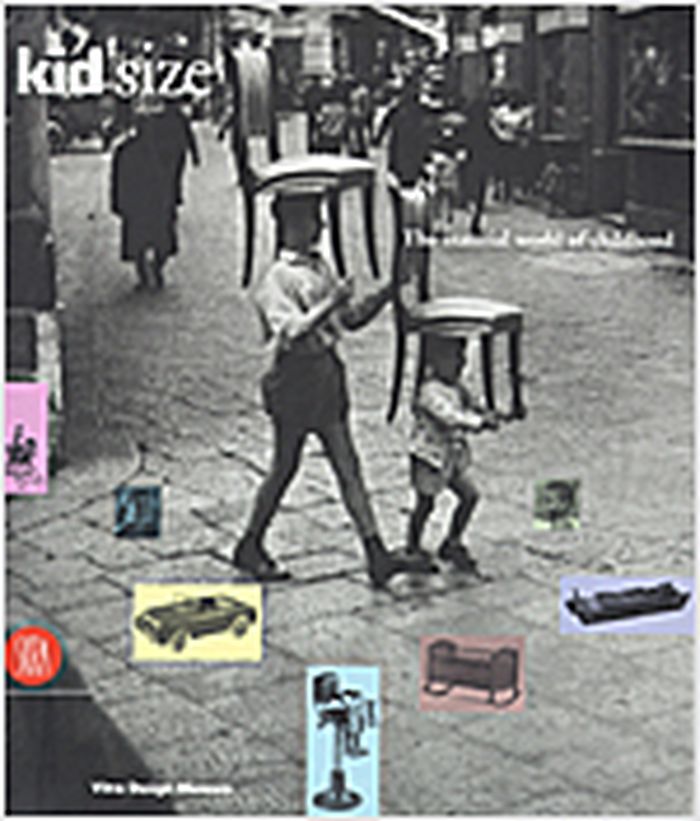
Kid size : the material world of childhood
Actions:
Prix:
$65.00
(disponible sur commande)
Résumé:
The volume, realized in co-operation with the Vitra Design Museum is both the catalogue of an internationally travelling exhibition and one of the first monographical studies entirely devoted to the subject of children’s games and furniture. Furniture and games for children, irrespective of culture or period, can be perceived as vehicles for communicating society’s attitudes towards learning, the child’s physical and phychological development, safety, order in the family, territory, the place of play and patterns of social behaviour; although the child, by contrast, regards them as largely interchangeable objects in the serious work of play, the organization of modern society tends to give them always more importance, changing them into real products of design. The volume aims to explore the world of childhood throughout the different types of furniture artefacts and games from various periods and cultures in the world which illuminate the changing relationship between children and adults, the growing attention to child-centred provision and educational values and the fundamental role of playing in the history of childhood of different countries. The catalogue essays are written by chilhood specialists, social historians, ethnologists, educationalists, industrials designers (specialist in playground and play equipment) and experts on children living in the various cultures of the world: Lucy Bullivant, Mike Scaife, Linda Pollock, Eileen Adams, Günter Beltzig, Ingeborg Weber-Kellermann, Gerhard Kubik, Tina Wodiung and Sally Kevill-Davies.
Classification:
livres
livres
Publication:
décembre 1998, Milano
décembre 1998, Milano
Sujet:
Zines
Zines
Classification:
livres
livres
Actions:
Prix:
$34.95
(disponible sur commande)
Résumé:
Vito Acconci's Mur Island in Graz forges a closer bond between life on the river and in the two halves of the city. The book introduces the artist-architect and his project. It seems as if a UFO has landed in the middle of Graz: an organic form, evoking a half shell or a snail's shell, is floating on the Mur river as an artificial island, connected by piers to both(...)
Publication:
octobre 2003, Ostfildern-Ruit
octobre 2003, Ostfildern-Ruit
Titre:
Vito Acconci/Acconci Studio : Building an island, Mur Island, Graz/Austria
Actions:
Prix:
$34.95
(disponible sur commande)
Résumé:
Vito Acconci's Mur Island in Graz forges a closer bond between life on the river and in the two halves of the city. The book introduces the artist-architect and his project. It seems as if a UFO has landed in the middle of Graz: an organic form, evoking a half shell or a snail's shell, is floating on the Mur river as an artificial island, connected by piers to both river banks. The steel construction was designed by the American-born architect-artist Vito Acconci, based on the idea of Robert Punkenhofer, a native of Graz, and realized within the scope of Graz 2003: Kulturhauptstadt Europas. Acconci Island, consisting of various interlocking surfaces with flowing transitions, houses an amphitheatre, a café and a playground. Large parts of its outer stainless-steel skin reflect the city; acrylic fibre, glass, steel grids and peepholes provide a view onto the water and the banks, while the transparent materials make the building look weightless. The result is a breathtaking, technically sophisticated avant-garde piece of architecture that refuses categorization. The book documents the different stages of the design, and places sketches and computer simulations next to remarkable photographs of models as well as shots of the finished island. An interview with Vito Acconci and a presentation of the diverse work by the Acconci Studio round off the book.
Classification:
livres
livres
Publication:
octobre 2003, Ostfildern-Ruit
octobre 2003, Ostfildern-Ruit
Classification:
livres
livres
Actions:
Prix:
$82.50
(disponible sur commande)
Résumé:
Room 4.1.3, an Australian landscape architecture firm, is renowned for producing some of the world's most finely tuned design work, striking a balance between theory and praxis, design and planning. The firm's projects engage visitors in a way that few public spaces have before. Founded in the 1990s by Richard Weller and Vladimir Sitta, Room 4.1.3 has received awards in(...)
Titre:
Room 4.1.3 : innovations in landscape architecture
Actions:
Prix:
$82.50
(disponible sur commande)
Résumé:
Room 4.1.3, an Australian landscape architecture firm, is renowned for producing some of the world's most finely tuned design work, striking a balance between theory and praxis, design and planning. The firm's projects engage visitors in a way that few public spaces have before. Founded in the 1990s by Richard Weller and Vladimir Sitta, Room 4.1.3 has received awards in more than forty open design competitions and is currently at work on a new city in Singapore, "fusion-polis." Adopting a new proscriptive approach, the designs exhibit a strong theoretical base that extends into cultural studies, art, geography, anthropology, and psychology. For example, the controversial Garden of Australian Dreams at the National Museum of Australia in Canberra is a veritable playground of meanings, invoking events of such varying cultural significance as the birth of Australia as a nation and the work of Jackson Pollock. This lavishly illustrated volume features many other award-winning Room 4.1.3 designs, including Namesti Miru in Prague, Potsdamer Platz in Berlin, and Gallipoli Peace Park in Turkey. Internationally renowned scholars and critics provide essays that contextualize each project and ultimately argue for the primacy and efficacy of poetic and subversive imagination in the formation of our environment. The works collected here, both built and unbuilt, will introduce Room 4.1.3's iconic style to an ever-widening audience in North America and open up an international discourse on new meanings of landscape architecture.
Classification:
livres
livres
Publication:
janvier 2005, Philadelphia
janvier 2005, Philadelphia
Sujet:
Jardins
Jardins
Classification:
livres
livres
Titre:
Zero yen houses
Zero yen houses
Actions:
Prix:
$75.00
(disponible sur commande)
Résumé:
A lean-to in an urban park, featuring a blue tarpaulin roof, a hinged door, and a bamboo blind. A car-shaped cardboard hut, lashed together with rope and sitting on a dolly. Temporary lodging under a bridge, incorporating a piece of playground equipment into its design. Each of these structures is an example of what Japanese artist and architect Kyohei Sakaguchi calls a(...)
Titre:
Zero yen houses
Actions:
Prix:
$75.00
(disponible sur commande)
Résumé:
A lean-to in an urban park, featuring a blue tarpaulin roof, a hinged door, and a bamboo blind. A car-shaped cardboard hut, lashed together with rope and sitting on a dolly. Temporary lodging under a bridge, incorporating a piece of playground equipment into its design. Each of these structures is an example of what Japanese artist and architect Kyohei Sakaguchi calls a "zero-yen house".Built by the homeless of Tokyo, Osaka, and Nagoya, zero-yen houses employ discarded and found materials, including pieces of wood and corrugated roofing, temple ornaments, blankets, shipping pallets, an umbrella, and those ubiquitous blue tarps. They also incorporate into their assembly the imminence of their disassembly: at any moment, they may have to be taken apart and moved.Since his days as a university student at the turn of the millennium, Sakaguchi has been studying the kinds of shelters that street people have created for themselves in Japan's three largest cities. Based in Tokyo, he appears to be obsessed with this peculiar and transient form of "vernacular architecture". Sakaguchi uses images, descriptions, and even facsimiles of the improvised homes of the homeless as a way of celebrating human resourcefulness and ingenuity. These dwellings, he tells us, are worthy of our interest and admiration rather than our indifference, our scorn, or even our pity. They can instruct us on an approach to architecture that is the reverse of overconsumption and resource depletion.
Classification:
livres
livres
Publication:
janvier 2004, Tokyo
janvier 2004, Tokyo
Sujet:
Architecture résidentielle
Architecture résidentielle
Classification:
livres
livres
Actions:
Prix:
$38.99
(disponible en magasin)
Résumé:
It is perhaps the eighth wonder of our world that despite modern mapping and satellite photography our planet continues to surprise us. Hidden lairs beneath layers of rock, forgotten cities rising out of deserted lands and even mankind's own feats of engineering eccentricity lie in the most unusual of destinations. Travis Elborough goes in search of the obscure and(...)
Titre:
Atlas of improbable places: a journey to the world's most unusual corners
Actions:
Prix:
$38.99
(disponible en magasin)
Résumé:
It is perhaps the eighth wonder of our world that despite modern mapping and satellite photography our planet continues to surprise us. Hidden lairs beneath layers of rock, forgotten cities rising out of deserted lands and even mankind's own feats of engineering eccentricity lie in the most unusual of destinations. Travis Elborough goes in search of the obscure and bizarre, the beautiful and estranged. Taking in the defiant relics of ancient cities such as Ani, a once thriving metropolis lost to conquered lands, and the church tower of San Juan Parangaricuto, that miraculously stands as the sole survivor of a town sunk by lava. Through the labyrinths of Berlin and Beijing - underground realms dug for refuge, espionage and even, as Canada's Moose Jaw, used as the playground for gangsters trading liquor and money over cards. Never forgetting the freaks and wonders of nature's own unusual masterpieces: the magical underground river shaped like a dragon's mouth in the Philippines and the floating world of Palmerston. With beautiful maps and stunning photography illustrating each destination, Atlas of Improbable Places is a fascinating voyage to the world's most incredible destinations. As the Island of Dolls and the hauntingly titled Door to Hell - an inextinguishable fire pit - attest, mystery is never far away. The truths and myths behind their creation are as varied as the destinations themselves. Standing as symbols of worship, testaments to kingships or even the strange and wonderful traditions of old and new, these curious places are not just extraordinary sights but reflections on man's own relationship with the world around us
Classification:
livres
livres
Publication:
octobre 2016
octobre 2016
Classification:
livres
livres
Actions:
Exemplaires:
Description:
volumes : illustrations, plates, portraits, maps ; 31 cm
Description:
volumes : illustrations, plates, portraits, maps ; 31 cm
Auteur:
Sujet:
Publication:
St. John's : Newfoundland Book Publishers, [©1937]-
St. John's : Newfoundland Book Publishers, [©1937]-
Titre:
The book of Newfoundland / editor, Joseph R. Smallwood ; associate editor, James R. Thomas.
Actions:
Exemplaires:
Description:
volumes : illustrations, plates, portraits, maps ; 31 cm
The book of Newfoundland / editor, Joseph R. Smallwood ; associate editor, James R. Thomas.
Actions:
Exemplaires:
Description:
volumes : illustrations, plates, portraits, maps ; 31 cm
Classification:
livres
livres
Publication:
St. John's : Newfoundland Book Publishers, [©1937]-
St. John's : Newfoundland Book Publishers, [©1937]-
Auteur:
Sujet:


