


63518 Résultats
Niveau de description archivistique:
Sous-série
Sous-série
Numéro de référence:
AP197.S1.SS3
Description:
This subseries documents Frampton's activities as Graham Foundation Fellow at the Institute for Architecture and Urban Studies (IAUS), including the development and design of IAUS’s only built project, the Low-Rise High-Density (LRHD) housing project in Brooklyn, New York. Also documented in this series are some of Frampton's other activities for IAUS. Frampton was not only co-founding editor of IAUS's magazine, "Oppositions" (1973), but also served as an editor for all of IAUS's publications; their journal, book series, and catalogue series. IAUS also served as a cultural space that held lectures for highschool and undergraduate students. Materials in this subseries consist of elevation and site drawings for the LRHD housing project and photographic materials for MoMA’s exhibition on the LRHD. Textual documentation is comprised of IAUS’s original application to the Ford Foundation and drafts of Frampton’s writings on the LRHD as well as IAUS meeting minutes, IAUS by-laws, announcement pamphlets, booklets, IAUS research programs and outlines of seminar sessions, correspondence, postcards, and posters. The subseries also includes an IAUS watch.
AP197.S1.SS3
Description:
This subseries documents Frampton's activities as Graham Foundation Fellow at the Institute for Architecture and Urban Studies (IAUS), including the development and design of IAUS’s only built project, the Low-Rise High-Density (LRHD) housing project in Brooklyn, New York. Also documented in this series are some of Frampton's other activities for IAUS. Frampton was not only co-founding editor of IAUS's magazine, "Oppositions" (1973), but also served as an editor for all of IAUS's publications; their journal, book series, and catalogue series. IAUS also served as a cultural space that held lectures for highschool and undergraduate students. Materials in this subseries consist of elevation and site drawings for the LRHD housing project and photographic materials for MoMA’s exhibition on the LRHD. Textual documentation is comprised of IAUS’s original application to the Ford Foundation and drafts of Frampton’s writings on the LRHD as well as IAUS meeting minutes, IAUS by-laws, announcement pamphlets, booklets, IAUS research programs and outlines of seminar sessions, correspondence, postcards, and posters. The subseries also includes an IAUS watch.
Personnes et institutions:
Date:
1970-2015
1970-2015
Titre:
Institute for Architecture and Urban Studies (IAUS) (1970-1982)
Actions:
AP197.S1.SS3
Description:
This subseries documents Frampton's activities as Graham Foundation Fellow at the Institute for Architecture and Urban Studies (IAUS), including the development and design of IAUS’s only built project, the Low-Rise High-Density (LRHD) housing project in Brooklyn, New York. Also documented in this series are some of Frampton's other activities for IAUS. Frampton was not only co-founding editor of IAUS's magazine, "Oppositions" (1973), but also served as an editor for all of IAUS's publications; their journal, book series, and catalogue series. IAUS also served as a cultural space that held lectures for highschool and undergraduate students. Materials in this subseries consist of elevation and site drawings for the LRHD housing project and photographic materials for MoMA’s exhibition on the LRHD. Textual documentation is comprised of IAUS’s original application to the Ford Foundation and drafts of Frampton’s writings on the LRHD as well as IAUS meeting minutes, IAUS by-laws, announcement pamphlets, booklets, IAUS research programs and outlines of seminar sessions, correspondence, postcards, and posters. The subseries also includes an IAUS watch.
Institute for Architecture and Urban Studies (IAUS) (1970-1982)
Actions:
AP197.S1.SS3
Description:
This subseries documents Frampton's activities as Graham Foundation Fellow at the Institute for Architecture and Urban Studies (IAUS), including the development and design of IAUS’s only built project, the Low-Rise High-Density (LRHD) housing project in Brooklyn, New York. Also documented in this series are some of Frampton's other activities for IAUS. Frampton was not only co-founding editor of IAUS's magazine, "Oppositions" (1973), but also served as an editor for all of IAUS's publications; their journal, book series, and catalogue series. IAUS also served as a cultural space that held lectures for highschool and undergraduate students. Materials in this subseries consist of elevation and site drawings for the LRHD housing project and photographic materials for MoMA’s exhibition on the LRHD. Textual documentation is comprised of IAUS’s original application to the Ford Foundation and drafts of Frampton’s writings on the LRHD as well as IAUS meeting minutes, IAUS by-laws, announcement pamphlets, booklets, IAUS research programs and outlines of seminar sessions, correspondence, postcards, and posters. The subseries also includes an IAUS watch.
Niveau de description archivistique:
Subseries
Subseries
Date:
1970-2015
1970-2015
Personnes et institutions:
Niveau de description archivistique:
Projet
Projet
Numéro de référence:
AP178.S1.2000.PR10
Description:
This project series document the Biblioteca da Câmara Municipal de Viana do Castelo in Viana do Castelo, Portugal. While the records were held in the office’s archives this project was assigned the number 11/00. The office assigned the dates 2000-2008 to this project. The project site is located between the Alameda 5 de Outubro and the Lima river. The library was part of the waterfront development plan, directed by Fernando Távora. The development plan included a multiuse pavilion designed by Eduardo Souto de Moura, two office buildings, and an auditorium designed by Tàvora. The architects, with the help of José Bernardo Tavora and Adalberto Dias chose together location. The orthogonal two-story library respects the recommendations of the Portuguese Institute of Book and Libraries (IPLB). This project was realized and won the National Contemporary Architecture Award. Documenting this project are sketches, studies, plans, working drawings, technical drawings, and details. Textual material includes correspondence and project documentation. Photographic material documents construction work and models.
AP178.S1.2000.PR10
Description:
This project series document the Biblioteca da Câmara Municipal de Viana do Castelo in Viana do Castelo, Portugal. While the records were held in the office’s archives this project was assigned the number 11/00. The office assigned the dates 2000-2008 to this project. The project site is located between the Alameda 5 de Outubro and the Lima river. The library was part of the waterfront development plan, directed by Fernando Távora. The development plan included a multiuse pavilion designed by Eduardo Souto de Moura, two office buildings, and an auditorium designed by Tàvora. The architects, with the help of José Bernardo Tavora and Adalberto Dias chose together location. The orthogonal two-story library respects the recommendations of the Portuguese Institute of Book and Libraries (IPLB). This project was realized and won the National Contemporary Architecture Award. Documenting this project are sketches, studies, plans, working drawings, technical drawings, and details. Textual material includes correspondence and project documentation. Photographic material documents construction work and models.
Personnes et institutions:
Date:
2000-2008
2000-2008
Titre:
Biblioteca da Câmara Municipal de Viana do Castelo [Viana do Castelo Public Library], Viana do Castelo, Portugal (2000-2008)
Actions:
AP178.S1.2000.PR10
Description:
This project series document the Biblioteca da Câmara Municipal de Viana do Castelo in Viana do Castelo, Portugal. While the records were held in the office’s archives this project was assigned the number 11/00. The office assigned the dates 2000-2008 to this project. The project site is located between the Alameda 5 de Outubro and the Lima river. The library was part of the waterfront development plan, directed by Fernando Távora. The development plan included a multiuse pavilion designed by Eduardo Souto de Moura, two office buildings, and an auditorium designed by Tàvora. The architects, with the help of José Bernardo Tavora and Adalberto Dias chose together location. The orthogonal two-story library respects the recommendations of the Portuguese Institute of Book and Libraries (IPLB). This project was realized and won the National Contemporary Architecture Award. Documenting this project are sketches, studies, plans, working drawings, technical drawings, and details. Textual material includes correspondence and project documentation. Photographic material documents construction work and models.
Biblioteca da Câmara Municipal de Viana do Castelo [Viana do Castelo Public Library], Viana do Castelo, Portugal (2000-2008)
Actions:
AP178.S1.2000.PR10
Description:
This project series document the Biblioteca da Câmara Municipal de Viana do Castelo in Viana do Castelo, Portugal. While the records were held in the office’s archives this project was assigned the number 11/00. The office assigned the dates 2000-2008 to this project. The project site is located between the Alameda 5 de Outubro and the Lima river. The library was part of the waterfront development plan, directed by Fernando Távora. The development plan included a multiuse pavilion designed by Eduardo Souto de Moura, two office buildings, and an auditorium designed by Tàvora. The architects, with the help of José Bernardo Tavora and Adalberto Dias chose together location. The orthogonal two-story library respects the recommendations of the Portuguese Institute of Book and Libraries (IPLB). This project was realized and won the National Contemporary Architecture Award. Documenting this project are sketches, studies, plans, working drawings, technical drawings, and details. Textual material includes correspondence and project documentation. Photographic material documents construction work and models.
Niveau de description archivistique:
Project
Project
Date:
2000-2008
2000-2008
Personnes et institutions:
Classification:
dessins
dessins
Numéro de référence:
DR1998:0092:002:006
Description:
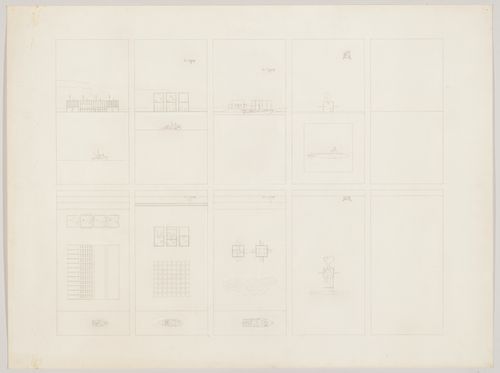
Robert Butscher was the draughtsman of this presentation drawing. The drawing, along with the drawing DR1998:0092:002:006 in this file, were done as part of a Third Year Architecture analysis project at Cooper Union School of Architecture. As part of the project, he read a great many of the novels written by the authors represented by the five sets of structures. The drawings were based on measurements taken from the presentation model. They were completed in 1980 and gifted to John Hejduk by Butscher to use in his Masque of Medusa book.
DR1998:0092:002:006
Description:
Robert Butscher was the draughtsman of this presentation drawing. The drawing, along with the drawing DR1998:0092:002:006 in this file, were done as part of a Third Year Architecture analysis project at Cooper Union School of Architecture. As part of the project, he read a great many of the novels written by the authors represented by the five sets of structures. The drawings were based on measurements taken from the presentation model. They were completed in 1980 and gifted to John Hejduk by Butscher to use in his Masque of Medusa book.
Personnes et institutions:
Date:
1974-1979
1974-1979
Titre:
Plans and elevations for The Silent Witnesses
Actions:
DR1998:0092:002:006
Description:
Robert Butscher was the draughtsman of this presentation drawing. The drawing, along with the drawing DR1998:0092:002:006 in this file, were done as part of a Third Year Architecture analysis project at Cooper Union School of Architecture. As part of the project, he read a great many of the novels written by the authors represented by the five sets of structures. The drawings were based on measurements taken from the presentation model. They were completed in 1980 and gifted to John Hejduk by Butscher to use in his Masque of Medusa book.
Plans and elevations for The Silent Witnesses
Actions:
DR1998:0092:002:006
Description:
Robert Butscher was the draughtsman of this presentation drawing. The drawing, along with the drawing DR1998:0092:002:006 in this file, were done as part of a Third Year Architecture analysis project at Cooper Union School of Architecture. As part of the project, he read a great many of the novels written by the authors represented by the five sets of structures. The drawings were based on measurements taken from the presentation model. They were completed in 1980 and gifted to John Hejduk by Butscher to use in his Masque of Medusa book.
Classification:
dessins
dessins
Date:
1974-1979
1974-1979
Personnes et institutions:
Classification:
dessins
dessins
Numéro de référence:
DR1998:0092:002:007
Description:
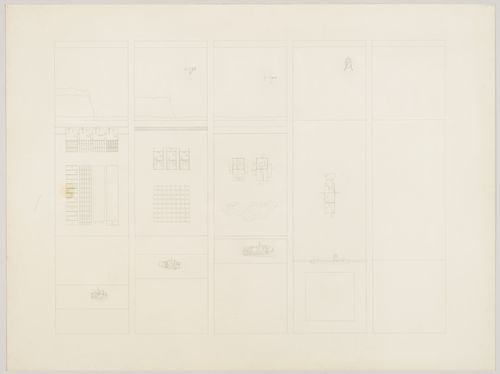
Robert Butscher was the draughtsman of this presentation drawing. The drawing, along with the drawing DR1998:0092:002:006 in this file, were done as part of a Third Year Architecture analysis project at Cooper Union School of Architecture. As part of the project, he read a great many of the novels written by the authors represented by the five sets of structures. The drawings were based on measurements taken from the presentation model. They were completed in 1980 and gifted to John Hejduk by Butscher to use in his Masque of Medusa book.
DR1998:0092:002:007
Description:
Robert Butscher was the draughtsman of this presentation drawing. The drawing, along with the drawing DR1998:0092:002:006 in this file, were done as part of a Third Year Architecture analysis project at Cooper Union School of Architecture. As part of the project, he read a great many of the novels written by the authors represented by the five sets of structures. The drawings were based on measurements taken from the presentation model. They were completed in 1980 and gifted to John Hejduk by Butscher to use in his Masque of Medusa book.
Personnes et institutions:
Date:
1974-1979
1974-1979
Titre:
Presentation drawing for The Silent Witnesses
Actions:
DR1998:0092:002:007
Description:
Robert Butscher was the draughtsman of this presentation drawing. The drawing, along with the drawing DR1998:0092:002:006 in this file, were done as part of a Third Year Architecture analysis project at Cooper Union School of Architecture. As part of the project, he read a great many of the novels written by the authors represented by the five sets of structures. The drawings were based on measurements taken from the presentation model. They were completed in 1980 and gifted to John Hejduk by Butscher to use in his Masque of Medusa book.
Presentation drawing for The Silent Witnesses
Actions:
DR1998:0092:002:007
Description:
Robert Butscher was the draughtsman of this presentation drawing. The drawing, along with the drawing DR1998:0092:002:006 in this file, were done as part of a Third Year Architecture analysis project at Cooper Union School of Architecture. As part of the project, he read a great many of the novels written by the authors represented by the five sets of structures. The drawings were based on measurements taken from the presentation model. They were completed in 1980 and gifted to John Hejduk by Butscher to use in his Masque of Medusa book.
Classification:
dessins
dessins
Date:
1974-1979
1974-1979
Personnes et institutions:
Classification:
photographies
photographies
Numéro de référence:
DR2012:0015:024:003
Description:
File containing photographic materials held in plastic sleeves and glassine, related to the following events, locations, and/or projects: - Melvin Charney’s travels through Italy (118 black-and-white negative frames, 91 contact sheet frames, 1 colour slide); - Corridart project (1 gelatin silver print); - CCA garden (5 colour slides); - Montréal, plus ou moins? (19 black-and-white slides). Materials possibly gathered for inclusion in Louis Martin's 2013 book, On architecture: Melvin Charney: a critical anthology. Original folder inscribed in graphite: AIGEUS MORT OSTIA ANTICA 1961
DR2012:0015:024:003
Description:
File containing photographic materials held in plastic sleeves and glassine, related to the following events, locations, and/or projects: - Melvin Charney’s travels through Italy (118 black-and-white negative frames, 91 contact sheet frames, 1 colour slide); - Corridart project (1 gelatin silver print); - CCA garden (5 colour slides); - Montréal, plus ou moins? (19 black-and-white slides). Materials possibly gathered for inclusion in Louis Martin's 2013 book, On architecture: Melvin Charney: a critical anthology. Original folder inscribed in graphite: AIGEUS MORT OSTIA ANTICA 1961
Personnes et institutions:
Date:
1960-1961, 1986, 2000
1960-1961, 1986, 2000
Titre:
Photographs of various artworks from Melvin Charney's projects and events
Actions:
DR2012:0015:024:003
Description:
File containing photographic materials held in plastic sleeves and glassine, related to the following events, locations, and/or projects: - Melvin Charney’s travels through Italy (118 black-and-white negative frames, 91 contact sheet frames, 1 colour slide); - Corridart project (1 gelatin silver print); - CCA garden (5 colour slides); - Montréal, plus ou moins? (19 black-and-white slides). Materials possibly gathered for inclusion in Louis Martin's 2013 book, On architecture: Melvin Charney: a critical anthology. Original folder inscribed in graphite: AIGEUS MORT OSTIA ANTICA 1961
Photographs of various artworks from Melvin Charney's projects and events
Actions:
DR2012:0015:024:003
Description:
File containing photographic materials held in plastic sleeves and glassine, related to the following events, locations, and/or projects: - Melvin Charney’s travels through Italy (118 black-and-white negative frames, 91 contact sheet frames, 1 colour slide); - Corridart project (1 gelatin silver print); - CCA garden (5 colour slides); - Montréal, plus ou moins? (19 black-and-white slides). Materials possibly gathered for inclusion in Louis Martin's 2013 book, On architecture: Melvin Charney: a critical anthology. Original folder inscribed in graphite: AIGEUS MORT OSTIA ANTICA 1961
Classification:
photographies
photographies
Date:
1960-1961, 1986, 2000
1960-1961, 1986, 2000
Personnes et institutions:
Actions:
Numéro de référence:
PH1979:0601
Description:
This 398 page album comprises a preface, index, 24 photographs and 1 lithographed map. It shows exterior and interior views of buildings and monuments of Bristol, England. Title page reads: A Book about Bristol; Historical, ecclesiastical, and biographical, from original research by John Taylor, Librarian of the Bristol Museum and Library. Author of "A Guide to Clifton," "Tintern Abbey and its Founders", etc. London : Houlston and Sons, Paternoster Row, Bristol: Thomas Kerslake & Co., Queen's Road; William George, 26 Park Street, 1872.
PH1979:0601
Description:
This 398 page album comprises a preface, index, 24 photographs and 1 lithographed map. It shows exterior and interior views of buildings and monuments of Bristol, England. Title page reads: A Book about Bristol; Historical, ecclesiastical, and biographical, from original research by John Taylor, Librarian of the Bristol Museum and Library. Author of "A Guide to Clifton," "Tintern Abbey and its Founders", etc. London : Houlston and Sons, Paternoster Row, Bristol: Thomas Kerslake & Co., Queen's Road; William George, 26 Park Street, 1872.
Personnes et institutions:
Sujet:
architecture
architecture
Date:
1872
1872
Titre:
A Book about Bristol; Historical, ecclesiastical, and biographical, from original research
Actions:
PH1979:0601
Description:
This 398 page album comprises a preface, index, 24 photographs and 1 lithographed map. It shows exterior and interior views of buildings and monuments of Bristol, England. Title page reads: A Book about Bristol; Historical, ecclesiastical, and biographical, from original research by John Taylor, Librarian of the Bristol Museum and Library. Author of "A Guide to Clifton," "Tintern Abbey and its Founders", etc. London : Houlston and Sons, Paternoster Row, Bristol: Thomas Kerslake & Co., Queen's Road; William George, 26 Park Street, 1872.
A Book about Bristol; Historical, ecclesiastical, and biographical, from original research
Actions:
PH1979:0601
Description:
This 398 page album comprises a preface, index, 24 photographs and 1 lithographed map. It shows exterior and interior views of buildings and monuments of Bristol, England. Title page reads: A Book about Bristol; Historical, ecclesiastical, and biographical, from original research by John Taylor, Librarian of the Bristol Museum and Library. Author of "A Guide to Clifton," "Tintern Abbey and its Founders", etc. London : Houlston and Sons, Paternoster Row, Bristol: Thomas Kerslake & Co., Queen's Road; William George, 26 Park Street, 1872.
Date:
1872
1872
Personnes et institutions:
Sujet:
architecture
architecture
Niveau de description archivistique:
Sous-série
Sous-série
Titre:
Education
Education
Numéro de référence:
CI001.S2.D1
Description:
Like his father Hubert, Charles Rohault de Fleury also studied at the École polytechnique with Jean-Nicolas-Louis Durand (1820-1821), and at the École des Beaux-Arts (1823-1825), Charles studied under his father and Louis Hippolyte Lebas. The CCA collection contains his printed exercise book from the École polytechnique and an album of drawings of the orders executed at both schools. The printed exercise book (DR1974:0002:001:001-105), primarily dated to 1821, provides an overview of the first year curriculum at the École polytechnique reflecting the emphasis placed on the course in descriptive geometry. The exercises proceed from the simple to the complex; from the analysis of simple shapes to the interpretation of basic architectural elements. Many of the problems have been solved by Charles, and carry the approval seal of his professor. A large engraving included in the album provides a succinct table recording the career paths of graduating students in the various Écoles d'application, a description of the core curriculum, and a historical and chronological outline of the École polytechnique from its inception to 1828. Charles' studies of the architectural orders (DR1974:0002:019:001-033), many of which are copied directly from Charles Normand's 'Nouveau parallele des ordres d'architecture...,' demonstrate the continued application of Durand's methodology applied to typical Beaux-Arts studies. The orders executed at the École polytechnique are pared down to their essential form and porticos are abstracted and grouped according to their tetrastyle, hexastyle, or octastyle configurations, whereas the orders completed at the École des beaux-arts are simplified, but still reflect the traditional mimetic interpretation of classical antiquity, with its fidelity to mouldings and details. The conspicous abscence of the composite order and the addition of the 'Dorique Romain and Moderne', attest to the continued influence of Durand's ''Precis'. The information regarding George's architectural career is limited to twelve drawings for architectural ornament and sculpture (1858-1859) submitted to a newly introduced, and obligatory, 'dessin' Concours d'emulation at the École des beaux-arts (1). (1) R. Chaffe, "The teaching of architecture at the École des Beaux-Arts" in Arthur Drexler ed., 'The Architecture of the École des Beaux-Arts' (New York: MOMA, 1975), p.84 and fn. 120.)
CI001.S2.D1
Description:
Like his father Hubert, Charles Rohault de Fleury also studied at the École polytechnique with Jean-Nicolas-Louis Durand (1820-1821), and at the École des Beaux-Arts (1823-1825), Charles studied under his father and Louis Hippolyte Lebas. The CCA collection contains his printed exercise book from the École polytechnique and an album of drawings of the orders executed at both schools. The printed exercise book (DR1974:0002:001:001-105), primarily dated to 1821, provides an overview of the first year curriculum at the École polytechnique reflecting the emphasis placed on the course in descriptive geometry. The exercises proceed from the simple to the complex; from the analysis of simple shapes to the interpretation of basic architectural elements. Many of the problems have been solved by Charles, and carry the approval seal of his professor. A large engraving included in the album provides a succinct table recording the career paths of graduating students in the various Écoles d'application, a description of the core curriculum, and a historical and chronological outline of the École polytechnique from its inception to 1828. Charles' studies of the architectural orders (DR1974:0002:019:001-033), many of which are copied directly from Charles Normand's 'Nouveau parallele des ordres d'architecture...,' demonstrate the continued application of Durand's methodology applied to typical Beaux-Arts studies. The orders executed at the École polytechnique are pared down to their essential form and porticos are abstracted and grouped according to their tetrastyle, hexastyle, or octastyle configurations, whereas the orders completed at the École des beaux-arts are simplified, but still reflect the traditional mimetic interpretation of classical antiquity, with its fidelity to mouldings and details. The conspicous abscence of the composite order and the addition of the 'Dorique Romain and Moderne', attest to the continued influence of Durand's ''Precis'. The information regarding George's architectural career is limited to twelve drawings for architectural ornament and sculpture (1858-1859) submitted to a newly introduced, and obligatory, 'dessin' Concours d'emulation at the École des beaux-arts (1). (1) R. Chaffe, "The teaching of architecture at the École des Beaux-Arts" in Arthur Drexler ed., 'The Architecture of the École des Beaux-Arts' (New York: MOMA, 1975), p.84 and fn. 120.)
Personnes et institutions:
Date:
[1776?]-1868
[1776?]-1868
Titre:
Education
CI001.S2.D1
Description:
Like his father Hubert, Charles Rohault de Fleury also studied at the École polytechnique with Jean-Nicolas-Louis Durand (1820-1821), and at the École des Beaux-Arts (1823-1825), Charles studied under his father and Louis Hippolyte Lebas. The CCA collection contains his printed exercise book from the École polytechnique and an album of drawings of the orders executed at both schools. The printed exercise book (DR1974:0002:001:001-105), primarily dated to 1821, provides an overview of the first year curriculum at the École polytechnique reflecting the emphasis placed on the course in descriptive geometry. The exercises proceed from the simple to the complex; from the analysis of simple shapes to the interpretation of basic architectural elements. Many of the problems have been solved by Charles, and carry the approval seal of his professor. A large engraving included in the album provides a succinct table recording the career paths of graduating students in the various Écoles d'application, a description of the core curriculum, and a historical and chronological outline of the École polytechnique from its inception to 1828. Charles' studies of the architectural orders (DR1974:0002:019:001-033), many of which are copied directly from Charles Normand's 'Nouveau parallele des ordres d'architecture...,' demonstrate the continued application of Durand's methodology applied to typical Beaux-Arts studies. The orders executed at the École polytechnique are pared down to their essential form and porticos are abstracted and grouped according to their tetrastyle, hexastyle, or octastyle configurations, whereas the orders completed at the École des beaux-arts are simplified, but still reflect the traditional mimetic interpretation of classical antiquity, with its fidelity to mouldings and details. The conspicous abscence of the composite order and the addition of the 'Dorique Romain and Moderne', attest to the continued influence of Durand's ''Precis'. The information regarding George's architectural career is limited to twelve drawings for architectural ornament and sculpture (1858-1859) submitted to a newly introduced, and obligatory, 'dessin' Concours d'emulation at the École des beaux-arts (1). (1) R. Chaffe, "The teaching of architecture at the École des Beaux-Arts" in Arthur Drexler ed., 'The Architecture of the École des Beaux-Arts' (New York: MOMA, 1975), p.84 and fn. 120.)
Education
CI001.S2.D1
Description:
Like his father Hubert, Charles Rohault de Fleury also studied at the École polytechnique with Jean-Nicolas-Louis Durand (1820-1821), and at the École des Beaux-Arts (1823-1825), Charles studied under his father and Louis Hippolyte Lebas. The CCA collection contains his printed exercise book from the École polytechnique and an album of drawings of the orders executed at both schools. The printed exercise book (DR1974:0002:001:001-105), primarily dated to 1821, provides an overview of the first year curriculum at the École polytechnique reflecting the emphasis placed on the course in descriptive geometry. The exercises proceed from the simple to the complex; from the analysis of simple shapes to the interpretation of basic architectural elements. Many of the problems have been solved by Charles, and carry the approval seal of his professor. A large engraving included in the album provides a succinct table recording the career paths of graduating students in the various Écoles d'application, a description of the core curriculum, and a historical and chronological outline of the École polytechnique from its inception to 1828. Charles' studies of the architectural orders (DR1974:0002:019:001-033), many of which are copied directly from Charles Normand's 'Nouveau parallele des ordres d'architecture...,' demonstrate the continued application of Durand's methodology applied to typical Beaux-Arts studies. The orders executed at the École polytechnique are pared down to their essential form and porticos are abstracted and grouped according to their tetrastyle, hexastyle, or octastyle configurations, whereas the orders completed at the École des beaux-arts are simplified, but still reflect the traditional mimetic interpretation of classical antiquity, with its fidelity to mouldings and details. The conspicous abscence of the composite order and the addition of the 'Dorique Romain and Moderne', attest to the continued influence of Durand's ''Precis'. The information regarding George's architectural career is limited to twelve drawings for architectural ornament and sculpture (1858-1859) submitted to a newly introduced, and obligatory, 'dessin' Concours d'emulation at the École des beaux-arts (1). (1) R. Chaffe, "The teaching of architecture at the École des Beaux-Arts" in Arthur Drexler ed., 'The Architecture of the École des Beaux-Arts' (New York: MOMA, 1975), p.84 and fn. 120.)
Niveau de description archivistique:
File 1
File 1
Date:
[1776?]-1868
[1776?]-1868
Personnes et institutions:
Classification:
archives
Niveau de description archivistique:
Fonds
archives
Niveau de description archivistique:
Fonds
Titre:
Fonds Pierre du Prey
Fonds Pierre du Prey
Numéro de référence:
AP133
Résumé:
The Pierre du Prey fonds documents Pierre du Prey’s work as a researcher and writer on the history of architecture. The fonds contains documents related to his work for "The Villas of Pliny: from antiquity to posterity," published in 1994, and a catalog he produced on Ockham Park in Surrey, England. It also documents du Prey's professional activities as an architectural historian, such as his lectures or his attendance to congresses.
AP133
Résumé:
The Pierre du Prey fonds documents Pierre du Prey’s work as a researcher and writer on the history of architecture. The fonds contains documents related to his work for "The Villas of Pliny: from antiquity to posterity," published in 1994, and a catalog he produced on Ockham Park in Surrey, England. It also documents du Prey's professional activities as an architectural historian, such as his lectures or his attendance to congresses.
Personnes et institutions:
Date:
1967-2019
1967-2019
Titre:
Fonds Pierre du Prey
Actions:
AP133
Résumé:
The Pierre du Prey fonds documents Pierre du Prey’s work as a researcher and writer on the history of architecture. The fonds contains documents related to his work for "The Villas of Pliny: from antiquity to posterity," published in 1994, and a catalog he produced on Ockham Park in Surrey, England. It also documents du Prey's professional activities as an architectural historian, such as his lectures or his attendance to congresses.
Fonds Pierre du Prey
Actions:
AP133
Résumé:
The Pierre du Prey fonds documents Pierre du Prey’s work as a researcher and writer on the history of architecture. The fonds contains documents related to his work for "The Villas of Pliny: from antiquity to posterity," published in 1994, and a catalog he produced on Ockham Park in Surrey, England. It also documents du Prey's professional activities as an architectural historian, such as his lectures or his attendance to congresses.
Classification:
archives
Niveau de description archivistique:
Fonds
archives
Niveau de description archivistique:
Fonds
Date:
1967-2019
1967-2019
Personnes et institutions:
Classification:
dessins
dessins
Actions:
Numéro de référence:
DR1988:0357
Description:
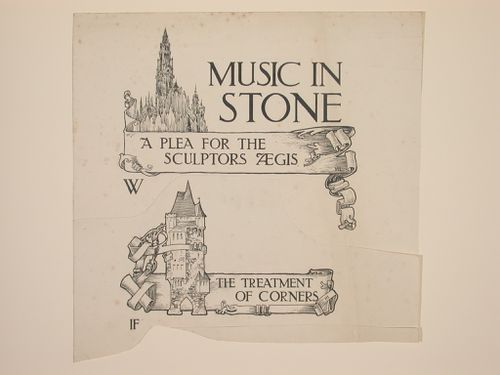
- These reprographic copies show two headings, possibly chapters of a book or article. Both headings were written inside scrolled borders which also incorporate small drawings of buildings. - The style of many of these drawings and reprographic copies by Henry Hyams (DR1988:0332 - DR1988:0414) suggests that they were possibly for periodical illustrations. Hyams contributed articles to the periodicals 'The Builder' and 'The Architect'. Two objects in the CCA collections can be linked to the article "Music in Stone" published prior to 1926 in 'The Architect'; a reprographic copy (DR1988:0357) and a drawing (DR1988:0364) (Who's Who in Architecture, 161).
DR1988:0357
Description:
- These reprographic copies show two headings, possibly chapters of a book or article. Both headings were written inside scrolled borders which also incorporate small drawings of buildings. - The style of many of these drawings and reprographic copies by Henry Hyams (DR1988:0332 - DR1988:0414) suggests that they were possibly for periodical illustrations. Hyams contributed articles to the periodicals 'The Builder' and 'The Architect'. Two objects in the CCA collections can be linked to the article "Music in Stone" published prior to 1926 in 'The Architect'; a reprographic copy (DR1988:0357) and a drawing (DR1988:0364) (Who's Who in Architecture, 161).
Personnes et institutions:
Sujet:
architecture
architecture
Date:
printed in the 1920s ?
printed in the 1920s ?
Titre:
Layout for the head titles "Music in stone..." and "The treatment of corners"
Actions:
DR1988:0357
Description:
- These reprographic copies show two headings, possibly chapters of a book or article. Both headings were written inside scrolled borders which also incorporate small drawings of buildings. - The style of many of these drawings and reprographic copies by Henry Hyams (DR1988:0332 - DR1988:0414) suggests that they were possibly for periodical illustrations. Hyams contributed articles to the periodicals 'The Builder' and 'The Architect'. Two objects in the CCA collections can be linked to the article "Music in Stone" published prior to 1926 in 'The Architect'; a reprographic copy (DR1988:0357) and a drawing (DR1988:0364) (Who's Who in Architecture, 161).
Layout for the head titles "Music in stone..." and "The treatment of corners"
Actions:
DR1988:0357
Description:
- These reprographic copies show two headings, possibly chapters of a book or article. Both headings were written inside scrolled borders which also incorporate small drawings of buildings. - The style of many of these drawings and reprographic copies by Henry Hyams (DR1988:0332 - DR1988:0414) suggests that they were possibly for periodical illustrations. Hyams contributed articles to the periodicals 'The Builder' and 'The Architect'. Two objects in the CCA collections can be linked to the article "Music in Stone" published prior to 1926 in 'The Architect'; a reprographic copy (DR1988:0357) and a drawing (DR1988:0364) (Who's Who in Architecture, 161).
Classification:
dessins
dessins
Date:
printed in the 1920s ?
printed in the 1920s ?
Personnes et institutions:
Sujet:
architecture
architecture
Niveau de description archivistique:
Sous-série
Sous-série
Titre:
Maison de Verre (1965, 1969)
Maison de Verre (1965, 1969)
Numéro de référence:
AP197.S1.SS1
Description:
Located on 31 Rue St Guillaume in Paris, France, Maison de Verre was designed between 1928 and 1931 by furniture designer and architect Pierre Chareau, architect Bernard Bijvoet, and metal craftsman Louis Dalbet. Although the home was built, no original drawings exist for this project. In 1965, as Hodder Fellow at Princeton University, Kenneth Frampton along with Robert Vickery and Michael Carapetian measured the home and its details. Originally, their intention was that this research lead to a book project, but they later published their work as an article entitled "Maison de Verre" in a 1969 issue of Perspecta. This subseries includes measurement sketches and sixteen axonometric representations on vellum that were produced from this research. Photographs document Maison de Verre and provide various interior and exterior views of the house. Photographs by Michael Carapetian, published in the Perspecta article, “Maison de Verre (1969),” are also included in this subseries. Textual documentation includes drafts of the publication on Maison de Verre, as well as notes, correspondence, and various research files on Paul Nelson, Pierre Chareau, and Maison de Verre.
AP197.S1.SS1
Description:
Located on 31 Rue St Guillaume in Paris, France, Maison de Verre was designed between 1928 and 1931 by furniture designer and architect Pierre Chareau, architect Bernard Bijvoet, and metal craftsman Louis Dalbet. Although the home was built, no original drawings exist for this project. In 1965, as Hodder Fellow at Princeton University, Kenneth Frampton along with Robert Vickery and Michael Carapetian measured the home and its details. Originally, their intention was that this research lead to a book project, but they later published their work as an article entitled "Maison de Verre" in a 1969 issue of Perspecta. This subseries includes measurement sketches and sixteen axonometric representations on vellum that were produced from this research. Photographs document Maison de Verre and provide various interior and exterior views of the house. Photographs by Michael Carapetian, published in the Perspecta article, “Maison de Verre (1969),” are also included in this subseries. Textual documentation includes drafts of the publication on Maison de Verre, as well as notes, correspondence, and various research files on Paul Nelson, Pierre Chareau, and Maison de Verre.
Personnes et institutions:
Date:
1965-1981
1965-1981
Titre:
Maison de Verre (1965, 1969)
Actions:
AP197.S1.SS1
Description:
Located on 31 Rue St Guillaume in Paris, France, Maison de Verre was designed between 1928 and 1931 by furniture designer and architect Pierre Chareau, architect Bernard Bijvoet, and metal craftsman Louis Dalbet. Although the home was built, no original drawings exist for this project. In 1965, as Hodder Fellow at Princeton University, Kenneth Frampton along with Robert Vickery and Michael Carapetian measured the home and its details. Originally, their intention was that this research lead to a book project, but they later published their work as an article entitled "Maison de Verre" in a 1969 issue of Perspecta. This subseries includes measurement sketches and sixteen axonometric representations on vellum that were produced from this research. Photographs document Maison de Verre and provide various interior and exterior views of the house. Photographs by Michael Carapetian, published in the Perspecta article, “Maison de Verre (1969),” are also included in this subseries. Textual documentation includes drafts of the publication on Maison de Verre, as well as notes, correspondence, and various research files on Paul Nelson, Pierre Chareau, and Maison de Verre.
Maison de Verre (1965, 1969)
Actions:
AP197.S1.SS1
Description:
Located on 31 Rue St Guillaume in Paris, France, Maison de Verre was designed between 1928 and 1931 by furniture designer and architect Pierre Chareau, architect Bernard Bijvoet, and metal craftsman Louis Dalbet. Although the home was built, no original drawings exist for this project. In 1965, as Hodder Fellow at Princeton University, Kenneth Frampton along with Robert Vickery and Michael Carapetian measured the home and its details. Originally, their intention was that this research lead to a book project, but they later published their work as an article entitled "Maison de Verre" in a 1969 issue of Perspecta. This subseries includes measurement sketches and sixteen axonometric representations on vellum that were produced from this research. Photographs document Maison de Verre and provide various interior and exterior views of the house. Photographs by Michael Carapetian, published in the Perspecta article, “Maison de Verre (1969),” are also included in this subseries. Textual documentation includes drafts of the publication on Maison de Verre, as well as notes, correspondence, and various research files on Paul Nelson, Pierre Chareau, and Maison de Verre.
Niveau de description archivistique:
Subseries
Subseries
Date:
1965-1981
1965-1981
Personnes et institutions:


