


36154 Résultats
Classification:
livres
livres
Actions:
Prix:
$18.95
(disponible sur commande)
Résumé:
We are living under the administration of fear: fear has become an environment, an everyday landscape. There was a time when wars, famines, and epidemics were localized and limited by a certain time frame. Today, it is the world itself that is limited, saturated, and manipulated, the world itself that seizes us and confines us with a stressful claustrophobia. Stock-market(...)
$18.95
(disponible sur commande)
Résumé:
We are living under the administration of fear: fear has become an environment, an everyday landscape. There was a time when wars, famines, and epidemics were localized and limited by a certain time frame. Today, it is the world itself that is limited, saturated, and manipulated, the world itself that seizes us and confines us with a stressful claustrophobia. Stock-market(...)
Titre:
Paul Virilio : the administration of fear
Actions:
Prix:
$18.95
(disponible sur commande)
Résumé:
We are living under the administration of fear: fear has become an environment, an everyday landscape. There was a time when wars, famines, and epidemics were localized and limited by a certain time frame. Today, it is the world itself that is limited, saturated, and manipulated, the world itself that seizes us and confines us with a stressful claustrophobia. Stock-market crises, undifferentiated terrorism, lightning pandemics, "professional" suicides.... Fear has become the world we live in.
Paul Virilio : the administration of fear
Actions:
Prix:
$18.95
(disponible sur commande)
Résumé:
We are living under the administration of fear: fear has become an environment, an everyday landscape. There was a time when wars, famines, and epidemics were localized and limited by a certain time frame. Today, it is the world itself that is limited, saturated, and manipulated, the world itself that seizes us and confines us with a stressful claustrophobia. Stock-market crises, undifferentiated terrorism, lightning pandemics, "professional" suicides.... Fear has become the world we live in.
Classification:
livres
livres
Publication:
avril 2012
avril 2012
Sujet:
Théorie/ philosophie
Théorie/ philosophie
Classification:
livres
livres
Actions:
Prix:
$19.95
(disponible sur commande)
Résumé:
"Learning from Las Vegas," originally published by the MIT Press in 1972, was one of the most influential and controversial architectural books of its era. Forty years later, it remains a perennial bestseller and a definitive theoretical text. Its authors - architects Robert Venturi, Denise ScottBrown, and Steven Izenour - famously used the Las Vegas Strip to argue the(...)
$19.95
(disponible sur commande)
Résumé:
"Learning from Las Vegas," originally published by the MIT Press in 1972, was one of the most influential and controversial architectural books of its era. Forty years later, it remains a perennial bestseller and a definitive theoretical text. Its authors - architects Robert Venturi, Denise ScottBrown, and Steven Izenour - famously used the Las Vegas Strip to argue the(...)
Titre:
I am a monument : on learning from Las Vegas
Actions:
Prix:
$19.95
(disponible sur commande)
Résumé:
"Learning from Las Vegas," originally published by the MIT Press in 1972, was one of the most influential and controversial architectural books of its era. Forty years later, it remains a perennial bestseller and a definitive theoretical text. Its authors - architects Robert Venturi, Denise ScottBrown, and Steven Izenour - famously used the Las Vegas Strip to argue the virtues ofthe "ordinary and ugly" above the "heroic and original"qualities of architectural modernism. In this provocative rereading of an iconic text, Aron Vinegar argues that to read "Learning from Las Vegas" only as an exemplary postmodernist text - to understand it, for example, as a call for pastiche or as ironic provocation - is to underestimate its deeper critical and ethical meaning, and to miss the underlying dialectic between skepticism and the ordinary, expression and the deadpan, that runs through the text.
I am a monument : on learning from Las Vegas
Actions:
Prix:
$19.95
(disponible sur commande)
Résumé:
"Learning from Las Vegas," originally published by the MIT Press in 1972, was one of the most influential and controversial architectural books of its era. Forty years later, it remains a perennial bestseller and a definitive theoretical text. Its authors - architects Robert Venturi, Denise ScottBrown, and Steven Izenour - famously used the Las Vegas Strip to argue the virtues ofthe "ordinary and ugly" above the "heroic and original"qualities of architectural modernism. In this provocative rereading of an iconic text, Aron Vinegar argues that to read "Learning from Las Vegas" only as an exemplary postmodernist text - to understand it, for example, as a call for pastiche or as ironic provocation - is to underestimate its deeper critical and ethical meaning, and to miss the underlying dialectic between skepticism and the ordinary, expression and the deadpan, that runs through the text.
Classification:
livres
livres
Publication:
avril 2012
avril 2012
Sujet:
Théorie de l’architecture
Théorie de l’architecture
Classification:
livres
livres
Prix:
$17.95
(disponible sur commande)
Résumé:
Sidewalks Conflict and Negotiation over Public Space Anastasia Loukaitou-Sideris and Renia Ehrenfeucht Urban sidewalks, critical but undervalued public spaces, have been sites for political demonstrations and urban greening, promenades for the wealthy and the well-dressed, and shelterless shelters for the homeless. On sidewalks, decade after decade, urbanites have(...)
$17.95
(disponible sur commande)
Résumé:
Sidewalks Conflict and Negotiation over Public Space Anastasia Loukaitou-Sideris and Renia Ehrenfeucht Urban sidewalks, critical but undervalued public spaces, have been sites for political demonstrations and urban greening, promenades for the wealthy and the well-dressed, and shelterless shelters for the homeless. On sidewalks, decade after decade, urbanites have(...)
Titre:
Sidewalks: conflict and negotiation over public space
Actions:
Prix:
$17.95
(disponible sur commande)
Résumé:
Sidewalks Conflict and Negotiation over Public Space Anastasia Loukaitou-Sideris and Renia Ehrenfeucht Urban sidewalks, critical but undervalued public spaces, have been sites for political demonstrations and urban greening, promenades for the wealthy and the well-dressed, and shelterless shelters for the homeless. On sidewalks, decade after decade, urbanites have socialized, paraded, and played, sold their wares, and observed city life. These many uses often overlap and conflict, and urban residents and planners try to include some and exclude others. In this first book-length analysis of the sidewalk as a distinct public space, Anastasia Loukaitou-Sideris and Renia Ehrenfeucht examine the evolution of the American urban sidewalk and trace conflicts that have arisen over its competing uses. Drawing on historical and contemporary examples as well as case study research and archival data from five cities--Boston, Los Angeles, New York, Miami, and Seattle--they discuss the characteristics of sidewalks as small urban public spaces, and such related issues as the ambiguous boundaries of their “public” status, contestation over specific uses, control and regulations, and the implications for First Amendment speech and assembly rights.
Sidewalks: conflict and negotiation over public space
Actions:
Prix:
$17.95
(disponible sur commande)
Résumé:
Sidewalks Conflict and Negotiation over Public Space Anastasia Loukaitou-Sideris and Renia Ehrenfeucht Urban sidewalks, critical but undervalued public spaces, have been sites for political demonstrations and urban greening, promenades for the wealthy and the well-dressed, and shelterless shelters for the homeless. On sidewalks, decade after decade, urbanites have socialized, paraded, and played, sold their wares, and observed city life. These many uses often overlap and conflict, and urban residents and planners try to include some and exclude others. In this first book-length analysis of the sidewalk as a distinct public space, Anastasia Loukaitou-Sideris and Renia Ehrenfeucht examine the evolution of the American urban sidewalk and trace conflicts that have arisen over its competing uses. Drawing on historical and contemporary examples as well as case study research and archival data from five cities--Boston, Los Angeles, New York, Miami, and Seattle--they discuss the characteristics of sidewalks as small urban public spaces, and such related issues as the ambiguous boundaries of their “public” status, contestation over specific uses, control and regulations, and the implications for First Amendment speech and assembly rights.
Classification:
livres
livres
Publication:
mars 2012
mars 2012
Sujet:
Espaces Public
Espaces Public
Classification:
livres
livres
Prix:
$89.00
(disponible sur commande)
Résumé:
Bois: systèmes constructifs propose un aperçu global, analytique et visuel de diverses typologies architecturales, de la maison individuelle aux programmes à plus grande échelle et à plusieurs étages. Les différents types d'enveloppe ainsi que les principaux systèmes de plancher et de cloisonnement intérieurs sont présentés avec précision. À l'aide de plans, de dessins(...)
$89.00
(disponible sur commande)
Résumé:
Bois: systèmes constructifs propose un aperçu global, analytique et visuel de diverses typologies architecturales, de la maison individuelle aux programmes à plus grande échelle et à plusieurs étages. Les différents types d'enveloppe ainsi que les principaux systèmes de plancher et de cloisonnement intérieurs sont présentés avec précision. À l'aide de plans, de dessins(...)
Titre:
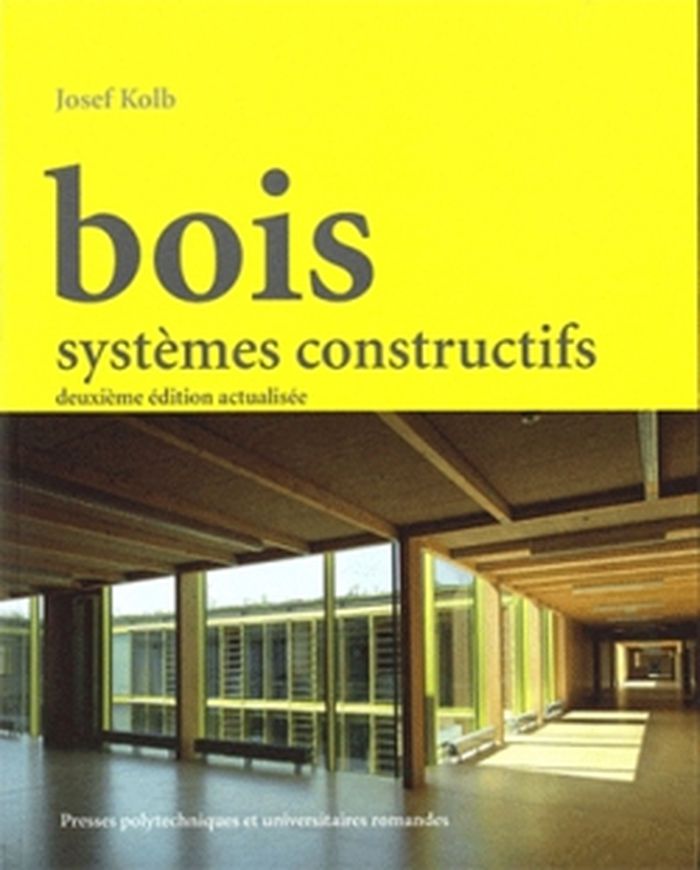
Bois: systèmes constructifs, deuxième édition actualisée
Actions:
Prix:
$89.00
(disponible sur commande)
Résumé:
Bois: systèmes constructifs propose un aperçu global, analytique et visuel de diverses typologies architecturales, de la maison individuelle aux programmes à plus grande échelle et à plusieurs étages. Les différents types d'enveloppe ainsi que les principaux systèmes de plancher et de cloisonnement intérieurs sont présentés avec précision. À l'aide de plans, de dessins schématiques et de photos, cet ouvrage reflète l'état actuel et futur des techniques de construction en bois telles qu'elles sont mises en oeuvre dans les pays les plus en pointe dans la maîtrise des systèmes constructifs en bois.
Bois: systèmes constructifs, deuxième édition actualisée
Actions:
Prix:
$89.00
(disponible sur commande)
Résumé:
Bois: systèmes constructifs propose un aperçu global, analytique et visuel de diverses typologies architecturales, de la maison individuelle aux programmes à plus grande échelle et à plusieurs étages. Les différents types d'enveloppe ainsi que les principaux systèmes de plancher et de cloisonnement intérieurs sont présentés avec précision. À l'aide de plans, de dessins schématiques et de photos, cet ouvrage reflète l'état actuel et futur des techniques de construction en bois telles qu'elles sont mises en oeuvre dans les pays les plus en pointe dans la maîtrise des systèmes constructifs en bois.
Classification:
livres
livres
Publication:
février 2012
février 2012
Sujet:
Constructions en bois
Constructions en bois
Classification:
livres
livres
Prix:
$21.00
(disponible sur commande)
Résumé:
Taking Henri Lefebvres 1967 essay, The Right to the City, as his jumping-off point, Harvey (Social Justice and the City) examines real estate booms and busts and predation on vulnerable populations; commodification of culture; neo-liberal capitalist dominance; and urban uprisings, from the Paris Commune to the massive 2006 protest against U.S. anti-immigrant policies to(...)
$21.00
(disponible sur commande)
Résumé:
Taking Henri Lefebvres 1967 essay, The Right to the City, as his jumping-off point, Harvey (Social Justice and the City) examines real estate booms and busts and predation on vulnerable populations; commodification of culture; neo-liberal capitalist dominance; and urban uprisings, from the Paris Commune to the massive 2006 protest against U.S. anti-immigrant policies to(...)
Titre:
Rebel cities : from the right to the city to the urban revolution
Actions:
Prix:
$21.00
(disponible sur commande)
Résumé:
Taking Henri Lefebvres 1967 essay, The Right to the City, as his jumping-off point, Harvey (Social Justice and the City) examines real estate booms and busts and predation on vulnerable populations; commodification of culture; neo-liberal capitalist dominance; and urban uprisings, from the Paris Commune to the massive 2006 protest against U.S. anti-immigrant policies to urbanized peasants and mineworkers in El Alto, Bolivia, who organized themselves and instigated a progressive Bolivian government. He asks: Is there something about the urban process and the urban experience... under capitalism, that, in itself, has the potential to ground anti-capitalist struggles?
Rebel cities : from the right to the city to the urban revolution
Actions:
Prix:
$21.00
(disponible sur commande)
Résumé:
Taking Henri Lefebvres 1967 essay, The Right to the City, as his jumping-off point, Harvey (Social Justice and the City) examines real estate booms and busts and predation on vulnerable populations; commodification of culture; neo-liberal capitalist dominance; and urban uprisings, from the Paris Commune to the massive 2006 protest against U.S. anti-immigrant policies to urbanized peasants and mineworkers in El Alto, Bolivia, who organized themselves and instigated a progressive Bolivian government. He asks: Is there something about the urban process and the urban experience... under capitalism, that, in itself, has the potential to ground anti-capitalist struggles?
Classification:
livres
livres
Publication:
avril 2012
avril 2012
Sujet:
Théorie de l’urbanisme
Théorie de l’urbanisme
Classification:
livres
livres
Actions:
Prix:
$37.50
(disponible sur commande)
Résumé:
In A Guide to the New Ruins of Great Britain, Owen Hatherley skewered New Labour’s architectural legacy in all its witless swagger. Now, in the year of the Diamond Jubilee and the London Olympics, he sets out to describe what the Coalition’s altogether different approach to economic mismanagement and civic irresponsibility is doing to the places where the British live. (...)
$37.50
(disponible sur commande)
Résumé:
In A Guide to the New Ruins of Great Britain, Owen Hatherley skewered New Labour’s architectural legacy in all its witless swagger. Now, in the year of the Diamond Jubilee and the London Olympics, he sets out to describe what the Coalition’s altogether different approach to economic mismanagement and civic irresponsibility is doing to the places where the British live. (...)
Titre:
A new kind of bleak : journeys through urban Britain
Actions:
Prix:
$37.50
(disponible sur commande)
Résumé:
In A Guide to the New Ruins of Great Britain, Owen Hatherley skewered New Labour’s architectural legacy in all its witless swagger. Now, in the year of the Diamond Jubilee and the London Olympics, he sets out to describe what the Coalition’s altogether different approach to economic mismanagement and civic irresponsibility is doing to the places where the British live. In a journey that begins and ends in the capital, Hatherley takes us from Plymouth and Brighton to Belfast and Aberdeen, by way of the eerie urbanism of the Welsh valleys and the much-mocked splendour of modernist Coventry. Everywhere outside the unreal Southeast, the building has stopped in towns and cities, which languish as they wait for the next bout of self-defeating austerity. Hatherley writes with unrivalled aggression about the disarray of modern Britain, and yet this remains a book about possibilities remembered, about unlikely successes in the midst of seemingly inexorable failure. For as well as trash, ancient and modern, Hatherley finds signs of the hopeful country Britain once was and hints of what it might become.
A new kind of bleak : journeys through urban Britain
Actions:
Prix:
$37.50
(disponible sur commande)
Résumé:
In A Guide to the New Ruins of Great Britain, Owen Hatherley skewered New Labour’s architectural legacy in all its witless swagger. Now, in the year of the Diamond Jubilee and the London Olympics, he sets out to describe what the Coalition’s altogether different approach to economic mismanagement and civic irresponsibility is doing to the places where the British live. In a journey that begins and ends in the capital, Hatherley takes us from Plymouth and Brighton to Belfast and Aberdeen, by way of the eerie urbanism of the Welsh valleys and the much-mocked splendour of modernist Coventry. Everywhere outside the unreal Southeast, the building has stopped in towns and cities, which languish as they wait for the next bout of self-defeating austerity. Hatherley writes with unrivalled aggression about the disarray of modern Britain, and yet this remains a book about possibilities remembered, about unlikely successes in the midst of seemingly inexorable failure. For as well as trash, ancient and modern, Hatherley finds signs of the hopeful country Britain once was and hints of what it might become.
Classification:
livres
livres
Publication:
mai 2012
mai 2012
Sujet:
Théorie de l’urbanisme
Théorie de l’urbanisme
Classification:
livres
livres

Actions:
Prix:
$31.00
(disponible sur commande)
Résumé:
From the tunnels of Gaza to the militarized airspace of the Occupied Territories, Eyal Weizman unravels Israel's mechanisms of control and its transformation of Palestinian towns, villages and roads into an artifice where all natural and built features serve military ends. Weizman traces the development of this strategy, from the influence of archaeology on urban(...)
$31.00
(disponible sur commande)
Résumé:
From the tunnels of Gaza to the militarized airspace of the Occupied Territories, Eyal Weizman unravels Israel's mechanisms of control and its transformation of Palestinian towns, villages and roads into an artifice where all natural and built features serve military ends. Weizman traces the development of this strategy, from the influence of archaeology on urban(...)
Titre:
Hollow land: Israel's architecture of occupation
Actions:
Prix:
$31.00
(disponible sur commande)
Résumé:
From the tunnels of Gaza to the militarized airspace of the Occupied Territories, Eyal Weizman unravels Israel's mechanisms of control and its transformation of Palestinian towns, villages and roads into an artifice where all natural and built features serve military ends. Weizman traces the development of this strategy, from the influence of archaeology on urban planning, Ariel Sharon's reconceptualization of military defence during the 1973 war, through the planning and architecture of the settlements, to the contemporary Israeli discourse and practice of urban warfare and airborne targeted assassinations. Hollow Land lays bare the political system at the heart of this complex and terrifying project of late-modern colonial occupation.
Hollow land: Israel's architecture of occupation
Actions:
Prix:
$31.00
(disponible sur commande)
Résumé:
From the tunnels of Gaza to the militarized airspace of the Occupied Territories, Eyal Weizman unravels Israel's mechanisms of control and its transformation of Palestinian towns, villages and roads into an artifice where all natural and built features serve military ends. Weizman traces the development of this strategy, from the influence of archaeology on urban planning, Ariel Sharon's reconceptualization of military defence during the 1973 war, through the planning and architecture of the settlements, to the contemporary Israeli discourse and practice of urban warfare and airborne targeted assassinations. Hollow Land lays bare the political system at the heart of this complex and terrifying project of late-modern colonial occupation.
Classification:
livres
livres
Publication:
mai 2012
mai 2012
Classification:
livres
livres
Actions:
Prix:
$39.95
(disponible sur commande)
Résumé:
Since the 1990s, critics and curators have broadly accepted the notion that participatory art is the ultimate political art: that by encouraging an audience to take part an artist can promote new emancipatory social relations. Around the world, the champions of this form of expression are numerous, ranging from art historians such as Grant Kester, curators such as Nicolas(...)
$39.95
(disponible sur commande)
Résumé:
Since the 1990s, critics and curators have broadly accepted the notion that participatory art is the ultimate political art: that by encouraging an audience to take part an artist can promote new emancipatory social relations. Around the world, the champions of this form of expression are numerous, ranging from art historians such as Grant Kester, curators such as Nicolas(...)
Titre:
Artificial hells : participatory art and the politics of spectatorship
Actions:
Prix:
$39.95
(disponible sur commande)
Résumé:
Since the 1990s, critics and curators have broadly accepted the notion that participatory art is the ultimate political art: that by encouraging an audience to take part an artist can promote new emancipatory social relations. Around the world, the champions of this form of expression are numerous, ranging from art historians such as Grant Kester, curators such as Nicolas Bourriaud and Nato Thompson, to performance theorists such as Shannon Jackson. Artificial Hells is the first historical and theoretical overview of socially engaged participatory art, known in the US as “social practice.” Claire Bishop follows the trajectory of twentieth-century art and examines key moments in the development of a participatory aesthetic. This itinerary takes in Futurism and Dada; the Situationist International; Happenings in Eastern Europe, Argentina and Paris; the 1970s Community Arts Movement; and the Artists Placement Group. It concludes with a discussion of long-term educational projects by contemporary artists such as Thomas Hirschhorn, Tania Bruguera, Pawe Althamer and Paul Chan. Since her controversial essay in Artforum in 2006, Claire Bishop has been one of the few to challenge the political and aesthetic ambitions of participatory art. In Artificial Hells, she not only scrutinizes the emancipatory claims made for these projects, but also provides an alternative to the ethical (rather than artistic) criteria invited by such artworks. Artificial Hells calls for a less prescriptive approach to art and politics, and for more compelling, troubling and bolder forms of participatory art and criticism.
Artificial hells : participatory art and the politics of spectatorship
Actions:
Prix:
$39.95
(disponible sur commande)
Résumé:
Since the 1990s, critics and curators have broadly accepted the notion that participatory art is the ultimate political art: that by encouraging an audience to take part an artist can promote new emancipatory social relations. Around the world, the champions of this form of expression are numerous, ranging from art historians such as Grant Kester, curators such as Nicolas Bourriaud and Nato Thompson, to performance theorists such as Shannon Jackson. Artificial Hells is the first historical and theoretical overview of socially engaged participatory art, known in the US as “social practice.” Claire Bishop follows the trajectory of twentieth-century art and examines key moments in the development of a participatory aesthetic. This itinerary takes in Futurism and Dada; the Situationist International; Happenings in Eastern Europe, Argentina and Paris; the 1970s Community Arts Movement; and the Artists Placement Group. It concludes with a discussion of long-term educational projects by contemporary artists such as Thomas Hirschhorn, Tania Bruguera, Pawe Althamer and Paul Chan. Since her controversial essay in Artforum in 2006, Claire Bishop has been one of the few to challenge the political and aesthetic ambitions of participatory art. In Artificial Hells, she not only scrutinizes the emancipatory claims made for these projects, but also provides an alternative to the ethical (rather than artistic) criteria invited by such artworks. Artificial Hells calls for a less prescriptive approach to art and politics, and for more compelling, troubling and bolder forms of participatory art and criticism.
Classification:
livres
livres
Publication:
juillet 2012
juillet 2012
Classification:
livres
livres
Prix:
$25.00
(disponible sur commande)
Résumé:
New Labour came to power in 1997 amid much talk of regenerating the inner cities left to rot under successive Conservative governments. Over the next decade, urban environments became the laboratories of the new enterprise economy: of finance, property speculation, and the service industry. Now, with New Labour capsized, Owen Hatherley sets out to explore the wreckage —(...)
$25.00
(disponible sur commande)
Résumé:
New Labour came to power in 1997 amid much talk of regenerating the inner cities left to rot under successive Conservative governments. Over the next decade, urban environments became the laboratories of the new enterprise economy: of finance, property speculation, and the service industry. Now, with New Labour capsized, Owen Hatherley sets out to explore the wreckage —(...)
Titre:
A guide to the new ruins of Great Britain (Paperback)
Actions:
Prix:
$25.00
(disponible sur commande)
Résumé:
New Labour came to power in 1997 amid much talk of regenerating the inner cities left to rot under successive Conservative governments. Over the next decade, urban environments became the laboratories of the new enterprise economy: of finance, property speculation, and the service industry. Now, with New Labour capsized, Owen Hatherley sets out to explore the wreckage — the architecture that epitomized an age of greed and selfish aspiration. From riverside apartment complexes, art galleries and amorphous interactive “centers” to shopping malls, call centers and factories turned into expensive lofts, Hatherley maps the derelict Britain of the 2010s, an emphatic expression of a failed politics.
A guide to the new ruins of Great Britain (Paperback)
Actions:
Prix:
$25.00
(disponible sur commande)
Résumé:
New Labour came to power in 1997 amid much talk of regenerating the inner cities left to rot under successive Conservative governments. Over the next decade, urban environments became the laboratories of the new enterprise economy: of finance, property speculation, and the service industry. Now, with New Labour capsized, Owen Hatherley sets out to explore the wreckage — the architecture that epitomized an age of greed and selfish aspiration. From riverside apartment complexes, art galleries and amorphous interactive “centers” to shopping malls, call centers and factories turned into expensive lofts, Hatherley maps the derelict Britain of the 2010s, an emphatic expression of a failed politics.
Classification:
livres
livres
Publication:
janvier 2012
janvier 2012
Sujet:
Théorie de l’urbanisme
Théorie de l’urbanisme
Classification:
livres
livres
Actions:
Prix:
$49.95
(disponible sur commande)
Résumé:
This edited collection offers a unique perspective on twentieth-century architectural history, disputing the primacy placed on individuals in the design and planning process and instead looking to the larger influences of politics, culture, economics, and globalization to uncover the roots of how our built environment evolves.
$49.95
(disponible sur commande)
Résumé:
This edited collection offers a unique perspective on twentieth-century architectural history, disputing the primacy placed on individuals in the design and planning process and instead looking to the larger influences of politics, culture, economics, and globalization to uncover the roots of how our built environment evolves.
Titre:
Governing by design : architecture, economy, and politics in the 20th century
Actions:
Prix:
$49.95
(disponible sur commande)
Résumé:
This edited collection offers a unique perspective on twentieth-century architectural history, disputing the primacy placed on individuals in the design and planning process and instead looking to the larger influences of politics, culture, economics, and globalization to uncover the roots of how our built environment evolves.
Governing by design : architecture, economy, and politics in the 20th century
Actions:
Prix:
$49.95
(disponible sur commande)
Résumé:
This edited collection offers a unique perspective on twentieth-century architectural history, disputing the primacy placed on individuals in the design and planning process and instead looking to the larger influences of politics, culture, economics, and globalization to uncover the roots of how our built environment evolves.
Classification:
livres
livres
Publication:
avril 2012
avril 2012


