


7457 Résultats
Classification:
livres
livres
Titre:
Terms and conditions
Terms and conditions
Actions:
Prix:
$16.95
(disponible sur commande)
Résumé:
For his newest project, R. Sikoryak tackles the monstrously and infamously dense legal document, iTunes Terms and Conditions, the contract everyone agrees to but no one reads. In a word for word 94-page adaptation, Sikoryak hilariously turns the agreement on its head—each page features an avatar of Apple cofounder and legendary visionary Steve Jobs juxtaposed with a(...)
$16.95
(disponible sur commande)
Résumé:
For his newest project, R. Sikoryak tackles the monstrously and infamously dense legal document, iTunes Terms and Conditions, the contract everyone agrees to but no one reads. In a word for word 94-page adaptation, Sikoryak hilariously turns the agreement on its head—each page features an avatar of Apple cofounder and legendary visionary Steve Jobs juxtaposed with a(...)
Titre:
Terms and conditions
Actions:
Prix:
$16.95
(disponible sur commande)
Résumé:
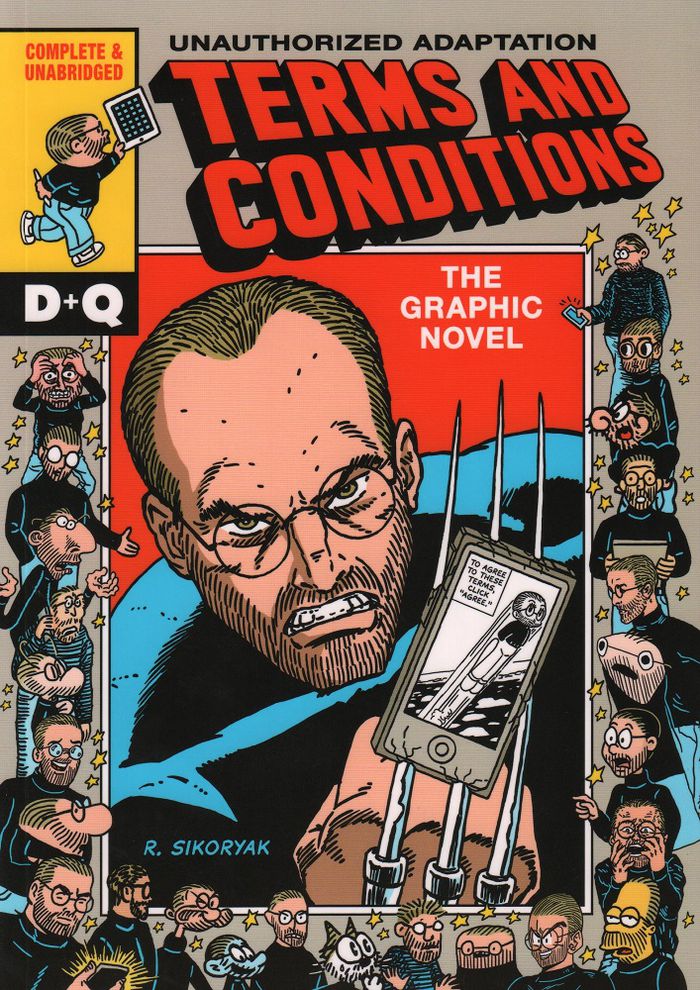
For his newest project, R. Sikoryak tackles the monstrously and infamously dense legal document, iTunes Terms and Conditions, the contract everyone agrees to but no one reads. In a word for word 94-page adaptation, Sikoryak hilariously turns the agreement on its head—each page features an avatar of Apple cofounder and legendary visionary Steve Jobs juxtaposed with a different classic strip such as Mort Walker’s Beetle Bailey, or a contemporary graphic novel such as Craig Thompson’s Blankets or Marjane Satrapi’s Persepolis . Adapting the legalese of the iTunes Terms and Conditions into another medium seems like an unfathomable undertaking, yet Sikoryak creates a surprisingly readable document, far different from its original, purely textual incarnation and thus proving the accessibility and flexibility of comics. When Sikoryak parodies Kate Beaton’s Hark A Vagrant peasant comics with Steve Jobs discussing objectionable material or Homer Simpson as Steve Jobs warning of the penalties of copyright infringement, Terms and Conditions serves as a surreal record of our modern digital age where technology competes with enduringly ironclad mediums.
Terms and conditions
Actions:
Prix:
$16.95
(disponible sur commande)
Résumé:
For his newest project, R. Sikoryak tackles the monstrously and infamously dense legal document, iTunes Terms and Conditions, the contract everyone agrees to but no one reads. In a word for word 94-page adaptation, Sikoryak hilariously turns the agreement on its head—each page features an avatar of Apple cofounder and legendary visionary Steve Jobs juxtaposed with a different classic strip such as Mort Walker’s Beetle Bailey, or a contemporary graphic novel such as Craig Thompson’s Blankets or Marjane Satrapi’s Persepolis . Adapting the legalese of the iTunes Terms and Conditions into another medium seems like an unfathomable undertaking, yet Sikoryak creates a surprisingly readable document, far different from its original, purely textual incarnation and thus proving the accessibility and flexibility of comics. When Sikoryak parodies Kate Beaton’s Hark A Vagrant peasant comics with Steve Jobs discussing objectionable material or Homer Simpson as Steve Jobs warning of the penalties of copyright infringement, Terms and Conditions serves as a surreal record of our modern digital age where technology competes with enduringly ironclad mediums.
Classification:
livres
livres
Publication:
mars 2017
mars 2017
Sujet:
Illustration
Illustration
Classification:
livres
livres
Prix:
$23.95
(disponible en magasin)
Résumé:
Geomedia offers critical analysis of the new possibilities and power relations emerging in the public space of contemporary cities. As ubiquitous digital networks enable embedded and mobile devices to integrate place-specific data with real-time feedback circuits, everyday experience of public space has become subject to new demands. Looking beyond debates framed by the(...)
$23.95
(disponible en magasin)
Résumé:
Geomedia offers critical analysis of the new possibilities and power relations emerging in the public space of contemporary cities. As ubiquitous digital networks enable embedded and mobile devices to integrate place-specific data with real-time feedback circuits, everyday experience of public space has become subject to new demands. Looking beyond debates framed by the(...)
Titre:
Geomedia: networked cities and the future of public space
Actions:
Prix:
$23.95
(disponible en magasin)
Résumé:
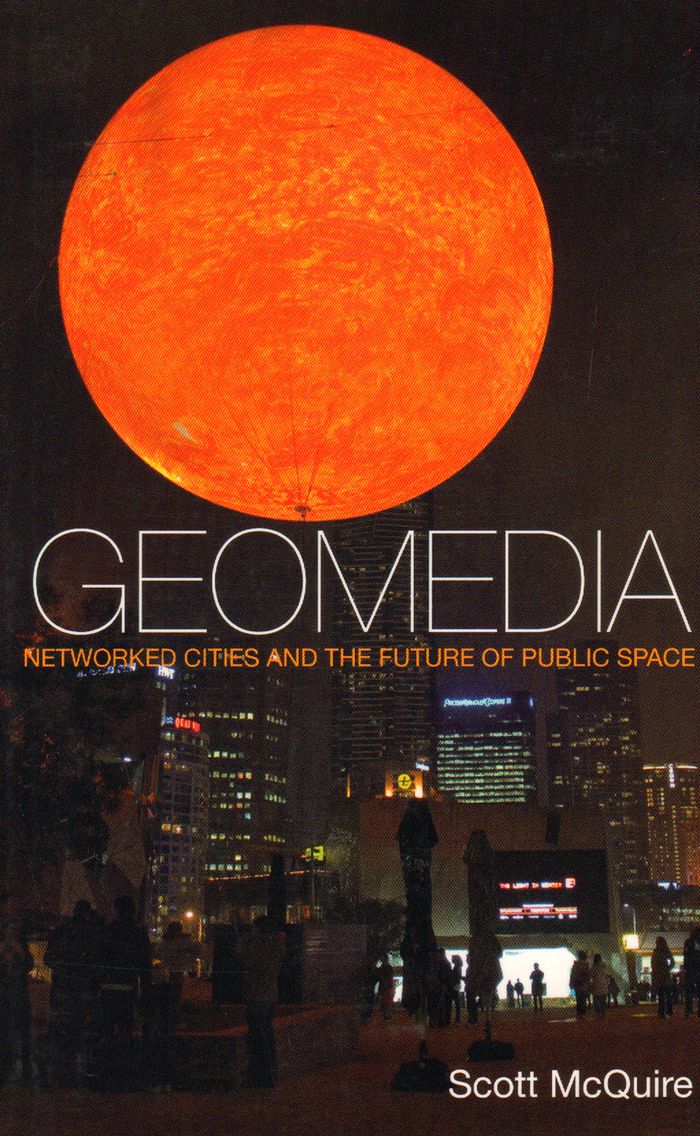
Geomedia offers critical analysis of the new possibilities and power relations emerging in the public space of contemporary cities. As ubiquitous digital networks enable embedded and mobile devices to integrate place-specific data with real-time feedback circuits, everyday experience of public space has become subject to new demands. Looking beyond debates framed by the dominance of surveillance and spectacle, McQuire asks: how might the kind of collaborative practices that have flourished in art and online cultures be translated into urban space? In the urban crisis of the 1960s, Henri Lefebvre argued that the capacity for a city’s inhabitants to actively appropriate the time and space of their surroundings was a critical dimension of modern democracy. What does it mean to speak of ‘the right to the city’ in the context of the networked city? Addressing this question through a series of case studies, this cutting-edge text highlights the tensions between citizen and consumer, communication and surveillance, participation and control, which define contemporary struggles over public space.
Geomedia: networked cities and the future of public space
Actions:
Prix:
$23.95
(disponible en magasin)
Résumé:
Geomedia offers critical analysis of the new possibilities and power relations emerging in the public space of contemporary cities. As ubiquitous digital networks enable embedded and mobile devices to integrate place-specific data with real-time feedback circuits, everyday experience of public space has become subject to new demands. Looking beyond debates framed by the dominance of surveillance and spectacle, McQuire asks: how might the kind of collaborative practices that have flourished in art and online cultures be translated into urban space? In the urban crisis of the 1960s, Henri Lefebvre argued that the capacity for a city’s inhabitants to actively appropriate the time and space of their surroundings was a critical dimension of modern democracy. What does it mean to speak of ‘the right to the city’ in the context of the networked city? Addressing this question through a series of case studies, this cutting-edge text highlights the tensions between citizen and consumer, communication and surveillance, participation and control, which define contemporary struggles over public space.
Classification:
livres
livres
Publication:
décembre 2016
décembre 2016
Sujet:
Théorie de l’urbanisme
Théorie de l’urbanisme
Classification:
livres
livres
Titre:
Font. the sourcebook
Font. the sourcebook
Actions:
Prix:
$50.00
(disponible sur commande)
Résumé:
Font: The Sourcebook is a resource for those interested in the story of type and with that visual communication. The first section of Font: The Sourcebook gives a thorough history of the public word, back to its roots in Egyptian hieroglyphs, describing the mechanics of early printing right up until the digital methods now in use. This comprehensive account includes(...)
$50.00
(disponible sur commande)
Résumé:
Font: The Sourcebook is a resource for those interested in the story of type and with that visual communication. The first section of Font: The Sourcebook gives a thorough history of the public word, back to its roots in Egyptian hieroglyphs, describing the mechanics of early printing right up until the digital methods now in use. This comprehensive account includes(...)
Titre:
Font. the sourcebook
Actions:
Prix:
$50.00
(disponible sur commande)
Résumé:
Font: The Sourcebook is a resource for those interested in the story of type and with that visual communication. The first section of Font: The Sourcebook gives a thorough history of the public word, back to its roots in Egyptian hieroglyphs, describing the mechanics of early printing right up until the digital methods now in use. This comprehensive account includes comment and analysis by some of the world's leading typographers, graphic designers and critics. Contributors include Penguin's David Pearson, Chairman of the Type Directors Club Alex W White, Will Hill, Pentagram's Domenic Lippa, Ed Fella, Peter Bi'lak, Experimental Jetset and more. The second part of Font: The Sourcebook profiles 50 of the most innovative and inspiring fonts in use today, with a short history of their origin, their inspiration and the designer who brought them to life. Each typeface entry is illustrated with an extensive library and examples of the font in use. Font: The Sourcebook is a resource no designer, typographer, artist or aesthete will want to be without.
Font. the sourcebook
Actions:
Prix:
$50.00
(disponible sur commande)
Résumé:
Font: The Sourcebook is a resource for those interested in the story of type and with that visual communication. The first section of Font: The Sourcebook gives a thorough history of the public word, back to its roots in Egyptian hieroglyphs, describing the mechanics of early printing right up until the digital methods now in use. This comprehensive account includes comment and analysis by some of the world's leading typographers, graphic designers and critics. Contributors include Penguin's David Pearson, Chairman of the Type Directors Club Alex W White, Will Hill, Pentagram's Domenic Lippa, Ed Fella, Peter Bi'lak, Experimental Jetset and more. The second part of Font: The Sourcebook profiles 50 of the most innovative and inspiring fonts in use today, with a short history of their origin, their inspiration and the designer who brought them to life. Each typeface entry is illustrated with an extensive library and examples of the font in use. Font: The Sourcebook is a resource no designer, typographer, artist or aesthete will want to be without.
Classification:
livres
livres
Publication:
août 2008, London
août 2008, London
Classification:
livres
livres

Actions:
Prix:
$45.00
(disponible sur commande)
Résumé:
Digital media–GIFs, films, TED Talks, tweets, and more–have become integral to daily life and, unsurprisingly, to Indigenous people’s strategies for addressing the historical and ongoing effects of colonization. In this volume, Thomas DuBois and Coppélie Cocq examine how Sámi people of Norway, Finland, and Sweden use media to advance a social, cultural, and political(...)
$45.00
(disponible sur commande)
Résumé:
Digital media–GIFs, films, TED Talks, tweets, and more–have become integral to daily life and, unsurprisingly, to Indigenous people’s strategies for addressing the historical and ongoing effects of colonization. In this volume, Thomas DuBois and Coppélie Cocq examine how Sámi people of Norway, Finland, and Sweden use media to advance a social, cultural, and political(...)
Titre:
Sámi media and Indigenous agency in the Arctic North
Actions:
Prix:
$45.00
(disponible sur commande)
Résumé:
Digital media–GIFs, films, TED Talks, tweets, and more–have become integral to daily life and, unsurprisingly, to Indigenous people’s strategies for addressing the historical and ongoing effects of colonization. In this volume, Thomas DuBois and Coppélie Cocq examine how Sámi people of Norway, Finland, and Sweden use media to advance a social, cultural, and political agenda anchored in notions of cultural continuity and self-determination. Beginning in the 1970s, Sámi have used Sámi-language media—including commercially produced musical recordings, feature and documentary films, books of literature and poetry, and magazines—to communicate a sense of identity both within the Sámi community and within broader Nordic and international arenas. In more contemporary contexts, Sámi activists, artists, and cultural workers have used the media to undo layers of ignorance surrounding Sámi livelihoods and rights to self-determination. Downloadable songs, music festivals, films, videos, social media posts, images, and tweets are just some of the diverse media through which Sámi activists transform how Nordic majority populations view and understand Sámi minority communities and, more globally, how modern states regard and treat Indigenous populations.
Sámi media and Indigenous agency in the Arctic North
Actions:
Prix:
$45.00
(disponible sur commande)
Résumé:
Digital media–GIFs, films, TED Talks, tweets, and more–have become integral to daily life and, unsurprisingly, to Indigenous people’s strategies for addressing the historical and ongoing effects of colonization. In this volume, Thomas DuBois and Coppélie Cocq examine how Sámi people of Norway, Finland, and Sweden use media to advance a social, cultural, and political agenda anchored in notions of cultural continuity and self-determination. Beginning in the 1970s, Sámi have used Sámi-language media—including commercially produced musical recordings, feature and documentary films, books of literature and poetry, and magazines—to communicate a sense of identity both within the Sámi community and within broader Nordic and international arenas. In more contemporary contexts, Sámi activists, artists, and cultural workers have used the media to undo layers of ignorance surrounding Sámi livelihoods and rights to self-determination. Downloadable songs, music festivals, films, videos, social media posts, images, and tweets are just some of the diverse media through which Sámi activists transform how Nordic majority populations view and understand Sámi minority communities and, more globally, how modern states regard and treat Indigenous populations.
Classification:
livres
livres
Publication:
mai 2020
mai 2020
Sujet:
Social
Social
Classification:
périodiques
périodiques
Actions:
Description:
1 online resource (volumes)
Auteur:
Sujet:
- Civil procedure Germany Periodicals.,
- Law Germany Periodicals.,
- Prawo cywilne procesowe.,
- Civil procedure,
- Law,
- Burgerlijk recht.,
- Dret civil Alemanya Revistes.,
- Niemcy.,
- Germany,
- Electronic journals.,
- Czasopismo prawnicze.,
- Periodicals
Publication:
Tübingen : J.C.B. Mohr, 1818-
Tübingen : J.C.B. Mohr, 1818-
Classification:
périodiques
périodiques
Publication:
Tübingen : J.C.B. Mohr, 1818-
Tübingen : J.C.B. Mohr, 1818-
Auteur:
Sujet:
- Civil procedure Germany Periodicals.,
- Law Germany Periodicals.,
- Prawo cywilne procesowe.,
- Civil procedure,
- Law,
- Burgerlijk recht.,
- Dret civil Alemanya Revistes.,
- Niemcy.,
- Germany,
- Electronic journals.,
- Czasopismo prawnicze.,
- Periodicals
Classification:
livres
livres
Actions:
Exemplaires:
Description:
237 pages : illustrations (chiefly color), charts, portraits ; 24 cm
Description:
237 pages : illustrations (chiefly color), charts, portraits ; 24 cm
Auteur:
- Schmitz-Morkramer, Caspar,,
- David, Aurelio,,
- Garrido, Federico,,
- Brensing, Christian,
Sujet:
- Stores, Retail Germany.,
- Retail trade Germany.,
- City planning Germany.,
- Magasins Allemagne.,
- Commerce de détail Allemagne.,
- City planning.,
- Retail trade.,
- Stores, Retail.,
- Germany.
Publication:
Berlin : Jovis, [2021], ©2021
Berlin : Jovis, [2021], ©2021
Titre:
Retail in transition / Autoren, Caspar Schmitz-Morkramer mit Aurelio David und Federico Garrido ; Übersetzung aus dem Englischen, Christian Brensing.
Actions:
Exemplaires:
Description:
237 pages : illustrations (chiefly color), charts, portraits ; 24 cm
Retail in transition / Autoren, Caspar Schmitz-Morkramer mit Aurelio David und Federico Garrido ; Übersetzung aus dem Englischen, Christian Brensing.
Actions:
Exemplaires:
Description:
237 pages : illustrations (chiefly color), charts, portraits ; 24 cm
Classification:
livres
livres
Publication:
Berlin : Jovis, [2021], ©2021
Berlin : Jovis, [2021], ©2021
Auteur:
- Schmitz-Morkramer, Caspar,,
- David, Aurelio,,
- Garrido, Federico,,
- Brensing, Christian,
Sujet:
- Stores, Retail Germany.,
- Retail trade Germany.,
- City planning Germany.,
- Magasins Allemagne.,
- Commerce de détail Allemagne.,
- City planning.,
- Retail trade.,
- Stores, Retail.,
- Germany.
Classification:
livres
livres
Actions:
Exemplaires:
Description:
volumes : illustrations, plans ; 43-50 cm.
- Bibliothèque main m 14256 | ID 87-B15285 | v. 1 | Disponible
- Bibliothèque main m 14255 | ID 87-B15285 | v. 2 | Disponible
- Bibliothèque main m 14254 | ID 87-B15285 | v. 3 | Disponible
- Bibliothèque main m 14253 | ID 87-B15285 | v. 4 | Disponible
- Bibliothèque main m 233700 | ID 87-B15285 | v. 5 | Disponible
- Bibliothèque main m 274925 | ID 87-B15285 | v. 6 | Disponible
Description:
volumes : illustrations, plans ; 43-50 cm.
Auteur:
- rilievo eseguito da Paola Basso e Elisabetta Cappella nel 1982 ; fascicolo a cura di T. Carunchio, V. Ceradini, A. Pugliano -- rilievo e ricerca di Stanislao Cocchia, Alessandra Palminteri, Laura Petroni eseguiti nel 1983-84 ; fascicolo a cura di T. Carunchio [and others] -- fascicolo a cura di T. Carunchio ; testi di T. Carunchio [and others] -- rilievo e ricerca, Raffaella Inglese e Maria Grazia Trillò, diretta da Tancredi Carunchio, 1986-87 ; fascicolo a cura di T. Carunchio ; testi di T. Carunchio, R. Inglese e M.G. Trillò -- rilievo eseguito da Tancredi Carunchio, Rita Sparvieri, Ettore Tamburrini nel 1998-99 ; revisione e desegni di Flaminia Belillo [and others] -- rilievo e ricerce eseguiti da Saverio Zinzi nel 1990 ; revisione a cura di Saverio Zinzi e Tancredi Carunchio nel 2008 ; trasposizione digitale a cura di Saverio Zinzi nel 2010 ; testo di Paolo Fancelli ; editing e redazione, Tancredi Carunchio, Saverio Zinzi.,
- Carunchio, Tancredi.,
- Basso, Paola.,
- Belillo, Flaminia.,
- Cappella, Elisabetta.,
- Ceradini, V.,
- Cocchia, Stanislao.,
- Fancelli, Paolo, 1947-,
- Inglese, Raffaela.,
- Palminteri, Alessandra.,
- Patroni, Laura.,
- Pugliano, A.,
- Sparvieri, Rita.,
- Tamburrini, Ettore.,
- Trillò, Maria Grazia.,
- Zinzi, Saverio.,
- Associazione per il rilievo, lo studio ed il restauro del patrimonio architettonico.
Sujet:
- Julius III, Pope, 1487-1555 Palaces Italy Rome.,
- Pius IV, Pope, 1499-1565 Palaces Vatican City.,
- Bēssariōn, Cardinal, 1403-1472 Homes and haunts.,
- Bēssariōn, Cardinal, 1403-1472,
- Julius III, Pope, 1487-1555,
- Pius IV, Pope, 1499-1565,
- Chiostro di S. Maria della Pace (Rome, Italy),
- Casina del Cardinale Bessarione (Rome, Italy),
- Casino di Pio IV (Vatican City),
- Villa Lante (Rome, Italy),
- Villa Trivulzio (Rome Italy),
- Architecture, Renaissance Italy Rome.,
- Architecture, Renaissance Vatican City.,
- Architecture Italy Rome History 16th century.,
- Architecture Vatican City History 16th century.,
- Architecture de la Renaissance Italie Rome.,
- Architecture de la Renaissance Vatican.,
- Architecture Italie Rome Histoire 16e siècle.,
- Architecture Vatican Histoire 16e siècle.,
- Architecture,
- Architecture, Renaissance,
- Buildings,
- Homes,
- Palaces,
- Rome (Italy) Buildings, structures, etc.,
- Vatican City Buildings, structures, etc.,
- Italy Rome,
- Vatican City,
- Architecture (object genre) Italy Rome 1500-1600.,
- Architecture (object genre) Vatican City 1500-1600.,
- History
Publication:
Roma : Il Ventaglio, ©1987-
Roma : Il Ventaglio, ©1987-
Titre:
Architetture del Cinquecento a Roma.
Actions:
Exemplaires:
Description:
volumes : illustrations, plans ; 43-50 cm.
Architetture del Cinquecento a Roma.
Actions:
Exemplaires:
- Bibliothèque main m 14256 | ID 87-B15285 | v. 1 | Disponible
- Bibliothèque main m 14255 | ID 87-B15285 | v. 2 | Disponible
- Bibliothèque main m 14254 | ID 87-B15285 | v. 3 | Disponible
- Bibliothèque main m 14253 | ID 87-B15285 | v. 4 | Disponible
- Bibliothèque main m 233700 | ID 87-B15285 | v. 5 | Disponible
- Bibliothèque main m 274925 | ID 87-B15285 | v. 6 | Disponible
Description:
volumes : illustrations, plans ; 43-50 cm.
Classification:
livres
livres
Publication:
Roma : Il Ventaglio, ©1987-
Roma : Il Ventaglio, ©1987-
Auteur:
- rilievo eseguito da Paola Basso e Elisabetta Cappella nel 1982 ; fascicolo a cura di T. Carunchio, V. Ceradini, A. Pugliano -- rilievo e ricerca di Stanislao Cocchia, Alessandra Palminteri, Laura Petroni eseguiti nel 1983-84 ; fascicolo a cura di T. Carunchio [and others] -- fascicolo a cura di T. Carunchio ; testi di T. Carunchio [and others] -- rilievo e ricerca, Raffaella Inglese e Maria Grazia Trillò, diretta da Tancredi Carunchio, 1986-87 ; fascicolo a cura di T. Carunchio ; testi di T. Carunchio, R. Inglese e M.G. Trillò -- rilievo eseguito da Tancredi Carunchio, Rita Sparvieri, Ettore Tamburrini nel 1998-99 ; revisione e desegni di Flaminia Belillo [and others] -- rilievo e ricerce eseguiti da Saverio Zinzi nel 1990 ; revisione a cura di Saverio Zinzi e Tancredi Carunchio nel 2008 ; trasposizione digitale a cura di Saverio Zinzi nel 2010 ; testo di Paolo Fancelli ; editing e redazione, Tancredi Carunchio, Saverio Zinzi.,
- Carunchio, Tancredi.,
- Basso, Paola.,
- Belillo, Flaminia.,
- Cappella, Elisabetta.,
- Ceradini, V.,
- Cocchia, Stanislao.,
- Fancelli, Paolo, 1947-,
- Inglese, Raffaela.,
- Palminteri, Alessandra.,
- Patroni, Laura.,
- Pugliano, A.,
- Sparvieri, Rita.,
- Tamburrini, Ettore.,
- Trillò, Maria Grazia.,
- Zinzi, Saverio.,
- Associazione per il rilievo, lo studio ed il restauro del patrimonio architettonico.
Sujet:
- Julius III, Pope, 1487-1555 Palaces Italy Rome.,
- Pius IV, Pope, 1499-1565 Palaces Vatican City.,
- Bēssariōn, Cardinal, 1403-1472 Homes and haunts.,
- Bēssariōn, Cardinal, 1403-1472,
- Julius III, Pope, 1487-1555,
- Pius IV, Pope, 1499-1565,
- Chiostro di S. Maria della Pace (Rome, Italy),
- Casina del Cardinale Bessarione (Rome, Italy),
- Casino di Pio IV (Vatican City),
- Villa Lante (Rome, Italy),
- Villa Trivulzio (Rome Italy),
- Architecture, Renaissance Italy Rome.,
- Architecture, Renaissance Vatican City.,
- Architecture Italy Rome History 16th century.,
- Architecture Vatican City History 16th century.,
- Architecture de la Renaissance Italie Rome.,
- Architecture de la Renaissance Vatican.,
- Architecture Italie Rome Histoire 16e siècle.,
- Architecture Vatican Histoire 16e siècle.,
- Architecture,
- Architecture, Renaissance,
- Buildings,
- Homes,
- Palaces,
- Rome (Italy) Buildings, structures, etc.,
- Vatican City Buildings, structures, etc.,
- Italy Rome,
- Vatican City,
- Architecture (object genre) Italy Rome 1500-1600.,
- Architecture (object genre) Vatican City 1500-1600.,
- History
Classification:
livres
livres
Actions:
Exemplaires:
Description:
xvii, 282 pages : illustrations ; 24 cm.
Description:
xvii, 282 pages : illustrations ; 24 cm.
Auteur:
Sujet:
- English literature 19th century History and criticism.,
- Home in literature.,
- Literature and society Great Britain History 19th century.,
- House furnishings Great Britain History 19th century.,
- Living rooms Great Britain History 19th century.,
- Domestic fiction, English History and criticism.,
- House furnishings in literature.,
- Littérature anglaise 19e siècle Histoire et critique.,
- Foyer dans la littérature.,
- Littérature et société Grande-Bretagne Histoire 19e siècle.,
- Ameublement Grande-Bretagne Histoire 19e siècle.,
- Ameublement dans la littérature.,
- Domestic fiction, English.,
- English literature.,
- House furnishings.,
- Literature and society.,
- Living rooms.,
- Manners and customs.,
- Great Britain Social life and customs 19th century.,
- Grande-Bretagne Mœurs et coutumes 19e siècle.,
- Great Britain.,
- Criticism, interpretation, etc.,
- History.
Publication:
Cambridge, UK ; New York : Cambridge University Press, 2006.
Cambridge, UK ; New York : Cambridge University Press, 2006.
Titre:
The Victorian parlour / Thad Logan.
Actions:
Exemplaires:
Description:
xvii, 282 pages : illustrations ; 24 cm.
The Victorian parlour / Thad Logan.
Actions:
Exemplaires:
Description:
xvii, 282 pages : illustrations ; 24 cm.
Classification:
livres
livres
Publication:
Cambridge, UK ; New York : Cambridge University Press, 2006.
Cambridge, UK ; New York : Cambridge University Press, 2006.
Auteur:
Sujet:
- English literature 19th century History and criticism.,
- Home in literature.,
- Literature and society Great Britain History 19th century.,
- House furnishings Great Britain History 19th century.,
- Living rooms Great Britain History 19th century.,
- Domestic fiction, English History and criticism.,
- House furnishings in literature.,
- Littérature anglaise 19e siècle Histoire et critique.,
- Foyer dans la littérature.,
- Littérature et société Grande-Bretagne Histoire 19e siècle.,
- Ameublement Grande-Bretagne Histoire 19e siècle.,
- Ameublement dans la littérature.,
- Domestic fiction, English.,
- English literature.,
- House furnishings.,
- Literature and society.,
- Living rooms.,
- Manners and customs.,
- Great Britain Social life and customs 19th century.,
- Grande-Bretagne Mœurs et coutumes 19e siècle.,
- Great Britain.,
- Criticism, interpretation, etc.,
- History.
Classification:
livres
livres
Actions:
Exemplaires:
Description:
352 pages : chiefly color illustrations ; 27 cm
Description:
352 pages : chiefly color illustrations ; 27 cm
Auteur:
- Ian Wallace (London, England),
- Augaitis, Daina,,
- Wallace, Ian, 1943- Works. Selections.,
- Arnold, Grant. Ian Wallace.,
- Vancouver Art Gallery,
Sujet:
- Wallace, Ian, 1943- Exhibitions.,
- Wallace, Ian, 1943- Expositions.,
- Wallace, Ian, 1943-,
- Wallace, Ian 1943-,
- Photography, Artistic Exhibitions.,
- Conceptual art Canada Exhibitions.,
- Photography Canada Exhibitions.,
- Photographie artistique Expositions.,
- Art conceptuel Canada Expositions.,
- Photographie Canada Expositions.,
- Photography.,
- Conceptual art,
- Photography, Artistic,
- Assemblage,
- Digitale Fotografie,
- Malerei,
- Fotografie,
- Fotokonst.,
- Konceptkonst.,
- Canada,
- Exhibition catalogues.,
- Exhibition catalogs.,
- exhibition catalogs.,
- Catalogues d'exposition.
Publication:
London : Black Dog Pub. ; Vancouver BC Canada : Vancouver Art Gallery, ©2012.
London : Black Dog Pub. ; Vancouver BC Canada : Vancouver Art Gallery, ©2012.
Titre:
Ian Wallace : at the intersection of painting and photography / Daina Augaitis, curator ; texts by Grant Arnold [and others].
Actions:
Exemplaires:
Description:
352 pages : chiefly color illustrations ; 27 cm
Ian Wallace : at the intersection of painting and photography / Daina Augaitis, curator ; texts by Grant Arnold [and others].
Actions:
Exemplaires:
Description:
352 pages : chiefly color illustrations ; 27 cm
Classification:
livres
livres
Publication:
London : Black Dog Pub. ; Vancouver BC Canada : Vancouver Art Gallery, ©2012.
London : Black Dog Pub. ; Vancouver BC Canada : Vancouver Art Gallery, ©2012.
Auteur:
- Ian Wallace (London, England),
- Augaitis, Daina,,
- Wallace, Ian, 1943- Works. Selections.,
- Arnold, Grant. Ian Wallace.,
- Vancouver Art Gallery,
Sujet:
- Wallace, Ian, 1943- Exhibitions.,
- Wallace, Ian, 1943- Expositions.,
- Wallace, Ian, 1943-,
- Wallace, Ian 1943-,
- Photography, Artistic Exhibitions.,
- Conceptual art Canada Exhibitions.,
- Photography Canada Exhibitions.,
- Photographie artistique Expositions.,
- Art conceptuel Canada Expositions.,
- Photographie Canada Expositions.,
- Photography.,
- Conceptual art,
- Photography, Artistic,
- Assemblage,
- Digitale Fotografie,
- Malerei,
- Fotografie,
- Fotokonst.,
- Konceptkonst.,
- Canada,
- Exhibition catalogues.,
- Exhibition catalogs.,
- exhibition catalogs.,
- Catalogues d'exposition.
Classification:
audio
audio
Actions:
Description:
1 online resource.
Auteur:
- Cooper, Birch,,
- Murphy, Brenna,,
- Library Stack,,
- Missionary Sisters of the Holy Rosary,,
- Library Stack.
Sujet:
- Composition (Music),
- Sound art.,
- Art sonore.,
- sound art.,
- Sound in art,
- Tracts (Ephemera),
- serials (publications),
- Pamphlets,
- Serial publications.,
- Publications en série.
Publication:
[Place of publication not identified] : EBM(T), 2015.
[Place of publication not identified] : EBM(T), 2015.
Classification:
audio
audio
Publication:
[Place of publication not identified] : EBM(T), 2015.
[Place of publication not identified] : EBM(T), 2015.
Auteur:
- Cooper, Birch,,
- Murphy, Brenna,,
- Library Stack,,
- Missionary Sisters of the Holy Rosary,,
- Library Stack.
Sujet:
- Composition (Music),
- Sound art.,
- Art sonore.,
- sound art.,
- Sound in art,
- Tracts (Ephemera),
- serials (publications),
- Pamphlets,
- Serial publications.,
- Publications en série.


