


12071 Résultats
Classification:
livres
livres

Actions:
Prix:
$84.95
(disponible sur commande)
Résumé:
Designers and forward thinkers in the field of interactive design share their reflections and show examples of different models of a responsive future environment. Interactive design has exploded in recent years with a number of inspiring projects that have opened up a new field of research and design.This book brings together some of the most prominent actors and(...)
Sujet:
Architecture contemporaine
Architecture contemporaine
Publication:
septembre 2023
septembre 2023
Titre:
Interactive design: Towards a responsive environment
Actions:
Prix:
$84.95
(disponible sur commande)
Résumé:
Designers and forward thinkers in the field of interactive design share their reflections and show examples of different models of a responsive future environment. Interactive design has exploded in recent years with a number of inspiring projects that have opened up a new field of research and design.This book brings together some of the most prominent actors and thinkers in the field of interactive design, with theoretical articles highlighting different aspects of this work and describing them through current practices and projects.
Classification:
livres
livres
Publication:
septembre 2023
septembre 2023
Sujet:
Architecture contemporaine
Architecture contemporaine
Classification:
livres
livres

Actions:
Prix:
$80.00
(disponible sur commande)
Résumé:
Building on the previous volume ''Re: Futures'' (2017), ''Re: Action'' presents a selection of innovative designs by Studio Hani Rashid at the University of Applied Arts Vienna's Institute of Architecture. The selected projects address architectural strategies for ensuring vitality in cities and ecosystems as well as sustainable urban growth. In his studio, Hani(...)
Titre:
Re: Action: Urban resilience, sustainable growth, and the vitality of cities and ecosystems
Actions:
Prix:
$80.00
(disponible sur commande)
Résumé:
Building on the previous volume ''Re: Futures'' (2017), ''Re: Action'' presents a selection of innovative designs by Studio Hani Rashid at the University of Applied Arts Vienna's Institute of Architecture. The selected projects address architectural strategies for ensuring vitality in cities and ecosystems as well as sustainable urban growth. In his studio, Hani Rashid, co-founder of the visionary New York firm Asymptote Architecture, focuses on architecture that responds to current and future ecological changes. Bringing together projects, texts, and conversations, the book highlights creative ways in which architecture can contribute to the development of a sustainable, progressive, and livable urban future.
Classification:
livres
livres
Publication:
juillet 2023
juillet 2023
Sujet:
Architecture contemporaine
Architecture contemporaine
Classification:
livres
livres
Prix:
$12.50
(disponible en magasin)
Résumé:
Recognizing the dire threats of climate collapse and mass extinction, the global initiative Bauhaus Earth convened a team of scientists, architects, spatial planners, and policymakers from around the world to author a manifesto. ''Toward Re-Entanglement: A Charter for the City and the Earth'' is a call for radical transformation. It challenges all those with a role in the(...)
Titre:
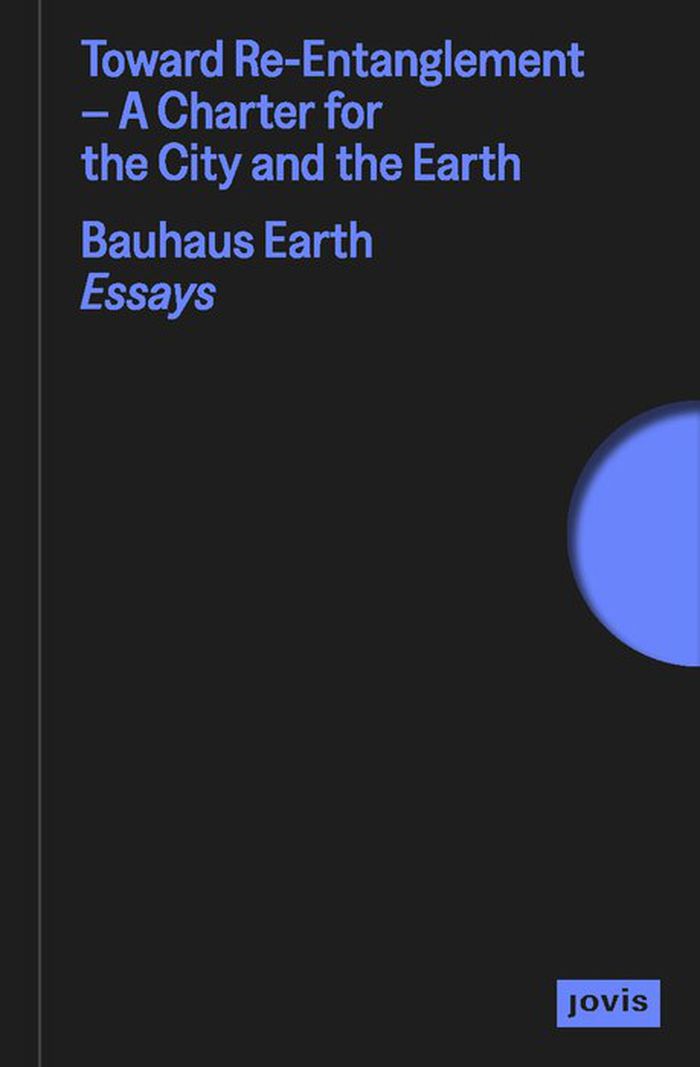
Toward re-entanglement: A charter for the city and the earth
Actions:
Prix:
$12.50
(disponible en magasin)
Résumé:
Recognizing the dire threats of climate collapse and mass extinction, the global initiative Bauhaus Earth convened a team of scientists, architects, spatial planners, and policymakers from around the world to author a manifesto. ''Toward Re-Entanglement: A Charter for the City and the Earth'' is a call for radical transformation. It challenges all those with a role in the conception, production, operation, and governance of the building sector to address the systemic ecological, climatic, and social impacts incurred by its activities. Twelve principles of "re-entanglement" guide the redesign of the entire life cycle of the urban realm: the reforming and rematerializing of the physical artifacts that comprise it, the reconfiguring of the socioeconomic structures that underpin it, and the reengaging of the bioregions that might sustainably supply it. In this way, the unprecedented convergence of the environmental and social crises we are causing offers powerful opportunities for systemic change.
Classification:
livres
livres
Publication:
septembre 2023
septembre 2023
Sujet:
Architecture écologique
Architecture écologique
Classification:
livres
livres
Actions:
Prix:
$53.95
(disponible sur commande)
Résumé:
An essay collection exploring the board game's relationship to the built environment, revealing the unexpected ways that play reflects perceptions of space. Although board games are often recreational objects, their mythologies and infrastructure do not exist in a vacuum—rather, they echo and reproduce prevalent cultural landscapes. This thesis forms the throughline of(...)
Titre:
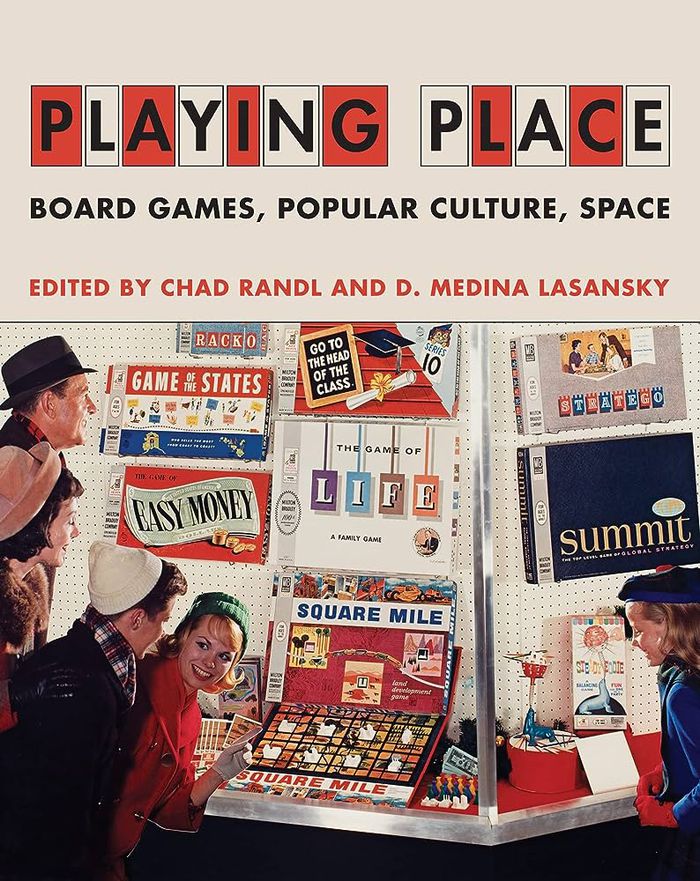
Playing place: Board games, popular culture, space
Actions:
Prix:
$53.95
(disponible sur commande)
Résumé:
An essay collection exploring the board game's relationship to the built environment, revealing the unexpected ways that play reflects perceptions of space. Although board games are often recreational objects, their mythologies and infrastructure do not exist in a vacuum—rather, they echo and reproduce prevalent cultural landscapes. This thesis forms the throughline of pieces reflecting on subjects as diverse as the rigidly gendered fantasies of classic mass-market games; the imperial convictions embedded in games that position player-protagonists as conquerors establishing dominion over their “discoveries”; and even the uncanny prescience of games that have players responding to a global pandemic. Representing a thrilling convergence of historiography, architectural history, and media studies scholarship, Playing Place suggests not only that tabletop games should be taken seriously but also that the medium itself is uniquely capable of facilitating our critical consideration of structures that are often taken for granted.
Classification:
livres
livres
Publication:
août 2023
août 2023
Sujet:
Théorie de l’architecture
Théorie de l’architecture
Classification:
livres
livres

Actions:
Prix:
$59.95
(disponible en magasin)
Résumé:
Lurking under the surface of our modern world lies an unseen architecture—or anarchitecture. It is a possible architecture, an analogous architecture, an architecture of anarchy, which haunts in the form of monsters that are humans and machines and cities all at once; or takes the form of explosions, veils, queer, playful spaces, or visions from artwork and video games.(...)
Titre:
The monster Leviathan: Anarchitecture
Actions:
Prix:
$59.95
(disponible en magasin)
Résumé:
Lurking under the surface of our modern world lies an unseen architecture—or anarchitecture. It is a possible architecture, an analogous architecture, an architecture of anarchy, which haunts in the form of monsters that are humans and machines and cities all at once; or takes the form of explosions, veils, queer, playful spaces, or visions from artwork and video games. In The Monster Leviathan, Aaron Betsky traces anarchitecture through texts, design, and art of the twentieth and early twenty-first century, and suggests that these ephemeral evocations are concrete proposals in and of themselves. Neither working models nor suggestions for new forms, they are scenes just believable enough to convince us they exist, or just fantastical enough to open our eyes.
Classification:
livres
livres
Publication:
décembre 2023
décembre 2023
Sujet:
Théorie de l’architecture
Théorie de l’architecture
Classification:
livres
livres
Actions:
Prix:
$28.95
(disponible sur commande)
Résumé:
In this volume of the Critical Spatial Practice series, Dennis Pohl locates the origin of Europe's dependency on carbon and nuclear power in the postwar architectural designs and energy policies of the European Community. Since the 1950s, architects have proposed territorial, regional, and urban development plans that served the European political project. They(...)
Titre:
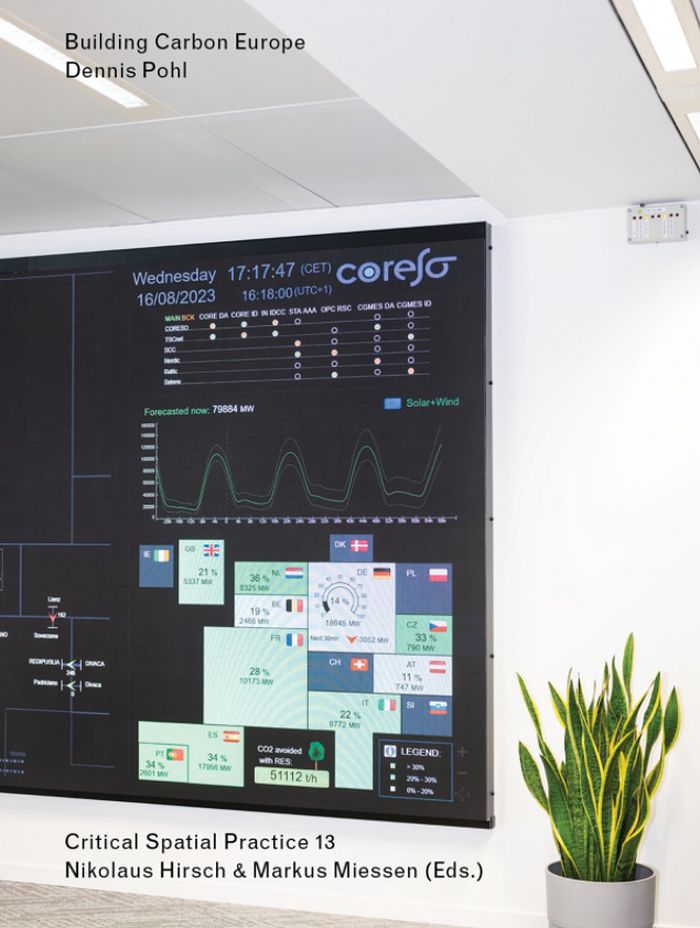
Building carbon europe: Coal, steel and nuclear power. Critical spatial practice
Actions:
Prix:
$28.95
(disponible sur commande)
Résumé:
In this volume of the Critical Spatial Practice series, Dennis Pohl locates the origin of Europe's dependency on carbon and nuclear power in the postwar architectural designs and energy policies of the European Community. Since the 1950s, architects have proposed territorial, regional, and urban development plans that served the European political project. They collaborated with the European Coal and Steel Community in an effort to render the steel building industry as efficient as the car industry; they incorporated the ideas of infinite nuclear energy, as promoted by the European Atomic Energy Community, into their designs. This book demonstrates how architecture served the political economy of postwar Europe as a means of turning coal, steel, and radioactivity into tools of European governance. Architectural design enabled EU institutions to support social policies and worker housing within the coal and steel industry as well as to promote a new pan-European lifestyle based on nuclear energy. In other words, architecture powered Europe's larger infrastructural, economic, and cultural network. Pohl's work not only sheds light on how architecture has contributed to the carbonization of Europe, it also highlights the environmental issue, which challenges both architectural criticism and historiography in the era of the Anthropocene.
Classification:
livres
livres
Publication:
avril 2024
avril 2024
Sujet:
Théorie de l’architecture
Théorie de l’architecture
Classification:
livres
livres
Prix:
$38.95
(disponible en magasin)
Résumé:
This anthology presents work on cultures of assembly. It stresses the relevance of small-scale and decentralized spatial formats of local knowledge production to community building and embedded political decision-making in the context of the socio-ecological transition. It reinforces the role of both individual and collective action while proposing distributed assembly(...)
Titre:
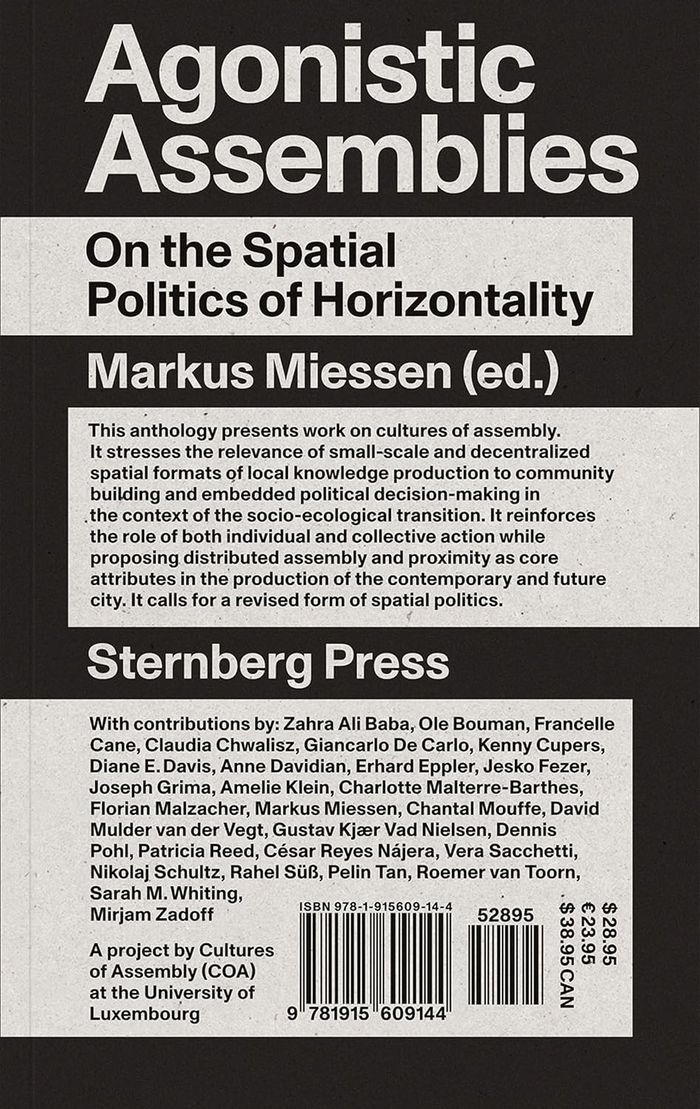
Agonistic assemblies: On the spatial politics of horizontality
Actions:
Prix:
$38.95
(disponible en magasin)
Résumé:
This anthology presents work on cultures of assembly. It stresses the relevance of small-scale and decentralized spatial formats of local knowledge production to community building and embedded political decision-making in the context of the socio-ecological transition. It reinforces the role of both individual and collective action while proposing distributed assembly and proximity as core attributes in the production of the contemporary and future city. It calls for a revised form of spatial politics. "Agonistic assemblies" asks: how can spaces—both physical and virtual—be envisaged to create publics? How is collectivity and society being generated spatially and in terms of policy? How do we “practice” society as a bodily, spatial form, and how does this practice contribute to spatial justice? Are there specific spatial settings that can intensify these practices? What kind of spatial design can we imagine as platforms for change?
Classification:
livres
livres
Publication:
juin 2024
juin 2024
Sujet:
Théorie de l’architecture
Théorie de l’architecture
Classification:
livres
livres
Actions:
Prix:
$25.95
(disponible en magasin)
Résumé:
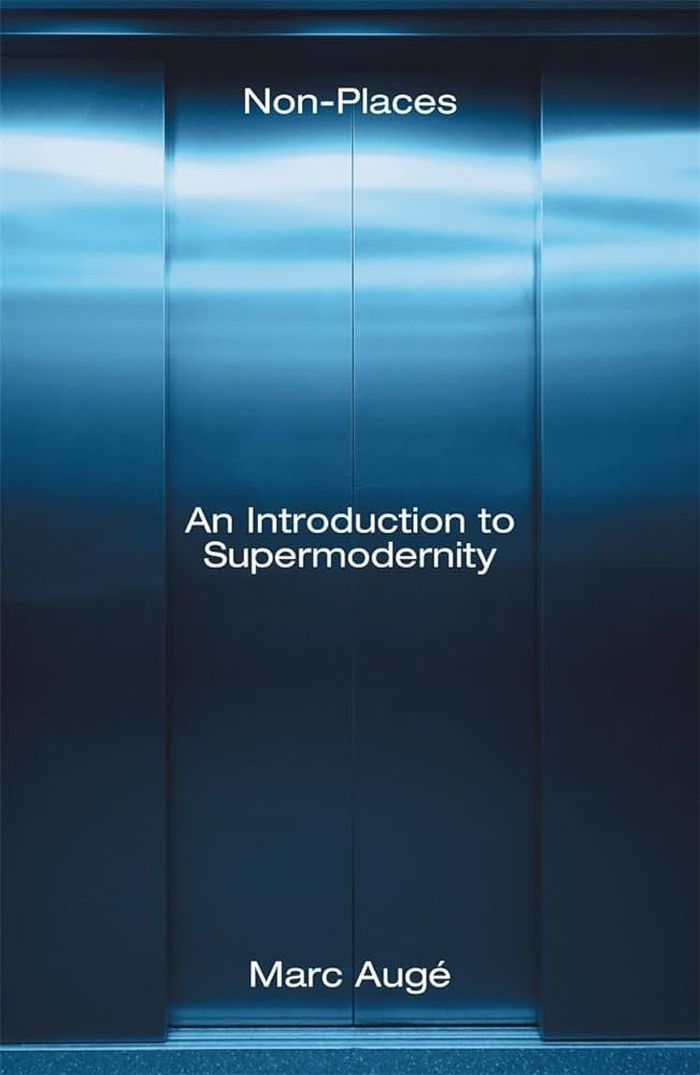
An ever-increasing proportion of our lives is spent in supermarkets, airports and hotels, on motorways or in front of TVs, computer and cash machines. This invasion of the world by what Marc Auge calls 'non-space' results in a profound alteration of awareness: something we perceive, but only in a partial and incoherent manner. Auge uses the concept of 'supermodernity' to(...)
Titre:
Non-places: An introduction to supermodernity
Actions:
Prix:
$25.95
(disponible en magasin)
Résumé:
An ever-increasing proportion of our lives is spent in supermarkets, airports and hotels, on motorways or in front of TVs, computer and cash machines. This invasion of the world by what Marc Auge calls 'non-space' results in a profound alteration of awareness: something we perceive, but only in a partial and incoherent manner. Auge uses the concept of 'supermodernity' to describe the logic of these late-capitalist phenomena - a logic of excessive information and excessive space. In this fascinating and lucid essay he seeks to establish and intellectual armature for an anthropology of supermodernity. Starting with an attempt to disentangle anthropology from history, Auge goes on to map the distinction between place, encrusted with historical monuments and creative social life, and non-place, to which individuals are connected in a uniform manner and where no organic social life is possible.
Classification:
livres
livres
Publication:
novembre 2023
novembre 2023
Sujet:
Théorie de l’architecture
Théorie de l’architecture
Classification:
livres
livres
Actions:
Prix:
$90.00
(disponible en magasin)
Résumé:
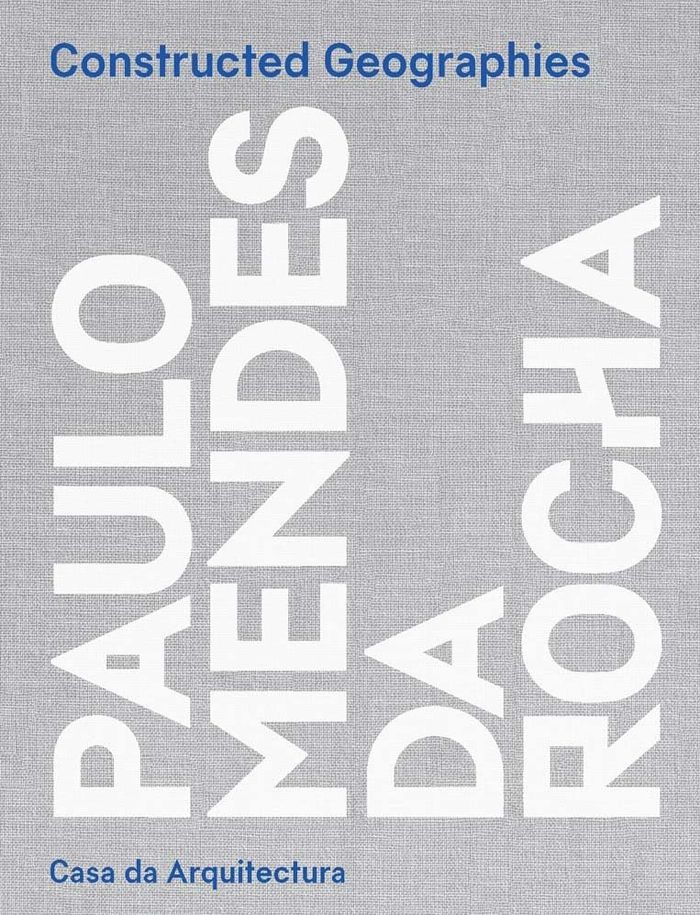
One of the most acclaimed architects working in Brazil since the mid-twentieth century, Paulo Mendes da Rocha (1928–2021) began building in the 1950s, championing an approach often associated with "Brutalism" but expanding well beyond it. This retrospective catalogue is the first major publication on Mendes da Rocha since the establishment of his archive at the Casa da(...)
Sujet:
Architecture, monographies
Architecture, monographies
Publication:
novembre 2024
novembre 2024
Titre:
Constructed geographies: Paulo Mendes da Rocha
Actions:
Prix:
$90.00
(disponible en magasin)
Résumé:
One of the most acclaimed architects working in Brazil since the mid-twentieth century, Paulo Mendes da Rocha (1928–2021) began building in the 1950s, championing an approach often associated with "Brutalism" but expanding well beyond it. This retrospective catalogue is the first major publication on Mendes da Rocha since the establishment of his archive at the Casa da Arquitectura in 2021. A team of international scholars provides a comprehensive view of the architect’s trajectory and the collective dimension of his work, along with thematic essays. Mendes da Rocha’s identity as a South American architect interested in the geographic relation between nature and culture is underlined. The book’s contributors explore his concern with the social and anthropogenic impact of the continent’s development, as well as its colonial past and postcolonial future.
Classification:
livres
livres
Publication:
novembre 2024
novembre 2024
Sujet:
Architecture, monographies
Architecture, monographies
Classification:
livres
livres
Prix:
$89.95
(disponible en magasin)
Résumé:
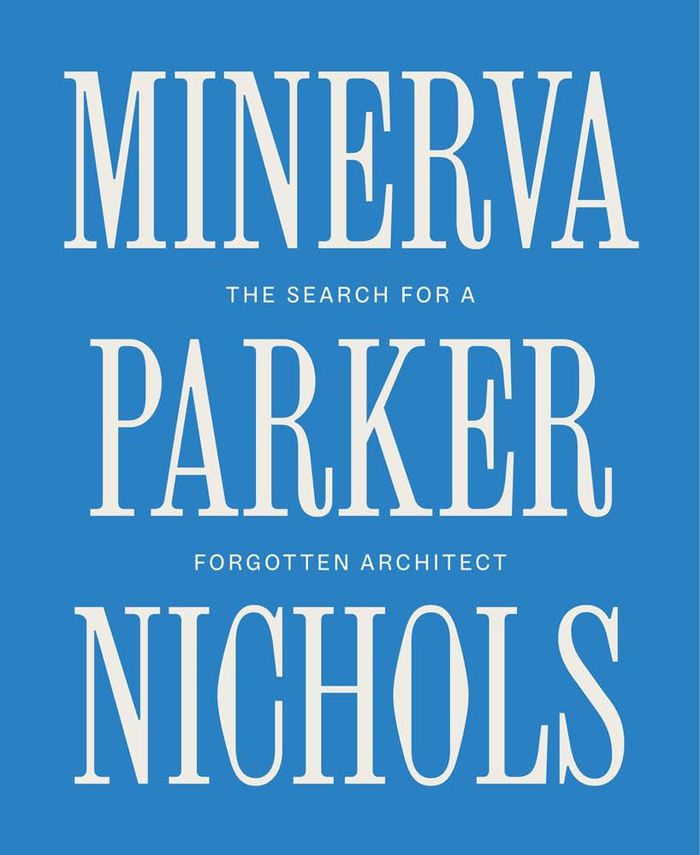
Minerva Parker Nichols (1862–1949) was the first American woman to practice architecture independently. Her specialty was residential spaces—though her commissions also included an iron foundry and a macaroni factory—and she was a significant figure in the design of the emerging railroad towns just outside of Philadelphia, where she was in active practice from 1883 until(...)
Titre:
Minerva Parker Nichols: The search for a forgotten architect
Actions:
Prix:
$89.95
(disponible en magasin)
Résumé:
Minerva Parker Nichols (1862–1949) was the first American woman to practice architecture independently. Her specialty was residential spaces—though her commissions also included an iron foundry and a macaroni factory—and she was a significant figure in the design of the emerging railroad towns just outside of Philadelphia, where she was in active practice from 1883 until 1896. She was also a writer, teacher, and active participant in several reform movements of the era. Creating an archive in the absence of one, this book recovers Nichols’s forgotten story to document a career that spanned seven decades, engaging with contemporary questions about absences in the historical record, the challenges of architectural history and preservation, and the need for new tools and frameworks to address these gaps.
Classification:
livres
livres
Publication:
septembre 2023
septembre 2023
Sujet:
Architecture, monographies
Architecture, monographies


