


782 Résultats
Classification:
livres
livres
Titre:
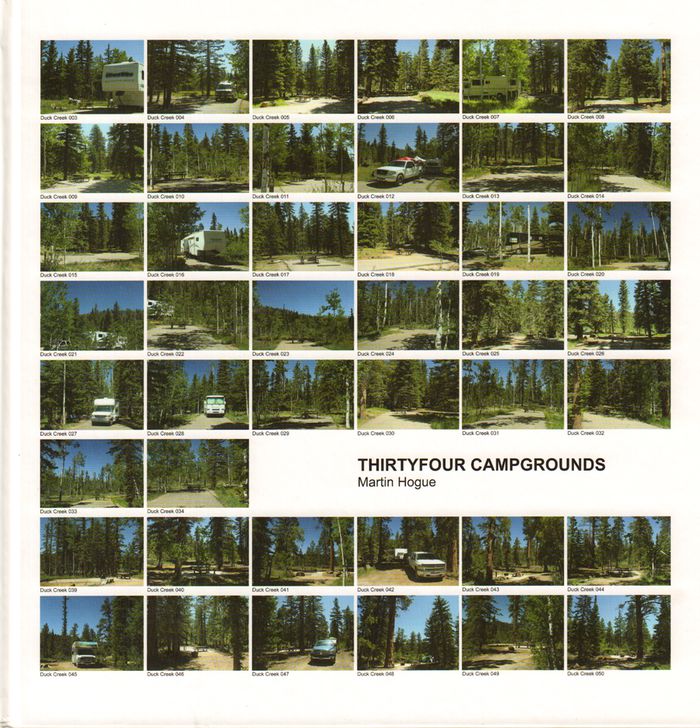
Thirtyfour campgrounds
Thirtyfour campgrounds
Actions:
Prix:
$51.00
(disponible sur commande)
Résumé:
Camping can make us feel a powerful connection to nature and our rugged backwoods forebears. Campers once confronted the elemental facts of life, but now, the millions of Americans taking to the road on camping trips are more likely to drive to a campground, hook up service conduits, connect to WiFi, drop their awnings, and set out patio chairs. It is as if, Martin Hogue(...)
Titre:
Thirtyfour campgrounds
Actions:
Prix:
$51.00
(disponible sur commande)
Résumé:
Camping can make us feel a powerful connection to nature and our rugged backwoods forebears. Campers once confronted the elemental facts of life, but now, the millions of Americans taking to the road on camping trips are more likely to drive to a campground, hook up service conduits, connect to WiFi, drop their awnings, and set out patio chairs. It is as if, Martin Hogue observes, each campsite functions as a stage upon which campers perform a series of ritualized activities (pitching the tent, building a fire, cooking over flames). In Thirtyfour Campgrounds, Hogue investigates these sites, individually and in multiples, offering a photographic and typological survey of nearly 6,500 American campsites, mapping subtle differences within the apparently identical. The central part of the book consists of color photographs of individual campsites, downloaded from such online reservation websites as reserveamerica.com and recreation.gov, organized by zip code, and arranged in grids across the pages. Hogue nods to artist Ed Ruscha's Thirtyfour Parking Lots for his title and its attitude, and to the work of Bernd and Hilla Becher for the serial arrangement of images in grids. The campsite pictures seem at first endlessly repetitious; but then the repetition makes way for difference. Time reveals itself in fading light and passing clouds, the weather changes between photographs of neighboring sites, leaves turn color and fall, in an unexpected kind of time-lapse photography. This is a book that was made so seriously that it must (not) be taken too seriously. More scientific than any campground literature, Thirtyfour Campgrounds calls the very nature of scientific survey, research, and publication into question.
Classification:
livres
livres
Publication:
septembre 2016
septembre 2016
Sujet:
Théorie du paysage
Théorie du paysage
Classification:
livres
livres
Actions:
Prix:
$56.50
(disponible sur commande)
Résumé:
The single-screen movie theaters that punctuated small-town America's main streets and city neighborhoods since the 1920s are all but gone. The well-dressed throng of moviegoers has vanished; the facades are boarded. In "Silent Screens", photographer Michael Putnam captures these once(...)
Publication:
juin 2000, Baltimore
juin 2000, Baltimore
Titre:
Silent screens : the decline and transformation of the American movie theater
Actions:
Prix:
$56.50
(disponible sur commande)
Résumé:
The single-screen movie theaters that punctuated small-town America's main streets and city neighborhoods since the 1920s are all but gone. The well-dressed throng of moviegoers has vanished; the facades are boarded. In "Silent Screens", photographer Michael Putnam captures these once prominent cinemas in decline and transformation. His photographs of abandoned movie houses and forlorn marquees are an elegy to this disappearing cultural icon. In the early 1980s, Putnam began photographing closed theaters, theaters that had been converted to other uses (a church, a swimming pool), theaters on the verge of collapse, theaters being demolished, and even vacant lots where theaters once stood. The result is an archive of images, large in quantity and geographically diffuse. Here is what has become of the Odeons, Strands, and Arcadias that existed as velvet and marble outposts of Hollywood drama next to barbershops, hardware stores, and five-and-dimes. Introduced by Robert Sklar, the starkly beautiful photographs are accompanied by original reminiscences on moviegoing by Peter Bogdanovich, Molly Haskell, Andrew Sarris, and Chester H. Liebs as well as excerpts from the works of poet John Hollander and writers Larry McMurtry and John Updike. Sklar begins by mapping the rise and fall of the local movie house, tracing the demise of small-town theaters to their role as bit players in the grand spectacle of Hollywood film distribution. "Under standard distribution practice," he writes, "a new film took from six months to a year to wend its way from picture palace to Podunk (the prints getting more and more frayed and scratched along the route). Even though the small-town theaters and their urban neighborhood counterparts made up the majority of the nation's movie houses, their significance, in terms of revenue returned to the major motion-picture companies that produced and distributed films, was paltry." In his essay, "Old Dreams," Last Picture Show director Peter Bogdanovich recalls the closing of New York City's great movie palaces -- the mammoth Roxy, the old Paramount near Times Square, the Capitol, and the Mayfair -- and the more innocent time in which they existed "when a quarter often bought you two features, a newsreel, a comedy short, a travelogue, a cartoon, a serial, and coming attractions." While the images in Putnam's book can be read as a metaphor for the death of many downtowns in America, "Silent Screens" goes beyond mere nostalgia to tell the important story of the disappearance of the single-screen theater, illuminating the layers of cultural and economic significance that still surround it.
Classification:
livres
livres
Publication:
juin 2000, Baltimore
juin 2000, Baltimore


