


8417 Résultats
Classification:
livres
livres
Actions:
Prix:
$22.99
(disponible sur commande)
Résumé:
In 1923, a group of young radical German thinkers and intellectuals came together to at Victoria Alle 7, Frankfurt, determined to explain the workings of the modern world. Among the most prominent members of what became the Frankfurt School were the philosophers Walter Benjamin, Theodor Adorno, Max Horkheimer, and Herbert Marcuse. Not only would they change the way we(...)
$22.99
(disponible sur commande)
Résumé:
In 1923, a group of young radical German thinkers and intellectuals came together to at Victoria Alle 7, Frankfurt, determined to explain the workings of the modern world. Among the most prominent members of what became the Frankfurt School were the philosophers Walter Benjamin, Theodor Adorno, Max Horkheimer, and Herbert Marcuse. Not only would they change the way we(...)
Titre:
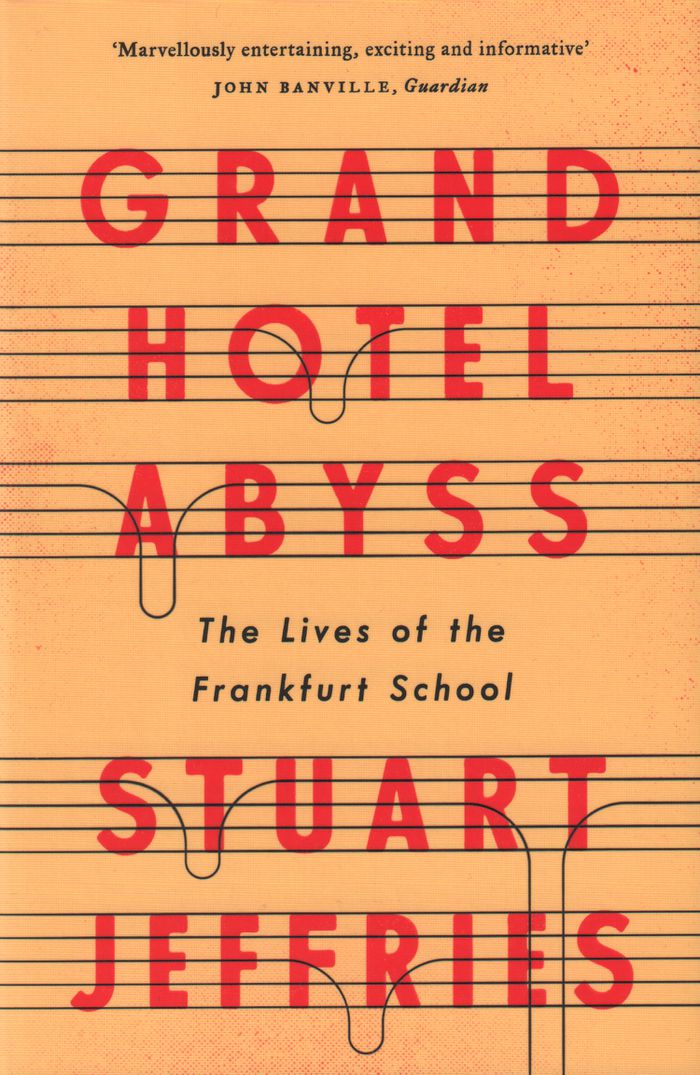
Grand Hotel Abyss: the lives of the Frankfurt school
Actions:
Prix:
$22.99
(disponible sur commande)
Résumé:
In 1923, a group of young radical German thinkers and intellectuals came together to at Victoria Alle 7, Frankfurt, determined to explain the workings of the modern world. Among the most prominent members of what became the Frankfurt School were the philosophers Walter Benjamin, Theodor Adorno, Max Horkheimer, and Herbert Marcuse. Not only would they change the way we think, but also the subjects we deem worthy of intellectual investigation. Their lives, like their ideas, profoundly, sometimes tragically, reflected and shaped the shattering events of the twentieth century. "Grand Hotel Abyss" combines biography, philosophy, and storytelling to reveal how the Frankfurt thinkers gathered in hopes of understanding the politics of culture during the rise of fascism. Some of them, forced to escape the horrors of Nazi Germany, later found exile in the United States. Benjamin, with his last great work—the incomplete Arcades Project—in his suitcase, was arrested in Spain and committed suicide when threatened with deportation to Nazi-occupied France. On the other side of the Atlantic, Adorno failed in his bid to become a Hollywood screenwriter, denounced jazz, and even met Charlie Chaplin in Malibu. After the war, there was a resurgence of interest in the School. From the relative comfort of sun-drenched California, Herbert Marcuse wrote the classic One Dimensional Man, which influenced the 1960s counterculture and thinkers such as Angela Davis; while in a tragic coda, Adorno died from a heart attack following confrontations with student radicals in Berlin. By taking popular culture seriously as an object of study—whether it was film, music, ideas, or consumerism—the Frankfurt School elaborated upon the nature and crisis of our mass-produced, mechanised society. Grand Hotel Abyss shows how much these ideas still tell us about our age of social media and runaway consumption.
Grand Hotel Abyss: the lives of the Frankfurt school
Actions:
Prix:
$22.99
(disponible sur commande)
Résumé:
In 1923, a group of young radical German thinkers and intellectuals came together to at Victoria Alle 7, Frankfurt, determined to explain the workings of the modern world. Among the most prominent members of what became the Frankfurt School were the philosophers Walter Benjamin, Theodor Adorno, Max Horkheimer, and Herbert Marcuse. Not only would they change the way we think, but also the subjects we deem worthy of intellectual investigation. Their lives, like their ideas, profoundly, sometimes tragically, reflected and shaped the shattering events of the twentieth century. "Grand Hotel Abyss" combines biography, philosophy, and storytelling to reveal how the Frankfurt thinkers gathered in hopes of understanding the politics of culture during the rise of fascism. Some of them, forced to escape the horrors of Nazi Germany, later found exile in the United States. Benjamin, with his last great work—the incomplete Arcades Project—in his suitcase, was arrested in Spain and committed suicide when threatened with deportation to Nazi-occupied France. On the other side of the Atlantic, Adorno failed in his bid to become a Hollywood screenwriter, denounced jazz, and even met Charlie Chaplin in Malibu. After the war, there was a resurgence of interest in the School. From the relative comfort of sun-drenched California, Herbert Marcuse wrote the classic One Dimensional Man, which influenced the 1960s counterculture and thinkers such as Angela Davis; while in a tragic coda, Adorno died from a heart attack following confrontations with student radicals in Berlin. By taking popular culture seriously as an object of study—whether it was film, music, ideas, or consumerism—the Frankfurt School elaborated upon the nature and crisis of our mass-produced, mechanised society. Grand Hotel Abyss shows how much these ideas still tell us about our age of social media and runaway consumption.
Classification:
livres
livres
Publication:
septembre 2017
septembre 2017
Sujet:
Théorie/ philosophie
Théorie/ philosophie
Classification:
livres
livres
Titre:
London the biography
London the biography
Actions:
Prix:
$37.95
(disponible sur commande)
Résumé:
Novelist and biographer Ackroyd (The Plato Papers; T.S. Eliot; etc.) offers a huge, enthralling "biography" of the city of London. The reader segues through this litany of lists and anthology of anecdotes via the sketchiest of topical linkages, but no matter not a page is dull, until brief closing chapters in which Ackroyd succumbs to bathos, for which he's(...)
$37.95
(disponible sur commande)
Résumé:
Novelist and biographer Ackroyd (The Plato Papers; T.S. Eliot; etc.) offers a huge, enthralling "biography" of the city of London. The reader segues through this litany of lists and anthology of anecdotes via the sketchiest of topical linkages, but no matter not a page is dull, until brief closing chapters in which Ackroyd succumbs to bathos, for which he's(...)
Titre:
London the biography
Actions:
Prix:
$37.95
(disponible sur commande)
Résumé:
Novelist and biographer Ackroyd (The Plato Papers; T.S. Eliot; etc.) offers a huge, enthralling "biography" of the city of London. The reader segues through this litany of lists and anthology of anecdotes via the sketchiest of topical linkages, but no matter not a page is dull, until brief closing chapters in which Ackroyd succumbs to bathos, for which he's instantaneously redeemed by the preceding chapters. He admits to using no original research, openly crediting his printed sources. Ackroyd examines London from its pre-history through today, artfully selecting, organizing and pacing stories, and rendering the past in witty and imaginative ways. "The opium quarter of Limehouse," he tells readers, for example, "is now represented by a Chinese take-away." Fast food, it seems, was always part of the London scene. When poet Thomas Southey asked a pastry cook why she kept her shop open in the worst weather, she told him that otherwise she would lose business, "so many were the persons who took up buns or biscuits as they passed by and threw their pence in, not allowing themselves time to enter." Ackroyd covers unrest and peace, fires and ruins, river and rail transport, crime and punishment, wealth and poverty, markets and churches, uncontrolled growth and barely controlled filth. If there is a hero among the throngs, it may be engineer Joseph Bazalgette, who in 1855 began building 1,265 miles of sewers to contain the Stygian odor of progress and keep the huge, ugly metropolis livable. No one should mind the extraordinary price of this extraordinary achievement. B illus., maps not seen by PW. (On sale Oct. 16)Forecast: Published to acclaim in England, this is virtually guaranteed major review coverage here, and the publisher will also shoot for national media. Anglophiles and others will rejoice.
London the biography
Actions:
Prix:
$37.95
(disponible sur commande)
Résumé:
Novelist and biographer Ackroyd (The Plato Papers; T.S. Eliot; etc.) offers a huge, enthralling "biography" of the city of London. The reader segues through this litany of lists and anthology of anecdotes via the sketchiest of topical linkages, but no matter not a page is dull, until brief closing chapters in which Ackroyd succumbs to bathos, for which he's instantaneously redeemed by the preceding chapters. He admits to using no original research, openly crediting his printed sources. Ackroyd examines London from its pre-history through today, artfully selecting, organizing and pacing stories, and rendering the past in witty and imaginative ways. "The opium quarter of Limehouse," he tells readers, for example, "is now represented by a Chinese take-away." Fast food, it seems, was always part of the London scene. When poet Thomas Southey asked a pastry cook why she kept her shop open in the worst weather, she told him that otherwise she would lose business, "so many were the persons who took up buns or biscuits as they passed by and threw their pence in, not allowing themselves time to enter." Ackroyd covers unrest and peace, fires and ruins, river and rail transport, crime and punishment, wealth and poverty, markets and churches, uncontrolled growth and barely controlled filth. If there is a hero among the throngs, it may be engineer Joseph Bazalgette, who in 1855 began building 1,265 miles of sewers to contain the Stygian odor of progress and keep the huge, ugly metropolis livable. No one should mind the extraordinary price of this extraordinary achievement. B illus., maps not seen by PW. (On sale Oct. 16)Forecast: Published to acclaim in England, this is virtually guaranteed major review coverage here, and the publisher will also shoot for national media. Anglophiles and others will rejoice.
Classification:
livres
livres
Publication:
septembre 2001, London
septembre 2001, London
Sujet:
Théorie de l’urbanisme
Théorie de l’urbanisme
Classification:
livres
livres
Actions:
Prix:
$71.95
(disponible sur commande)
Résumé:
Although many people view virtual reality as a totally new phenomenon, it has its foundations in an unrecognized history of immersive images. Indeed, the search for illusionary visual space can be traced back to antiquity. In this book Oliver Grau shows how virtual art fits into the art history of illusion and immersion. He describes the metamorphosis of the concepts of(...)
$71.95
(disponible sur commande)
Résumé:
Although many people view virtual reality as a totally new phenomenon, it has its foundations in an unrecognized history of immersive images. Indeed, the search for illusionary visual space can be traced back to antiquity. In this book Oliver Grau shows how virtual art fits into the art history of illusion and immersion. He describes the metamorphosis of the concepts of(...)
Titre:
Virtual art from illusion to immersion
Actions:
Prix:
$71.95
(disponible sur commande)
Résumé:
Although many people view virtual reality as a totally new phenomenon, it has its foundations in an unrecognized history of immersive images. Indeed, the search for illusionary visual space can be traced back to antiquity. In this book Oliver Grau shows how virtual art fits into the art history of illusion and immersion. He describes the metamorphosis of the concepts of art and the image and relates those concepts to interactive art, interface design, agents, telepresence, and image evolution. Grau retells art history as media history, helping us to understand the phenomenon of virtual reality beyond the hype. Grau shows how each epoch used the technical means available to produce maximum illusion. He discusses frescoes such as those in the Villa dei Misteri in Pompeii and the gardens of the Villa Livia near Primaporta, Renaissance and Baroque illusion spaces, and panoramas, which were the most developed form of illusion achieved through traditional methods of painting and the mass image medium before film. Through a detailed analysis of perhaps the most important German panorama, Anton von Werner's 1883 The Battle of Sedan, Grau shows how immersion produced emotional responses. He traces immersive cinema through Cinerama, Sensorama, Expanded Cinema, 3-D, Omnimax and IMAX, and the head mounted display with its military origins. He also examines those characteristics of virtual reality that distinguish it from earlier forms of illusionary art. His analysis draws on the work of contemporary artists and groups ART+COM, Maurice Benayoun, Charlotte Davies, Monika Fleischmann, Ken Goldberg, Agnes Hegedues, Eduardo Kac, Knowbotic Research, Laurent Mignonneau, Michael Naimark, Simon Penny, Daniela Plewe, Paul Sermon, Jeffrey Shaw, Karl Sims, Christa Sommerer, and Wolfgang Strauss. Grau offers not just a history of illusionary space but also a theoretical framework for analyzing its phenomenologies, functions, and strategies throughout history and into the future.
Virtual art from illusion to immersion
Actions:
Prix:
$71.95
(disponible sur commande)
Résumé:
Although many people view virtual reality as a totally new phenomenon, it has its foundations in an unrecognized history of immersive images. Indeed, the search for illusionary visual space can be traced back to antiquity. In this book Oliver Grau shows how virtual art fits into the art history of illusion and immersion. He describes the metamorphosis of the concepts of art and the image and relates those concepts to interactive art, interface design, agents, telepresence, and image evolution. Grau retells art history as media history, helping us to understand the phenomenon of virtual reality beyond the hype. Grau shows how each epoch used the technical means available to produce maximum illusion. He discusses frescoes such as those in the Villa dei Misteri in Pompeii and the gardens of the Villa Livia near Primaporta, Renaissance and Baroque illusion spaces, and panoramas, which were the most developed form of illusion achieved through traditional methods of painting and the mass image medium before film. Through a detailed analysis of perhaps the most important German panorama, Anton von Werner's 1883 The Battle of Sedan, Grau shows how immersion produced emotional responses. He traces immersive cinema through Cinerama, Sensorama, Expanded Cinema, 3-D, Omnimax and IMAX, and the head mounted display with its military origins. He also examines those characteristics of virtual reality that distinguish it from earlier forms of illusionary art. His analysis draws on the work of contemporary artists and groups ART+COM, Maurice Benayoun, Charlotte Davies, Monika Fleischmann, Ken Goldberg, Agnes Hegedues, Eduardo Kac, Knowbotic Research, Laurent Mignonneau, Michael Naimark, Simon Penny, Daniela Plewe, Paul Sermon, Jeffrey Shaw, Karl Sims, Christa Sommerer, and Wolfgang Strauss. Grau offers not just a history of illusionary space but also a theoretical framework for analyzing its phenomenologies, functions, and strategies throughout history and into the future.
Classification:
livres
livres
Publication:
janvier 1900, Cambridge, Mass.
janvier 1900, Cambridge, Mass.
Sujet:
Épistémologie et réseau
Épistémologie et réseau
Classification:
livres
livres
Prix:
$25.95
(disponible sur commande)
Résumé:
Finally, we are learning that simplicity equals sanity. We're rebelling against technology that's too complicated, DVD players with too many menus, and software accompanied by 75-megabyte "read me" manuals. The iPod's clean gadgetry has made simplicity hip. But sometimes we find ourselves caught up in the simplicity paradox: we want something that's simple and easy to(...)
$25.95
(disponible sur commande)
Résumé:
Finally, we are learning that simplicity equals sanity. We're rebelling against technology that's too complicated, DVD players with too many menus, and software accompanied by 75-megabyte "read me" manuals. The iPod's clean gadgetry has made simplicity hip. But sometimes we find ourselves caught up in the simplicity paradox: we want something that's simple and easy to(...)
Titre:
The laws of simplicity : design, technology, business, life
Actions:
Prix:
$25.95
(disponible sur commande)
Résumé:
Finally, we are learning that simplicity equals sanity. We're rebelling against technology that's too complicated, DVD players with too many menus, and software accompanied by 75-megabyte "read me" manuals. The iPod's clean gadgetry has made simplicity hip. But sometimes we find ourselves caught up in the simplicity paradox: we want something that's simple and easy to use, but also does all the complex things we might ever want it to do. In "The laws of simplicity", John Maeda offers ten laws for balancing simplicity and complexity in business, technology, and design -guidelines for needing less and actually getting more. Maeda - a professor in MIT's Media Lab and a world-renowned graphic designer - explores the question of how we can redefine the notion of "improved" so that it doesn't always mean something more, something added on. Maeda's first law of simplicity is "Reduce." It's not necessarily beneficial to add technology features just because we can. And the features that we do have must be organized (Law 2) in a sensible hierarchy so users aren't distracted by features and functions they don't need. But simplicity is not less just for the sake of less. Skip ahead to Law 9: "Failure : accept the fact that some things can never be made simple." Maeda's concise guide to simplicity in the digital age shows us how this idea can be a cornerstone of organizations and their products -how it can drive both business and technology. We can learn to simplify without sacrificing comfort and meaning, and we can achieve the balance described in Law 10. This law, which Maeda calls "The One," tells us: "Simplicity is about subtracting the obvious, and adding the meaningful."
The laws of simplicity : design, technology, business, life
Actions:
Prix:
$25.95
(disponible sur commande)
Résumé:
Finally, we are learning that simplicity equals sanity. We're rebelling against technology that's too complicated, DVD players with too many menus, and software accompanied by 75-megabyte "read me" manuals. The iPod's clean gadgetry has made simplicity hip. But sometimes we find ourselves caught up in the simplicity paradox: we want something that's simple and easy to use, but also does all the complex things we might ever want it to do. In "The laws of simplicity", John Maeda offers ten laws for balancing simplicity and complexity in business, technology, and design -guidelines for needing less and actually getting more. Maeda - a professor in MIT's Media Lab and a world-renowned graphic designer - explores the question of how we can redefine the notion of "improved" so that it doesn't always mean something more, something added on. Maeda's first law of simplicity is "Reduce." It's not necessarily beneficial to add technology features just because we can. And the features that we do have must be organized (Law 2) in a sensible hierarchy so users aren't distracted by features and functions they don't need. But simplicity is not less just for the sake of less. Skip ahead to Law 9: "Failure : accept the fact that some things can never be made simple." Maeda's concise guide to simplicity in the digital age shows us how this idea can be a cornerstone of organizations and their products -how it can drive both business and technology. We can learn to simplify without sacrificing comfort and meaning, and we can achieve the balance described in Law 10. This law, which Maeda calls "The One," tells us: "Simplicity is about subtracting the obvious, and adding the meaningful."
Classification:
livres
livres
Publication:
septembre 2006, Cambridge (MA)
septembre 2006, Cambridge (MA)
Sujet:
Théorie du design
Théorie du design
Classification:
livres
livres
Actions:
Prix:
$31.95
(disponible sur commande)
Résumé:
L'architecture, son évolution comme sa connaissance, dépend en grande partie de la circulation et de la transmission dans l'espace et le temps d'une accumulation d'expériences, de règles ou de modèles. Voilà pourquoi ce livre examine les moyens de communication utilisés par les architectes occidentaux, de Vitruve à l'époque moderne, en montrant comment chaque média influe(...)
$31.95
(disponible sur commande)
Résumé:
L'architecture, son évolution comme sa connaissance, dépend en grande partie de la circulation et de la transmission dans l'espace et le temps d'une accumulation d'expériences, de règles ou de modèles. Voilà pourquoi ce livre examine les moyens de communication utilisés par les architectes occidentaux, de Vitruve à l'époque moderne, en montrant comment chaque média influe(...)
Titre:
L'architecture à l'âge de l'imprimerie
Actions:
Prix:
$31.95
(disponible sur commande)
Résumé:
L'architecture, son évolution comme sa connaissance, dépend en grande partie de la circulation et de la transmission dans l'espace et le temps d'une accumulation d'expériences, de règles ou de modèles. Voilà pourquoi ce livre examine les moyens de communication utilisés par les architectes occidentaux, de Vitruve à l'époque moderne, en montrant comment chaque média influe sur les formes spécifiques de la pensée architecturale et sur les modalités de la diffusion des savoirs.
L'architecture à l'âge de l'imprimerie
Actions:
Prix:
$31.95
(disponible sur commande)
Résumé:
L'architecture, son évolution comme sa connaissance, dépend en grande partie de la circulation et de la transmission dans l'espace et le temps d'une accumulation d'expériences, de règles ou de modèles. Voilà pourquoi ce livre examine les moyens de communication utilisés par les architectes occidentaux, de Vitruve à l'époque moderne, en montrant comment chaque média influe sur les formes spécifiques de la pensée architecturale et sur les modalités de la diffusion des savoirs.
Classification:
livres
livres
Publication:
avril 2009, Paris
avril 2009, Paris
Classification:
livres
livres
Actions:
Prix:
$42.95
(disponible sur commande)
Résumé:
Aaron Swartz était programmeur informatique, essayiste, organisateur politique, et hacker-activiste américain. Adolescent, il était déjà un libre penseur, un programmeur, un écrivain et un militant profondément engagé en faveur de l’accès libre et gratuit à l’information contribuant au bien du public. Élevé dans la banlieue riche de Chicago, il atteint la majorité alors(...)
$42.95
(disponible sur commande)
Résumé:
Aaron Swartz était programmeur informatique, essayiste, organisateur politique, et hacker-activiste américain. Adolescent, il était déjà un libre penseur, un programmeur, un écrivain et un militant profondément engagé en faveur de l’accès libre et gratuit à l’information contribuant au bien du public. Élevé dans la banlieue riche de Chicago, il atteint la majorité alors(...)
Publication:
avril 2017
avril 2017
Titre:
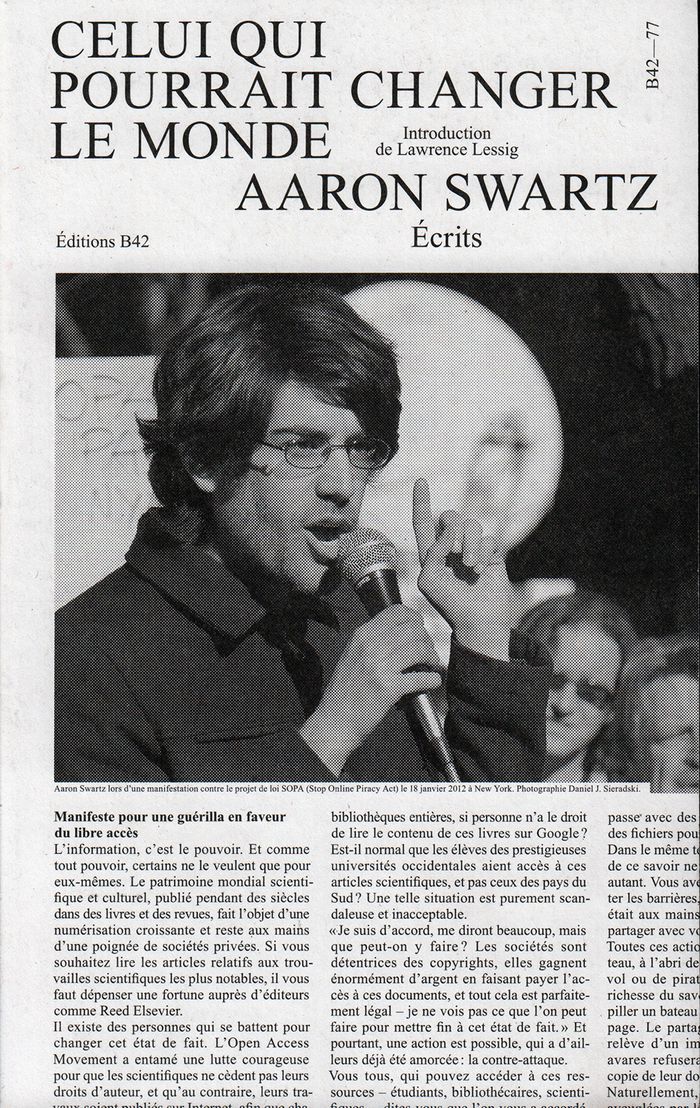
Celui qui pourrait changer le monde : écrits
Actions:
Prix:
$42.95
(disponible sur commande)
Résumé:
Aaron Swartz était programmeur informatique, essayiste, organisateur politique, et hacker-activiste américain. Adolescent, il était déjà un libre penseur, un programmeur, un écrivain et un militant profondément engagé en faveur de l’accès libre et gratuit à l’information contribuant au bien du public. Élevé dans la banlieue riche de Chicago, il atteint la majorité alors que la bataille relative au téléchargement illégal de musique bat son plein. Il devancera à cette occasion grand nombre des questions encore débattues aujourd’hui. Harcelé par le FBI suite au procès attenté à son égard, Aaron Swartz connaît une fin tragique en mettant fin à ses jours à l’âge de 26 ans alors qu’il faisait face à l’opposition entre son idéal de « free culture » et les lois relatives à la propriété intellectuelle aux États-Unis. Étant donné la terrible brièveté de son audacieuse vie intellectuelle "Celui qui pourrait changer le monde" est une remarquable et substantielle collection de ses écrits (articles, essais, conférences), qui soulignent la pluralité des intérêts du jeune homme, de son amour pour le code, à son idéal d’un monde collaboratif et virtuel. On y découvre un personnage curieux de tout, drôle, brillant, radical et visionnaire, mais aussi plein d’autodérision. Le livre est divisé en six chapitres, suivant ses centres d’intérêts : la culture libre, tout d’abord, les ordinateurs, la politique, les media, les livres et la culture et enfin l’éducation. Ses différents combats (pour la culture libre notamment, qui se politisèrent à la fin de sa vie) sont enracinés dans la croyance qu’accéder à la connaissance et la possibilité de l’utiliser constitue le meilleur moyen d’empowerment et de justice. L’activisme multi-facette de Swartz inclue l’orchestration de pétitions massives en ligne contre les lois relatives au droit d’auteur et la lutte contre le piratage. Swartz a également écrit avec passion sur les livres (Kafka et David Foster font partis de ses favoris), les magazines, les films, la musique et l’éducation.
Celui qui pourrait changer le monde : écrits
Actions:
Prix:
$42.95
(disponible sur commande)
Résumé:
Aaron Swartz était programmeur informatique, essayiste, organisateur politique, et hacker-activiste américain. Adolescent, il était déjà un libre penseur, un programmeur, un écrivain et un militant profondément engagé en faveur de l’accès libre et gratuit à l’information contribuant au bien du public. Élevé dans la banlieue riche de Chicago, il atteint la majorité alors que la bataille relative au téléchargement illégal de musique bat son plein. Il devancera à cette occasion grand nombre des questions encore débattues aujourd’hui. Harcelé par le FBI suite au procès attenté à son égard, Aaron Swartz connaît une fin tragique en mettant fin à ses jours à l’âge de 26 ans alors qu’il faisait face à l’opposition entre son idéal de « free culture » et les lois relatives à la propriété intellectuelle aux États-Unis. Étant donné la terrible brièveté de son audacieuse vie intellectuelle "Celui qui pourrait changer le monde" est une remarquable et substantielle collection de ses écrits (articles, essais, conférences), qui soulignent la pluralité des intérêts du jeune homme, de son amour pour le code, à son idéal d’un monde collaboratif et virtuel. On y découvre un personnage curieux de tout, drôle, brillant, radical et visionnaire, mais aussi plein d’autodérision. Le livre est divisé en six chapitres, suivant ses centres d’intérêts : la culture libre, tout d’abord, les ordinateurs, la politique, les media, les livres et la culture et enfin l’éducation. Ses différents combats (pour la culture libre notamment, qui se politisèrent à la fin de sa vie) sont enracinés dans la croyance qu’accéder à la connaissance et la possibilité de l’utiliser constitue le meilleur moyen d’empowerment et de justice. L’activisme multi-facette de Swartz inclue l’orchestration de pétitions massives en ligne contre les lois relatives au droit d’auteur et la lutte contre le piratage. Swartz a également écrit avec passion sur les livres (Kafka et David Foster font partis de ses favoris), les magazines, les films, la musique et l’éducation.
Classification:
livres
livres
Publication:
avril 2017
avril 2017
Classification:
livres
livres
Titre:
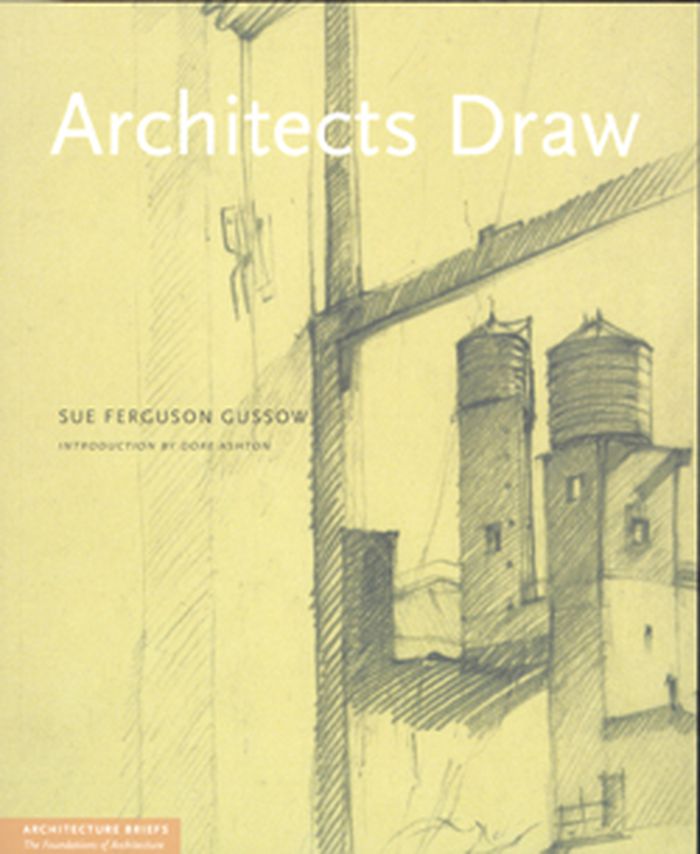
Architects draw
Architects draw
Actions:
Prix:
$27.95
(disponible sur commande)
Résumé:
Architects Draw offers a practical and invaluable way to help students and would-be sketchers translate what they see onto the page, not as an imitation of reality, but as a comprehensive union of voids and solids, light and shadows, lines and shapes. For over forty years revered Cooper Union professor and artist Sue Gussow has taught aspiring architects of varying(...)
$27.95
(disponible sur commande)
Résumé:
Architects Draw offers a practical and invaluable way to help students and would-be sketchers translate what they see onto the page, not as an imitation of reality, but as a comprehensive union of voids and solids, light and shadows, lines and shapes. For over forty years revered Cooper Union professor and artist Sue Gussow has taught aspiring architects of varying(...)
Publication:
juin 2008, New York
juin 2008, New York
Titre:
Architects draw
Actions:
Prix:
$27.95
(disponible sur commande)
Résumé:
Architects Draw offers a practical and invaluable way to help students and would-be sketchers translate what they see onto the page, not as an imitation of reality, but as a comprehensive union of voids and solids, light and shadows, lines and shapes. For over forty years revered Cooper Union professor and artist Sue Gussow has taught aspiring architects of varying abilities how to fully observe and perceive the spaces that make up our physical environment. Gussow skillfully applies architectural language to twenty-five drawing exercises that tackle a variety of forms–from peas in a pod to monkeys, skeletons, dinosaur bones, and the art of Giacometti and Mondrian. She shows, for example, how cut fruit and paper bags reveal that the physical world is made up of planes, dimensions, and enclosed space. Architects Draw features examples from postgraduate architectural practice that explicitly connect drawing to the world of architecture. It also includes a guide to artists' materials, a visual checklist of quick drawing exercises, and other invaluable information that can be detached from the book for quick reference. This unique course provides a solid foundation for anyone interested in using drawing as a visual language to describe architecture. Sue Ferguson Gussow is a figurative painter who works in a wide range of drawing and painting media. A graduate of The Cooper Union, Columbia University, and Tulane University, Gussow has served on the faculties of both the School of Art and The Irwin S. Chanin School of Architecture at The Cooper Union and has taught and lectured at several universities and art institutions, among them Yale, Columbia, Bennington, New York University, Maryland Art Institute, Parsons School of Design and the Frick Collection. Now Professor Emerita of the Irwin S. Chanin School of Architecture of the Cooper Union, she has designed and taught Freehand Drawing for three decades and presently teaches the Advanced Drawing Seminar in the School of Architecture.
Architects draw
Actions:
Prix:
$27.95
(disponible sur commande)
Résumé:
Architects Draw offers a practical and invaluable way to help students and would-be sketchers translate what they see onto the page, not as an imitation of reality, but as a comprehensive union of voids and solids, light and shadows, lines and shapes. For over forty years revered Cooper Union professor and artist Sue Gussow has taught aspiring architects of varying abilities how to fully observe and perceive the spaces that make up our physical environment. Gussow skillfully applies architectural language to twenty-five drawing exercises that tackle a variety of forms–from peas in a pod to monkeys, skeletons, dinosaur bones, and the art of Giacometti and Mondrian. She shows, for example, how cut fruit and paper bags reveal that the physical world is made up of planes, dimensions, and enclosed space. Architects Draw features examples from postgraduate architectural practice that explicitly connect drawing to the world of architecture. It also includes a guide to artists' materials, a visual checklist of quick drawing exercises, and other invaluable information that can be detached from the book for quick reference. This unique course provides a solid foundation for anyone interested in using drawing as a visual language to describe architecture. Sue Ferguson Gussow is a figurative painter who works in a wide range of drawing and painting media. A graduate of The Cooper Union, Columbia University, and Tulane University, Gussow has served on the faculties of both the School of Art and The Irwin S. Chanin School of Architecture at The Cooper Union and has taught and lectured at several universities and art institutions, among them Yale, Columbia, Bennington, New York University, Maryland Art Institute, Parsons School of Design and the Frick Collection. Now Professor Emerita of the Irwin S. Chanin School of Architecture of the Cooper Union, she has designed and taught Freehand Drawing for three decades and presently teaches the Advanced Drawing Seminar in the School of Architecture.
Classification:
livres
livres
Publication:
juin 2008, New York
juin 2008, New York
Classification:
livres
livres
Actions:
Prix:
$20.95
(disponible en magasin)
Résumé:
In December 2006, close to Zurich airport, Opfikerpark was completed after a construction period of 79 weeks. Central element of the park is a concrete sculpture, over 500m-long, accommodating a lake surrounded by sandy beaches and a reed belt. The idea for the design of the park was the result of an international competition initiated in 2001 and won by Berlin practice(...)
$20.95
(disponible en magasin)
Résumé:
In December 2006, close to Zurich airport, Opfikerpark was completed after a construction period of 79 weeks. Central element of the park is a concrete sculpture, over 500m-long, accommodating a lake surrounded by sandy beaches and a reed belt. The idea for the design of the park was the result of an international competition initiated in 2001 and won by Berlin practice(...)
Publication:
juillet 2007, Berlin
juillet 2007, Berlin
Titre:
79 KW Zurich : building Opfikerpark
Actions:
Prix:
$20.95
(disponible en magasin)
Résumé:
In December 2006, close to Zurich airport, Opfikerpark was completed after a construction period of 79 weeks. Central element of the park is a concrete sculpture, over 500m-long, accommodating a lake surrounded by sandy beaches and a reed belt. The idea for the design of the park was the result of an international competition initiated in 2001 and won by Berlin practice Kiefer. As the second exhibition at gallery AedesLand, this project will be introduced in June 2007. Contrary to the usual approach, the exhibition does not aim to present an already completed construction but rather make transparent the process of creation and realization of the building project ‘opfikerpark’. The efforts and challenges to create a complex and outstanding structure, which were faced by client, planners, engineers as well as executing contractors, shall be recorded in a commented illustration of the construction work. Building sites are temporary production sites involving a multitude of disciplines and trades which need to be coordinated. The exhibition reflects the progressing technological, organizational and design process as well as the objective and subjective influences in effect and thus aims to convey a realistic image of the building activities. Photographer Hanns Joosten has documented the construction progress at regular intervals. His high-quality, large-scale images communicate the special aesthetics of a building site in all its diversity and affect the atmosphere of the exhibition. The whole exhibition space will be part of the exhibition, even floors and ceilings. In addition, a media installation explains the progress of constructing Opfikerpark where viewpoints of diverse disciplines and participants meet. The players get a chance to speak and express their personal perspective on the building process with spoken commentaries. How is a large park constructed? How does a building site work? What do you need so many planners for? And how do they work together? Based on these questions, spontaneous contributions shall throw a critical and ironic light on the expert discourse.
79 KW Zurich : building Opfikerpark
Actions:
Prix:
$20.95
(disponible en magasin)
Résumé:
In December 2006, close to Zurich airport, Opfikerpark was completed after a construction period of 79 weeks. Central element of the park is a concrete sculpture, over 500m-long, accommodating a lake surrounded by sandy beaches and a reed belt. The idea for the design of the park was the result of an international competition initiated in 2001 and won by Berlin practice Kiefer. As the second exhibition at gallery AedesLand, this project will be introduced in June 2007. Contrary to the usual approach, the exhibition does not aim to present an already completed construction but rather make transparent the process of creation and realization of the building project ‘opfikerpark’. The efforts and challenges to create a complex and outstanding structure, which were faced by client, planners, engineers as well as executing contractors, shall be recorded in a commented illustration of the construction work. Building sites are temporary production sites involving a multitude of disciplines and trades which need to be coordinated. The exhibition reflects the progressing technological, organizational and design process as well as the objective and subjective influences in effect and thus aims to convey a realistic image of the building activities. Photographer Hanns Joosten has documented the construction progress at regular intervals. His high-quality, large-scale images communicate the special aesthetics of a building site in all its diversity and affect the atmosphere of the exhibition. The whole exhibition space will be part of the exhibition, even floors and ceilings. In addition, a media installation explains the progress of constructing Opfikerpark where viewpoints of diverse disciplines and participants meet. The players get a chance to speak and express their personal perspective on the building process with spoken commentaries. How is a large park constructed? How does a building site work? What do you need so many planners for? And how do they work together? Based on these questions, spontaneous contributions shall throw a critical and ironic light on the expert discourse.
Classification:
livres
livres
Publication:
juillet 2007, Berlin
juillet 2007, Berlin
Classification:
livres
livres
Actions:
Exemplaires:
Description:
xix, 396 pages : illustrations, maps, plans ; 24 cm.
Description:
xix, 396 pages : illustrations, maps, plans ; 24 cm.
Auteur:
Sujet:
Publication:
New York, New York : Cambridge University Press, 2010., ©2010
New York, New York : Cambridge University Press, 2010., ©2010
Titre:
The ancient Indus : urbanism, economy, and society / Rita P. Wright.
Actions:
Exemplaires:
Description:
xix, 396 pages : illustrations, maps, plans ; 24 cm.
The ancient Indus : urbanism, economy, and society / Rita P. Wright.
Actions:
Exemplaires:
Description:
xix, 396 pages : illustrations, maps, plans ; 24 cm.
Classification:
livres
livres
Publication:
New York, New York : Cambridge University Press, 2010., ©2010
New York, New York : Cambridge University Press, 2010., ©2010
Auteur:
Sujet:
Classification:
livres
livres
Titre:
Loving the High Line
Loving the High Line
Actions:
Prix:
$20.00
(disponible sur commande)
Résumé:
As an elevated rail line, designed to lift freight trains serving the Hudson River docks above street level circulation, The High Line was originally constructed as material infrastructure for an industrial city. It was closed in 1960s and stood abandoned for the next forty years. In this time organic debris accumulated and decayed, and seeds landed on the newly forming(...)
$20.00
(disponible sur commande)
Résumé:
As an elevated rail line, designed to lift freight trains serving the Hudson River docks above street level circulation, The High Line was originally constructed as material infrastructure for an industrial city. It was closed in 1960s and stood abandoned for the next forty years. In this time organic debris accumulated and decayed, and seeds landed on the newly forming(...)
Titre:
Loving the High Line
Actions:
Prix:
$20.00
(disponible sur commande)
Résumé:
As an elevated rail line, designed to lift freight trains serving the Hudson River docks above street level circulation, The High Line was originally constructed as material infrastructure for an industrial city. It was closed in 1960s and stood abandoned for the next forty years. In this time organic debris accumulated and decayed, and seeds landed on the newly forming soil creating a meadow on the derelict railbed. This microcosmic biome then also became a heterotopic, other space, in the social ecology of the city as an efflorescence of new art forms and underground subcultures flourished in the evacuated post-industrial spaces of Chelsea. These processes would unfold as New York City was being transformed into a global center in an emerging political-economy defined by the integration of finance capital with media and information industries. In this, marginal spaces of the kind that developed in Chelsea, and the cultures that create them, became important sources of new aesthetic and cultural innovation, that offer an exploitable social ground from which to extract semiotic value. As the Bloomberg administration gave shape to this new regime, a project was initiated to convert the High Line into a publicly accessible, linear park. This would be realized through a convoluted process in which the manifold tensions and contradictions of the postmodern city would be dramatically played out and the disjunctions between ideal image regimes and the reality of the material substrates that support them would be brought to light, if only to be newly obscured. The High Line urban park has been both heralded as a definitive model for new urban development, and denounced as a driver, or at least a morbid symptom, of devastating gentrification, and the destructive financialization of urban space. This text, originally published in 2015 as part of the Deconstructing the High Line anthology, edited by Mark Linder and Brian Rosa, tracks a collection of interconnected historical treads that converge in the reconstruction of the High Line, and situates the project within architectural discourse and practice, and social and material conditions with which it struggles to engage.
Loving the High Line
Actions:
Prix:
$20.00
(disponible sur commande)
Résumé:
As an elevated rail line, designed to lift freight trains serving the Hudson River docks above street level circulation, The High Line was originally constructed as material infrastructure for an industrial city. It was closed in 1960s and stood abandoned for the next forty years. In this time organic debris accumulated and decayed, and seeds landed on the newly forming soil creating a meadow on the derelict railbed. This microcosmic biome then also became a heterotopic, other space, in the social ecology of the city as an efflorescence of new art forms and underground subcultures flourished in the evacuated post-industrial spaces of Chelsea. These processes would unfold as New York City was being transformed into a global center in an emerging political-economy defined by the integration of finance capital with media and information industries. In this, marginal spaces of the kind that developed in Chelsea, and the cultures that create them, became important sources of new aesthetic and cultural innovation, that offer an exploitable social ground from which to extract semiotic value. As the Bloomberg administration gave shape to this new regime, a project was initiated to convert the High Line into a publicly accessible, linear park. This would be realized through a convoluted process in which the manifold tensions and contradictions of the postmodern city would be dramatically played out and the disjunctions between ideal image regimes and the reality of the material substrates that support them would be brought to light, if only to be newly obscured. The High Line urban park has been both heralded as a definitive model for new urban development, and denounced as a driver, or at least a morbid symptom, of devastating gentrification, and the destructive financialization of urban space. This text, originally published in 2015 as part of the Deconstructing the High Line anthology, edited by Mark Linder and Brian Rosa, tracks a collection of interconnected historical treads that converge in the reconstruction of the High Line, and situates the project within architectural discourse and practice, and social and material conditions with which it struggles to engage.
Classification:
livres
livres
Publication:
novembre 2022
novembre 2022
Sujet:
Paysages urbains
Paysages urbains


