


960 Résultats
Classification:
livres
livres
Actions:
Prix:
$32.95
(disponible sur commande)
Résumé:
Uniting eighteen leading critics in early modern literary studies, this volume explores book history and the material text. The essays incorporate a broad range of subjects, such as gender and sexuality, religion, postcolonial theory, political and economic history, adaptation and appropriation, historical formalism, and digital humanities. With essays on Shakespeare,(...)
$32.95
(disponible sur commande)
Résumé:
Uniting eighteen leading critics in early modern literary studies, this volume explores book history and the material text. The essays incorporate a broad range of subjects, such as gender and sexuality, religion, postcolonial theory, political and economic history, adaptation and appropriation, historical formalism, and digital humanities. With essays on Shakespeare,(...)
Publication:
août 2016
août 2016
Titre:
The book in history, the book as history
Actions:
Prix:
$32.95
(disponible sur commande)
Résumé:
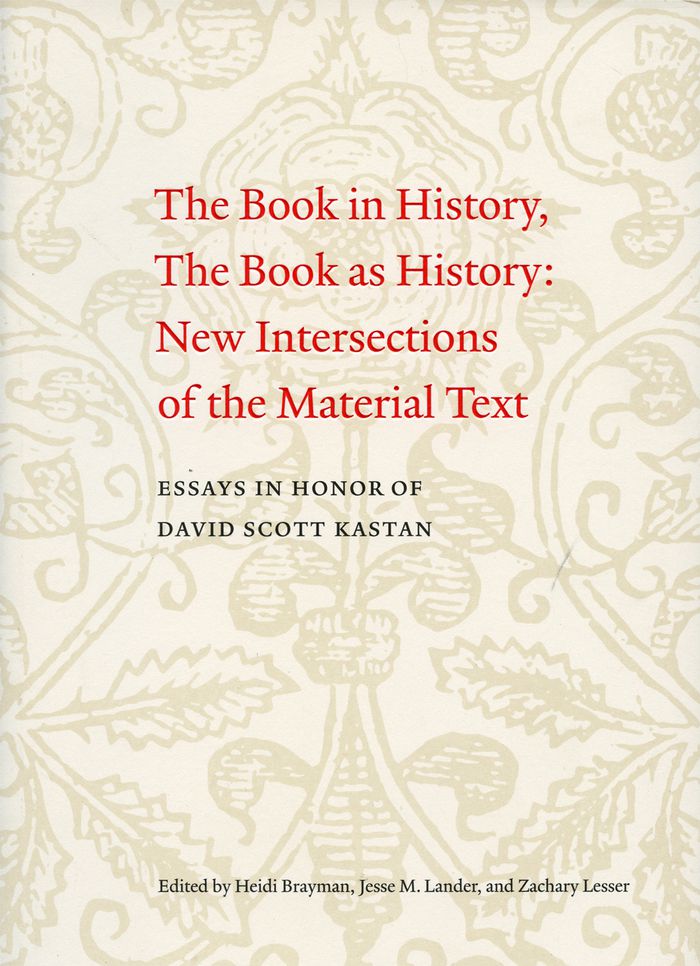
Uniting eighteen leading critics in early modern literary studies, this volume explores book history and the material text. The essays incorporate a broad range of subjects, such as gender and sexuality, religion, postcolonial theory, political and economic history, adaptation and appropriation, historical formalism, and digital humanities. With essays on Shakespeare, Spenser, Milton, and others, this volume makes early modern literary studies and book history accessible and will be a core resource in the field for years to come.
The book in history, the book as history
Actions:
Prix:
$32.95
(disponible sur commande)
Résumé:
Uniting eighteen leading critics in early modern literary studies, this volume explores book history and the material text. The essays incorporate a broad range of subjects, such as gender and sexuality, religion, postcolonial theory, political and economic history, adaptation and appropriation, historical formalism, and digital humanities. With essays on Shakespeare, Spenser, Milton, and others, this volume makes early modern literary studies and book history accessible and will be a core resource in the field for years to come.
Classification:
livres
livres
Publication:
août 2016
août 2016
Classification:
livres
livres
Actions:
Prix:
$52.95
(disponible sur commande)
Résumé:
The normative order and authoritarian use of conventional archives has long been criticised. This volume investigates the digitally informed transformation and multiplication of archives today, in conjunction with the increase in both accessibility and the amount of data produced, stored, and circulated. Despite improved search capabilities, documents, photographs, and(...)
$52.95
(disponible sur commande)
Résumé:
The normative order and authoritarian use of conventional archives has long been criticised. This volume investigates the digitally informed transformation and multiplication of archives today, in conjunction with the increase in both accessibility and the amount of data produced, stored, and circulated. Despite improved search capabilities, documents, photographs, and(...)
Titre:
Order and collapse: the lives of archives
Actions:
Prix:
$52.95
(disponible sur commande)
Résumé:
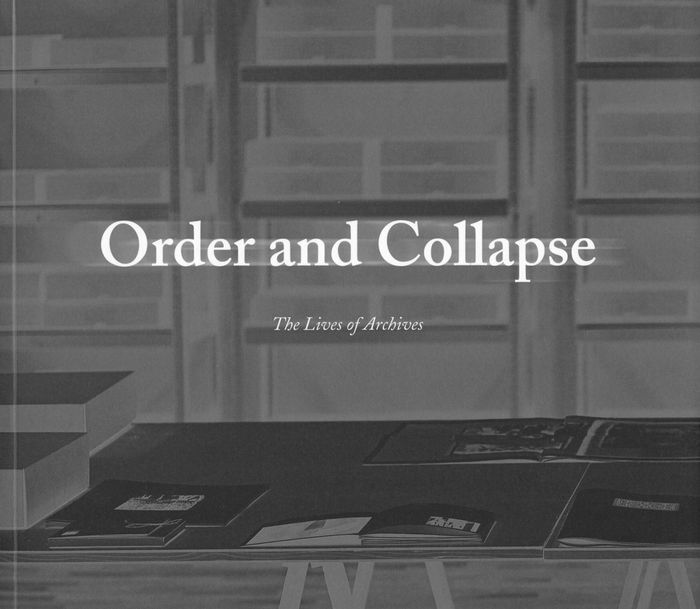
The normative order and authoritarian use of conventional archives has long been criticised. This volume investigates the digitally informed transformation and multiplication of archives today, in conjunction with the increase in both accessibility and the amount of data produced, stored, and circulated. Despite improved search capabilities, documents, photographs, and other images are in danger of vanishing. Yet new knowledge, connotations, and materialities are also emerging. Through various texts and artworks, a selection of contemporary artistic and research-based approaches to existing archives, the act of collecting images, and creating new archives is represented.
Order and collapse: the lives of archives
Actions:
Prix:
$52.95
(disponible sur commande)
Résumé:
The normative order and authoritarian use of conventional archives has long been criticised. This volume investigates the digitally informed transformation and multiplication of archives today, in conjunction with the increase in both accessibility and the amount of data produced, stored, and circulated. Despite improved search capabilities, documents, photographs, and other images are in danger of vanishing. Yet new knowledge, connotations, and materialities are also emerging. Through various texts and artworks, a selection of contemporary artistic and research-based approaches to existing archives, the act of collecting images, and creating new archives is represented.
Classification:
livres
livres
Publication:
août 2016
août 2016
Classification:
livres
livres
Prix:
$45.95
(disponible en magasin)
Résumé:
Nous entrons dans « l’ère post-numérique », les technologies du numérique ne sont plus perçues comme un phénomène révolutionnaire, mais plutôt comme faisant partie intégrante de notre quotidien. La mutation de l’industrie de la musique et du cinéma, où les fichiers circulent en « bits et octets » via les téléchargements et le streaming, est désormais tenue pour acquise.(...)
$45.95
(disponible en magasin)
Résumé:
Nous entrons dans « l’ère post-numérique », les technologies du numérique ne sont plus perçues comme un phénomène révolutionnaire, mais plutôt comme faisant partie intégrante de notre quotidien. La mutation de l’industrie de la musique et du cinéma, où les fichiers circulent en « bits et octets » via les téléchargements et le streaming, est désormais tenue pour acquise.(...)
Titre:
Post-digital print : la mutation de l'édition depuis 1984
Actions:
Prix:
$45.95
(disponible en magasin)
Résumé:
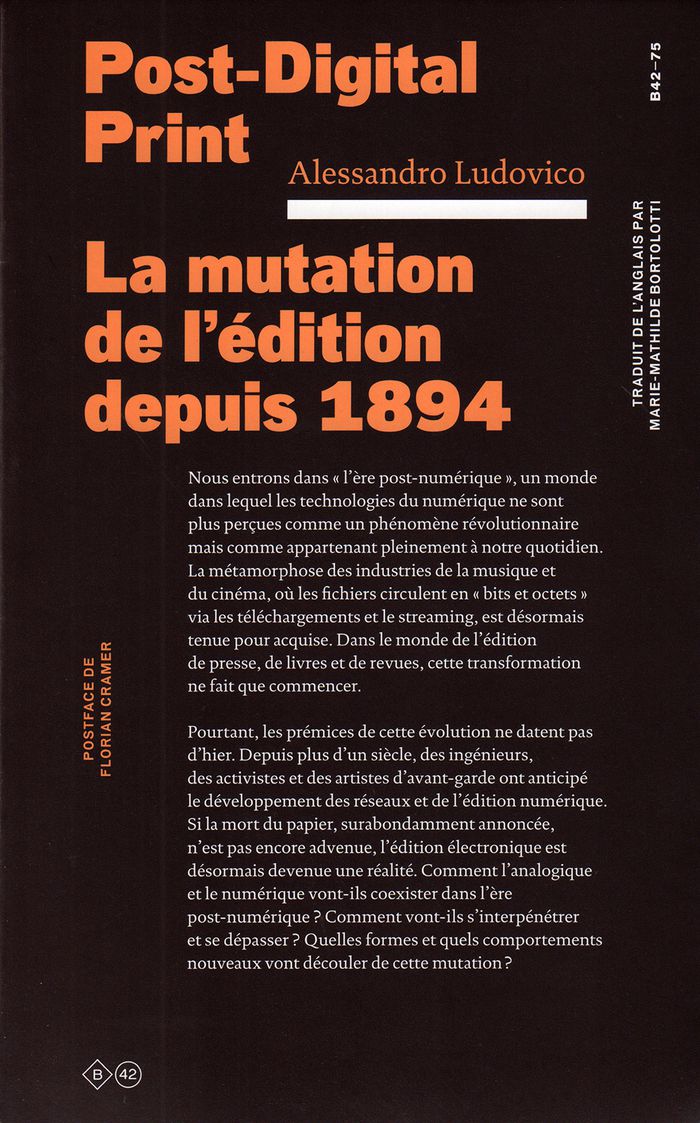
Nous entrons dans « l’ère post-numérique », les technologies du numérique ne sont plus perçues comme un phénomène révolutionnaire, mais plutôt comme faisant partie intégrante de notre quotidien. La mutation de l’industrie de la musique et du cinéma, où les fichiers circulent en « bits et octets » via les téléchargements et le streaming, est désormais tenue pour acquise. Cependant, dans le monde de l’édition de livres et de revues, cette transformation ne fait que commencer. Pourtant, les prémices de cette mutation sont loin d’être récents. Depuis plus d’un siècle, des artistes d’avant-garde, des activistes et des ingénieurs ont anticipé le développement des réseaux et de l’édition numérique. Bien que la mort annoncée du papier ait été largement exagérée, l’édition numérique est désormais devenue une réalité. Comment l’analogique et le numérique vont-ils coexister dans l’ère post-numérique ? Comment vont-ils s’entrecroiser, se mélanger et se dépasser ? Dans ce livre, Alessandro Ludovico repense l’histoire de la technologie des médias, de l’activisme culturel et des arts d’avant-garde comme une préhistoire de la soi-disant dichotomie entre papier et numérique.
Post-digital print : la mutation de l'édition depuis 1984
Actions:
Prix:
$45.95
(disponible en magasin)
Résumé:
Nous entrons dans « l’ère post-numérique », les technologies du numérique ne sont plus perçues comme un phénomène révolutionnaire, mais plutôt comme faisant partie intégrante de notre quotidien. La mutation de l’industrie de la musique et du cinéma, où les fichiers circulent en « bits et octets » via les téléchargements et le streaming, est désormais tenue pour acquise. Cependant, dans le monde de l’édition de livres et de revues, cette transformation ne fait que commencer. Pourtant, les prémices de cette mutation sont loin d’être récents. Depuis plus d’un siècle, des artistes d’avant-garde, des activistes et des ingénieurs ont anticipé le développement des réseaux et de l’édition numérique. Bien que la mort annoncée du papier ait été largement exagérée, l’édition numérique est désormais devenue une réalité. Comment l’analogique et le numérique vont-ils coexister dans l’ère post-numérique ? Comment vont-ils s’entrecroiser, se mélanger et se dépasser ? Dans ce livre, Alessandro Ludovico repense l’histoire de la technologie des médias, de l’activisme culturel et des arts d’avant-garde comme une préhistoire de la soi-disant dichotomie entre papier et numérique.
Classification:
livres
livres
Publication:
janvier 2017
janvier 2017
Classification:
livres
livres

Prix:
$28.00
(disponible sur commande)
Résumé:
When we speak of clouds these days, it is as likely that we mean data clouds or network clouds as cumulus or stratus. In their sharing of the term, both kinds of clouds reveal an essential truth: that the natural world and the technological world are not so distinct. In The Marvelous Clouds, John Durham Peters argues that though we often think of media as environments,(...)
$28.00
(disponible sur commande)
Résumé:
When we speak of clouds these days, it is as likely that we mean data clouds or network clouds as cumulus or stratus. In their sharing of the term, both kinds of clouds reveal an essential truth: that the natural world and the technological world are not so distinct. In The Marvelous Clouds, John Durham Peters argues that though we often think of media as environments,(...)
Titre:
The marvelous clouds: toward a philosophy of elemental media
Actions:
Prix:
$28.00
(disponible sur commande)
Résumé:
When we speak of clouds these days, it is as likely that we mean data clouds or network clouds as cumulus or stratus. In their sharing of the term, both kinds of clouds reveal an essential truth: that the natural world and the technological world are not so distinct. In The Marvelous Clouds, John Durham Peters argues that though we often think of media as environments, the reverse is just as true—environments are media.
The marvelous clouds: toward a philosophy of elemental media
Actions:
Prix:
$28.00
(disponible sur commande)
Résumé:
When we speak of clouds these days, it is as likely that we mean data clouds or network clouds as cumulus or stratus. In their sharing of the term, both kinds of clouds reveal an essential truth: that the natural world and the technological world are not so distinct. In The Marvelous Clouds, John Durham Peters argues that though we often think of media as environments, the reverse is just as true—environments are media.
Classification:
livres
livres
Publication:
août 2016
août 2016
Classification:
livres
livres
Prix:
$34.50
(disponible sur commande)
Résumé:
Archives are collections of records that are preserved for historical, cultural and evidentiary purposes. As such, archives are considered as sites of a past, places that contain traces of a collective memory of a nation, a people or a group. Digital archives have changed from stable entities into flexible systems, at times referred to with the term ‘Living Archives’. In(...)
$34.50
(disponible sur commande)
Résumé:
Archives are collections of records that are preserved for historical, cultural and evidentiary purposes. As such, archives are considered as sites of a past, places that contain traces of a collective memory of a nation, a people or a group. Digital archives have changed from stable entities into flexible systems, at times referred to with the term ‘Living Archives’. In(...)
Titre:
Lost and living (in) archives collectively shaping new memories
Actions:
Prix:
$34.50
(disponible sur commande)
Résumé:
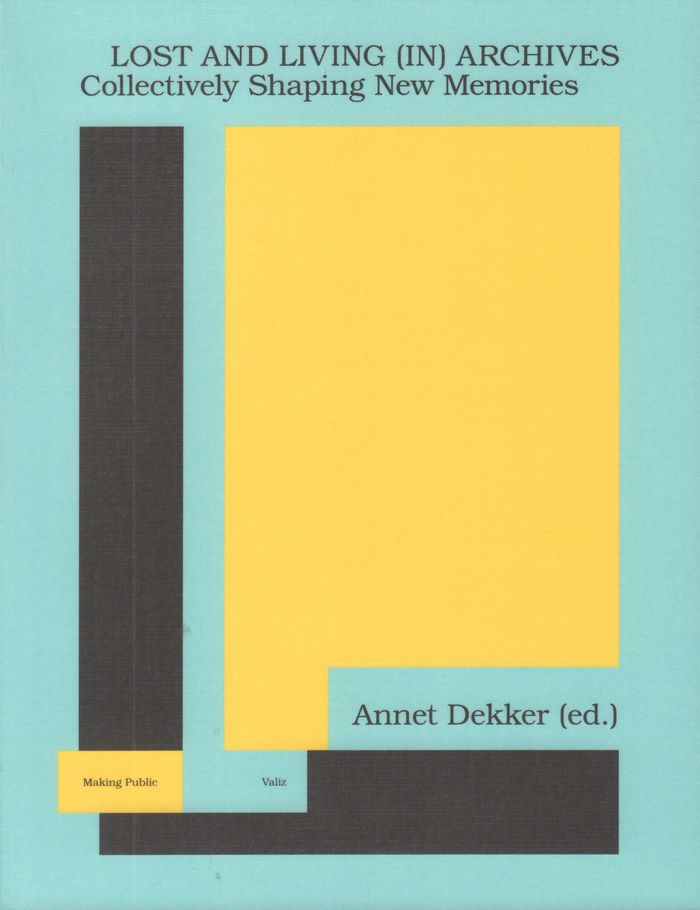
Archives are collections of records that are preserved for historical, cultural and evidentiary purposes. As such, archives are considered as sites of a past, places that contain traces of a collective memory of a nation, a people or a group. Digital archives have changed from stable entities into flexible systems, at times referred to with the term ‘Living Archives’. In which ways has this change affected our relationship to the past? Will the erased, forgotten and neglected be redeemed, and new memories be allowed? Will the fictional versus factual mode of archiving offer the democracy that the public domain implies, or is it another way for public instruments of power to operate? Lost and Living (in) Archives shows that archives are not simply a recording, a reflection, or an image of an event, but that THEY shape the event itself and thus influence the past, present and future.
Lost and living (in) archives collectively shaping new memories
Actions:
Prix:
$34.50
(disponible sur commande)
Résumé:
Archives are collections of records that are preserved for historical, cultural and evidentiary purposes. As such, archives are considered as sites of a past, places that contain traces of a collective memory of a nation, a people or a group. Digital archives have changed from stable entities into flexible systems, at times referred to with the term ‘Living Archives’. In which ways has this change affected our relationship to the past? Will the erased, forgotten and neglected be redeemed, and new memories be allowed? Will the fictional versus factual mode of archiving offer the democracy that the public domain implies, or is it another way for public instruments of power to operate? Lost and Living (in) Archives shows that archives are not simply a recording, a reflection, or an image of an event, but that THEY shape the event itself and thus influence the past, present and future.
Classification:
livres
livres
Publication:
novembre 2017
novembre 2017
Classification:
livres
livres
Titre:
Digital cultures
Digital cultures
Actions:
Prix:
$26.00
(disponible sur commande)
Résumé:
Writing accessibly about the underlying technology, Doueihi explores the multidimensional question of what it means to participate in online culture—from literacy and citizenship to texts, archiving, and storage. By bringing together topics explored separately elsewhere—such as copyright, digital subjectivity, and social networks—Digital Cultures offers a comprehensive(...)
$26.00
(disponible sur commande)
Résumé:
Writing accessibly about the underlying technology, Doueihi explores the multidimensional question of what it means to participate in online culture—from literacy and citizenship to texts, archiving, and storage. By bringing together topics explored separately elsewhere—such as copyright, digital subjectivity, and social networks—Digital Cultures offers a comprehensive(...)
Titre:
Digital cultures
Actions:
Prix:
$26.00
(disponible sur commande)
Résumé:
Writing accessibly about the underlying technology, Doueihi explores the multidimensional question of what it means to participate in online culture—from literacy and citizenship to texts, archiving, and storage. By bringing together topics explored separately elsewhere—such as copyright, digital subjectivity, and social networks—Digital Cultures offers a comprehensive view of the emerging digital space.
Digital cultures
Actions:
Prix:
$26.00
(disponible sur commande)
Résumé:
Writing accessibly about the underlying technology, Doueihi explores the multidimensional question of what it means to participate in online culture—from literacy and citizenship to texts, archiving, and storage. By bringing together topics explored separately elsewhere—such as copyright, digital subjectivity, and social networks—Digital Cultures offers a comprehensive view of the emerging digital space.
Classification:
livres
livres
Publication:
mars 2011
mars 2011
Classification:
livres
livres
Actions:
Prix:
$31.00
(disponible sur commande)
Résumé:
Today on almost every desk in every office sits a computer. Eighty years ago, desktops were equipped with a nonelectronic data processing machine: a card file. In this publication, Markus Krajewski traces the evolution of this proto-computer of rearrangeable parts (file cards) that became ubiquitous in offices between the world wars. The story begins with Konrad(...)
$31.00
(disponible sur commande)
Résumé:
Today on almost every desk in every office sits a computer. Eighty years ago, desktops were equipped with a nonelectronic data processing machine: a card file. In this publication, Markus Krajewski traces the evolution of this proto-computer of rearrangeable parts (file cards) that became ubiquitous in offices between the world wars. The story begins with Konrad(...)
Titre:
Paper machines : about cards & catalogs, 1548-1929
Actions:
Prix:
$31.00
(disponible sur commande)
Résumé:
Today on almost every desk in every office sits a computer. Eighty years ago, desktops were equipped with a nonelectronic data processing machine: a card file. In this publication, Markus Krajewski traces the evolution of this proto-computer of rearrangeable parts (file cards) that became ubiquitous in offices between the world wars. The story begins with Konrad Gessner, a sixteenth-century Swiss polymath who described a new method of processing data: to cut up a sheet of handwritten notes into slips of paper, with one fact or topic per slip, and arrange as desired. In the late eighteenth century, the card catalog became the librarian's answer to the threat of information overload. Then, at the turn of the twentieth century, business adopted the technology of the card catalog as a bookkeeping tool. Krajewski explores this conceptual development and casts the card file as a "universal paper machine" that accomplishes the basic operations of Turing's universal discrete machine: storing, processing, and transferring data. In telling his story, Krajewski takes the reader on a number of illuminating detours, telling us, for example, that the card catalog and the numbered street address emerged at the same time in the same city (Vienna), and that Harvard University's home-grown cataloging system grew out of a librarian's laziness; and that Melvil Dewey (originator of the Dewey Decimal System) helped bring about the technology transfer of card files to business.
Paper machines : about cards & catalogs, 1548-1929
Actions:
Prix:
$31.00
(disponible sur commande)
Résumé:
Today on almost every desk in every office sits a computer. Eighty years ago, desktops were equipped with a nonelectronic data processing machine: a card file. In this publication, Markus Krajewski traces the evolution of this proto-computer of rearrangeable parts (file cards) that became ubiquitous in offices between the world wars. The story begins with Konrad Gessner, a sixteenth-century Swiss polymath who described a new method of processing data: to cut up a sheet of handwritten notes into slips of paper, with one fact or topic per slip, and arrange as desired. In the late eighteenth century, the card catalog became the librarian's answer to the threat of information overload. Then, at the turn of the twentieth century, business adopted the technology of the card catalog as a bookkeeping tool. Krajewski explores this conceptual development and casts the card file as a "universal paper machine" that accomplishes the basic operations of Turing's universal discrete machine: storing, processing, and transferring data. In telling his story, Krajewski takes the reader on a number of illuminating detours, telling us, for example, that the card catalog and the numbered street address emerged at the same time in the same city (Vienna), and that Harvard University's home-grown cataloging system grew out of a librarian's laziness; and that Melvil Dewey (originator of the Dewey Decimal System) helped bring about the technology transfer of card files to business.
Classification:
livres
livres
Publication:
octobre 2011
octobre 2011
Classification:
livres
livres
Titre:
Moving archives
Moving archives
Actions:
Prix:
$85.00
(disponible sur commande)
Résumé:
The image of the dusty, undisturbed archive has been swept away in response to growing interest across disciplines in the materials they house and the desire to find and make meaning through an engagement with those materials. Archival studies scholars and archivists are developing related theoretical frameworks and practices that recognize that the archives are anything(...)
$85.00
(disponible sur commande)
Résumé:
The image of the dusty, undisturbed archive has been swept away in response to growing interest across disciplines in the materials they house and the desire to find and make meaning through an engagement with those materials. Archival studies scholars and archivists are developing related theoretical frameworks and practices that recognize that the archives are anything(...)
Titre:
Moving archives
Actions:
Prix:
$85.00
(disponible sur commande)
Résumé:
The image of the dusty, undisturbed archive has been swept away in response to growing interest across disciplines in the materials they house and the desire to find and make meaning through an engagement with those materials. Archival studies scholars and archivists are developing related theoretical frameworks and practices that recognize that the archives are anything but static. Archival deposits are proliferating, and the architects, practitioners, and scholars engaged with them are scarcely able to keep abreast of them. Archives, archival theory, and archival practice are on the move. But what of the archives that were once safely housed and have since been lost, or are under threat? What of the urgency that underscores the appeals made on behalf of these archives? As scholars in this volume argue, archives—their materialization, their preservation, and the research produced about them—are moving in a different way: they are involved in an emotionally engaged and charged process, one that acts equally upon archival subjects and those engaged with them. So too do archives at once represent members of various communities and the fields of study drawn to them. "Moving Archives" grounds itself in the critical trajectory related to what Sara Ahmed calls “affective economies” to offer fresh insights about the process of archiving and approaching literary materials. These economies are not necessarily determined by ethical impulses, although many scholars have called out for such impulses to underwrite current archival practices; rather, they form the crucial affective contexts for the legitimization of archival caches in the present moment and for future use.
Moving archives
Actions:
Prix:
$85.00
(disponible sur commande)
Résumé:
The image of the dusty, undisturbed archive has been swept away in response to growing interest across disciplines in the materials they house and the desire to find and make meaning through an engagement with those materials. Archival studies scholars and archivists are developing related theoretical frameworks and practices that recognize that the archives are anything but static. Archival deposits are proliferating, and the architects, practitioners, and scholars engaged with them are scarcely able to keep abreast of them. Archives, archival theory, and archival practice are on the move. But what of the archives that were once safely housed and have since been lost, or are under threat? What of the urgency that underscores the appeals made on behalf of these archives? As scholars in this volume argue, archives—their materialization, their preservation, and the research produced about them—are moving in a different way: they are involved in an emotionally engaged and charged process, one that acts equally upon archival subjects and those engaged with them. So too do archives at once represent members of various communities and the fields of study drawn to them. "Moving Archives" grounds itself in the critical trajectory related to what Sara Ahmed calls “affective economies” to offer fresh insights about the process of archiving and approaching literary materials. These economies are not necessarily determined by ethical impulses, although many scholars have called out for such impulses to underwrite current archival practices; rather, they form the crucial affective contexts for the legitimization of archival caches in the present moment and for future use.
Classification:
livres
livres
Publication:
janvier 2020
janvier 2020
Classification:
livres
livres
Titre:
Archives
Archives
Actions:
Prix:
$26.95
(disponible sur commande)
Résumé:
Archives have become a nexus in the wake of the digital turn. Electronic files, search engines, video sites, and media player libraries make the concepts of “archival” and “retrieval” practically synonymous with the experience of interconnected computing. Archives today are the center of much attention but few agendas. Can archives inform the redistribution of power and(...)
$26.95
(disponible sur commande)
Résumé:
Archives have become a nexus in the wake of the digital turn. Electronic files, search engines, video sites, and media player libraries make the concepts of “archival” and “retrieval” practically synonymous with the experience of interconnected computing. Archives today are the center of much attention but few agendas. Can archives inform the redistribution of power and(...)
Publication:
juillet 2019
juillet 2019
Titre:
Archives
Actions:
Prix:
$26.95
(disponible sur commande)
Résumé:
Archives have become a nexus in the wake of the digital turn. Electronic files, search engines, video sites, and media player libraries make the concepts of “archival” and “retrieval” practically synonymous with the experience of interconnected computing. Archives today are the center of much attention but few agendas. Can archives inform the redistribution of power and resources when the concept of the public library as an institution makes knowledge and culture accessible to all members of society regardless of social or economic status? This book sets out to show that archives need our active support and continuing engagement.
Archives
Actions:
Prix:
$26.95
(disponible sur commande)
Résumé:
Archives have become a nexus in the wake of the digital turn. Electronic files, search engines, video sites, and media player libraries make the concepts of “archival” and “retrieval” practically synonymous with the experience of interconnected computing. Archives today are the center of much attention but few agendas. Can archives inform the redistribution of power and resources when the concept of the public library as an institution makes knowledge and culture accessible to all members of society regardless of social or economic status? This book sets out to show that archives need our active support and continuing engagement.
Classification:
livres
livres
Publication:
juillet 2019
juillet 2019
Classification:
livres
livres
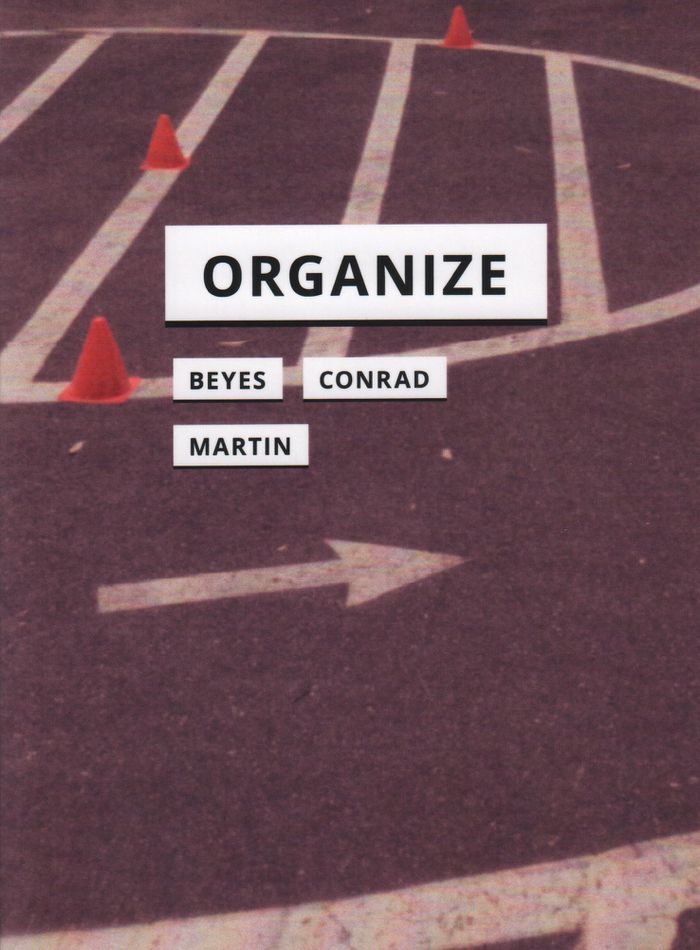
Titre:
Organize
Organize
Actions:
Prix:
$26.95
(disponible sur commande)
Résumé:
Media organize things into patterns and relations. As intermediaries among people and between people and worlds, media shape sociotechnical orders. At the same time, media are organized: while they condition different organizational forms and processes, they, too, are formed and can be re-formed. This intimate relation of media and organizing is timeless. Yet arguably,(...)
$26.95
(disponible sur commande)
Résumé:
Media organize things into patterns and relations. As intermediaries among people and between people and worlds, media shape sociotechnical orders. At the same time, media are organized: while they condition different organizational forms and processes, they, too, are formed and can be re-formed. This intimate relation of media and organizing is timeless. Yet arguably,(...)
Publication:
octobre 2019
octobre 2019
Titre:
Organize
Actions:
Prix:
$26.95
(disponible sur commande)
Résumé:
Media organize things into patterns and relations. As intermediaries among people and between people and worlds, media shape sociotechnical orders. At the same time, media are organized: while they condition different organizational forms and processes, they, too, are formed and can be re-formed. This intimate relation of media and organizing is timeless. Yet arguably, digital media technologies repose the question of organization—and thus of power and domination, control and surveillance, disruption and emancipation. Bringing together leading media thinkers and organization theorists, this book interrogates organization as an effect and condition of media. How can we understand the recursive relation between media and organization? How can we think, explore, critique, and perhaps alter the organizational bodies and scripts that shape contemporary life?
Organize
Actions:
Prix:
$26.95
(disponible sur commande)
Résumé:
Media organize things into patterns and relations. As intermediaries among people and between people and worlds, media shape sociotechnical orders. At the same time, media are organized: while they condition different organizational forms and processes, they, too, are formed and can be re-formed. This intimate relation of media and organizing is timeless. Yet arguably, digital media technologies repose the question of organization—and thus of power and domination, control and surveillance, disruption and emancipation. Bringing together leading media thinkers and organization theorists, this book interrogates organization as an effect and condition of media. How can we understand the recursive relation between media and organization? How can we think, explore, critique, and perhaps alter the organizational bodies and scripts that shape contemporary life?
Classification:
livres
livres
Publication:
octobre 2019
octobre 2019


