


2173 Résultats
Classification:
photographies
photographies
Numéro de référence:
DR2012:0015:023:004
Description:
Ring binder containing the following photographs: - Fragments... la maison de Rivière-des-Prairies (1 photograph); - Memo series...planche 112 - Mies on his way to Los Angeles (1 photograph) - Old Montreal (3 photographs); - Entrance to the Lachine Canal (1 photograph); - Lachine Canal, 1956 (4 photographs); - Possibly additional photographs of Lachine Canal (3 photographs); - Unidentified columns (3 photographs); - Grain elevators (3 photographs); - Temple of Concordia (3 photographs); - Unidentified buildings (7 photographs); - A street in Montreal, 1964 (1 printout); - A house in the village of Casuvin (1 printout).
DR2012:0015:023:004
Description:
Ring binder containing the following photographs: - Fragments... la maison de Rivière-des-Prairies (1 photograph); - Memo series...planche 112 - Mies on his way to Los Angeles (1 photograph) - Old Montreal (3 photographs); - Entrance to the Lachine Canal (1 photograph); - Lachine Canal, 1956 (4 photographs); - Possibly additional photographs of Lachine Canal (3 photographs); - Unidentified columns (3 photographs); - Grain elevators (3 photographs); - Temple of Concordia (3 photographs); - Unidentified buildings (7 photographs); - A street in Montreal, 1964 (1 printout); - A house in the village of Casuvin (1 printout).
Personnes et institutions:
Date:
between 1956 and 1988
between 1956 and 1988
Titre:
Photographs from Melvin Charney's early and middle career
Actions:
DR2012:0015:023:004
Description:
Ring binder containing the following photographs: - Fragments... la maison de Rivière-des-Prairies (1 photograph); - Memo series...planche 112 - Mies on his way to Los Angeles (1 photograph) - Old Montreal (3 photographs); - Entrance to the Lachine Canal (1 photograph); - Lachine Canal, 1956 (4 photographs); - Possibly additional photographs of Lachine Canal (3 photographs); - Unidentified columns (3 photographs); - Grain elevators (3 photographs); - Temple of Concordia (3 photographs); - Unidentified buildings (7 photographs); - A street in Montreal, 1964 (1 printout); - A house in the village of Casuvin (1 printout).
Photographs from Melvin Charney's early and middle career
Actions:
DR2012:0015:023:004
Description:
Ring binder containing the following photographs: - Fragments... la maison de Rivière-des-Prairies (1 photograph); - Memo series...planche 112 - Mies on his way to Los Angeles (1 photograph) - Old Montreal (3 photographs); - Entrance to the Lachine Canal (1 photograph); - Lachine Canal, 1956 (4 photographs); - Possibly additional photographs of Lachine Canal (3 photographs); - Unidentified columns (3 photographs); - Grain elevators (3 photographs); - Temple of Concordia (3 photographs); - Unidentified buildings (7 photographs); - A street in Montreal, 1964 (1 printout); - A house in the village of Casuvin (1 printout).
Classification:
photographies
photographies
Date:
between 1956 and 1988
between 1956 and 1988
Personnes et institutions:
Classification:
oeuvres d'art
oeuvres d'art

Actions:
Numéro de référence:
DR1974:0002:006:001-024
Description:
- This album consists of transfer lithographed contract drawings - mainly plans, but also elevations, sections, and sectional elevations - for Hôtel Sauvage, Paris. The hôtel is U-shaped in plan with two pavilions connected by a monumental entrance hall and staircase which face a central "cours d'honneur". The hôtel's exterior has a rusticated "rez-de-chaussée", mansard roofs, and is embellished with classical features including arched and pedimented windows, pilasters, entablatures, and Corinthian columns. The sectional drawings show lavishly decorated interiors. The revisions and notations on the transfer lithographs of this album suggest that they were probably the architect's copy.
DR1974:0002:006:001-024
Description:
- This album consists of transfer lithographed contract drawings - mainly plans, but also elevations, sections, and sectional elevations - for Hôtel Sauvage, Paris. The hôtel is U-shaped in plan with two pavilions connected by a monumental entrance hall and staircase which face a central "cours d'honneur". The hôtel's exterior has a rusticated "rez-de-chaussée", mansard roofs, and is embellished with classical features including arched and pedimented windows, pilasters, entablatures, and Corinthian columns. The sectional drawings show lavishly decorated interiors. The revisions and notations on the transfer lithographs of this album suggest that they were probably the architect's copy.
Personnes et institutions:
Sujet:
architecture, design d'intérieur
architecture, design d'intérieur
Date:
printed before 30 March 1861 or before 1 April 1861
printed before 30 March 1861 or before 1 April 1861
Titre:
Album of transfer lithographs of contract drawings for Hôtel Sauvage, avenue des Champs-Elysées and rue de Chaillot, Paris
Actions:
DR1974:0002:006:001-024
Description:
- This album consists of transfer lithographed contract drawings - mainly plans, but also elevations, sections, and sectional elevations - for Hôtel Sauvage, Paris. The hôtel is U-shaped in plan with two pavilions connected by a monumental entrance hall and staircase which face a central "cours d'honneur". The hôtel's exterior has a rusticated "rez-de-chaussée", mansard roofs, and is embellished with classical features including arched and pedimented windows, pilasters, entablatures, and Corinthian columns. The sectional drawings show lavishly decorated interiors. The revisions and notations on the transfer lithographs of this album suggest that they were probably the architect's copy.
Album of transfer lithographs of contract drawings for Hôtel Sauvage, avenue des Champs-Elysées and rue de Chaillot, Paris
Actions:
DR1974:0002:006:001-024
Description:
- This album consists of transfer lithographed contract drawings - mainly plans, but also elevations, sections, and sectional elevations - for Hôtel Sauvage, Paris. The hôtel is U-shaped in plan with two pavilions connected by a monumental entrance hall and staircase which face a central "cours d'honneur". The hôtel's exterior has a rusticated "rez-de-chaussée", mansard roofs, and is embellished with classical features including arched and pedimented windows, pilasters, entablatures, and Corinthian columns. The sectional drawings show lavishly decorated interiors. The revisions and notations on the transfer lithographs of this album suggest that they were probably the architect's copy.
Classification:
oeuvres d'art
oeuvres d'art
Date:
printed before 30 March 1861 or before 1 April 1861
printed before 30 March 1861 or before 1 April 1861
Personnes et institutions:
Sujet:
architecture, design d'intérieur
architecture, design d'intérieur
Classification:
oeuvres d'art
oeuvres d'art

Actions:
Numéro de référence:
DR1988:0322
Description:
- This print depicts an altarpiece with painted and sculpted elements. The architectural framework consists of two pairs of columns, unfluted Corinthian and Solomonic, supporting an elaborate broken pediment. In the centre is a tall painting depicting the entombment of Christ in a diagonal composition, with Mary Magdalen kneeling prominently in the foreground. The top of the altar is adorned with angels holding instruments of the Passion - cross, nails, crown of thorns - and a staff with a cross symbolizing the Resurrection. - The incomplete series of numbered prints, DR1988:0306 - DR1988:0331, shows Early Baroque church facades in Rome, altars, tombs, wall monuments, tabernacles and an antique temple.
DR1988:0322
Description:
- This print depicts an altarpiece with painted and sculpted elements. The architectural framework consists of two pairs of columns, unfluted Corinthian and Solomonic, supporting an elaborate broken pediment. In the centre is a tall painting depicting the entombment of Christ in a diagonal composition, with Mary Magdalen kneeling prominently in the foreground. The top of the altar is adorned with angels holding instruments of the Passion - cross, nails, crown of thorns - and a staff with a cross symbolizing the Resurrection. - The incomplete series of numbered prints, DR1988:0306 - DR1988:0331, shows Early Baroque church facades in Rome, altars, tombs, wall monuments, tabernacles and an antique temple.
Personnes et institutions:
Sujet:
architecture
architecture
Date:
printed during the first half of the 17th century
printed during the first half of the 17th century
Titre:
Design for an altar with an altarpiece showing the Entombment of Christ
Actions:
DR1988:0322
Description:
- This print depicts an altarpiece with painted and sculpted elements. The architectural framework consists of two pairs of columns, unfluted Corinthian and Solomonic, supporting an elaborate broken pediment. In the centre is a tall painting depicting the entombment of Christ in a diagonal composition, with Mary Magdalen kneeling prominently in the foreground. The top of the altar is adorned with angels holding instruments of the Passion - cross, nails, crown of thorns - and a staff with a cross symbolizing the Resurrection. - The incomplete series of numbered prints, DR1988:0306 - DR1988:0331, shows Early Baroque church facades in Rome, altars, tombs, wall monuments, tabernacles and an antique temple.
Design for an altar with an altarpiece showing the Entombment of Christ
Actions:
DR1988:0322
Description:
- This print depicts an altarpiece with painted and sculpted elements. The architectural framework consists of two pairs of columns, unfluted Corinthian and Solomonic, supporting an elaborate broken pediment. In the centre is a tall painting depicting the entombment of Christ in a diagonal composition, with Mary Magdalen kneeling prominently in the foreground. The top of the altar is adorned with angels holding instruments of the Passion - cross, nails, crown of thorns - and a staff with a cross symbolizing the Resurrection. - The incomplete series of numbered prints, DR1988:0306 - DR1988:0331, shows Early Baroque church facades in Rome, altars, tombs, wall monuments, tabernacles and an antique temple.
Classification:
oeuvres d'art
oeuvres d'art
Date:
printed during the first half of the 17th century
printed during the first half of the 17th century
Personnes et institutions:
Sujet:
architecture
architecture
Classification:
oeuvres d'art
oeuvres d'art

Titre:
Design for a triumphal arch
Design for a triumphal arch
Actions:
Numéro de référence:
DR1990:0046
Description:
Triumphal arch flanked by two pairs of fluted Doric columns that have capitals ornamented with grotesques. The arch leads to a coffered barrel vault and grotesques covering both sides of the interior walls. The entablature is also Doric, with metopes featuring bovine skulls and alternating circular ornaments. In the attic story is a quadrilateral cartouche with a Latin inscription that reads “MVLTA RENAS CENTVR QVE NVNCCECIDERE.” On either side of the cartouche are arabesques with anthropomorphic feet and vases/urns that are also decorated with grotesque ornamentation. Above is a series of three scalloped niches. The central niche uses a highly ornamental Corinthian order below a triangular pediment.
DR1990:0046
Description:
Triumphal arch flanked by two pairs of fluted Doric columns that have capitals ornamented with grotesques. The arch leads to a coffered barrel vault and grotesques covering both sides of the interior walls. The entablature is also Doric, with metopes featuring bovine skulls and alternating circular ornaments. In the attic story is a quadrilateral cartouche with a Latin inscription that reads “MVLTA RENAS CENTVR QVE NVNCCECIDERE.” On either side of the cartouche are arabesques with anthropomorphic feet and vases/urns that are also decorated with grotesque ornamentation. Above is a series of three scalloped niches. The central niche uses a highly ornamental Corinthian order below a triangular pediment.
Personnes et institutions:
Sujet:
architecture
architecture
Date:
early 1530s
early 1530s
Titre:
Design for a triumphal arch
Actions:
DR1990:0046
Description:
Triumphal arch flanked by two pairs of fluted Doric columns that have capitals ornamented with grotesques. The arch leads to a coffered barrel vault and grotesques covering both sides of the interior walls. The entablature is also Doric, with metopes featuring bovine skulls and alternating circular ornaments. In the attic story is a quadrilateral cartouche with a Latin inscription that reads “MVLTA RENAS CENTVR QVE NVNCCECIDERE.” On either side of the cartouche are arabesques with anthropomorphic feet and vases/urns that are also decorated with grotesque ornamentation. Above is a series of three scalloped niches. The central niche uses a highly ornamental Corinthian order below a triangular pediment.
Design for a triumphal arch
Actions:
DR1990:0046
Description:
Triumphal arch flanked by two pairs of fluted Doric columns that have capitals ornamented with grotesques. The arch leads to a coffered barrel vault and grotesques covering both sides of the interior walls. The entablature is also Doric, with metopes featuring bovine skulls and alternating circular ornaments. In the attic story is a quadrilateral cartouche with a Latin inscription that reads “MVLTA RENAS CENTVR QVE NVNCCECIDERE.” On either side of the cartouche are arabesques with anthropomorphic feet and vases/urns that are also decorated with grotesque ornamentation. Above is a series of three scalloped niches. The central niche uses a highly ornamental Corinthian order below a triangular pediment.
Classification:
oeuvres d'art
oeuvres d'art
Date:
early 1530s
early 1530s
Personnes et institutions:
Sujet:
architecture
architecture
Classification:
oeuvres d'art
oeuvres d'art

Titre:
Design for a triumphal arch
Design for a triumphal arch
Actions:
Numéro de référence:
DR1990:0045
Description:
This print shows a heavily ornamented triumphal arch leading to vaulted corridor. Pairs of columns on either side of the portal have Corinthian capitals and fluted shafts sit atop non-canonical urn-like bases. The corridor that recedes into the distance has quadripartite vaults. The entablature features two male profile portrait rondels surrounded by laurel leaves. The frieze includes putti, arabesques, and grotesques. The attic story has two urns on either side of a central fronton with a Latin inscription evoking the mythical city of Troy and the date of execution, 1534. These elements are also covered in grotesques. At the top, an empty cartouche is flanked by two cornucopia and two additional vases/urns.
DR1990:0045
Description:
This print shows a heavily ornamented triumphal arch leading to vaulted corridor. Pairs of columns on either side of the portal have Corinthian capitals and fluted shafts sit atop non-canonical urn-like bases. The corridor that recedes into the distance has quadripartite vaults. The entablature features two male profile portrait rondels surrounded by laurel leaves. The frieze includes putti, arabesques, and grotesques. The attic story has two urns on either side of a central fronton with a Latin inscription evoking the mythical city of Troy and the date of execution, 1534. These elements are also covered in grotesques. At the top, an empty cartouche is flanked by two cornucopia and two additional vases/urns.
Personnes et institutions:
Sujet:
architecture
architecture
Date:
1534
1534
Titre:
Design for a triumphal arch
Actions:
DR1990:0045
Description:
This print shows a heavily ornamented triumphal arch leading to vaulted corridor. Pairs of columns on either side of the portal have Corinthian capitals and fluted shafts sit atop non-canonical urn-like bases. The corridor that recedes into the distance has quadripartite vaults. The entablature features two male profile portrait rondels surrounded by laurel leaves. The frieze includes putti, arabesques, and grotesques. The attic story has two urns on either side of a central fronton with a Latin inscription evoking the mythical city of Troy and the date of execution, 1534. These elements are also covered in grotesques. At the top, an empty cartouche is flanked by two cornucopia and two additional vases/urns.
Design for a triumphal arch
Actions:
DR1990:0045
Description:
This print shows a heavily ornamented triumphal arch leading to vaulted corridor. Pairs of columns on either side of the portal have Corinthian capitals and fluted shafts sit atop non-canonical urn-like bases. The corridor that recedes into the distance has quadripartite vaults. The entablature features two male profile portrait rondels surrounded by laurel leaves. The frieze includes putti, arabesques, and grotesques. The attic story has two urns on either side of a central fronton with a Latin inscription evoking the mythical city of Troy and the date of execution, 1534. These elements are also covered in grotesques. At the top, an empty cartouche is flanked by two cornucopia and two additional vases/urns.
Classification:
oeuvres d'art
oeuvres d'art
Date:
1534
1534
Personnes et institutions:
Sujet:
architecture
architecture
Classification:
dessins
dessins
Actions:
Numéro de référence:
DR1960:0021
Description:
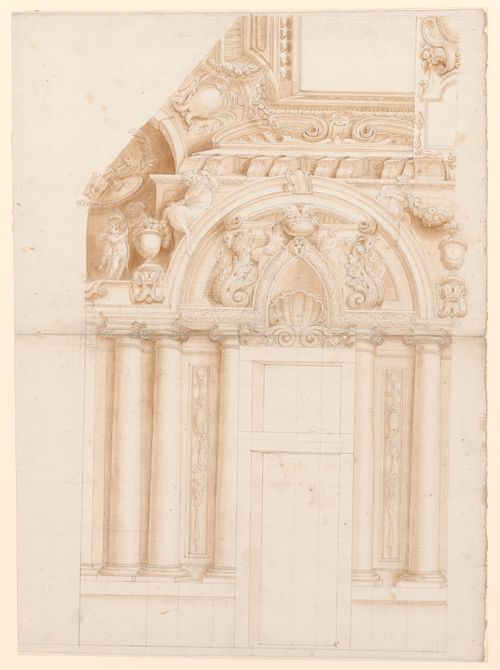
- This drawing, by an unknown Italian artist, active probably in the area of Bologna in the last half of the 17th century, illustrates some of the conventions of quadratura design - the art of illusionistic wall and ceiling painting - that evolved during that century. Part of a wall and adjacent ceiling are shown as one continuous unfurling of space on a flat sheet of paper. The curve between the vertical and diagonal lines at the left-hand edge of the design indicate a modest coving. Around and above a doorway several ionic columns support an arch and archivolt which is decorated with acanthus leaves, putti, ram's head, and urn below, and satyrs, putti, garlands and urns above. A cornice, cartouche, balustrade, and scrolled pediment complete the decorations.
DR1960:0021
Description:
- This drawing, by an unknown Italian artist, active probably in the area of Bologna in the last half of the 17th century, illustrates some of the conventions of quadratura design - the art of illusionistic wall and ceiling painting - that evolved during that century. Part of a wall and adjacent ceiling are shown as one continuous unfurling of space on a flat sheet of paper. The curve between the vertical and diagonal lines at the left-hand edge of the design indicate a modest coving. Around and above a doorway several ionic columns support an arch and archivolt which is decorated with acanthus leaves, putti, ram's head, and urn below, and satyrs, putti, garlands and urns above. A cornice, cartouche, balustrade, and scrolled pediment complete the decorations.
Personnes et institutions:
Sujet:
design d'intérieur
design d'intérieur
Date:
ca. 1675-1725
ca. 1675-1725
Titre:
Quadratura drawing for door-frame and surround
Actions:
DR1960:0021
Description:
- This drawing, by an unknown Italian artist, active probably in the area of Bologna in the last half of the 17th century, illustrates some of the conventions of quadratura design - the art of illusionistic wall and ceiling painting - that evolved during that century. Part of a wall and adjacent ceiling are shown as one continuous unfurling of space on a flat sheet of paper. The curve between the vertical and diagonal lines at the left-hand edge of the design indicate a modest coving. Around and above a doorway several ionic columns support an arch and archivolt which is decorated with acanthus leaves, putti, ram's head, and urn below, and satyrs, putti, garlands and urns above. A cornice, cartouche, balustrade, and scrolled pediment complete the decorations.
Quadratura drawing for door-frame and surround
Actions:
DR1960:0021
Description:
- This drawing, by an unknown Italian artist, active probably in the area of Bologna in the last half of the 17th century, illustrates some of the conventions of quadratura design - the art of illusionistic wall and ceiling painting - that evolved during that century. Part of a wall and adjacent ceiling are shown as one continuous unfurling of space on a flat sheet of paper. The curve between the vertical and diagonal lines at the left-hand edge of the design indicate a modest coving. Around and above a doorway several ionic columns support an arch and archivolt which is decorated with acanthus leaves, putti, ram's head, and urn below, and satyrs, putti, garlands and urns above. A cornice, cartouche, balustrade, and scrolled pediment complete the decorations.
Classification:
dessins
dessins
Date:
ca. 1675-1725
ca. 1675-1725
Personnes et institutions:
Sujet:
design d'intérieur
design d'intérieur
Classification:
dessins
dessins
Actions:
Numéro de référence:
DR1990:0056
Description:
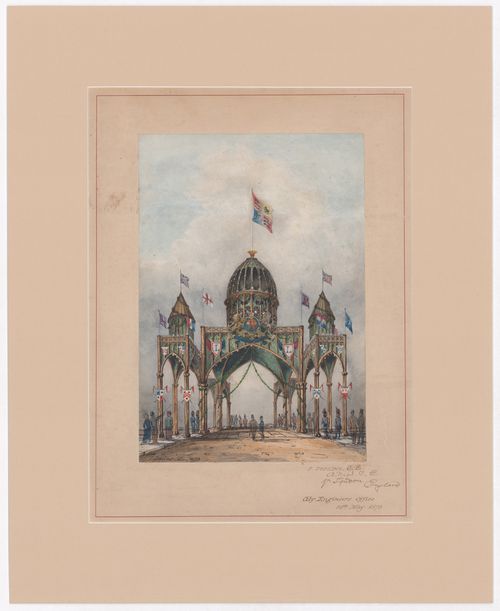
- This watercolour rendering depicts a welcome arch which spans the intersection of two streets. The arch is composed of a large central groin vaulted archway and four smaller groin vaulted archways. The central archway is supported by four compound piers and is surmounted by a dome on a drum. The smaller archways which are surmounted by turrets, span the sidewalks at the street corners and are each supported by a compound pier and three columns. The structure is embellished with Gothic-inspired features such as blind tracery and pointed arches as well as shields, including two inscribed with the letter "L", flags, floral garlands, the British royal coat of arms, a sheaf of wheat and possibly lights. Staffage indicates the large scale of the arch.
DR1990:0056
Description:
- This watercolour rendering depicts a welcome arch which spans the intersection of two streets. The arch is composed of a large central groin vaulted archway and four smaller groin vaulted archways. The central archway is supported by four compound piers and is surmounted by a dome on a drum. The smaller archways which are surmounted by turrets, span the sidewalks at the street corners and are each supported by a compound pier and three columns. The structure is embellished with Gothic-inspired features such as blind tracery and pointed arches as well as shields, including two inscribed with the letter "L", flags, floral garlands, the British royal coat of arms, a sheaf of wheat and possibly lights. Staffage indicates the large scale of the arch.
Personnes et institutions:
Sujet:
architecture temporaire
architecture temporaire
Date:
16 May 1879
16 May 1879
Titre:
Perspective for a temporary welcome arch for the visit of the Marquess of Lorne and Princess Louise to Toronto, September 1879
Actions:
DR1990:0056
Description:
- This watercolour rendering depicts a welcome arch which spans the intersection of two streets. The arch is composed of a large central groin vaulted archway and four smaller groin vaulted archways. The central archway is supported by four compound piers and is surmounted by a dome on a drum. The smaller archways which are surmounted by turrets, span the sidewalks at the street corners and are each supported by a compound pier and three columns. The structure is embellished with Gothic-inspired features such as blind tracery and pointed arches as well as shields, including two inscribed with the letter "L", flags, floral garlands, the British royal coat of arms, a sheaf of wheat and possibly lights. Staffage indicates the large scale of the arch.
Perspective for a temporary welcome arch for the visit of the Marquess of Lorne and Princess Louise to Toronto, September 1879
Actions:
DR1990:0056
Description:
- This watercolour rendering depicts a welcome arch which spans the intersection of two streets. The arch is composed of a large central groin vaulted archway and four smaller groin vaulted archways. The central archway is supported by four compound piers and is surmounted by a dome on a drum. The smaller archways which are surmounted by turrets, span the sidewalks at the street corners and are each supported by a compound pier and three columns. The structure is embellished with Gothic-inspired features such as blind tracery and pointed arches as well as shields, including two inscribed with the letter "L", flags, floral garlands, the British royal coat of arms, a sheaf of wheat and possibly lights. Staffage indicates the large scale of the arch.
Classification:
dessins
dessins
Date:
16 May 1879
16 May 1879
Personnes et institutions:
Sujet:
architecture temporaire
architecture temporaire
Classification:
dessins
dessins
Actions:
Numéro de référence:
DR1988:0411
Description:
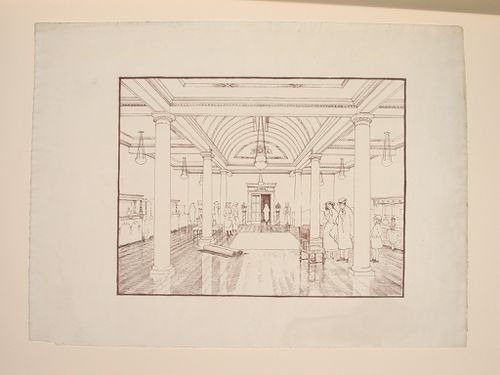
- This reprographic copy shows the interior of a room with two rows of columns supporting a barrel vaulted arch over the central aisle. The rest of the ceiling is coffered. The room is identified as a furniture showroom because the walls of the room are lined with furniture and there are several groups of people standing around a few chairs and rugs in the centre of the room. - The style of many of these drawings and reprographic copies by Henry Hyams (DR1988:0332 - DR1988:0414) suggests that they were possibly for periodical illustrations. Hyams contributed articles to the periodicals 'The Builder' and 'The Architect'. Two objects in the CCA collections can be linked to the article "Music in Stone" published prior to 1926 in 'The Architect'; a reprographic copy (DR1988:0357) and a drawing (DR1988:0364) (Who's Who in Architecture, 161).
DR1988:0411
Description:
- This reprographic copy shows the interior of a room with two rows of columns supporting a barrel vaulted arch over the central aisle. The rest of the ceiling is coffered. The room is identified as a furniture showroom because the walls of the room are lined with furniture and there are several groups of people standing around a few chairs and rugs in the centre of the room. - The style of many of these drawings and reprographic copies by Henry Hyams (DR1988:0332 - DR1988:0414) suggests that they were possibly for periodical illustrations. Hyams contributed articles to the periodicals 'The Builder' and 'The Architect'. Two objects in the CCA collections can be linked to the article "Music in Stone" published prior to 1926 in 'The Architect'; a reprographic copy (DR1988:0357) and a drawing (DR1988:0364) (Who's Who in Architecture, 161).
Personnes et institutions:
Sujet:
architecture, design d'intérieur
architecture, design d'intérieur
Date:
printed in the 1920s or 1930s
printed in the 1920s or 1930s
Titre:
Perspective showing the interior of a room, probably a furniture showroom
Actions:
DR1988:0411
Description:
- This reprographic copy shows the interior of a room with two rows of columns supporting a barrel vaulted arch over the central aisle. The rest of the ceiling is coffered. The room is identified as a furniture showroom because the walls of the room are lined with furniture and there are several groups of people standing around a few chairs and rugs in the centre of the room. - The style of many of these drawings and reprographic copies by Henry Hyams (DR1988:0332 - DR1988:0414) suggests that they were possibly for periodical illustrations. Hyams contributed articles to the periodicals 'The Builder' and 'The Architect'. Two objects in the CCA collections can be linked to the article "Music in Stone" published prior to 1926 in 'The Architect'; a reprographic copy (DR1988:0357) and a drawing (DR1988:0364) (Who's Who in Architecture, 161).
Perspective showing the interior of a room, probably a furniture showroom
Actions:
DR1988:0411
Description:
- This reprographic copy shows the interior of a room with two rows of columns supporting a barrel vaulted arch over the central aisle. The rest of the ceiling is coffered. The room is identified as a furniture showroom because the walls of the room are lined with furniture and there are several groups of people standing around a few chairs and rugs in the centre of the room. - The style of many of these drawings and reprographic copies by Henry Hyams (DR1988:0332 - DR1988:0414) suggests that they were possibly for periodical illustrations. Hyams contributed articles to the periodicals 'The Builder' and 'The Architect'. Two objects in the CCA collections can be linked to the article "Music in Stone" published prior to 1926 in 'The Architect'; a reprographic copy (DR1988:0357) and a drawing (DR1988:0364) (Who's Who in Architecture, 161).
Classification:
dessins
dessins
Date:
printed in the 1920s or 1930s
printed in the 1920s or 1930s
Personnes et institutions:
Sujet:
architecture, design d'intérieur
architecture, design d'intérieur
Classification:
dessins
dessins
Actions:
Numéro de référence:
DR1994:0011:001 R/V
Description:
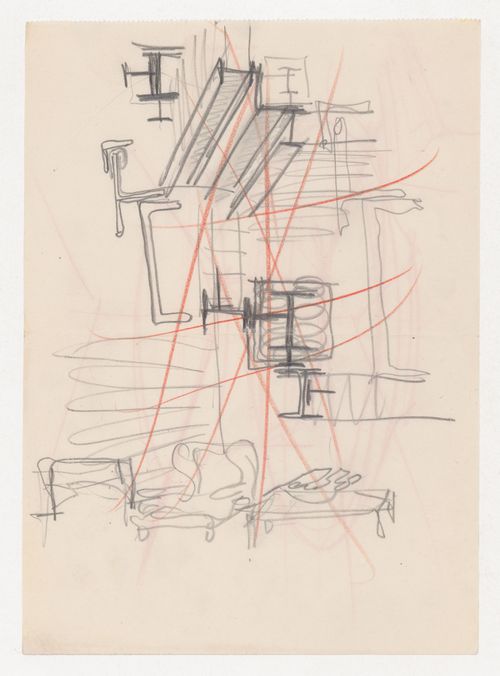
- Group DR1994:0011:001 R/V - DR1994:0011:030 includes three sketches (DR1994:0011:001 R/V - DR1994:0011:002 R/V and DR1994:0011:030), 24 pages of notes (DR1994:0011:003 - DR1994:0011:026), two sketchbooks (DR1994:0011:027:001-035 and DR1994:0011:028:001-008 R/V), and the envelope in which these materials were housed at acquisition (DR1994:0011:029). The sketches are for various subjects including I-beams (DR1994:0011:001 R/V), a column-to-beam connection and an unidentified building (DR1994:0011:002 R/V), and a sketch plan of Mies' 1928-1929 design for the Friedrichstrasse office building in Berlin (DR1994:0011:030). Notes DR1994:0011:003 - DR1994:0011:024 are written in German and are generally illegible. Many changes have been made to the notes, and some sheets appear to have been reordered or struck out. Some of the notes may be about urban planning. The number in the upper left corner of sheets DR1994:0011:010, DR1994:0011:012-016 and DR1994:0011:020-021 may indicate the order of the topics dealt with in the notes. Notes DR1994:0011:025 are illegible. Notes DR1994:0011:026 are written in English, and may be notes of a lecture. The notes in sketchbook DR1994:0011:027:001-035 are written in German, are generally illegible, and are usually written in point form or sometimes as lists. Chicago is mentioned on several of the sheets. There is a shift in the clarity of the handwriting halfway through the sketchbook and some of the notes in the latter half may relate to Mies' readings of philosophy. Some of the notes in sketchbook DR1994:0028:001-008 R/V are written in German and some in English. The first and second pages of the sketchbook describe measurements for addresses on the campus of IIT, as well as for the Power Plant. The last three pages of the sketchbook discuss the architectural education programm at IIT and an exhibition of student work.
DR1994:0011:001 R/V
Description:
- Group DR1994:0011:001 R/V - DR1994:0011:030 includes three sketches (DR1994:0011:001 R/V - DR1994:0011:002 R/V and DR1994:0011:030), 24 pages of notes (DR1994:0011:003 - DR1994:0011:026), two sketchbooks (DR1994:0011:027:001-035 and DR1994:0011:028:001-008 R/V), and the envelope in which these materials were housed at acquisition (DR1994:0011:029). The sketches are for various subjects including I-beams (DR1994:0011:001 R/V), a column-to-beam connection and an unidentified building (DR1994:0011:002 R/V), and a sketch plan of Mies' 1928-1929 design for the Friedrichstrasse office building in Berlin (DR1994:0011:030). Notes DR1994:0011:003 - DR1994:0011:024 are written in German and are generally illegible. Many changes have been made to the notes, and some sheets appear to have been reordered or struck out. Some of the notes may be about urban planning. The number in the upper left corner of sheets DR1994:0011:010, DR1994:0011:012-016 and DR1994:0011:020-021 may indicate the order of the topics dealt with in the notes. Notes DR1994:0011:025 are illegible. Notes DR1994:0011:026 are written in English, and may be notes of a lecture. The notes in sketchbook DR1994:0011:027:001-035 are written in German, are generally illegible, and are usually written in point form or sometimes as lists. Chicago is mentioned on several of the sheets. There is a shift in the clarity of the handwriting halfway through the sketchbook and some of the notes in the latter half may relate to Mies' readings of philosophy. Some of the notes in sketchbook DR1994:0028:001-008 R/V are written in German and some in English. The first and second pages of the sketchbook describe measurements for addresses on the campus of IIT, as well as for the Power Plant. The last three pages of the sketchbook discuss the architectural education programm at IIT and an exhibition of student work.
Personnes et institutions:
Sujet:
architecture
architecture
Date:
1944-1965
1944-1965
Titre:
Sketch of a teacup; verso: Study sketches for I-beams and sketch of a chair and table
Actions:
DR1994:0011:001 R/V
Description:
- Group DR1994:0011:001 R/V - DR1994:0011:030 includes three sketches (DR1994:0011:001 R/V - DR1994:0011:002 R/V and DR1994:0011:030), 24 pages of notes (DR1994:0011:003 - DR1994:0011:026), two sketchbooks (DR1994:0011:027:001-035 and DR1994:0011:028:001-008 R/V), and the envelope in which these materials were housed at acquisition (DR1994:0011:029). The sketches are for various subjects including I-beams (DR1994:0011:001 R/V), a column-to-beam connection and an unidentified building (DR1994:0011:002 R/V), and a sketch plan of Mies' 1928-1929 design for the Friedrichstrasse office building in Berlin (DR1994:0011:030). Notes DR1994:0011:003 - DR1994:0011:024 are written in German and are generally illegible. Many changes have been made to the notes, and some sheets appear to have been reordered or struck out. Some of the notes may be about urban planning. The number in the upper left corner of sheets DR1994:0011:010, DR1994:0011:012-016 and DR1994:0011:020-021 may indicate the order of the topics dealt with in the notes. Notes DR1994:0011:025 are illegible. Notes DR1994:0011:026 are written in English, and may be notes of a lecture. The notes in sketchbook DR1994:0011:027:001-035 are written in German, are generally illegible, and are usually written in point form or sometimes as lists. Chicago is mentioned on several of the sheets. There is a shift in the clarity of the handwriting halfway through the sketchbook and some of the notes in the latter half may relate to Mies' readings of philosophy. Some of the notes in sketchbook DR1994:0028:001-008 R/V are written in German and some in English. The first and second pages of the sketchbook describe measurements for addresses on the campus of IIT, as well as for the Power Plant. The last three pages of the sketchbook discuss the architectural education programm at IIT and an exhibition of student work.
Sketch of a teacup; verso: Study sketches for I-beams and sketch of a chair and table
Actions:
DR1994:0011:001 R/V
Description:
- Group DR1994:0011:001 R/V - DR1994:0011:030 includes three sketches (DR1994:0011:001 R/V - DR1994:0011:002 R/V and DR1994:0011:030), 24 pages of notes (DR1994:0011:003 - DR1994:0011:026), two sketchbooks (DR1994:0011:027:001-035 and DR1994:0011:028:001-008 R/V), and the envelope in which these materials were housed at acquisition (DR1994:0011:029). The sketches are for various subjects including I-beams (DR1994:0011:001 R/V), a column-to-beam connection and an unidentified building (DR1994:0011:002 R/V), and a sketch plan of Mies' 1928-1929 design for the Friedrichstrasse office building in Berlin (DR1994:0011:030). Notes DR1994:0011:003 - DR1994:0011:024 are written in German and are generally illegible. Many changes have been made to the notes, and some sheets appear to have been reordered or struck out. Some of the notes may be about urban planning. The number in the upper left corner of sheets DR1994:0011:010, DR1994:0011:012-016 and DR1994:0011:020-021 may indicate the order of the topics dealt with in the notes. Notes DR1994:0011:025 are illegible. Notes DR1994:0011:026 are written in English, and may be notes of a lecture. The notes in sketchbook DR1994:0011:027:001-035 are written in German, are generally illegible, and are usually written in point form or sometimes as lists. Chicago is mentioned on several of the sheets. There is a shift in the clarity of the handwriting halfway through the sketchbook and some of the notes in the latter half may relate to Mies' readings of philosophy. Some of the notes in sketchbook DR1994:0028:001-008 R/V are written in German and some in English. The first and second pages of the sketchbook describe measurements for addresses on the campus of IIT, as well as for the Power Plant. The last three pages of the sketchbook discuss the architectural education programm at IIT and an exhibition of student work.
Classification:
dessins
dessins
Date:
1944-1965
1944-1965
Personnes et institutions:
Sujet:
architecture
architecture
Classification:
documents textuels
documents textuels
Actions:
Numéro de référence:
DR1994:0011:003
Description:
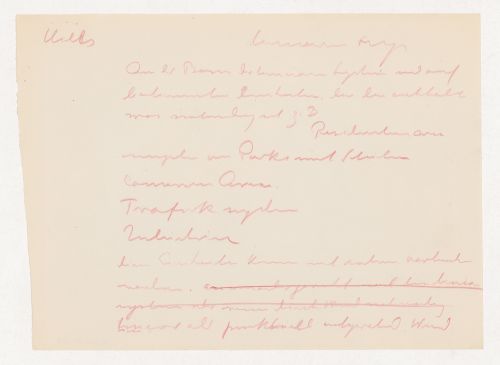
- Group DR1994:0011:001 R/V - DR1994:0011:030 includes three sketches (DR1994:0011:001 R/V - DR1994:0011:002 R/V and DR1994:0011:030), 24 pages of notes (DR1994:0011:003 - DR1994:0011:026), two sketchbooks (DR1994:0011:027:001-035 and DR1994:0011:028:001-008 R/V), and the envelope in which these materials were housed at acquisition (DR1994:0011:029). The sketches are for various subjects including I-beams (DR1994:0011:001 R/V), a column-to-beam connection and an unidentified building (DR1994:0011:002 R/V), and a sketch plan of Mies' 1928-1929 design for the Friedrichstrasse office building in Berlin (DR1994:0011:030). Notes DR1994:0011:003 - DR1994:0011:024 are written in German and are generally illegible. Many changes have been made to the notes, and some sheets appear to have been reordered or struck out. Some of the notes may be about urban planning. The number in the upper left corner of sheets DR1994:0011:010, DR1994:0011:012-016 and DR1994:0011:020-021 may indicate the order of the topics dealt with in the notes. Notes DR1994:0011:025 are illegible. Notes DR1994:0011:026 are written in English, and may be notes of a lecture. The notes in sketchbook DR1994:0011:027:001-035 are written in German, are generally illegible, and are usually written in point form or sometimes as lists. Chicago is mentioned on several of the sheets. There is a shift in the clarity of the handwriting halfway through the sketchbook and some of the notes in the latter half may relate to Mies' readings of philosophy. Some of the notes in sketchbook DR1994:0028:001-008 R/V are written in German and some in English. The first and second pages of the sketchbook describe measurements for addresses on the campus of IIT, as well as for the Power Plant. The last three pages of the sketchbook discuss the architectural education programme at IIT and an exhibition of student work.
DR1994:0011:003
Description:
- Group DR1994:0011:001 R/V - DR1994:0011:030 includes three sketches (DR1994:0011:001 R/V - DR1994:0011:002 R/V and DR1994:0011:030), 24 pages of notes (DR1994:0011:003 - DR1994:0011:026), two sketchbooks (DR1994:0011:027:001-035 and DR1994:0011:028:001-008 R/V), and the envelope in which these materials were housed at acquisition (DR1994:0011:029). The sketches are for various subjects including I-beams (DR1994:0011:001 R/V), a column-to-beam connection and an unidentified building (DR1994:0011:002 R/V), and a sketch plan of Mies' 1928-1929 design for the Friedrichstrasse office building in Berlin (DR1994:0011:030). Notes DR1994:0011:003 - DR1994:0011:024 are written in German and are generally illegible. Many changes have been made to the notes, and some sheets appear to have been reordered or struck out. Some of the notes may be about urban planning. The number in the upper left corner of sheets DR1994:0011:010, DR1994:0011:012-016 and DR1994:0011:020-021 may indicate the order of the topics dealt with in the notes. Notes DR1994:0011:025 are illegible. Notes DR1994:0011:026 are written in English, and may be notes of a lecture. The notes in sketchbook DR1994:0011:027:001-035 are written in German, are generally illegible, and are usually written in point form or sometimes as lists. Chicago is mentioned on several of the sheets. There is a shift in the clarity of the handwriting halfway through the sketchbook and some of the notes in the latter half may relate to Mies' readings of philosophy. Some of the notes in sketchbook DR1994:0028:001-008 R/V are written in German and some in English. The first and second pages of the sketchbook describe measurements for addresses on the campus of IIT, as well as for the Power Plant. The last three pages of the sketchbook discuss the architectural education programme at IIT and an exhibition of student work.
Personnes et institutions:
Sujet:
architecture
architecture
Date:
1955
1955
Titre:
Notes, probably for a lecture
Actions:
DR1994:0011:003
Description:
- Group DR1994:0011:001 R/V - DR1994:0011:030 includes three sketches (DR1994:0011:001 R/V - DR1994:0011:002 R/V and DR1994:0011:030), 24 pages of notes (DR1994:0011:003 - DR1994:0011:026), two sketchbooks (DR1994:0011:027:001-035 and DR1994:0011:028:001-008 R/V), and the envelope in which these materials were housed at acquisition (DR1994:0011:029). The sketches are for various subjects including I-beams (DR1994:0011:001 R/V), a column-to-beam connection and an unidentified building (DR1994:0011:002 R/V), and a sketch plan of Mies' 1928-1929 design for the Friedrichstrasse office building in Berlin (DR1994:0011:030). Notes DR1994:0011:003 - DR1994:0011:024 are written in German and are generally illegible. Many changes have been made to the notes, and some sheets appear to have been reordered or struck out. Some of the notes may be about urban planning. The number in the upper left corner of sheets DR1994:0011:010, DR1994:0011:012-016 and DR1994:0011:020-021 may indicate the order of the topics dealt with in the notes. Notes DR1994:0011:025 are illegible. Notes DR1994:0011:026 are written in English, and may be notes of a lecture. The notes in sketchbook DR1994:0011:027:001-035 are written in German, are generally illegible, and are usually written in point form or sometimes as lists. Chicago is mentioned on several of the sheets. There is a shift in the clarity of the handwriting halfway through the sketchbook and some of the notes in the latter half may relate to Mies' readings of philosophy. Some of the notes in sketchbook DR1994:0028:001-008 R/V are written in German and some in English. The first and second pages of the sketchbook describe measurements for addresses on the campus of IIT, as well as for the Power Plant. The last three pages of the sketchbook discuss the architectural education programme at IIT and an exhibition of student work.
Notes, probably for a lecture
Actions:
DR1994:0011:003
Description:
- Group DR1994:0011:001 R/V - DR1994:0011:030 includes three sketches (DR1994:0011:001 R/V - DR1994:0011:002 R/V and DR1994:0011:030), 24 pages of notes (DR1994:0011:003 - DR1994:0011:026), two sketchbooks (DR1994:0011:027:001-035 and DR1994:0011:028:001-008 R/V), and the envelope in which these materials were housed at acquisition (DR1994:0011:029). The sketches are for various subjects including I-beams (DR1994:0011:001 R/V), a column-to-beam connection and an unidentified building (DR1994:0011:002 R/V), and a sketch plan of Mies' 1928-1929 design for the Friedrichstrasse office building in Berlin (DR1994:0011:030). Notes DR1994:0011:003 - DR1994:0011:024 are written in German and are generally illegible. Many changes have been made to the notes, and some sheets appear to have been reordered or struck out. Some of the notes may be about urban planning. The number in the upper left corner of sheets DR1994:0011:010, DR1994:0011:012-016 and DR1994:0011:020-021 may indicate the order of the topics dealt with in the notes. Notes DR1994:0011:025 are illegible. Notes DR1994:0011:026 are written in English, and may be notes of a lecture. The notes in sketchbook DR1994:0011:027:001-035 are written in German, are generally illegible, and are usually written in point form or sometimes as lists. Chicago is mentioned on several of the sheets. There is a shift in the clarity of the handwriting halfway through the sketchbook and some of the notes in the latter half may relate to Mies' readings of philosophy. Some of the notes in sketchbook DR1994:0028:001-008 R/V are written in German and some in English. The first and second pages of the sketchbook describe measurements for addresses on the campus of IIT, as well as for the Power Plant. The last three pages of the sketchbook discuss the architectural education programme at IIT and an exhibition of student work.
Classification:
documents textuels
documents textuels
Date:
1955
1955
Personnes et institutions:
Sujet:
architecture
architecture


