


10284 Résultats
Classification:
livres
livres
Actions:
Exemplaires:
Description:
xvii, 480 pages : illustrations, maps ; 26 cm.
Description:
xvii, 480 pages : illustrations, maps ; 26 cm.
Auteur:
Sujet:
Publication:
Charlottesville : University of Virginia Press, [2014], ©2014
Charlottesville : University of Virginia Press, [2014], ©2014
Titre:
Buildings of Vermont / Glenn M. Andres, Curtis B. Johnson ; with contributions by Chester H. Liebs ; photographer, Curtis B. Johnson.
Actions:
Exemplaires:
Description:
xvii, 480 pages : illustrations, maps ; 26 cm.
Buildings of Vermont / Glenn M. Andres, Curtis B. Johnson ; with contributions by Chester H. Liebs ; photographer, Curtis B. Johnson.
Actions:
Exemplaires:
Description:
xvii, 480 pages : illustrations, maps ; 26 cm.
Classification:
livres
livres
Publication:
Charlottesville : University of Virginia Press, [2014], ©2014
Charlottesville : University of Virginia Press, [2014], ©2014
Auteur:
Sujet:
Classification:
livres
livres
Actions:
Exemplaires:
Description:
243 pages : illustrations (chiefly color) ; 23 cm
Description:
243 pages : illustrations (chiefly color) ; 23 cm
Auteur:
Sujet:
Publication:
Paris : Archibooks + Sautereau éditeur, [2021]
Paris : Archibooks + Sautereau éditeur, [2021]
Titre:
Bourse de Commerce-Pinault Collection : Tadao Ando Architect & Associates, NeM-Niney et Marca Architectes, Agence Pierre-Antoine Gatier / texte par Andreas Kofler.
Actions:
Exemplaires:
Description:
243 pages : illustrations (chiefly color) ; 23 cm
Bourse de Commerce-Pinault Collection : Tadao Ando Architect & Associates, NeM-Niney et Marca Architectes, Agence Pierre-Antoine Gatier / texte par Andreas Kofler.
Actions:
Exemplaires:
Description:
243 pages : illustrations (chiefly color) ; 23 cm
Classification:
livres
livres
Publication:
Paris : Archibooks + Sautereau éditeur, [2021]
Paris : Archibooks + Sautereau éditeur, [2021]
Auteur:
Sujet:
Classification:
livres
livres
Actions:
Exemplaires:
Description:
xvi, 224 pages : illustrations, facsimile, genealogical tables, portraits ; 23 cm
Description:
xvi, 224 pages : illustrations, facsimile, genealogical tables, portraits ; 23 cm
Auteur:
Sujet:
Publication:
Montreal ; Ithaca : McGill-Queen's University Press, ©2000.
Montreal ; Ithaca : McGill-Queen's University Press, ©2000.
Titre:
The making and unmaking of a university museum : the McCord, 1921-1996 / Brian Young.
Actions:
Exemplaires:
Description:
xvi, 224 pages : illustrations, facsimile, genealogical tables, portraits ; 23 cm
The making and unmaking of a university museum : the McCord, 1921-1996 / Brian Young.
Actions:
Exemplaires:
Description:
xvi, 224 pages : illustrations, facsimile, genealogical tables, portraits ; 23 cm
Classification:
livres
livres
Publication:
Montreal ; Ithaca : McGill-Queen's University Press, ©2000.
Montreal ; Ithaca : McGill-Queen's University Press, ©2000.
Auteur:
Sujet:
Classification:
livres
livres
Actions:
Exemplaires:
Description:
x, 309 pages ; 25 cm
Description:
x, 309 pages ; 25 cm
Auteur:
Sujet:
Publication:
Chicester, West Sussex ; New York : Academy Editions, 1998.
Chicester, West Sussex ; New York : Academy Editions, 1998.
Titre:
The Fluxus reader / edited by Ken Friedman.
Actions:
Exemplaires:
Description:
x, 309 pages ; 25 cm
The Fluxus reader / edited by Ken Friedman.
Actions:
Exemplaires:
Description:
x, 309 pages ; 25 cm
Classification:
livres
livres
Publication:
Chicester, West Sussex ; New York : Academy Editions, 1998.
Chicester, West Sussex ; New York : Academy Editions, 1998.
Auteur:
Sujet:
Classification:
livres
livres
Actions:
Prix:
$67.50
(disponible en magasin)
Résumé:
Founded by Alexander the Great in 332 BC, Alexandria was for a long time the largest city in the ancient world. Flattened by a tsunami in 365 AD, it was little more than a fishing village when captured by Napoleon in 1798. The 19th century saw it become the center of the Egyptian cotton trade, bringing prosperity and an influx of European merchants. Then came the(...)
$67.50
(disponible en magasin)
Résumé:
Founded by Alexander the Great in 332 BC, Alexandria was for a long time the largest city in the ancient world. Flattened by a tsunami in 365 AD, it was little more than a fishing village when captured by Napoleon in 1798. The 19th century saw it become the center of the Egyptian cotton trade, bringing prosperity and an influx of European merchants. Then came the(...)
Titre:
Alexandria architectural guide
Actions:
Prix:
$67.50
(disponible en magasin)
Résumé:
Founded by Alexander the Great in 332 BC, Alexandria was for a long time the largest city in the ancient world. Flattened by a tsunami in 365 AD, it was little more than a fishing village when captured by Napoleon in 1798. The 19th century saw it become the center of the Egyptian cotton trade, bringing prosperity and an influx of European merchants. Then came the bombardment by the English in 1882, which almost flattened the city a second time, and the revolution of 1952, which in effect condemned many of its residential buildings to slow but picturesque decay. The ebbs and flows of history and different cultures (especially Arabic, Muslim, Greek, Italian, English, and, not least, Jewish) have all left their marks on Alexandria's architecture. There are classical ruins; Ottoman fortifications; Egyptian okelles (medieval merchants' buildings); a colorful fishing port; mosques, shrines, churches, and synagogues; mansions and apartment buildings in the neo-Renaissance, art deco, and international styles; brutalist post-revolutionary institutions. And then are oddities such as the Cotton Palace Tower, a skyscraper intended for use as the headquarters of the country s cotton industry but inexplicably abandoned before completion.
Alexandria architectural guide
Actions:
Prix:
$67.50
(disponible en magasin)
Résumé:
Founded by Alexander the Great in 332 BC, Alexandria was for a long time the largest city in the ancient world. Flattened by a tsunami in 365 AD, it was little more than a fishing village when captured by Napoleon in 1798. The 19th century saw it become the center of the Egyptian cotton trade, bringing prosperity and an influx of European merchants. Then came the bombardment by the English in 1882, which almost flattened the city a second time, and the revolution of 1952, which in effect condemned many of its residential buildings to slow but picturesque decay. The ebbs and flows of history and different cultures (especially Arabic, Muslim, Greek, Italian, English, and, not least, Jewish) have all left their marks on Alexandria's architecture. There are classical ruins; Ottoman fortifications; Egyptian okelles (medieval merchants' buildings); a colorful fishing port; mosques, shrines, churches, and synagogues; mansions and apartment buildings in the neo-Renaissance, art deco, and international styles; brutalist post-revolutionary institutions. And then are oddities such as the Cotton Palace Tower, a skyscraper intended for use as the headquarters of the country s cotton industry but inexplicably abandoned before completion.
Classification:
livres
livres
Publication:
juillet 2021
juillet 2021
Sujet:
Guides des villes
Guides des villes
Classification:
livres
livres
Titre:
The passionate triangle
The passionate triangle
Actions:
Prix:
$49.95
(disponible sur commande)
Résumé:
Triangles abounded in the intellectual culture of early modern Europe—the Christian Trinity was often mapped as a triangle, for instance, and perspective, a characteristic artistic technique, is based on a triangular theory of vision. Renaissance artists, for their part, often used shapes and lines to arrange figures into a triangle on the surface of a painting—a practice(...)
$49.95
(disponible sur commande)
Résumé:
Triangles abounded in the intellectual culture of early modern Europe—the Christian Trinity was often mapped as a triangle, for instance, and perspective, a characteristic artistic technique, is based on a triangular theory of vision. Renaissance artists, for their part, often used shapes and lines to arrange figures into a triangle on the surface of a painting—a practice(...)
Titre:
The passionate triangle
Actions:
Prix:
$49.95
(disponible sur commande)
Résumé:
Triangles abounded in the intellectual culture of early modern Europe—the Christian Trinity was often mapped as a triangle, for instance, and perspective, a characteristic artistic technique, is based on a triangular theory of vision. Renaissance artists, for their part, often used shapes and lines to arrange figures into a triangle on the surface of a painting—a practice modern scholars call triangular composition. But is there secret meaning in the triangular arrangements artists used, or just a pleasing symmetry? What do triangles really tell us about the European Renaissance and its most beguiling works of art? In this book, Rebecca Zorach takes us on a lively hunt for the triangle’s embedded significance. From the leisure pursuits of Egyptian priests to Jacopo Tintoretto’s love triangles, Zorach explores how the visual and mathematical properties of triangles allowed them to express new ideas and to inspire surprisingly intense passions. Examining prints and paintings as well as literary, scientific, and philosophical texts, 'The Passionate Triangle' opens up an array of new ideas, presenting unexpected stories of the irrational, passionate, melancholic, and often erotic potential of mathematical thinking before the Scientific Revolution.
The passionate triangle
Actions:
Prix:
$49.95
(disponible sur commande)
Résumé:
Triangles abounded in the intellectual culture of early modern Europe—the Christian Trinity was often mapped as a triangle, for instance, and perspective, a characteristic artistic technique, is based on a triangular theory of vision. Renaissance artists, for their part, often used shapes and lines to arrange figures into a triangle on the surface of a painting—a practice modern scholars call triangular composition. But is there secret meaning in the triangular arrangements artists used, or just a pleasing symmetry? What do triangles really tell us about the European Renaissance and its most beguiling works of art? In this book, Rebecca Zorach takes us on a lively hunt for the triangle’s embedded significance. From the leisure pursuits of Egyptian priests to Jacopo Tintoretto’s love triangles, Zorach explores how the visual and mathematical properties of triangles allowed them to express new ideas and to inspire surprisingly intense passions. Examining prints and paintings as well as literary, scientific, and philosophical texts, 'The Passionate Triangle' opens up an array of new ideas, presenting unexpected stories of the irrational, passionate, melancholic, and often erotic potential of mathematical thinking before the Scientific Revolution.
Classification:
livres
livres
Publication:
juin 2011
juin 2011
Sujet:
Théorie de l’art
Théorie de l’art
Classification:
livres
livres
Actions:
Prix:
$52.95
(disponible sur commande)
Résumé:
In the seventeenth century, a map of the plague suggested a radical idea—that the disease was carried and spread by humans. In the nineteenth century, maps of cholera cases were used to prove its waterborne nature. More recently, maps charting the swine flu pandemic caused worldwide panic and sent shockwaves through the medical community. In Disease Maps, Tom Koch(...)
$52.95
(disponible sur commande)
Résumé:
In the seventeenth century, a map of the plague suggested a radical idea—that the disease was carried and spread by humans. In the nineteenth century, maps of cholera cases were used to prove its waterborne nature. More recently, maps charting the swine flu pandemic caused worldwide panic and sent shockwaves through the medical community. In Disease Maps, Tom Koch(...)
Titre:
Disease maps: epidemics on the ground
Actions:
Prix:
$52.95
(disponible sur commande)
Résumé:
In the seventeenth century, a map of the plague suggested a radical idea—that the disease was carried and spread by humans. In the nineteenth century, maps of cholera cases were used to prove its waterborne nature. More recently, maps charting the swine flu pandemic caused worldwide panic and sent shockwaves through the medical community. In Disease Maps, Tom Koch contends that to understand epidemics and their history we need to think about maps of varying scale, from the individual body to shared symptoms evidenced across cities, nations, and the world. Disease Maps begins with a brief review of epidemic mapping today and a detailed example of its power. Koch then traces the early history of medical cartography, including pandemics such as European plague and yellow fever, and the advancements in anatomy, printing, and world atlases that paved the way for their mapping. Moving on to the scourge of the nineteenth century—cholera—Koch considers the many choleras argued into existence by the maps of the day, including a new perspective on John Snow’s science and legacy. Finally, Koch addresses contemporary outbreaks such as AIDS, cancer, and H1N1, and reaches into the future, toward the coming epidemics.
Disease maps: epidemics on the ground
Actions:
Prix:
$52.95
(disponible sur commande)
Résumé:
In the seventeenth century, a map of the plague suggested a radical idea—that the disease was carried and spread by humans. In the nineteenth century, maps of cholera cases were used to prove its waterborne nature. More recently, maps charting the swine flu pandemic caused worldwide panic and sent shockwaves through the medical community. In Disease Maps, Tom Koch contends that to understand epidemics and their history we need to think about maps of varying scale, from the individual body to shared symptoms evidenced across cities, nations, and the world. Disease Maps begins with a brief review of epidemic mapping today and a detailed example of its power. Koch then traces the early history of medical cartography, including pandemics such as European plague and yellow fever, and the advancements in anatomy, printing, and world atlases that paved the way for their mapping. Moving on to the scourge of the nineteenth century—cholera—Koch considers the many choleras argued into existence by the maps of the day, including a new perspective on John Snow’s science and legacy. Finally, Koch addresses contemporary outbreaks such as AIDS, cancer, and H1N1, and reaches into the future, toward the coming epidemics.
Classification:
livres
livres
Publication:
août 2011
août 2011
Classification:
livres
livres
Actions:
Prix:
$28.50
(disponible en magasin)
Résumé:
Peter Reyner Banham, taught in the newly founded architecture program at the State University of New York at Buffalo between 1976 and 1980. During his tenure at Buffalo, inspired by the daylight factories and the grain silos of the region, he conducted research that led to his seminal book, A concrete Atlantis, illuminating the relationship between American industrial(...)
$28.50
(disponible en magasin)
Résumé:
Peter Reyner Banham, taught in the newly founded architecture program at the State University of New York at Buffalo between 1976 and 1980. During his tenure at Buffalo, inspired by the daylight factories and the grain silos of the region, he conducted research that led to his seminal book, A concrete Atlantis, illuminating the relationship between American industrial(...)
Titre:
Banham in Buffalo: 5 years of the Peter Reyner Banham Fellowship at the University at Buffalo Department of Architecture
Actions:
Prix:
$28.50
(disponible en magasin)
Résumé:
Peter Reyner Banham, taught in the newly founded architecture program at the State University of New York at Buffalo between 1976 and 1980. During his tenure at Buffalo, inspired by the daylight factories and the grain silos of the region, he conducted research that led to his seminal book, A concrete Atlantis, illuminating the relationship between American industrial buildings and European Modern Architecture. The Peter Reyner Banham Fellowship program at Buffalo was established in 2000 to celebrate Banham's legacy at Buffalo, and, most importantly, to project new work that is inspired by Banham's foundational body of scholarship on material and visual culture. Each year, the Banham Fellow engages the students and the faculty of the department through research, creative activity, and teaching, and presents that body of work through an exhibition and a lecture. In this publication, the projections of the past five Banham Fellows are documented: Jonathan Solomon (2005-2006), Sergio Lopez-Pineiro (2006-2007), Eva Franch-Gilabert (2007-2008), Michael Kubo (2008-2009), Brian Tabolt (2009-2010). This document is a testament to the reach of Banham's visions and to the visionary work of the Fellows at Buffalo.
Banham in Buffalo: 5 years of the Peter Reyner Banham Fellowship at the University at Buffalo Department of Architecture
Actions:
Prix:
$28.50
(disponible en magasin)
Résumé:
Peter Reyner Banham, taught in the newly founded architecture program at the State University of New York at Buffalo between 1976 and 1980. During his tenure at Buffalo, inspired by the daylight factories and the grain silos of the region, he conducted research that led to his seminal book, A concrete Atlantis, illuminating the relationship between American industrial buildings and European Modern Architecture. The Peter Reyner Banham Fellowship program at Buffalo was established in 2000 to celebrate Banham's legacy at Buffalo, and, most importantly, to project new work that is inspired by Banham's foundational body of scholarship on material and visual culture. Each year, the Banham Fellow engages the students and the faculty of the department through research, creative activity, and teaching, and presents that body of work through an exhibition and a lecture. In this publication, the projections of the past five Banham Fellows are documented: Jonathan Solomon (2005-2006), Sergio Lopez-Pineiro (2006-2007), Eva Franch-Gilabert (2007-2008), Michael Kubo (2008-2009), Brian Tabolt (2009-2010). This document is a testament to the reach of Banham's visions and to the visionary work of the Fellows at Buffalo.
Classification:
livres
livres
Publication:
janvier 2012
janvier 2012
Sujet:
Théorie de l’architecture
Théorie de l’architecture
Classification:
livres
livres
Actions:
Prix:
$85.00
(disponible sur commande)
Résumé:
This book revisits the history of modernism in architecture through the legacy of one of its protagonists, Armenian architect Gabriel Guevrekian (c. 1900–70). Born in Istanbul, Guevrekian grew up in Tehran and then moved to Vienna to study architecture at the Kunstgewerbeschule; he later worked with Oskar Strnad, Josef Hoffmann, Adolf Loos, Henri Sauvage and Robert(...)
$85.00
(disponible sur commande)
Résumé:
This book revisits the history of modernism in architecture through the legacy of one of its protagonists, Armenian architect Gabriel Guevrekian (c. 1900–70). Born in Istanbul, Guevrekian grew up in Tehran and then moved to Vienna to study architecture at the Kunstgewerbeschule; he later worked with Oskar Strnad, Josef Hoffmann, Adolf Loos, Henri Sauvage and Robert(...)
Titre:
Gabriel Guevrekian: the elusive modernist
Actions:
Prix:
$85.00
(disponible sur commande)
Résumé:
This book revisits the history of modernism in architecture through the legacy of one of its protagonists, Armenian architect Gabriel Guevrekian (c. 1900–70). Born in Istanbul, Guevrekian grew up in Tehran and then moved to Vienna to study architecture at the Kunstgewerbeschule; he later worked with Oskar Strnad, Josef Hoffmann, Adolf Loos, Henri Sauvage and Robert Mallet-Stevens. Among Guevrekian’s famous designs are the Cubist Garden for Villa Noailles in France and two houses for the Vienna Werkbund exhibition. Before he turned 30, Guevrekian was recognized as one of the protagonists of the European avant-garde in Paris. During the 1930s, Guevrekian spent a few years in Iran designing public buildings. Later, after the World War II, he took up teaching positions in Europe and America. All of Guevrekian’s various pursuits, and the homes and nationalities he held in Asia, Europe and then America, led the architect to a serial adoption of personae. Guevrekian was an architect, an avant-gardist and a cosmopolitan. He made every discipline meaningful, every city central, every period epochal, simply by his own very tangible engagement with it.
Gabriel Guevrekian: the elusive modernist
Actions:
Prix:
$85.00
(disponible sur commande)
Résumé:
This book revisits the history of modernism in architecture through the legacy of one of its protagonists, Armenian architect Gabriel Guevrekian (c. 1900–70). Born in Istanbul, Guevrekian grew up in Tehran and then moved to Vienna to study architecture at the Kunstgewerbeschule; he later worked with Oskar Strnad, Josef Hoffmann, Adolf Loos, Henri Sauvage and Robert Mallet-Stevens. Among Guevrekian’s famous designs are the Cubist Garden for Villa Noailles in France and two houses for the Vienna Werkbund exhibition. Before he turned 30, Guevrekian was recognized as one of the protagonists of the European avant-garde in Paris. During the 1930s, Guevrekian spent a few years in Iran designing public buildings. Later, after the World War II, he took up teaching positions in Europe and America. All of Guevrekian’s various pursuits, and the homes and nationalities he held in Asia, Europe and then America, led the architect to a serial adoption of personae. Guevrekian was an architect, an avant-gardist and a cosmopolitan. He made every discipline meaningful, every city central, every period epochal, simply by his own very tangible engagement with it.
Classification:
livres
livres
Publication:
janvier 2021
janvier 2021
Sujet:
Architecture, monographies
Architecture, monographies
Classification:
livres
livres
Titre:
Barrier-free design
Barrier-free design
Actions:
Prix:
$59.99
(disponible sur commande)
Résumé:
Building for everyone -- that is the best definition of what lies behind the unwieldy concept of ""barrier-free design"": the complete and total usability of buildings, including for those with disabilities, for the integration of all of society's members can only succeed when their environment is made accessible to them. Demographic changes demand new qualities of(...)
$59.99
(disponible sur commande)
Résumé:
Building for everyone -- that is the best definition of what lies behind the unwieldy concept of ""barrier-free design"": the complete and total usability of buildings, including for those with disabilities, for the integration of all of society's members can only succeed when their environment is made accessible to them. Demographic changes demand new qualities of(...)
Publication:
novembre 2010
novembre 2010
Titre:
Barrier-free design
Actions:
Prix:
$59.99
(disponible sur commande)
Résumé:
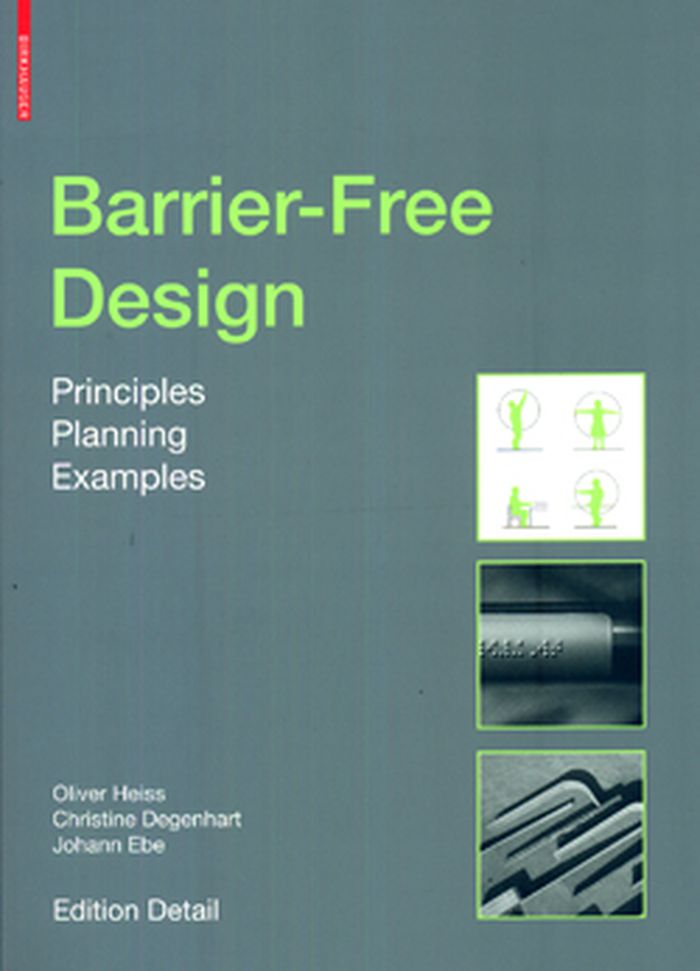
Building for everyone -- that is the best definition of what lies behind the unwieldy concept of ""barrier-free design"": the complete and total usability of buildings, including for those with disabilities, for the integration of all of society's members can only succeed when their environment is made accessible to them. Demographic changes demand new qualities of private and public space, qualities that are also required by new legislation. The Detail Practice volume Barrier-Free Design provides all planners and architects, but also interested building sponsors, with basic practical information and a range of possible planning implementations in the domain of barrier freedom. It shows how corresponding requirements can be turned into aesthetically distinguished architecture. And it demonstrates that taking barrier freedom into account in the early planning stages of a project need not lead to additional costs compared to ""classical"" construction and design. In addition to an overview of planning fundamentals, the book also includes the associated body of rules and regulations as well as examples of how they are embodied in actual projects and perspectives on their development in the larger European context.
Barrier-free design
Actions:
Prix:
$59.99
(disponible sur commande)
Résumé:
Building for everyone -- that is the best definition of what lies behind the unwieldy concept of ""barrier-free design"": the complete and total usability of buildings, including for those with disabilities, for the integration of all of society's members can only succeed when their environment is made accessible to them. Demographic changes demand new qualities of private and public space, qualities that are also required by new legislation. The Detail Practice volume Barrier-Free Design provides all planners and architects, but also interested building sponsors, with basic practical information and a range of possible planning implementations in the domain of barrier freedom. It shows how corresponding requirements can be turned into aesthetically distinguished architecture. And it demonstrates that taking barrier freedom into account in the early planning stages of a project need not lead to additional costs compared to ""classical"" construction and design. In addition to an overview of planning fundamentals, the book also includes the associated body of rules and regulations as well as examples of how they are embodied in actual projects and perspectives on their development in the larger European context.
Classification:
livres
livres
Publication:
novembre 2010
novembre 2010


