


1009 Résultats
Classification:
périodiques
périodiques
Titre:
Border crossing issue 144
Border crossing issue 144
Actions:
Prix:
$9.95
(disponible sur commande)
Résumé:
In this issue, Border Crossings looks in large part at contemporary sculpture in the work of two artists, American icon Richard Serra and Montreal-based Jean-Pierre Gauthier; In the articles section, Gary Pearson discusses works by senior Canadian photographer and filmmaker, Ian Wallace, in “The Art of Deep Collecting: Ian Wallace and the Rennie Museum”. Michael Davidge(...)
$9.95
(disponible sur commande)
Résumé:
In this issue, Border Crossings looks in large part at contemporary sculpture in the work of two artists, American icon Richard Serra and Montreal-based Jean-Pierre Gauthier; In the articles section, Gary Pearson discusses works by senior Canadian photographer and filmmaker, Ian Wallace, in “The Art of Deep Collecting: Ian Wallace and the Rennie Museum”. Michael Davidge(...)
Titre:
Border crossing issue 144
Actions:
Prix:
$9.95
(disponible sur commande)
Résumé:
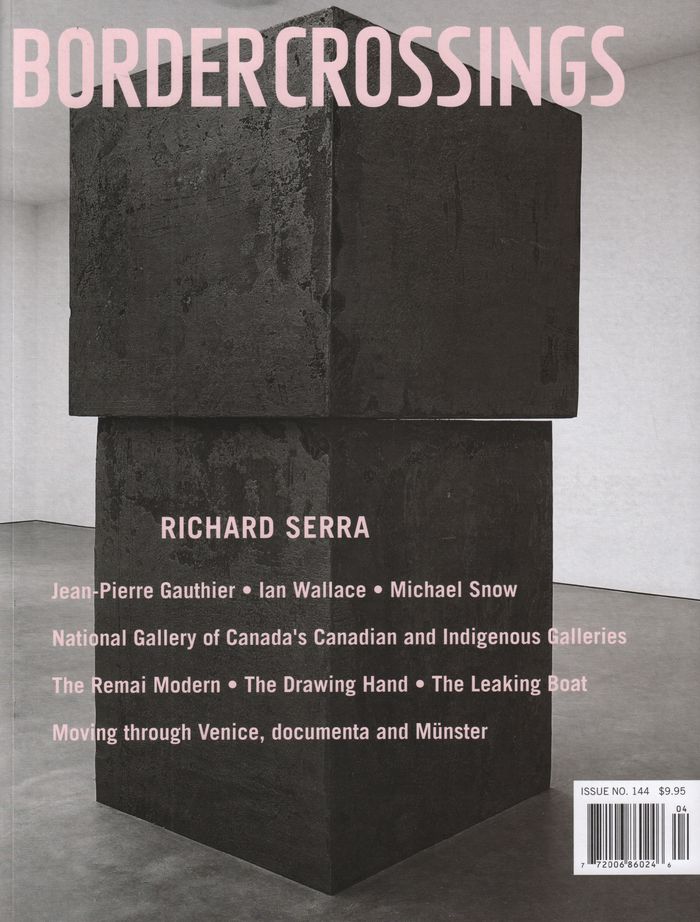
In this issue, Border Crossings looks in large part at contemporary sculpture in the work of two artists, American icon Richard Serra and Montreal-based Jean-Pierre Gauthier; In the articles section, Gary Pearson discusses works by senior Canadian photographer and filmmaker, Ian Wallace, in “The Art of Deep Collecting: Ian Wallace and the Rennie Museum”. Michael Davidge takes an in-depth look at the National Gallery of Canada after the recent reconfiguration of its Canadian and Indigenous Galleries; Stephen Horne takes the “grand tour” of arts exhibitions as the Venice Biennale, documenta, and the Münster Skulptur Projekte align in what is nearly a once-in-a-lifetime exhibition lineup; Aryen Hoekstra discuses fakery and fiction in the work of artist Thomas Demand, filmmaker Alexander Kluge and scenographer Anna Viebrock in “The Boat is Leaking. The Captain Lied.”
Border crossing issue 144
Actions:
Prix:
$9.95
(disponible sur commande)
Résumé:
In this issue, Border Crossings looks in large part at contemporary sculpture in the work of two artists, American icon Richard Serra and Montreal-based Jean-Pierre Gauthier; In the articles section, Gary Pearson discusses works by senior Canadian photographer and filmmaker, Ian Wallace, in “The Art of Deep Collecting: Ian Wallace and the Rennie Museum”. Michael Davidge takes an in-depth look at the National Gallery of Canada after the recent reconfiguration of its Canadian and Indigenous Galleries; Stephen Horne takes the “grand tour” of arts exhibitions as the Venice Biennale, documenta, and the Münster Skulptur Projekte align in what is nearly a once-in-a-lifetime exhibition lineup; Aryen Hoekstra discuses fakery and fiction in the work of artist Thomas Demand, filmmaker Alexander Kluge and scenographer Anna Viebrock in “The Boat is Leaking. The Captain Lied.”
Classification:
périodiques
périodiques
Publication:
décembre 2017
décembre 2017
Sujet:
Revues
Revues
Classification:
livres
livres
Prix:
$37.95
(disponible sur commande)
Résumé:
Life in the countryside, often perceived as either idyllic or depleted, has long been misrepresented. Challenging the stereotypes and myths that surround the idea of rurality, "Our Rural Selves" interrogates and represents individual and collective memories of childhood in rural landscapes and small towns. Drawing on visual artifacts whose origins range from the early(...)
$37.95
(disponible sur commande)
Résumé:
Life in the countryside, often perceived as either idyllic or depleted, has long been misrepresented. Challenging the stereotypes and myths that surround the idea of rurality, "Our Rural Selves" interrogates and represents individual and collective memories of childhood in rural landscapes and small towns. Drawing on visual artifacts whose origins range from the early(...)
Titre:
Our rural selves: memory and the visual in Canadian childhoods
Actions:
Prix:
$37.95
(disponible sur commande)
Résumé:
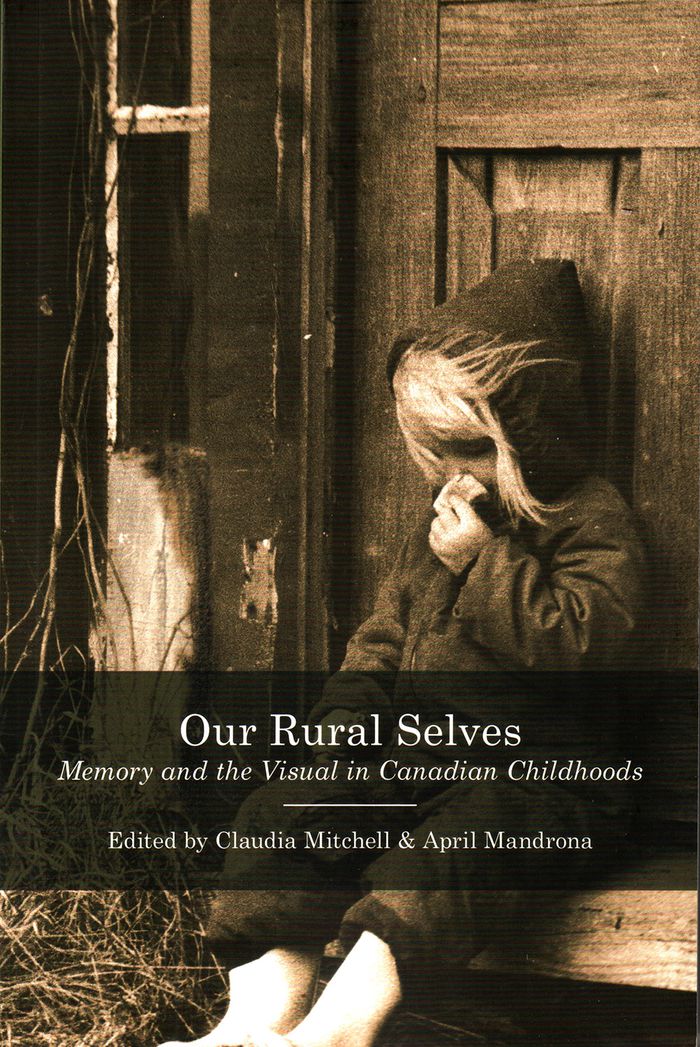
Life in the countryside, often perceived as either idyllic or depleted, has long been misrepresented. Challenging the stereotypes and myths that surround the idea of rurality, "Our Rural Selves" interrogates and represents individual and collective memories of childhood in rural landscapes and small towns. Drawing on visual artifacts whose origins range from the early twentieth century to today, such as photographs, films, objects, picture books, and digital games, contributors offer readings of childhood that are geographically, ethnically, and culturally diverse. They examine the memories of Indigenous children, the experiences of back-to-the-land youth, and boom-or-bust childhoods within the petroleum, farming, and fishing industries. Illustrating often neglected and overlooked aspects of adolescence, this collection suggests new ways of studying social connectedness and collective futures. "Our Rural Selves" explores representation, imagination, and what it means to grow up rural in Canada.
Our rural selves: memory and the visual in Canadian childhoods
Actions:
Prix:
$37.95
(disponible sur commande)
Résumé:
Life in the countryside, often perceived as either idyllic or depleted, has long been misrepresented. Challenging the stereotypes and myths that surround the idea of rurality, "Our Rural Selves" interrogates and represents individual and collective memories of childhood in rural landscapes and small towns. Drawing on visual artifacts whose origins range from the early twentieth century to today, such as photographs, films, objects, picture books, and digital games, contributors offer readings of childhood that are geographically, ethnically, and culturally diverse. They examine the memories of Indigenous children, the experiences of back-to-the-land youth, and boom-or-bust childhoods within the petroleum, farming, and fishing industries. Illustrating often neglected and overlooked aspects of adolescence, this collection suggests new ways of studying social connectedness and collective futures. "Our Rural Selves" explores representation, imagination, and what it means to grow up rural in Canada.
Classification:
livres
livres
Publication:
avril 2019
avril 2019
Sujet:
Architecture du Canada
Architecture du Canada
Classification:
livres
livres
Prix:
$45.00
(disponible sur commande)
Résumé:
John M. Lyle (18721945) was an anomaly among architects: a Beaux-Arts classicist who nevertheless found much inspiration in modernism, allowing his own traditionalist practice to be affected in form and detail by a brave new emphasis on minimalism and indigenous influence. With ornamentation showcasing local flora and fauna and a turn to native landscape for inspiration,(...)
$45.00
(disponible sur commande)
Résumé:
John M. Lyle (18721945) was an anomaly among architects: a Beaux-Arts classicist who nevertheless found much inspiration in modernism, allowing his own traditionalist practice to be affected in form and detail by a brave new emphasis on minimalism and indigenous influence. With ornamentation showcasing local flora and fauna and a turn to native landscape for inspiration,(...)
Titre:
A progressive traditionalist: John M. Lyle, architect
Actions:
Prix:
$45.00
(disponible sur commande)
Résumé:
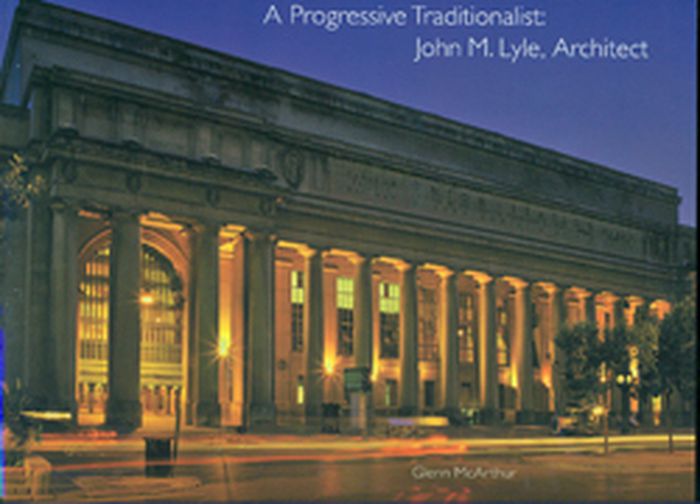
John M. Lyle (18721945) was an anomaly among architects: a Beaux-Arts classicist who nevertheless found much inspiration in modernism, allowing his own traditionalist practice to be affected in form and detail by a brave new emphasis on minimalism and indigenous influence. With ornamentation showcasing local flora and fauna and a turn to native landscape for inspiration, his innumerable buildings contributed to a burgeoning nationalism in the field. A Progressive Traditionalist traces this aesthetic trajectory, documenting Lyles training at Yale and in Paris, his early career in New York and his later success in Toronto, including countless legendary banks and residences and the iconic Union Station. Part biography and part architectural history, and extensively illustrated with colour photographs and drawings throughout, this book is the first to examine in depth the important contributions of one of the early twentieth centurys foremost architects.
A progressive traditionalist: John M. Lyle, architect
Actions:
Prix:
$45.00
(disponible sur commande)
Résumé:
John M. Lyle (18721945) was an anomaly among architects: a Beaux-Arts classicist who nevertheless found much inspiration in modernism, allowing his own traditionalist practice to be affected in form and detail by a brave new emphasis on minimalism and indigenous influence. With ornamentation showcasing local flora and fauna and a turn to native landscape for inspiration, his innumerable buildings contributed to a burgeoning nationalism in the field. A Progressive Traditionalist traces this aesthetic trajectory, documenting Lyles training at Yale and in Paris, his early career in New York and his later success in Toronto, including countless legendary banks and residences and the iconic Union Station. Part biography and part architectural history, and extensively illustrated with colour photographs and drawings throughout, this book is the first to examine in depth the important contributions of one of the early twentieth centurys foremost architects.
Classification:
livres
livres
Publication:
mars 2009
mars 2009
Sujet:
Architecture du Canada
Architecture du Canada
Classification:
livres
livres
Titre:
Cecilia Vicuña: Deer book
Cecilia Vicuña: Deer book
Actions:
Prix:
$65.00
(disponible sur commande)
Résumé:
Inspired initially by Jerome Rothenberg’s translation Flower World Variations, which Cecilia Vicuña (born 1948) first encountered in 1985, ''Cecilia Vicuña: Deer Book'' brings together nearly 40 years of the artist’s poetry, "poethical" translations and drawings related to cosmologies and mythologies surrounding the deer, and sacrificial dance in cultures around the(...)
$65.00
(disponible sur commande)
Résumé:
Inspired initially by Jerome Rothenberg’s translation Flower World Variations, which Cecilia Vicuña (born 1948) first encountered in 1985, ''Cecilia Vicuña: Deer Book'' brings together nearly 40 years of the artist’s poetry, "poethical" translations and drawings related to cosmologies and mythologies surrounding the deer, and sacrificial dance in cultures around the(...)
Titre:
Cecilia Vicuña: Deer book
Actions:
Prix:
$65.00
(disponible sur commande)
Résumé:
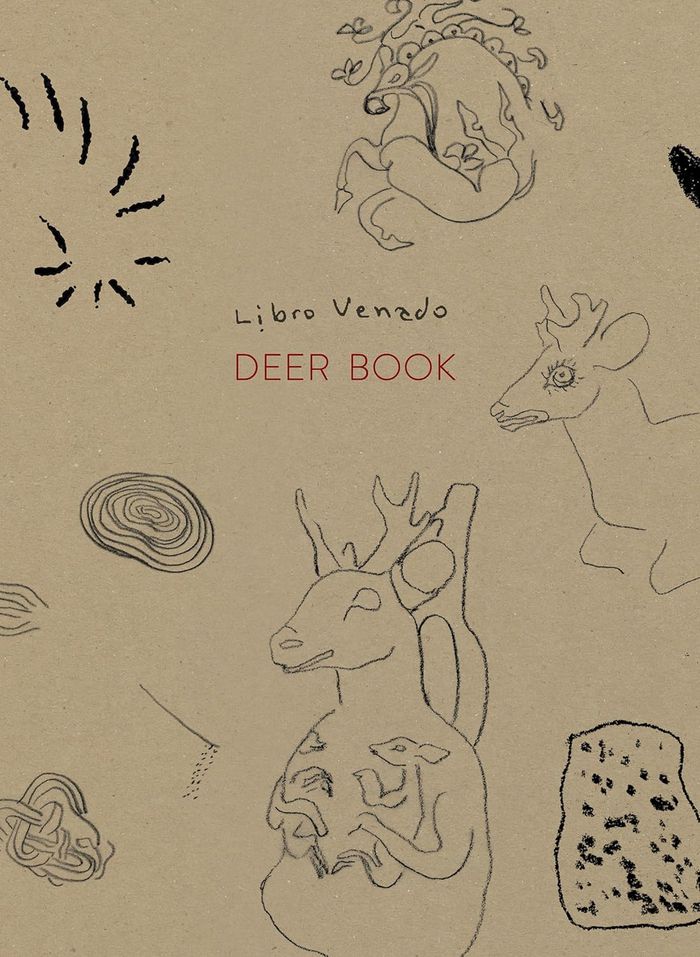
Inspired initially by Jerome Rothenberg’s translation Flower World Variations, which Cecilia Vicuña (born 1948) first encountered in 1985, ''Cecilia Vicuña: Deer Book'' brings together nearly 40 years of the artist’s poetry, "poethical" translations and drawings related to cosmologies and mythologies surrounding the deer, and sacrificial dance in cultures around the world. Woven like one of her quipu installations, Vicuña’s texts—which include original compositions in Spanish as well as English translations by Daniel Borzutzky—become meditations on translation, not just of the sacred nature of this animal but on how our understandings of ceremony and ritual are transformed by this ongoing process. Taken as inspiration rather than conundrum, the impossibility of translation opens up poetic possibilities for Vicuña as she continues her lifelong exploration into the nature of communication across eras and distant lands, languages and shared symbols within Indigenous spiritualities.
Cecilia Vicuña: Deer book
Actions:
Prix:
$65.00
(disponible sur commande)
Résumé:
Inspired initially by Jerome Rothenberg’s translation Flower World Variations, which Cecilia Vicuña (born 1948) first encountered in 1985, ''Cecilia Vicuña: Deer Book'' brings together nearly 40 years of the artist’s poetry, "poethical" translations and drawings related to cosmologies and mythologies surrounding the deer, and sacrificial dance in cultures around the world. Woven like one of her quipu installations, Vicuña’s texts—which include original compositions in Spanish as well as English translations by Daniel Borzutzky—become meditations on translation, not just of the sacred nature of this animal but on how our understandings of ceremony and ritual are transformed by this ongoing process. Taken as inspiration rather than conundrum, the impossibility of translation opens up poetic possibilities for Vicuña as she continues her lifelong exploration into the nature of communication across eras and distant lands, languages and shared symbols within Indigenous spiritualities.
Classification:
livres
livres
Publication:
août 2023
août 2023
Classification:
livres
livres
Actions:
Prix:
$15.00
(disponible sur commande)
Résumé:
The June issue looks at the housing spectrum, with a particular focus on non-market and affordable housing. Odile Hénault starts our journey in Montreal, where two shelters—Le Christin by Atelier Big City and Les Studios du PAS by L. McComber in collaboration with Inform—offer dignity to people experiencing homelessness. We next travel to Beaverton Heights, a transitional(...)
$15.00
(disponible sur commande)
Résumé:
The June issue looks at the housing spectrum, with a particular focus on non-market and affordable housing. Odile Hénault starts our journey in Montreal, where two shelters—Le Christin by Atelier Big City and Les Studios du PAS by L. McComber in collaboration with Inform—offer dignity to people experiencing homelessness. We next travel to Beaverton Heights, a transitional(...)
Titre:
Canadian architect v.70 no.04 June 2025
Actions:
Prix:
$15.00
(disponible sur commande)
Résumé:
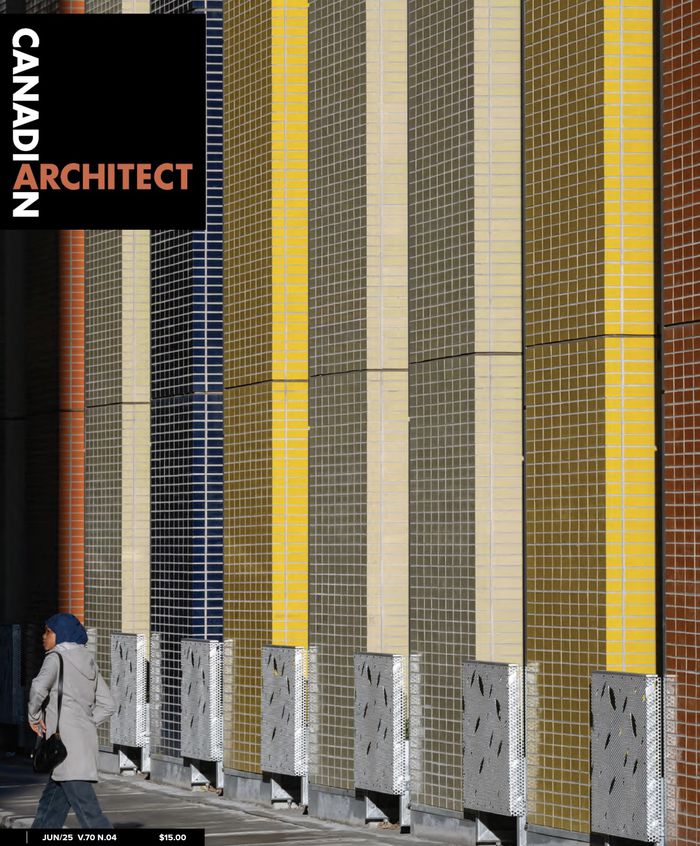
The June issue looks at the housing spectrum, with a particular focus on non-market and affordable housing. Odile Hénault starts our journey in Montreal, where two shelters—Le Christin by Atelier Big City and Les Studios du PAS by L. McComber in collaboration with Inform—offer dignity to people experiencing homelessness. We next travel to Beaverton Heights, a transitional housing project in the Region of Durham, Ontario. Designed by Montgomery Sisam Architects, the complex addresses the often-invisible homelessness of a rural area, and expands the aesthetic possibilities of modular construction. In Toronto, we visit Gerrard Healthy Housing by Atkinson Architect, which aims to add gentle density to an established neighbourhood. We also tour Anduhyaun, LGA Architectural Partners’ shelter for Indigenous women, which offers a place of nurture and grounding for its clients. And more...
Canadian architect v.70 no.04 June 2025
Actions:
Prix:
$15.00
(disponible sur commande)
Résumé:
The June issue looks at the housing spectrum, with a particular focus on non-market and affordable housing. Odile Hénault starts our journey in Montreal, where two shelters—Le Christin by Atelier Big City and Les Studios du PAS by L. McComber in collaboration with Inform—offer dignity to people experiencing homelessness. We next travel to Beaverton Heights, a transitional housing project in the Region of Durham, Ontario. Designed by Montgomery Sisam Architects, the complex addresses the often-invisible homelessness of a rural area, and expands the aesthetic possibilities of modular construction. In Toronto, we visit Gerrard Healthy Housing by Atkinson Architect, which aims to add gentle density to an established neighbourhood. We also tour Anduhyaun, LGA Architectural Partners’ shelter for Indigenous women, which offers a place of nurture and grounding for its clients. And more...
Classification:
livres
livres
Publication:
juin 2025
juin 2025
Sujet:
Revues
Revues
Classification:
livres
livres

Actions:
Prix:
$37.99
(disponible en magasin)
Résumé:
''Checkpoint 300'', the highly securitized border facility between occupied Bethlehem and Jerusalem, is a central feature of Israeli control of Palestinian land and life. An apparatus of turnstiles, overcrowded corridors, and invasive inspections, the checkpoint regulates the movement of hundreds of thousands of Palestinians, granting access to some while excluding most.(...)
$37.99
(disponible en magasin)
Résumé:
''Checkpoint 300'', the highly securitized border facility between occupied Bethlehem and Jerusalem, is a central feature of Israeli control of Palestinian land and life. An apparatus of turnstiles, overcrowded corridors, and invasive inspections, the checkpoint regulates the movement of hundreds of thousands of Palestinians, granting access to some while excluding most.(...)
Titre:
Checkpoint 3000: Colonial space in Palestine
Actions:
Prix:
$37.99
(disponible en magasin)
Résumé:
''Checkpoint 300'', the highly securitized border facility between occupied Bethlehem and Jerusalem, is a central feature of Israeli control of Palestinian land and life. An apparatus of turnstiles, overcrowded corridors, and invasive inspections, the checkpoint regulates the movement of hundreds of thousands of Palestinians, granting access to some while excluding most. Offering a nuanced exploration of space, Mark Griffiths reveals ''Checkpoint 300'' as a stark symbol of Israeli colonialism that embodies larger systems of control and violence. Drawing on nearly a decade of fieldwork, Griffiths examines how colonial power infiltrates family dynamics, enforces gendered mobility restrictions, shapes local economies, and extends into the global exchange of capital and security technologies. He also underscores how Palestinians endure and resist under oppressive conditions and how indigenous forms of life and living are sustained, illuminating how colonial space is contested and countered, unmade and remade.
Checkpoint 3000: Colonial space in Palestine
Actions:
Prix:
$37.99
(disponible en magasin)
Résumé:
''Checkpoint 300'', the highly securitized border facility between occupied Bethlehem and Jerusalem, is a central feature of Israeli control of Palestinian land and life. An apparatus of turnstiles, overcrowded corridors, and invasive inspections, the checkpoint regulates the movement of hundreds of thousands of Palestinians, granting access to some while excluding most. Offering a nuanced exploration of space, Mark Griffiths reveals ''Checkpoint 300'' as a stark symbol of Israeli colonialism that embodies larger systems of control and violence. Drawing on nearly a decade of fieldwork, Griffiths examines how colonial power infiltrates family dynamics, enforces gendered mobility restrictions, shapes local economies, and extends into the global exchange of capital and security technologies. He also underscores how Palestinians endure and resist under oppressive conditions and how indigenous forms of life and living are sustained, illuminating how colonial space is contested and countered, unmade and remade.
Classification:
livres
livres
Publication:
août 2025
août 2025
Sujet:
Arch Moyen-Orient
Arch Moyen-Orient
Classification:
livres
livres
Prix:
$64.00
(disponible en magasin)
Résumé:
Native artists are at the vanguard of performance art practices and discourse, using humor as a strategy for cultural critique and reflection, parsing the relationships between objecthood and agency. This reader centers performance and theater as origin points for the development of contemporary art by Native American, First Nations, Métis, Inuit and Alaska Native(...)
$64.00
(disponible en magasin)
Résumé:
Native artists are at the vanguard of performance art practices and discourse, using humor as a strategy for cultural critique and reflection, parsing the relationships between objecthood and agency. This reader centers performance and theater as origin points for the development of contemporary art by Native American, First Nations, Métis, Inuit and Alaska Native(...)
Titre:
Native visual sovereignty: A reader on art and performance
Actions:
Prix:
$64.00
(disponible en magasin)
Résumé:
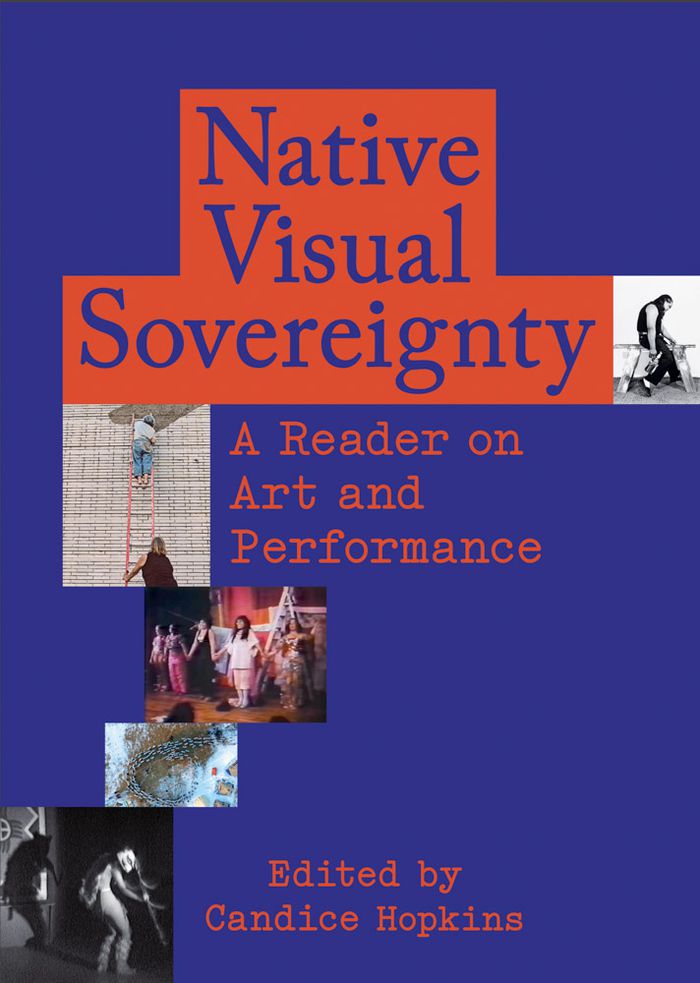
Native artists are at the vanguard of performance art practices and discourse, using humor as a strategy for cultural critique and reflection, parsing the relationships between objecthood and agency. This reader centers performance and theater as origin points for the development of contemporary art by Native American, First Nations, Métis, Inuit and Alaska Native artists. Song, dance and music are also posited as a basis for collectivity and resistance and a means to speak to a time when Native traditional ceremony and public gatherings were illegal in both the United States and Canada. Featuring excerpts from the 1969 document Indian Theatre: An Artistic Experiment in Process, this illustrated reader also includes four long-form essays by leading Indigenous scholars, nine artist contributions, oral history interviews and a selection of key texts from the fields of Native contemporary art, art history and theory.
Native visual sovereignty: A reader on art and performance
Actions:
Prix:
$64.00
(disponible en magasin)
Résumé:
Native artists are at the vanguard of performance art practices and discourse, using humor as a strategy for cultural critique and reflection, parsing the relationships between objecthood and agency. This reader centers performance and theater as origin points for the development of contemporary art by Native American, First Nations, Métis, Inuit and Alaska Native artists. Song, dance and music are also posited as a basis for collectivity and resistance and a means to speak to a time when Native traditional ceremony and public gatherings were illegal in both the United States and Canada. Featuring excerpts from the 1969 document Indian Theatre: An Artistic Experiment in Process, this illustrated reader also includes four long-form essays by leading Indigenous scholars, nine artist contributions, oral history interviews and a selection of key texts from the fields of Native contemporary art, art history and theory.
Classification:
livres
livres
Publication:
décembre 2025
décembre 2025
Sujet:
Théorie de l’art
Théorie de l’art
Classification:
livres
livres
Prix:
$26.50
(disponible en magasin)
Résumé:
In this sequel to her enduring bestseller ''Hope in the Dark'', Solnit surveys a world that has changed dramatically since the year 1960. Despite the forces seeking to turn back the clock on history, change is not a possibility; it is an inevitability. The changes amount to nothing less than dismantling an old civilization and building a new one, whose newness is often(...)
$26.50
(disponible en magasin)
Résumé:
In this sequel to her enduring bestseller ''Hope in the Dark'', Solnit surveys a world that has changed dramatically since the year 1960. Despite the forces seeking to turn back the clock on history, change is not a possibility; it is an inevitability. The changes amount to nothing less than dismantling an old civilization and building a new one, whose newness is often(...)
Titre:
The beginning comes after the end: Notes on a world of change
Actions:
Prix:
$26.50
(disponible en magasin)
Résumé:
In this sequel to her enduring bestseller ''Hope in the Dark'', Solnit surveys a world that has changed dramatically since the year 1960. Despite the forces seeking to turn back the clock on history, change is not a possibility; it is an inevitability. The changes amount to nothing less than dismantling an old civilization and building a new one, whose newness is often the return of the old ways and wisdoms. In this rising worldview, interconnection is a core idea and value. But because the transformation is obscured within a longer arc of history, its scale is seldom recognized. While the white nationalist and authoritarian backlash drives individualism and isolation, this new world embraces antiracism, feminism, a more expansive understanding of gender, environmental thinking, scientific breakthroughs, and Indigenous and non-Western ideas, pointing toward a more interconnected, relational world.
The beginning comes after the end: Notes on a world of change
Actions:
Prix:
$26.50
(disponible en magasin)
Résumé:
In this sequel to her enduring bestseller ''Hope in the Dark'', Solnit surveys a world that has changed dramatically since the year 1960. Despite the forces seeking to turn back the clock on history, change is not a possibility; it is an inevitability. The changes amount to nothing less than dismantling an old civilization and building a new one, whose newness is often the return of the old ways and wisdoms. In this rising worldview, interconnection is a core idea and value. But because the transformation is obscured within a longer arc of history, its scale is seldom recognized. While the white nationalist and authoritarian backlash drives individualism and isolation, this new world embraces antiracism, feminism, a more expansive understanding of gender, environmental thinking, scientific breakthroughs, and Indigenous and non-Western ideas, pointing toward a more interconnected, relational world.
Classification:
livres
livres
Publication:
avril 2026
avril 2026
Sujet:
Social
Social
Classification:
livres
livres
Actions:
Prix:
$36.95
(disponible sur commande)
Résumé:
In ''Designs for the Pluriverse'' Arturo Escobar presents a new vision of design theory and practice aimed at channeling design's world-making capacity toward ways of being and doing that are deeply attuned to justice and the Earth. Noting that most design—from consumer goods and digital technologies to built environments—currently serves capitalist ends, Escobar argues(...)
$36.95
(disponible sur commande)
Résumé:
In ''Designs for the Pluriverse'' Arturo Escobar presents a new vision of design theory and practice aimed at channeling design's world-making capacity toward ways of being and doing that are deeply attuned to justice and the Earth. Noting that most design—from consumer goods and digital technologies to built environments—currently serves capitalist ends, Escobar argues(...)
Titre:
Designs for the pluriverse: Radical interdependence, autonomy, and the making of world
Actions:
Prix:
$36.95
(disponible sur commande)
Résumé:
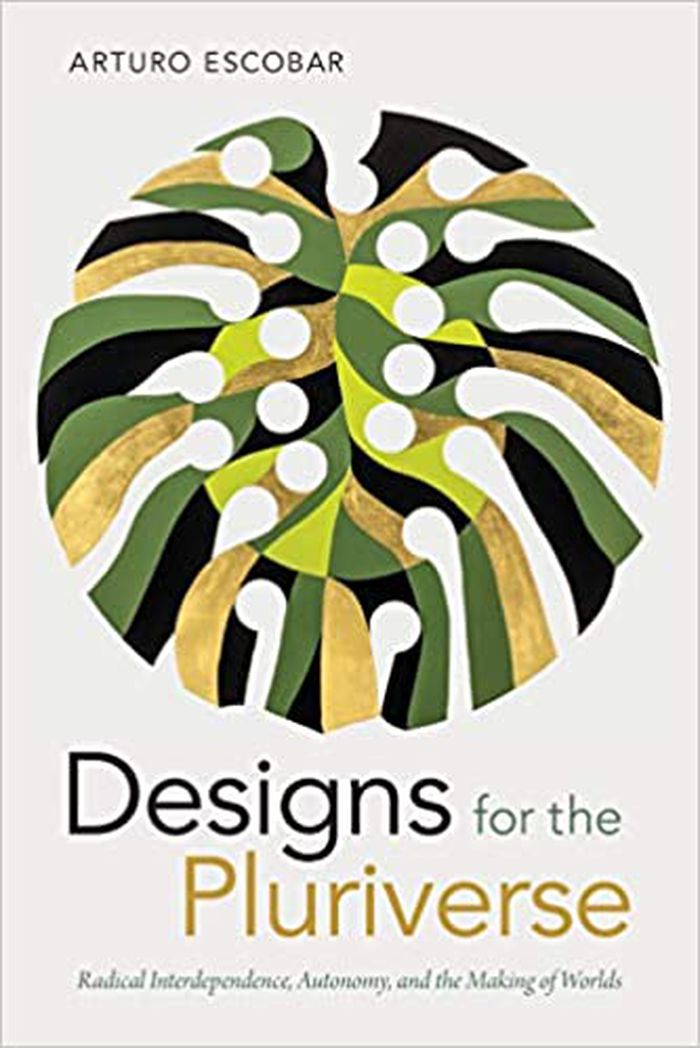
In ''Designs for the Pluriverse'' Arturo Escobar presents a new vision of design theory and practice aimed at channeling design's world-making capacity toward ways of being and doing that are deeply attuned to justice and the Earth. Noting that most design—from consumer goods and digital technologies to built environments—currently serves capitalist ends, Escobar argues for the development of an 'autonomous design' that eschews commercial and modernizing aims in favor of more collaborative and placed-based approaches. Such design attends to questions of environment, experience, and politics while focusing on the production of human experience based on the radical interdependence of all beings. Mapping autonomous design’s principles to the history of decolonial efforts of indigenous and Afro-descended people in Latin America, Escobar shows how refiguring current design practices could lead to the creation of more just and sustainable social orders.
Designs for the pluriverse: Radical interdependence, autonomy, and the making of world
Actions:
Prix:
$36.95
(disponible sur commande)
Résumé:
In ''Designs for the Pluriverse'' Arturo Escobar presents a new vision of design theory and practice aimed at channeling design's world-making capacity toward ways of being and doing that are deeply attuned to justice and the Earth. Noting that most design—from consumer goods and digital technologies to built environments—currently serves capitalist ends, Escobar argues for the development of an 'autonomous design' that eschews commercial and modernizing aims in favor of more collaborative and placed-based approaches. Such design attends to questions of environment, experience, and politics while focusing on the production of human experience based on the radical interdependence of all beings. Mapping autonomous design’s principles to the history of decolonial efforts of indigenous and Afro-descended people in Latin America, Escobar shows how refiguring current design practices could lead to the creation of more just and sustainable social orders.
Classification:
livres
livres
Publication:
mars 2018
mars 2018
Classification:
livres
livres
Titre:
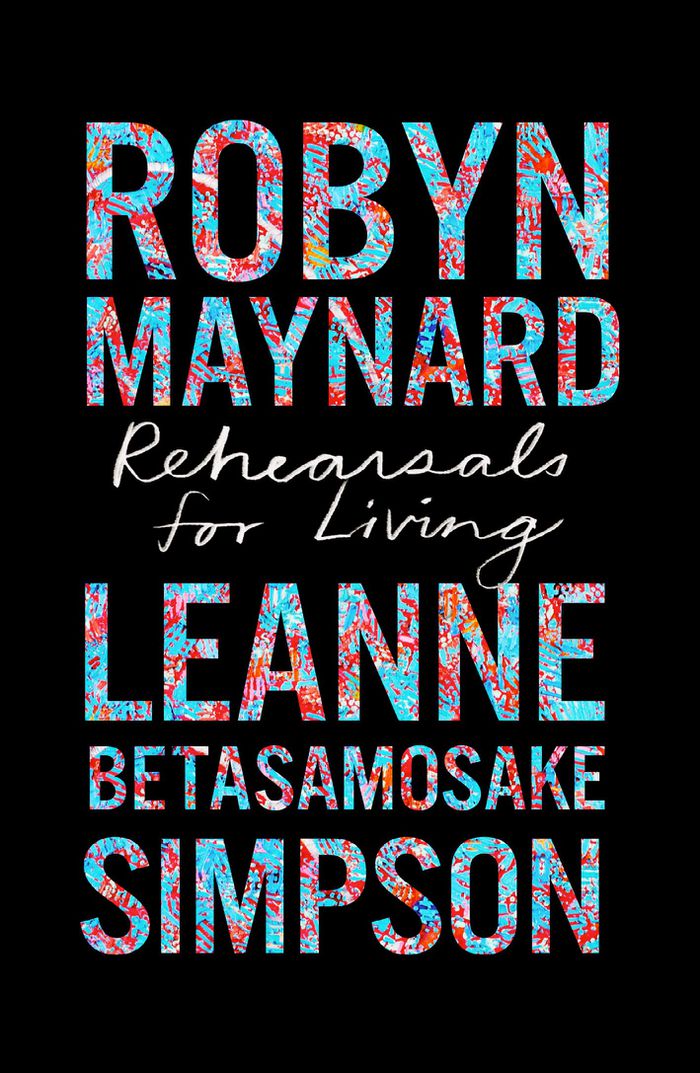
Rehearsals for living
Rehearsals for living
Actions:
Prix:
$32.00
(disponible sur commande)
Résumé:
When the world entered pandemic lockdown in spring 2020, Robyn Maynard and Leanne Betasamosake Simpson began writing each other letters—a gesture sparked by a desire for kinship and connection in a world shattering under the intersecting crises of pandemic, police killings, and climate catastrophe. These letters soon grew into a powerful exchange about where we go from(...)
$32.00
(disponible sur commande)
Résumé:
When the world entered pandemic lockdown in spring 2020, Robyn Maynard and Leanne Betasamosake Simpson began writing each other letters—a gesture sparked by a desire for kinship and connection in a world shattering under the intersecting crises of pandemic, police killings, and climate catastrophe. These letters soon grew into a powerful exchange about where we go from(...)
Titre:
Rehearsals for living
Actions:
Prix:
$32.00
(disponible sur commande)
Résumé:
When the world entered pandemic lockdown in spring 2020, Robyn Maynard and Leanne Betasamosake Simpson began writing each other letters—a gesture sparked by a desire for kinship and connection in a world shattering under the intersecting crises of pandemic, police killings, and climate catastrophe. These letters soon grew into a powerful exchange about where we go from here. Ths book is a captivating and visionary work—part debate, part dialogue, part lively and detailed familial correspondence between two razor-sharp writers. By articulating to each other Black and Indigenous perspectives on our unprecedented here and now, and reiterating the long-disavowed histories of slavery and colonization that have brought us to this moment, Maynard and Simpson create something new: an urgent demand for a different way forward, and a poetic call to dream up other ways of ordering earthly life.
Rehearsals for living
Actions:
Prix:
$32.00
(disponible sur commande)
Résumé:
When the world entered pandemic lockdown in spring 2020, Robyn Maynard and Leanne Betasamosake Simpson began writing each other letters—a gesture sparked by a desire for kinship and connection in a world shattering under the intersecting crises of pandemic, police killings, and climate catastrophe. These letters soon grew into a powerful exchange about where we go from here. Ths book is a captivating and visionary work—part debate, part dialogue, part lively and detailed familial correspondence between two razor-sharp writers. By articulating to each other Black and Indigenous perspectives on our unprecedented here and now, and reiterating the long-disavowed histories of slavery and colonization that have brought us to this moment, Maynard and Simpson create something new: an urgent demand for a different way forward, and a poetic call to dream up other ways of ordering earthly life.
Classification:
livres
livres
Publication:
juin 2022
juin 2022
Sujet:
Social
Social


