


13794 Résultats
Classification:
livres
livres
Titre:
Différence et répétition
Différence et répétition
Actions:
Prix:
$59.95
(disponible sur commande)
Résumé:
Un concept de différence implique une différence qui n'est pas seulement entre deux choses, et qui n'est pas non plus une simple différence conceptuelle. Faut-il aller jusqu'à une différence infinie (théologie) ou se tourner vers une raison du sensible (physique) ? A quelles conditions constituer un pur concept de la différence ? Un concept de la répétition implique une(...)
$59.95
(disponible sur commande)
Résumé:
Un concept de différence implique une différence qui n'est pas seulement entre deux choses, et qui n'est pas non plus une simple différence conceptuelle. Faut-il aller jusqu'à une différence infinie (théologie) ou se tourner vers une raison du sensible (physique) ? A quelles conditions constituer un pur concept de la différence ? Un concept de la répétition implique une(...)
Titre:
Différence et répétition
Actions:
Prix:
$59.95
(disponible sur commande)
Résumé:
Un concept de différence implique une différence qui n'est pas seulement entre deux choses, et qui n'est pas non plus une simple différence conceptuelle. Faut-il aller jusqu'à une différence infinie (théologie) ou se tourner vers une raison du sensible (physique) ? A quelles conditions constituer un pur concept de la différence ? Un concept de la répétition implique une répétition qui n'est pas seulement celle d'une même chose ou d'un même élément. Les choses ou les éléments supposent une répétition plus profonde, rythmique. L'art n'est-il pas à la recherche de cette répétition paradoxale, mais aussi la pensée (Kierkegaard, Nietzsche, Péguy) ? Quelle chance y a-t-il pour que les deux concepts, de différence pure et de répétition profonde, se rejoignent et s'identifient ?
Différence et répétition
Actions:
Prix:
$59.95
(disponible sur commande)
Résumé:
Un concept de différence implique une différence qui n'est pas seulement entre deux choses, et qui n'est pas non plus une simple différence conceptuelle. Faut-il aller jusqu'à une différence infinie (théologie) ou se tourner vers une raison du sensible (physique) ? A quelles conditions constituer un pur concept de la différence ? Un concept de la répétition implique une répétition qui n'est pas seulement celle d'une même chose ou d'un même élément. Les choses ou les éléments supposent une répétition plus profonde, rythmique. L'art n'est-il pas à la recherche de cette répétition paradoxale, mais aussi la pensée (Kierkegaard, Nietzsche, Péguy) ? Quelle chance y a-t-il pour que les deux concepts, de différence pure et de répétition profonde, se rejoignent et s'identifient ?
Classification:
livres
livres
Publication:
janvier 1900, Paris
janvier 1900, Paris
Sujet:
Théorie/ philosophie
Théorie/ philosophie
Classification:
livres
livres
Actions:
Prix:
$31.95
(disponible sur commande)
Résumé:
La philosophie n'est ni contemplation, ni réflexion, ni communication. Elle est l'activité qui crée les concepts. Comment se distingue-t-elle de ses rivales, qui prétendent nous fournir en concepts (comme le marketing aujourd'hui) ? La philosophie doit nous dire quelle est la nature créative du concept, et quels en sont les concomitants : la pure immanence, le plan(...)
$31.95
(disponible sur commande)
Résumé:
La philosophie n'est ni contemplation, ni réflexion, ni communication. Elle est l'activité qui crée les concepts. Comment se distingue-t-elle de ses rivales, qui prétendent nous fournir en concepts (comme le marketing aujourd'hui) ? La philosophie doit nous dire quelle est la nature créative du concept, et quels en sont les concomitants : la pure immanence, le plan(...)
Titre:
Qu'est-ce que la philosophie?
Actions:
Prix:
$31.95
(disponible sur commande)
Résumé:
La philosophie n'est ni contemplation, ni réflexion, ni communication. Elle est l'activité qui crée les concepts. Comment se distingue-t-elle de ses rivales, qui prétendent nous fournir en concepts (comme le marketing aujourd'hui) ? La philosophie doit nous dire quelle est la nature créative du concept, et quels en sont les concomitants : la pure immanence, le plan d'immanence, et les personnages conceptuels. Par là, la philosophie se distingue de la science et de la logique. Celles-ci n'opèrent pas par concepts, mais par fonctions, sur un plan de référence et avec des observateurs partiels. L'art opère par percepts et affects, sur un plan de composition avec des figures esthétiques. La philosophie n'est pas interdisciplinaire, elle est elle-même une discipline entière qui entre en résonance avec la science et avec l'art, comme ceux-ci avec elle trouver le concept d'une fonction, etc. C'est que les trois plans sont les trois manières dont le cerveau recoupe le chaos, et l'affronte. Ce sont les Chaoïdes. La pensée ne se constitue que dans ce rapport où elle risque toujours de sombrer.
Qu'est-ce que la philosophie?
Actions:
Prix:
$31.95
(disponible sur commande)
Résumé:
La philosophie n'est ni contemplation, ni réflexion, ni communication. Elle est l'activité qui crée les concepts. Comment se distingue-t-elle de ses rivales, qui prétendent nous fournir en concepts (comme le marketing aujourd'hui) ? La philosophie doit nous dire quelle est la nature créative du concept, et quels en sont les concomitants : la pure immanence, le plan d'immanence, et les personnages conceptuels. Par là, la philosophie se distingue de la science et de la logique. Celles-ci n'opèrent pas par concepts, mais par fonctions, sur un plan de référence et avec des observateurs partiels. L'art opère par percepts et affects, sur un plan de composition avec des figures esthétiques. La philosophie n'est pas interdisciplinaire, elle est elle-même une discipline entière qui entre en résonance avec la science et avec l'art, comme ceux-ci avec elle trouver le concept d'une fonction, etc. C'est que les trois plans sont les trois manières dont le cerveau recoupe le chaos, et l'affronte. Ce sont les Chaoïdes. La pensée ne se constitue que dans ce rapport où elle risque toujours de sombrer.
Classification:
livres
livres
Publication:
janvier 1900, Paris
janvier 1900, Paris
Sujet:
Théorie/ philosophie
Théorie/ philosophie
Classification:
livres
livres
Prix:
$62.00
(disponible sur commande)
Résumé:
An inquiry into emergent media's rich lineage, "Devices of Wonder" explores the artful machines humans have used to augment visual perception. The encyclopedic cabinet of curiosities serves as a model for this study of the archaic instruments lurking in state-of-the art technology. Featured in "Devices of Wonder" are android automata, lunar landscapes, perspective(...)
$62.00
(disponible sur commande)
Résumé:
An inquiry into emergent media's rich lineage, "Devices of Wonder" explores the artful machines humans have used to augment visual perception. The encyclopedic cabinet of curiosities serves as a model for this study of the archaic instruments lurking in state-of-the art technology. Featured in "Devices of Wonder" are android automata, lunar landscapes, perspective(...)
Sujet:
Théorie de l’architecture
Théorie de l’architecture
Publication:
novembre 2001, Los Angeles
novembre 2001, Los Angeles
Titre:
Devices of wonder from the world in a box to images on a screen
Actions:
Prix:
$62.00
(disponible sur commande)
Résumé:
An inquiry into emergent media's rich lineage, "Devices of Wonder" explores the artful machines humans have used to augment visual perception. The encyclopedic cabinet of curiosities serves as a model for this study of the archaic instruments lurking in state-of-the art technology. Featured in "Devices of Wonder" are android automata, lunar landscapes, perspective theaters, vues d'optique, microscopes, magnetic games, magic lanterns, camera obscuras, boxes by Joseph Cornell, Lucas Samaras's Mirrored Room, Suzanne Anker's Zoosemiotics, Mark Tilden's UniBug 3.1, panoramic works by Jeff Wall and Giovanni Lusieri, paintings by Jean-Baptiste Chardin and Joseph Wright of Derby, projections by Diana Thater and James Turrell, and a pop-up book by Kara Walker. Barbara Stafford's introduction weaves these fascinating artifacts into a provocative narrative analyzing the complex links between old and new media. Her wide-ranging investigation is complemented by thirty-one short essays in which Frances Terpak tracks the often surprising connections among individual items. Like the cabinet of curiosities, "Devices of Wonder" functions as an analogical instrument, reframing the beautiful "eye machines" that continue to mediate our encounters with the world. This book is published in conjunction with an exhibition at the Getty from November 13, 2001, through February 6, 2002.
Devices of wonder from the world in a box to images on a screen
Actions:
Prix:
$62.00
(disponible sur commande)
Résumé:
An inquiry into emergent media's rich lineage, "Devices of Wonder" explores the artful machines humans have used to augment visual perception. The encyclopedic cabinet of curiosities serves as a model for this study of the archaic instruments lurking in state-of-the art technology. Featured in "Devices of Wonder" are android automata, lunar landscapes, perspective theaters, vues d'optique, microscopes, magnetic games, magic lanterns, camera obscuras, boxes by Joseph Cornell, Lucas Samaras's Mirrored Room, Suzanne Anker's Zoosemiotics, Mark Tilden's UniBug 3.1, panoramic works by Jeff Wall and Giovanni Lusieri, paintings by Jean-Baptiste Chardin and Joseph Wright of Derby, projections by Diana Thater and James Turrell, and a pop-up book by Kara Walker. Barbara Stafford's introduction weaves these fascinating artifacts into a provocative narrative analyzing the complex links between old and new media. Her wide-ranging investigation is complemented by thirty-one short essays in which Frances Terpak tracks the often surprising connections among individual items. Like the cabinet of curiosities, "Devices of Wonder" functions as an analogical instrument, reframing the beautiful "eye machines" that continue to mediate our encounters with the world. This book is published in conjunction with an exhibition at the Getty from November 13, 2001, through February 6, 2002.
Classification:
livres
livres
Publication:
novembre 2001, Los Angeles
novembre 2001, Los Angeles
Sujet:
Théorie de l’architecture
Théorie de l’architecture
Classification:
livres
livres
Prix:
$29.95
(disponible sur commande)
Résumé:
The Cold War was the war that never happened. Nonetheless, it spurred the most significant buildup of military contingency this country has ever known: from the bunkers of Greenbrier, West Virginia, to the "proving grounds" of Nevada, where entire cities were built only to be vaporized. The Cold War was waged on a territory that knew no boundaries but left few traces.(...)
$29.95
(disponible sur commande)
Résumé:
The Cold War was the war that never happened. Nonetheless, it spurred the most significant buildup of military contingency this country has ever known: from the bunkers of Greenbrier, West Virginia, to the "proving grounds" of Nevada, where entire cities were built only to be vaporized. The Cold War was waged on a territory that knew no boundaries but left few traces.(...)
Titre:
Survival city : adventures among the ruins of atomic America
Actions:
Prix:
$29.95
(disponible sur commande)
Résumé:
The Cold War was the war that never happened. Nonetheless, it spurred the most significant buildup of military contingency this country has ever known: from the bunkers of Greenbrier, West Virginia, to the "proving grounds" of Nevada, where entire cities were built only to be vaporized. The Cold War was waged on a territory that knew no boundaries but left few traces. In this fascinating--and at turns frightening and comical--travelogue to the hidden battlefields of the Cold War, Tom Vanderbilt travels the Interstate (itself a product of the Cold War) to uncover the sites of Cold War architecture and reflect on their lasting heritage. In the process, Vanderbilt shows us what the Cold War landscape looked like, how architecture tried to adapt to the threat of mass destruction, how cities coped with the knowledge that they were nuclear targets, and finally what remains of the Cold War theater today, both its visible and invisible legacies. Ultimately, Vanderbilt gives us a deep look into our cultural soul, the dreams and fears that drove us for the last half of the 20th century.
Survival city : adventures among the ruins of atomic America
Actions:
Prix:
$29.95
(disponible sur commande)
Résumé:
The Cold War was the war that never happened. Nonetheless, it spurred the most significant buildup of military contingency this country has ever known: from the bunkers of Greenbrier, West Virginia, to the "proving grounds" of Nevada, where entire cities were built only to be vaporized. The Cold War was waged on a territory that knew no boundaries but left few traces. In this fascinating--and at turns frightening and comical--travelogue to the hidden battlefields of the Cold War, Tom Vanderbilt travels the Interstate (itself a product of the Cold War) to uncover the sites of Cold War architecture and reflect on their lasting heritage. In the process, Vanderbilt shows us what the Cold War landscape looked like, how architecture tried to adapt to the threat of mass destruction, how cities coped with the knowledge that they were nuclear targets, and finally what remains of the Cold War theater today, both its visible and invisible legacies. Ultimately, Vanderbilt gives us a deep look into our cultural soul, the dreams and fears that drove us for the last half of the 20th century.
Classification:
livres
livres
Publication:
mars 2002, New York
mars 2002, New York
Sujet:
Théorie de l’architecture
Théorie de l’architecture
Classification:
livres
livres
Prix:
$63.95
(disponible sur commande)
Résumé:
In this engaging and generously illustrated book, Ann Satterthwaite traces the history of shopping and considers its meaning and significance.Examining trends in the United States and abroad where new approaches to an old activity are strengthening its social and civic role, she states that shopping is more than ever a public concern with profound public impacts.
$63.95
(disponible sur commande)
Résumé:
In this engaging and generously illustrated book, Ann Satterthwaite traces the history of shopping and considers its meaning and significance.Examining trends in the United States and abroad where new approaches to an old activity are strengthening its social and civic role, she states that shopping is more than ever a public concern with profound public impacts.
Titre:
Going shopping consumer choices and community consequences
Actions:
Prix:
$63.95
(disponible sur commande)
Résumé:
In this engaging and generously illustrated book, Ann Satterthwaite traces the history of shopping and considers its meaning and significance.Examining trends in the United States and abroad where new approaches to an old activity are strengthening its social and civic role, she states that shopping is more than ever a public concern with profound public impacts.
Going shopping consumer choices and community consequences
Actions:
Prix:
$63.95
(disponible sur commande)
Résumé:
In this engaging and generously illustrated book, Ann Satterthwaite traces the history of shopping and considers its meaning and significance.Examining trends in the United States and abroad where new approaches to an old activity are strengthening its social and civic role, she states that shopping is more than ever a public concern with profound public impacts.
Classification:
livres
livres
Publication:
novembre 2001, New Haven
novembre 2001, New Haven
Sujet:
Théorie de l’urbanisme
Théorie de l’urbanisme
Classification:
livres
livres
Prix:
$65.00
(disponible sur commande)
$65.00
(disponible sur commande)
Sujet:
Théorie de l’urbanisme
Théorie de l’urbanisme
Publication:
janvier 2002, Cologne
janvier 2002, Cologne
Titre:
Harvard Design School guide to shopping : project on the city 2
Actions:
Prix:
$65.00
(disponible sur commande)
Résumé:
Harvard Design School guide to shopping : project on the city 2
Actions:
Prix:
$65.00
(disponible sur commande)
Résumé:
Classification:
livres
livres
Publication:
janvier 2002, Cologne
janvier 2002, Cologne
Sujet:
Théorie de l’urbanisme
Théorie de l’urbanisme
Classification:
livres
livres
Titre:
Urban design futures
Urban design futures
Actions:
Prix:
$72.95
(disponible sur commande)
Résumé:
The last decade has seen the rise of urban design which has taken a central position in the new agendas for urban regeneration and renaissance. Urban design has moved from marginality to mainstream. The principles espoused by urban designers over the past 30 years are now accepted as key to a better urban environment and as we move towards greater sustainability,(...)
$72.95
(disponible sur commande)
Résumé:
The last decade has seen the rise of urban design which has taken a central position in the new agendas for urban regeneration and renaissance. Urban design has moved from marginality to mainstream. The principles espoused by urban designers over the past 30 years are now accepted as key to a better urban environment and as we move towards greater sustainability,(...)
Sujet:
Théorie de l’urbanisme
Théorie de l’urbanisme
Publication:
octobre 2005, London, New York
octobre 2005, London, New York
Titre:
Urban design futures
Actions:
Prix:
$72.95
(disponible sur commande)
Résumé:
The last decade has seen the rise of urban design which has taken a central position in the new agendas for urban regeneration and renaissance. Urban design has moved from marginality to mainstream. The principles espoused by urban designers over the past 30 years are now accepted as key to a better urban environment and as we move towards greater sustainability, different ideas are emerging that are challenging some of the accepted urban design norms; urban design is at a watershed. Essays from an international cast of authors review progress and explore emerging ideas: should urban design reflect the future rather than recreate the past? What are the new driving forces that will shape urban living and hence urban design in the future? This book explores new concepts and points the way towards a series of urban design paradigms for the twenty-first century.
Urban design futures
Actions:
Prix:
$72.95
(disponible sur commande)
Résumé:
The last decade has seen the rise of urban design which has taken a central position in the new agendas for urban regeneration and renaissance. Urban design has moved from marginality to mainstream. The principles espoused by urban designers over the past 30 years are now accepted as key to a better urban environment and as we move towards greater sustainability, different ideas are emerging that are challenging some of the accepted urban design norms; urban design is at a watershed. Essays from an international cast of authors review progress and explore emerging ideas: should urban design reflect the future rather than recreate the past? What are the new driving forces that will shape urban living and hence urban design in the future? This book explores new concepts and points the way towards a series of urban design paradigms for the twenty-first century.
Classification:
livres
livres
Publication:
octobre 2005, London, New York
octobre 2005, London, New York
Sujet:
Théorie de l’urbanisme
Théorie de l’urbanisme
Classification:
livres
livres
Actions:
Prix:
$26.00
(disponible sur commande)
Résumé:
"Bodyline" is a visual essay on the human body, approaches its subject in a spirit both playful and seriously experimental. Organised by themes in turn figurative and abstract, organic, and mechanical, immaterial, "Bodyline" contains not one predictable image of the body. Instead it uses diffracted views to conjure seven alternative visions of the flesh in the age of(...)
$26.00
(disponible sur commande)
Résumé:
"Bodyline" is a visual essay on the human body, approaches its subject in a spirit both playful and seriously experimental. Organised by themes in turn figurative and abstract, organic, and mechanical, immaterial, "Bodyline" contains not one predictable image of the body. Instead it uses diffracted views to conjure seven alternative visions of the flesh in the age of(...)
Sujet:
Théorie de l’architecture
Théorie de l’architecture
Publication:
janvier 1900, London
janvier 1900, London
Titre:
Bodyline : the end of our meta-mechanical body
Actions:
Prix:
$26.00
(disponible sur commande)
Résumé:
"Bodyline" is a visual essay on the human body, approaches its subject in a spirit both playful and seriously experimental. Organised by themes in turn figurative and abstract, organic, and mechanical, immaterial, "Bodyline" contains not one predictable image of the body. Instead it uses diffracted views to conjure seven alternative visions of the flesh in the age of meta-mechanical reproduction, reconstructing the human physique by means of synthetic images, clothing patterns and technical blueprints. As such, "Bodyline" is a much about perception and delineation as it is about the body. The book is devided into three chapters loosely based on Robert Hughe's "Nothing if not critical". Here, through, the original categories are reversed : "Ancestors" explores the latest paradigms of virtual bodies, the computer-generated meshes of the gaming industry, which are also figurative; "Moderns", which constitutes the book's central exploration, features twentieth-century micro-narratives of pattern and garnment in which the body is already all but unrecognisable; and "Contemporaries" celebrates the reflections of self-portraiture through the projective network of Mongean geometry. The seven images of the body contained in this book - "Ectopic birth" (Nazila Maghzian), "How tall am I?" (Sharon Givony), "Vital points" (Eiichi Matsuda), "Inside out" (Kun-Min Kim), "Growth and decay" (Lawrence Ler), "Tiny deaths" (Carolin Hinne) and "10 years after" (Ema Bonifacio) - are accompagned by concise, literary texts.
Bodyline : the end of our meta-mechanical body
Actions:
Prix:
$26.00
(disponible sur commande)
Résumé:
"Bodyline" is a visual essay on the human body, approaches its subject in a spirit both playful and seriously experimental. Organised by themes in turn figurative and abstract, organic, and mechanical, immaterial, "Bodyline" contains not one predictable image of the body. Instead it uses diffracted views to conjure seven alternative visions of the flesh in the age of meta-mechanical reproduction, reconstructing the human physique by means of synthetic images, clothing patterns and technical blueprints. As such, "Bodyline" is a much about perception and delineation as it is about the body. The book is devided into three chapters loosely based on Robert Hughe's "Nothing if not critical". Here, through, the original categories are reversed : "Ancestors" explores the latest paradigms of virtual bodies, the computer-generated meshes of the gaming industry, which are also figurative; "Moderns", which constitutes the book's central exploration, features twentieth-century micro-narratives of pattern and garnment in which the body is already all but unrecognisable; and "Contemporaries" celebrates the reflections of self-portraiture through the projective network of Mongean geometry. The seven images of the body contained in this book - "Ectopic birth" (Nazila Maghzian), "How tall am I?" (Sharon Givony), "Vital points" (Eiichi Matsuda), "Inside out" (Kun-Min Kim), "Growth and decay" (Lawrence Ler), "Tiny deaths" (Carolin Hinne) and "10 years after" (Ema Bonifacio) - are accompagned by concise, literary texts.
Classification:
livres
livres
Publication:
janvier 1900, London
janvier 1900, London
Sujet:
Théorie de l’architecture
Théorie de l’architecture
Classification:
livres
livres

Prix:
$39.95
(disponible sur commande)
Résumé:
1950-2000. Cinquante années de pratique, cinquante années de fréquentations d'un milieu professionnel disparate, contradictoire, passionné et passionnel mais toujours surprenant, celui des architectes. Puiser dans ce vivier, y prélever quelques échantillons caractéristiques et les livrer à cru au lecteur, peut être considéré comme éclairant pour l'architecture. Certes(...)
$39.95
(disponible sur commande)
Résumé:
1950-2000. Cinquante années de pratique, cinquante années de fréquentations d'un milieu professionnel disparate, contradictoire, passionné et passionnel mais toujours surprenant, celui des architectes. Puiser dans ce vivier, y prélever quelques échantillons caractéristiques et les livrer à cru au lecteur, peut être considéré comme éclairant pour l'architecture. Certes(...)
Titre:
Portraits d'architectes (impressionnistes et véridiques)
Actions:
Prix:
$39.95
(disponible sur commande)
Résumé:
1950-2000. Cinquante années de pratique, cinquante années de fréquentations d'un milieu professionnel disparate, contradictoire, passionné et passionnel mais toujours surprenant, celui des architectes. Puiser dans ce vivier, y prélever quelques échantillons caractéristiques et les livrer à cru au lecteur, peut être considéré comme éclairant pour l'architecture. Certes il ne s'agit là que de spécimens, mais ils ont l'avantage d'être saisis sur le vif dans leur vécu quotidien, en une sorte d'instantané photographique. Il reste qu'à la lumière rouge, dans le bain du révélateur, se distingue un peu de la conscience profonde de chacun.
Portraits d'architectes (impressionnistes et véridiques)
Actions:
Prix:
$39.95
(disponible sur commande)
Résumé:
1950-2000. Cinquante années de pratique, cinquante années de fréquentations d'un milieu professionnel disparate, contradictoire, passionné et passionnel mais toujours surprenant, celui des architectes. Puiser dans ce vivier, y prélever quelques échantillons caractéristiques et les livrer à cru au lecteur, peut être considéré comme éclairant pour l'architecture. Certes il ne s'agit là que de spécimens, mais ils ont l'avantage d'être saisis sur le vif dans leur vécu quotidien, en une sorte d'instantané photographique. Il reste qu'à la lumière rouge, dans le bain du révélateur, se distingue un peu de la conscience profonde de chacun.
Classification:
livres
livres
Publication:
janvier 1900, Paris
janvier 1900, Paris
Sujet:
Théorie de l’architecture
Théorie de l’architecture
Classification:
livres
livres
Actions:
Prix:
$32.50
(disponible sur commande)
Résumé:
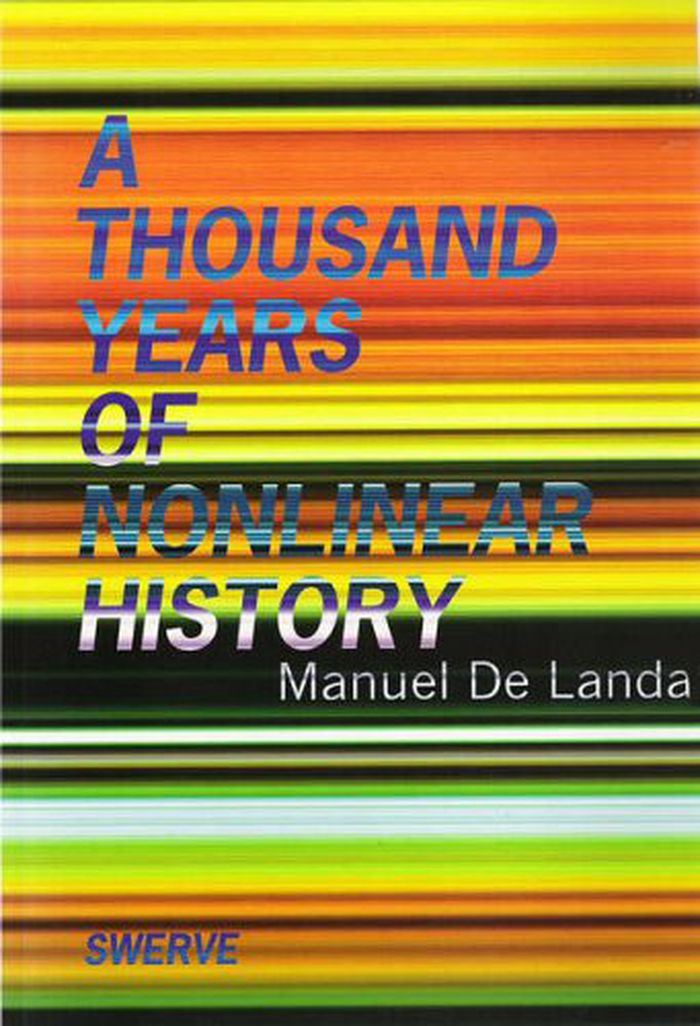
A Thousand Years of Nonlinear History sketches the outlines of a renewed materialist philosophy of history in the tradition of Fernand Braudel, Gilles Deleuze, and Félix Guattari. Working against prevailing attitudes that see history merely as the arena of texts, discourses, ideologies, and metaphors, De Landa traces the concrete movements and interplays of matter and(...)
$32.50
(disponible sur commande)
Résumé:
A Thousand Years of Nonlinear History sketches the outlines of a renewed materialist philosophy of history in the tradition of Fernand Braudel, Gilles Deleuze, and Félix Guattari. Working against prevailing attitudes that see history merely as the arena of texts, discourses, ideologies, and metaphors, De Landa traces the concrete movements and interplays of matter and(...)
Titre:
A thousand years of nonlinear history
Actions:
Prix:
$32.50
(disponible sur commande)
Résumé:
A Thousand Years of Nonlinear History sketches the outlines of a renewed materialist philosophy of history in the tradition of Fernand Braudel, Gilles Deleuze, and Félix Guattari. Working against prevailing attitudes that see history merely as the arena of texts, discourses, ideologies, and metaphors, De Landa traces the concrete movements and interplays of matter and energy through human populations in the last millennium.
A thousand years of nonlinear history
Actions:
Prix:
$32.50
(disponible sur commande)
Résumé:
A Thousand Years of Nonlinear History sketches the outlines of a renewed materialist philosophy of history in the tradition of Fernand Braudel, Gilles Deleuze, and Félix Guattari. Working against prevailing attitudes that see history merely as the arena of texts, discourses, ideologies, and metaphors, De Landa traces the concrete movements and interplays of matter and energy through human populations in the last millennium.
Classification:
livres
livres
Publication:
septembre 2000
septembre 2000
Sujet:
Théorie/ philosophie
Théorie/ philosophie


