


12621 Résultats
Classification:
archives
Niveau de description archivistique:
Fonds
archives
Niveau de description archivistique:
Fonds
Numéro de référence:
AP149
Résumé:
The Minimum Cost Housing Group fonds documents the publications related to the research projects for low-cost housing and energy conservation undertaken by the Minimum Cost Housing Group of the McGill School of Architecture from the early 1970s to the early 2000s. The documents in the fonds consist of textual records, photographs and artefacts relating to over 20 of the group's publications, theses, research papers, offices records and reference material.
AP149
Résumé:
The Minimum Cost Housing Group fonds documents the publications related to the research projects for low-cost housing and energy conservation undertaken by the Minimum Cost Housing Group of the McGill School of Architecture from the early 1970s to the early 2000s. The documents in the fonds consist of textual records, photographs and artefacts relating to over 20 of the group's publications, theses, research papers, offices records and reference material.
Personnes et institutions:
Date:
1947, 1970-2012
1947, 1970-2012
Titre:
Fonds Minimum Cost Housing Group
Actions:
AP149
Résumé:
The Minimum Cost Housing Group fonds documents the publications related to the research projects for low-cost housing and energy conservation undertaken by the Minimum Cost Housing Group of the McGill School of Architecture from the early 1970s to the early 2000s. The documents in the fonds consist of textual records, photographs and artefacts relating to over 20 of the group's publications, theses, research papers, offices records and reference material.
Fonds Minimum Cost Housing Group
Actions:
AP149
Résumé:
The Minimum Cost Housing Group fonds documents the publications related to the research projects for low-cost housing and energy conservation undertaken by the Minimum Cost Housing Group of the McGill School of Architecture from the early 1970s to the early 2000s. The documents in the fonds consist of textual records, photographs and artefacts relating to over 20 of the group's publications, theses, research papers, offices records and reference material.
Classification:
archives
Niveau de description archivistique:
Fonds
archives
Niveau de description archivistique:
Fonds
Date:
1947, 1970-2012
1947, 1970-2012
Personnes et institutions:
Niveau de description archivistique:
Projet
Projet
Numéro de référence:
AP018.S1.1970.PR01
Description:
This project series documents an addition to the IBM headquarters building in North York, Ontario from 1970-1971. The office identified the project number as 70002. This project consisted of an expansion to the north-west corner of the U-shaped building, which was located on top of a ravine at 1150 Eglington Avenue East, on the same property as the IBM plant. The planning for this addition had already commenced when the original building's construction began by Parkin Architects Planners in 1965 (see project series AP018.S1.1965.PR03 described in this fonds). The project is recorded through reprographic copies of drawings dating from 1970, which consist of construction sets of architectural, structural, electrical and mechanical drawings.
AP018.S1.1970.PR01
Description:
This project series documents an addition to the IBM headquarters building in North York, Ontario from 1970-1971. The office identified the project number as 70002. This project consisted of an expansion to the north-west corner of the U-shaped building, which was located on top of a ravine at 1150 Eglington Avenue East, on the same property as the IBM plant. The planning for this addition had already commenced when the original building's construction began by Parkin Architects Planners in 1965 (see project series AP018.S1.1965.PR03 described in this fonds). The project is recorded through reprographic copies of drawings dating from 1970, which consist of construction sets of architectural, structural, electrical and mechanical drawings.
Personnes et institutions:
Date:
1970
1970
Titre:
IBM Headquarters Building, Addition, North York, Ontario (1970-1971)
Actions:
AP018.S1.1970.PR01
Description:
This project series documents an addition to the IBM headquarters building in North York, Ontario from 1970-1971. The office identified the project number as 70002. This project consisted of an expansion to the north-west corner of the U-shaped building, which was located on top of a ravine at 1150 Eglington Avenue East, on the same property as the IBM plant. The planning for this addition had already commenced when the original building's construction began by Parkin Architects Planners in 1965 (see project series AP018.S1.1965.PR03 described in this fonds). The project is recorded through reprographic copies of drawings dating from 1970, which consist of construction sets of architectural, structural, electrical and mechanical drawings.
IBM Headquarters Building, Addition, North York, Ontario (1970-1971)
Actions:
AP018.S1.1970.PR01
Description:
This project series documents an addition to the IBM headquarters building in North York, Ontario from 1970-1971. The office identified the project number as 70002. This project consisted of an expansion to the north-west corner of the U-shaped building, which was located on top of a ravine at 1150 Eglington Avenue East, on the same property as the IBM plant. The planning for this addition had already commenced when the original building's construction began by Parkin Architects Planners in 1965 (see project series AP018.S1.1965.PR03 described in this fonds). The project is recorded through reprographic copies of drawings dating from 1970, which consist of construction sets of architectural, structural, electrical and mechanical drawings.
Niveau de description archivistique:
Project
Project
Date:
1970
1970
Personnes et institutions:
Niveau de description archivistique:
Projet
Projet
Titre:
Nicollet Island
Nicollet Island
Numéro de référence:
AP143.S4.D188
Description:
File documents an unexecuted project for Nicollet Island, Minneapolis, Minnesota. The project was published in 'Design Quarterly', No. 101/102, "The River: Images of the Mississippi" (1976), pp. 80-83. Material in this file was probably produced in 1976. File contains design development drawings and presentation drawings.
AP143.S4.D188
Description:
File documents an unexecuted project for Nicollet Island, Minneapolis, Minnesota. The project was published in 'Design Quarterly', No. 101/102, "The River: Images of the Mississippi" (1976), pp. 80-83. Material in this file was probably produced in 1976. File contains design development drawings and presentation drawings.
Personnes et institutions:
Date:
[1976]
[1976]
Titre:
Nicollet Island
Actions:
AP143.S4.D188
Description:
File documents an unexecuted project for Nicollet Island, Minneapolis, Minnesota. The project was published in 'Design Quarterly', No. 101/102, "The River: Images of the Mississippi" (1976), pp. 80-83. Material in this file was probably produced in 1976. File contains design development drawings and presentation drawings.
Nicollet Island
Actions:
AP143.S4.D188
Description:
File documents an unexecuted project for Nicollet Island, Minneapolis, Minnesota. The project was published in 'Design Quarterly', No. 101/102, "The River: Images of the Mississippi" (1976), pp. 80-83. Material in this file was probably produced in 1976. File contains design development drawings and presentation drawings.
Niveau de description archivistique:
File 188
File 188
Date:
[1976]
[1976]
Personnes et institutions:
Classification:
dessins
dessins
Titre:
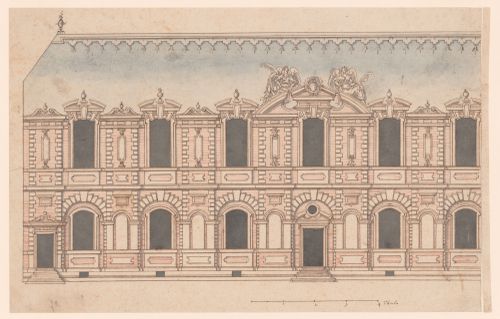
Elevation of a palace façade
Elevation of a palace façade
Actions:
Numéro de référence:
DR1970:0003
Description:
This drawing shows an exterior of a residential building. The artist uses color to suggest the materials used in construction; blue-grey for the pitched slate roof, brown for masonry details and architectural sculpture, and red striations for brickwork. This combination of materials was common in early modern France, where a play on color and materiality enlivened the façades of well-known royal edifices including the chateaux of Fontainebleau and Saint-Germain-en-Laye. As with the construction technique that interwove stone with brick, the architectural style depicted in the drawing combines traditional French ideas about building with classicizing elements imported to France via Italian artists and architects as well as through printed translations of Vitruvius’s 'De architectura' and Sebastiano Serlio’s architectural treatise. The inclusion of masonry rustication and the decorative urns that punctuate the roofline suggest a knowledge of classicizing trends in architectural ornament and a familiarity with the œuvre of artists working in the circle of the first and second Écoles de Fontainebleau. The structure’s elongated form suggests a gallery and the organization of the façade borrows the combination of slightly protruding vertical bays and long horizontal registers that characterizes Pierre Lescot’s wing of the Louvre, a project that would have been well-known in court circles in the latter half of the sixteenth century. Similarly, the two winged allegorical figures flanking the central pediment are reminiscent of Jean Goujon’s sculptural additions to the Lescot wing. In the Canadian Centre for Architecture’s drawing both figures hold palms, but the artist omitted any further identifying attributes, perhaps – along with the empty niches – as an invitation for the patron to imagine his or her own thematic program for the project.
DR1970:0003
Description:
This drawing shows an exterior of a residential building. The artist uses color to suggest the materials used in construction; blue-grey for the pitched slate roof, brown for masonry details and architectural sculpture, and red striations for brickwork. This combination of materials was common in early modern France, where a play on color and materiality enlivened the façades of well-known royal edifices including the chateaux of Fontainebleau and Saint-Germain-en-Laye. As with the construction technique that interwove stone with brick, the architectural style depicted in the drawing combines traditional French ideas about building with classicizing elements imported to France via Italian artists and architects as well as through printed translations of Vitruvius’s 'De architectura' and Sebastiano Serlio’s architectural treatise. The inclusion of masonry rustication and the decorative urns that punctuate the roofline suggest a knowledge of classicizing trends in architectural ornament and a familiarity with the œuvre of artists working in the circle of the first and second Écoles de Fontainebleau. The structure’s elongated form suggests a gallery and the organization of the façade borrows the combination of slightly protruding vertical bays and long horizontal registers that characterizes Pierre Lescot’s wing of the Louvre, a project that would have been well-known in court circles in the latter half of the sixteenth century. Similarly, the two winged allegorical figures flanking the central pediment are reminiscent of Jean Goujon’s sculptural additions to the Lescot wing. In the Canadian Centre for Architecture’s drawing both figures hold palms, but the artist omitted any further identifying attributes, perhaps – along with the empty niches – as an invitation for the patron to imagine his or her own thematic program for the project.
Personnes et institutions:
Date:
first quarter of the 16th century
first quarter of the 16th century
Titre:
Elevation of a palace façade
Actions:
DR1970:0003
Description:
This drawing shows an exterior of a residential building. The artist uses color to suggest the materials used in construction; blue-grey for the pitched slate roof, brown for masonry details and architectural sculpture, and red striations for brickwork. This combination of materials was common in early modern France, where a play on color and materiality enlivened the façades of well-known royal edifices including the chateaux of Fontainebleau and Saint-Germain-en-Laye. As with the construction technique that interwove stone with brick, the architectural style depicted in the drawing combines traditional French ideas about building with classicizing elements imported to France via Italian artists and architects as well as through printed translations of Vitruvius’s 'De architectura' and Sebastiano Serlio’s architectural treatise. The inclusion of masonry rustication and the decorative urns that punctuate the roofline suggest a knowledge of classicizing trends in architectural ornament and a familiarity with the œuvre of artists working in the circle of the first and second Écoles de Fontainebleau. The structure’s elongated form suggests a gallery and the organization of the façade borrows the combination of slightly protruding vertical bays and long horizontal registers that characterizes Pierre Lescot’s wing of the Louvre, a project that would have been well-known in court circles in the latter half of the sixteenth century. Similarly, the two winged allegorical figures flanking the central pediment are reminiscent of Jean Goujon’s sculptural additions to the Lescot wing. In the Canadian Centre for Architecture’s drawing both figures hold palms, but the artist omitted any further identifying attributes, perhaps – along with the empty niches – as an invitation for the patron to imagine his or her own thematic program for the project.
Elevation of a palace façade
Actions:
DR1970:0003
Description:
This drawing shows an exterior of a residential building. The artist uses color to suggest the materials used in construction; blue-grey for the pitched slate roof, brown for masonry details and architectural sculpture, and red striations for brickwork. This combination of materials was common in early modern France, where a play on color and materiality enlivened the façades of well-known royal edifices including the chateaux of Fontainebleau and Saint-Germain-en-Laye. As with the construction technique that interwove stone with brick, the architectural style depicted in the drawing combines traditional French ideas about building with classicizing elements imported to France via Italian artists and architects as well as through printed translations of Vitruvius’s 'De architectura' and Sebastiano Serlio’s architectural treatise. The inclusion of masonry rustication and the decorative urns that punctuate the roofline suggest a knowledge of classicizing trends in architectural ornament and a familiarity with the œuvre of artists working in the circle of the first and second Écoles de Fontainebleau. The structure’s elongated form suggests a gallery and the organization of the façade borrows the combination of slightly protruding vertical bays and long horizontal registers that characterizes Pierre Lescot’s wing of the Louvre, a project that would have been well-known in court circles in the latter half of the sixteenth century. Similarly, the two winged allegorical figures flanking the central pediment are reminiscent of Jean Goujon’s sculptural additions to the Lescot wing. In the Canadian Centre for Architecture’s drawing both figures hold palms, but the artist omitted any further identifying attributes, perhaps – along with the empty niches – as an invitation for the patron to imagine his or her own thematic program for the project.
Classification:
dessins
dessins
Date:
first quarter of the 16th century
first quarter of the 16th century
Personnes et institutions:
Classification:
archives
Niveau de description archivistique:
Fonds
archives
Niveau de description archivistique:
Fonds
Titre:
Bernard Tschumi fonds
Bernard Tschumi fonds
Numéro de référence:
AP214
Résumé:
The Bernard Tschumi fonds, dating from approximately 1965-2015, documents the professional activities of Bernard Tschumi including Tschumi’s career in academia and his professional practice as an architect through approximately 75 projects dating from the late 1980s to 2012.
AP214
Résumé:
The Bernard Tschumi fonds, dating from approximately 1965-2015, documents the professional activities of Bernard Tschumi including Tschumi’s career in academia and his professional practice as an architect through approximately 75 projects dating from the late 1980s to 2012.
Personnes et institutions:
Date:
circa 1964-2015
circa 1964-2015
Titre:
Bernard Tschumi fonds
Actions:
AP214
Résumé:
The Bernard Tschumi fonds, dating from approximately 1965-2015, documents the professional activities of Bernard Tschumi including Tschumi’s career in academia and his professional practice as an architect through approximately 75 projects dating from the late 1980s to 2012.
Bernard Tschumi fonds
Actions:
AP214
Résumé:
The Bernard Tschumi fonds, dating from approximately 1965-2015, documents the professional activities of Bernard Tschumi including Tschumi’s career in academia and his professional practice as an architect through approximately 75 projects dating from the late 1980s to 2012.
Classification:
archives
Niveau de description archivistique:
Fonds
archives
Niveau de description archivistique:
Fonds
Date:
circa 1964-2015
circa 1964-2015
Personnes et institutions:
Niveau de description archivistique:
Projet
Projet
Numéro de référence:
AP206.S1.1981.PR01
Description:
This project series documents a residence for Aditya Prakash in Chandigarh, India in 1981, and later, the addition of a studio to the house around 1992. Located on plot no. 18 on Street B in Sector 8C, the residence was two-storeys in height with a barsati and terrace making up the second floor. The studio addition was also two-storeys, with his architectural offices on the ground level and his painting studio above.[1] The studio's façade was marked with distinctive geometric windows of varying shapes and sizes that were red, blue and yellow in colour. The project is recorded through original drawings of plans, elevations, sections and perspectives of both the home and studio addition, dating from around 1981-1992. [1] Vikramaditya Prakash, One Continuous Line: Art, Architecture and Urbanism of Aditya Prakash (Ahmedabad, India: Mapin Publishing Pvt. Ltd., 2019), 232.
AP206.S1.1981.PR01
Description:
This project series documents a residence for Aditya Prakash in Chandigarh, India in 1981, and later, the addition of a studio to the house around 1992. Located on plot no. 18 on Street B in Sector 8C, the residence was two-storeys in height with a barsati and terrace making up the second floor. The studio addition was also two-storeys, with his architectural offices on the ground level and his painting studio above.[1] The studio's façade was marked with distinctive geometric windows of varying shapes and sizes that were red, blue and yellow in colour. The project is recorded through original drawings of plans, elevations, sections and perspectives of both the home and studio addition, dating from around 1981-1992. [1] Vikramaditya Prakash, One Continuous Line: Art, Architecture and Urbanism of Aditya Prakash (Ahmedabad, India: Mapin Publishing Pvt. Ltd., 2019), 232.
Personnes et institutions:
Date:
circa 1981-1992
circa 1981-1992
Titre:
Residence for Shri Aditya Prakash, Chandigarh, India (circa 1981-1992)
Actions:
AP206.S1.1981.PR01
Description:
This project series documents a residence for Aditya Prakash in Chandigarh, India in 1981, and later, the addition of a studio to the house around 1992. Located on plot no. 18 on Street B in Sector 8C, the residence was two-storeys in height with a barsati and terrace making up the second floor. The studio addition was also two-storeys, with his architectural offices on the ground level and his painting studio above.[1] The studio's façade was marked with distinctive geometric windows of varying shapes and sizes that were red, blue and yellow in colour. The project is recorded through original drawings of plans, elevations, sections and perspectives of both the home and studio addition, dating from around 1981-1992. [1] Vikramaditya Prakash, One Continuous Line: Art, Architecture and Urbanism of Aditya Prakash (Ahmedabad, India: Mapin Publishing Pvt. Ltd., 2019), 232.
Residence for Shri Aditya Prakash, Chandigarh, India (circa 1981-1992)
Actions:
AP206.S1.1981.PR01
Description:
This project series documents a residence for Aditya Prakash in Chandigarh, India in 1981, and later, the addition of a studio to the house around 1992. Located on plot no. 18 on Street B in Sector 8C, the residence was two-storeys in height with a barsati and terrace making up the second floor. The studio addition was also two-storeys, with his architectural offices on the ground level and his painting studio above.[1] The studio's façade was marked with distinctive geometric windows of varying shapes and sizes that were red, blue and yellow in colour. The project is recorded through original drawings of plans, elevations, sections and perspectives of both the home and studio addition, dating from around 1981-1992. [1] Vikramaditya Prakash, One Continuous Line: Art, Architecture and Urbanism of Aditya Prakash (Ahmedabad, India: Mapin Publishing Pvt. Ltd., 2019), 232.
Niveau de description archivistique:
Project
Project
Date:
circa 1981-1992
circa 1981-1992
Personnes et institutions:
Niveau de description archivistique:
Projet
Projet
Titre:
House, Selsdon
House, Selsdon
Numéro de référence:
AP144.S2.D42
Description:
File documents an unexecuted project for a detached private residence located at Beech Way in Selsdon, Surrey, (now Croydon, part of Greater London), England, for Jean Newlove (Mrs. Jean McColl). The local planning authority refused the project citing aesthetic considerations. The house was to be constructed as a "series of interleaved reinforced concrete trays" supported by columns ("Cedric Price Supplement No. 2", 'Architectural Design', vol. 41, (January 1971), 36). File contains conceptual and design development sketches that explore exterior elevations, stair and glazing details; axonometric drawings and sections that show relationship between floor levels and functions; and framing plans showing the preliminary structural layout. Material in this file was produced between 1962 and 1964. File contains conceptual drawings, design development drawings, presentation drawings, photographic materials, and textual records.
AP144.S2.D42
Description:
File documents an unexecuted project for a detached private residence located at Beech Way in Selsdon, Surrey, (now Croydon, part of Greater London), England, for Jean Newlove (Mrs. Jean McColl). The local planning authority refused the project citing aesthetic considerations. The house was to be constructed as a "series of interleaved reinforced concrete trays" supported by columns ("Cedric Price Supplement No. 2", 'Architectural Design', vol. 41, (January 1971), 36). File contains conceptual and design development sketches that explore exterior elevations, stair and glazing details; axonometric drawings and sections that show relationship between floor levels and functions; and framing plans showing the preliminary structural layout. Material in this file was produced between 1962 and 1964. File contains conceptual drawings, design development drawings, presentation drawings, photographic materials, and textual records.
Personnes et institutions:
Date:
1962-1964
1962-1964
Titre:
House, Selsdon
Actions:
AP144.S2.D42
Description:
File documents an unexecuted project for a detached private residence located at Beech Way in Selsdon, Surrey, (now Croydon, part of Greater London), England, for Jean Newlove (Mrs. Jean McColl). The local planning authority refused the project citing aesthetic considerations. The house was to be constructed as a "series of interleaved reinforced concrete trays" supported by columns ("Cedric Price Supplement No. 2", 'Architectural Design', vol. 41, (January 1971), 36). File contains conceptual and design development sketches that explore exterior elevations, stair and glazing details; axonometric drawings and sections that show relationship between floor levels and functions; and framing plans showing the preliminary structural layout. Material in this file was produced between 1962 and 1964. File contains conceptual drawings, design development drawings, presentation drawings, photographic materials, and textual records.
House, Selsdon
Actions:
AP144.S2.D42
Description:
File documents an unexecuted project for a detached private residence located at Beech Way in Selsdon, Surrey, (now Croydon, part of Greater London), England, for Jean Newlove (Mrs. Jean McColl). The local planning authority refused the project citing aesthetic considerations. The house was to be constructed as a "series of interleaved reinforced concrete trays" supported by columns ("Cedric Price Supplement No. 2", 'Architectural Design', vol. 41, (January 1971), 36). File contains conceptual and design development sketches that explore exterior elevations, stair and glazing details; axonometric drawings and sections that show relationship between floor levels and functions; and framing plans showing the preliminary structural layout. Material in this file was produced between 1962 and 1964. File contains conceptual drawings, design development drawings, presentation drawings, photographic materials, and textual records.
Niveau de description archivistique:
File 42
File 42
Date:
1962-1964
1962-1964
Personnes et institutions:
Niveau de description archivistique:
Projet
Projet
Titre:
Steel House
Steel House
Numéro de référence:
AP144.S2.D60
Description:
File documents an unsuccessful competition entry, in collaboration with Miles Park, Douglas Smith and Frank Newby, for a mass-produced housing system using steel, for a competition sponsored by the European Coal and Steel Community. Requirements called for rapid assembly/disassembly, and flexible unit plans that could be altered by home owners and appeal to a wide range of owners and their preferences. Schematic sketches include exterior elevations, floor plans, preliminary details, and charts for building components. Conceptual sketches show alternate unit and floor plan arrangements, and include network analysis plans, site maximization plans based on transportability, family breakdown diagrams, alternate internal unit layout plans based on age and other factors, functional area plans indicating separation possibilities, and charts which cross-reference factors such as transportability, construction, and assembly requirements. Design development drawings show typical plans, site plans, sections, elevations, details, axonometric drawings of structure and cladding, internal units, and components. Some material in this file was published in Price, Cedric, "Steel Housing", 'Architectural Design', vol. 37, (May 1967) 244, and Price, Cedric, 'Cedric Price-Works II' (London: Architectural Press, 1984) 36, 49-50, 113. Material in this file was produced between 1965 and 1969. 'High Authority of the European Coal and Steel Community' is the full name of the client as found in the textual records. The title of the competition is 'International Competition for the Design of Industrially Fabricated Dwellings'. File contains conceptual drawings, design development drawings, photographic material, presentation panels, textual records, and model.
AP144.S2.D60
Description:
File documents an unsuccessful competition entry, in collaboration with Miles Park, Douglas Smith and Frank Newby, for a mass-produced housing system using steel, for a competition sponsored by the European Coal and Steel Community. Requirements called for rapid assembly/disassembly, and flexible unit plans that could be altered by home owners and appeal to a wide range of owners and their preferences. Schematic sketches include exterior elevations, floor plans, preliminary details, and charts for building components. Conceptual sketches show alternate unit and floor plan arrangements, and include network analysis plans, site maximization plans based on transportability, family breakdown diagrams, alternate internal unit layout plans based on age and other factors, functional area plans indicating separation possibilities, and charts which cross-reference factors such as transportability, construction, and assembly requirements. Design development drawings show typical plans, site plans, sections, elevations, details, axonometric drawings of structure and cladding, internal units, and components. Some material in this file was published in Price, Cedric, "Steel Housing", 'Architectural Design', vol. 37, (May 1967) 244, and Price, Cedric, 'Cedric Price-Works II' (London: Architectural Press, 1984) 36, 49-50, 113. Material in this file was produced between 1965 and 1969. 'High Authority of the European Coal and Steel Community' is the full name of the client as found in the textual records. The title of the competition is 'International Competition for the Design of Industrially Fabricated Dwellings'. File contains conceptual drawings, design development drawings, photographic material, presentation panels, textual records, and model.
Personnes et institutions:
Date:
1965-1969
1965-1969
Titre:
Steel House
Actions:
AP144.S2.D60
Description:
File documents an unsuccessful competition entry, in collaboration with Miles Park, Douglas Smith and Frank Newby, for a mass-produced housing system using steel, for a competition sponsored by the European Coal and Steel Community. Requirements called for rapid assembly/disassembly, and flexible unit plans that could be altered by home owners and appeal to a wide range of owners and their preferences. Schematic sketches include exterior elevations, floor plans, preliminary details, and charts for building components. Conceptual sketches show alternate unit and floor plan arrangements, and include network analysis plans, site maximization plans based on transportability, family breakdown diagrams, alternate internal unit layout plans based on age and other factors, functional area plans indicating separation possibilities, and charts which cross-reference factors such as transportability, construction, and assembly requirements. Design development drawings show typical plans, site plans, sections, elevations, details, axonometric drawings of structure and cladding, internal units, and components. Some material in this file was published in Price, Cedric, "Steel Housing", 'Architectural Design', vol. 37, (May 1967) 244, and Price, Cedric, 'Cedric Price-Works II' (London: Architectural Press, 1984) 36, 49-50, 113. Material in this file was produced between 1965 and 1969. 'High Authority of the European Coal and Steel Community' is the full name of the client as found in the textual records. The title of the competition is 'International Competition for the Design of Industrially Fabricated Dwellings'. File contains conceptual drawings, design development drawings, photographic material, presentation panels, textual records, and model.
Steel House
Actions:
AP144.S2.D60
Description:
File documents an unsuccessful competition entry, in collaboration with Miles Park, Douglas Smith and Frank Newby, for a mass-produced housing system using steel, for a competition sponsored by the European Coal and Steel Community. Requirements called for rapid assembly/disassembly, and flexible unit plans that could be altered by home owners and appeal to a wide range of owners and their preferences. Schematic sketches include exterior elevations, floor plans, preliminary details, and charts for building components. Conceptual sketches show alternate unit and floor plan arrangements, and include network analysis plans, site maximization plans based on transportability, family breakdown diagrams, alternate internal unit layout plans based on age and other factors, functional area plans indicating separation possibilities, and charts which cross-reference factors such as transportability, construction, and assembly requirements. Design development drawings show typical plans, site plans, sections, elevations, details, axonometric drawings of structure and cladding, internal units, and components. Some material in this file was published in Price, Cedric, "Steel Housing", 'Architectural Design', vol. 37, (May 1967) 244, and Price, Cedric, 'Cedric Price-Works II' (London: Architectural Press, 1984) 36, 49-50, 113. Material in this file was produced between 1965 and 1969. 'High Authority of the European Coal and Steel Community' is the full name of the client as found in the textual records. The title of the competition is 'International Competition for the Design of Industrially Fabricated Dwellings'. File contains conceptual drawings, design development drawings, photographic material, presentation panels, textual records, and model.
Niveau de description archivistique:
File 60
File 60
Date:
1965-1969
1965-1969
Personnes et institutions:
Classification:
documents textuels
documents textuels
Numéro de référence:
DR1995:0216:400-550
Description:
correspondence, some with N.B.L. Pevsner, Stanford Anderson, and Christopher Alexander, notes, sketches, clippings, bibliography, list of drawings, draft proposal report, employment statistics, calculations, list of existing facilities, list of housing sites, list of survey photographs, map of Stoke-on-Trent, reprints of articles in 'Architectural Design' (October, 1966) and 'New Society' (June 1966), Archigram flyer for Instant City Workshop, receipts, invoices, some for Tone Vale Hospital, Fun Palace Pilot Project, Donmar and miscellaneous lectures, publication, and draft layout of article in 'New Society'
DR1995:0216:400-550
Description:
correspondence, some with N.B.L. Pevsner, Stanford Anderson, and Christopher Alexander, notes, sketches, clippings, bibliography, list of drawings, draft proposal report, employment statistics, calculations, list of existing facilities, list of housing sites, list of survey photographs, map of Stoke-on-Trent, reprints of articles in 'Architectural Design' (October, 1966) and 'New Society' (June 1966), Archigram flyer for Instant City Workshop, receipts, invoices, some for Tone Vale Hospital, Fun Palace Pilot Project, Donmar and miscellaneous lectures, publication, and draft layout of article in 'New Society'
Personnes et institutions:
Titre:
Correspondence, some with N.B.L. Pevsner, Stanford Anderson, and Christopher Alexander, notes, sketches, clippings
Actions:
DR1995:0216:400-550
Description:
correspondence, some with N.B.L. Pevsner, Stanford Anderson, and Christopher Alexander, notes, sketches, clippings, bibliography, list of drawings, draft proposal report, employment statistics, calculations, list of existing facilities, list of housing sites, list of survey photographs, map of Stoke-on-Trent, reprints of articles in 'Architectural Design' (October, 1966) and 'New Society' (June 1966), Archigram flyer for Instant City Workshop, receipts, invoices, some for Tone Vale Hospital, Fun Palace Pilot Project, Donmar and miscellaneous lectures, publication, and draft layout of article in 'New Society'
Correspondence, some with N.B.L. Pevsner, Stanford Anderson, and Christopher Alexander, notes, sketches, clippings
Actions:
DR1995:0216:400-550
Description:
correspondence, some with N.B.L. Pevsner, Stanford Anderson, and Christopher Alexander, notes, sketches, clippings, bibliography, list of drawings, draft proposal report, employment statistics, calculations, list of existing facilities, list of housing sites, list of survey photographs, map of Stoke-on-Trent, reprints of articles in 'Architectural Design' (October, 1966) and 'New Society' (June 1966), Archigram flyer for Instant City Workshop, receipts, invoices, some for Tone Vale Hospital, Fun Palace Pilot Project, Donmar and miscellaneous lectures, publication, and draft layout of article in 'New Society'
Classification:
documents textuels
documents textuels
Personnes et institutions:
Niveau de description archivistique:
Projet
Projet
Titre:
Generator
Generator
Numéro de référence:
AP144.S2.D100
Description:
File documents Generator, an unexecuted project for the Gilman Paper Company, at the White Oak Plantation, in Yulee, Florida. After an initial investigation Cedric Price proposed a complex that could accommodate company activities, cultural events, and artist residencies and would provide "a menu of items for individual and group demands of space, control, containment and delight. A place to work, create, think, and stare." ('Architectural Review', Jan. 1980, 16). The design called for timber-framed structures with variable infill panels and cladding, along with screens, to be placed on a grid of concrete pads by cranes with the help of computers in response to users' needs. Conceptual, schematic and design development drawings show grid placement, site layout, landscaping, designs for cubes and components, proposed activities, axonometric views, and design notes with sketches. Development sketches, site plans, and charts include site analysis examining future growth, activity charts, shadow study plans, and axonometric details. Drawings of the structures include: plans, elevations, details, and perspective views for cubes, screens, and cladding; shadow studies for cube variations; and axonometric views of cube arrangements. Other drawings include: site plans and sections; landscaping and parking layouts; plans for circulation patterns; drawings for boardwalks; and electrical and drainage plans. Charts study design validity, activities, networks, project feasibility, component life-cycle, and cube and component placement/construction sequencing. Computer generated printouts by John Frazer, et al show perspective views of cubes from various viewpoints. Two sets of annotated reprographic copies show details for a typical cube and the foundation. Presentation and publication materials include: photographs and reprographic copies of design models; coloured reprographic copies of computer parts and facilities; a coloured air-brushed rendering of cubes and screens by "Jeremie '77"; two perspective renderings; and reprographic copies made from published material. Some material in this file was published in 'Building Design', 23 February 1979; 'Building Design', 9 November 1979; 'Architectural Review' (January 1980), 16-17; 'L'Architecture d'Aujourd'hui', December 1980; 'Techniques et Architecture', December 1980; 'Design', January 1981; 'New Scientist', 19 March 1981; 'Schemes: Cedric Price' (ex. cat.; London: Waddington Galleries, 1981); 'Cedric Price-Works II' (London: Architectural Press, 1984), 90, 92-97. Material in this file was produced between 1959 and 1995, but predominantly between 1976 and 1980. Main consultants for Generator in the United Kingdom include Felix J. Samuely & Partners, consulting engineers; Baker, Wilkins and Smith, quantity surveyors; John Frazer, computer modelling and systems; Sandy Brown Associates, acoustic consultants. Main consultants in the United States include Marvin Boutwell; Law Engineering Testing Company as consulting engineers; and WTCA; Robertson Ward Jr., as architects. Computer printouts in group DR1995:0280:538-552 in Generator (AP144.S2.D100) are attributed to John and Julia Frazer, Art and Design Research, Ulster Polytechnic and the Department of Architecture, Liverpool Polytechnic. Some material in group DR1995:0280:567-576 is attributed to Felix J. Samuely & Partners. File contains conceptual drawings, design, development drawings, presentation drawings, photographic materials, boxes, an artefact, models, and textual records.
AP144.S2.D100
Description:
File documents Generator, an unexecuted project for the Gilman Paper Company, at the White Oak Plantation, in Yulee, Florida. After an initial investigation Cedric Price proposed a complex that could accommodate company activities, cultural events, and artist residencies and would provide "a menu of items for individual and group demands of space, control, containment and delight. A place to work, create, think, and stare." ('Architectural Review', Jan. 1980, 16). The design called for timber-framed structures with variable infill panels and cladding, along with screens, to be placed on a grid of concrete pads by cranes with the help of computers in response to users' needs. Conceptual, schematic and design development drawings show grid placement, site layout, landscaping, designs for cubes and components, proposed activities, axonometric views, and design notes with sketches. Development sketches, site plans, and charts include site analysis examining future growth, activity charts, shadow study plans, and axonometric details. Drawings of the structures include: plans, elevations, details, and perspective views for cubes, screens, and cladding; shadow studies for cube variations; and axonometric views of cube arrangements. Other drawings include: site plans and sections; landscaping and parking layouts; plans for circulation patterns; drawings for boardwalks; and electrical and drainage plans. Charts study design validity, activities, networks, project feasibility, component life-cycle, and cube and component placement/construction sequencing. Computer generated printouts by John Frazer, et al show perspective views of cubes from various viewpoints. Two sets of annotated reprographic copies show details for a typical cube and the foundation. Presentation and publication materials include: photographs and reprographic copies of design models; coloured reprographic copies of computer parts and facilities; a coloured air-brushed rendering of cubes and screens by "Jeremie '77"; two perspective renderings; and reprographic copies made from published material. Some material in this file was published in 'Building Design', 23 February 1979; 'Building Design', 9 November 1979; 'Architectural Review' (January 1980), 16-17; 'L'Architecture d'Aujourd'hui', December 1980; 'Techniques et Architecture', December 1980; 'Design', January 1981; 'New Scientist', 19 March 1981; 'Schemes: Cedric Price' (ex. cat.; London: Waddington Galleries, 1981); 'Cedric Price-Works II' (London: Architectural Press, 1984), 90, 92-97. Material in this file was produced between 1959 and 1995, but predominantly between 1976 and 1980. Main consultants for Generator in the United Kingdom include Felix J. Samuely & Partners, consulting engineers; Baker, Wilkins and Smith, quantity surveyors; John Frazer, computer modelling and systems; Sandy Brown Associates, acoustic consultants. Main consultants in the United States include Marvin Boutwell; Law Engineering Testing Company as consulting engineers; and WTCA; Robertson Ward Jr., as architects. Computer printouts in group DR1995:0280:538-552 in Generator (AP144.S2.D100) are attributed to John and Julia Frazer, Art and Design Research, Ulster Polytechnic and the Department of Architecture, Liverpool Polytechnic. Some material in group DR1995:0280:567-576 is attributed to Felix J. Samuely & Partners. File contains conceptual drawings, design, development drawings, presentation drawings, photographic materials, boxes, an artefact, models, and textual records.
Personnes et institutions:
Date:
1959-1995, predominant 1976-1980
1959-1995, predominant 1976-1980
Titre:
Generator
Actions:
AP144.S2.D100
Description:
File documents Generator, an unexecuted project for the Gilman Paper Company, at the White Oak Plantation, in Yulee, Florida. After an initial investigation Cedric Price proposed a complex that could accommodate company activities, cultural events, and artist residencies and would provide "a menu of items for individual and group demands of space, control, containment and delight. A place to work, create, think, and stare." ('Architectural Review', Jan. 1980, 16). The design called for timber-framed structures with variable infill panels and cladding, along with screens, to be placed on a grid of concrete pads by cranes with the help of computers in response to users' needs. Conceptual, schematic and design development drawings show grid placement, site layout, landscaping, designs for cubes and components, proposed activities, axonometric views, and design notes with sketches. Development sketches, site plans, and charts include site analysis examining future growth, activity charts, shadow study plans, and axonometric details. Drawings of the structures include: plans, elevations, details, and perspective views for cubes, screens, and cladding; shadow studies for cube variations; and axonometric views of cube arrangements. Other drawings include: site plans and sections; landscaping and parking layouts; plans for circulation patterns; drawings for boardwalks; and electrical and drainage plans. Charts study design validity, activities, networks, project feasibility, component life-cycle, and cube and component placement/construction sequencing. Computer generated printouts by John Frazer, et al show perspective views of cubes from various viewpoints. Two sets of annotated reprographic copies show details for a typical cube and the foundation. Presentation and publication materials include: photographs and reprographic copies of design models; coloured reprographic copies of computer parts and facilities; a coloured air-brushed rendering of cubes and screens by "Jeremie '77"; two perspective renderings; and reprographic copies made from published material. Some material in this file was published in 'Building Design', 23 February 1979; 'Building Design', 9 November 1979; 'Architectural Review' (January 1980), 16-17; 'L'Architecture d'Aujourd'hui', December 1980; 'Techniques et Architecture', December 1980; 'Design', January 1981; 'New Scientist', 19 March 1981; 'Schemes: Cedric Price' (ex. cat.; London: Waddington Galleries, 1981); 'Cedric Price-Works II' (London: Architectural Press, 1984), 90, 92-97. Material in this file was produced between 1959 and 1995, but predominantly between 1976 and 1980. Main consultants for Generator in the United Kingdom include Felix J. Samuely & Partners, consulting engineers; Baker, Wilkins and Smith, quantity surveyors; John Frazer, computer modelling and systems; Sandy Brown Associates, acoustic consultants. Main consultants in the United States include Marvin Boutwell; Law Engineering Testing Company as consulting engineers; and WTCA; Robertson Ward Jr., as architects. Computer printouts in group DR1995:0280:538-552 in Generator (AP144.S2.D100) are attributed to John and Julia Frazer, Art and Design Research, Ulster Polytechnic and the Department of Architecture, Liverpool Polytechnic. Some material in group DR1995:0280:567-576 is attributed to Felix J. Samuely & Partners. File contains conceptual drawings, design, development drawings, presentation drawings, photographic materials, boxes, an artefact, models, and textual records.
Generator
Actions:
AP144.S2.D100
Description:
File documents Generator, an unexecuted project for the Gilman Paper Company, at the White Oak Plantation, in Yulee, Florida. After an initial investigation Cedric Price proposed a complex that could accommodate company activities, cultural events, and artist residencies and would provide "a menu of items for individual and group demands of space, control, containment and delight. A place to work, create, think, and stare." ('Architectural Review', Jan. 1980, 16). The design called for timber-framed structures with variable infill panels and cladding, along with screens, to be placed on a grid of concrete pads by cranes with the help of computers in response to users' needs. Conceptual, schematic and design development drawings show grid placement, site layout, landscaping, designs for cubes and components, proposed activities, axonometric views, and design notes with sketches. Development sketches, site plans, and charts include site analysis examining future growth, activity charts, shadow study plans, and axonometric details. Drawings of the structures include: plans, elevations, details, and perspective views for cubes, screens, and cladding; shadow studies for cube variations; and axonometric views of cube arrangements. Other drawings include: site plans and sections; landscaping and parking layouts; plans for circulation patterns; drawings for boardwalks; and electrical and drainage plans. Charts study design validity, activities, networks, project feasibility, component life-cycle, and cube and component placement/construction sequencing. Computer generated printouts by John Frazer, et al show perspective views of cubes from various viewpoints. Two sets of annotated reprographic copies show details for a typical cube and the foundation. Presentation and publication materials include: photographs and reprographic copies of design models; coloured reprographic copies of computer parts and facilities; a coloured air-brushed rendering of cubes and screens by "Jeremie '77"; two perspective renderings; and reprographic copies made from published material. Some material in this file was published in 'Building Design', 23 February 1979; 'Building Design', 9 November 1979; 'Architectural Review' (January 1980), 16-17; 'L'Architecture d'Aujourd'hui', December 1980; 'Techniques et Architecture', December 1980; 'Design', January 1981; 'New Scientist', 19 March 1981; 'Schemes: Cedric Price' (ex. cat.; London: Waddington Galleries, 1981); 'Cedric Price-Works II' (London: Architectural Press, 1984), 90, 92-97. Material in this file was produced between 1959 and 1995, but predominantly between 1976 and 1980. Main consultants for Generator in the United Kingdom include Felix J. Samuely & Partners, consulting engineers; Baker, Wilkins and Smith, quantity surveyors; John Frazer, computer modelling and systems; Sandy Brown Associates, acoustic consultants. Main consultants in the United States include Marvin Boutwell; Law Engineering Testing Company as consulting engineers; and WTCA; Robertson Ward Jr., as architects. Computer printouts in group DR1995:0280:538-552 in Generator (AP144.S2.D100) are attributed to John and Julia Frazer, Art and Design Research, Ulster Polytechnic and the Department of Architecture, Liverpool Polytechnic. Some material in group DR1995:0280:567-576 is attributed to Felix J. Samuely & Partners. File contains conceptual drawings, design, development drawings, presentation drawings, photographic materials, boxes, an artefact, models, and textual records.
Niveau de description archivistique:
File 100
File 100
Date:
1959-1995, predominant 1976-1980
1959-1995, predominant 1976-1980
Personnes et institutions:


