


Audible Archives
David Stevenson remarks on time-based media in the CCA Collection
The following text describes the conservation work and audio formats at the centre of our Hall Cases exhibition Audible Archives, on view from 18 December 2025 to 18 October 2026.
Actions that facilitate archival access typically include unrolling, unfolding, separating, or opening. Usually, something is exposed to light for the first time in a long time. Other, less common actions may be mediated by a machine and may include scrolling through, pressing play, lowering the tonearm, and increasingly, opening a digital file.
Within an archival or museum collection, time-based media is a category including audio, film, video, and computer-based works. These instances possess both physical and temporal dimensions and provide informational content that unfolds to the listener or viewer over time. Time-based media presents preservation challenges very distinct from those of the paper-based archive. Their media is sometimes prone to physical degradation, and additionally, they rely on playback technology that can become obsolete. A broken or worn-out part on a playback machine that is obscure and cannot be replaced will leave all related recorded media inaccessible. For these reasons, even in the optimal preservation environment of the CCA’s storage vaults, information on these carriers is still categorically “at-risk” and are candidates for digitization.
In 2015, we sought to determine and then digitize the most vulnerable audio media in the Collection. At the time, we were already thinking about “futureproofing” and accessibility amidst our Archaeology of the Digital series of exhibitions, and our acquisition of twenty-five born-digital architectural projects. Our list ended up being a small assemblage of audio anomalies.
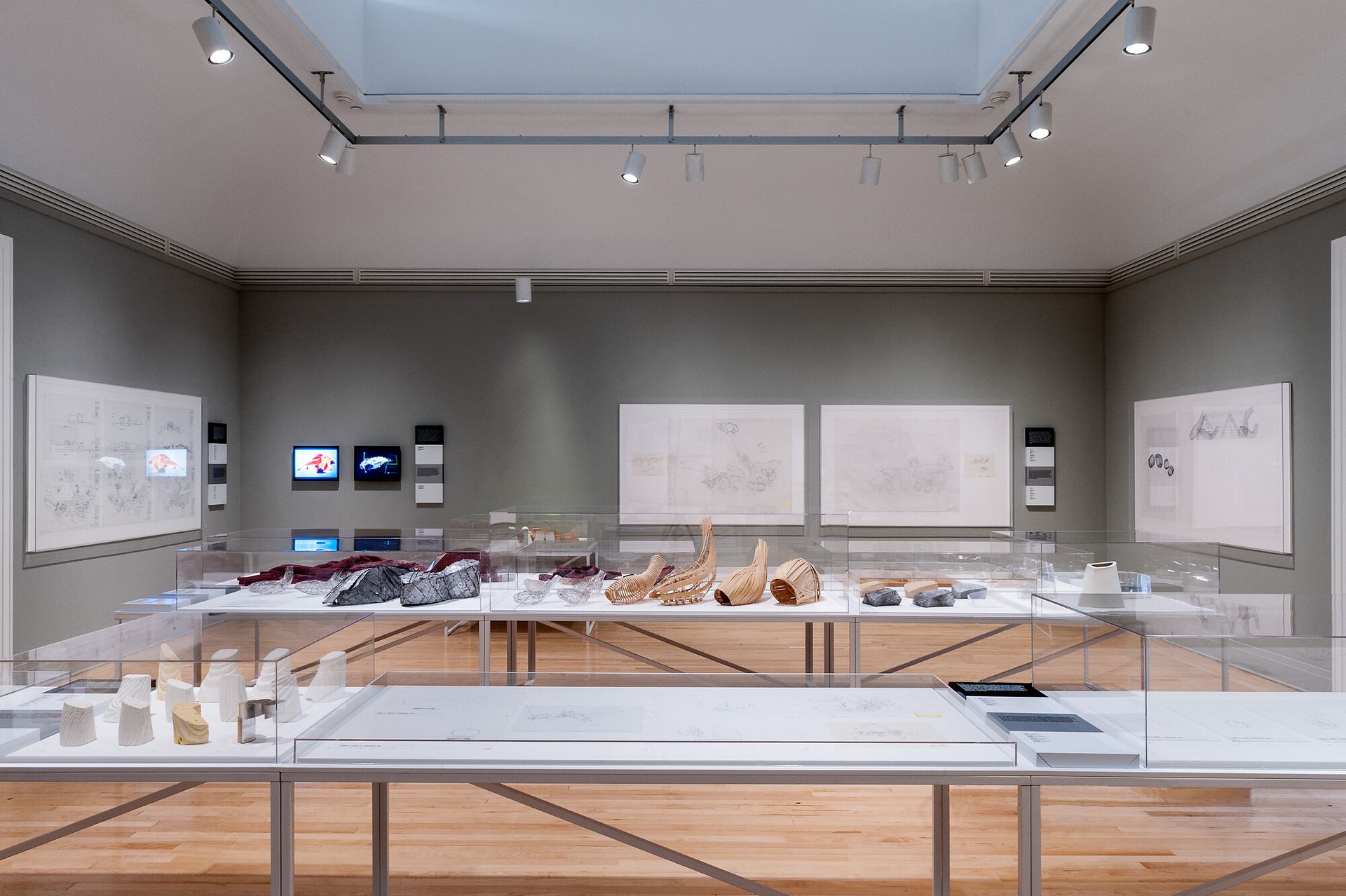
Exhibition view of Archaeology of the Digital, 2013. CCA © CCA
The list included a format called Fidelipac: the earliest commercially available audio cartridge format and predecessor of the 8-track cassette. There were others: a wire recording, a simple spool of incredibly fine stainless-steel wire akin to something seen in a hobby or hardware store; various minicassettes and microcassettes about the size of a matchbox; and some quarter-inch audio tapes susceptible to “sticky shed syndrome” (as undesirable as the name would imply). There were some vinyl LP’s and some flexi-discs: small, flexible records included in the pages of a magazine. Thankfully, a short list to send to an external vendor and all worth the digitization effort that have assured the preservation of the informational content.
Over a decade later, the prospect of revisiting these items arose in the context of a possible exhibition for our hallcases entitled Audible Archives. In its incipient stages, we considered how to present this material. Would it be useful to showcase these objects almost reverently, as threatened collection material? Or, as artefacts of the past, as either familiar tech, or retro curiosity? What about digitized sound samples, and if so, how could the visitor hear this? If, perhaps, less endangered, what other audio formats within the collection might be of interest? What, beyond the simple theme of “audio” could be the thread that ties these isolated pieces together? We decided to blend the perspectives of a conservator, concerned with the preservation of the collection, with that of our curatorial team, engaged in creating the through-line of these disparate objects, selecting further objects in support, and creating the written texts.
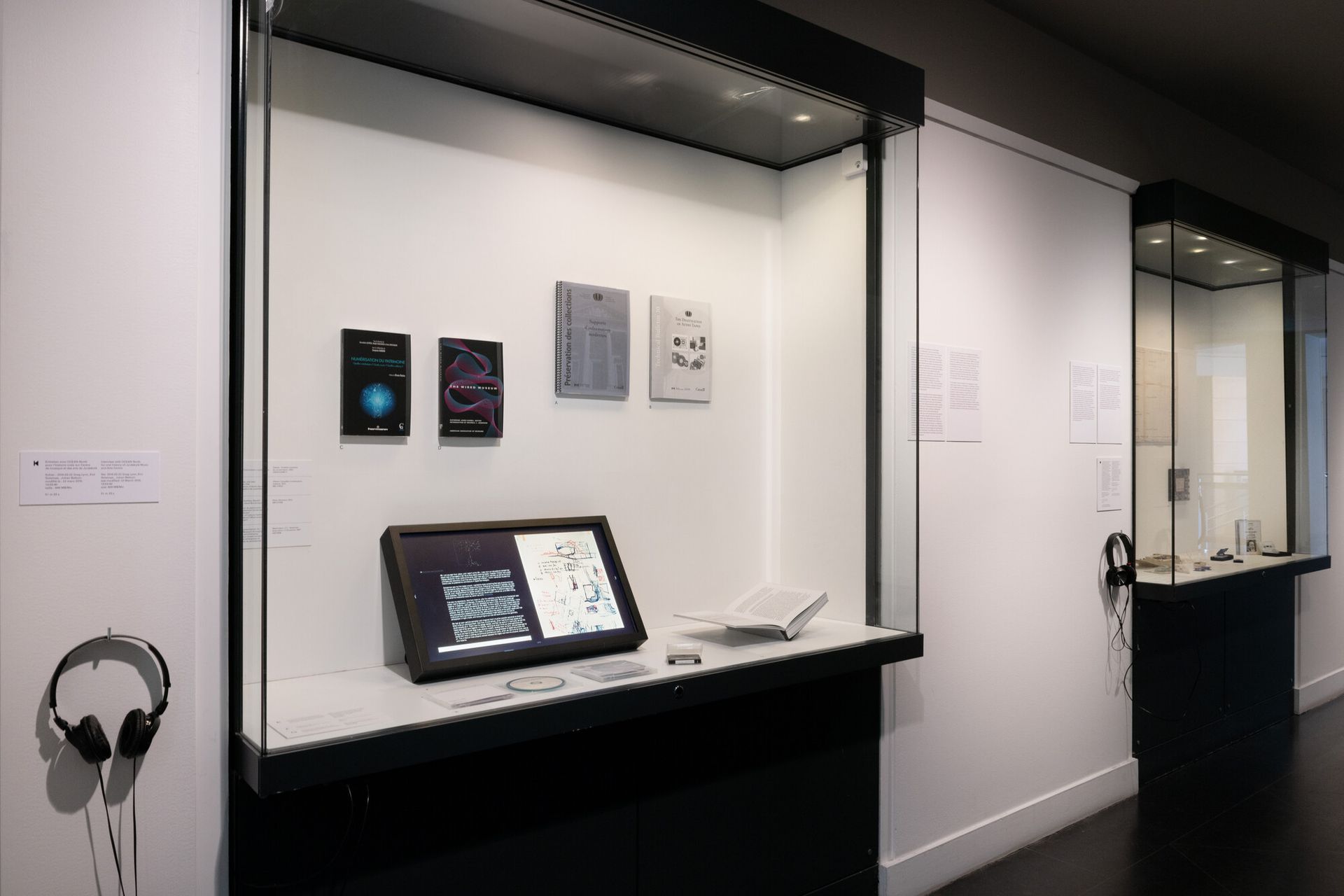
Exhibition view of Audible Archives, 2026. CCA © CCA
While the exhibition has a prominent visual component, it presents a non-visual perspective of our Collection and of architectural practice. The selections are media that were tools used either peripherally or directly related to architecture: for capturing raw ideas; for recording interviews, lectures, and symposia; for teaching; for exchanging ideas; for public enquiry; and for creative expression. If the pen, pencil, paper, camera, and computer have been the dominant—and clearly visual—tools of architectural theory and practice, in this exhibition we briefly consider the role of audio in relation to creativity, discourse, dissemination, their position within the archive, and preservation concerns. The seven vitrines are dedicated either to an audio medium or to projects involving audio recordings. As technology, these media are fallible, presenting preservation and access concerns. We can look at a selection of media from the exhibition, seeing not only their utility for recording, reproduction, and dissemination, but for the preservation issues they present.
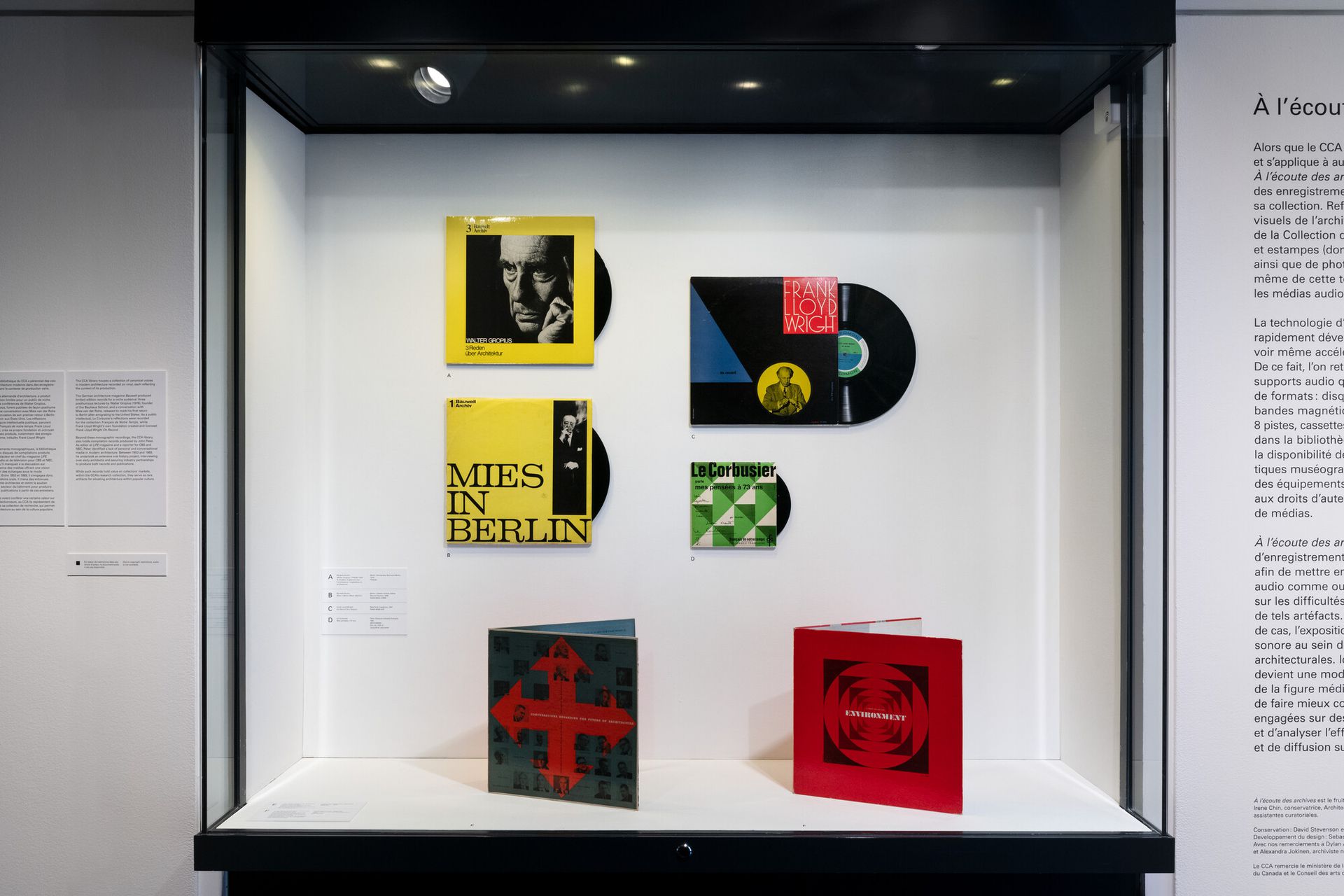
Exhibition view of Audible Archives, 2026. CCA © CCA
The sound media synonymous with twentieth century popular culture is the phonographic record. The LP was a medium for music or the spoken word; for entertainment and instruction; for the home, school, office, or club. Our selection displays the graphic designs offered by large LP covers, as produced by architectural publishers (Bauwelt), associated industries (Reynolds Metals), a spoken word record label (Caedmon), and by a cultural organization (Alliance Française).
The phonograph record is a non-composite object; it is made of only one functional component or material. “Vinyl” is polyvinyl chloride (PVC), a synthetic polymer rendered into a very specific form on both a human and a microscopic level. The encoded recording is held within the grooves of a perfect spiral. Due to the inherent chemical stability of PVC, if stored vertically and away from heat sources, kept clean and handled by the edges, and played under a good stylus with appropriate alignment and vertical force, records will have longevity. The playback equipment is common and will be with us for the foreseeable future.
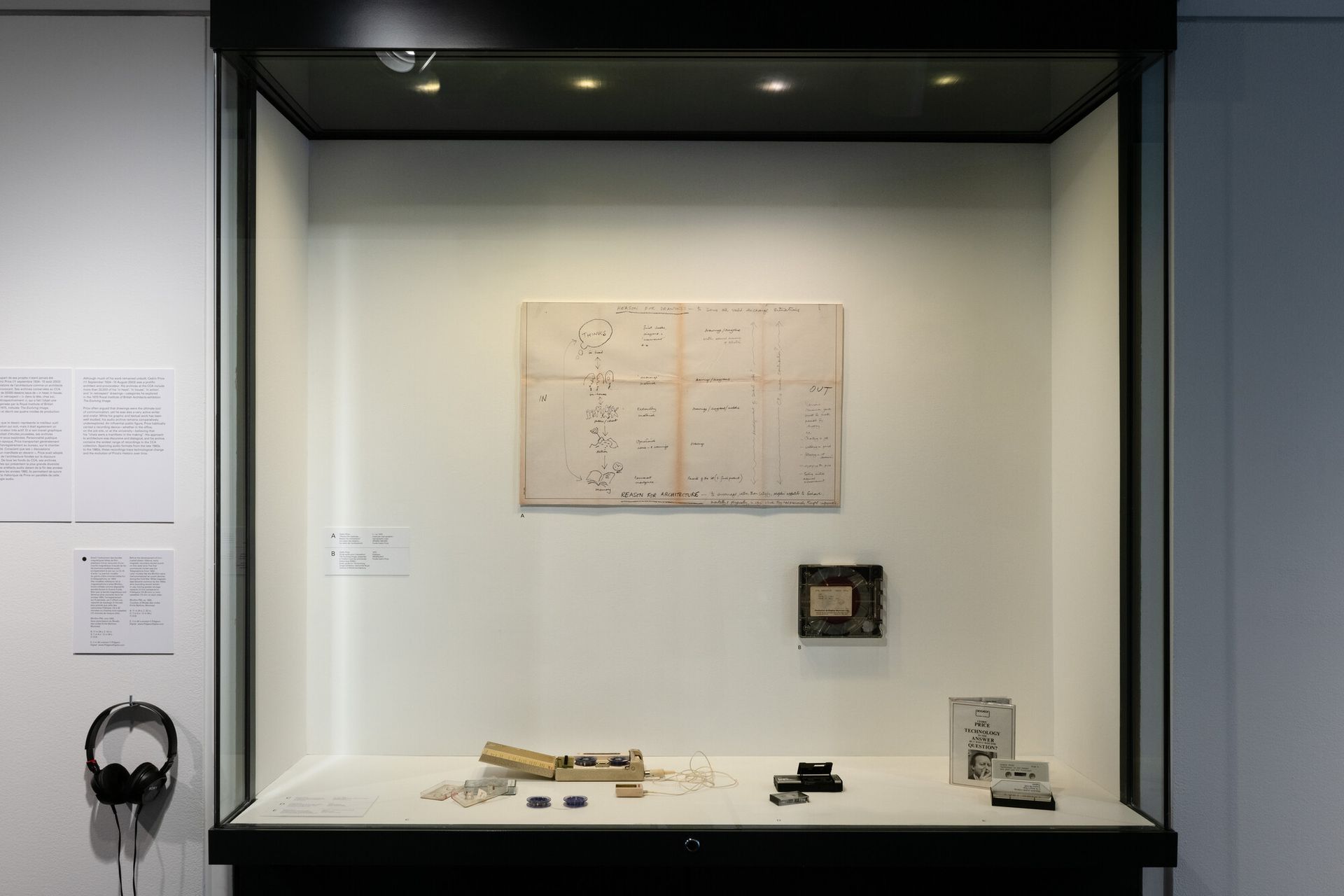
Exhibition view of Audible Archives, 2026. CCA © CCA
Elsewhere in the exhibition, we see the wire recording with its player—a 1950’s era dictaphone, a Protona Minifon P55—and microphone. In sharp contrast to all other contemporaneous recording devices, the wire recorder was small and easily concealed. One application was a Cold War-era spy device (an accessory for the P55 is a wristwatch microphone with a wire that ran up the sleeve, but it would probably be incorrect to speculate that Price would have used this).1 The wire recording in our possession is certainly low fidelity, a quiet recording with audible background hiss. The gains made in portability meant a sacrifice in sound quality, and ‘portable’ sound was in its infancy. In conservation terms, exposure to a strong magnetic field could have erased this recording in an instant. It was a challenge to find a company whose specialization is archival digitization, with a functioning wire recorder. It was not until we received the digitization that we could confirm that there was a magnetic recording that had survived the decades.
-
See our article Audible Archives: Cedric Price for more on Price’s audio recordings. ↩
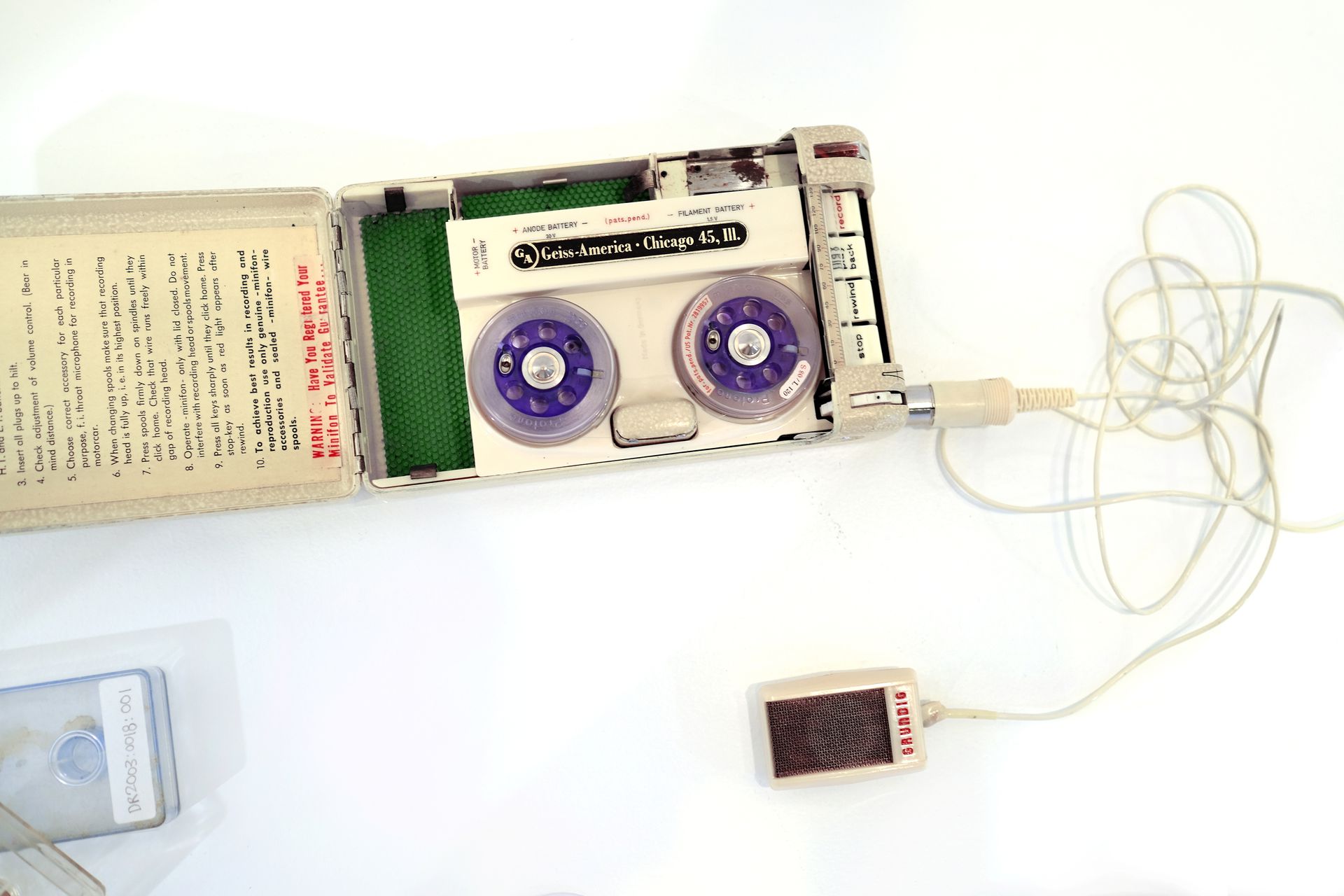
David Stevenson, view of Cedric Price’s P55 Dictaphone, 2026. CCA © CCA
By contrast, the exhibition also contains the most contemporary physical audio formats in our collection: writeable or “burned” CD-R’s, and Digital Audio Tape (DAT). Evidently, these modern carriers prove that being more recent does not ensure longevity. The earliest CD-R disks used cyanine dyes, which were susceptible to heat degradation and fading from ambient light within just a few years. While certain technical improvements were to the earliest iterations of this format, fifty years remain at the threshold of permanence for CD-R discs with cyanine dyes. They were replaced with Azo pigments, which are inherently more stable and have a lifespan rated for decades longer. DAT cassettes, a relatively short-lived format popularized in the 1990’s, face critical preservation challenges. The physical tape with binary encoding is prone to minor dimensional deformations; when read by contacting a rapidly spinning helical scanning head, these deformations can cause tape misalignment, data misreading, or worse, surface damage and data loss.
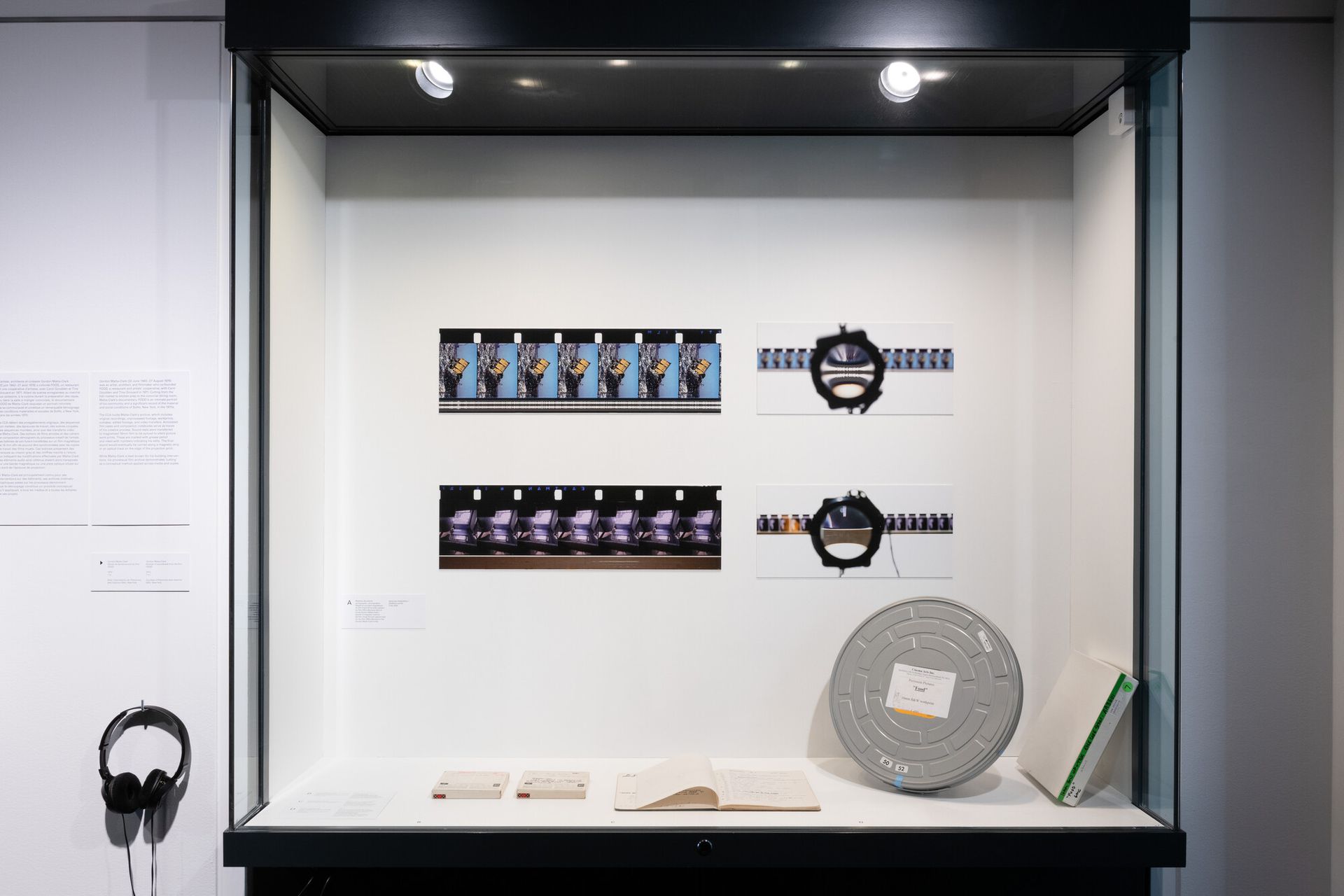
Exhibition view of Audible Archives, 2026. CCA © CCA
The diverse collection of Gordon Matta-Clark has provided us with audio materials associated with his filmmaking. The exhibition features film production and distribution products of his film Food, shot in his Manhattan artist-run restaurant of the same name.1 Here, we can see evidence of the role of recorded sound at different stages of production, including quarter-inch tape on reel-to-reel with their annotated boxes and a notebook with Matta-Clark’s personal notes on audio in the film.
We see the reproduction of the final sound mix on the final projection prints of two of Matta-Clark’s films: one by magnetic strip (brown-coloured iron oxide running along the side of the film stock) and the other by optical track. Optical track is a sound-on-film method of sound reproduction, whereby light pulses convert audio waveforms into visual patterns on a film strip, which a projector’s light sensor then translates back into electrical signals and audible sound. As applies to most audio, the simplicity of hearing these recorded sounds belies to the complexity of the processes and technologies that have created them.
-
See our article Audible Archives: Gordon Matta-Clark for more on Food. ↩
Exhibition view of Audible Archives, 2026. CCA © CCA
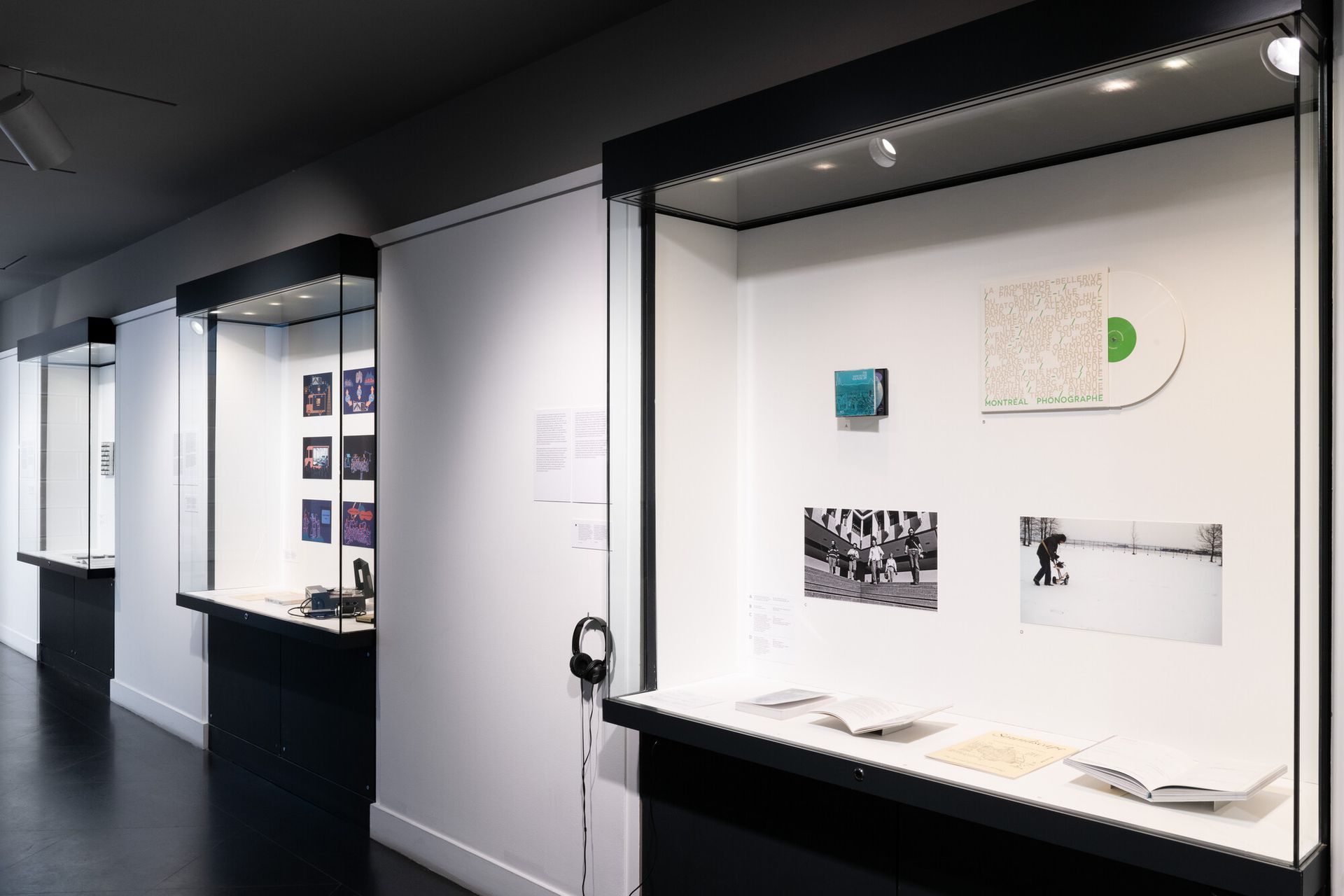
R. Murray Schafer coined the term “acoustic ecology,” describing the sonic relationship between humans, human products, and the natural world. Also known as “soundscapes,” a series of field recordings are featured in the next vitrine. This includes the 1973 recording Vancouver Soundscape (we exhibit a commercially produced “etched” CD release), and Schafer’s book Soundscapes. Douglas Moffat, an interdisciplinary artist, used a bespoke stylus as a recording device, which he manually dragged across portions of the island of Montreal in a roughly spiral formation, analogous to the spiral formation within a vinyl record. His 2012 recording, Montreal Phonographe, which he calls “a document of a landscape transduced into sound” is on display as a white vinyl record, with accompanying sound samples.1
-
See our article Listening to Vancouver, Playing Montréal for more on the work of R. Murray Schafer and Douglas Moffat. ↩
Exhibition view of Audible Archives, 2026. CCA © CCA
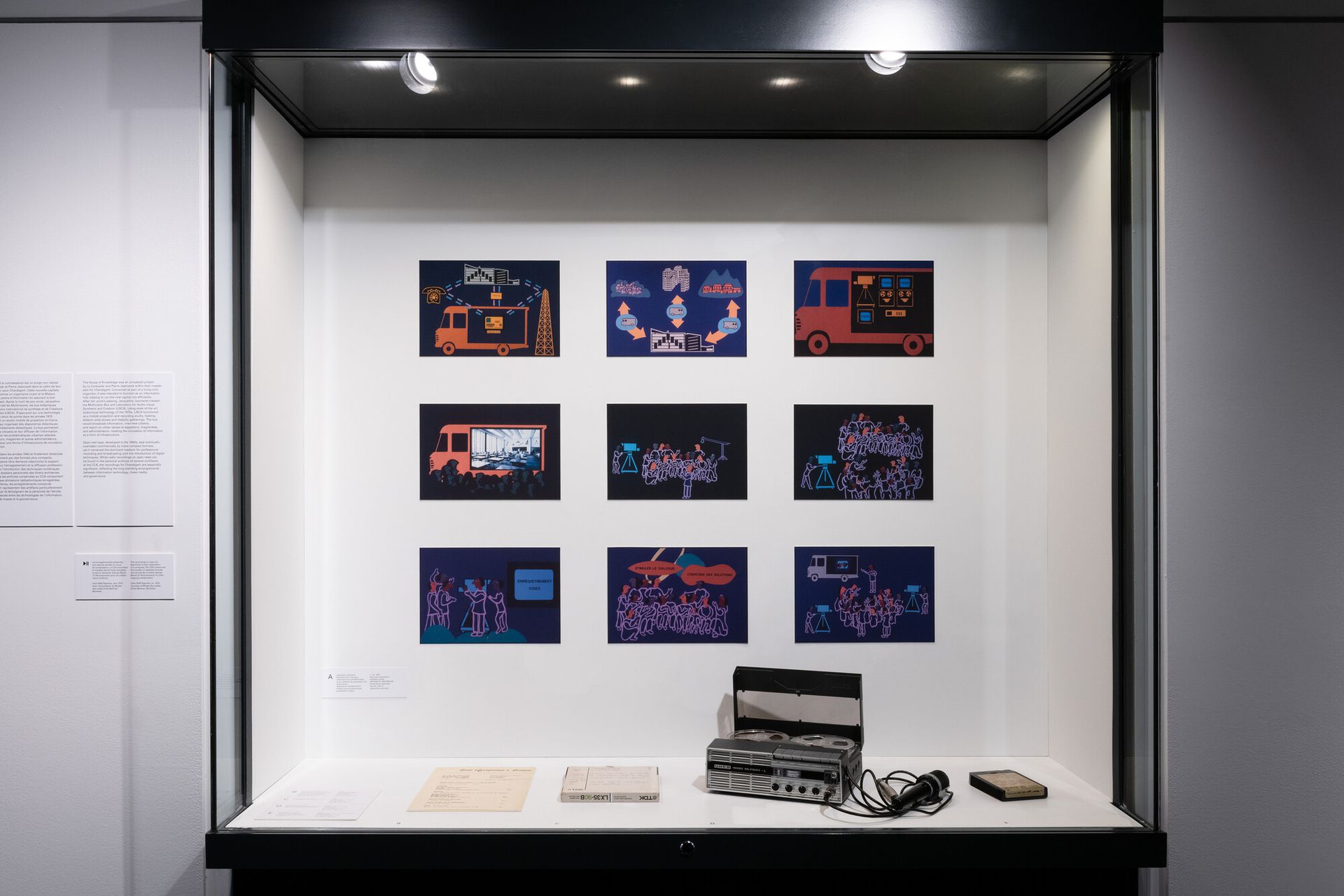
The CCA Collection holds magnetic tape in large quantities in various formats. We see this medium featured at the end of the exhibition, a hopeful reminder of opportunity for the prospective researcher. The House of Knowledge in Chandigarh, India, is an unbuilt concept designed by Le Corbusier for the Capitol complex.1 Audio-visual media played an integral role in the broader conceptualization of the development of the site. In addition to the visual illustrations in this vitrine are quarter-inch audio tapes on an industry-standard portable Uher 4000 reel-to-reel with microphone, loaned to us by the Musée des Ondes Emile Berliner with their collection of recording and broadcasting technologies.
-
See our article Audible Archives: Jacqueline Jeanneret for more on The House of Knowledge in Chandigarh. ↩
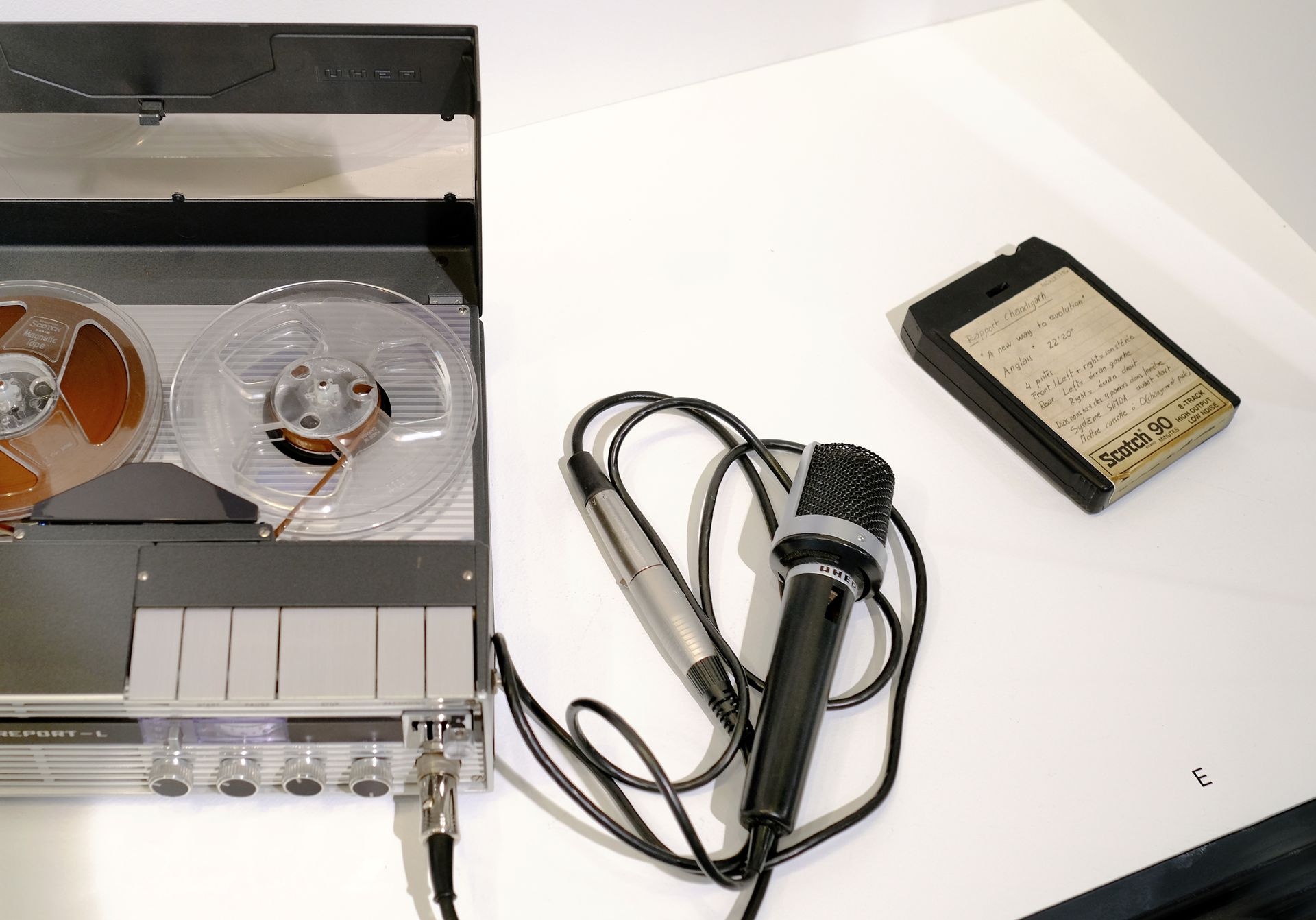
David Stevenson, View of Uher 4000 reel-to-reel with microphone and 8-track cartridge, 2026. CCA, Musée des Ondes Emile Berliner
The exhibition ends with a selection from Peter Eisenman’s vast collection of compact cassette recordings of his lectures and symposia. This includes the 1990’s conferences of the Anyone Corporation, a multidisciplinary alliance of experts from various fields, who met to discuss and debate the future of architecture. Compact cassettes are small, inexpensive, easily recorded upon and exchanged. Like the LP, tapes have assumed a specific place in popular culture. They form a significant part of the CCA’s audio collection of primary source material (our inventories list over 1,800 instances).
The LP is non-composite by its design, and the cassette is its antithesis. Replete with small moving parts and carrying a thin tape with a laminate structure, the cassette is complex and prone to malfunction, especially in a badly calibrated player. Demagnetization, accidental overwriting, tension and wind issues, and the common adhesive failure of the small felt pressure pad that ensures adequate contact between the magnetic tape and the playback head. Mindful of these issues, we carefully inspect all audio cassettes prior to in-house digitization, and we maintain our playback and digitization equipment.
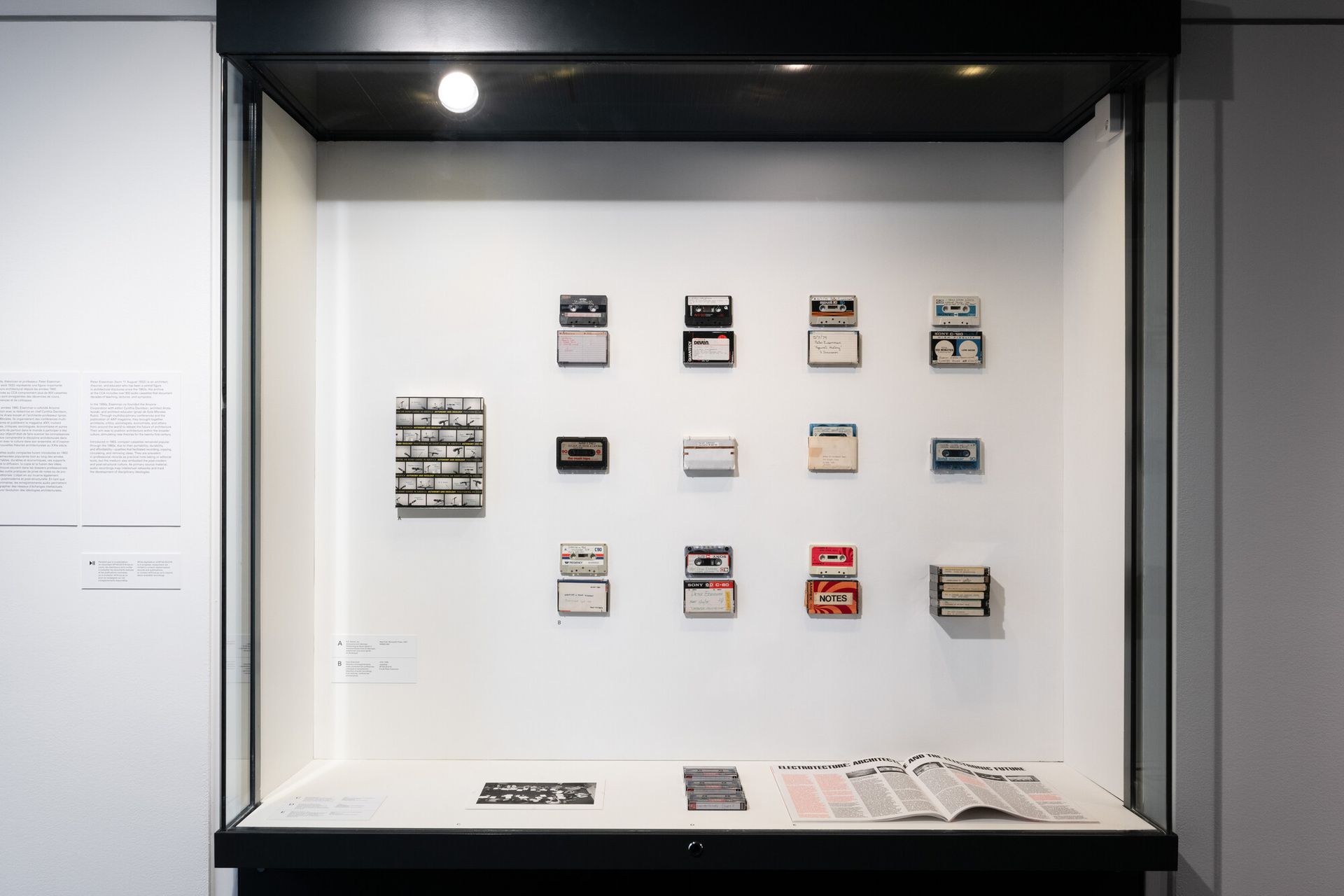
Exhibition view of Audible Archives, 2026. CCA © CCA
Marshall McLuhan posited that, in relation to sound within the human environment: “the ear world is a world of simultaneous relationships”. Even more than vision, he suggested, human existence has been one of constant immersion in sound: “we simply are not equipped with earlids”.
By contrast, recorded sounds are highly edited, defined by human choices, and the particulars of sound reproduction, including such variables as: the positioning of the microphone(s), whether stereo or mono, the start and duration of the recording itself, the inherent fidelity of the recording medium, and the fidelity of the playback machine. Adding to this are apparent limitations imposed by time, longevity, and use. All these factors will contribute to the qualitative experience of hearing the archive.
McLuhan’s friend and collaborator, Father John Culkin, made the claim in relation to media, that “we shape our tools and thereafter our tools shape us.” To what extent audio as a tool has been used in architecture is not concluded in our exhibition. Audible Archives is just a glimpse into the CCA’s archival audio holdings, a small portal into what role sound recordings have had in the field of architecture, and an infinitesimal view into the presence of audio recordings in archival holdings globally.


