


33494 Résultats
Classification:
archives
Niveau de description archivistique:
Collection
archives
Niveau de description archivistique:
Collection
Numéro de référence:
CD042
Résumé:
The collection documents the research of Susan Wagg, one of the curators of the exhibition “Money Matters: A Critical Look at Bank Architecture”, on bank buildings in the United States and in Canada, from 1795 to 1979. It contains her research files on each of the bank buildings presented in the exhibition and the photograhic commission of the banks by photographers Robert Bourdeau, Edward Burtynsky, David Duchow, David Miller, Marilyn Bridges, James Iska, Len Jenshel, John Pfahl, George Tice, Catherine Wagner and Serge Hambourg.
CD042
Résumé:
The collection documents the research of Susan Wagg, one of the curators of the exhibition “Money Matters: A Critical Look at Bank Architecture”, on bank buildings in the United States and in Canada, from 1795 to 1979. It contains her research files on each of the bank buildings presented in the exhibition and the photograhic commission of the banks by photographers Robert Bourdeau, Edward Burtynsky, David Duchow, David Miller, Marilyn Bridges, James Iska, Len Jenshel, John Pfahl, George Tice, Catherine Wagner and Serge Hambourg.
Personnes et institutions:
Date:
1926-1993
1926-1993
Titre:
Collection de l’exposition Money Matters
Actions:
CD042
Résumé:
The collection documents the research of Susan Wagg, one of the curators of the exhibition “Money Matters: A Critical Look at Bank Architecture”, on bank buildings in the United States and in Canada, from 1795 to 1979. It contains her research files on each of the bank buildings presented in the exhibition and the photograhic commission of the banks by photographers Robert Bourdeau, Edward Burtynsky, David Duchow, David Miller, Marilyn Bridges, James Iska, Len Jenshel, John Pfahl, George Tice, Catherine Wagner and Serge Hambourg.
Collection de l’exposition Money Matters
Actions:
CD042
Résumé:
The collection documents the research of Susan Wagg, one of the curators of the exhibition “Money Matters: A Critical Look at Bank Architecture”, on bank buildings in the United States and in Canada, from 1795 to 1979. It contains her research files on each of the bank buildings presented in the exhibition and the photograhic commission of the banks by photographers Robert Bourdeau, Edward Burtynsky, David Duchow, David Miller, Marilyn Bridges, James Iska, Len Jenshel, John Pfahl, George Tice, Catherine Wagner and Serge Hambourg.
Classification:
archives
Niveau de description archivistique:
Collection
archives
Niveau de description archivistique:
Collection
Date:
1926-1993
1926-1993
Personnes et institutions:
Classification:
oeuvres d'art
oeuvres d'art
Numéro de référence:
DR1986:0442:001-022
Description:
- Michele Marieschi was a short-lived Venetian vedutista whose small graphic output was limited almost exclusively to this group of twenty-one etchings. The album is a modern-bound collection of the first edition (before the addition of plate numbers) of Marieschi's prints. The prints were all designed and etched by Marieschi himself, with only two exceptions. The frontpiece, with its portrait of Marieschi (and proud proclamation of his status as painter and architect) was drawn by Anzolo Trivisan (Angelo Trevisani, 1669-after 1753) and engraved by Carlo Orsolini (1710-1780). The dedication to the Prince of Beauvau-Craon and the prince's coat of arms, which appear below Marieschi's view of the Piazzetta and Ducal Palace, were also engraved by Orsolini. RH - Marieschi was probably called an architect in the frontispiece to this volume of etchings (folio 1) in reference to his activity as a stage designer. Folio 21 gives us an indication of Marieschi's activity as a stage designer. According to Fabio Mauroner (Print Collector's Quarterly, vol. 27), the painted façade shown on the Church of San Rocco on the first state of folio 21 was designed by Marieschi. Here Marieschi is probably illustrating a festival which took place on the saint's feast day, since easel paintings are also shown placed against the façades of the buildings to the right in the square. It is interesting that in the second state of the same folio, another façade is shown, the one added to the church by the architect Macarazzi in 1768. According to the text on the first state of the same folio, the original façade on San Rocco was constructed in marble according to a design by Sebastiano Serlio (Mauroner, pl. 16). In addition, the exaggerated two-point and multi-point perspectives which Marieschi uses in many of his views of Venice, also reveal the influence of the principles of stage set design as illustrated in the contemporary drawings of the Bibiera family. MNR
DR1986:0442:001-022
Description:
- Michele Marieschi was a short-lived Venetian vedutista whose small graphic output was limited almost exclusively to this group of twenty-one etchings. The album is a modern-bound collection of the first edition (before the addition of plate numbers) of Marieschi's prints. The prints were all designed and etched by Marieschi himself, with only two exceptions. The frontpiece, with its portrait of Marieschi (and proud proclamation of his status as painter and architect) was drawn by Anzolo Trivisan (Angelo Trevisani, 1669-after 1753) and engraved by Carlo Orsolini (1710-1780). The dedication to the Prince of Beauvau-Craon and the prince's coat of arms, which appear below Marieschi's view of the Piazzetta and Ducal Palace, were also engraved by Orsolini. RH - Marieschi was probably called an architect in the frontispiece to this volume of etchings (folio 1) in reference to his activity as a stage designer. Folio 21 gives us an indication of Marieschi's activity as a stage designer. According to Fabio Mauroner (Print Collector's Quarterly, vol. 27), the painted façade shown on the Church of San Rocco on the first state of folio 21 was designed by Marieschi. Here Marieschi is probably illustrating a festival which took place on the saint's feast day, since easel paintings are also shown placed against the façades of the buildings to the right in the square. It is interesting that in the second state of the same folio, another façade is shown, the one added to the church by the architect Macarazzi in 1768. According to the text on the first state of the same folio, the original façade on San Rocco was constructed in marble according to a design by Sebastiano Serlio (Mauroner, pl. 16). In addition, the exaggerated two-point and multi-point perspectives which Marieschi uses in many of his views of Venice, also reveal the influence of the principles of stage set design as illustrated in the contemporary drawings of the Bibiera family. MNR
Personnes et institutions:
Sujet:
architecture
architecture
Date:
ca. 1741
ca. 1741
Titre:
Magnificentiores Selectioresque Urbis Venetiarum Prospectus
Actions:
DR1986:0442:001-022
Description:
- Michele Marieschi was a short-lived Venetian vedutista whose small graphic output was limited almost exclusively to this group of twenty-one etchings. The album is a modern-bound collection of the first edition (before the addition of plate numbers) of Marieschi's prints. The prints were all designed and etched by Marieschi himself, with only two exceptions. The frontpiece, with its portrait of Marieschi (and proud proclamation of his status as painter and architect) was drawn by Anzolo Trivisan (Angelo Trevisani, 1669-after 1753) and engraved by Carlo Orsolini (1710-1780). The dedication to the Prince of Beauvau-Craon and the prince's coat of arms, which appear below Marieschi's view of the Piazzetta and Ducal Palace, were also engraved by Orsolini. RH - Marieschi was probably called an architect in the frontispiece to this volume of etchings (folio 1) in reference to his activity as a stage designer. Folio 21 gives us an indication of Marieschi's activity as a stage designer. According to Fabio Mauroner (Print Collector's Quarterly, vol. 27), the painted façade shown on the Church of San Rocco on the first state of folio 21 was designed by Marieschi. Here Marieschi is probably illustrating a festival which took place on the saint's feast day, since easel paintings are also shown placed against the façades of the buildings to the right in the square. It is interesting that in the second state of the same folio, another façade is shown, the one added to the church by the architect Macarazzi in 1768. According to the text on the first state of the same folio, the original façade on San Rocco was constructed in marble according to a design by Sebastiano Serlio (Mauroner, pl. 16). In addition, the exaggerated two-point and multi-point perspectives which Marieschi uses in many of his views of Venice, also reveal the influence of the principles of stage set design as illustrated in the contemporary drawings of the Bibiera family. MNR
Magnificentiores Selectioresque Urbis Venetiarum Prospectus
Actions:
DR1986:0442:001-022
Description:
- Michele Marieschi was a short-lived Venetian vedutista whose small graphic output was limited almost exclusively to this group of twenty-one etchings. The album is a modern-bound collection of the first edition (before the addition of plate numbers) of Marieschi's prints. The prints were all designed and etched by Marieschi himself, with only two exceptions. The frontpiece, with its portrait of Marieschi (and proud proclamation of his status as painter and architect) was drawn by Anzolo Trivisan (Angelo Trevisani, 1669-after 1753) and engraved by Carlo Orsolini (1710-1780). The dedication to the Prince of Beauvau-Craon and the prince's coat of arms, which appear below Marieschi's view of the Piazzetta and Ducal Palace, were also engraved by Orsolini. RH - Marieschi was probably called an architect in the frontispiece to this volume of etchings (folio 1) in reference to his activity as a stage designer. Folio 21 gives us an indication of Marieschi's activity as a stage designer. According to Fabio Mauroner (Print Collector's Quarterly, vol. 27), the painted façade shown on the Church of San Rocco on the first state of folio 21 was designed by Marieschi. Here Marieschi is probably illustrating a festival which took place on the saint's feast day, since easel paintings are also shown placed against the façades of the buildings to the right in the square. It is interesting that in the second state of the same folio, another façade is shown, the one added to the church by the architect Macarazzi in 1768. According to the text on the first state of the same folio, the original façade on San Rocco was constructed in marble according to a design by Sebastiano Serlio (Mauroner, pl. 16). In addition, the exaggerated two-point and multi-point perspectives which Marieschi uses in many of his views of Venice, also reveal the influence of the principles of stage set design as illustrated in the contemporary drawings of the Bibiera family. MNR
Classification:
oeuvres d'art
oeuvres d'art
Date:
ca. 1741
ca. 1741
Personnes et institutions:
Sujet:
architecture
architecture
Classification:
oeuvres d'art
oeuvres d'art
Actions:
Numéro de référence:
DR1987:0342
Description:
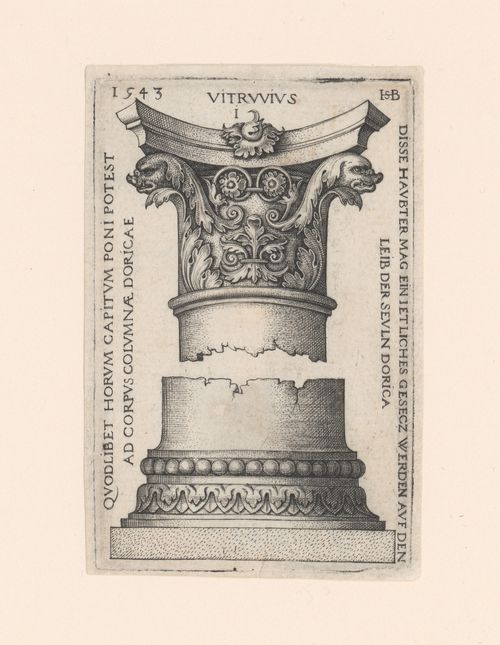
- This engraving depicts a design for an order of architecture showing the capital and the base. Although the inscriptions refer to "DORICA[E]", this is not one of the traditional orders of architecture: the acanthus leaves on the capital suggest a Corinthian model while other details, such as the dolphin heads, suggest a more personal interpretation. - This print is one of a set of four prints of capitals and bases which were engraved by Hans Sebald Beham. Patricia Condon suggests that these prints were made for a general audience rather than for architects ('Ornament and Architecture', 29). Three of the prints in the CCA collection are from the collection of the Ducs d'Arenburg, while the provenance of this print is unknown.
DR1987:0342
Description:
- This engraving depicts a design for an order of architecture showing the capital and the base. Although the inscriptions refer to "DORICA[E]", this is not one of the traditional orders of architecture: the acanthus leaves on the capital suggest a Corinthian model while other details, such as the dolphin heads, suggest a more personal interpretation. - This print is one of a set of four prints of capitals and bases which were engraved by Hans Sebald Beham. Patricia Condon suggests that these prints were made for a general audience rather than for architects ('Ornament and Architecture', 29). Three of the prints in the CCA collection are from the collection of the Ducs d'Arenburg, while the provenance of this print is unknown.
Personnes et institutions:
Sujet:
architecture
architecture
Date:
1543
1543
Titre:
Design for the capital and base of a column
Actions:
DR1987:0342
Description:
- This engraving depicts a design for an order of architecture showing the capital and the base. Although the inscriptions refer to "DORICA[E]", this is not one of the traditional orders of architecture: the acanthus leaves on the capital suggest a Corinthian model while other details, such as the dolphin heads, suggest a more personal interpretation. - This print is one of a set of four prints of capitals and bases which were engraved by Hans Sebald Beham. Patricia Condon suggests that these prints were made for a general audience rather than for architects ('Ornament and Architecture', 29). Three of the prints in the CCA collection are from the collection of the Ducs d'Arenburg, while the provenance of this print is unknown.
Design for the capital and base of a column
Actions:
DR1987:0342
Description:
- This engraving depicts a design for an order of architecture showing the capital and the base. Although the inscriptions refer to "DORICA[E]", this is not one of the traditional orders of architecture: the acanthus leaves on the capital suggest a Corinthian model while other details, such as the dolphin heads, suggest a more personal interpretation. - This print is one of a set of four prints of capitals and bases which were engraved by Hans Sebald Beham. Patricia Condon suggests that these prints were made for a general audience rather than for architects ('Ornament and Architecture', 29). Three of the prints in the CCA collection are from the collection of the Ducs d'Arenburg, while the provenance of this print is unknown.
Classification:
oeuvres d'art
oeuvres d'art
Date:
1543
1543
Personnes et institutions:
Sujet:
architecture
architecture
Classification:
dessins
dessins
Titre:
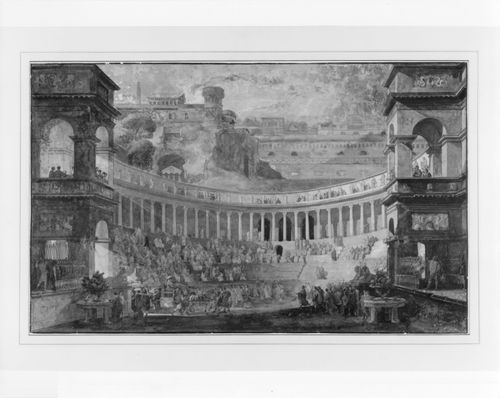
The Triumph of Hannibal
The Triumph of Hannibal
Actions:
Numéro de référence:
DR1984:1641
Description:
- The turbaned figure being carried into the theatre seated on a litter certainly refers to a non-Roman figure, possibly Hannibal. Behind this figure is a theatre and an imaginary town on a hill. The town buildings recall the Sicilian monuments in the 'Voyage pittoresque ou description des royaumes de Naples et de Sicile' published by the Abbé de Saint-Non in Paris between 1781 and 1786. Desprez interrupted his studies at the French Academy in Rome from December 1777 to January 1779 to accompany Dominique Vivant Denon and several other artists to Naples and Sicily in order to make drawings for this publication. The town buildings also recall several buildings Desprez planned in Stockholm while stage designer and architect to Gustavus III of Sweden from 1784 to 1792.
DR1984:1641
Description:
- The turbaned figure being carried into the theatre seated on a litter certainly refers to a non-Roman figure, possibly Hannibal. Behind this figure is a theatre and an imaginary town on a hill. The town buildings recall the Sicilian monuments in the 'Voyage pittoresque ou description des royaumes de Naples et de Sicile' published by the Abbé de Saint-Non in Paris between 1781 and 1786. Desprez interrupted his studies at the French Academy in Rome from December 1777 to January 1779 to accompany Dominique Vivant Denon and several other artists to Naples and Sicily in order to make drawings for this publication. The town buildings also recall several buildings Desprez planned in Stockholm while stage designer and architect to Gustavus III of Sweden from 1784 to 1792.
Personnes et institutions:
Sujet:
design de théâtre
design de théâtre
Date:
ca. 1780-1790
ca. 1780-1790
Titre:
The Triumph of Hannibal
Actions:
DR1984:1641
Description:
- The turbaned figure being carried into the theatre seated on a litter certainly refers to a non-Roman figure, possibly Hannibal. Behind this figure is a theatre and an imaginary town on a hill. The town buildings recall the Sicilian monuments in the 'Voyage pittoresque ou description des royaumes de Naples et de Sicile' published by the Abbé de Saint-Non in Paris between 1781 and 1786. Desprez interrupted his studies at the French Academy in Rome from December 1777 to January 1779 to accompany Dominique Vivant Denon and several other artists to Naples and Sicily in order to make drawings for this publication. The town buildings also recall several buildings Desprez planned in Stockholm while stage designer and architect to Gustavus III of Sweden from 1784 to 1792.
The Triumph of Hannibal
Actions:
DR1984:1641
Description:
- The turbaned figure being carried into the theatre seated on a litter certainly refers to a non-Roman figure, possibly Hannibal. Behind this figure is a theatre and an imaginary town on a hill. The town buildings recall the Sicilian monuments in the 'Voyage pittoresque ou description des royaumes de Naples et de Sicile' published by the Abbé de Saint-Non in Paris between 1781 and 1786. Desprez interrupted his studies at the French Academy in Rome from December 1777 to January 1779 to accompany Dominique Vivant Denon and several other artists to Naples and Sicily in order to make drawings for this publication. The town buildings also recall several buildings Desprez planned in Stockholm while stage designer and architect to Gustavus III of Sweden from 1784 to 1792.
Classification:
dessins
dessins
Date:
ca. 1780-1790
ca. 1780-1790
Personnes et institutions:
Sujet:
design de théâtre
design de théâtre
Niveau de description archivistique:
Projet
Projet
Titre:
Circlorama
Circlorama
Numéro de référence:
AP144.S2.D51
Description:
File documents proposals for a portable circular cinema for Circlorama Theatres Limited, of London, England, United Kingdom. Thumbnail sketches show positioning of concrete bases; erection of the cinema, central tower, and trussed wall frames; and the installation of the radially-trussed roof, interior fixtures, and exterior aluminum cladding. Diagrammatic sections show alternate designs for the structure and structural systems. A flow diagram illustrates projected circulation patterns. Also included in the group are fabrication drawings for the cinema by various consultants which Price may have used for reference purposes. Material in this file was produced between 1962 and 1964. File contains drawings by the following firms: Lawrence Colebrook (Construction Equipment) Co. Ltd, Andrew Smith Harkness Ltd, Cotton Ballard & Blow Architects & Surveyors. File contains design development drawings and textual records.
AP144.S2.D51
Description:
File documents proposals for a portable circular cinema for Circlorama Theatres Limited, of London, England, United Kingdom. Thumbnail sketches show positioning of concrete bases; erection of the cinema, central tower, and trussed wall frames; and the installation of the radially-trussed roof, interior fixtures, and exterior aluminum cladding. Diagrammatic sections show alternate designs for the structure and structural systems. A flow diagram illustrates projected circulation patterns. Also included in the group are fabrication drawings for the cinema by various consultants which Price may have used for reference purposes. Material in this file was produced between 1962 and 1964. File contains drawings by the following firms: Lawrence Colebrook (Construction Equipment) Co. Ltd, Andrew Smith Harkness Ltd, Cotton Ballard & Blow Architects & Surveyors. File contains design development drawings and textual records.
Personnes et institutions:
Date:
1962-1964, 1967
1962-1964, 1967
Titre:
Circlorama
Actions:
AP144.S2.D51
Description:
File documents proposals for a portable circular cinema for Circlorama Theatres Limited, of London, England, United Kingdom. Thumbnail sketches show positioning of concrete bases; erection of the cinema, central tower, and trussed wall frames; and the installation of the radially-trussed roof, interior fixtures, and exterior aluminum cladding. Diagrammatic sections show alternate designs for the structure and structural systems. A flow diagram illustrates projected circulation patterns. Also included in the group are fabrication drawings for the cinema by various consultants which Price may have used for reference purposes. Material in this file was produced between 1962 and 1964. File contains drawings by the following firms: Lawrence Colebrook (Construction Equipment) Co. Ltd, Andrew Smith Harkness Ltd, Cotton Ballard & Blow Architects & Surveyors. File contains design development drawings and textual records.
Circlorama
Actions:
AP144.S2.D51
Description:
File documents proposals for a portable circular cinema for Circlorama Theatres Limited, of London, England, United Kingdom. Thumbnail sketches show positioning of concrete bases; erection of the cinema, central tower, and trussed wall frames; and the installation of the radially-trussed roof, interior fixtures, and exterior aluminum cladding. Diagrammatic sections show alternate designs for the structure and structural systems. A flow diagram illustrates projected circulation patterns. Also included in the group are fabrication drawings for the cinema by various consultants which Price may have used for reference purposes. Material in this file was produced between 1962 and 1964. File contains drawings by the following firms: Lawrence Colebrook (Construction Equipment) Co. Ltd, Andrew Smith Harkness Ltd, Cotton Ballard & Blow Architects & Surveyors. File contains design development drawings and textual records.
Niveau de description archivistique:
File 51
File 51
Date:
1962-1964, 1967
1962-1964, 1967
Personnes et institutions:
Niveau de description archivistique:
Projet
Projet
Numéro de référence:
CI005.S1.1931.PR2
Description:
In 1929, the north Rotterdam neighbourhood of Blijodorp became the site of a municipal housing plan. Previous plans had been formulated in the early 1920s by architects Kromhout and Heijkoop but foundered due to lack of funding. Oud was brought into the project in the early 1930s and combined a perimeter block with row housing in his design of 306 dwellings for workers and eighteen buildings for seniors. The nine housing blocks faced the gardens and feature a living room, kitchen and three bedrooms with storage space situated below the elevated living level. His plans were not realized because the national government withdrew its investment in the housing market (Taverne et al. 2001, 304-310). Project series includes drawings of plans for Blijdorp Municipal Housing and a photograph of a perspective drawing.
CI005.S1.1931.PR2
Description:
In 1929, the north Rotterdam neighbourhood of Blijodorp became the site of a municipal housing plan. Previous plans had been formulated in the early 1920s by architects Kromhout and Heijkoop but foundered due to lack of funding. Oud was brought into the project in the early 1930s and combined a perimeter block with row housing in his design of 306 dwellings for workers and eighteen buildings for seniors. The nine housing blocks faced the gardens and feature a living room, kitchen and three bedrooms with storage space situated below the elevated living level. His plans were not realized because the national government withdrew its investment in the housing market (Taverne et al. 2001, 304-310). Project series includes drawings of plans for Blijdorp Municipal Housing and a photograph of a perspective drawing.
Personnes et institutions:
Date:
1931-1932
1931-1932
Titre:
Blijdorp Municipal Housing, Rotterdam, Netherlands (1931-1932)
Actions:
CI005.S1.1931.PR2
Description:
In 1929, the north Rotterdam neighbourhood of Blijodorp became the site of a municipal housing plan. Previous plans had been formulated in the early 1920s by architects Kromhout and Heijkoop but foundered due to lack of funding. Oud was brought into the project in the early 1930s and combined a perimeter block with row housing in his design of 306 dwellings for workers and eighteen buildings for seniors. The nine housing blocks faced the gardens and feature a living room, kitchen and three bedrooms with storage space situated below the elevated living level. His plans were not realized because the national government withdrew its investment in the housing market (Taverne et al. 2001, 304-310). Project series includes drawings of plans for Blijdorp Municipal Housing and a photograph of a perspective drawing.
Blijdorp Municipal Housing, Rotterdam, Netherlands (1931-1932)
Actions:
CI005.S1.1931.PR2
Description:
In 1929, the north Rotterdam neighbourhood of Blijodorp became the site of a municipal housing plan. Previous plans had been formulated in the early 1920s by architects Kromhout and Heijkoop but foundered due to lack of funding. Oud was brought into the project in the early 1930s and combined a perimeter block with row housing in his design of 306 dwellings for workers and eighteen buildings for seniors. The nine housing blocks faced the gardens and feature a living room, kitchen and three bedrooms with storage space situated below the elevated living level. His plans were not realized because the national government withdrew its investment in the housing market (Taverne et al. 2001, 304-310). Project series includes drawings of plans for Blijdorp Municipal Housing and a photograph of a perspective drawing.
Niveau de description archivistique:
project
project
Date:
1931-1932
1931-1932
Personnes et institutions:
Niveau de description archivistique:
Projet
Projet
Actions:
Numéro de référence:
CI005.S1.1933.PR1
Description:
The director of the Metz & Co interior design firm, Joseph de Leeuw, commissioned furniture designs from several prominent Dutch artists and architects, including Oud, Van der Leck and Rietveld. Oud's four chair designs were featured in the company's exhibition, "Steel Furniture in 1934." The chairs were made of steel frames; the third chair featured angular rear supports with sharp front angles adjoining the front, while in the fourth, the chair front and rear leg supports were crossed. Oud also designed four more chair types in 1934, including the 07 series, which received critical acclaim (Taverne et al. 2001, 375-377). Project series includes drawings of sketch perspectives of chairs, a sketch plan for a house and unidentified details, possibly for Metz & Co, as well as photographs of the chairs.
CI005.S1.1933.PR1
Description:
The director of the Metz & Co interior design firm, Joseph de Leeuw, commissioned furniture designs from several prominent Dutch artists and architects, including Oud, Van der Leck and Rietveld. Oud's four chair designs were featured in the company's exhibition, "Steel Furniture in 1934." The chairs were made of steel frames; the third chair featured angular rear supports with sharp front angles adjoining the front, while in the fourth, the chair front and rear leg supports were crossed. Oud also designed four more chair types in 1934, including the 07 series, which received critical acclaim (Taverne et al. 2001, 375-377). Project series includes drawings of sketch perspectives of chairs, a sketch plan for a house and unidentified details, possibly for Metz & Co, as well as photographs of the chairs.
Personnes et institutions:
Date:
1933-1934
1933-1934
Titre:
Furniture Designs for Metz & Co, Amsterdam, Netherlands (1933-1934)
Actions:
CI005.S1.1933.PR1
Description:
The director of the Metz & Co interior design firm, Joseph de Leeuw, commissioned furniture designs from several prominent Dutch artists and architects, including Oud, Van der Leck and Rietveld. Oud's four chair designs were featured in the company's exhibition, "Steel Furniture in 1934." The chairs were made of steel frames; the third chair featured angular rear supports with sharp front angles adjoining the front, while in the fourth, the chair front and rear leg supports were crossed. Oud also designed four more chair types in 1934, including the 07 series, which received critical acclaim (Taverne et al. 2001, 375-377). Project series includes drawings of sketch perspectives of chairs, a sketch plan for a house and unidentified details, possibly for Metz & Co, as well as photographs of the chairs.
Furniture Designs for Metz & Co, Amsterdam, Netherlands (1933-1934)
Actions:
CI005.S1.1933.PR1
Description:
The director of the Metz & Co interior design firm, Joseph de Leeuw, commissioned furniture designs from several prominent Dutch artists and architects, including Oud, Van der Leck and Rietveld. Oud's four chair designs were featured in the company's exhibition, "Steel Furniture in 1934." The chairs were made of steel frames; the third chair featured angular rear supports with sharp front angles adjoining the front, while in the fourth, the chair front and rear leg supports were crossed. Oud also designed four more chair types in 1934, including the 07 series, which received critical acclaim (Taverne et al. 2001, 375-377). Project series includes drawings of sketch perspectives of chairs, a sketch plan for a house and unidentified details, possibly for Metz & Co, as well as photographs of the chairs.
Niveau de description archivistique:
project
project
Date:
1933-1934
1933-1934
Personnes et institutions:
Niveau de description archivistique:
Série(s)
Série(s)
Numéro de référence:
AP197.S4
Description:
This series consists of materials that Frampton collected, received or was awarded throughout his professional career, inlcuding his collection of postcards, some of which may include correspondence. Photographs in this series comprise of professional headshots of Kenneth Frampton as well as photographs of Frampton with family members and architects at various events. Also included in this series are drawings, prints, and posters that Frampton collected or received as gifts. Objects in this box consist of several gifts and personal items, including a Chinese seal of Frampton’s name and red seal paste, his father’s moulding plane, tarot cards, a watch designed by Arata Isozaki, a tie designed by Manuel de Solà, and two sample tiles of Alvar Aalto’s studio in Helinski. Certificates, diplomas, awards and medals that Frampton received are also included in this series.
AP197.S4
Description:
This series consists of materials that Frampton collected, received or was awarded throughout his professional career, inlcuding his collection of postcards, some of which may include correspondence. Photographs in this series comprise of professional headshots of Kenneth Frampton as well as photographs of Frampton with family members and architects at various events. Also included in this series are drawings, prints, and posters that Frampton collected or received as gifts. Objects in this box consist of several gifts and personal items, including a Chinese seal of Frampton’s name and red seal paste, his father’s moulding plane, tarot cards, a watch designed by Arata Isozaki, a tie designed by Manuel de Solà, and two sample tiles of Alvar Aalto’s studio in Helinski. Certificates, diplomas, awards and medals that Frampton received are also included in this series.
Personnes et institutions:
Date:
1956-2016
1956-2016
Titre:
Postcards, photographs, awards and souvenirs
Actions:
AP197.S4
Description:
This series consists of materials that Frampton collected, received or was awarded throughout his professional career, inlcuding his collection of postcards, some of which may include correspondence. Photographs in this series comprise of professional headshots of Kenneth Frampton as well as photographs of Frampton with family members and architects at various events. Also included in this series are drawings, prints, and posters that Frampton collected or received as gifts. Objects in this box consist of several gifts and personal items, including a Chinese seal of Frampton’s name and red seal paste, his father’s moulding plane, tarot cards, a watch designed by Arata Isozaki, a tie designed by Manuel de Solà, and two sample tiles of Alvar Aalto’s studio in Helinski. Certificates, diplomas, awards and medals that Frampton received are also included in this series.
Postcards, photographs, awards and souvenirs
Actions:
AP197.S4
Description:
This series consists of materials that Frampton collected, received or was awarded throughout his professional career, inlcuding his collection of postcards, some of which may include correspondence. Photographs in this series comprise of professional headshots of Kenneth Frampton as well as photographs of Frampton with family members and architects at various events. Also included in this series are drawings, prints, and posters that Frampton collected or received as gifts. Objects in this box consist of several gifts and personal items, including a Chinese seal of Frampton’s name and red seal paste, his father’s moulding plane, tarot cards, a watch designed by Arata Isozaki, a tie designed by Manuel de Solà, and two sample tiles of Alvar Aalto’s studio in Helinski. Certificates, diplomas, awards and medals that Frampton received are also included in this series.
Niveau de description archivistique:
Series
Series
Date:
1956-2016
1956-2016
Personnes et institutions:
Niveau de description archivistique:
Projet
Projet
Titre:
Strike
Strike
Numéro de référence:
AP144.S2.D99
Description:
File documents the exhibition design for 'Remember 1926: An Exhibition on the General Strike' which took place in July 1976 at the Flower Market in Covent Garden, London, England. Cedric Price was the architect for the exhibition which was organized by the Committee to Commemorate the 50th Anniversary of the General Strike. Archigram appear as collaborators for projection and photographic materials. Competition drawings for Domain (AP144.S2.D108) are included in the file. Material in the file was produced between 1976 and 1977. Many of the drawings in group DR2004:1273 in Strike (AP144.S2.D99) are attributed to David Price. The Small Works Department of Sir Robert McAlpine & Sons Ltd were involved in the exhibition installation. File contains design drawings, photographic materials, posters, a model, and textual records.
AP144.S2.D99
Description:
File documents the exhibition design for 'Remember 1926: An Exhibition on the General Strike' which took place in July 1976 at the Flower Market in Covent Garden, London, England. Cedric Price was the architect for the exhibition which was organized by the Committee to Commemorate the 50th Anniversary of the General Strike. Archigram appear as collaborators for projection and photographic materials. Competition drawings for Domain (AP144.S2.D108) are included in the file. Material in the file was produced between 1976 and 1977. Many of the drawings in group DR2004:1273 in Strike (AP144.S2.D99) are attributed to David Price. The Small Works Department of Sir Robert McAlpine & Sons Ltd were involved in the exhibition installation. File contains design drawings, photographic materials, posters, a model, and textual records.
Personnes et institutions:
Date:
1976-1977
1976-1977
Titre:
Strike
Actions:
AP144.S2.D99
Description:
File documents the exhibition design for 'Remember 1926: An Exhibition on the General Strike' which took place in July 1976 at the Flower Market in Covent Garden, London, England. Cedric Price was the architect for the exhibition which was organized by the Committee to Commemorate the 50th Anniversary of the General Strike. Archigram appear as collaborators for projection and photographic materials. Competition drawings for Domain (AP144.S2.D108) are included in the file. Material in the file was produced between 1976 and 1977. Many of the drawings in group DR2004:1273 in Strike (AP144.S2.D99) are attributed to David Price. The Small Works Department of Sir Robert McAlpine & Sons Ltd were involved in the exhibition installation. File contains design drawings, photographic materials, posters, a model, and textual records.
Strike
Actions:
AP144.S2.D99
Description:
File documents the exhibition design for 'Remember 1926: An Exhibition on the General Strike' which took place in July 1976 at the Flower Market in Covent Garden, London, England. Cedric Price was the architect for the exhibition which was organized by the Committee to Commemorate the 50th Anniversary of the General Strike. Archigram appear as collaborators for projection and photographic materials. Competition drawings for Domain (AP144.S2.D108) are included in the file. Material in the file was produced between 1976 and 1977. Many of the drawings in group DR2004:1273 in Strike (AP144.S2.D99) are attributed to David Price. The Small Works Department of Sir Robert McAlpine & Sons Ltd were involved in the exhibition installation. File contains design drawings, photographic materials, posters, a model, and textual records.
Niveau de description archivistique:
File 99
File 99
Date:
1976-1977
1976-1977
Personnes et institutions:
Niveau de description archivistique:
Projet
Projet
Numéro de référence:
AP143.S4.D78
Description:
File documents the executed project for the Aronoff Center for Design and Art, University of Cincinnati, Ohio. Material in this file was produced between 1955 and 1996 (predominant 1986-1996). File contains conceptual drawings, design development drawings, presentation drawings, working drawings, publication drawings, reference drawings, textual records, photographic material, CD-Rs, and models. The 1986 drawings are presentation graphics for a preliminary architectural program study for the Center. Design development drawings include schematic proposals similar to presentation and publication drawings. Reference drawings include 1955 working drawings of the existing buildings by James Allan, architect and engineer. Textual records include information on the University of Cincinnati, project proposals, correspondence, meetings minutes, memos, financial records, 401 slides, 264 photographs, 11 transparencies, three computer disks, one audio cassette, one VHS cassette, and one artifact.
AP143.S4.D78
Description:
File documents the executed project for the Aronoff Center for Design and Art, University of Cincinnati, Ohio. Material in this file was produced between 1955 and 1996 (predominant 1986-1996). File contains conceptual drawings, design development drawings, presentation drawings, working drawings, publication drawings, reference drawings, textual records, photographic material, CD-Rs, and models. The 1986 drawings are presentation graphics for a preliminary architectural program study for the Center. Design development drawings include schematic proposals similar to presentation and publication drawings. Reference drawings include 1955 working drawings of the existing buildings by James Allan, architect and engineer. Textual records include information on the University of Cincinnati, project proposals, correspondence, meetings minutes, memos, financial records, 401 slides, 264 photographs, 11 transparencies, three computer disks, one audio cassette, one VHS cassette, and one artifact.
Personnes et institutions:
Date:
1955-1996, predominant 1986-1996
1955-1996, predominant 1986-1996
Titre:
Aronoff Center for Design and Art (DAAP), University of Cincinnati, Ohio
Actions:
AP143.S4.D78
Description:
File documents the executed project for the Aronoff Center for Design and Art, University of Cincinnati, Ohio. Material in this file was produced between 1955 and 1996 (predominant 1986-1996). File contains conceptual drawings, design development drawings, presentation drawings, working drawings, publication drawings, reference drawings, textual records, photographic material, CD-Rs, and models. The 1986 drawings are presentation graphics for a preliminary architectural program study for the Center. Design development drawings include schematic proposals similar to presentation and publication drawings. Reference drawings include 1955 working drawings of the existing buildings by James Allan, architect and engineer. Textual records include information on the University of Cincinnati, project proposals, correspondence, meetings minutes, memos, financial records, 401 slides, 264 photographs, 11 transparencies, three computer disks, one audio cassette, one VHS cassette, and one artifact.
Aronoff Center for Design and Art (DAAP), University of Cincinnati, Ohio
Actions:
AP143.S4.D78
Description:
File documents the executed project for the Aronoff Center for Design and Art, University of Cincinnati, Ohio. Material in this file was produced between 1955 and 1996 (predominant 1986-1996). File contains conceptual drawings, design development drawings, presentation drawings, working drawings, publication drawings, reference drawings, textual records, photographic material, CD-Rs, and models. The 1986 drawings are presentation graphics for a preliminary architectural program study for the Center. Design development drawings include schematic proposals similar to presentation and publication drawings. Reference drawings include 1955 working drawings of the existing buildings by James Allan, architect and engineer. Textual records include information on the University of Cincinnati, project proposals, correspondence, meetings minutes, memos, financial records, 401 slides, 264 photographs, 11 transparencies, three computer disks, one audio cassette, one VHS cassette, and one artifact.
Niveau de description archivistique:
File 78
File 78
Date:
1955-1996, predominant 1986-1996
1955-1996, predominant 1986-1996
Personnes et institutions:


