


13023 Résultats
Classification:
dessins
dessins
Numéro de référence:
DR1987:0693
Description:
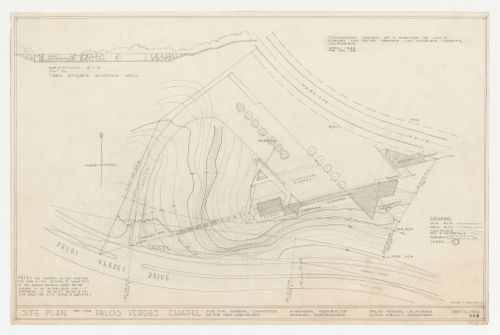
- This block plan for Wayfarers' Chapel, Palos Verdes, California, includes the new highway and shows the rectory and the triangular-plan parish house, neither of which were built. - The survey information on drawing DR1987:0693 appears to be copied by Kazio from an April 1949 survey by Charles C. Miller (probably DR1987:0679 or DR1987:0677).
DR1987:0693
Description:
- This block plan for Wayfarers' Chapel, Palos Verdes, California, includes the new highway and shows the rectory and the triangular-plan parish house, neither of which were built. - The survey information on drawing DR1987:0693 appears to be copied by Kazio from an April 1949 survey by Charles C. Miller (probably DR1987:0679 or DR1987:0677).
Personnes et institutions:
Sujet:
architecture, topographique
architecture, topographique
Date:
2 September 1954, revised 1 May 1956
2 September 1954, revised 1 May 1956
Titre:
Wayfarers' Chapel, Palos Verdes, California: Site plan based on a topographic survey, with section through entrance steps showing gateway
Actions:
DR1987:0693
Description:
- This block plan for Wayfarers' Chapel, Palos Verdes, California, includes the new highway and shows the rectory and the triangular-plan parish house, neither of which were built. - The survey information on drawing DR1987:0693 appears to be copied by Kazio from an April 1949 survey by Charles C. Miller (probably DR1987:0679 or DR1987:0677).
Wayfarers' Chapel, Palos Verdes, California: Site plan based on a topographic survey, with section through entrance steps showing gateway
Actions:
DR1987:0693
Description:
- This block plan for Wayfarers' Chapel, Palos Verdes, California, includes the new highway and shows the rectory and the triangular-plan parish house, neither of which were built. - The survey information on drawing DR1987:0693 appears to be copied by Kazio from an April 1949 survey by Charles C. Miller (probably DR1987:0679 or DR1987:0677).
Classification:
dessins
dessins
Date:
2 September 1954, revised 1 May 1956
2 September 1954, revised 1 May 1956
Personnes et institutions:
Sujet:
architecture, topographique
architecture, topographique
Classification:
photographies
photographies
Actions:
Numéro de référence:
PH1987:0445
Description:
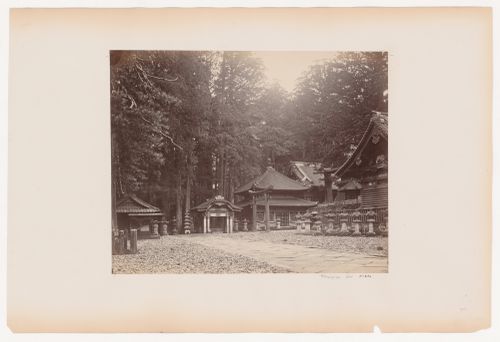
- The structures visible in this photograph are the Guardhouse (at left), the Washbasin Shed, the Sutra Repository and a torii (at centre), Honchi-do, the Drum House, the Bronze Lantern and the Upper Treasury (at right) (Okawa, pp. 62-66; Ota, p. 74, fig. 176).
PH1987:0445
Description:
- The structures visible in this photograph are the Guardhouse (at left), the Washbasin Shed, the Sutra Repository and a torii (at centre), Honchi-do, the Drum House, the Bronze Lantern and the Upper Treasury (at right) (Okawa, pp. 62-66; Ota, p. 74, fig. 176).
Personnes et institutions:
Sujet:
architecture
architecture
Date:
between 1863 and 1877
between 1863 and 1877
Titre:
Partial view of the Toshogu Mausoleum complex showing the Guardhouse, the Washbasin Shed, the Sutra Repository, a torii, and other structures, Nikko, Japan
Actions:
PH1987:0445
Description:
- The structures visible in this photograph are the Guardhouse (at left), the Washbasin Shed, the Sutra Repository and a torii (at centre), Honchi-do, the Drum House, the Bronze Lantern and the Upper Treasury (at right) (Okawa, pp. 62-66; Ota, p. 74, fig. 176).
Partial view of the Toshogu Mausoleum complex showing the Guardhouse, the Washbasin Shed, the Sutra Repository, a torii, and other structures, Nikko, Japan
Actions:
PH1987:0445
Description:
- The structures visible in this photograph are the Guardhouse (at left), the Washbasin Shed, the Sutra Repository and a torii (at centre), Honchi-do, the Drum House, the Bronze Lantern and the Upper Treasury (at right) (Okawa, pp. 62-66; Ota, p. 74, fig. 176).
Classification:
photographies
photographies
Date:
between 1863 and 1877
between 1863 and 1877
Personnes et institutions:
Sujet:
architecture
architecture
Classification:
photographies
photographies
![View of bundled "reet" [a swamp grass or reed used for thatching] stacked for drying, Hamburg, Germany](/img-collection/UPj7nCu2yU4-KK6Z-JGqqZZskR4=/500x387/361564.jpg)
Actions:
Numéro de référence:
PH1985:0292
Description:
- There are nine photographs by Klaus Frahm which show stacked bales of straw or "reet" in Hamburg, Germany (PH1985:0285, PH1985:0292, and PH1985:0294), Mainz, Germany (PH1985:0287 - PH1985:0290), Tirrenia, Italy (PH1985:0286) and Toscana, Italy (PH1985:0293). "Reet" is apparently a swamp grass or reed used for thatching roofs in northern Germany (see the photographer's inscription on photograph PH1985:0294). Four of the photographs show bales of straw or bundles of reet stacked in various ways (PH1985:0285, PH1985:0289, PH1985:0292, PH1985:0294). Photograph PH1985:0287 shows a stack of bales of straw covered in plastic. The remaining four photographs show bales of straw stacked in the form of houses (PH1985:0286, PH1985:0288, PH1985:0290, PH1985:0293).
PH1985:0292
Description:
- There are nine photographs by Klaus Frahm which show stacked bales of straw or "reet" in Hamburg, Germany (PH1985:0285, PH1985:0292, and PH1985:0294), Mainz, Germany (PH1985:0287 - PH1985:0290), Tirrenia, Italy (PH1985:0286) and Toscana, Italy (PH1985:0293). "Reet" is apparently a swamp grass or reed used for thatching roofs in northern Germany (see the photographer's inscription on photograph PH1985:0294). Four of the photographs show bales of straw or bundles of reet stacked in various ways (PH1985:0285, PH1985:0289, PH1985:0292, PH1985:0294). Photograph PH1985:0287 shows a stack of bales of straw covered in plastic. The remaining four photographs show bales of straw stacked in the form of houses (PH1985:0286, PH1985:0288, PH1985:0290, PH1985:0293).
Personnes et institutions:
Sujet:
architecture, topographique
architecture, topographique
Date:
1978
1978
Titre:
View of bundled "reet" [a swamp grass or reed used for thatching] stacked for drying, Hamburg, Germany
Actions:
PH1985:0292
Description:
- There are nine photographs by Klaus Frahm which show stacked bales of straw or "reet" in Hamburg, Germany (PH1985:0285, PH1985:0292, and PH1985:0294), Mainz, Germany (PH1985:0287 - PH1985:0290), Tirrenia, Italy (PH1985:0286) and Toscana, Italy (PH1985:0293). "Reet" is apparently a swamp grass or reed used for thatching roofs in northern Germany (see the photographer's inscription on photograph PH1985:0294). Four of the photographs show bales of straw or bundles of reet stacked in various ways (PH1985:0285, PH1985:0289, PH1985:0292, PH1985:0294). Photograph PH1985:0287 shows a stack of bales of straw covered in plastic. The remaining four photographs show bales of straw stacked in the form of houses (PH1985:0286, PH1985:0288, PH1985:0290, PH1985:0293).
View of bundled "reet" [a swamp grass or reed used for thatching] stacked for drying, Hamburg, Germany
Actions:
PH1985:0292
Description:
- There are nine photographs by Klaus Frahm which show stacked bales of straw or "reet" in Hamburg, Germany (PH1985:0285, PH1985:0292, and PH1985:0294), Mainz, Germany (PH1985:0287 - PH1985:0290), Tirrenia, Italy (PH1985:0286) and Toscana, Italy (PH1985:0293). "Reet" is apparently a swamp grass or reed used for thatching roofs in northern Germany (see the photographer's inscription on photograph PH1985:0294). Four of the photographs show bales of straw or bundles of reet stacked in various ways (PH1985:0285, PH1985:0289, PH1985:0292, PH1985:0294). Photograph PH1985:0287 shows a stack of bales of straw covered in plastic. The remaining four photographs show bales of straw stacked in the form of houses (PH1985:0286, PH1985:0288, PH1985:0290, PH1985:0293).
Classification:
photographies
photographies
Date:
1978
1978
Personnes et institutions:
Sujet:
architecture, topographique
architecture, topographique
Classification:
photographies
photographies
![View of Closes Nos. 97 and 103 showing a common water tap or pump in the foreground, Saltmarket [street], Glasgow, Scotland](/img-collection/gXBDkbcpf36NB53oH6mlMBCBzpk=/500x615/11265.jpg)
Actions:
Numéro de référence:
PH1980:0358:028
Description:
- Closes, vennels and wynds are narrow passages that lead from the street to side entrances of houses.
PH1980:0358:028
Description:
- Closes, vennels and wynds are narrow passages that lead from the street to side entrances of houses.
Personnes et institutions:
Sujet:
architecture
architecture
Date:
1868-1871
1868-1871
Titre:
View of Closes Nos. 97 and 103 showing a common water tap or pump in the foreground, Saltmarket [street], Glasgow, Scotland
Actions:
PH1980:0358:028
Description:
- Closes, vennels and wynds are narrow passages that lead from the street to side entrances of houses.
View of Closes Nos. 97 and 103 showing a common water tap or pump in the foreground, Saltmarket [street], Glasgow, Scotland
Actions:
PH1980:0358:028
Description:
- Closes, vennels and wynds are narrow passages that lead from the street to side entrances of houses.
Classification:
photographies
photographies
Date:
1868-1871
1868-1871
Personnes et institutions:
Sujet:
architecture
architecture
Classification:
archives
Niveau de description archivistique:
Fonds
archives
Niveau de description archivistique:
Fonds
Numéro de référence:
AP074
Résumé:
The Catherine Chard Wisnicki fonds contains photographs dating from about 1947, of a house project in West Vancouver which Chard Wisnicki, the first female graduate of the McGill School of Architecture, was assistant architect. The fonds also contains a videocassette recording of an interview with Chard Wisnicki from 1995, and one textual document from 1997.
AP074
Résumé:
The Catherine Chard Wisnicki fonds contains photographs dating from about 1947, of a house project in West Vancouver which Chard Wisnicki, the first female graduate of the McGill School of Architecture, was assistant architect. The fonds also contains a videocassette recording of an interview with Chard Wisnicki from 1995, and one textual document from 1997.
Personnes et institutions:
Date:
[ca. 1947], 1995, 1997
[ca. 1947], 1995, 1997
Titre:
Fonds Catherine Chard Wisnicki
Actions:
AP074
Résumé:
The Catherine Chard Wisnicki fonds contains photographs dating from about 1947, of a house project in West Vancouver which Chard Wisnicki, the first female graduate of the McGill School of Architecture, was assistant architect. The fonds also contains a videocassette recording of an interview with Chard Wisnicki from 1995, and one textual document from 1997.
Fonds Catherine Chard Wisnicki
Actions:
AP074
Résumé:
The Catherine Chard Wisnicki fonds contains photographs dating from about 1947, of a house project in West Vancouver which Chard Wisnicki, the first female graduate of the McGill School of Architecture, was assistant architect. The fonds also contains a videocassette recording of an interview with Chard Wisnicki from 1995, and one textual document from 1997.
Classification:
archives
Niveau de description archivistique:
Fonds
archives
Niveau de description archivistique:
Fonds
Date:
[ca. 1947], 1995, 1997
[ca. 1947], 1995, 1997
Personnes et institutions:
Classification:
photographies
photographies
Numéro de référence:
DR2012:0012:095:024
Description:
File containing photographs, printouts, and a slide related to the Une construction à Québec [A Quebec construction… houses/poles/flags] project. Original folder inscribed in graphite: MUSEE DU QUEBEC - PAYSAGES VERTICAUX JUIN-OCT. 1989
DR2012:0012:095:024
Description:
File containing photographs, printouts, and a slide related to the Une construction à Québec [A Quebec construction… houses/poles/flags] project. Original folder inscribed in graphite: MUSEE DU QUEBEC - PAYSAGES VERTICAUX JUIN-OCT. 1989
Personnes et institutions:
Date:
1989
1989
Titre:
Photographs, Une construction à Québec
Actions:
DR2012:0012:095:024
Description:
File containing photographs, printouts, and a slide related to the Une construction à Québec [A Quebec construction… houses/poles/flags] project. Original folder inscribed in graphite: MUSEE DU QUEBEC - PAYSAGES VERTICAUX JUIN-OCT. 1989
Photographs, Une construction à Québec
Actions:
DR2012:0012:095:024
Description:
File containing photographs, printouts, and a slide related to the Une construction à Québec [A Quebec construction… houses/poles/flags] project. Original folder inscribed in graphite: MUSEE DU QUEBEC - PAYSAGES VERTICAUX JUIN-OCT. 1989
Classification:
photographies
photographies
Date:
1989
1989
Personnes et institutions:
Classification:
photographies
photographies
Actions:
Numéro de référence:
PH1985:0413
Description:
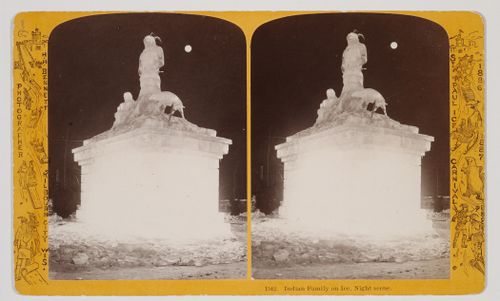
The sculpture depicts what seems to be a man standing, dressed in Indigenous clothing with regalia and tomahawk, and a woman seated on his right side and an animal (dog?) standing on his left. This way of representing an Indigenous couple reflects 19th century settler notions of gender roles. In Indigenous families the woman is the head of the house and would be the one standing, with the man beside her as her equal. The Saint Paul Ice Carnival, founded in 1886, is now known as the Saint Paul Winter Carnival.
PH1985:0413
Description:
The sculpture depicts what seems to be a man standing, dressed in Indigenous clothing with regalia and tomahawk, and a woman seated on his right side and an animal (dog?) standing on his left. This way of representing an Indigenous couple reflects 19th century settler notions of gender roles. In Indigenous families the woman is the head of the house and would be the one standing, with the man beside her as her equal. The Saint Paul Ice Carnival, founded in 1886, is now known as the Saint Paul Winter Carnival.
Personnes et institutions:
Date:
circa 1886-1888
circa 1886-1888
Titre:
Stereoview of an illuminated ice sculpture at the Saint Paul Ice Carnival representing two Indigenous persons and animal on a base, Saint Paul, Minnesota, United States
Actions:
PH1985:0413
Description:
The sculpture depicts what seems to be a man standing, dressed in Indigenous clothing with regalia and tomahawk, and a woman seated on his right side and an animal (dog?) standing on his left. This way of representing an Indigenous couple reflects 19th century settler notions of gender roles. In Indigenous families the woman is the head of the house and would be the one standing, with the man beside her as her equal. The Saint Paul Ice Carnival, founded in 1886, is now known as the Saint Paul Winter Carnival.
Stereoview of an illuminated ice sculpture at the Saint Paul Ice Carnival representing two Indigenous persons and animal on a base, Saint Paul, Minnesota, United States
Actions:
PH1985:0413
Description:
The sculpture depicts what seems to be a man standing, dressed in Indigenous clothing with regalia and tomahawk, and a woman seated on his right side and an animal (dog?) standing on his left. This way of representing an Indigenous couple reflects 19th century settler notions of gender roles. In Indigenous families the woman is the head of the house and would be the one standing, with the man beside her as her equal. The Saint Paul Ice Carnival, founded in 1886, is now known as the Saint Paul Winter Carnival.
Classification:
photographies
photographies
Date:
circa 1886-1888
circa 1886-1888
Personnes et institutions:
Classification:
photographies
photographies
Actions:
Numéro de référence:
PH1989:0147
Description:
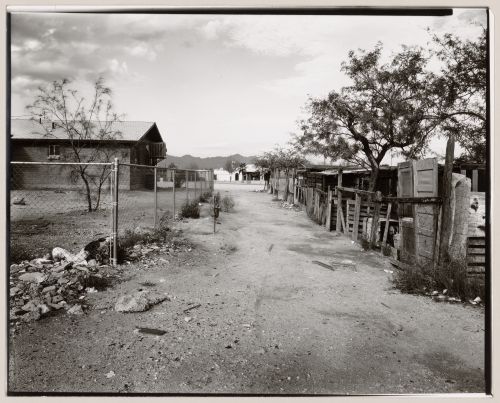
One of a series of forty-four photographs of the Yaqui community of Old Pascua by Lorne Greenberg. The photographs document the relationship of household and church in the Yaqui community. The photographs were exhibited at the Arizona State Museum in 1983. The CCA collection includes ten photographs from the series (PH1989:0147 - PH1989:0156). In 1978, the San Ignacio Yaqui Council applied for Community Development Block Grants (CDBG), which had been established by the United States Government in 1974. The community first received CDBG funding in 1979/1980. Since that time, most of the owner-occupied houses in Pascua Village have been torn down and new homes have been built.
PH1989:0147
Description:
One of a series of forty-four photographs of the Yaqui community of Old Pascua by Lorne Greenberg. The photographs document the relationship of household and church in the Yaqui community. The photographs were exhibited at the Arizona State Museum in 1983. The CCA collection includes ten photographs from the series (PH1989:0147 - PH1989:0156). In 1978, the San Ignacio Yaqui Council applied for Community Development Block Grants (CDBG), which had been established by the United States Government in 1974. The community first received CDBG funding in 1979/1980. Since that time, most of the owner-occupied houses in Pascua Village have been torn down and new homes have been built.
Personnes et institutions:
Sujet:
architecture
architecture
Date:
1981
1981
Titre:
View of path to church, Old Pascua, Tucson, Arizona, United States (from a series documenting the Yaqui community of Old Pascua)
Actions:
PH1989:0147
Description:
One of a series of forty-four photographs of the Yaqui community of Old Pascua by Lorne Greenberg. The photographs document the relationship of household and church in the Yaqui community. The photographs were exhibited at the Arizona State Museum in 1983. The CCA collection includes ten photographs from the series (PH1989:0147 - PH1989:0156). In 1978, the San Ignacio Yaqui Council applied for Community Development Block Grants (CDBG), which had been established by the United States Government in 1974. The community first received CDBG funding in 1979/1980. Since that time, most of the owner-occupied houses in Pascua Village have been torn down and new homes have been built.
View of path to church, Old Pascua, Tucson, Arizona, United States (from a series documenting the Yaqui community of Old Pascua)
Actions:
PH1989:0147
Description:
One of a series of forty-four photographs of the Yaqui community of Old Pascua by Lorne Greenberg. The photographs document the relationship of household and church in the Yaqui community. The photographs were exhibited at the Arizona State Museum in 1983. The CCA collection includes ten photographs from the series (PH1989:0147 - PH1989:0156). In 1978, the San Ignacio Yaqui Council applied for Community Development Block Grants (CDBG), which had been established by the United States Government in 1974. The community first received CDBG funding in 1979/1980. Since that time, most of the owner-occupied houses in Pascua Village have been torn down and new homes have been built.
Classification:
photographies
photographies
Date:
1981
1981
Personnes et institutions:
Sujet:
architecture
architecture
Classification:
photographies
photographies
Actions:
Numéro de référence:
PH1989:0152
Description:
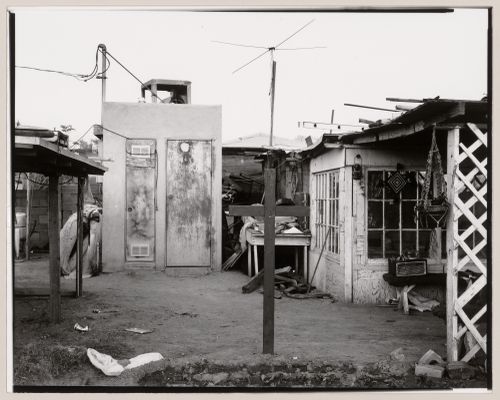
One of a series of forty-four photographs of the Yaqui community of Old Pascua by Lorne Greenberg. The photographs document the relationship of household and church in the Yaqui community. The photographs were exhibited at the Arizona State Museum in 1983. The CCA collection includes ten photographs from the series (PH1989:0147 - PH1989:0156). In 1978, the San Ignacio Yaqui Council applied for Community Development Block Grants (CDBG), which had been established by the United States Government in 1974. The community first received CDBG funding in 1979/1980. Since that time, most of the owner-occupied houses in Pascua Village have been torn down and new homes have been built.
PH1989:0152
Description:
One of a series of forty-four photographs of the Yaqui community of Old Pascua by Lorne Greenberg. The photographs document the relationship of household and church in the Yaqui community. The photographs were exhibited at the Arizona State Museum in 1983. The CCA collection includes ten photographs from the series (PH1989:0147 - PH1989:0156). In 1978, the San Ignacio Yaqui Council applied for Community Development Block Grants (CDBG), which had been established by the United States Government in 1974. The community first received CDBG funding in 1979/1980. Since that time, most of the owner-occupied houses in Pascua Village have been torn down and new homes have been built.
Personnes et institutions:
Sujet:
architecture
architecture
Date:
1981
1981
Titre:
View of cross in yard, Old Pascua, Tucson, Arizona, United States (from a series documenting the Yaqui community of Old Pascua)
Actions:
PH1989:0152
Description:
One of a series of forty-four photographs of the Yaqui community of Old Pascua by Lorne Greenberg. The photographs document the relationship of household and church in the Yaqui community. The photographs were exhibited at the Arizona State Museum in 1983. The CCA collection includes ten photographs from the series (PH1989:0147 - PH1989:0156). In 1978, the San Ignacio Yaqui Council applied for Community Development Block Grants (CDBG), which had been established by the United States Government in 1974. The community first received CDBG funding in 1979/1980. Since that time, most of the owner-occupied houses in Pascua Village have been torn down and new homes have been built.
View of cross in yard, Old Pascua, Tucson, Arizona, United States (from a series documenting the Yaqui community of Old Pascua)
Actions:
PH1989:0152
Description:
One of a series of forty-four photographs of the Yaqui community of Old Pascua by Lorne Greenberg. The photographs document the relationship of household and church in the Yaqui community. The photographs were exhibited at the Arizona State Museum in 1983. The CCA collection includes ten photographs from the series (PH1989:0147 - PH1989:0156). In 1978, the San Ignacio Yaqui Council applied for Community Development Block Grants (CDBG), which had been established by the United States Government in 1974. The community first received CDBG funding in 1979/1980. Since that time, most of the owner-occupied houses in Pascua Village have been torn down and new homes have been built.
Classification:
photographies
photographies
Date:
1981
1981
Personnes et institutions:
Sujet:
architecture
architecture
Classification:
photographies
photographies
Actions:
Numéro de référence:
PH1989:0153
Description:
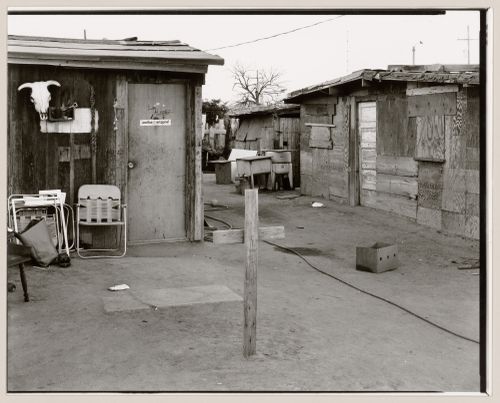
One of a series of forty-four photographs of the Yaqui community of Old Pascua by Lorne Greenberg. The photographs document the relationship of household and church in the Yaqui community. The photographs were exhibited at the Arizona State Museum in 1983. The CCA collection includes ten photographs from the series (PH1989:0147 - PH1989:0156). In 1978, the San Ignacio Yaqui Council applied for Community Development Block Grants (CDBG), which had been established by the United States Government in 1974. The community first received CDBG funding in 1979/1980. Since that time, most of the owner-occupied houses in Pascua Village have been torn down and new homes have been built.
PH1989:0153
Description:
One of a series of forty-four photographs of the Yaqui community of Old Pascua by Lorne Greenberg. The photographs document the relationship of household and church in the Yaqui community. The photographs were exhibited at the Arizona State Museum in 1983. The CCA collection includes ten photographs from the series (PH1989:0147 - PH1989:0156). In 1978, the San Ignacio Yaqui Council applied for Community Development Block Grants (CDBG), which had been established by the United States Government in 1974. The community first received CDBG funding in 1979/1980. Since that time, most of the owner-occupied houses in Pascua Village have been torn down and new homes have been built.
Personnes et institutions:
Sujet:
architecture
architecture
Date:
1981
1981
Titre:
View of cross in yard, Old Pascua, Tucson, Arizona, United States (from a series documenting the Yaqui community of Old Pascua)
Actions:
PH1989:0153
Description:
One of a series of forty-four photographs of the Yaqui community of Old Pascua by Lorne Greenberg. The photographs document the relationship of household and church in the Yaqui community. The photographs were exhibited at the Arizona State Museum in 1983. The CCA collection includes ten photographs from the series (PH1989:0147 - PH1989:0156). In 1978, the San Ignacio Yaqui Council applied for Community Development Block Grants (CDBG), which had been established by the United States Government in 1974. The community first received CDBG funding in 1979/1980. Since that time, most of the owner-occupied houses in Pascua Village have been torn down and new homes have been built.
View of cross in yard, Old Pascua, Tucson, Arizona, United States (from a series documenting the Yaqui community of Old Pascua)
Actions:
PH1989:0153
Description:
One of a series of forty-four photographs of the Yaqui community of Old Pascua by Lorne Greenberg. The photographs document the relationship of household and church in the Yaqui community. The photographs were exhibited at the Arizona State Museum in 1983. The CCA collection includes ten photographs from the series (PH1989:0147 - PH1989:0156). In 1978, the San Ignacio Yaqui Council applied for Community Development Block Grants (CDBG), which had been established by the United States Government in 1974. The community first received CDBG funding in 1979/1980. Since that time, most of the owner-occupied houses in Pascua Village have been torn down and new homes have been built.
Classification:
photographies
photographies
Date:
1981
1981
Personnes et institutions:
Sujet:
architecture
architecture


