


expositions
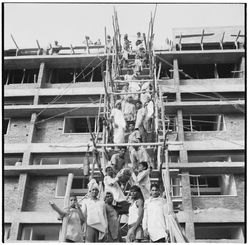
des pros : construction auto-documentée sur les réseaux sociaux étudie l’émergence, sur les médias sociaux, de clips populaires documentant les travaux de construction par les personnes présentes sur le chantier elles-mêmes. Inspirés par l’essor de l’économie de la création, les entrepreneurs, les ouvriers et les artisans ont commencé à enregistrer et à partager leurs(...)
salle octogonale Mot(s)-clé(s):
médias sociaux, TikTok, Instagram, photographie d'architecture, travailleurs de la construction, main-d'œuvre, compétences
juin 2024 au octobre 2024
des pros : construction auto documentée sur les réseaux sociaux
Actions:
Description:
des pros : construction auto-documentée sur les réseaux sociaux étudie l’émergence, sur les médias sociaux, de clips populaires documentant les travaux de construction par les personnes présentes sur le chantier elles-mêmes. Inspirés par l’essor de l’économie de la création, les entrepreneurs, les ouvriers et les artisans ont commencé à enregistrer et à partager leurs(...)
expositions
juin 2024 au
octobre 2024
salle octogonale Mot(s)-clé(s):
médias sociaux, TikTok, Instagram, photographie d'architecture, travailleurs de la construction, main-d'œuvre, compétences
Projet
Steel House
AP144.S2.D60
Description:
File documents an unsuccessful competition entry, in collaboration with Miles Park, Douglas Smith and Frank Newby, for a mass-produced housing system using steel, for a competition sponsored by the European Coal and Steel Community. Requirements called for rapid assembly/disassembly, and flexible unit plans that could be altered by home owners and appeal to a wide range of owners and their preferences. Schematic sketches include exterior elevations, floor plans, preliminary details, and charts for building components. Conceptual sketches show alternate unit and floor plan arrangements, and include network analysis plans, site maximization plans based on transportability, family breakdown diagrams, alternate internal unit layout plans based on age and other factors, functional area plans indicating separation possibilities, and charts which cross-reference factors such as transportability, construction, and assembly requirements. Design development drawings show typical plans, site plans, sections, elevations, details, axonometric drawings of structure and cladding, internal units, and components. Some material in this file was published in Price, Cedric, "Steel Housing", 'Architectural Design', vol. 37, (May 1967) 244, and Price, Cedric, 'Cedric Price-Works II' (London: Architectural Press, 1984) 36, 49-50, 113. Material in this file was produced between 1965 and 1969. 'High Authority of the European Coal and Steel Community' is the full name of the client as found in the textual records. The title of the competition is 'International Competition for the Design of Industrially Fabricated Dwellings'. File contains conceptual drawings, design development drawings, photographic material, presentation panels, textual records, and model.
1965-1969
Steel House
Actions:
AP144.S2.D60
Description:
File documents an unsuccessful competition entry, in collaboration with Miles Park, Douglas Smith and Frank Newby, for a mass-produced housing system using steel, for a competition sponsored by the European Coal and Steel Community. Requirements called for rapid assembly/disassembly, and flexible unit plans that could be altered by home owners and appeal to a wide range of owners and their preferences. Schematic sketches include exterior elevations, floor plans, preliminary details, and charts for building components. Conceptual sketches show alternate unit and floor plan arrangements, and include network analysis plans, site maximization plans based on transportability, family breakdown diagrams, alternate internal unit layout plans based on age and other factors, functional area plans indicating separation possibilities, and charts which cross-reference factors such as transportability, construction, and assembly requirements. Design development drawings show typical plans, site plans, sections, elevations, details, axonometric drawings of structure and cladding, internal units, and components. Some material in this file was published in Price, Cedric, "Steel Housing", 'Architectural Design', vol. 37, (May 1967) 244, and Price, Cedric, 'Cedric Price-Works II' (London: Architectural Press, 1984) 36, 49-50, 113. Material in this file was produced between 1965 and 1969. 'High Authority of the European Coal and Steel Community' is the full name of the client as found in the textual records. The title of the competition is 'International Competition for the Design of Industrially Fabricated Dwellings'. File contains conceptual drawings, design development drawings, photographic material, presentation panels, textual records, and model.
File 60
1965-1969
expositions
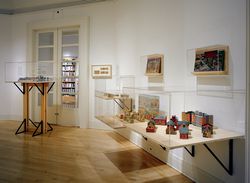
La ville en jeux
L’exposition La ville en jeux explore la manière dont on a représenté les villes et villages dans les jouets d’Europe et d’Amérique du Nord. Les 29 villes en jouet de l’exposition, tirées de la collection de jeux et jouets d’architecture du CCA, reflètent l’évolution des valeurs sociales en même temps que différentes façons de concevoir, d’organiser et de planifier le(...)
Salle octogonale
22 octobre 1997 au 31 mai 1998
La ville en jeux
Actions:
Description:
L’exposition La ville en jeux explore la manière dont on a représenté les villes et villages dans les jouets d’Europe et d’Amérique du Nord. Les 29 villes en jouet de l’exposition, tirées de la collection de jeux et jouets d’architecture du CCA, reflètent l’évolution des valeurs sociales en même temps que différentes façons de concevoir, d’organiser et de planifier le(...)
expositions
22 octobre 1997 au
31 mai 1998
Salle octogonale
pages web
Making Mamak est une boîte à outils destinée à tous les travailleurs culturels, organisateurs sociaux et membres de la communauté. Cette boîte à outils est conçue pour aider à s’engager dans des formes locales et communautaires de création et de rassemblement. En s’inspirant des collectifs artistiques des centres urbains de Malaisie, il est possible de développer des liens de parenté avec sa propre communauté, de formuler des aides mutuelles, de s’approprier des espaces collectifs et de lancer des mouvements sociaux de fond.
« Making Mamak » : Écologies collectives de l’espace urbain
Actions:
Résumé:
Making Mamak est une boîte à outils destinée à tous les travailleurs culturels, organisateurs sociaux et membres de la communauté. Cette boîte à outils est conçue pour aider à s’engager dans des formes locales et communautaires de création et de rassemblement. En s’inspirant des collectifs artistiques des centres urbains de Malaisie, il est possible de développer des liens de parenté avec sa propre communauté, de formuler des aides mutuelles, de s’approprier des espaces collectifs et de lancer des mouvements sociaux de fond.
pages web
Projet
CI005.S1.1922.PR1
Description:
The city of Rotterdam in May 1922 commissioned a project to re-house homeless slum-dwellers and to alleviate Rotterdam's crisis in housing shortage: the housing unit was known as The Witte Dorp housing community, in the polder of Oud-Mathenesse. Oud designed the site plan and dwellings for this municipal housing project of 343 dwellings, eight shop units and a fire-engine shed. Oud created a geometric street plan with short axes that joined at the playground and townscape with identical facades of row houses facing one another. The houses were white with contrasting red roofs, blue front doors and yellow door frames and window casings (Taverne et al. 2001, 250). Project series includes drawings of plans and eighteen photographs, including exterior views and photographs of a plan.
1922-1924
Oud-Mathenesse Municipal Housing Scheme, Rotterdam, Netherlands (1922-1924)
Actions:
CI005.S1.1922.PR1
Description:
The city of Rotterdam in May 1922 commissioned a project to re-house homeless slum-dwellers and to alleviate Rotterdam's crisis in housing shortage: the housing unit was known as The Witte Dorp housing community, in the polder of Oud-Mathenesse. Oud designed the site plan and dwellings for this municipal housing project of 343 dwellings, eight shop units and a fire-engine shed. Oud created a geometric street plan with short axes that joined at the playground and townscape with identical facades of row houses facing one another. The houses were white with contrasting red roofs, blue front doors and yellow door frames and window casings (Taverne et al. 2001, 250). Project series includes drawings of plans and eighteen photographs, including exterior views and photographs of a plan.
project
1922-1924
archives
Niveau de description archivistique:
Fonds
AP075
Résumé:
The Cornelia Hahn Oberlander fonds documents Oberlander's professional activities as a landscape architect. It contains over 203 projects that span from 1950 to 2018 predominantly in Canada and in the United States, but also in Germany. The fonds is a complete record of Oberlander's work, and comprises her playground projects, roof gardens, and public space landscapes, as well as landscape designs for private residences, as well as administrative records from her practice, her professional engagements, and her research materials. The material in this fonds is dated from 1936 to 2021.
1936-2021
Fonds Cornelia Hahn Oberlander
Actions:
AP075
Résumé:
The Cornelia Hahn Oberlander fonds documents Oberlander's professional activities as a landscape architect. It contains over 203 projects that span from 1950 to 2018 predominantly in Canada and in the United States, but also in Germany. The fonds is a complete record of Oberlander's work, and comprises her playground projects, roof gardens, and public space landscapes, as well as landscape designs for private residences, as well as administrative records from her practice, her professional engagements, and her research materials. The material in this fonds is dated from 1936 to 2021.
archives
Niveau de description archivistique:
Fonds
1936-2021
archives
Niveau de description archivistique:
Fonds
Fonds Shoei Yoh
AP166
Résumé:
The Shoei Yoh fonds (1976-2014, predominant 1990-1996) documents a selection of works by the Japanese architect and designer Shoei Yoh and the firm Shoei Yoh + Architects. The selection is comprised of two projects that were featured in the CCA exhibition Archaeology of the Digital (May 7-October 27, 2013)—the Galaxy Toyama Gymnasium and the unbuilt Odawara Municipal Sports Complex --and five other projects.The fonds also includes some published material by and about Shoei Yoh.
1976-2014, predominant 1990-1996
Fonds Shoei Yoh
Actions:
AP166
Résumé:
The Shoei Yoh fonds (1976-2014, predominant 1990-1996) documents a selection of works by the Japanese architect and designer Shoei Yoh and the firm Shoei Yoh + Architects. The selection is comprised of two projects that were featured in the CCA exhibition Archaeology of the Digital (May 7-October 27, 2013)—the Galaxy Toyama Gymnasium and the unbuilt Odawara Municipal Sports Complex --and five other projects.The fonds also includes some published material by and about Shoei Yoh.
archives
Niveau de description archivistique:
Fonds
1976-2014, predominant 1990-1996
articles
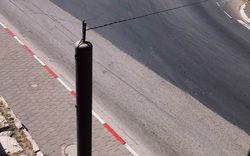
Fictions de fictions
Fictions de fictions
Piper Bernbaum sur les réalités physiques et les fictions juridiques de l’érouv à Jérusalem
Actions:
Figurer un territoire
expositions
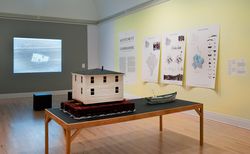
Si l’immigration est un thème dominant de la culture contemporaine, les discussions à son sujet sont souvent limitées à l’expérience humaine, telles que la traversée de frontières et les problématiques d’identité nationale. L’exposition Trajets adopte une perspective autre, celle de l’impact des mouvements sur l’environnement. Les exemples vont de la noix de coco qui(...)
Salles principales
20 octobre 2010 au 13 mars 2011
Trajets: comment la mobilité des fruits, des idées et des architectures recompose notre environnement
Actions:
Description:
Si l’immigration est un thème dominant de la culture contemporaine, les discussions à son sujet sont souvent limitées à l’expérience humaine, telles que la traversée de frontières et les problématiques d’identité nationale. L’exposition Trajets adopte une perspective autre, celle de l’impact des mouvements sur l’environnement. Les exemples vont de la noix de coco qui(...)
expositions
20 octobre 2010 au
13 mars 2011
Salles principales
Projet
AP178.S1.1990.PR03
Description:
This project series documents the Urban design for Boulevard Brune, Cité de Jeunesse in Paris, France. While the records were held in the office’s archives this project was assigned the number 5/90. The office assigned the date 1990 to this project. This project consisted of a competition entry for the fourth and last phase of a social housing program for the young postmen of Paris. The competition was organized by the Ministère des Postes et des Télécommunications. The proposal for the Boulevard Brune building included four units; a school for mailmen (Edificio A), two housing buildings (Edificio B and C), and a community center (Edificio D). The program also mentioned a parking lot. Alvaro Siza was one of the three finalists selected but was not chosen for the project. Documenting this project are sketches, studies and site plans. Textual material includes project documentation, competition documentation, and correspondence. Photographs, photomontages and negatives document the project site.
1983-1991
Plano Urbanístico Boulevard Brune [Urban design for Boulevard Brune, Cité de Jeunesse], Paris, France (1990)
Actions:
AP178.S1.1990.PR03
Description:
This project series documents the Urban design for Boulevard Brune, Cité de Jeunesse in Paris, France. While the records were held in the office’s archives this project was assigned the number 5/90. The office assigned the date 1990 to this project. This project consisted of a competition entry for the fourth and last phase of a social housing program for the young postmen of Paris. The competition was organized by the Ministère des Postes et des Télécommunications. The proposal for the Boulevard Brune building included four units; a school for mailmen (Edificio A), two housing buildings (Edificio B and C), and a community center (Edificio D). The program also mentioned a parking lot. Alvaro Siza was one of the three finalists selected but was not chosen for the project. Documenting this project are sketches, studies and site plans. Textual material includes project documentation, competition documentation, and correspondence. Photographs, photomontages and negatives document the project site.
Project
1983-1991


