


7057 Résultats
Niveau de description archivistique:
Projet
Projet
Numéro de référence:
AP056.S1.1990.PR03
Description:
This project series documents the Joseph Stauffer Library at Queen's University in Kingston, Ontario from 1990-1994. The office identified the project number as 9011. This project was the winning entry of a national design competition and was completed with Thomas Payne at its head and with the firm Moffat Kinoshita Associates acting as consulting architects. Located at the corner of Alfred and University Streets, the project consisted of a new 200,000 square foot library for the campus. Influenced by the surrounding gothic collegiate buildings, the library's exteriors focused on vertical, upward movement and had rich textures created by limestone, copper flashing and wood window frames and entrance screens. The library's main entrance at the Union Street and University Street corner was a rotunda that featured a fireplace-lined reading room on the second floor. Other reading rooms and a café lined the building's exterior, while the main library stacks were housed in the core of the building. Wood panelling was disbursed amongst the walls to add warmth to the buildings interior. This project also included plans to expand the library in the following decades. This project received a Governor General's Award in Architecture in 1997. This project is recorded through drawings, photographs, presentation paintings and textual records dating from 1990-1994. The drawings are mostly originals and include sketches, presentation drawings, plans, elevations, sections, perspectives, details and axonometric drawings. The photographs show the finished building, while the textual records consist of publicity on the building and the program description.
AP056.S1.1990.PR03
Description:
This project series documents the Joseph Stauffer Library at Queen's University in Kingston, Ontario from 1990-1994. The office identified the project number as 9011. This project was the winning entry of a national design competition and was completed with Thomas Payne at its head and with the firm Moffat Kinoshita Associates acting as consulting architects. Located at the corner of Alfred and University Streets, the project consisted of a new 200,000 square foot library for the campus. Influenced by the surrounding gothic collegiate buildings, the library's exteriors focused on vertical, upward movement and had rich textures created by limestone, copper flashing and wood window frames and entrance screens. The library's main entrance at the Union Street and University Street corner was a rotunda that featured a fireplace-lined reading room on the second floor. Other reading rooms and a café lined the building's exterior, while the main library stacks were housed in the core of the building. Wood panelling was disbursed amongst the walls to add warmth to the buildings interior. This project also included plans to expand the library in the following decades. This project received a Governor General's Award in Architecture in 1997. This project is recorded through drawings, photographs, presentation paintings and textual records dating from 1990-1994. The drawings are mostly originals and include sketches, presentation drawings, plans, elevations, sections, perspectives, details and axonometric drawings. The photographs show the finished building, while the textual records consist of publicity on the building and the program description.
Personnes et institutions:
Date:
1990-1994
1990-1994
Titre:
Joseph Stauffer Library, Queen's University, Kingston, Ontario (1990-1994)
Actions:
AP056.S1.1990.PR03
Description:
This project series documents the Joseph Stauffer Library at Queen's University in Kingston, Ontario from 1990-1994. The office identified the project number as 9011. This project was the winning entry of a national design competition and was completed with Thomas Payne at its head and with the firm Moffat Kinoshita Associates acting as consulting architects. Located at the corner of Alfred and University Streets, the project consisted of a new 200,000 square foot library for the campus. Influenced by the surrounding gothic collegiate buildings, the library's exteriors focused on vertical, upward movement and had rich textures created by limestone, copper flashing and wood window frames and entrance screens. The library's main entrance at the Union Street and University Street corner was a rotunda that featured a fireplace-lined reading room on the second floor. Other reading rooms and a café lined the building's exterior, while the main library stacks were housed in the core of the building. Wood panelling was disbursed amongst the walls to add warmth to the buildings interior. This project also included plans to expand the library in the following decades. This project received a Governor General's Award in Architecture in 1997. This project is recorded through drawings, photographs, presentation paintings and textual records dating from 1990-1994. The drawings are mostly originals and include sketches, presentation drawings, plans, elevations, sections, perspectives, details and axonometric drawings. The photographs show the finished building, while the textual records consist of publicity on the building and the program description.
Joseph Stauffer Library, Queen's University, Kingston, Ontario (1990-1994)
Actions:
AP056.S1.1990.PR03
Description:
This project series documents the Joseph Stauffer Library at Queen's University in Kingston, Ontario from 1990-1994. The office identified the project number as 9011. This project was the winning entry of a national design competition and was completed with Thomas Payne at its head and with the firm Moffat Kinoshita Associates acting as consulting architects. Located at the corner of Alfred and University Streets, the project consisted of a new 200,000 square foot library for the campus. Influenced by the surrounding gothic collegiate buildings, the library's exteriors focused on vertical, upward movement and had rich textures created by limestone, copper flashing and wood window frames and entrance screens. The library's main entrance at the Union Street and University Street corner was a rotunda that featured a fireplace-lined reading room on the second floor. Other reading rooms and a café lined the building's exterior, while the main library stacks were housed in the core of the building. Wood panelling was disbursed amongst the walls to add warmth to the buildings interior. This project also included plans to expand the library in the following decades. This project received a Governor General's Award in Architecture in 1997. This project is recorded through drawings, photographs, presentation paintings and textual records dating from 1990-1994. The drawings are mostly originals and include sketches, presentation drawings, plans, elevations, sections, perspectives, details and axonometric drawings. The photographs show the finished building, while the textual records consist of publicity on the building and the program description.
Niveau de description archivistique:
Project
Project
Date:
1990-1994
1990-1994
Personnes et institutions:
Classification:
photographies
photographies
Actions:
Numéro de référence:
PH1999:0172
Description:
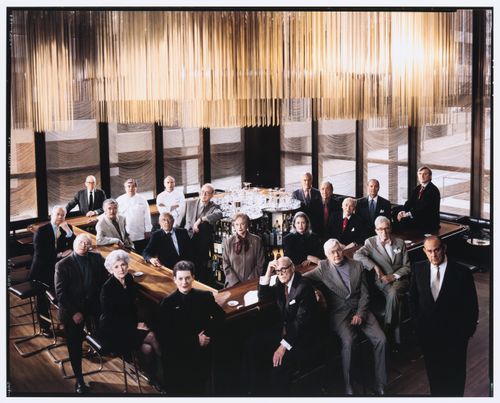
Photograph commissioned by Vanity Fair. Published in Vanity Fair, "Season in the Sun", August 1999.Outside the bar, counterclockwise from rear left: former pastry chef Albert Kumin, former press agent Roger Martin, landscape architect Karl Linn, architecture critic Ada Louise Huxtable, project director Phyllis Lambert, architect Philip Johnson, sculptor Richard Lippold, lawyer Lester Klepper, former co-owner Tom Margittai. Inside the bar, from left: former executive chef Seppi Renggli, current chef Hitsch Albin, former press agent Philip Miles, current pastry chef Patrick Lemblé, adman George Lois, food writer Mimi Sheraton, sculptor Marilynn Gelfman Karp, adman Ron Holland, menu and logo designer Emil Antonucci, former director George Lang, current co-directors Alex von Bidder and Julian Niccolini.
PH1999:0172
Description:
Photograph commissioned by Vanity Fair. Published in Vanity Fair, "Season in the Sun", August 1999.Outside the bar, counterclockwise from rear left: former pastry chef Albert Kumin, former press agent Roger Martin, landscape architect Karl Linn, architecture critic Ada Louise Huxtable, project director Phyllis Lambert, architect Philip Johnson, sculptor Richard Lippold, lawyer Lester Klepper, former co-owner Tom Margittai. Inside the bar, from left: former executive chef Seppi Renggli, current chef Hitsch Albin, former press agent Philip Miles, current pastry chef Patrick Lemblé, adman George Lois, food writer Mimi Sheraton, sculptor Marilynn Gelfman Karp, adman Ron Holland, menu and logo designer Emil Antonucci, former director George Lang, current co-directors Alex von Bidder and Julian Niccolini.
Personnes et institutions:
Sujet:
architecture
architecture
Date:
19 March 1999; 14 April 1999
19 March 1999; 14 April 1999
Titre:
Group portrait of the original creative team of the Four Seasons Restaurant Grill Room, including Phyllis Lambert and Philip Johnson, Restaurant Four Seasons, Seagram Building, New York City, New York, United States
Actions:
PH1999:0172
Description:
Photograph commissioned by Vanity Fair. Published in Vanity Fair, "Season in the Sun", August 1999.Outside the bar, counterclockwise from rear left: former pastry chef Albert Kumin, former press agent Roger Martin, landscape architect Karl Linn, architecture critic Ada Louise Huxtable, project director Phyllis Lambert, architect Philip Johnson, sculptor Richard Lippold, lawyer Lester Klepper, former co-owner Tom Margittai. Inside the bar, from left: former executive chef Seppi Renggli, current chef Hitsch Albin, former press agent Philip Miles, current pastry chef Patrick Lemblé, adman George Lois, food writer Mimi Sheraton, sculptor Marilynn Gelfman Karp, adman Ron Holland, menu and logo designer Emil Antonucci, former director George Lang, current co-directors Alex von Bidder and Julian Niccolini.
Group portrait of the original creative team of the Four Seasons Restaurant Grill Room, including Phyllis Lambert and Philip Johnson, Restaurant Four Seasons, Seagram Building, New York City, New York, United States
Actions:
PH1999:0172
Description:
Photograph commissioned by Vanity Fair. Published in Vanity Fair, "Season in the Sun", August 1999.Outside the bar, counterclockwise from rear left: former pastry chef Albert Kumin, former press agent Roger Martin, landscape architect Karl Linn, architecture critic Ada Louise Huxtable, project director Phyllis Lambert, architect Philip Johnson, sculptor Richard Lippold, lawyer Lester Klepper, former co-owner Tom Margittai. Inside the bar, from left: former executive chef Seppi Renggli, current chef Hitsch Albin, former press agent Philip Miles, current pastry chef Patrick Lemblé, adman George Lois, food writer Mimi Sheraton, sculptor Marilynn Gelfman Karp, adman Ron Holland, menu and logo designer Emil Antonucci, former director George Lang, current co-directors Alex von Bidder and Julian Niccolini.
Classification:
photographies
photographies
Date:
19 March 1999; 14 April 1999
19 March 1999; 14 April 1999
Personnes et institutions:
Sujet:
architecture
architecture
Classification:
archives
Niveau de description archivistique:
Fonds
archives
Niveau de description archivistique:
Fonds
Titre:
Fonds Richard Henriquez
Fonds Richard Henriquez
Numéro de référence:
AP059
Résumé:
The Richard Henriquez fonds, 1962-2002, documents the professional career of architect and urban designer Richard G. Henriquez. More specifically, the fonds documents Henriquez’s architectural training at the University of Manitoba, his early career as an architect in Jamaica, and his career as a principal at the architectural firm Henriquez Partners Architects. The fonds contains approximately 8935 drawings (including reprographic copies), 106 panels, 100 photographs, 31 l.m textual records, 5 offset printing plates and 1 model.
AP059
Résumé:
The Richard Henriquez fonds, 1962-2002, documents the professional career of architect and urban designer Richard G. Henriquez. More specifically, the fonds documents Henriquez’s architectural training at the University of Manitoba, his early career as an architect in Jamaica, and his career as a principal at the architectural firm Henriquez Partners Architects. The fonds contains approximately 8935 drawings (including reprographic copies), 106 panels, 100 photographs, 31 l.m textual records, 5 offset printing plates and 1 model.
Personnes et institutions:
Date:
1962-2002
1962-2002
Titre:
Fonds Richard Henriquez
Actions:
AP059
Résumé:
The Richard Henriquez fonds, 1962-2002, documents the professional career of architect and urban designer Richard G. Henriquez. More specifically, the fonds documents Henriquez’s architectural training at the University of Manitoba, his early career as an architect in Jamaica, and his career as a principal at the architectural firm Henriquez Partners Architects. The fonds contains approximately 8935 drawings (including reprographic copies), 106 panels, 100 photographs, 31 l.m textual records, 5 offset printing plates and 1 model.
Fonds Richard Henriquez
Actions:
AP059
Résumé:
The Richard Henriquez fonds, 1962-2002, documents the professional career of architect and urban designer Richard G. Henriquez. More specifically, the fonds documents Henriquez’s architectural training at the University of Manitoba, his early career as an architect in Jamaica, and his career as a principal at the architectural firm Henriquez Partners Architects. The fonds contains approximately 8935 drawings (including reprographic copies), 106 panels, 100 photographs, 31 l.m textual records, 5 offset printing plates and 1 model.
Classification:
archives
Niveau de description archivistique:
Fonds
archives
Niveau de description archivistique:
Fonds
Date:
1962-2002
1962-2002
Personnes et institutions:
Niveau de description archivistique:
Projet
Projet
Numéro de référence:
AP018.S1.1960.PR02
Description:
This project series documents the Imperial Oil Ontario region office in North York, Ontario from 1960-1962. The office identified the project number as 6049. This project consisted of a three-storey, 110,000 square foot building located at the corner of Don Mills Road and Eglington Avenue. The front entrance was accessed from a circular driveway off Wynford Drive, with parking lots on either side that held 330 vehicles. The basement level had storage rooms, machine and boiler rooms, a telephone switch gear room and shipping areas. The first floor included food service areas, offices, locker rooms, and a doctor's office complete with x-ray rooms, treatment areas and a quiet room for female employees, among others. The second floor contained administrative areas for accounting, data control and banking, while the third floor contained more offices. The building's frame consisted of a rectangular steel skeleton faced with concrete panels. The ground level was recessed 20 feet to allow for sidewalks around the building. Concrete columns at this level supported the upper two storeys. The landscaped surroundings include long, fountain-spotted reflecting pools. This project won the silver Massey Medal for Architecture in 1964, as well as an honourable distinction at the International Exhibition of Architects VIII Biennial of São Paula in 1965. The project is recorded through drawings, textual records and a photograph dating from 1961-1970. The drawings are mostly reprographic copies that include plans, sections, elevations, details, schedules and electrical, mechanical and structural drawings. The textual records consist of specifications originally arranged with the drawings. The photograph shows the finished buillding.
AP018.S1.1960.PR02
Description:
This project series documents the Imperial Oil Ontario region office in North York, Ontario from 1960-1962. The office identified the project number as 6049. This project consisted of a three-storey, 110,000 square foot building located at the corner of Don Mills Road and Eglington Avenue. The front entrance was accessed from a circular driveway off Wynford Drive, with parking lots on either side that held 330 vehicles. The basement level had storage rooms, machine and boiler rooms, a telephone switch gear room and shipping areas. The first floor included food service areas, offices, locker rooms, and a doctor's office complete with x-ray rooms, treatment areas and a quiet room for female employees, among others. The second floor contained administrative areas for accounting, data control and banking, while the third floor contained more offices. The building's frame consisted of a rectangular steel skeleton faced with concrete panels. The ground level was recessed 20 feet to allow for sidewalks around the building. Concrete columns at this level supported the upper two storeys. The landscaped surroundings include long, fountain-spotted reflecting pools. This project won the silver Massey Medal for Architecture in 1964, as well as an honourable distinction at the International Exhibition of Architects VIII Biennial of São Paula in 1965. The project is recorded through drawings, textual records and a photograph dating from 1961-1970. The drawings are mostly reprographic copies that include plans, sections, elevations, details, schedules and electrical, mechanical and structural drawings. The textual records consist of specifications originally arranged with the drawings. The photograph shows the finished buillding.
Personnes et institutions:
Date:
1961 - 1970
1961 - 1970
Titre:
Imperial Oil Limited, Ontario Region Office Building, North York (1960-1962)
Actions:
AP018.S1.1960.PR02
Description:
This project series documents the Imperial Oil Ontario region office in North York, Ontario from 1960-1962. The office identified the project number as 6049. This project consisted of a three-storey, 110,000 square foot building located at the corner of Don Mills Road and Eglington Avenue. The front entrance was accessed from a circular driveway off Wynford Drive, with parking lots on either side that held 330 vehicles. The basement level had storage rooms, machine and boiler rooms, a telephone switch gear room and shipping areas. The first floor included food service areas, offices, locker rooms, and a doctor's office complete with x-ray rooms, treatment areas and a quiet room for female employees, among others. The second floor contained administrative areas for accounting, data control and banking, while the third floor contained more offices. The building's frame consisted of a rectangular steel skeleton faced with concrete panels. The ground level was recessed 20 feet to allow for sidewalks around the building. Concrete columns at this level supported the upper two storeys. The landscaped surroundings include long, fountain-spotted reflecting pools. This project won the silver Massey Medal for Architecture in 1964, as well as an honourable distinction at the International Exhibition of Architects VIII Biennial of São Paula in 1965. The project is recorded through drawings, textual records and a photograph dating from 1961-1970. The drawings are mostly reprographic copies that include plans, sections, elevations, details, schedules and electrical, mechanical and structural drawings. The textual records consist of specifications originally arranged with the drawings. The photograph shows the finished buillding.
Imperial Oil Limited, Ontario Region Office Building, North York (1960-1962)
Actions:
AP018.S1.1960.PR02
Description:
This project series documents the Imperial Oil Ontario region office in North York, Ontario from 1960-1962. The office identified the project number as 6049. This project consisted of a three-storey, 110,000 square foot building located at the corner of Don Mills Road and Eglington Avenue. The front entrance was accessed from a circular driveway off Wynford Drive, with parking lots on either side that held 330 vehicles. The basement level had storage rooms, machine and boiler rooms, a telephone switch gear room and shipping areas. The first floor included food service areas, offices, locker rooms, and a doctor's office complete with x-ray rooms, treatment areas and a quiet room for female employees, among others. The second floor contained administrative areas for accounting, data control and banking, while the third floor contained more offices. The building's frame consisted of a rectangular steel skeleton faced with concrete panels. The ground level was recessed 20 feet to allow for sidewalks around the building. Concrete columns at this level supported the upper two storeys. The landscaped surroundings include long, fountain-spotted reflecting pools. This project won the silver Massey Medal for Architecture in 1964, as well as an honourable distinction at the International Exhibition of Architects VIII Biennial of São Paula in 1965. The project is recorded through drawings, textual records and a photograph dating from 1961-1970. The drawings are mostly reprographic copies that include plans, sections, elevations, details, schedules and electrical, mechanical and structural drawings. The textual records consist of specifications originally arranged with the drawings. The photograph shows the finished buillding.
Niveau de description archivistique:
Project
Project
Date:
1961 - 1970
1961 - 1970
Personnes et institutions:
Classification:
archives
Niveau de description archivistique:
Fonds
archives
Niveau de description archivistique:
Fonds
Titre:
Fonds Peter Rose
Fonds Peter Rose
Numéro de référence:
AP046
Résumé:
The Peter Rose fonds, documents the design and construction of the Canadian Centre for Architecture (1989) and a design for the redevelopment of the Old Port of Montréal, Master Plan (1992) by architect Peter Rose. Both projects include drawings, textual records, models and photographs.
AP046
Résumé:
The Peter Rose fonds, documents the design and construction of the Canadian Centre for Architecture (1989) and a design for the redevelopment of the Old Port of Montréal, Master Plan (1992) by architect Peter Rose. Both projects include drawings, textual records, models and photographs.
Personnes et institutions:
Date:
1983-1989
1983-1989
Titre:
Fonds Peter Rose
Actions:
AP046
Résumé:
The Peter Rose fonds, documents the design and construction of the Canadian Centre for Architecture (1989) and a design for the redevelopment of the Old Port of Montréal, Master Plan (1992) by architect Peter Rose. Both projects include drawings, textual records, models and photographs.
Fonds Peter Rose
Actions:
AP046
Résumé:
The Peter Rose fonds, documents the design and construction of the Canadian Centre for Architecture (1989) and a design for the redevelopment of the Old Port of Montréal, Master Plan (1992) by architect Peter Rose. Both projects include drawings, textual records, models and photographs.
Classification:
archives
Niveau de description archivistique:
Fonds
archives
Niveau de description archivistique:
Fonds
Date:
1983-1989
1983-1989
Personnes et institutions:
Niveau de description archivistique:
Projet
Projet
Numéro de référence:
AP207.S1.2014.PR01
Description:
The project series documents the installation "Architettura "Correta"" designed by Pettena for the exhibition "Soleil Politique" at the Museion in Bolzano, in 2014. The project was a design for a new museum entrance. The installation was made of three glass walls on which were drawn facade details of three historical buildings of the city. The central glass wall represents the entrance from the Piacentini square in Bolzano, with, at its left, a ‘serlian’ arch, and, at its right, a detail of the portico of a ‘Piazza d’Italia’ by Giorgio de Chirico. The idea was to "connect the museum to the city’s history, an architectural element was chosen, one which, in addition to favoring the idea of ‘entrance’ to the exhibit also permitted a view both of the urban and the natural setting, the sky, the mountains, an environment typical of the area in which the city itself rises." [1] The project series contains a sketch and a spiral bound volume with correspondence between Pettena and Pierre Bal Blanc, curator of the exhibitions, and proposals for the installation. The project series also contains photographs of the installation, including printouts. Source: [1] Gianni Pettena website, https://www.giannipettena.it/italiano/opere-1/inst-revised-architecture-2014/ (last accessed 27 January 2020)
AP207.S1.2014.PR01
Description:
The project series documents the installation "Architettura "Correta"" designed by Pettena for the exhibition "Soleil Politique" at the Museion in Bolzano, in 2014. The project was a design for a new museum entrance. The installation was made of three glass walls on which were drawn facade details of three historical buildings of the city. The central glass wall represents the entrance from the Piacentini square in Bolzano, with, at its left, a ‘serlian’ arch, and, at its right, a detail of the portico of a ‘Piazza d’Italia’ by Giorgio de Chirico. The idea was to "connect the museum to the city’s history, an architectural element was chosen, one which, in addition to favoring the idea of ‘entrance’ to the exhibit also permitted a view both of the urban and the natural setting, the sky, the mountains, an environment typical of the area in which the city itself rises." [1] The project series contains a sketch and a spiral bound volume with correspondence between Pettena and Pierre Bal Blanc, curator of the exhibitions, and proposals for the installation. The project series also contains photographs of the installation, including printouts. Source: [1] Gianni Pettena website, https://www.giannipettena.it/italiano/opere-1/inst-revised-architecture-2014/ (last accessed 27 January 2020)
Personnes et institutions:
Date:
2014-2015
2014-2015
Titre:
Architettura "Correta" ["Revised" Architecture] (2014)
Actions:
AP207.S1.2014.PR01
Description:
The project series documents the installation "Architettura "Correta"" designed by Pettena for the exhibition "Soleil Politique" at the Museion in Bolzano, in 2014. The project was a design for a new museum entrance. The installation was made of three glass walls on which were drawn facade details of three historical buildings of the city. The central glass wall represents the entrance from the Piacentini square in Bolzano, with, at its left, a ‘serlian’ arch, and, at its right, a detail of the portico of a ‘Piazza d’Italia’ by Giorgio de Chirico. The idea was to "connect the museum to the city’s history, an architectural element was chosen, one which, in addition to favoring the idea of ‘entrance’ to the exhibit also permitted a view both of the urban and the natural setting, the sky, the mountains, an environment typical of the area in which the city itself rises." [1] The project series contains a sketch and a spiral bound volume with correspondence between Pettena and Pierre Bal Blanc, curator of the exhibitions, and proposals for the installation. The project series also contains photographs of the installation, including printouts. Source: [1] Gianni Pettena website, https://www.giannipettena.it/italiano/opere-1/inst-revised-architecture-2014/ (last accessed 27 January 2020)
Architettura "Correta" ["Revised" Architecture] (2014)
Actions:
AP207.S1.2014.PR01
Description:
The project series documents the installation "Architettura "Correta"" designed by Pettena for the exhibition "Soleil Politique" at the Museion in Bolzano, in 2014. The project was a design for a new museum entrance. The installation was made of three glass walls on which were drawn facade details of three historical buildings of the city. The central glass wall represents the entrance from the Piacentini square in Bolzano, with, at its left, a ‘serlian’ arch, and, at its right, a detail of the portico of a ‘Piazza d’Italia’ by Giorgio de Chirico. The idea was to "connect the museum to the city’s history, an architectural element was chosen, one which, in addition to favoring the idea of ‘entrance’ to the exhibit also permitted a view both of the urban and the natural setting, the sky, the mountains, an environment typical of the area in which the city itself rises." [1] The project series contains a sketch and a spiral bound volume with correspondence between Pettena and Pierre Bal Blanc, curator of the exhibitions, and proposals for the installation. The project series also contains photographs of the installation, including printouts. Source: [1] Gianni Pettena website, https://www.giannipettena.it/italiano/opere-1/inst-revised-architecture-2014/ (last accessed 27 January 2020)
Niveau de description archivistique:
Project
Project
Date:
2014-2015
2014-2015
Personnes et institutions:
Classification:
archives
Niveau de description archivistique:
Fonds
archives
Niveau de description archivistique:
Fonds
Numéro de référence:
AP009
Résumé:
The Arcop Associates Maison Alcan project records, 1979 – 1983, document Arcop’s (Architects in Co-Partnership) design and construction of Alcan’s Montreal head office, Maison Alcan. These project records consist of the following: approximately 6000 drawings (including reprographic copies), 915 photographic materials, 15 l.m. of textual records, 2 models, 2 panels, 2 plaster mouldings, 1 book, and 1 mullion extrusion.
AP009
Résumé:
The Arcop Associates Maison Alcan project records, 1979 – 1983, document Arcop’s (Architects in Co-Partnership) design and construction of Alcan’s Montreal head office, Maison Alcan. These project records consist of the following: approximately 6000 drawings (including reprographic copies), 915 photographic materials, 15 l.m. of textual records, 2 models, 2 panels, 2 plaster mouldings, 1 book, and 1 mullion extrusion.
Personnes et institutions:
Date:
1979-1983
1979-1983
Titre:
Documents d’archives d’Arcop Associates pour le projet Maison Alcan
Actions:
AP009
Résumé:
The Arcop Associates Maison Alcan project records, 1979 – 1983, document Arcop’s (Architects in Co-Partnership) design and construction of Alcan’s Montreal head office, Maison Alcan. These project records consist of the following: approximately 6000 drawings (including reprographic copies), 915 photographic materials, 15 l.m. of textual records, 2 models, 2 panels, 2 plaster mouldings, 1 book, and 1 mullion extrusion.
Documents d’archives d’Arcop Associates pour le projet Maison Alcan
Actions:
AP009
Résumé:
The Arcop Associates Maison Alcan project records, 1979 – 1983, document Arcop’s (Architects in Co-Partnership) design and construction of Alcan’s Montreal head office, Maison Alcan. These project records consist of the following: approximately 6000 drawings (including reprographic copies), 915 photographic materials, 15 l.m. of textual records, 2 models, 2 panels, 2 plaster mouldings, 1 book, and 1 mullion extrusion.
Classification:
archives
Niveau de description archivistique:
Fonds
archives
Niveau de description archivistique:
Fonds
Date:
1979-1983
1979-1983
Personnes et institutions:
Classification:
archives
Niveau de description archivistique:
Fonds
archives
Niveau de description archivistique:
Fonds
Titre:
Bauhaus in America fonds
Bauhaus in America fonds
Numéro de référence:
AP217
Résumé:
The Bauhaus in America fonds, circa 1930 – 2011, documents the research and production activities that went into producing the documentary film Bauhaus in America (1995) directed by Judith Pearlman. Material in the fonds consists of research in the form of photographs, textual records, publications, and ephemera from institutions in Germany and the United States. The fonds also contains film, video, and audio recordings that were used for preliminary research and compiled into the finished film. The recordings are primarily interviews with Bauhaus-related individuals. There is also material related to publishing activities based on the research for the film.
AP217
Résumé:
The Bauhaus in America fonds, circa 1930 – 2011, documents the research and production activities that went into producing the documentary film Bauhaus in America (1995) directed by Judith Pearlman. Material in the fonds consists of research in the form of photographs, textual records, publications, and ephemera from institutions in Germany and the United States. The fonds also contains film, video, and audio recordings that were used for preliminary research and compiled into the finished film. The recordings are primarily interviews with Bauhaus-related individuals. There is also material related to publishing activities based on the research for the film.
Personnes et institutions:
Date:
circa 1930 - 2011
circa 1930 - 2011
Titre:
Bauhaus in America fonds
Actions:
AP217
Résumé:
The Bauhaus in America fonds, circa 1930 – 2011, documents the research and production activities that went into producing the documentary film Bauhaus in America (1995) directed by Judith Pearlman. Material in the fonds consists of research in the form of photographs, textual records, publications, and ephemera from institutions in Germany and the United States. The fonds also contains film, video, and audio recordings that were used for preliminary research and compiled into the finished film. The recordings are primarily interviews with Bauhaus-related individuals. There is also material related to publishing activities based on the research for the film.
Bauhaus in America fonds
Actions:
AP217
Résumé:
The Bauhaus in America fonds, circa 1930 – 2011, documents the research and production activities that went into producing the documentary film Bauhaus in America (1995) directed by Judith Pearlman. Material in the fonds consists of research in the form of photographs, textual records, publications, and ephemera from institutions in Germany and the United States. The fonds also contains film, video, and audio recordings that were used for preliminary research and compiled into the finished film. The recordings are primarily interviews with Bauhaus-related individuals. There is also material related to publishing activities based on the research for the film.
Classification:
archives
Niveau de description archivistique:
Fonds
archives
Niveau de description archivistique:
Fonds
Date:
circa 1930 - 2011
circa 1930 - 2011
Personnes et institutions:
Niveau de description archivistique:
Projet
Projet
Titre:
Generator
Generator
Numéro de référence:
AP144.S2.D100
Description:
File documents Generator, an unexecuted project for the Gilman Paper Company, at the White Oak Plantation, in Yulee, Florida. After an initial investigation Cedric Price proposed a complex that could accommodate company activities, cultural events, and artist residencies and would provide "a menu of items for individual and group demands of space, control, containment and delight. A place to work, create, think, and stare." ('Architectural Review', Jan. 1980, 16). The design called for timber-framed structures with variable infill panels and cladding, along with screens, to be placed on a grid of concrete pads by cranes with the help of computers in response to users' needs. Conceptual, schematic and design development drawings show grid placement, site layout, landscaping, designs for cubes and components, proposed activities, axonometric views, and design notes with sketches. Development sketches, site plans, and charts include site analysis examining future growth, activity charts, shadow study plans, and axonometric details. Drawings of the structures include: plans, elevations, details, and perspective views for cubes, screens, and cladding; shadow studies for cube variations; and axonometric views of cube arrangements. Other drawings include: site plans and sections; landscaping and parking layouts; plans for circulation patterns; drawings for boardwalks; and electrical and drainage plans. Charts study design validity, activities, networks, project feasibility, component life-cycle, and cube and component placement/construction sequencing. Computer generated printouts by John Frazer, et al show perspective views of cubes from various viewpoints. Two sets of annotated reprographic copies show details for a typical cube and the foundation. Presentation and publication materials include: photographs and reprographic copies of design models; coloured reprographic copies of computer parts and facilities; a coloured air-brushed rendering of cubes and screens by "Jeremie '77"; two perspective renderings; and reprographic copies made from published material. Some material in this file was published in 'Building Design', 23 February 1979; 'Building Design', 9 November 1979; 'Architectural Review' (January 1980), 16-17; 'L'Architecture d'Aujourd'hui', December 1980; 'Techniques et Architecture', December 1980; 'Design', January 1981; 'New Scientist', 19 March 1981; 'Schemes: Cedric Price' (ex. cat.; London: Waddington Galleries, 1981); 'Cedric Price-Works II' (London: Architectural Press, 1984), 90, 92-97. Material in this file was produced between 1959 and 1995, but predominantly between 1976 and 1980. Main consultants for Generator in the United Kingdom include Felix J. Samuely & Partners, consulting engineers; Baker, Wilkins and Smith, quantity surveyors; John Frazer, computer modelling and systems; Sandy Brown Associates, acoustic consultants. Main consultants in the United States include Marvin Boutwell; Law Engineering Testing Company as consulting engineers; and WTCA; Robertson Ward Jr., as architects. Computer printouts in group DR1995:0280:538-552 in Generator (AP144.S2.D100) are attributed to John and Julia Frazer, Art and Design Research, Ulster Polytechnic and the Department of Architecture, Liverpool Polytechnic. Some material in group DR1995:0280:567-576 is attributed to Felix J. Samuely & Partners. File contains conceptual drawings, design, development drawings, presentation drawings, photographic materials, boxes, an artefact, models, and textual records.
AP144.S2.D100
Description:
File documents Generator, an unexecuted project for the Gilman Paper Company, at the White Oak Plantation, in Yulee, Florida. After an initial investigation Cedric Price proposed a complex that could accommodate company activities, cultural events, and artist residencies and would provide "a menu of items for individual and group demands of space, control, containment and delight. A place to work, create, think, and stare." ('Architectural Review', Jan. 1980, 16). The design called for timber-framed structures with variable infill panels and cladding, along with screens, to be placed on a grid of concrete pads by cranes with the help of computers in response to users' needs. Conceptual, schematic and design development drawings show grid placement, site layout, landscaping, designs for cubes and components, proposed activities, axonometric views, and design notes with sketches. Development sketches, site plans, and charts include site analysis examining future growth, activity charts, shadow study plans, and axonometric details. Drawings of the structures include: plans, elevations, details, and perspective views for cubes, screens, and cladding; shadow studies for cube variations; and axonometric views of cube arrangements. Other drawings include: site plans and sections; landscaping and parking layouts; plans for circulation patterns; drawings for boardwalks; and electrical and drainage plans. Charts study design validity, activities, networks, project feasibility, component life-cycle, and cube and component placement/construction sequencing. Computer generated printouts by John Frazer, et al show perspective views of cubes from various viewpoints. Two sets of annotated reprographic copies show details for a typical cube and the foundation. Presentation and publication materials include: photographs and reprographic copies of design models; coloured reprographic copies of computer parts and facilities; a coloured air-brushed rendering of cubes and screens by "Jeremie '77"; two perspective renderings; and reprographic copies made from published material. Some material in this file was published in 'Building Design', 23 February 1979; 'Building Design', 9 November 1979; 'Architectural Review' (January 1980), 16-17; 'L'Architecture d'Aujourd'hui', December 1980; 'Techniques et Architecture', December 1980; 'Design', January 1981; 'New Scientist', 19 March 1981; 'Schemes: Cedric Price' (ex. cat.; London: Waddington Galleries, 1981); 'Cedric Price-Works II' (London: Architectural Press, 1984), 90, 92-97. Material in this file was produced between 1959 and 1995, but predominantly between 1976 and 1980. Main consultants for Generator in the United Kingdom include Felix J. Samuely & Partners, consulting engineers; Baker, Wilkins and Smith, quantity surveyors; John Frazer, computer modelling and systems; Sandy Brown Associates, acoustic consultants. Main consultants in the United States include Marvin Boutwell; Law Engineering Testing Company as consulting engineers; and WTCA; Robertson Ward Jr., as architects. Computer printouts in group DR1995:0280:538-552 in Generator (AP144.S2.D100) are attributed to John and Julia Frazer, Art and Design Research, Ulster Polytechnic and the Department of Architecture, Liverpool Polytechnic. Some material in group DR1995:0280:567-576 is attributed to Felix J. Samuely & Partners. File contains conceptual drawings, design, development drawings, presentation drawings, photographic materials, boxes, an artefact, models, and textual records.
Personnes et institutions:
Date:
1959-1995, predominant 1976-1980
1959-1995, predominant 1976-1980
Titre:
Generator
Actions:
AP144.S2.D100
Description:
File documents Generator, an unexecuted project for the Gilman Paper Company, at the White Oak Plantation, in Yulee, Florida. After an initial investigation Cedric Price proposed a complex that could accommodate company activities, cultural events, and artist residencies and would provide "a menu of items for individual and group demands of space, control, containment and delight. A place to work, create, think, and stare." ('Architectural Review', Jan. 1980, 16). The design called for timber-framed structures with variable infill panels and cladding, along with screens, to be placed on a grid of concrete pads by cranes with the help of computers in response to users' needs. Conceptual, schematic and design development drawings show grid placement, site layout, landscaping, designs for cubes and components, proposed activities, axonometric views, and design notes with sketches. Development sketches, site plans, and charts include site analysis examining future growth, activity charts, shadow study plans, and axonometric details. Drawings of the structures include: plans, elevations, details, and perspective views for cubes, screens, and cladding; shadow studies for cube variations; and axonometric views of cube arrangements. Other drawings include: site plans and sections; landscaping and parking layouts; plans for circulation patterns; drawings for boardwalks; and electrical and drainage plans. Charts study design validity, activities, networks, project feasibility, component life-cycle, and cube and component placement/construction sequencing. Computer generated printouts by John Frazer, et al show perspective views of cubes from various viewpoints. Two sets of annotated reprographic copies show details for a typical cube and the foundation. Presentation and publication materials include: photographs and reprographic copies of design models; coloured reprographic copies of computer parts and facilities; a coloured air-brushed rendering of cubes and screens by "Jeremie '77"; two perspective renderings; and reprographic copies made from published material. Some material in this file was published in 'Building Design', 23 February 1979; 'Building Design', 9 November 1979; 'Architectural Review' (January 1980), 16-17; 'L'Architecture d'Aujourd'hui', December 1980; 'Techniques et Architecture', December 1980; 'Design', January 1981; 'New Scientist', 19 March 1981; 'Schemes: Cedric Price' (ex. cat.; London: Waddington Galleries, 1981); 'Cedric Price-Works II' (London: Architectural Press, 1984), 90, 92-97. Material in this file was produced between 1959 and 1995, but predominantly between 1976 and 1980. Main consultants for Generator in the United Kingdom include Felix J. Samuely & Partners, consulting engineers; Baker, Wilkins and Smith, quantity surveyors; John Frazer, computer modelling and systems; Sandy Brown Associates, acoustic consultants. Main consultants in the United States include Marvin Boutwell; Law Engineering Testing Company as consulting engineers; and WTCA; Robertson Ward Jr., as architects. Computer printouts in group DR1995:0280:538-552 in Generator (AP144.S2.D100) are attributed to John and Julia Frazer, Art and Design Research, Ulster Polytechnic and the Department of Architecture, Liverpool Polytechnic. Some material in group DR1995:0280:567-576 is attributed to Felix J. Samuely & Partners. File contains conceptual drawings, design, development drawings, presentation drawings, photographic materials, boxes, an artefact, models, and textual records.
Generator
Actions:
AP144.S2.D100
Description:
File documents Generator, an unexecuted project for the Gilman Paper Company, at the White Oak Plantation, in Yulee, Florida. After an initial investigation Cedric Price proposed a complex that could accommodate company activities, cultural events, and artist residencies and would provide "a menu of items for individual and group demands of space, control, containment and delight. A place to work, create, think, and stare." ('Architectural Review', Jan. 1980, 16). The design called for timber-framed structures with variable infill panels and cladding, along with screens, to be placed on a grid of concrete pads by cranes with the help of computers in response to users' needs. Conceptual, schematic and design development drawings show grid placement, site layout, landscaping, designs for cubes and components, proposed activities, axonometric views, and design notes with sketches. Development sketches, site plans, and charts include site analysis examining future growth, activity charts, shadow study plans, and axonometric details. Drawings of the structures include: plans, elevations, details, and perspective views for cubes, screens, and cladding; shadow studies for cube variations; and axonometric views of cube arrangements. Other drawings include: site plans and sections; landscaping and parking layouts; plans for circulation patterns; drawings for boardwalks; and electrical and drainage plans. Charts study design validity, activities, networks, project feasibility, component life-cycle, and cube and component placement/construction sequencing. Computer generated printouts by John Frazer, et al show perspective views of cubes from various viewpoints. Two sets of annotated reprographic copies show details for a typical cube and the foundation. Presentation and publication materials include: photographs and reprographic copies of design models; coloured reprographic copies of computer parts and facilities; a coloured air-brushed rendering of cubes and screens by "Jeremie '77"; two perspective renderings; and reprographic copies made from published material. Some material in this file was published in 'Building Design', 23 February 1979; 'Building Design', 9 November 1979; 'Architectural Review' (January 1980), 16-17; 'L'Architecture d'Aujourd'hui', December 1980; 'Techniques et Architecture', December 1980; 'Design', January 1981; 'New Scientist', 19 March 1981; 'Schemes: Cedric Price' (ex. cat.; London: Waddington Galleries, 1981); 'Cedric Price-Works II' (London: Architectural Press, 1984), 90, 92-97. Material in this file was produced between 1959 and 1995, but predominantly between 1976 and 1980. Main consultants for Generator in the United Kingdom include Felix J. Samuely & Partners, consulting engineers; Baker, Wilkins and Smith, quantity surveyors; John Frazer, computer modelling and systems; Sandy Brown Associates, acoustic consultants. Main consultants in the United States include Marvin Boutwell; Law Engineering Testing Company as consulting engineers; and WTCA; Robertson Ward Jr., as architects. Computer printouts in group DR1995:0280:538-552 in Generator (AP144.S2.D100) are attributed to John and Julia Frazer, Art and Design Research, Ulster Polytechnic and the Department of Architecture, Liverpool Polytechnic. Some material in group DR1995:0280:567-576 is attributed to Felix J. Samuely & Partners. File contains conceptual drawings, design, development drawings, presentation drawings, photographic materials, boxes, an artefact, models, and textual records.
Niveau de description archivistique:
File 100
File 100
Date:
1959-1995, predominant 1976-1980
1959-1995, predominant 1976-1980
Personnes et institutions:
Niveau de description archivistique:
Projet
Projet
Numéro de référence:
AP075.S1.2009.PR01
Description:
Project series documents Cornelia Hahn Oberlander's project for the new Visitor Centre of VanDusen Botanical Garden in Vancouver, British Columbia. Oberlander worked on this project from 2007 to 2011 with architectural firm Busby Perkins+Will Architects and landscape architecture firm Sharp and Diamond Landscape Architects. The project consisted in building an access to the botanical garden from Oak Street. The building includes a undulating green roof shaped as a native orchid leaf and covered in plants inspired by the Pacific Northwest Coastal grassland. The building entrance is marked by "a single petal raised above the others" [1] while another of the giant roof petal in the back "almost touched the ground, and transported water to Oberlander's rainwater garden." [2] The project series contains design developement drawings such as site plans, planting plans, landscape plans, landscape sections and a few sketches, and also sets of building drawings or older landscape drawings of the garden used as reference. The project is also documented through textual records, including correspondence with architects, consultants and clients, project proposals, documentation on botanical garden or on the VanDusen Botanical Garden, and press articles and clippings about the project. The project series comprises also digital photographs of the completed building. Source: [1] [2] Herrington, Susan. Cornelia Hahn Oberlander: Making the Modern Landscape, University of Virginia Press, 2014, 304 pages, p. 225.
AP075.S1.2009.PR01
Description:
Project series documents Cornelia Hahn Oberlander's project for the new Visitor Centre of VanDusen Botanical Garden in Vancouver, British Columbia. Oberlander worked on this project from 2007 to 2011 with architectural firm Busby Perkins+Will Architects and landscape architecture firm Sharp and Diamond Landscape Architects. The project consisted in building an access to the botanical garden from Oak Street. The building includes a undulating green roof shaped as a native orchid leaf and covered in plants inspired by the Pacific Northwest Coastal grassland. The building entrance is marked by "a single petal raised above the others" [1] while another of the giant roof petal in the back "almost touched the ground, and transported water to Oberlander's rainwater garden." [2] The project series contains design developement drawings such as site plans, planting plans, landscape plans, landscape sections and a few sketches, and also sets of building drawings or older landscape drawings of the garden used as reference. The project is also documented through textual records, including correspondence with architects, consultants and clients, project proposals, documentation on botanical garden or on the VanDusen Botanical Garden, and press articles and clippings about the project. The project series comprises also digital photographs of the completed building. Source: [1] [2] Herrington, Susan. Cornelia Hahn Oberlander: Making the Modern Landscape, University of Virginia Press, 2014, 304 pages, p. 225.
Personnes et institutions:
Date:
1973-2018
1973-2018
Titre:
VanDusen Botanical Garden, Vancouver, British Columbia (2009)
Actions:
AP075.S1.2009.PR01
Description:
Project series documents Cornelia Hahn Oberlander's project for the new Visitor Centre of VanDusen Botanical Garden in Vancouver, British Columbia. Oberlander worked on this project from 2007 to 2011 with architectural firm Busby Perkins+Will Architects and landscape architecture firm Sharp and Diamond Landscape Architects. The project consisted in building an access to the botanical garden from Oak Street. The building includes a undulating green roof shaped as a native orchid leaf and covered in plants inspired by the Pacific Northwest Coastal grassland. The building entrance is marked by "a single petal raised above the others" [1] while another of the giant roof petal in the back "almost touched the ground, and transported water to Oberlander's rainwater garden." [2] The project series contains design developement drawings such as site plans, planting plans, landscape plans, landscape sections and a few sketches, and also sets of building drawings or older landscape drawings of the garden used as reference. The project is also documented through textual records, including correspondence with architects, consultants and clients, project proposals, documentation on botanical garden or on the VanDusen Botanical Garden, and press articles and clippings about the project. The project series comprises also digital photographs of the completed building. Source: [1] [2] Herrington, Susan. Cornelia Hahn Oberlander: Making the Modern Landscape, University of Virginia Press, 2014, 304 pages, p. 225.
VanDusen Botanical Garden, Vancouver, British Columbia (2009)
Actions:
AP075.S1.2009.PR01
Description:
Project series documents Cornelia Hahn Oberlander's project for the new Visitor Centre of VanDusen Botanical Garden in Vancouver, British Columbia. Oberlander worked on this project from 2007 to 2011 with architectural firm Busby Perkins+Will Architects and landscape architecture firm Sharp and Diamond Landscape Architects. The project consisted in building an access to the botanical garden from Oak Street. The building includes a undulating green roof shaped as a native orchid leaf and covered in plants inspired by the Pacific Northwest Coastal grassland. The building entrance is marked by "a single petal raised above the others" [1] while another of the giant roof petal in the back "almost touched the ground, and transported water to Oberlander's rainwater garden." [2] The project series contains design developement drawings such as site plans, planting plans, landscape plans, landscape sections and a few sketches, and also sets of building drawings or older landscape drawings of the garden used as reference. The project is also documented through textual records, including correspondence with architects, consultants and clients, project proposals, documentation on botanical garden or on the VanDusen Botanical Garden, and press articles and clippings about the project. The project series comprises also digital photographs of the completed building. Source: [1] [2] Herrington, Susan. Cornelia Hahn Oberlander: Making the Modern Landscape, University of Virginia Press, 2014, 304 pages, p. 225.
Niveau de description archivistique:
Project
Project
Date:
1973-2018
1973-2018
Personnes et institutions:


