


1294 Résultats
Classification:
oeuvres d'art
oeuvres d'art

Numéro de référence:
DR1988:0437:046
Description:
- This etching for a fireworks construction or macchina is in the form of a temple dedicated to peace. The temple appears to be centrally-planned, consisting of a square lower story crowned by a shallow dome similar to that of the Pantheon except that is roofed with fish-scale shingles. The front façade is in the form of a triumphal arch.
DR1988:0437:046
Description:
- This etching for a fireworks construction or macchina is in the form of a temple dedicated to peace. The temple appears to be centrally-planned, consisting of a square lower story crowned by a shallow dome similar to that of the Pantheon except that is roofed with fish-scale shingles. The front façade is in the form of a triumphal arch.
Personnes et institutions:
Sujet:
architecture temporaire
architecture temporaire
Date:
printed 1773
printed 1773
Titre:
Etching of Posi's design for the "prima macchina" of 1773
Actions:
DR1988:0437:046
Description:
- This etching for a fireworks construction or macchina is in the form of a temple dedicated to peace. The temple appears to be centrally-planned, consisting of a square lower story crowned by a shallow dome similar to that of the Pantheon except that is roofed with fish-scale shingles. The front façade is in the form of a triumphal arch.
Etching of Posi's design for the "prima macchina" of 1773
Actions:
DR1988:0437:046
Description:
- This etching for a fireworks construction or macchina is in the form of a temple dedicated to peace. The temple appears to be centrally-planned, consisting of a square lower story crowned by a shallow dome similar to that of the Pantheon except that is roofed with fish-scale shingles. The front façade is in the form of a triumphal arch.
Classification:
oeuvres d'art
oeuvres d'art
Date:
printed 1773
printed 1773
Personnes et institutions:
Sujet:
architecture temporaire
architecture temporaire
Classification:
dessins
Quantité:
14 File
dessins
Quantité:
14 File
Numéro de référence:
ARCH41264
Description:
dentist's laboratory for General Offices, wickets, doors for General Offices, grating and catch-pit for Central Heating Plant, A.A. dome for Torpedo and Gunnery School, exterior steps, doors and breeching for chimney for Central Heating Plant, pipe trench and water main to temporary barracks, entrance to Torpedo and Gunnery School, windows for Signal A.S.D.I.C. Building, partition and window for hospital
ARCH41264
Description:
dentist's laboratory for General Offices, wickets, doors for General Offices, grating and catch-pit for Central Heating Plant, A.A. dome for Torpedo and Gunnery School, exterior steps, doors and breeching for chimney for Central Heating Plant, pipe trench and water main to temporary barracks, entrance to Torpedo and Gunnery School, windows for Signal A.S.D.I.C. Building, partition and window for hospital
Personnes et institutions:
Titre:
Dentist's laboratory for General Offices, wickets, doors for General Offices
Actions:
ARCH41264
Description:
dentist's laboratory for General Offices, wickets, doors for General Offices, grating and catch-pit for Central Heating Plant, A.A. dome for Torpedo and Gunnery School, exterior steps, doors and breeching for chimney for Central Heating Plant, pipe trench and water main to temporary barracks, entrance to Torpedo and Gunnery School, windows for Signal A.S.D.I.C. Building, partition and window for hospital
Dentist's laboratory for General Offices, wickets, doors for General Offices
Actions:
ARCH41264
Description:
dentist's laboratory for General Offices, wickets, doors for General Offices, grating and catch-pit for Central Heating Plant, A.A. dome for Torpedo and Gunnery School, exterior steps, doors and breeching for chimney for Central Heating Plant, pipe trench and water main to temporary barracks, entrance to Torpedo and Gunnery School, windows for Signal A.S.D.I.C. Building, partition and window for hospital
Classification:
dessins
Quantité:
14 File
dessins
Quantité:
14 File
Personnes et institutions:
Classification:
expositions
expositions
Titre:
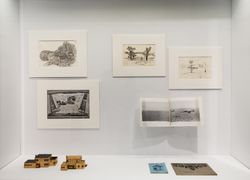
Sur les traces de... voyage
Sur les traces de... voyage
Actions:
Description:
Interprétant de la manière la plus large le thème des voyages lointains, l’exposition cartographie et élargit la notion de voyage qui s’étend aux expéditions imaginaires, aux sites étranges, aux points de fuite, aux maisons transportables et flottantes, aux caves sans fond, aux dômes de verre convolutés, aux tombeaux, aux cryptes et catacombes, aux aventures dans des(...)
Interprétant de la manière la plus large le thème des voyages lointains, l’exposition cartographie et élargit la notion de voyage qui s’étend aux expéditions imaginaires, aux sites étranges, aux points de fuite, aux maisons transportables et flottantes, aux caves sans fond, aux dômes de verre convolutés, aux tombeaux, aux cryptes et catacombes, aux aventures dans des(...)
Localisation:
Vitrines
Vitrines
Date:
3 décembre 2008 au 1 mai 2009
3 décembre 2008 au 1 mai 2009
Titre:
Sur les traces de... voyage
Actions:
Description:
Interprétant de la manière la plus large le thème des voyages lointains, l’exposition cartographie et élargit la notion de voyage qui s’étend aux expéditions imaginaires, aux sites étranges, aux points de fuite, aux maisons transportables et flottantes, aux caves sans fond, aux dômes de verre convolutés, aux tombeaux, aux cryptes et catacombes, aux aventures dans des(...)
Sur les traces de... voyage
Actions:
Description:
Interprétant de la manière la plus large le thème des voyages lointains, l’exposition cartographie et élargit la notion de voyage qui s’étend aux expéditions imaginaires, aux sites étranges, aux points de fuite, aux maisons transportables et flottantes, aux caves sans fond, aux dômes de verre convolutés, aux tombeaux, aux cryptes et catacombes, aux aventures dans des(...)
Classification:
expositions
expositions
Date:
3 décembre 2008 au
1 mai 2009
3 décembre 2008 au
1 mai 2009
Localisation:
Vitrines
Vitrines
Classification:
dessins, documents textuels
dessins, documents textuels
Actions:
Numéro de référence:
DR1982:0127 R
Description:
- The drawing apparently depicts a coronation ceremony showing an interior resembling that of St. Peter's, Rome, looking towards the altar. Under the dome there is an elevated throne with a baldachin formed by a huge central crown with swags of red fabric which extend from the crown to the piers at the crossing. The design for a smaller structure which figures below is probably an earlier drawing.
DR1982:0127 R
Description:
- The drawing apparently depicts a coronation ceremony showing an interior resembling that of St. Peter's, Rome, looking towards the altar. Under the dome there is an elevated throne with a baldachin formed by a huge central crown with swags of red fabric which extend from the crown to the piers at the crossing. The design for a smaller structure which figures below is probably an earlier drawing.
Personnes et institutions:
Sujet:
architecture
architecture
Date:
second half of the 19th century
second half of the 19th century
Titre:
Sketch and a manuscript relating to the coronation ceremony of Alberto I
Actions:
DR1982:0127 R
Description:
- The drawing apparently depicts a coronation ceremony showing an interior resembling that of St. Peter's, Rome, looking towards the altar. Under the dome there is an elevated throne with a baldachin formed by a huge central crown with swags of red fabric which extend from the crown to the piers at the crossing. The design for a smaller structure which figures below is probably an earlier drawing.
Sketch and a manuscript relating to the coronation ceremony of Alberto I
Actions:
DR1982:0127 R
Description:
- The drawing apparently depicts a coronation ceremony showing an interior resembling that of St. Peter's, Rome, looking towards the altar. Under the dome there is an elevated throne with a baldachin formed by a huge central crown with swags of red fabric which extend from the crown to the piers at the crossing. The design for a smaller structure which figures below is probably an earlier drawing.
Classification:
dessins, documents textuels
dessins, documents textuels
Date:
second half of the 19th century
second half of the 19th century
Personnes et institutions:
Sujet:
architecture
architecture
Classification:
dessins
dessins
Actions:
Numéro de référence:
DR1988:0083
Description:
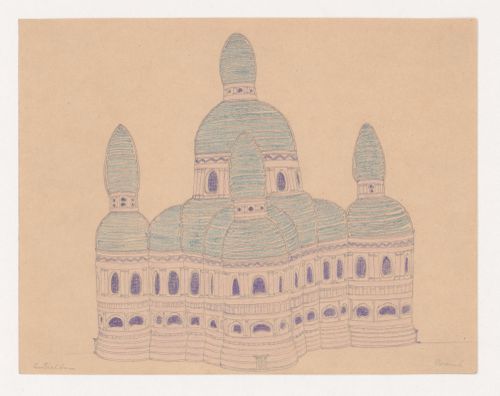
- Design for a large building with at least three wings, and several domes.
DR1988:0083
Description:
- Design for a large building with at least three wings, and several domes.
Personnes et institutions:
Sujet:
architecture
architecture
Date:
circa 1920-1921
circa 1920-1921
Titre:
Visionary design for a central-plan building
Actions:
DR1988:0083
Description:
- Design for a large building with at least three wings, and several domes.
Visionary design for a central-plan building
Actions:
DR1988:0083
Description:
- Design for a large building with at least three wings, and several domes.
Classification:
dessins
dessins
Date:
circa 1920-1921
circa 1920-1921
Personnes et institutions:
Sujet:
architecture
architecture
Niveau de description archivistique:
Série(s)
Série(s)
Numéro de référence:
AP115.S1
Description:
Cette série porte sur le travail de documentation photographique de Robert Duchesnay d'un des exemples construit du Dymaxion Dwelling Machine, à Wichita, Kansas, aux États-Unis. Le Dymaxion Dwelling Machine, concept conçu par Buckminster Fuller et considéré comme le précurseur du dôme géodésique, visait a créer un mode d'habitation donnant un maximun d'espace pour un minimum de coût et de matériaux. L'exemple du Wichita House est conçu par Fuller en 1945-1946. "L'apparence de cette machine à habiter ressemble quelque peu à une soucoupe volante. Avec sa peau externe en aluminium et ses fenêtres en plexiglass, elle offre un surface élégante et profilée, tout en renferman un espace au sol de 1100 pieds carrées." [1] Le Dymaxion Dwelling Machine est abandonné en 1970, pour être finalement acquise en 1990 par le Henry Ford Museum à Detroit, au Michigan. La structure est démantelé la même année avec l'aide d'un ancien collaborateur de Buckminster Fuller, Jay Baldwin. Le Dymaxion Dwelling Machine est toujours visible au Ford Museum. La série contient des photographies de la Wichita House avant et durant le démantèlement, brochures et feuillets du Wichita Art Museum présentant l'exposition de Robert Duchesnay sur le bâtiment, correspondance reçue par Duchesnay sur son projet de documentation des dômes géodésiques de Buckminster Fuller, et coupures de presse sur le Dymaxion Dwelling Machine et le démantèlement de la Wichita House. [1] Robert Duchesnay, "Dymaxion Dwelling Machine", 2022, https://robertduchesnay.com/fr/dymaxion-fr/ (page consultée 27 février 2023).
AP115.S1
Description:
Cette série porte sur le travail de documentation photographique de Robert Duchesnay d'un des exemples construit du Dymaxion Dwelling Machine, à Wichita, Kansas, aux États-Unis. Le Dymaxion Dwelling Machine, concept conçu par Buckminster Fuller et considéré comme le précurseur du dôme géodésique, visait a créer un mode d'habitation donnant un maximun d'espace pour un minimum de coût et de matériaux. L'exemple du Wichita House est conçu par Fuller en 1945-1946. "L'apparence de cette machine à habiter ressemble quelque peu à une soucoupe volante. Avec sa peau externe en aluminium et ses fenêtres en plexiglass, elle offre un surface élégante et profilée, tout en renferman un espace au sol de 1100 pieds carrées." [1] Le Dymaxion Dwelling Machine est abandonné en 1970, pour être finalement acquise en 1990 par le Henry Ford Museum à Detroit, au Michigan. La structure est démantelé la même année avec l'aide d'un ancien collaborateur de Buckminster Fuller, Jay Baldwin. Le Dymaxion Dwelling Machine est toujours visible au Ford Museum. La série contient des photographies de la Wichita House avant et durant le démantèlement, brochures et feuillets du Wichita Art Museum présentant l'exposition de Robert Duchesnay sur le bâtiment, correspondance reçue par Duchesnay sur son projet de documentation des dômes géodésiques de Buckminster Fuller, et coupures de presse sur le Dymaxion Dwelling Machine et le démantèlement de la Wichita House. [1] Robert Duchesnay, "Dymaxion Dwelling Machine", 2022, https://robertduchesnay.com/fr/dymaxion-fr/ (page consultée 27 février 2023).
Personnes et institutions:
Date:
1990-1992
1990-1992
Titre:
Dymaxion Dwelling Machine, Wichita, Kansas
Actions:
AP115.S1
Description:
Cette série porte sur le travail de documentation photographique de Robert Duchesnay d'un des exemples construit du Dymaxion Dwelling Machine, à Wichita, Kansas, aux États-Unis. Le Dymaxion Dwelling Machine, concept conçu par Buckminster Fuller et considéré comme le précurseur du dôme géodésique, visait a créer un mode d'habitation donnant un maximun d'espace pour un minimum de coût et de matériaux. L'exemple du Wichita House est conçu par Fuller en 1945-1946. "L'apparence de cette machine à habiter ressemble quelque peu à une soucoupe volante. Avec sa peau externe en aluminium et ses fenêtres en plexiglass, elle offre un surface élégante et profilée, tout en renferman un espace au sol de 1100 pieds carrées." [1] Le Dymaxion Dwelling Machine est abandonné en 1970, pour être finalement acquise en 1990 par le Henry Ford Museum à Detroit, au Michigan. La structure est démantelé la même année avec l'aide d'un ancien collaborateur de Buckminster Fuller, Jay Baldwin. Le Dymaxion Dwelling Machine est toujours visible au Ford Museum. La série contient des photographies de la Wichita House avant et durant le démantèlement, brochures et feuillets du Wichita Art Museum présentant l'exposition de Robert Duchesnay sur le bâtiment, correspondance reçue par Duchesnay sur son projet de documentation des dômes géodésiques de Buckminster Fuller, et coupures de presse sur le Dymaxion Dwelling Machine et le démantèlement de la Wichita House. [1] Robert Duchesnay, "Dymaxion Dwelling Machine", 2022, https://robertduchesnay.com/fr/dymaxion-fr/ (page consultée 27 février 2023).
Dymaxion Dwelling Machine, Wichita, Kansas
Actions:
AP115.S1
Description:
Cette série porte sur le travail de documentation photographique de Robert Duchesnay d'un des exemples construit du Dymaxion Dwelling Machine, à Wichita, Kansas, aux États-Unis. Le Dymaxion Dwelling Machine, concept conçu par Buckminster Fuller et considéré comme le précurseur du dôme géodésique, visait a créer un mode d'habitation donnant un maximun d'espace pour un minimum de coût et de matériaux. L'exemple du Wichita House est conçu par Fuller en 1945-1946. "L'apparence de cette machine à habiter ressemble quelque peu à une soucoupe volante. Avec sa peau externe en aluminium et ses fenêtres en plexiglass, elle offre un surface élégante et profilée, tout en renferman un espace au sol de 1100 pieds carrées." [1] Le Dymaxion Dwelling Machine est abandonné en 1970, pour être finalement acquise en 1990 par le Henry Ford Museum à Detroit, au Michigan. La structure est démantelé la même année avec l'aide d'un ancien collaborateur de Buckminster Fuller, Jay Baldwin. Le Dymaxion Dwelling Machine est toujours visible au Ford Museum. La série contient des photographies de la Wichita House avant et durant le démantèlement, brochures et feuillets du Wichita Art Museum présentant l'exposition de Robert Duchesnay sur le bâtiment, correspondance reçue par Duchesnay sur son projet de documentation des dômes géodésiques de Buckminster Fuller, et coupures de presse sur le Dymaxion Dwelling Machine et le démantèlement de la Wichita House. [1] Robert Duchesnay, "Dymaxion Dwelling Machine", 2022, https://robertduchesnay.com/fr/dymaxion-fr/ (page consultée 27 février 2023).
Niveau de description archivistique:
Série
Série
Date:
1990-1992
1990-1992
Personnes et institutions:
Classification:
photographies
photographies
Numéro de référence:
ARCH268464
Description:
Ring binder containing 493 slides. Contents: "miscellaneous computer renderings", "patent images", "some robot and medical stuff", "Cooper Union projects", "wooden prototype sphere", "early projects (eg. folding tent)", "very miscellaneous -- Includes paintings, nasa projects, non-Hoberman-yet-related-structures, space project renderings", "RCCL Icosahedron slides (all originals") October 2000, "EXPO Dome pre-installation at Liberty Science Center Spring 2000 (all originals)"
ARCH268464
Description:
Ring binder containing 493 slides. Contents: "miscellaneous computer renderings", "patent images", "some robot and medical stuff", "Cooper Union projects", "wooden prototype sphere", "early projects (eg. folding tent)", "very miscellaneous -- Includes paintings, nasa projects, non-Hoberman-yet-related-structures, space project renderings", "RCCL Icosahedron slides (all originals") October 2000, "EXPO Dome pre-installation at Liberty Science Center Spring 2000 (all originals)"
Personnes et institutions:
Date:
1977-2000
1977-2000
Titre:
RCCL / Patent Images
Actions:
ARCH268464
Description:
Ring binder containing 493 slides. Contents: "miscellaneous computer renderings", "patent images", "some robot and medical stuff", "Cooper Union projects", "wooden prototype sphere", "early projects (eg. folding tent)", "very miscellaneous -- Includes paintings, nasa projects, non-Hoberman-yet-related-structures, space project renderings", "RCCL Icosahedron slides (all originals") October 2000, "EXPO Dome pre-installation at Liberty Science Center Spring 2000 (all originals)"
RCCL / Patent Images
Actions:
ARCH268464
Description:
Ring binder containing 493 slides. Contents: "miscellaneous computer renderings", "patent images", "some robot and medical stuff", "Cooper Union projects", "wooden prototype sphere", "early projects (eg. folding tent)", "very miscellaneous -- Includes paintings, nasa projects, non-Hoberman-yet-related-structures, space project renderings", "RCCL Icosahedron slides (all originals") October 2000, "EXPO Dome pre-installation at Liberty Science Center Spring 2000 (all originals)"
Classification:
photographies
photographies
Date:
1977-2000
1977-2000
Personnes et institutions:
Classification:
archives
Niveau de description archivistique:
Fonds
archives
Niveau de description archivistique:
Fonds
Titre:
Fonds Shoei Yoh
Fonds Shoei Yoh
Numéro de référence:
AP166
Résumé:
The Shoei Yoh fonds (1976-2014, predominant 1990-1996) documents a selection of works by the Japanese architect and designer Shoei Yoh and the firm Shoei Yoh + Architects. The selection is comprised of two projects that were featured in the CCA exhibition Archaeology of the Digital (May 7-October 27, 2013)—the Galaxy Toyama Gymnasium and the unbuilt Odawara Municipal Sports Complex --and five other projects.The fonds also includes some published material by and about Shoei Yoh.
AP166
Résumé:
The Shoei Yoh fonds (1976-2014, predominant 1990-1996) documents a selection of works by the Japanese architect and designer Shoei Yoh and the firm Shoei Yoh + Architects. The selection is comprised of two projects that were featured in the CCA exhibition Archaeology of the Digital (May 7-October 27, 2013)—the Galaxy Toyama Gymnasium and the unbuilt Odawara Municipal Sports Complex --and five other projects.The fonds also includes some published material by and about Shoei Yoh.
Personnes et institutions:
Date:
1976-2014, predominant 1990-1996
1976-2014, predominant 1990-1996
Titre:
Fonds Shoei Yoh
Actions:
AP166
Résumé:
The Shoei Yoh fonds (1976-2014, predominant 1990-1996) documents a selection of works by the Japanese architect and designer Shoei Yoh and the firm Shoei Yoh + Architects. The selection is comprised of two projects that were featured in the CCA exhibition Archaeology of the Digital (May 7-October 27, 2013)—the Galaxy Toyama Gymnasium and the unbuilt Odawara Municipal Sports Complex --and five other projects.The fonds also includes some published material by and about Shoei Yoh.
Fonds Shoei Yoh
Actions:
AP166
Résumé:
The Shoei Yoh fonds (1976-2014, predominant 1990-1996) documents a selection of works by the Japanese architect and designer Shoei Yoh and the firm Shoei Yoh + Architects. The selection is comprised of two projects that were featured in the CCA exhibition Archaeology of the Digital (May 7-October 27, 2013)—the Galaxy Toyama Gymnasium and the unbuilt Odawara Municipal Sports Complex --and five other projects.The fonds also includes some published material by and about Shoei Yoh.
Classification:
archives
Niveau de description archivistique:
Fonds
archives
Niveau de description archivistique:
Fonds
Date:
1976-2014, predominant 1990-1996
1976-2014, predominant 1990-1996
Personnes et institutions:
Niveau de description archivistique:
Série(s)
Série(s)
Titre:
Audiovisual material
Audiovisual material
Numéro de référence:
AP165.S5
Description:
The Audiovisual material series, 1990 – 2002, consists of 175 video recordings that document various aspects of Hoberman’s work in transformable design, as well as the operations of his company Hoberman Associates, Inc. This includes broadcast footage featuring Hoberman, media coverage of installations and exhibitions, interviews with Hoberman, promotional material produced by Hoberman Associates Inc., documentary footage of toy and business-related activities, and home videos. Material consists of analog and digital recording techniques on a variety of formats including MiniDV cassettes, Betacam SP cassettes, DVCAM cassettes, U-matic cassettes, Hi-8 cassettes, Betacam cassettes and Digital Betacam cassettes. The majority of the records date from the mid to late 90’s to early 2000’s. Video recordings in this series are about Hoberman and/or were produced by his company, Hoberman Associates, Inc. It includes television programs featuring Hoberman, media coverage relating to specific projects such as the Iris Dome and other expanding geodesic spheres, promotional videos for toy products, documentary footage of international business operations, and media coverage of notable events such as the installation and inauguration of the Hoberman Arch at the 2002 Olympics in Salt Lake City and footage of Bill Clinton with the Hoberman sphere. While there are some completed broadcast productions in the series, the majority of the material is comprised of audio-visual production elements including raw footage, rushes, cuts, rough edits, masters, and compilations.
AP165.S5
Description:
The Audiovisual material series, 1990 – 2002, consists of 175 video recordings that document various aspects of Hoberman’s work in transformable design, as well as the operations of his company Hoberman Associates, Inc. This includes broadcast footage featuring Hoberman, media coverage of installations and exhibitions, interviews with Hoberman, promotional material produced by Hoberman Associates Inc., documentary footage of toy and business-related activities, and home videos. Material consists of analog and digital recording techniques on a variety of formats including MiniDV cassettes, Betacam SP cassettes, DVCAM cassettes, U-matic cassettes, Hi-8 cassettes, Betacam cassettes and Digital Betacam cassettes. The majority of the records date from the mid to late 90’s to early 2000’s. Video recordings in this series are about Hoberman and/or were produced by his company, Hoberman Associates, Inc. It includes television programs featuring Hoberman, media coverage relating to specific projects such as the Iris Dome and other expanding geodesic spheres, promotional videos for toy products, documentary footage of international business operations, and media coverage of notable events such as the installation and inauguration of the Hoberman Arch at the 2002 Olympics in Salt Lake City and footage of Bill Clinton with the Hoberman sphere. While there are some completed broadcast productions in the series, the majority of the material is comprised of audio-visual production elements including raw footage, rushes, cuts, rough edits, masters, and compilations.
Personnes et institutions:
Date:
1990-2002
1990-2002
Titre:
Audiovisual material
Actions:
AP165.S5
Description:
The Audiovisual material series, 1990 – 2002, consists of 175 video recordings that document various aspects of Hoberman’s work in transformable design, as well as the operations of his company Hoberman Associates, Inc. This includes broadcast footage featuring Hoberman, media coverage of installations and exhibitions, interviews with Hoberman, promotional material produced by Hoberman Associates Inc., documentary footage of toy and business-related activities, and home videos. Material consists of analog and digital recording techniques on a variety of formats including MiniDV cassettes, Betacam SP cassettes, DVCAM cassettes, U-matic cassettes, Hi-8 cassettes, Betacam cassettes and Digital Betacam cassettes. The majority of the records date from the mid to late 90’s to early 2000’s. Video recordings in this series are about Hoberman and/or were produced by his company, Hoberman Associates, Inc. It includes television programs featuring Hoberman, media coverage relating to specific projects such as the Iris Dome and other expanding geodesic spheres, promotional videos for toy products, documentary footage of international business operations, and media coverage of notable events such as the installation and inauguration of the Hoberman Arch at the 2002 Olympics in Salt Lake City and footage of Bill Clinton with the Hoberman sphere. While there are some completed broadcast productions in the series, the majority of the material is comprised of audio-visual production elements including raw footage, rushes, cuts, rough edits, masters, and compilations.
Audiovisual material
Actions:
AP165.S5
Description:
The Audiovisual material series, 1990 – 2002, consists of 175 video recordings that document various aspects of Hoberman’s work in transformable design, as well as the operations of his company Hoberman Associates, Inc. This includes broadcast footage featuring Hoberman, media coverage of installations and exhibitions, interviews with Hoberman, promotional material produced by Hoberman Associates Inc., documentary footage of toy and business-related activities, and home videos. Material consists of analog and digital recording techniques on a variety of formats including MiniDV cassettes, Betacam SP cassettes, DVCAM cassettes, U-matic cassettes, Hi-8 cassettes, Betacam cassettes and Digital Betacam cassettes. The majority of the records date from the mid to late 90’s to early 2000’s. Video recordings in this series are about Hoberman and/or were produced by his company, Hoberman Associates, Inc. It includes television programs featuring Hoberman, media coverage relating to specific projects such as the Iris Dome and other expanding geodesic spheres, promotional videos for toy products, documentary footage of international business operations, and media coverage of notable events such as the installation and inauguration of the Hoberman Arch at the 2002 Olympics in Salt Lake City and footage of Bill Clinton with the Hoberman sphere. While there are some completed broadcast productions in the series, the majority of the material is comprised of audio-visual production elements including raw footage, rushes, cuts, rough edits, masters, and compilations.
Niveau de description archivistique:
Series 5
Series 5
Date:
1990-2002
1990-2002
Personnes et institutions:
Niveau de description archivistique:
Projet
Projet
Numéro de référence:
AP018.S1.1958.PR03
Description:
This project series documents the design and construction of Toronto City Hall and Civic Square in Toronto from 1958-1965. The office identified the project number as 5867. The design of Toronto's New City Hall, built next to its older counterpart, was realized through an international architectural competition that attracted more than 500 entries from around the world. Eventually, a unanimous jury chose Finnish architect Viljo Revell's design, cementing the age of modernist architecture in Toronto. However, the rules stated that if the winning architect was not part of the Ontario Association of Architects, they were required to partner with a local firm. In this way, John B. Parkin Associates was chosen as the associate architects for this project. The design was comprised of a concrete dome house, which contained the city council chambers, surrounded by two curved office towers, all perched on top of a podium, with a public square to the south, known as Nathan Phillips Square. The buildings were 816,000 square feet in size, the west tower having 18 office floors and the east tower with 25. The project is recorded through drawings, a mounted presentation photograph of the project and textual records dating from 1958-1966. The drawings are mostly reprographic copies, which include plans, elevations, sections, details and perspectives. The textual records consist of a competition synopsis book, a book of submission materials for the competition, and correspondence between Parkin and Revell.
AP018.S1.1958.PR03
Description:
This project series documents the design and construction of Toronto City Hall and Civic Square in Toronto from 1958-1965. The office identified the project number as 5867. The design of Toronto's New City Hall, built next to its older counterpart, was realized through an international architectural competition that attracted more than 500 entries from around the world. Eventually, a unanimous jury chose Finnish architect Viljo Revell's design, cementing the age of modernist architecture in Toronto. However, the rules stated that if the winning architect was not part of the Ontario Association of Architects, they were required to partner with a local firm. In this way, John B. Parkin Associates was chosen as the associate architects for this project. The design was comprised of a concrete dome house, which contained the city council chambers, surrounded by two curved office towers, all perched on top of a podium, with a public square to the south, known as Nathan Phillips Square. The buildings were 816,000 square feet in size, the west tower having 18 office floors and the east tower with 25. The project is recorded through drawings, a mounted presentation photograph of the project and textual records dating from 1958-1966. The drawings are mostly reprographic copies, which include plans, elevations, sections, details and perspectives. The textual records consist of a competition synopsis book, a book of submission materials for the competition, and correspondence between Parkin and Revell.
Personnes et institutions:
Date:
1958-1966
1958-1966
Titre:
Toronto City Hall and Civic Square, Toronto (1958)
Actions:
AP018.S1.1958.PR03
Description:
This project series documents the design and construction of Toronto City Hall and Civic Square in Toronto from 1958-1965. The office identified the project number as 5867. The design of Toronto's New City Hall, built next to its older counterpart, was realized through an international architectural competition that attracted more than 500 entries from around the world. Eventually, a unanimous jury chose Finnish architect Viljo Revell's design, cementing the age of modernist architecture in Toronto. However, the rules stated that if the winning architect was not part of the Ontario Association of Architects, they were required to partner with a local firm. In this way, John B. Parkin Associates was chosen as the associate architects for this project. The design was comprised of a concrete dome house, which contained the city council chambers, surrounded by two curved office towers, all perched on top of a podium, with a public square to the south, known as Nathan Phillips Square. The buildings were 816,000 square feet in size, the west tower having 18 office floors and the east tower with 25. The project is recorded through drawings, a mounted presentation photograph of the project and textual records dating from 1958-1966. The drawings are mostly reprographic copies, which include plans, elevations, sections, details and perspectives. The textual records consist of a competition synopsis book, a book of submission materials for the competition, and correspondence between Parkin and Revell.
Toronto City Hall and Civic Square, Toronto (1958)
Actions:
AP018.S1.1958.PR03
Description:
This project series documents the design and construction of Toronto City Hall and Civic Square in Toronto from 1958-1965. The office identified the project number as 5867. The design of Toronto's New City Hall, built next to its older counterpart, was realized through an international architectural competition that attracted more than 500 entries from around the world. Eventually, a unanimous jury chose Finnish architect Viljo Revell's design, cementing the age of modernist architecture in Toronto. However, the rules stated that if the winning architect was not part of the Ontario Association of Architects, they were required to partner with a local firm. In this way, John B. Parkin Associates was chosen as the associate architects for this project. The design was comprised of a concrete dome house, which contained the city council chambers, surrounded by two curved office towers, all perched on top of a podium, with a public square to the south, known as Nathan Phillips Square. The buildings were 816,000 square feet in size, the west tower having 18 office floors and the east tower with 25. The project is recorded through drawings, a mounted presentation photograph of the project and textual records dating from 1958-1966. The drawings are mostly reprographic copies, which include plans, elevations, sections, details and perspectives. The textual records consist of a competition synopsis book, a book of submission materials for the competition, and correspondence between Parkin and Revell.
Niveau de description archivistique:
Project
Project
Date:
1958-1966
1958-1966
Personnes et institutions:


