


3189 Résultats
Classification:
expositions
expositions
Actions:
Description:
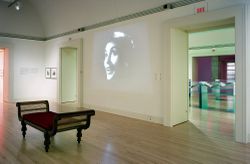
Empreintes de l’Inde démontre le rôle social, politique et anthropologique que de telles images peuvent jouer, en décrivant comment les éléments représentés ont jeté les fondements historiques – réels ou souhaités – sur lesquels un empire, plutôt qu’un assemblage de comptoirs coloniaux, a pu être bâti. Articulée autour de six thèmes, l’exposition explore des plus grands(...)
Empreintes de l’Inde démontre le rôle social, politique et anthropologique que de telles images peuvent jouer, en décrivant comment les éléments représentés ont jeté les fondements historiques – réels ou souhaités – sur lesquels un empire, plutôt qu’un assemblage de comptoirs coloniaux, a pu être bâti. Articulée autour de six thèmes, l’exposition explore des plus grands(...)
Localisation:
Salles principales
Salles principales
Date:
15 mai 2003 au 14 septembre 2003
15 mai 2003 au 14 septembre 2003
Titre:
Empreintes de l’Inde : photographie, architecture et politiques de la représentation
Actions:
Description:
Empreintes de l’Inde démontre le rôle social, politique et anthropologique que de telles images peuvent jouer, en décrivant comment les éléments représentés ont jeté les fondements historiques – réels ou souhaités – sur lesquels un empire, plutôt qu’un assemblage de comptoirs coloniaux, a pu être bâti. Articulée autour de six thèmes, l’exposition explore des plus grands(...)
Empreintes de l’Inde : photographie, architecture et politiques de la représentation
Actions:
Description:
Empreintes de l’Inde démontre le rôle social, politique et anthropologique que de telles images peuvent jouer, en décrivant comment les éléments représentés ont jeté les fondements historiques – réels ou souhaités – sur lesquels un empire, plutôt qu’un assemblage de comptoirs coloniaux, a pu être bâti. Articulée autour de six thèmes, l’exposition explore des plus grands(...)
Classification:
expositions
expositions
Date:
15 mai 2003 au
14 septembre 2003
15 mai 2003 au
14 septembre 2003
Localisation:
Salles principales
Salles principales
Classification:
expositions
expositions
Actions:
Description:
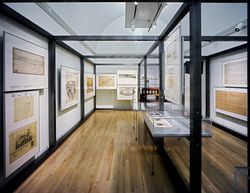
L’exposition Lidée de la grande ville s’intéresse au rôle de l’urbanisme dans tout l’Empire austro-hongrois, avant et après sa dissolution, et enrichit l’histoire de l’architecture en mettant en évidence la diversité des tendances modernistes de cette période. Autour de la Première Guerre mondiale, cette diversité était le reflet des nombreuses identités nationales et(...)
L’exposition Lidée de la grande ville s’intéresse au rôle de l’urbanisme dans tout l’Empire austro-hongrois, avant et après sa dissolution, et enrichit l’histoire de l’architecture en mettant en évidence la diversité des tendances modernistes de cette période. Autour de la Première Guerre mondiale, cette diversité était le reflet des nombreuses identités nationales et(...)
Localisation:
Salles principales et vitrines
Salles principales et vitrines
Date:
14 mai 2000 au 15 octobre 2000
14 mai 2000 au 15 octobre 2000
Titre:
L'idée de la grande ville : l'architecture moderne en Europe centrale, 1890–1937
Actions:
Description:
L’exposition Lidée de la grande ville s’intéresse au rôle de l’urbanisme dans tout l’Empire austro-hongrois, avant et après sa dissolution, et enrichit l’histoire de l’architecture en mettant en évidence la diversité des tendances modernistes de cette période. Autour de la Première Guerre mondiale, cette diversité était le reflet des nombreuses identités nationales et(...)
L'idée de la grande ville : l'architecture moderne en Europe centrale, 1890–1937
Actions:
Description:
L’exposition Lidée de la grande ville s’intéresse au rôle de l’urbanisme dans tout l’Empire austro-hongrois, avant et après sa dissolution, et enrichit l’histoire de l’architecture en mettant en évidence la diversité des tendances modernistes de cette période. Autour de la Première Guerre mondiale, cette diversité était le reflet des nombreuses identités nationales et(...)
Classification:
expositions
expositions
Date:
14 mai 2000 au
15 octobre 2000
14 mai 2000 au
15 octobre 2000
Localisation:
Salles principales et vitrines
Salles principales et vitrines
Niveau de description archivistique:
Sous-série
Sous-série
Titre:
Domestic Commissions
Domestic Commissions
Numéro de référence:
CI001.S1.D2
Description:
Hubert and Charles Rohault de Fleury received domestic commissions for both urban housing -hôtel particuliers and apartment houses- and rural dwellings -châteaux, country houses and estates. Hubert also executed designs for furniture and garden pavilions. Hubert' work is characterized by restrained classical exteriors and luxurious Empire style interiors; both Charles' exteriors and interiors, especially those for Hôtels Sauvage and Soltykoff, reflect the exuberance of the Second Empire. The CCA albums include drawings from all stages of the design process but with an emphasis on design development drawings. Hubert's albums contain cost calculations and estimates, notes and letters. In general, the drawings by Charles are from a more developed phase of design than Hubert's; Hubert's commissions are more varied than Charles'. The austere classicism of Hubert's domestic work reflects the prevailing taste of the day and reveals the strong influence of his teacher, Jean Nicholas Louis Durand. The compostional effect of the houses' façades relies on the shape and rhythm of the fenestration and the geometric division by string courses and occasionally, pilasters. Columns are used infrequently as is decorative stonework. The plans are symmetrical and modular. This approach to design is especially evident in the series of proposals for a country house for comte Treilhard (DR1974:0002:034:001-082) and in a group of unidentified designs for houses (DR1974:0002:035:001-034), all of which illustrate an emphasis on plan in the design process and a distinct approach to the composition of the elevations, both derived from Durand. Hubert's domestic work was also influenced by Palladio (see especially DR1974:0002:038:001-029). The interiors and furniture designed by Hubert are typical of the Empire style (1). The drawings in the CCA collection illustrate the materials, palette and ornamental motifs of the period. The garden structures in Hubert's albums are more fanciful than his houses and are either Rustic, Chinoiserie or classical in style (2). His garden designs follow the contemporary French trend for "jardins anglais" with winding paths and naturalistic placement of the vegetation, sometimes in combination with more formal French gardens (3). One of the most comprehensively documented domestic project by Hubert is the Rohault de Fleury House (12-14 rue d'Aguesseau; 1824). The CCA collection contains an interesting series of preliminary drawings for alternate proposals for this house, a number of highly finished wash drawings (including the interior decorative scheme) for the final scheme (DR1974:0002:011:001-08) and several earlier (ca. 1806) proposals (DR1974:0002:035:001-034). The Domaine de la Vallée album (DR1974:0002:025:001-059) is notable for the range of subject matter included as well as for the insights into the character of a working country estate in the nineteenth century. The proposed modifications encompassed both functional (a bridge, a levee, granaries and stables) and aesthetic improvements, such as ornamental garden temples. The renovation of the house also exhibits both functional and aesthetic improvements. (1) Examples of Hubert's interiors and furniture can be found in albums, DR1974:0002:007:001-068, DR1974:0002:011:001-089, DR1974:0002:025:001-059, DR1974:0002:030:001-065 and DR1974:0002:035:001-034. (2) The best examples of his pavilions are found in album, DR1974:0002:038:001-029 with other examples in albums, DR1974:0002:025:001-059, DR1974:0002:030:001-065 and DR1974:0002:035:001-034. (3) Examples are found in albums, DR1974:0002:035:001-034 and DR1974:0002 :025:001-059. Also of note are drawings, DR1974:0002:007:007 and DR1974:0002:007:068.
CI001.S1.D2
Description:
Hubert and Charles Rohault de Fleury received domestic commissions for both urban housing -hôtel particuliers and apartment houses- and rural dwellings -châteaux, country houses and estates. Hubert also executed designs for furniture and garden pavilions. Hubert' work is characterized by restrained classical exteriors and luxurious Empire style interiors; both Charles' exteriors and interiors, especially those for Hôtels Sauvage and Soltykoff, reflect the exuberance of the Second Empire. The CCA albums include drawings from all stages of the design process but with an emphasis on design development drawings. Hubert's albums contain cost calculations and estimates, notes and letters. In general, the drawings by Charles are from a more developed phase of design than Hubert's; Hubert's commissions are more varied than Charles'. The austere classicism of Hubert's domestic work reflects the prevailing taste of the day and reveals the strong influence of his teacher, Jean Nicholas Louis Durand. The compostional effect of the houses' façades relies on the shape and rhythm of the fenestration and the geometric division by string courses and occasionally, pilasters. Columns are used infrequently as is decorative stonework. The plans are symmetrical and modular. This approach to design is especially evident in the series of proposals for a country house for comte Treilhard (DR1974:0002:034:001-082) and in a group of unidentified designs for houses (DR1974:0002:035:001-034), all of which illustrate an emphasis on plan in the design process and a distinct approach to the composition of the elevations, both derived from Durand. Hubert's domestic work was also influenced by Palladio (see especially DR1974:0002:038:001-029). The interiors and furniture designed by Hubert are typical of the Empire style (1). The drawings in the CCA collection illustrate the materials, palette and ornamental motifs of the period. The garden structures in Hubert's albums are more fanciful than his houses and are either Rustic, Chinoiserie or classical in style (2). His garden designs follow the contemporary French trend for "jardins anglais" with winding paths and naturalistic placement of the vegetation, sometimes in combination with more formal French gardens (3). One of the most comprehensively documented domestic project by Hubert is the Rohault de Fleury House (12-14 rue d'Aguesseau; 1824). The CCA collection contains an interesting series of preliminary drawings for alternate proposals for this house, a number of highly finished wash drawings (including the interior decorative scheme) for the final scheme (DR1974:0002:011:001-08) and several earlier (ca. 1806) proposals (DR1974:0002:035:001-034). The Domaine de la Vallée album (DR1974:0002:025:001-059) is notable for the range of subject matter included as well as for the insights into the character of a working country estate in the nineteenth century. The proposed modifications encompassed both functional (a bridge, a levee, granaries and stables) and aesthetic improvements, such as ornamental garden temples. The renovation of the house also exhibits both functional and aesthetic improvements. (1) Examples of Hubert's interiors and furniture can be found in albums, DR1974:0002:007:001-068, DR1974:0002:011:001-089, DR1974:0002:025:001-059, DR1974:0002:030:001-065 and DR1974:0002:035:001-034. (2) The best examples of his pavilions are found in album, DR1974:0002:038:001-029 with other examples in albums, DR1974:0002:025:001-059, DR1974:0002:030:001-065 and DR1974:0002:035:001-034. (3) Examples are found in albums, DR1974:0002:035:001-034 and DR1974:0002 :025:001-059. Also of note are drawings, DR1974:0002:007:007 and DR1974:0002:007:068.
Personnes et institutions:
Date:
1802-[1840]
1802-[1840]
Titre:
Domestic Commissions
CI001.S1.D2
Description:
Hubert and Charles Rohault de Fleury received domestic commissions for both urban housing -hôtel particuliers and apartment houses- and rural dwellings -châteaux, country houses and estates. Hubert also executed designs for furniture and garden pavilions. Hubert' work is characterized by restrained classical exteriors and luxurious Empire style interiors; both Charles' exteriors and interiors, especially those for Hôtels Sauvage and Soltykoff, reflect the exuberance of the Second Empire. The CCA albums include drawings from all stages of the design process but with an emphasis on design development drawings. Hubert's albums contain cost calculations and estimates, notes and letters. In general, the drawings by Charles are from a more developed phase of design than Hubert's; Hubert's commissions are more varied than Charles'. The austere classicism of Hubert's domestic work reflects the prevailing taste of the day and reveals the strong influence of his teacher, Jean Nicholas Louis Durand. The compostional effect of the houses' façades relies on the shape and rhythm of the fenestration and the geometric division by string courses and occasionally, pilasters. Columns are used infrequently as is decorative stonework. The plans are symmetrical and modular. This approach to design is especially evident in the series of proposals for a country house for comte Treilhard (DR1974:0002:034:001-082) and in a group of unidentified designs for houses (DR1974:0002:035:001-034), all of which illustrate an emphasis on plan in the design process and a distinct approach to the composition of the elevations, both derived from Durand. Hubert's domestic work was also influenced by Palladio (see especially DR1974:0002:038:001-029). The interiors and furniture designed by Hubert are typical of the Empire style (1). The drawings in the CCA collection illustrate the materials, palette and ornamental motifs of the period. The garden structures in Hubert's albums are more fanciful than his houses and are either Rustic, Chinoiserie or classical in style (2). His garden designs follow the contemporary French trend for "jardins anglais" with winding paths and naturalistic placement of the vegetation, sometimes in combination with more formal French gardens (3). One of the most comprehensively documented domestic project by Hubert is the Rohault de Fleury House (12-14 rue d'Aguesseau; 1824). The CCA collection contains an interesting series of preliminary drawings for alternate proposals for this house, a number of highly finished wash drawings (including the interior decorative scheme) for the final scheme (DR1974:0002:011:001-08) and several earlier (ca. 1806) proposals (DR1974:0002:035:001-034). The Domaine de la Vallée album (DR1974:0002:025:001-059) is notable for the range of subject matter included as well as for the insights into the character of a working country estate in the nineteenth century. The proposed modifications encompassed both functional (a bridge, a levee, granaries and stables) and aesthetic improvements, such as ornamental garden temples. The renovation of the house also exhibits both functional and aesthetic improvements. (1) Examples of Hubert's interiors and furniture can be found in albums, DR1974:0002:007:001-068, DR1974:0002:011:001-089, DR1974:0002:025:001-059, DR1974:0002:030:001-065 and DR1974:0002:035:001-034. (2) The best examples of his pavilions are found in album, DR1974:0002:038:001-029 with other examples in albums, DR1974:0002:025:001-059, DR1974:0002:030:001-065 and DR1974:0002:035:001-034. (3) Examples are found in albums, DR1974:0002:035:001-034 and DR1974:0002 :025:001-059. Also of note are drawings, DR1974:0002:007:007 and DR1974:0002:007:068.
Domestic Commissions
CI001.S1.D2
Description:
Hubert and Charles Rohault de Fleury received domestic commissions for both urban housing -hôtel particuliers and apartment houses- and rural dwellings -châteaux, country houses and estates. Hubert also executed designs for furniture and garden pavilions. Hubert' work is characterized by restrained classical exteriors and luxurious Empire style interiors; both Charles' exteriors and interiors, especially those for Hôtels Sauvage and Soltykoff, reflect the exuberance of the Second Empire. The CCA albums include drawings from all stages of the design process but with an emphasis on design development drawings. Hubert's albums contain cost calculations and estimates, notes and letters. In general, the drawings by Charles are from a more developed phase of design than Hubert's; Hubert's commissions are more varied than Charles'. The austere classicism of Hubert's domestic work reflects the prevailing taste of the day and reveals the strong influence of his teacher, Jean Nicholas Louis Durand. The compostional effect of the houses' façades relies on the shape and rhythm of the fenestration and the geometric division by string courses and occasionally, pilasters. Columns are used infrequently as is decorative stonework. The plans are symmetrical and modular. This approach to design is especially evident in the series of proposals for a country house for comte Treilhard (DR1974:0002:034:001-082) and in a group of unidentified designs for houses (DR1974:0002:035:001-034), all of which illustrate an emphasis on plan in the design process and a distinct approach to the composition of the elevations, both derived from Durand. Hubert's domestic work was also influenced by Palladio (see especially DR1974:0002:038:001-029). The interiors and furniture designed by Hubert are typical of the Empire style (1). The drawings in the CCA collection illustrate the materials, palette and ornamental motifs of the period. The garden structures in Hubert's albums are more fanciful than his houses and are either Rustic, Chinoiserie or classical in style (2). His garden designs follow the contemporary French trend for "jardins anglais" with winding paths and naturalistic placement of the vegetation, sometimes in combination with more formal French gardens (3). One of the most comprehensively documented domestic project by Hubert is the Rohault de Fleury House (12-14 rue d'Aguesseau; 1824). The CCA collection contains an interesting series of preliminary drawings for alternate proposals for this house, a number of highly finished wash drawings (including the interior decorative scheme) for the final scheme (DR1974:0002:011:001-08) and several earlier (ca. 1806) proposals (DR1974:0002:035:001-034). The Domaine de la Vallée album (DR1974:0002:025:001-059) is notable for the range of subject matter included as well as for the insights into the character of a working country estate in the nineteenth century. The proposed modifications encompassed both functional (a bridge, a levee, granaries and stables) and aesthetic improvements, such as ornamental garden temples. The renovation of the house also exhibits both functional and aesthetic improvements. (1) Examples of Hubert's interiors and furniture can be found in albums, DR1974:0002:007:001-068, DR1974:0002:011:001-089, DR1974:0002:025:001-059, DR1974:0002:030:001-065 and DR1974:0002:035:001-034. (2) The best examples of his pavilions are found in album, DR1974:0002:038:001-029 with other examples in albums, DR1974:0002:025:001-059, DR1974:0002:030:001-065 and DR1974:0002:035:001-034. (3) Examples are found in albums, DR1974:0002:035:001-034 and DR1974:0002 :025:001-059. Also of note are drawings, DR1974:0002:007:007 and DR1974:0002:007:068.
Niveau de description archivistique:
File 2
File 2
Date:
1802-[1840]
1802-[1840]
Personnes et institutions:
Classification:
recherche
recherche
Titre:
Chercheurs en résidence 2006
Chercheurs en résidence 2006
Actions:
Description:
Jean Attali, LÉcole Nationale Supérieure dArchitecture de Paris-Malaquais, Paris, France Sujet : Figures d’énonciation de la pensée architecturale et spatiale: manifestes et oppositions dans les oeuvres d’Aldo Rossi, Peter Eisenman et Rem Koolhaas Cammy Brothers, University of Virginia, Charlottesville, États-Unis Sujet : Drawing from Memory: Giuliano da Sangallo and(...)
Jean Attali, LÉcole Nationale Supérieure dArchitecture de Paris-Malaquais, Paris, France Sujet : Figures d’énonciation de la pensée architecturale et spatiale: manifestes et oppositions dans les oeuvres d’Aldo Rossi, Peter Eisenman et Rem Koolhaas Cammy Brothers, University of Virginia, Charlottesville, États-Unis Sujet : Drawing from Memory: Giuliano da Sangallo and(...)
Date:
10 janvier 2006 au 15 septembre 2006
10 janvier 2006 au 15 septembre 2006
Titre:
Chercheurs en résidence 2006
Actions:
Description:
Jean Attali, LÉcole Nationale Supérieure dArchitecture de Paris-Malaquais, Paris, France Sujet : Figures d’énonciation de la pensée architecturale et spatiale: manifestes et oppositions dans les oeuvres d’Aldo Rossi, Peter Eisenman et Rem Koolhaas Cammy Brothers, University of Virginia, Charlottesville, États-Unis Sujet : Drawing from Memory: Giuliano da Sangallo and(...)
Chercheurs en résidence 2006
Actions:
Description:
Jean Attali, LÉcole Nationale Supérieure dArchitecture de Paris-Malaquais, Paris, France Sujet : Figures d’énonciation de la pensée architecturale et spatiale: manifestes et oppositions dans les oeuvres d’Aldo Rossi, Peter Eisenman et Rem Koolhaas Cammy Brothers, University of Virginia, Charlottesville, États-Unis Sujet : Drawing from Memory: Giuliano da Sangallo and(...)
Classification:
recherche
recherche
Date:
10 janvier 2006 au
15 septembre 2006
10 janvier 2006 au
15 septembre 2006
Classification:
documents textuels
documents textuels
Titre:
Receipts
Receipts
Numéro de référence:
ARCH255528
Description:
18 accordion files with receipts from - Canadian Knife & Saw, Canadian Tire, City of Toronto 7 Highland Ave. (water), Clarence La Fountaine Inc., C.N.C.P Communications, Con Edison (Olympic Towers), consultant fees payable, Cory Coffee service plan, Curry's Art Store, John Cook time charges, Design Services International, Diamond Taxicab, Dominion Saw and Sales, Douglas Elliman (Olympic Towers), Empire Office Equipment, employee advances
ARCH255528
Description:
18 accordion files with receipts from - Canadian Knife & Saw, Canadian Tire, City of Toronto 7 Highland Ave. (water), Clarence La Fountaine Inc., C.N.C.P Communications, Con Edison (Olympic Towers), consultant fees payable, Cory Coffee service plan, Curry's Art Store, John Cook time charges, Design Services International, Diamond Taxicab, Dominion Saw and Sales, Douglas Elliman (Olympic Towers), Empire Office Equipment, employee advances
Personnes et institutions:
Date:
1976-1979
1976-1979
Titre:
Receipts
Actions:
ARCH255528
Description:
18 accordion files with receipts from - Canadian Knife & Saw, Canadian Tire, City of Toronto 7 Highland Ave. (water), Clarence La Fountaine Inc., C.N.C.P Communications, Con Edison (Olympic Towers), consultant fees payable, Cory Coffee service plan, Curry's Art Store, John Cook time charges, Design Services International, Diamond Taxicab, Dominion Saw and Sales, Douglas Elliman (Olympic Towers), Empire Office Equipment, employee advances
Receipts
Actions:
ARCH255528
Description:
18 accordion files with receipts from - Canadian Knife & Saw, Canadian Tire, City of Toronto 7 Highland Ave. (water), Clarence La Fountaine Inc., C.N.C.P Communications, Con Edison (Olympic Towers), consultant fees payable, Cory Coffee service plan, Curry's Art Store, John Cook time charges, Design Services International, Diamond Taxicab, Dominion Saw and Sales, Douglas Elliman (Olympic Towers), Empire Office Equipment, employee advances
Classification:
documents textuels
documents textuels
Date:
1976-1979
1976-1979
Personnes et institutions:
Niveau de description archivistique:
Sous-série
Sous-série
Titre:
Miscellanea
Miscellanea
Numéro de référence:
CI001.S1.D4
Description:
The three portfolios of "Croquis", originally attributed to Hubert Rohault de Fleury, but probably also including work by Charles, are particularly informative of the range of artistic and architectural interests of these architects. While some of the drawings in these portfolios may be travel sketches or based on travel sketches (Charles is known to have visited some of the locations depicted (1)), the majority are probably copied or adapted from books and prints. In some cases, these sources have been identified. The stylistic range of the drawings is eclectic; in addition to the expected Classical material, Gothic, Romanesque, Islamic, Exotic Revival (namely Etruscan and Egyptian), Renaissance and Baroque periods and styles as well as contemporary 19th century architecture are all represented. The subject matter is equally varied. DR1974:0002:032:001-066, two portfolios, includes arabesque ornament (some from Palazzo del Te and Palazzo Ducal in Mantua (2)), Islamic ornament motifs, tile patterns, Sicilian architectural subjects - mainly church interiors, and stonework and woodwork from Romanesque and Gothic structures . DR1974:0002:031:001-055, three portfolios, contains drawings of classical figures, Christian imagery and architectural sculpture from antique, medieval [?] and 19th century sources, sculpture from the 16th century sepulchral monument of Maximillian I, Italian Classical structures and contemporary classically-inspired subject matter including a number of Parisian fountains and monuments, and several English townhouses. DR1974:0002:030:001-065, four portfolios, includes drawings of Classical, Gothic and Exotic Revival buildings and interiors as well as a number of drawings of non-architectural subject matter including military subjects - fortification, armaments, soldiers, and revolutionary battle scenes - and topographic views. A folder of Italian views and buildings in this portfolio may have been intended for publication. The designs for interiors, Empire furniture, garden structures and several of the buildings are probably original designs by Hubert. (1) A description of Charles' travels based on his sketchbooks held by the Académie d'architecture is found in Académie d'architecture, 'Catalogue des collection' (Paris: Académie d'architecture, 1988) 35-36 and 230-241. (2) These drawings were copied from Wilhelm Zahn, 'Gemalte Ornamente von Julio Romano' (s.l., s.n, ca. 1833)., The three portfolios of "Croquis" were originally attributed to Hubert Rohault de Fleury, but probably also including work by Charles. The source and purpose of many of these drawings is unclear; some may be record drawings and travel sketches or based on travel sketches, but the majority are probably copied or adapted from books and prints. The stylistic range and subject matter of the drawings is broad and eclectic: arabesques, Islamic ornament, stonework and woodwork from Romanesque and Gothic structures (DR1974:0002:032:001-066); classical and Christian imagery, architectural sculpture from antique, medieval [?] and 19th century sources, Italian Classical structures, nineteenth century classically-inspired subject matter (DR1974:0002:031:001-055); non-architectural subject matter including military subjects, topographic views, and Italian views and buildings, possibly intended for publication (DR1974:0002:030:001-065). Portfolio, DR1974:0002:030:001-065 also includes interiors, Empire furniture, garden structures and Classical, Gothic and Exotic Revival buildings, some of which are probably original designs by Hubert Rohault de Fleury. Bibliography: - Bergdoll, Barry. "Hubert Rohault de Fleury: Cinquième Partie: Équisses et Dessins d'Ornament." 'CCA Research Report.' n.d. - Académie d'architecture (France). 'Catalogue des collections' (Paris: L'Academie, 1988), 35-37 and 230-241.
CI001.S1.D4
Description:
The three portfolios of "Croquis", originally attributed to Hubert Rohault de Fleury, but probably also including work by Charles, are particularly informative of the range of artistic and architectural interests of these architects. While some of the drawings in these portfolios may be travel sketches or based on travel sketches (Charles is known to have visited some of the locations depicted (1)), the majority are probably copied or adapted from books and prints. In some cases, these sources have been identified. The stylistic range of the drawings is eclectic; in addition to the expected Classical material, Gothic, Romanesque, Islamic, Exotic Revival (namely Etruscan and Egyptian), Renaissance and Baroque periods and styles as well as contemporary 19th century architecture are all represented. The subject matter is equally varied. DR1974:0002:032:001-066, two portfolios, includes arabesque ornament (some from Palazzo del Te and Palazzo Ducal in Mantua (2)), Islamic ornament motifs, tile patterns, Sicilian architectural subjects - mainly church interiors, and stonework and woodwork from Romanesque and Gothic structures . DR1974:0002:031:001-055, three portfolios, contains drawings of classical figures, Christian imagery and architectural sculpture from antique, medieval [?] and 19th century sources, sculpture from the 16th century sepulchral monument of Maximillian I, Italian Classical structures and contemporary classically-inspired subject matter including a number of Parisian fountains and monuments, and several English townhouses. DR1974:0002:030:001-065, four portfolios, includes drawings of Classical, Gothic and Exotic Revival buildings and interiors as well as a number of drawings of non-architectural subject matter including military subjects - fortification, armaments, soldiers, and revolutionary battle scenes - and topographic views. A folder of Italian views and buildings in this portfolio may have been intended for publication. The designs for interiors, Empire furniture, garden structures and several of the buildings are probably original designs by Hubert. (1) A description of Charles' travels based on his sketchbooks held by the Académie d'architecture is found in Académie d'architecture, 'Catalogue des collection' (Paris: Académie d'architecture, 1988) 35-36 and 230-241. (2) These drawings were copied from Wilhelm Zahn, 'Gemalte Ornamente von Julio Romano' (s.l., s.n, ca. 1833)., The three portfolios of "Croquis" were originally attributed to Hubert Rohault de Fleury, but probably also including work by Charles. The source and purpose of many of these drawings is unclear; some may be record drawings and travel sketches or based on travel sketches, but the majority are probably copied or adapted from books and prints. The stylistic range and subject matter of the drawings is broad and eclectic: arabesques, Islamic ornament, stonework and woodwork from Romanesque and Gothic structures (DR1974:0002:032:001-066); classical and Christian imagery, architectural sculpture from antique, medieval [?] and 19th century sources, Italian Classical structures, nineteenth century classically-inspired subject matter (DR1974:0002:031:001-055); non-architectural subject matter including military subjects, topographic views, and Italian views and buildings, possibly intended for publication (DR1974:0002:030:001-065). Portfolio, DR1974:0002:030:001-065 also includes interiors, Empire furniture, garden structures and Classical, Gothic and Exotic Revival buildings, some of which are probably original designs by Hubert Rohault de Fleury. Bibliography: - Bergdoll, Barry. "Hubert Rohault de Fleury: Cinquième Partie: Équisses et Dessins d'Ornament." 'CCA Research Report.' n.d. - Académie d'architecture (France). 'Catalogue des collections' (Paris: L'Academie, 1988), 35-37 and 230-241.
Personnes et institutions:
Date:
[1800-1868]
[1800-1868]
Titre:
Miscellanea
CI001.S1.D4
Description:
The three portfolios of "Croquis", originally attributed to Hubert Rohault de Fleury, but probably also including work by Charles, are particularly informative of the range of artistic and architectural interests of these architects. While some of the drawings in these portfolios may be travel sketches or based on travel sketches (Charles is known to have visited some of the locations depicted (1)), the majority are probably copied or adapted from books and prints. In some cases, these sources have been identified. The stylistic range of the drawings is eclectic; in addition to the expected Classical material, Gothic, Romanesque, Islamic, Exotic Revival (namely Etruscan and Egyptian), Renaissance and Baroque periods and styles as well as contemporary 19th century architecture are all represented. The subject matter is equally varied. DR1974:0002:032:001-066, two portfolios, includes arabesque ornament (some from Palazzo del Te and Palazzo Ducal in Mantua (2)), Islamic ornament motifs, tile patterns, Sicilian architectural subjects - mainly church interiors, and stonework and woodwork from Romanesque and Gothic structures . DR1974:0002:031:001-055, three portfolios, contains drawings of classical figures, Christian imagery and architectural sculpture from antique, medieval [?] and 19th century sources, sculpture from the 16th century sepulchral monument of Maximillian I, Italian Classical structures and contemporary classically-inspired subject matter including a number of Parisian fountains and monuments, and several English townhouses. DR1974:0002:030:001-065, four portfolios, includes drawings of Classical, Gothic and Exotic Revival buildings and interiors as well as a number of drawings of non-architectural subject matter including military subjects - fortification, armaments, soldiers, and revolutionary battle scenes - and topographic views. A folder of Italian views and buildings in this portfolio may have been intended for publication. The designs for interiors, Empire furniture, garden structures and several of the buildings are probably original designs by Hubert. (1) A description of Charles' travels based on his sketchbooks held by the Académie d'architecture is found in Académie d'architecture, 'Catalogue des collection' (Paris: Académie d'architecture, 1988) 35-36 and 230-241. (2) These drawings were copied from Wilhelm Zahn, 'Gemalte Ornamente von Julio Romano' (s.l., s.n, ca. 1833)., The three portfolios of "Croquis" were originally attributed to Hubert Rohault de Fleury, but probably also including work by Charles. The source and purpose of many of these drawings is unclear; some may be record drawings and travel sketches or based on travel sketches, but the majority are probably copied or adapted from books and prints. The stylistic range and subject matter of the drawings is broad and eclectic: arabesques, Islamic ornament, stonework and woodwork from Romanesque and Gothic structures (DR1974:0002:032:001-066); classical and Christian imagery, architectural sculpture from antique, medieval [?] and 19th century sources, Italian Classical structures, nineteenth century classically-inspired subject matter (DR1974:0002:031:001-055); non-architectural subject matter including military subjects, topographic views, and Italian views and buildings, possibly intended for publication (DR1974:0002:030:001-065). Portfolio, DR1974:0002:030:001-065 also includes interiors, Empire furniture, garden structures and Classical, Gothic and Exotic Revival buildings, some of which are probably original designs by Hubert Rohault de Fleury. Bibliography: - Bergdoll, Barry. "Hubert Rohault de Fleury: Cinquième Partie: Équisses et Dessins d'Ornament." 'CCA Research Report.' n.d. - Académie d'architecture (France). 'Catalogue des collections' (Paris: L'Academie, 1988), 35-37 and 230-241.
Miscellanea
CI001.S1.D4
Description:
The three portfolios of "Croquis", originally attributed to Hubert Rohault de Fleury, but probably also including work by Charles, are particularly informative of the range of artistic and architectural interests of these architects. While some of the drawings in these portfolios may be travel sketches or based on travel sketches (Charles is known to have visited some of the locations depicted (1)), the majority are probably copied or adapted from books and prints. In some cases, these sources have been identified. The stylistic range of the drawings is eclectic; in addition to the expected Classical material, Gothic, Romanesque, Islamic, Exotic Revival (namely Etruscan and Egyptian), Renaissance and Baroque periods and styles as well as contemporary 19th century architecture are all represented. The subject matter is equally varied. DR1974:0002:032:001-066, two portfolios, includes arabesque ornament (some from Palazzo del Te and Palazzo Ducal in Mantua (2)), Islamic ornament motifs, tile patterns, Sicilian architectural subjects - mainly church interiors, and stonework and woodwork from Romanesque and Gothic structures . DR1974:0002:031:001-055, three portfolios, contains drawings of classical figures, Christian imagery and architectural sculpture from antique, medieval [?] and 19th century sources, sculpture from the 16th century sepulchral monument of Maximillian I, Italian Classical structures and contemporary classically-inspired subject matter including a number of Parisian fountains and monuments, and several English townhouses. DR1974:0002:030:001-065, four portfolios, includes drawings of Classical, Gothic and Exotic Revival buildings and interiors as well as a number of drawings of non-architectural subject matter including military subjects - fortification, armaments, soldiers, and revolutionary battle scenes - and topographic views. A folder of Italian views and buildings in this portfolio may have been intended for publication. The designs for interiors, Empire furniture, garden structures and several of the buildings are probably original designs by Hubert. (1) A description of Charles' travels based on his sketchbooks held by the Académie d'architecture is found in Académie d'architecture, 'Catalogue des collection' (Paris: Académie d'architecture, 1988) 35-36 and 230-241. (2) These drawings were copied from Wilhelm Zahn, 'Gemalte Ornamente von Julio Romano' (s.l., s.n, ca. 1833)., The three portfolios of "Croquis" were originally attributed to Hubert Rohault de Fleury, but probably also including work by Charles. The source and purpose of many of these drawings is unclear; some may be record drawings and travel sketches or based on travel sketches, but the majority are probably copied or adapted from books and prints. The stylistic range and subject matter of the drawings is broad and eclectic: arabesques, Islamic ornament, stonework and woodwork from Romanesque and Gothic structures (DR1974:0002:032:001-066); classical and Christian imagery, architectural sculpture from antique, medieval [?] and 19th century sources, Italian Classical structures, nineteenth century classically-inspired subject matter (DR1974:0002:031:001-055); non-architectural subject matter including military subjects, topographic views, and Italian views and buildings, possibly intended for publication (DR1974:0002:030:001-065). Portfolio, DR1974:0002:030:001-065 also includes interiors, Empire furniture, garden structures and Classical, Gothic and Exotic Revival buildings, some of which are probably original designs by Hubert Rohault de Fleury. Bibliography: - Bergdoll, Barry. "Hubert Rohault de Fleury: Cinquième Partie: Équisses et Dessins d'Ornament." 'CCA Research Report.' n.d. - Académie d'architecture (France). 'Catalogue des collections' (Paris: L'Academie, 1988), 35-37 and 230-241.
Niveau de description archivistique:
File 4
File 4
Date:
[1800-1868]
[1800-1868]
Personnes et institutions:
Classification:
dessins
dessins
Numéro de référence:
DR1978:0006
Description:
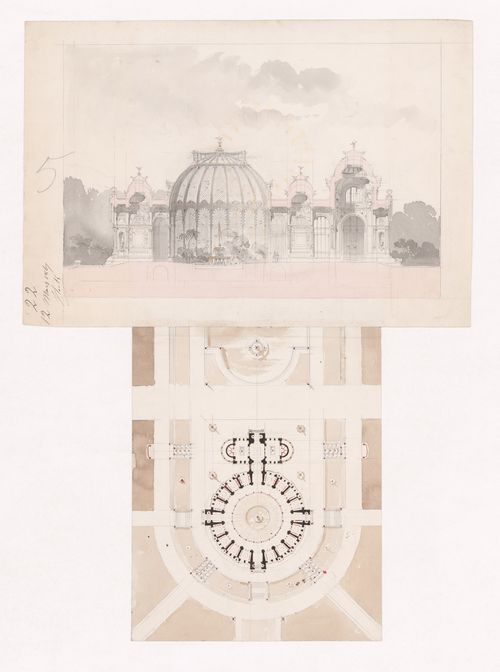
- These two sheets describe a project for an aviary in plan and section. The metal cage, which rises to form an open lattice sphere, is centred on a circular fountain and encased by a continuous series of short, radial walls made of stone. An entranceway is formed at each end of the two main axes, the principal entrance taking the form of a semi-detached vestibule with apsidal ends at left and right. The whole is set on a slight rise surrounded by steps, fountains, cascades, walkways, and, on the front, by a reflecting pool. The ornamental vocabulary, expressed in iron and stone, is a rich version of the Second Empire Style.
DR1978:0006
Description:
- These two sheets describe a project for an aviary in plan and section. The metal cage, which rises to form an open lattice sphere, is centred on a circular fountain and encased by a continuous series of short, radial walls made of stone. An entranceway is formed at each end of the two main axes, the principal entrance taking the form of a semi-detached vestibule with apsidal ends at left and right. The whole is set on a slight rise surrounded by steps, fountains, cascades, walkways, and, on the front, by a reflecting pool. The ornamental vocabulary, expressed in iron and stone, is a rich version of the Second Empire Style.
Personnes et institutions:
Sujet:
architecture
architecture
Date:
1867
1867
Titre:
Student project for an aviary on a circular ground plan
Actions:
DR1978:0006
Description:
- These two sheets describe a project for an aviary in plan and section. The metal cage, which rises to form an open lattice sphere, is centred on a circular fountain and encased by a continuous series of short, radial walls made of stone. An entranceway is formed at each end of the two main axes, the principal entrance taking the form of a semi-detached vestibule with apsidal ends at left and right. The whole is set on a slight rise surrounded by steps, fountains, cascades, walkways, and, on the front, by a reflecting pool. The ornamental vocabulary, expressed in iron and stone, is a rich version of the Second Empire Style.
Student project for an aviary on a circular ground plan
Actions:
DR1978:0006
Description:
- These two sheets describe a project for an aviary in plan and section. The metal cage, which rises to form an open lattice sphere, is centred on a circular fountain and encased by a continuous series of short, radial walls made of stone. An entranceway is formed at each end of the two main axes, the principal entrance taking the form of a semi-detached vestibule with apsidal ends at left and right. The whole is set on a slight rise surrounded by steps, fountains, cascades, walkways, and, on the front, by a reflecting pool. The ornamental vocabulary, expressed in iron and stone, is a rich version of the Second Empire Style.
Classification:
dessins
dessins
Date:
1867
1867
Personnes et institutions:
Sujet:
architecture
architecture
Classification:
archives
Niveau de description archivistique:
Fonds
archives
Niveau de description archivistique:
Fonds
Titre:
Joseph Rykwert fonds
Joseph Rykwert fonds
Numéro de référence:
AP209
Résumé:
The Joseph Rykwert fonds, 1928-2022, documents Joseph Rykwert’s career as an architectural historian, author and professor. The fonds includes the records for over a dozen monographs written between the mid-1960s and the mid-2010s as well as edited works and articles, and details his teaching and lecturing activities from the 1960s onwards in universities in Europe and the United States. The records highlight Joseph Rykwert’s multidisciplinary approach, which involved archaeology, anthropology and psychoanalysis in his study of the history and theory of architecture and of the urban form. The fonds is composed of textual records, publications and ephemera, and of photographs including multiple albums and a large number of slides; the fonds also documents Joseph Rykwert’s career as an independent designer through drawings realized between the late 1940s and the late 1970s.
AP209
Résumé:
The Joseph Rykwert fonds, 1928-2022, documents Joseph Rykwert’s career as an architectural historian, author and professor. The fonds includes the records for over a dozen monographs written between the mid-1960s and the mid-2010s as well as edited works and articles, and details his teaching and lecturing activities from the 1960s onwards in universities in Europe and the United States. The records highlight Joseph Rykwert’s multidisciplinary approach, which involved archaeology, anthropology and psychoanalysis in his study of the history and theory of architecture and of the urban form. The fonds is composed of textual records, publications and ephemera, and of photographs including multiple albums and a large number of slides; the fonds also documents Joseph Rykwert’s career as an independent designer through drawings realized between the late 1940s and the late 1970s.
Personnes et institutions:
Date:
1928-2022
1928-2022
Titre:
Joseph Rykwert fonds
Actions:
AP209
Résumé:
The Joseph Rykwert fonds, 1928-2022, documents Joseph Rykwert’s career as an architectural historian, author and professor. The fonds includes the records for over a dozen monographs written between the mid-1960s and the mid-2010s as well as edited works and articles, and details his teaching and lecturing activities from the 1960s onwards in universities in Europe and the United States. The records highlight Joseph Rykwert’s multidisciplinary approach, which involved archaeology, anthropology and psychoanalysis in his study of the history and theory of architecture and of the urban form. The fonds is composed of textual records, publications and ephemera, and of photographs including multiple albums and a large number of slides; the fonds also documents Joseph Rykwert’s career as an independent designer through drawings realized between the late 1940s and the late 1970s.
Joseph Rykwert fonds
Actions:
AP209
Résumé:
The Joseph Rykwert fonds, 1928-2022, documents Joseph Rykwert’s career as an architectural historian, author and professor. The fonds includes the records for over a dozen monographs written between the mid-1960s and the mid-2010s as well as edited works and articles, and details his teaching and lecturing activities from the 1960s onwards in universities in Europe and the United States. The records highlight Joseph Rykwert’s multidisciplinary approach, which involved archaeology, anthropology and psychoanalysis in his study of the history and theory of architecture and of the urban form. The fonds is composed of textual records, publications and ephemera, and of photographs including multiple albums and a large number of slides; the fonds also documents Joseph Rykwert’s career as an independent designer through drawings realized between the late 1940s and the late 1970s.
Classification:
archives
Niveau de description archivistique:
Fonds
archives
Niveau de description archivistique:
Fonds
Date:
1928-2022
1928-2022
Personnes et institutions:
Classification:
dessins, documents textuels
dessins, documents textuels
Actions:
Numéro de référence:
DR1974:0002:007:001-068
Description:
- This album consists mostly of preliminary, design development and presentation drawings - plans, sections and elevations - for a château for M. de Lorgeril at Motte Beaumanoir, Brittany, and for renovations for a house for M. le Dhuy, perhaps in Paris. These buildings are in an austere classical style with minimal ornament and in some cases, Doric columns. Structural drawings, details of architectural elements, and coloured elevations for the Empire style interiors are included for both projects, as well as drawings for Empire style furniture for M. le Dhuy. A perspective and plan for a sepulchral chapel for the de Lorgeril family (DR1974:0002:007:030) are also included. The album contains several documents: notes by Rohault de Fleury, mostly illegible, which probably concern project(s) for M. de Lorgeril; detailed cost estimates for two country houses and a pavilion, possibly variant schemes for a single project; and letters to Hubert Rohault de Fleury from M. de Lorgeril concerning plans by the latter for an apartment house in Rennes (rue de la Poissonière and rue Beaumanoir) which he sent to Rohault de Fleury for his criticism and correction. M. de Lorgeril also sought Rohault de Fleury's advice on the municipal affairs of Rennes. There are five unidentified drawings, possibly for a hôtel for the de Lorgeril family in Rennes (DR1974:0002:007:037 - DR1974:0002:007:036). Four drawings for an unidentified country house may possibly be for a project of 1811 for a M. des Dederseul (name only partially legible), if the inscriptions on the page preceding them in the album are related to these drawings (DR1974:0002:007:037 - DR1974:0002:007:040). Also included in the album is a lot plan, inscribed with the names fo the owners, for property adjacent to rue de la Chaussée d'Antin, Paris (DR1974:0002:007:048).
DR1974:0002:007:001-068
Description:
- This album consists mostly of preliminary, design development and presentation drawings - plans, sections and elevations - for a château for M. de Lorgeril at Motte Beaumanoir, Brittany, and for renovations for a house for M. le Dhuy, perhaps in Paris. These buildings are in an austere classical style with minimal ornament and in some cases, Doric columns. Structural drawings, details of architectural elements, and coloured elevations for the Empire style interiors are included for both projects, as well as drawings for Empire style furniture for M. le Dhuy. A perspective and plan for a sepulchral chapel for the de Lorgeril family (DR1974:0002:007:030) are also included. The album contains several documents: notes by Rohault de Fleury, mostly illegible, which probably concern project(s) for M. de Lorgeril; detailed cost estimates for two country houses and a pavilion, possibly variant schemes for a single project; and letters to Hubert Rohault de Fleury from M. de Lorgeril concerning plans by the latter for an apartment house in Rennes (rue de la Poissonière and rue Beaumanoir) which he sent to Rohault de Fleury for his criticism and correction. M. de Lorgeril also sought Rohault de Fleury's advice on the municipal affairs of Rennes. There are five unidentified drawings, possibly for a hôtel for the de Lorgeril family in Rennes (DR1974:0002:007:037 - DR1974:0002:007:036). Four drawings for an unidentified country house may possibly be for a project of 1811 for a M. des Dederseul (name only partially legible), if the inscriptions on the page preceding them in the album are related to these drawings (DR1974:0002:007:037 - DR1974:0002:007:040). Also included in the album is a lot plan, inscribed with the names fo the owners, for property adjacent to rue de la Chaussée d'Antin, Paris (DR1974:0002:007:048).
Personnes et institutions:
Sujet:
architecture, architecture de paysage, design d'intérieur
architecture, architecture de paysage, design d'intérieur
Date:
drawings executed between 1802 and 1833, manuscripts between 1802 and 1821
drawings executed between 1802 and 1833, manuscripts between 1802 and 1821
Titre:
Album of drawings and manuscripts, mostly for a château for M. de Lorgeril and for renovations for a house for M. le Dhuy, France
Actions:
DR1974:0002:007:001-068
Description:
- This album consists mostly of preliminary, design development and presentation drawings - plans, sections and elevations - for a château for M. de Lorgeril at Motte Beaumanoir, Brittany, and for renovations for a house for M. le Dhuy, perhaps in Paris. These buildings are in an austere classical style with minimal ornament and in some cases, Doric columns. Structural drawings, details of architectural elements, and coloured elevations for the Empire style interiors are included for both projects, as well as drawings for Empire style furniture for M. le Dhuy. A perspective and plan for a sepulchral chapel for the de Lorgeril family (DR1974:0002:007:030) are also included. The album contains several documents: notes by Rohault de Fleury, mostly illegible, which probably concern project(s) for M. de Lorgeril; detailed cost estimates for two country houses and a pavilion, possibly variant schemes for a single project; and letters to Hubert Rohault de Fleury from M. de Lorgeril concerning plans by the latter for an apartment house in Rennes (rue de la Poissonière and rue Beaumanoir) which he sent to Rohault de Fleury for his criticism and correction. M. de Lorgeril also sought Rohault de Fleury's advice on the municipal affairs of Rennes. There are five unidentified drawings, possibly for a hôtel for the de Lorgeril family in Rennes (DR1974:0002:007:037 - DR1974:0002:007:036). Four drawings for an unidentified country house may possibly be for a project of 1811 for a M. des Dederseul (name only partially legible), if the inscriptions on the page preceding them in the album are related to these drawings (DR1974:0002:007:037 - DR1974:0002:007:040). Also included in the album is a lot plan, inscribed with the names fo the owners, for property adjacent to rue de la Chaussée d'Antin, Paris (DR1974:0002:007:048).
Album of drawings and manuscripts, mostly for a château for M. de Lorgeril and for renovations for a house for M. le Dhuy, France
Actions:
DR1974:0002:007:001-068
Description:
- This album consists mostly of preliminary, design development and presentation drawings - plans, sections and elevations - for a château for M. de Lorgeril at Motte Beaumanoir, Brittany, and for renovations for a house for M. le Dhuy, perhaps in Paris. These buildings are in an austere classical style with minimal ornament and in some cases, Doric columns. Structural drawings, details of architectural elements, and coloured elevations for the Empire style interiors are included for both projects, as well as drawings for Empire style furniture for M. le Dhuy. A perspective and plan for a sepulchral chapel for the de Lorgeril family (DR1974:0002:007:030) are also included. The album contains several documents: notes by Rohault de Fleury, mostly illegible, which probably concern project(s) for M. de Lorgeril; detailed cost estimates for two country houses and a pavilion, possibly variant schemes for a single project; and letters to Hubert Rohault de Fleury from M. de Lorgeril concerning plans by the latter for an apartment house in Rennes (rue de la Poissonière and rue Beaumanoir) which he sent to Rohault de Fleury for his criticism and correction. M. de Lorgeril also sought Rohault de Fleury's advice on the municipal affairs of Rennes. There are five unidentified drawings, possibly for a hôtel for the de Lorgeril family in Rennes (DR1974:0002:007:037 - DR1974:0002:007:036). Four drawings for an unidentified country house may possibly be for a project of 1811 for a M. des Dederseul (name only partially legible), if the inscriptions on the page preceding them in the album are related to these drawings (DR1974:0002:007:037 - DR1974:0002:007:040). Also included in the album is a lot plan, inscribed with the names fo the owners, for property adjacent to rue de la Chaussée d'Antin, Paris (DR1974:0002:007:048).
Classification:
dessins, documents textuels
dessins, documents textuels
Date:
drawings executed between 1802 and 1833, manuscripts between 1802 and 1821
drawings executed between 1802 and 1833, manuscripts between 1802 and 1821
Personnes et institutions:
Sujet:
architecture, architecture de paysage, design d'intérieur
architecture, architecture de paysage, design d'intérieur
Classification:
archives
Niveau de description archivistique:
Collection
archives
Niveau de description archivistique:
Collection
Titre:
Collection Rohault de Fleury
Collection Rohault de Fleury
Numéro de référence:
CI001
Résumé:
The Rohault de Fleury collection documents the work of three generations of French architects, Hubert, his son Charles, and his grandson Georges, spanning from the early 18th to late 19th century. The collection is extremely varied encompassing both private and government commissions and including domestic work, institutional buildings, commercial buildings, urban planning, and student work from both the École des beaux-arts and the École polytechnique, and archaeological studies. Stylistically, the projects incorporate the two dominant contemporary directions in French architecture - functionalism as advocated by Jean-Nicolas-Louis Durand and the classicism of the École des beaux-arts.
CI001
Résumé:
The Rohault de Fleury collection documents the work of three generations of French architects, Hubert, his son Charles, and his grandson Georges, spanning from the early 18th to late 19th century. The collection is extremely varied encompassing both private and government commissions and including domestic work, institutional buildings, commercial buildings, urban planning, and student work from both the École des beaux-arts and the École polytechnique, and archaeological studies. Stylistically, the projects incorporate the two dominant contemporary directions in French architecture - functionalism as advocated by Jean-Nicolas-Louis Durand and the classicism of the École des beaux-arts.
Personnes et institutions:
Date:
1717-[1884]
1717-[1884]
Titre:
Collection Rohault de Fleury
CI001
Résumé:
The Rohault de Fleury collection documents the work of three generations of French architects, Hubert, his son Charles, and his grandson Georges, spanning from the early 18th to late 19th century. The collection is extremely varied encompassing both private and government commissions and including domestic work, institutional buildings, commercial buildings, urban planning, and student work from both the École des beaux-arts and the École polytechnique, and archaeological studies. Stylistically, the projects incorporate the two dominant contemporary directions in French architecture - functionalism as advocated by Jean-Nicolas-Louis Durand and the classicism of the École des beaux-arts.
Collection Rohault de Fleury
CI001
Résumé:
The Rohault de Fleury collection documents the work of three generations of French architects, Hubert, his son Charles, and his grandson Georges, spanning from the early 18th to late 19th century. The collection is extremely varied encompassing both private and government commissions and including domestic work, institutional buildings, commercial buildings, urban planning, and student work from both the École des beaux-arts and the École polytechnique, and archaeological studies. Stylistically, the projects incorporate the two dominant contemporary directions in French architecture - functionalism as advocated by Jean-Nicolas-Louis Durand and the classicism of the École des beaux-arts.
Classification:
archives
Niveau de description archivistique:
Collection 1
archives
Niveau de description archivistique:
Collection 1
Date:
1717-[1884]
1717-[1884]
Personnes et institutions:


