


6062 Résultats
Classification:
dessins
dessins
Actions:
Numéro de référence:
DR1967:0012
Description:
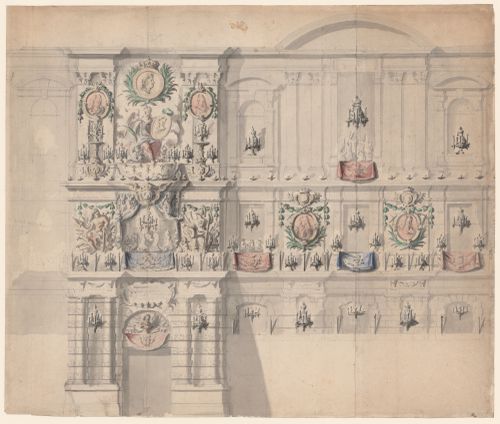
The drawing shows an elevation of the Porte Jean Goujon (now known as the Porte Barbet de Jouy) on the southern, quai-side façade of the Louvre, as well as part of the façade to the east of the portal. On the ground floor, candelabras line the windows and niches. The entry portal features a sculptural bust – likely a representation of Louis XIV – and a red banner with the king’s coat of arms. Above the portal’s tympanum is a large ovoid cartouche with faint script in black chalk that may read « Plate pour l’inscription, » indicating that the text had not yet been finalized at the time of the drawing’s creation. The heavily-decorated middle register features two over-life-size mythical and allegorical figures on either side of a balcony. To the left is Hercules, with his club, and to the right is an allegorical representation of Bellona. The balcony is hung with a blue tapestry woven with the king’s interlocking L monogram. Blue curtains with fleurs-de-lys hang over the balcony, revealing the revelers inside the building. These ornamental elements continue along the façade, which is hung with two large, circular portrait reliefs that likely show Louis XIV’s son, Grand Dauphin Louis, and grandson, Louis, the Duke of Burgundy, who was the father of the Duke of Brittany whose birth was being celebrated. Green watercolor paint is used to highlight the foliage festoons and palms that frame the portraits. On the top register of the portal is a seated allegorical figure holding a palm and a portrait, perhaps of the infant Louis, Duke of Brittany. Above her is a large, crowned medallion with the profile of Louis XIV in the guise of a Roman emperor surrounded by green palms. On either side of this central scene are large candelabras and circular portraits of the Grand Dauphin and the Duke of Burgundy. The architectural elements of the façade are carefully drawn in black chalk and faithfully render the architecture of the Louvre in the early eighteenth century.
DR1967:0012
Description:
The drawing shows an elevation of the Porte Jean Goujon (now known as the Porte Barbet de Jouy) on the southern, quai-side façade of the Louvre, as well as part of the façade to the east of the portal. On the ground floor, candelabras line the windows and niches. The entry portal features a sculptural bust – likely a representation of Louis XIV – and a red banner with the king’s coat of arms. Above the portal’s tympanum is a large ovoid cartouche with faint script in black chalk that may read « Plate pour l’inscription, » indicating that the text had not yet been finalized at the time of the drawing’s creation. The heavily-decorated middle register features two over-life-size mythical and allegorical figures on either side of a balcony. To the left is Hercules, with his club, and to the right is an allegorical representation of Bellona. The balcony is hung with a blue tapestry woven with the king’s interlocking L monogram. Blue curtains with fleurs-de-lys hang over the balcony, revealing the revelers inside the building. These ornamental elements continue along the façade, which is hung with two large, circular portrait reliefs that likely show Louis XIV’s son, Grand Dauphin Louis, and grandson, Louis, the Duke of Burgundy, who was the father of the Duke of Brittany whose birth was being celebrated. Green watercolor paint is used to highlight the foliage festoons and palms that frame the portraits. On the top register of the portal is a seated allegorical figure holding a palm and a portrait, perhaps of the infant Louis, Duke of Brittany. Above her is a large, crowned medallion with the profile of Louis XIV in the guise of a Roman emperor surrounded by green palms. On either side of this central scene are large candelabras and circular portraits of the Grand Dauphin and the Duke of Burgundy. The architectural elements of the façade are carefully drawn in black chalk and faithfully render the architecture of the Louvre in the early eighteenth century.
Personnes et institutions:
Sujet:
architecture temporaire
architecture temporaire
Date:
circa 1704
circa 1704
Titre:
Design for ceremonial decorations at the Louvre
Actions:
DR1967:0012
Description:
The drawing shows an elevation of the Porte Jean Goujon (now known as the Porte Barbet de Jouy) on the southern, quai-side façade of the Louvre, as well as part of the façade to the east of the portal. On the ground floor, candelabras line the windows and niches. The entry portal features a sculptural bust – likely a representation of Louis XIV – and a red banner with the king’s coat of arms. Above the portal’s tympanum is a large ovoid cartouche with faint script in black chalk that may read « Plate pour l’inscription, » indicating that the text had not yet been finalized at the time of the drawing’s creation. The heavily-decorated middle register features two over-life-size mythical and allegorical figures on either side of a balcony. To the left is Hercules, with his club, and to the right is an allegorical representation of Bellona. The balcony is hung with a blue tapestry woven with the king’s interlocking L monogram. Blue curtains with fleurs-de-lys hang over the balcony, revealing the revelers inside the building. These ornamental elements continue along the façade, which is hung with two large, circular portrait reliefs that likely show Louis XIV’s son, Grand Dauphin Louis, and grandson, Louis, the Duke of Burgundy, who was the father of the Duke of Brittany whose birth was being celebrated. Green watercolor paint is used to highlight the foliage festoons and palms that frame the portraits. On the top register of the portal is a seated allegorical figure holding a palm and a portrait, perhaps of the infant Louis, Duke of Brittany. Above her is a large, crowned medallion with the profile of Louis XIV in the guise of a Roman emperor surrounded by green palms. On either side of this central scene are large candelabras and circular portraits of the Grand Dauphin and the Duke of Burgundy. The architectural elements of the façade are carefully drawn in black chalk and faithfully render the architecture of the Louvre in the early eighteenth century.
Design for ceremonial decorations at the Louvre
Actions:
DR1967:0012
Description:
The drawing shows an elevation of the Porte Jean Goujon (now known as the Porte Barbet de Jouy) on the southern, quai-side façade of the Louvre, as well as part of the façade to the east of the portal. On the ground floor, candelabras line the windows and niches. The entry portal features a sculptural bust – likely a representation of Louis XIV – and a red banner with the king’s coat of arms. Above the portal’s tympanum is a large ovoid cartouche with faint script in black chalk that may read « Plate pour l’inscription, » indicating that the text had not yet been finalized at the time of the drawing’s creation. The heavily-decorated middle register features two over-life-size mythical and allegorical figures on either side of a balcony. To the left is Hercules, with his club, and to the right is an allegorical representation of Bellona. The balcony is hung with a blue tapestry woven with the king’s interlocking L monogram. Blue curtains with fleurs-de-lys hang over the balcony, revealing the revelers inside the building. These ornamental elements continue along the façade, which is hung with two large, circular portrait reliefs that likely show Louis XIV’s son, Grand Dauphin Louis, and grandson, Louis, the Duke of Burgundy, who was the father of the Duke of Brittany whose birth was being celebrated. Green watercolor paint is used to highlight the foliage festoons and palms that frame the portraits. On the top register of the portal is a seated allegorical figure holding a palm and a portrait, perhaps of the infant Louis, Duke of Brittany. Above her is a large, crowned medallion with the profile of Louis XIV in the guise of a Roman emperor surrounded by green palms. On either side of this central scene are large candelabras and circular portraits of the Grand Dauphin and the Duke of Burgundy. The architectural elements of the façade are carefully drawn in black chalk and faithfully render the architecture of the Louvre in the early eighteenth century.
Classification:
dessins
dessins
Date:
circa 1704
circa 1704
Personnes et institutions:
Sujet:
architecture temporaire
architecture temporaire
Classification:
expositions
expositions
Actions:
Description:
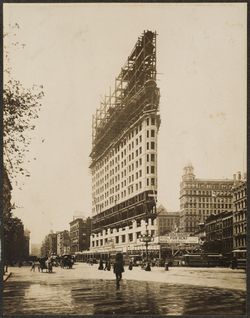
L’exposition Architectes de l’image : les photographes à l’âge héroïque des grands travaux fait ressortir les liens entre la représentation photographique et les grands travaux entrepris au cours du premier siècle de développement de la photographie dans les domaines de l’architecture et de l’ingénierie. L’idée centrale de l’exposition – le photographe vu comme un(...)
L’exposition Architectes de l’image : les photographes à l’âge héroïque des grands travaux fait ressortir les liens entre la représentation photographique et les grands travaux entrepris au cours du premier siècle de développement de la photographie dans les domaines de l’architecture et de l’ingénierie. L’idée centrale de l’exposition – le photographe vu comme un(...)
Date:
11 octobre 1995 au 4 février 1996
11 octobre 1995 au 4 février 1996
Titre:
Architectes de l'image : les photographes à l'âge héroïque des grands travaux
Actions:
Description:
L’exposition Architectes de l’image : les photographes à l’âge héroïque des grands travaux fait ressortir les liens entre la représentation photographique et les grands travaux entrepris au cours du premier siècle de développement de la photographie dans les domaines de l’architecture et de l’ingénierie. L’idée centrale de l’exposition – le photographe vu comme un(...)
Architectes de l'image : les photographes à l'âge héroïque des grands travaux
Actions:
Description:
L’exposition Architectes de l’image : les photographes à l’âge héroïque des grands travaux fait ressortir les liens entre la représentation photographique et les grands travaux entrepris au cours du premier siècle de développement de la photographie dans les domaines de l’architecture et de l’ingénierie. L’idée centrale de l’exposition – le photographe vu comme un(...)
Classification:
expositions
expositions
Date:
11 octobre 1995 au
4 février 1996
11 octobre 1995 au
4 février 1996
Classification:
expositions
expositions

Actions:
Description:
Le bâtiment du Centre Canadien d’Architecture (CCA) fut conçu à la fois comme une extension de la maison Shaughnessy, une résidence construite au XIXe siècle, et comme un objet à part entière de la collection. Le CCA est inauguré en 1989 avec l’exposition Architecture et paysage qui présentait le nouvel édifice et ses jardins. En tant qu’acteur essentiel dans la recherche(...)
Le bâtiment du Centre Canadien d’Architecture (CCA) fut conçu à la fois comme une extension de la maison Shaughnessy, une résidence construite au XIXe siècle, et comme un objet à part entière de la collection. Le CCA est inauguré en 1989 avec l’exposition Architecture et paysage qui présentait le nouvel édifice et ses jardins. En tant qu’acteur essentiel dans la recherche(...)
Localisation:
Vitrines
Vitrines
Date:
22 avril 2015 au 30 novembre 2015
22 avril 2015 au 30 novembre 2015
Titre:
Photographies du CCA, 1987-2015
Actions:
Description:
Le bâtiment du Centre Canadien d’Architecture (CCA) fut conçu à la fois comme une extension de la maison Shaughnessy, une résidence construite au XIXe siècle, et comme un objet à part entière de la collection. Le CCA est inauguré en 1989 avec l’exposition Architecture et paysage qui présentait le nouvel édifice et ses jardins. En tant qu’acteur essentiel dans la recherche(...)
Photographies du CCA, 1987-2015
Actions:
Description:
Le bâtiment du Centre Canadien d’Architecture (CCA) fut conçu à la fois comme une extension de la maison Shaughnessy, une résidence construite au XIXe siècle, et comme un objet à part entière de la collection. Le CCA est inauguré en 1989 avec l’exposition Architecture et paysage qui présentait le nouvel édifice et ses jardins. En tant qu’acteur essentiel dans la recherche(...)
Classification:
expositions
expositions
Date:
22 avril 2015 au
30 novembre 2015
22 avril 2015 au
30 novembre 2015
Localisation:
Vitrines
Vitrines
Classification:
articles
articles
Dossier:
Trajets et transferts
Trajets et transferts
Classification:
événements
événements
Description:
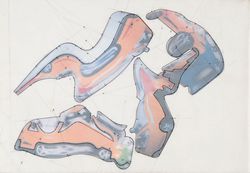
Dans cette conférence, Amy Kulper situe le « virage numérique » de l’architecture en 1988, avec la création de Photoshop par Thomas Knoll. Développé à l’origine en tant que logiciel d’édition d’images, Photoshop s’inscrivait parfaitement dans la longue histoire de la correction optique dans la discipline architecturale. Pourtant, son omniprésence aujourd’hui soulève de(...)
Dans cette conférence, Amy Kulper situe le « virage numérique » de l’architecture en 1988, avec la création de Photoshop par Thomas Knoll. Développé à l’origine en tant que logiciel d’édition d’images, Photoshop s’inscrivait parfaitement dans la longue histoire de la correction optique dans la discipline architecturale. Pourtant, son omniprésence aujourd’hui soulève de(...)
Localisation:
Théâtre Paul-Desmarais
Théâtre Paul-Desmarais
Date:
9 juin 2016, 18h
9 juin 2016, 18h
Titre:
Amy Kulper : Le « virage numérique » et l’avènement de Photoshop
Actions:
Description:
Dans cette conférence, Amy Kulper situe le « virage numérique » de l’architecture en 1988, avec la création de Photoshop par Thomas Knoll. Développé à l’origine en tant que logiciel d’édition d’images, Photoshop s’inscrivait parfaitement dans la longue histoire de la correction optique dans la discipline architecturale. Pourtant, son omniprésence aujourd’hui soulève de(...)
Amy Kulper : Le « virage numérique » et l’avènement de Photoshop
Actions:
Description:
Dans cette conférence, Amy Kulper situe le « virage numérique » de l’architecture en 1988, avec la création de Photoshop par Thomas Knoll. Développé à l’origine en tant que logiciel d’édition d’images, Photoshop s’inscrivait parfaitement dans la longue histoire de la correction optique dans la discipline architecturale. Pourtant, son omniprésence aujourd’hui soulève de(...)
Classification:
événements
événements
Date:
9 juin 2016
18h
9 juin 2016
18h
Localisation:
Théâtre Paul-Desmarais
Théâtre Paul-Desmarais
Classification:
dessins
dessins
Actions:
Numéro de référence:
DR1984:0509
Description:
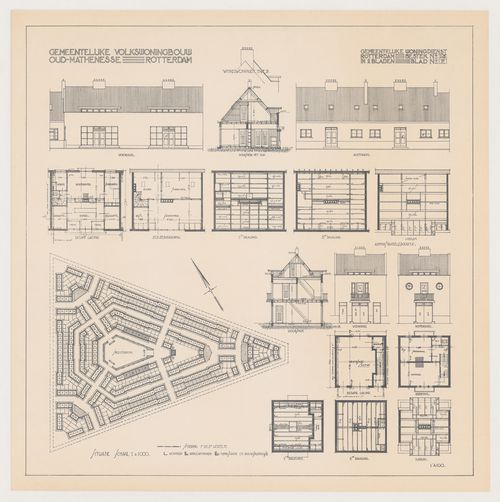
- A legend at the bottom of the drawing indicates that solid lines represent houses (WONINGEN), single hatching represents shop/houses (WINKELWONINGEN), and cross-hatching represents administration and fire station buildings (ADMINISTRATIE EN BRANDSPUITHUISJE).
DR1984:0509
Description:
- A legend at the bottom of the drawing indicates that solid lines represent houses (WONINGEN), single hatching represents shop/houses (WINKELWONINGEN), and cross-hatching represents administration and fire station buildings (ADMINISTRATIE EN BRANDSPUITHUISJE).
Personnes et institutions:
Sujet:
architecture
architecture
Date:
printed 1922-1923
printed 1922-1923
Titre:
Site plan, floor, roof and framing plans, sections, and elevations for Oud-Mathenesse Housing Estate, Rotterdam, Netherlands
Actions:
DR1984:0509
Description:
- A legend at the bottom of the drawing indicates that solid lines represent houses (WONINGEN), single hatching represents shop/houses (WINKELWONINGEN), and cross-hatching represents administration and fire station buildings (ADMINISTRATIE EN BRANDSPUITHUISJE).
Site plan, floor, roof and framing plans, sections, and elevations for Oud-Mathenesse Housing Estate, Rotterdam, Netherlands
Actions:
DR1984:0509
Description:
- A legend at the bottom of the drawing indicates that solid lines represent houses (WONINGEN), single hatching represents shop/houses (WINKELWONINGEN), and cross-hatching represents administration and fire station buildings (ADMINISTRATIE EN BRANDSPUITHUISJE).
Classification:
dessins
dessins
Date:
printed 1922-1923
printed 1922-1923
Personnes et institutions:
Sujet:
architecture
architecture
Classification:
dessins
dessins
Actions:
Numéro de référence:
DR1984:0510
Description:
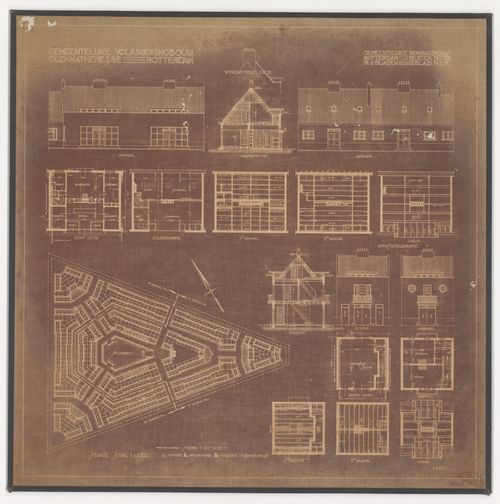
- A legend at the bottom of this drawing indicates that solid lines represent houses (WONINGEN), single hatching represents shop/houses (WINKELWONINGEN), and cross-hatching represents administration and fire station buildings (ADMINISTRATIE EN BRANDSPUITHUISJE).
DR1984:0510
Description:
- A legend at the bottom of this drawing indicates that solid lines represent houses (WONINGEN), single hatching represents shop/houses (WINKELWONINGEN), and cross-hatching represents administration and fire station buildings (ADMINISTRATIE EN BRANDSPUITHUISJE).
Personnes et institutions:
Sujet:
architecture
architecture
Date:
printed 1922-1923
printed 1922-1923
Titre:
Site plan, floor, roof, and framing plans, sections and elevations for Oud-Mathenesse Housing Estate, Rotterdam, Netherlands
Actions:
DR1984:0510
Description:
- A legend at the bottom of this drawing indicates that solid lines represent houses (WONINGEN), single hatching represents shop/houses (WINKELWONINGEN), and cross-hatching represents administration and fire station buildings (ADMINISTRATIE EN BRANDSPUITHUISJE).
Site plan, floor, roof, and framing plans, sections and elevations for Oud-Mathenesse Housing Estate, Rotterdam, Netherlands
Actions:
DR1984:0510
Description:
- A legend at the bottom of this drawing indicates that solid lines represent houses (WONINGEN), single hatching represents shop/houses (WINKELWONINGEN), and cross-hatching represents administration and fire station buildings (ADMINISTRATIE EN BRANDSPUITHUISJE).
Classification:
dessins
dessins
Date:
printed 1922-1923
printed 1922-1923
Personnes et institutions:
Sujet:
architecture
architecture
Classification:
expositions
expositions
Titre:
Sur les traces des... gens
Sur les traces des... gens
Actions:
Description:
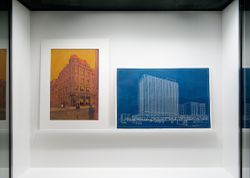
L’un des indicateurs de la modernité à partir du XVIIIe siècle est l’apparition des « gens » comme nouvelle entité politique respectée. En réponse à ce phénomène, les architectes se sont engagés dans la transformation des villes, ont exploré de nouvelles technologies, testé de nouveaux discours en architecture et ont pris part dans des conflits culturels enflammés – le(...)
L’un des indicateurs de la modernité à partir du XVIIIe siècle est l’apparition des « gens » comme nouvelle entité politique respectée. En réponse à ce phénomène, les architectes se sont engagés dans la transformation des villes, ont exploré de nouvelles technologies, testé de nouveaux discours en architecture et ont pris part dans des conflits culturels enflammés – le(...)
Localisation:
Vitrines
Vitrines
Date:
5 octobre 2011 au 22 janvier 2012
5 octobre 2011 au 22 janvier 2012
Titre:
Sur les traces des... gens
Actions:
Description:
L’un des indicateurs de la modernité à partir du XVIIIe siècle est l’apparition des « gens » comme nouvelle entité politique respectée. En réponse à ce phénomène, les architectes se sont engagés dans la transformation des villes, ont exploré de nouvelles technologies, testé de nouveaux discours en architecture et ont pris part dans des conflits culturels enflammés – le(...)
Sur les traces des... gens
Actions:
Description:
L’un des indicateurs de la modernité à partir du XVIIIe siècle est l’apparition des « gens » comme nouvelle entité politique respectée. En réponse à ce phénomène, les architectes se sont engagés dans la transformation des villes, ont exploré de nouvelles technologies, testé de nouveaux discours en architecture et ont pris part dans des conflits culturels enflammés – le(...)
Classification:
expositions
expositions
Date:
5 octobre 2011 au
22 janvier 2012
5 octobre 2011 au
22 janvier 2012
Localisation:
Vitrines
Vitrines
Titre:
Various awards and honours
Various awards and honours
Numéro de référence:
ARCH277083
Description:
File contains awards and honours in recognition of Arthur Erickson or his firms Erickson/Massey Architects, Arthur Erickson Architects or Arthur Erickson Corporation. Includes: National Design Award from the Canadian Housing Design Council for 5185 Keith Road, W. Vancouver and 3281 W. 35 Avenue, Vancouver (1964), Associate Member of the American Hospital Association (1975), Qualification to practice architecture in the state of New York (1979), Honorary Fellowship from the American Institute of Architects (1978), Charter Member of the American Planning Association (1978), Honorary Doctor of Laws from the University of Manitoba (1978), Festival of Architecture Honor Awards for Eppich House, Robson Square/The Law Courts, Habitat Pavilion, Sikh Temple and Museum of Anthropology (1980), Governor General's Medal for Architecture for the Yorkdale Rapit Transit Station, Certification of Practice firn the California State Boad of Architectural Examiners (1981), Second Prize in the Concours Europeen Cembureau for Napp Laboratories (1985), President's Award for Excellence from The American Society of Landscape Architects for Robson Square - first phase, Citation confered upon Cornelia Oberlander from the Canadian Society of Landscape Architects for the landscape architecture of the Canadian Chancery (1991), Award for Excellence in the graphic representation of architecture for the Hotel and Convention Centre and Malaysiana (1993), Honorary Member Diploma from La Sociedad de Arquitectos Mexicanos (1993), architectural licence from the National Council of Architecturall Registration Boards (1994).
ARCH277083
Description:
File contains awards and honours in recognition of Arthur Erickson or his firms Erickson/Massey Architects, Arthur Erickson Architects or Arthur Erickson Corporation. Includes: National Design Award from the Canadian Housing Design Council for 5185 Keith Road, W. Vancouver and 3281 W. 35 Avenue, Vancouver (1964), Associate Member of the American Hospital Association (1975), Qualification to practice architecture in the state of New York (1979), Honorary Fellowship from the American Institute of Architects (1978), Charter Member of the American Planning Association (1978), Honorary Doctor of Laws from the University of Manitoba (1978), Festival of Architecture Honor Awards for Eppich House, Robson Square/The Law Courts, Habitat Pavilion, Sikh Temple and Museum of Anthropology (1980), Governor General's Medal for Architecture for the Yorkdale Rapit Transit Station, Certification of Practice firn the California State Boad of Architectural Examiners (1981), Second Prize in the Concours Europeen Cembureau for Napp Laboratories (1985), President's Award for Excellence from The American Society of Landscape Architects for Robson Square - first phase, Citation confered upon Cornelia Oberlander from the Canadian Society of Landscape Architects for the landscape architecture of the Canadian Chancery (1991), Award for Excellence in the graphic representation of architecture for the Hotel and Convention Centre and Malaysiana (1993), Honorary Member Diploma from La Sociedad de Arquitectos Mexicanos (1993), architectural licence from the National Council of Architecturall Registration Boards (1994).
Personnes et institutions:
Date:
1964-1994
1964-1994
Titre:
Various awards and honours
Actions:
ARCH277083
Description:
File contains awards and honours in recognition of Arthur Erickson or his firms Erickson/Massey Architects, Arthur Erickson Architects or Arthur Erickson Corporation. Includes: National Design Award from the Canadian Housing Design Council for 5185 Keith Road, W. Vancouver and 3281 W. 35 Avenue, Vancouver (1964), Associate Member of the American Hospital Association (1975), Qualification to practice architecture in the state of New York (1979), Honorary Fellowship from the American Institute of Architects (1978), Charter Member of the American Planning Association (1978), Honorary Doctor of Laws from the University of Manitoba (1978), Festival of Architecture Honor Awards for Eppich House, Robson Square/The Law Courts, Habitat Pavilion, Sikh Temple and Museum of Anthropology (1980), Governor General's Medal for Architecture for the Yorkdale Rapit Transit Station, Certification of Practice firn the California State Boad of Architectural Examiners (1981), Second Prize in the Concours Europeen Cembureau for Napp Laboratories (1985), President's Award for Excellence from The American Society of Landscape Architects for Robson Square - first phase, Citation confered upon Cornelia Oberlander from the Canadian Society of Landscape Architects for the landscape architecture of the Canadian Chancery (1991), Award for Excellence in the graphic representation of architecture for the Hotel and Convention Centre and Malaysiana (1993), Honorary Member Diploma from La Sociedad de Arquitectos Mexicanos (1993), architectural licence from the National Council of Architecturall Registration Boards (1994).
Various awards and honours
Actions:
ARCH277083
Description:
File contains awards and honours in recognition of Arthur Erickson or his firms Erickson/Massey Architects, Arthur Erickson Architects or Arthur Erickson Corporation. Includes: National Design Award from the Canadian Housing Design Council for 5185 Keith Road, W. Vancouver and 3281 W. 35 Avenue, Vancouver (1964), Associate Member of the American Hospital Association (1975), Qualification to practice architecture in the state of New York (1979), Honorary Fellowship from the American Institute of Architects (1978), Charter Member of the American Planning Association (1978), Honorary Doctor of Laws from the University of Manitoba (1978), Festival of Architecture Honor Awards for Eppich House, Robson Square/The Law Courts, Habitat Pavilion, Sikh Temple and Museum of Anthropology (1980), Governor General's Medal for Architecture for the Yorkdale Rapit Transit Station, Certification of Practice firn the California State Boad of Architectural Examiners (1981), Second Prize in the Concours Europeen Cembureau for Napp Laboratories (1985), President's Award for Excellence from The American Society of Landscape Architects for Robson Square - first phase, Citation confered upon Cornelia Oberlander from the Canadian Society of Landscape Architects for the landscape architecture of the Canadian Chancery (1991), Award for Excellence in the graphic representation of architecture for the Hotel and Convention Centre and Malaysiana (1993), Honorary Member Diploma from La Sociedad de Arquitectos Mexicanos (1993), architectural licence from the National Council of Architecturall Registration Boards (1994).
Date:
1964-1994
1964-1994
Personnes et institutions:
Classification:
articles
articles
Titre:
Une histoire de rencontres
Une histoire de rencontres
Actions:
Francesco Garutti introduit Sur le terrain
Dossier:
Forces de friction
Forces de friction


