


3141 Résultats
Classification:
dessins
dessins
Titre:
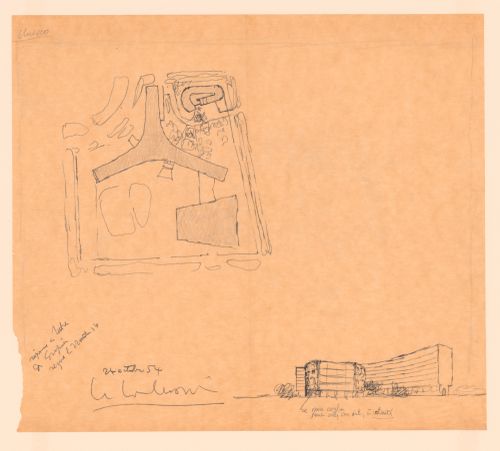
Sketch site plan and sketch view of an alternative proposal for the pavilion at UNESCO Headquarters
Sketch site plan and sketch view of an alternative proposal for the pavilion at UNESCO Headquarters
Actions:
Numéro de référence:
DR1988:0425
Description:
- Le Corbusier prepared this drawing inscribed "reponse a lettre / de Gropius / recue le 22 Octobre 54" in response to Walter Gropius' suggestion that he too reply to a letter addressed only to Gropius by Eugene Callison, Chief engineer at UNESCO Headquarters, Paris. Callison had requested that Gropius comment on a proposal by the Zehrfuss-Breuer-Nervi team to add a pavilion to the existing UNESCO building. Le Corbusier was dissatisfied with the team's pavilion, which shows a narrow, glazed oblong raised on pilotis (Shapiro, fig. 219). He proposed instead this sketch for a detached pavilion consisting of a roughly-finished, curving wall enclosing a garden, which he sent to Callison, along with a critique of the Zehrfuss-Breuer-Nervi team's proposition. On 26 October 1954, he also sent copies of his proposal to all of the project advisors.
DR1988:0425
Description:
- Le Corbusier prepared this drawing inscribed "reponse a lettre / de Gropius / recue le 22 Octobre 54" in response to Walter Gropius' suggestion that he too reply to a letter addressed only to Gropius by Eugene Callison, Chief engineer at UNESCO Headquarters, Paris. Callison had requested that Gropius comment on a proposal by the Zehrfuss-Breuer-Nervi team to add a pavilion to the existing UNESCO building. Le Corbusier was dissatisfied with the team's pavilion, which shows a narrow, glazed oblong raised on pilotis (Shapiro, fig. 219). He proposed instead this sketch for a detached pavilion consisting of a roughly-finished, curving wall enclosing a garden, which he sent to Callison, along with a critique of the Zehrfuss-Breuer-Nervi team's proposition. On 26 October 1954, he also sent copies of his proposal to all of the project advisors.
Personnes et institutions:
Sujet:
architecture
architecture
Date:
1954
1954
Titre:
Sketch site plan and sketch view of an alternative proposal for the pavilion at UNESCO Headquarters
Actions:
DR1988:0425
Description:
- Le Corbusier prepared this drawing inscribed "reponse a lettre / de Gropius / recue le 22 Octobre 54" in response to Walter Gropius' suggestion that he too reply to a letter addressed only to Gropius by Eugene Callison, Chief engineer at UNESCO Headquarters, Paris. Callison had requested that Gropius comment on a proposal by the Zehrfuss-Breuer-Nervi team to add a pavilion to the existing UNESCO building. Le Corbusier was dissatisfied with the team's pavilion, which shows a narrow, glazed oblong raised on pilotis (Shapiro, fig. 219). He proposed instead this sketch for a detached pavilion consisting of a roughly-finished, curving wall enclosing a garden, which he sent to Callison, along with a critique of the Zehrfuss-Breuer-Nervi team's proposition. On 26 October 1954, he also sent copies of his proposal to all of the project advisors.
Sketch site plan and sketch view of an alternative proposal for the pavilion at UNESCO Headquarters
Actions:
DR1988:0425
Description:
- Le Corbusier prepared this drawing inscribed "reponse a lettre / de Gropius / recue le 22 Octobre 54" in response to Walter Gropius' suggestion that he too reply to a letter addressed only to Gropius by Eugene Callison, Chief engineer at UNESCO Headquarters, Paris. Callison had requested that Gropius comment on a proposal by the Zehrfuss-Breuer-Nervi team to add a pavilion to the existing UNESCO building. Le Corbusier was dissatisfied with the team's pavilion, which shows a narrow, glazed oblong raised on pilotis (Shapiro, fig. 219). He proposed instead this sketch for a detached pavilion consisting of a roughly-finished, curving wall enclosing a garden, which he sent to Callison, along with a critique of the Zehrfuss-Breuer-Nervi team's proposition. On 26 October 1954, he also sent copies of his proposal to all of the project advisors.
Classification:
dessins
dessins
Date:
1954
1954
Personnes et institutions:
Sujet:
architecture
architecture
Classification:
documents textuels
Quantité:
12 file
documents textuels
Quantité:
12 file
Numéro de référence:
ARCH241912
Description:
Dear Reader #13 Andrew Benjamin - drafts Saint-Amand - drafts of Pierre Saint-Amand's review of Allen S. Weiss's Mirrors of Infinity: The Franch Formal Garden and 17th-Century Metaphysics (1995) Farès el-Dahdah - drafts of Letter from Abu Dhabi Ole Bouman - drafts Galiano / Davidson - drafts of article by Luis-Fernandez-Galiano and Cynthia Davidson Kwinter FFE 13 - drafts of article by Sanford Kwinter Teyssot - drafts and translations of article by Georges Teyssot Tate Interview - transcript of Richard Burdett and Nicholas Serota interviewed by Cynthia Davidson Keller - drafts of Ed Keller's review of Shusaku Arakawa and Madeline Gins' Architecture: Sites of Reversible Destiny (1995) Herzog Interview - transcript of Jacques Herzog interviewed by Cynthia Davidson Tate Project Descriptions
ARCH241912
Description:
Dear Reader #13 Andrew Benjamin - drafts Saint-Amand - drafts of Pierre Saint-Amand's review of Allen S. Weiss's Mirrors of Infinity: The Franch Formal Garden and 17th-Century Metaphysics (1995) Farès el-Dahdah - drafts of Letter from Abu Dhabi Ole Bouman - drafts Galiano / Davidson - drafts of article by Luis-Fernandez-Galiano and Cynthia Davidson Kwinter FFE 13 - drafts of article by Sanford Kwinter Teyssot - drafts and translations of article by Georges Teyssot Tate Interview - transcript of Richard Burdett and Nicholas Serota interviewed by Cynthia Davidson Keller - drafts of Ed Keller's review of Shusaku Arakawa and Madeline Gins' Architecture: Sites of Reversible Destiny (1995) Herzog Interview - transcript of Jacques Herzog interviewed by Cynthia Davidson Tate Project Descriptions
Personnes et institutions:
Date:
1995
1995
Titre:
Drafts of articles
Actions:
ARCH241912
Description:
Dear Reader #13 Andrew Benjamin - drafts Saint-Amand - drafts of Pierre Saint-Amand's review of Allen S. Weiss's Mirrors of Infinity: The Franch Formal Garden and 17th-Century Metaphysics (1995) Farès el-Dahdah - drafts of Letter from Abu Dhabi Ole Bouman - drafts Galiano / Davidson - drafts of article by Luis-Fernandez-Galiano and Cynthia Davidson Kwinter FFE 13 - drafts of article by Sanford Kwinter Teyssot - drafts and translations of article by Georges Teyssot Tate Interview - transcript of Richard Burdett and Nicholas Serota interviewed by Cynthia Davidson Keller - drafts of Ed Keller's review of Shusaku Arakawa and Madeline Gins' Architecture: Sites of Reversible Destiny (1995) Herzog Interview - transcript of Jacques Herzog interviewed by Cynthia Davidson Tate Project Descriptions
Drafts of articles
Actions:
ARCH241912
Description:
Dear Reader #13 Andrew Benjamin - drafts Saint-Amand - drafts of Pierre Saint-Amand's review of Allen S. Weiss's Mirrors of Infinity: The Franch Formal Garden and 17th-Century Metaphysics (1995) Farès el-Dahdah - drafts of Letter from Abu Dhabi Ole Bouman - drafts Galiano / Davidson - drafts of article by Luis-Fernandez-Galiano and Cynthia Davidson Kwinter FFE 13 - drafts of article by Sanford Kwinter Teyssot - drafts and translations of article by Georges Teyssot Tate Interview - transcript of Richard Burdett and Nicholas Serota interviewed by Cynthia Davidson Keller - drafts of Ed Keller's review of Shusaku Arakawa and Madeline Gins' Architecture: Sites of Reversible Destiny (1995) Herzog Interview - transcript of Jacques Herzog interviewed by Cynthia Davidson Tate Project Descriptions
Classification:
documents textuels
Quantité:
12 file
documents textuels
Quantité:
12 file
Date:
1995
1995
Personnes et institutions:
Classification:
documents textuels
documents textuels
Numéro de référence:
ARCH274002
Description:
Duplicates of writings by Jeet Malhotra, predominantly concerning Chandigarh, India, and the life and work of Pierre Jeanneret. File contains copies of articles by Malhotra: - "Article de J. L. Malhotra" about Pierre Jeanneret's design for furniture (in French) - "A Summary of my Views on Contemporary Indian Architecture" - "Memorial Shadeed Bhagat Singh à Hussainewala Head Works, Ferozepur, Punjab" about the construction of the Memorial Shadeed Bhagat Singh (in French) - Articles by Malhotra for the "Chandigarh News Letter." - "Pour Jeet Malhotra" consisting in advices from Pierre Jeanneret to Jeet Malhotra (in French) - "Talwara Town, Punjab" about Talwara - 2 copies of the article "Chandigarh Club" (in French and in English) - "Deux maisons de Chandigarh" about two houses in Chandigarh - "Pour le corps et l'âme" about education - "École maternelle du Secteur 9, Chandigarh" about a nursery school in Chandigarh
ARCH274002
Description:
Duplicates of writings by Jeet Malhotra, predominantly concerning Chandigarh, India, and the life and work of Pierre Jeanneret. File contains copies of articles by Malhotra: - "Article de J. L. Malhotra" about Pierre Jeanneret's design for furniture (in French) - "A Summary of my Views on Contemporary Indian Architecture" - "Memorial Shadeed Bhagat Singh à Hussainewala Head Works, Ferozepur, Punjab" about the construction of the Memorial Shadeed Bhagat Singh (in French) - Articles by Malhotra for the "Chandigarh News Letter." - "Pour Jeet Malhotra" consisting in advices from Pierre Jeanneret to Jeet Malhotra (in French) - "Talwara Town, Punjab" about Talwara - 2 copies of the article "Chandigarh Club" (in French and in English) - "Deux maisons de Chandigarh" about two houses in Chandigarh - "Pour le corps et l'âme" about education - "École maternelle du Secteur 9, Chandigarh" about a nursery school in Chandigarh
Personnes et institutions:
Date:
n.d.
n.d.
Titre:
Duplicates of writings by Jeet Malhotra, predominantly concerning Chandigarh
Actions:
ARCH274002
Description:
Duplicates of writings by Jeet Malhotra, predominantly concerning Chandigarh, India, and the life and work of Pierre Jeanneret. File contains copies of articles by Malhotra: - "Article de J. L. Malhotra" about Pierre Jeanneret's design for furniture (in French) - "A Summary of my Views on Contemporary Indian Architecture" - "Memorial Shadeed Bhagat Singh à Hussainewala Head Works, Ferozepur, Punjab" about the construction of the Memorial Shadeed Bhagat Singh (in French) - Articles by Malhotra for the "Chandigarh News Letter." - "Pour Jeet Malhotra" consisting in advices from Pierre Jeanneret to Jeet Malhotra (in French) - "Talwara Town, Punjab" about Talwara - 2 copies of the article "Chandigarh Club" (in French and in English) - "Deux maisons de Chandigarh" about two houses in Chandigarh - "Pour le corps et l'âme" about education - "École maternelle du Secteur 9, Chandigarh" about a nursery school in Chandigarh
Duplicates of writings by Jeet Malhotra, predominantly concerning Chandigarh
Actions:
ARCH274002
Description:
Duplicates of writings by Jeet Malhotra, predominantly concerning Chandigarh, India, and the life and work of Pierre Jeanneret. File contains copies of articles by Malhotra: - "Article de J. L. Malhotra" about Pierre Jeanneret's design for furniture (in French) - "A Summary of my Views on Contemporary Indian Architecture" - "Memorial Shadeed Bhagat Singh à Hussainewala Head Works, Ferozepur, Punjab" about the construction of the Memorial Shadeed Bhagat Singh (in French) - Articles by Malhotra for the "Chandigarh News Letter." - "Pour Jeet Malhotra" consisting in advices from Pierre Jeanneret to Jeet Malhotra (in French) - "Talwara Town, Punjab" about Talwara - 2 copies of the article "Chandigarh Club" (in French and in English) - "Deux maisons de Chandigarh" about two houses in Chandigarh - "Pour le corps et l'âme" about education - "École maternelle du Secteur 9, Chandigarh" about a nursery school in Chandigarh
Classification:
documents textuels
documents textuels
Date:
n.d.
n.d.
Personnes et institutions:
Classification:
documents textuels
documents textuels
Numéro de référence:
ARCH153544
Description:
Documentation concerning the project of a Journal for Discussion, and Criticism of Architecture, Planning and Urban Design, to be edited by Stanford Anderson and Anthony Vidler : with lists of proposed writers and topics for first issues; budget data Photocopy of Denise Levertov : "Some Notes on Organic Form", Poetry, vol. 106, no 6, September 1965 Schedule and introductory text by H.-R. Hitchcock for the "3rd Modern Architecture Symposium", Columbia University, May 13-15, 1966 CASE editorial Board Meeting, May 9 1965 Schedule of Seminar on Constructivism, A.A. 24/6/65 "A Work Study Program" Correspondence between PDE and Anthony Vidler Letter from Stuart Cohen [Statements of the editors about] Re:Form Editorial Statement (CASE/Problems in Architecture) Statement of the Editorial Board New York May 9, 1965; Colin Rowe, Peter Eisenman, Stanford Anderson, Kenneth Frampton, Henry Millon
ARCH153544
Description:
Documentation concerning the project of a Journal for Discussion, and Criticism of Architecture, Planning and Urban Design, to be edited by Stanford Anderson and Anthony Vidler : with lists of proposed writers and topics for first issues; budget data Photocopy of Denise Levertov : "Some Notes on Organic Form", Poetry, vol. 106, no 6, September 1965 Schedule and introductory text by H.-R. Hitchcock for the "3rd Modern Architecture Symposium", Columbia University, May 13-15, 1966 CASE editorial Board Meeting, May 9 1965 Schedule of Seminar on Constructivism, A.A. 24/6/65 "A Work Study Program" Correspondence between PDE and Anthony Vidler Letter from Stuart Cohen [Statements of the editors about] Re:Form Editorial Statement (CASE/Problems in Architecture) Statement of the Editorial Board New York May 9, 1965; Colin Rowe, Peter Eisenman, Stanford Anderson, Kenneth Frampton, Henry Millon
Personnes et institutions:
Date:
1965-1971
1965-1971
Titre:
PDE IAUS, 1971: D Projects - 2 IAUS magazine: CASE Mag. 1965-1971
Actions:
ARCH153544
Description:
Documentation concerning the project of a Journal for Discussion, and Criticism of Architecture, Planning and Urban Design, to be edited by Stanford Anderson and Anthony Vidler : with lists of proposed writers and topics for first issues; budget data Photocopy of Denise Levertov : "Some Notes on Organic Form", Poetry, vol. 106, no 6, September 1965 Schedule and introductory text by H.-R. Hitchcock for the "3rd Modern Architecture Symposium", Columbia University, May 13-15, 1966 CASE editorial Board Meeting, May 9 1965 Schedule of Seminar on Constructivism, A.A. 24/6/65 "A Work Study Program" Correspondence between PDE and Anthony Vidler Letter from Stuart Cohen [Statements of the editors about] Re:Form Editorial Statement (CASE/Problems in Architecture) Statement of the Editorial Board New York May 9, 1965; Colin Rowe, Peter Eisenman, Stanford Anderson, Kenneth Frampton, Henry Millon
PDE IAUS, 1971: D Projects - 2 IAUS magazine: CASE Mag. 1965-1971
Actions:
ARCH153544
Description:
Documentation concerning the project of a Journal for Discussion, and Criticism of Architecture, Planning and Urban Design, to be edited by Stanford Anderson and Anthony Vidler : with lists of proposed writers and topics for first issues; budget data Photocopy of Denise Levertov : "Some Notes on Organic Form", Poetry, vol. 106, no 6, September 1965 Schedule and introductory text by H.-R. Hitchcock for the "3rd Modern Architecture Symposium", Columbia University, May 13-15, 1966 CASE editorial Board Meeting, May 9 1965 Schedule of Seminar on Constructivism, A.A. 24/6/65 "A Work Study Program" Correspondence between PDE and Anthony Vidler Letter from Stuart Cohen [Statements of the editors about] Re:Form Editorial Statement (CASE/Problems in Architecture) Statement of the Editorial Board New York May 9, 1965; Colin Rowe, Peter Eisenman, Stanford Anderson, Kenneth Frampton, Henry Millon
Classification:
documents textuels
documents textuels
Date:
1965-1971
1965-1971
Personnes et institutions:
Niveau de description archivistique:
Série(s)
Série(s)
Titre:
Architectural projects
Architectural projects
Numéro de référence:
AP178.S1
Description:
Series AP178.S1 is the largest series of the Álvaro Siza fonds and documents over 200 of Siza’s built and unbuilt architectural projects. The series is divided into project series which are arranged chronologically by project year. Presently, materials in this series range from 1958-2012. The CCA will also receive materials documenting Siza’s more recent work in future additions. Documenting the projects are conceptual, design, presentation, and working drawings, as well as photographic materials, textual documentation, and models. Although the drawings for each project have been identified, Siza often sketches or doodles on textual documentation, such as minutes of meetings or notes. When possible, folders that include textual documents with sketches or doodles have been identified. Amounts and types of materials vary from project to project. Project documentation is usually in Portuguese, with some exceptions including French, English, German, and Dutch. Most project series include sketches, studies, and working drawings. Other drawings included are site plans, floor plans, topographic surveys, elevations, sections, as well as technical and mechanical details. Also documenting the projects are photographic materials and textual documentation, such as correspondence, building programs, contracts, notes, and other working details. Photographic materials found within this archive are slides, negatives, photomontages and photographs of project sites and models.The photomontages were often used to study the function of the project site. To fully understand Siza’s methodology, sketchbooks (Series AP178.S2) should be viewed alongside the project drawings, when possible. Each project series description highlights sketchbooks in series AP178.S2 which contain related sketches. It is important to note that not all projects are represented in the sketchbooks in Series AP178.S2. Moreover, project series descriptions only list related sketchbooks when sketches have been positively identified as related to the corresponding project. The Siza fonds will be processed in four phases. The materials processed in the first, second, and third phases are architectural projects from the 1950’s, 1960’s, and 1970’s; urban planning projects; Reconstrução do Chiado; Berlin projects submitted to the IBA competition; cultural institutions; individual houses; and the Plano de urbanização Deelgebied 5 Schilderswijk-West in The Hague. Among The Hague and the Berlin projects are the Punt en Komma social housing, Bonjour Tristesse, and the Residential settlement in Schilderswijk. This series is better understood in the context of how the records for architectural projects were arranged by Siza’s office. Earlier projects were initially numbered by Siza’s office and then received new project numbers by the office archivist, who joined the office in the 1990s. Project files have been kept in the order in which they were received by the CCA, which is how they were arranged by the office archivist. The project numbers and dates assigned by Siza’s office archivist are included in the descriptions for each project and form the basis for the arrangement of this series. The office archivist numbered projects consecutively by decade, for instance, 58/80 was the 58th project during the 1980s. Numbers which were included in square brackets, ex. [14]/75, show that the project was not a ‘full’ project and contains a small amount of documentation. When projects are followed by a letter (A, B, C) this signifies a project is connected to the first. When the project number is followed by a number (1, 2, 3) this signifies a separate building within a larger project. For the purposes of arrangement, project numbers that were assigned a letter or number are arranged as sub-series of the related project series. Exceptions to this numbering convention are projects 23/60, 25/60, 28/60, 33/60, 34/60 and 35/60. These projects were not in the office’s original project list and were not officially considered projects. The office archivist assembled documentation related to these projects and assigned them numbers. In the early 2000s a large number of photographic materials were gathered together by the office archivist from various correspondence files for a digitization project initiated by the office. These materials remained housed together as a photograph collection in the office. Not all of these materials were digitized by the office. Those that were digitized were assigned numbers which have been identified in the file descriptions. It is important to note that several photographic materials were left with the textual documentation or drawings. When this is the case they are identified in the file description. There are also several panoramic photomontages which were created by either gluing or taping several photographs together to make panoramas of project sites.
AP178.S1
Description:
Series AP178.S1 is the largest series of the Álvaro Siza fonds and documents over 200 of Siza’s built and unbuilt architectural projects. The series is divided into project series which are arranged chronologically by project year. Presently, materials in this series range from 1958-2012. The CCA will also receive materials documenting Siza’s more recent work in future additions. Documenting the projects are conceptual, design, presentation, and working drawings, as well as photographic materials, textual documentation, and models. Although the drawings for each project have been identified, Siza often sketches or doodles on textual documentation, such as minutes of meetings or notes. When possible, folders that include textual documents with sketches or doodles have been identified. Amounts and types of materials vary from project to project. Project documentation is usually in Portuguese, with some exceptions including French, English, German, and Dutch. Most project series include sketches, studies, and working drawings. Other drawings included are site plans, floor plans, topographic surveys, elevations, sections, as well as technical and mechanical details. Also documenting the projects are photographic materials and textual documentation, such as correspondence, building programs, contracts, notes, and other working details. Photographic materials found within this archive are slides, negatives, photomontages and photographs of project sites and models.The photomontages were often used to study the function of the project site. To fully understand Siza’s methodology, sketchbooks (Series AP178.S2) should be viewed alongside the project drawings, when possible. Each project series description highlights sketchbooks in series AP178.S2 which contain related sketches. It is important to note that not all projects are represented in the sketchbooks in Series AP178.S2. Moreover, project series descriptions only list related sketchbooks when sketches have been positively identified as related to the corresponding project. The Siza fonds will be processed in four phases. The materials processed in the first, second, and third phases are architectural projects from the 1950’s, 1960’s, and 1970’s; urban planning projects; Reconstrução do Chiado; Berlin projects submitted to the IBA competition; cultural institutions; individual houses; and the Plano de urbanização Deelgebied 5 Schilderswijk-West in The Hague. Among The Hague and the Berlin projects are the Punt en Komma social housing, Bonjour Tristesse, and the Residential settlement in Schilderswijk. This series is better understood in the context of how the records for architectural projects were arranged by Siza’s office. Earlier projects were initially numbered by Siza’s office and then received new project numbers by the office archivist, who joined the office in the 1990s. Project files have been kept in the order in which they were received by the CCA, which is how they were arranged by the office archivist. The project numbers and dates assigned by Siza’s office archivist are included in the descriptions for each project and form the basis for the arrangement of this series. The office archivist numbered projects consecutively by decade, for instance, 58/80 was the 58th project during the 1980s. Numbers which were included in square brackets, ex. [14]/75, show that the project was not a ‘full’ project and contains a small amount of documentation. When projects are followed by a letter (A, B, C) this signifies a project is connected to the first. When the project number is followed by a number (1, 2, 3) this signifies a separate building within a larger project. For the purposes of arrangement, project numbers that were assigned a letter or number are arranged as sub-series of the related project series. Exceptions to this numbering convention are projects 23/60, 25/60, 28/60, 33/60, 34/60 and 35/60. These projects were not in the office’s original project list and were not officially considered projects. The office archivist assembled documentation related to these projects and assigned them numbers. In the early 2000s a large number of photographic materials were gathered together by the office archivist from various correspondence files for a digitization project initiated by the office. These materials remained housed together as a photograph collection in the office. Not all of these materials were digitized by the office. Those that were digitized were assigned numbers which have been identified in the file descriptions. It is important to note that several photographic materials were left with the textual documentation or drawings. When this is the case they are identified in the file description. There are also several panoramic photomontages which were created by either gluing or taping several photographs together to make panoramas of project sites.
Personnes et institutions:
Date:
1948-2012
1948-2012
Titre:
Architectural projects
Actions:
AP178.S1
Description:
Series AP178.S1 is the largest series of the Álvaro Siza fonds and documents over 200 of Siza’s built and unbuilt architectural projects. The series is divided into project series which are arranged chronologically by project year. Presently, materials in this series range from 1958-2012. The CCA will also receive materials documenting Siza’s more recent work in future additions. Documenting the projects are conceptual, design, presentation, and working drawings, as well as photographic materials, textual documentation, and models. Although the drawings for each project have been identified, Siza often sketches or doodles on textual documentation, such as minutes of meetings or notes. When possible, folders that include textual documents with sketches or doodles have been identified. Amounts and types of materials vary from project to project. Project documentation is usually in Portuguese, with some exceptions including French, English, German, and Dutch. Most project series include sketches, studies, and working drawings. Other drawings included are site plans, floor plans, topographic surveys, elevations, sections, as well as technical and mechanical details. Also documenting the projects are photographic materials and textual documentation, such as correspondence, building programs, contracts, notes, and other working details. Photographic materials found within this archive are slides, negatives, photomontages and photographs of project sites and models.The photomontages were often used to study the function of the project site. To fully understand Siza’s methodology, sketchbooks (Series AP178.S2) should be viewed alongside the project drawings, when possible. Each project series description highlights sketchbooks in series AP178.S2 which contain related sketches. It is important to note that not all projects are represented in the sketchbooks in Series AP178.S2. Moreover, project series descriptions only list related sketchbooks when sketches have been positively identified as related to the corresponding project. The Siza fonds will be processed in four phases. The materials processed in the first, second, and third phases are architectural projects from the 1950’s, 1960’s, and 1970’s; urban planning projects; Reconstrução do Chiado; Berlin projects submitted to the IBA competition; cultural institutions; individual houses; and the Plano de urbanização Deelgebied 5 Schilderswijk-West in The Hague. Among The Hague and the Berlin projects are the Punt en Komma social housing, Bonjour Tristesse, and the Residential settlement in Schilderswijk. This series is better understood in the context of how the records for architectural projects were arranged by Siza’s office. Earlier projects were initially numbered by Siza’s office and then received new project numbers by the office archivist, who joined the office in the 1990s. Project files have been kept in the order in which they were received by the CCA, which is how they were arranged by the office archivist. The project numbers and dates assigned by Siza’s office archivist are included in the descriptions for each project and form the basis for the arrangement of this series. The office archivist numbered projects consecutively by decade, for instance, 58/80 was the 58th project during the 1980s. Numbers which were included in square brackets, ex. [14]/75, show that the project was not a ‘full’ project and contains a small amount of documentation. When projects are followed by a letter (A, B, C) this signifies a project is connected to the first. When the project number is followed by a number (1, 2, 3) this signifies a separate building within a larger project. For the purposes of arrangement, project numbers that were assigned a letter or number are arranged as sub-series of the related project series. Exceptions to this numbering convention are projects 23/60, 25/60, 28/60, 33/60, 34/60 and 35/60. These projects were not in the office’s original project list and were not officially considered projects. The office archivist assembled documentation related to these projects and assigned them numbers. In the early 2000s a large number of photographic materials were gathered together by the office archivist from various correspondence files for a digitization project initiated by the office. These materials remained housed together as a photograph collection in the office. Not all of these materials were digitized by the office. Those that were digitized were assigned numbers which have been identified in the file descriptions. It is important to note that several photographic materials were left with the textual documentation or drawings. When this is the case they are identified in the file description. There are also several panoramic photomontages which were created by either gluing or taping several photographs together to make panoramas of project sites.
Architectural projects
Actions:
AP178.S1
Description:
Series AP178.S1 is the largest series of the Álvaro Siza fonds and documents over 200 of Siza’s built and unbuilt architectural projects. The series is divided into project series which are arranged chronologically by project year. Presently, materials in this series range from 1958-2012. The CCA will also receive materials documenting Siza’s more recent work in future additions. Documenting the projects are conceptual, design, presentation, and working drawings, as well as photographic materials, textual documentation, and models. Although the drawings for each project have been identified, Siza often sketches or doodles on textual documentation, such as minutes of meetings or notes. When possible, folders that include textual documents with sketches or doodles have been identified. Amounts and types of materials vary from project to project. Project documentation is usually in Portuguese, with some exceptions including French, English, German, and Dutch. Most project series include sketches, studies, and working drawings. Other drawings included are site plans, floor plans, topographic surveys, elevations, sections, as well as technical and mechanical details. Also documenting the projects are photographic materials and textual documentation, such as correspondence, building programs, contracts, notes, and other working details. Photographic materials found within this archive are slides, negatives, photomontages and photographs of project sites and models.The photomontages were often used to study the function of the project site. To fully understand Siza’s methodology, sketchbooks (Series AP178.S2) should be viewed alongside the project drawings, when possible. Each project series description highlights sketchbooks in series AP178.S2 which contain related sketches. It is important to note that not all projects are represented in the sketchbooks in Series AP178.S2. Moreover, project series descriptions only list related sketchbooks when sketches have been positively identified as related to the corresponding project. The Siza fonds will be processed in four phases. The materials processed in the first, second, and third phases are architectural projects from the 1950’s, 1960’s, and 1970’s; urban planning projects; Reconstrução do Chiado; Berlin projects submitted to the IBA competition; cultural institutions; individual houses; and the Plano de urbanização Deelgebied 5 Schilderswijk-West in The Hague. Among The Hague and the Berlin projects are the Punt en Komma social housing, Bonjour Tristesse, and the Residential settlement in Schilderswijk. This series is better understood in the context of how the records for architectural projects were arranged by Siza’s office. Earlier projects were initially numbered by Siza’s office and then received new project numbers by the office archivist, who joined the office in the 1990s. Project files have been kept in the order in which they were received by the CCA, which is how they were arranged by the office archivist. The project numbers and dates assigned by Siza’s office archivist are included in the descriptions for each project and form the basis for the arrangement of this series. The office archivist numbered projects consecutively by decade, for instance, 58/80 was the 58th project during the 1980s. Numbers which were included in square brackets, ex. [14]/75, show that the project was not a ‘full’ project and contains a small amount of documentation. When projects are followed by a letter (A, B, C) this signifies a project is connected to the first. When the project number is followed by a number (1, 2, 3) this signifies a separate building within a larger project. For the purposes of arrangement, project numbers that were assigned a letter or number are arranged as sub-series of the related project series. Exceptions to this numbering convention are projects 23/60, 25/60, 28/60, 33/60, 34/60 and 35/60. These projects were not in the office’s original project list and were not officially considered projects. The office archivist assembled documentation related to these projects and assigned them numbers. In the early 2000s a large number of photographic materials were gathered together by the office archivist from various correspondence files for a digitization project initiated by the office. These materials remained housed together as a photograph collection in the office. Not all of these materials were digitized by the office. Those that were digitized were assigned numbers which have been identified in the file descriptions. It is important to note that several photographic materials were left with the textual documentation or drawings. When this is the case they are identified in the file description. There are also several panoramic photomontages which were created by either gluing or taping several photographs together to make panoramas of project sites.
Niveau de description archivistique:
Series
Series
Date:
1948-2012
1948-2012
Personnes et institutions:
Classification:
documents textuels
documents textuels
Titre:
Labels, a letter, memos, notes, clippings, information on Mobile Homes, a directory, publications
Labels, a letter, memos, notes, clippings, information on Mobile Homes, a directory, publications
Actions:
Numéro de référence:
DR1999:0364
Description:
documents include labels, a letter, memos, notes, clippings, information on Mobile Homes, a directory, publications, and development projects files and brochures including: Arizona: - Sun City West California: - Vintage Club Florida: - Atlantis on Brickell; Bal Harbour Shops; Bay Village; California Contemporaries; Chalets IV; Charleston Place; Clipper Bay; Coral Grove; County Walk; Doral Estates; Fort Myers Six Lakes; Greenbrook; The Hamlet; The Hammocks; Hilton Head Plantation; Hunters Run; Jonothan's Landing; Juniper; Kenlands Court, Michigan Homes; The Moorings; Ocala Springs; Ocean Reef Club; Palm Coast; PGA National Golf Club; The Plaza on the Mall; Punto Gorda Isles; South Seas Plantation; Sunset Condor; Whiskey Creek; Useppa Island Club South Carolina: - Admiral's Row; Broad Creek Landing; Calibogue Club; Evian; Forest Beach; Fripp Island; Hilton Head Four Seasons; Hilton Head General; Isles of Palms; Kiawah Island; Land's End; Lighthouse II; Palmetto Dunes; Seabrook Islands; Sea Crest Surf; South Beach Club; The Village; Windmill Harbour
DR1999:0364
Description:
documents include labels, a letter, memos, notes, clippings, information on Mobile Homes, a directory, publications, and development projects files and brochures including: Arizona: - Sun City West California: - Vintage Club Florida: - Atlantis on Brickell; Bal Harbour Shops; Bay Village; California Contemporaries; Chalets IV; Charleston Place; Clipper Bay; Coral Grove; County Walk; Doral Estates; Fort Myers Six Lakes; Greenbrook; The Hamlet; The Hammocks; Hilton Head Plantation; Hunters Run; Jonothan's Landing; Juniper; Kenlands Court, Michigan Homes; The Moorings; Ocala Springs; Ocean Reef Club; Palm Coast; PGA National Golf Club; The Plaza on the Mall; Punto Gorda Isles; South Seas Plantation; Sunset Condor; Whiskey Creek; Useppa Island Club South Carolina: - Admiral's Row; Broad Creek Landing; Calibogue Club; Evian; Forest Beach; Fripp Island; Hilton Head Four Seasons; Hilton Head General; Isles of Palms; Kiawah Island; Land's End; Lighthouse II; Palmetto Dunes; Seabrook Islands; Sea Crest Surf; South Beach Club; The Village; Windmill Harbour
Titre:
Labels, a letter, memos, notes, clippings, information on Mobile Homes, a directory, publications
Actions:
DR1999:0364
Description:
documents include labels, a letter, memos, notes, clippings, information on Mobile Homes, a directory, publications, and development projects files and brochures including: Arizona: - Sun City West California: - Vintage Club Florida: - Atlantis on Brickell; Bal Harbour Shops; Bay Village; California Contemporaries; Chalets IV; Charleston Place; Clipper Bay; Coral Grove; County Walk; Doral Estates; Fort Myers Six Lakes; Greenbrook; The Hamlet; The Hammocks; Hilton Head Plantation; Hunters Run; Jonothan's Landing; Juniper; Kenlands Court, Michigan Homes; The Moorings; Ocala Springs; Ocean Reef Club; Palm Coast; PGA National Golf Club; The Plaza on the Mall; Punto Gorda Isles; South Seas Plantation; Sunset Condor; Whiskey Creek; Useppa Island Club South Carolina: - Admiral's Row; Broad Creek Landing; Calibogue Club; Evian; Forest Beach; Fripp Island; Hilton Head Four Seasons; Hilton Head General; Isles of Palms; Kiawah Island; Land's End; Lighthouse II; Palmetto Dunes; Seabrook Islands; Sea Crest Surf; South Beach Club; The Village; Windmill Harbour
Labels, a letter, memos, notes, clippings, information on Mobile Homes, a directory, publications
Actions:
DR1999:0364
Description:
documents include labels, a letter, memos, notes, clippings, information on Mobile Homes, a directory, publications, and development projects files and brochures including: Arizona: - Sun City West California: - Vintage Club Florida: - Atlantis on Brickell; Bal Harbour Shops; Bay Village; California Contemporaries; Chalets IV; Charleston Place; Clipper Bay; Coral Grove; County Walk; Doral Estates; Fort Myers Six Lakes; Greenbrook; The Hamlet; The Hammocks; Hilton Head Plantation; Hunters Run; Jonothan's Landing; Juniper; Kenlands Court, Michigan Homes; The Moorings; Ocala Springs; Ocean Reef Club; Palm Coast; PGA National Golf Club; The Plaza on the Mall; Punto Gorda Isles; South Seas Plantation; Sunset Condor; Whiskey Creek; Useppa Island Club South Carolina: - Admiral's Row; Broad Creek Landing; Calibogue Club; Evian; Forest Beach; Fripp Island; Hilton Head Four Seasons; Hilton Head General; Isles of Palms; Kiawah Island; Land's End; Lighthouse II; Palmetto Dunes; Seabrook Islands; Sea Crest Surf; South Beach Club; The Village; Windmill Harbour
Classification:
documents textuels
documents textuels
Classification:
documents textuels
Quantité:
13 file
documents textuels
Quantité:
13 file
Numéro de référence:
ARCH241922
Description:
Schwarzer Unforeseen - drafts of article by Mitchell Schwarzer Schwarzer Tectonics Unbound - drafts of article by Mitchell Schwarzer, includes curriculum vitae and correspondence Musicon Bremen - drafts project description by Daniel Libeskind Lynn Blob - drafts of article by Greg Lynn Fausch Opposition of Postmodern Tectonics - drafts of article by Deborah Fausch Isenstadt Spectacular Tectonics - drafts of article by Sandy Isenstadt Rakatansky What Kahn wants to Be - drafts of article by Mark Rakatansky Mertins Benjamin's Techonic Unconscious - drafts of article by Detlef Mertins Bressani - draft of article by Martin Bressani Wolf Metaphysical Foundations of Schinkel's Tectonics - drafts of article by Scott C. Wolf Calvahouse Review - drafts of review by Tim Culvahouse of Kenneth Frampton's Studies in Tectonic Culture: The Poetics of Construction in Nineteenth and Twentieth Century Architecture (1995) Apter - Letter from Paris drafts by Emily Apter Bergdoll Review - review by Barry Bergdoll of Sigfried Giedion's Building in France, building in iron, building in ferroconcrete (1995)
ARCH241922
Description:
Schwarzer Unforeseen - drafts of article by Mitchell Schwarzer Schwarzer Tectonics Unbound - drafts of article by Mitchell Schwarzer, includes curriculum vitae and correspondence Musicon Bremen - drafts project description by Daniel Libeskind Lynn Blob - drafts of article by Greg Lynn Fausch Opposition of Postmodern Tectonics - drafts of article by Deborah Fausch Isenstadt Spectacular Tectonics - drafts of article by Sandy Isenstadt Rakatansky What Kahn wants to Be - drafts of article by Mark Rakatansky Mertins Benjamin's Techonic Unconscious - drafts of article by Detlef Mertins Bressani - draft of article by Martin Bressani Wolf Metaphysical Foundations of Schinkel's Tectonics - drafts of article by Scott C. Wolf Calvahouse Review - drafts of review by Tim Culvahouse of Kenneth Frampton's Studies in Tectonic Culture: The Poetics of Construction in Nineteenth and Twentieth Century Architecture (1995) Apter - Letter from Paris drafts by Emily Apter Bergdoll Review - review by Barry Bergdoll of Sigfried Giedion's Building in France, building in iron, building in ferroconcrete (1995)
Personnes et institutions:
Date:
1995-1996
1995-1996
Titre:
Drafts of articles, curriculum vitae and correspondence
Actions:
ARCH241922
Description:
Schwarzer Unforeseen - drafts of article by Mitchell Schwarzer Schwarzer Tectonics Unbound - drafts of article by Mitchell Schwarzer, includes curriculum vitae and correspondence Musicon Bremen - drafts project description by Daniel Libeskind Lynn Blob - drafts of article by Greg Lynn Fausch Opposition of Postmodern Tectonics - drafts of article by Deborah Fausch Isenstadt Spectacular Tectonics - drafts of article by Sandy Isenstadt Rakatansky What Kahn wants to Be - drafts of article by Mark Rakatansky Mertins Benjamin's Techonic Unconscious - drafts of article by Detlef Mertins Bressani - draft of article by Martin Bressani Wolf Metaphysical Foundations of Schinkel's Tectonics - drafts of article by Scott C. Wolf Calvahouse Review - drafts of review by Tim Culvahouse of Kenneth Frampton's Studies in Tectonic Culture: The Poetics of Construction in Nineteenth and Twentieth Century Architecture (1995) Apter - Letter from Paris drafts by Emily Apter Bergdoll Review - review by Barry Bergdoll of Sigfried Giedion's Building in France, building in iron, building in ferroconcrete (1995)
Drafts of articles, curriculum vitae and correspondence
Actions:
ARCH241922
Description:
Schwarzer Unforeseen - drafts of article by Mitchell Schwarzer Schwarzer Tectonics Unbound - drafts of article by Mitchell Schwarzer, includes curriculum vitae and correspondence Musicon Bremen - drafts project description by Daniel Libeskind Lynn Blob - drafts of article by Greg Lynn Fausch Opposition of Postmodern Tectonics - drafts of article by Deborah Fausch Isenstadt Spectacular Tectonics - drafts of article by Sandy Isenstadt Rakatansky What Kahn wants to Be - drafts of article by Mark Rakatansky Mertins Benjamin's Techonic Unconscious - drafts of article by Detlef Mertins Bressani - draft of article by Martin Bressani Wolf Metaphysical Foundations of Schinkel's Tectonics - drafts of article by Scott C. Wolf Calvahouse Review - drafts of review by Tim Culvahouse of Kenneth Frampton's Studies in Tectonic Culture: The Poetics of Construction in Nineteenth and Twentieth Century Architecture (1995) Apter - Letter from Paris drafts by Emily Apter Bergdoll Review - review by Barry Bergdoll of Sigfried Giedion's Building in France, building in iron, building in ferroconcrete (1995)
Classification:
documents textuels
Quantité:
13 file
documents textuels
Quantité:
13 file
Date:
1995-1996
1995-1996
Personnes et institutions:
Classification:
documents textuels
documents textuels
Titre:
Hejduk
Hejduk
Numéro de référence:
ARCH153754
Description:
Various documents relating to the exhibition catalogue, "John Hejduk, 7 Houses : January 22 to February 16, 1980" / introduction by Peter Eisenman. -- New York, N.Y. : Institute for Architecture and Urban Studies, [1979] Transcript of a conversation between John Hejduk and PDE; October13, 1977; "Nine Square House" Hejduk; 17 December 1979 (essay: "In My Father's House Are Many Mansions") Photocopy : Eisenman's preface, Galley Transcripts of a conversation between Wall and Hejduk : In perspective (no date) Typewritten manuscript : "The Destruction of the Box" Class discussion at Cooper Union; February 11 1976 (Mr. Rosaro, PDE, Chris, Wilcox, Rick, Blitz Brochure: John Hejduk: 3 + 1, 1976 1 exhibition catalogue: Projects/John Hejduk, architect: an exhibition at the Foundation Le Corbusier, Paris, October 1972 Folder Country: John Hejduk Interview, John Hejduk - Reima Pietila, Finnish Architect, Helsinki Interview, John Hejduk - Donald Wall, Professor; School of Architecture, New Jersey Institute of Technology & Nancy Ferrara, Experimental Psychologist Statement, John Hejduk Exhibition; January 22 - February 16 1980 Letter to PDE from Prof. P. Sanders, November 2 1979
ARCH153754
Description:
Various documents relating to the exhibition catalogue, "John Hejduk, 7 Houses : January 22 to February 16, 1980" / introduction by Peter Eisenman. -- New York, N.Y. : Institute for Architecture and Urban Studies, [1979] Transcript of a conversation between John Hejduk and PDE; October13, 1977; "Nine Square House" Hejduk; 17 December 1979 (essay: "In My Father's House Are Many Mansions") Photocopy : Eisenman's preface, Galley Transcripts of a conversation between Wall and Hejduk : In perspective (no date) Typewritten manuscript : "The Destruction of the Box" Class discussion at Cooper Union; February 11 1976 (Mr. Rosaro, PDE, Chris, Wilcox, Rick, Blitz Brochure: John Hejduk: 3 + 1, 1976 1 exhibition catalogue: Projects/John Hejduk, architect: an exhibition at the Foundation Le Corbusier, Paris, October 1972 Folder Country: John Hejduk Interview, John Hejduk - Reima Pietila, Finnish Architect, Helsinki Interview, John Hejduk - Donald Wall, Professor; School of Architecture, New Jersey Institute of Technology & Nancy Ferrara, Experimental Psychologist Statement, John Hejduk Exhibition; January 22 - February 16 1980 Letter to PDE from Prof. P. Sanders, November 2 1979
Personnes et institutions:
Date:
1972-1980
1972-1980
Titre:
Hejduk
Actions:
ARCH153754
Description:
Various documents relating to the exhibition catalogue, "John Hejduk, 7 Houses : January 22 to February 16, 1980" / introduction by Peter Eisenman. -- New York, N.Y. : Institute for Architecture and Urban Studies, [1979] Transcript of a conversation between John Hejduk and PDE; October13, 1977; "Nine Square House" Hejduk; 17 December 1979 (essay: "In My Father's House Are Many Mansions") Photocopy : Eisenman's preface, Galley Transcripts of a conversation between Wall and Hejduk : In perspective (no date) Typewritten manuscript : "The Destruction of the Box" Class discussion at Cooper Union; February 11 1976 (Mr. Rosaro, PDE, Chris, Wilcox, Rick, Blitz Brochure: John Hejduk: 3 + 1, 1976 1 exhibition catalogue: Projects/John Hejduk, architect: an exhibition at the Foundation Le Corbusier, Paris, October 1972 Folder Country: John Hejduk Interview, John Hejduk - Reima Pietila, Finnish Architect, Helsinki Interview, John Hejduk - Donald Wall, Professor; School of Architecture, New Jersey Institute of Technology & Nancy Ferrara, Experimental Psychologist Statement, John Hejduk Exhibition; January 22 - February 16 1980 Letter to PDE from Prof. P. Sanders, November 2 1979
Hejduk
Actions:
ARCH153754
Description:
Various documents relating to the exhibition catalogue, "John Hejduk, 7 Houses : January 22 to February 16, 1980" / introduction by Peter Eisenman. -- New York, N.Y. : Institute for Architecture and Urban Studies, [1979] Transcript of a conversation between John Hejduk and PDE; October13, 1977; "Nine Square House" Hejduk; 17 December 1979 (essay: "In My Father's House Are Many Mansions") Photocopy : Eisenman's preface, Galley Transcripts of a conversation between Wall and Hejduk : In perspective (no date) Typewritten manuscript : "The Destruction of the Box" Class discussion at Cooper Union; February 11 1976 (Mr. Rosaro, PDE, Chris, Wilcox, Rick, Blitz Brochure: John Hejduk: 3 + 1, 1976 1 exhibition catalogue: Projects/John Hejduk, architect: an exhibition at the Foundation Le Corbusier, Paris, October 1972 Folder Country: John Hejduk Interview, John Hejduk - Reima Pietila, Finnish Architect, Helsinki Interview, John Hejduk - Donald Wall, Professor; School of Architecture, New Jersey Institute of Technology & Nancy Ferrara, Experimental Psychologist Statement, John Hejduk Exhibition; January 22 - February 16 1980 Letter to PDE from Prof. P. Sanders, November 2 1979
Classification:
documents textuels
documents textuels
Date:
1972-1980
1972-1980
Personnes et institutions:
Niveau de description archivistique:
Projet
Projet
Numéro de référence:
AP148.S1.1970.PR02
Description:
The project series documents Poli's work on the Interplanetary Architecture project, which was also made into a film by Superstudio directed by Alessandro Poli (the film is not included in the fonds). The project reflects Poli's deep fascination with the moon landing in 1969. Poli uses this major media event as a catalyst for thinking about a new approach to architecture and tools for design, including the idea that film and the movie camera should become part of the toolset. The project also seems to be in some way a response to Epoch magazine's challenge for a "Primo concorso di architettura nello spazio" (the first architectural competition in space), and includes much imagery and textual references to a new road or architectural links between the earth and other planets, including an earth moon highway. In his storyboard, Poli also makes reference to his earlier Piper project, and some imagery features wheels and an amusement park. The Interplanetary Architecture project was exhibited by Superstudio in Rome in 1972 and featured in "Casabella" magazine in April 1972 (no. 364). The project was also featured in the 2010 CCA exhibition "Other Space Odysseys". In the accompanying CCA publication, Poli describes this project as "a voyage off earthbound routes in quest of architecture unfettered by the urban nightmare, by induced needs or by planning as the only tool for regulating and solving the world's problems" (Poli quoted in Borasi and Zardini, 2010, 110). Poli's work on this project is deeply tied to the Zeno project, which was also featured in this exhibition and is included in this fonds (see AP148.S1.1972.PR01). For the Zeno project, Poli envisioned a dialogue between astronaut Buzz Aldrin and an Italian peasant, Zeno of Riparbella. Poli felt that these two shared a similarity in that both their homes were isolated capsules, one that provided a lens from which to see the rest of the world and understand their place in it. The material in the series includes numerous photomontages and collages of astronauts in space, as well as drawings of plantery shapes and structures. There are also texts, some of which include calculations of distances and diameters of planets, as well as notebooks and sketchbooks, many of which Poli included in a folder he entitled "Storyboard." The series also includes an unsent letter from Poli to Adolfo Natalini which describes how, after the moon landing, everything - the planet, the moon, the stars - is architecture, and that this will necessitate the need for new design tools, such as the movie camera. Some works are signed Alessandro Poli-Superstudio. Source cited: Giovanna Borasi and Mirko Zardini, eds., Other Space Odysseys, Montreal and Baden: Canadian Centre for Architecture/Lars Müller Publishers, 2010.
AP148.S1.1970.PR02
Description:
The project series documents Poli's work on the Interplanetary Architecture project, which was also made into a film by Superstudio directed by Alessandro Poli (the film is not included in the fonds). The project reflects Poli's deep fascination with the moon landing in 1969. Poli uses this major media event as a catalyst for thinking about a new approach to architecture and tools for design, including the idea that film and the movie camera should become part of the toolset. The project also seems to be in some way a response to Epoch magazine's challenge for a "Primo concorso di architettura nello spazio" (the first architectural competition in space), and includes much imagery and textual references to a new road or architectural links between the earth and other planets, including an earth moon highway. In his storyboard, Poli also makes reference to his earlier Piper project, and some imagery features wheels and an amusement park. The Interplanetary Architecture project was exhibited by Superstudio in Rome in 1972 and featured in "Casabella" magazine in April 1972 (no. 364). The project was also featured in the 2010 CCA exhibition "Other Space Odysseys". In the accompanying CCA publication, Poli describes this project as "a voyage off earthbound routes in quest of architecture unfettered by the urban nightmare, by induced needs or by planning as the only tool for regulating and solving the world's problems" (Poli quoted in Borasi and Zardini, 2010, 110). Poli's work on this project is deeply tied to the Zeno project, which was also featured in this exhibition and is included in this fonds (see AP148.S1.1972.PR01). For the Zeno project, Poli envisioned a dialogue between astronaut Buzz Aldrin and an Italian peasant, Zeno of Riparbella. Poli felt that these two shared a similarity in that both their homes were isolated capsules, one that provided a lens from which to see the rest of the world and understand their place in it. The material in the series includes numerous photomontages and collages of astronauts in space, as well as drawings of plantery shapes and structures. There are also texts, some of which include calculations of distances and diameters of planets, as well as notebooks and sketchbooks, many of which Poli included in a folder he entitled "Storyboard." The series also includes an unsent letter from Poli to Adolfo Natalini which describes how, after the moon landing, everything - the planet, the moon, the stars - is architecture, and that this will necessitate the need for new design tools, such as the movie camera. Some works are signed Alessandro Poli-Superstudio. Source cited: Giovanna Borasi and Mirko Zardini, eds., Other Space Odysseys, Montreal and Baden: Canadian Centre for Architecture/Lars Müller Publishers, 2010.
Personnes et institutions:
Date:
1969-1971
1969-1971
Titre:
Architettura Interplanetaria [Interplanetary Architecture] (1970-1971)
Actions:
AP148.S1.1970.PR02
Description:
The project series documents Poli's work on the Interplanetary Architecture project, which was also made into a film by Superstudio directed by Alessandro Poli (the film is not included in the fonds). The project reflects Poli's deep fascination with the moon landing in 1969. Poli uses this major media event as a catalyst for thinking about a new approach to architecture and tools for design, including the idea that film and the movie camera should become part of the toolset. The project also seems to be in some way a response to Epoch magazine's challenge for a "Primo concorso di architettura nello spazio" (the first architectural competition in space), and includes much imagery and textual references to a new road or architectural links between the earth and other planets, including an earth moon highway. In his storyboard, Poli also makes reference to his earlier Piper project, and some imagery features wheels and an amusement park. The Interplanetary Architecture project was exhibited by Superstudio in Rome in 1972 and featured in "Casabella" magazine in April 1972 (no. 364). The project was also featured in the 2010 CCA exhibition "Other Space Odysseys". In the accompanying CCA publication, Poli describes this project as "a voyage off earthbound routes in quest of architecture unfettered by the urban nightmare, by induced needs or by planning as the only tool for regulating and solving the world's problems" (Poli quoted in Borasi and Zardini, 2010, 110). Poli's work on this project is deeply tied to the Zeno project, which was also featured in this exhibition and is included in this fonds (see AP148.S1.1972.PR01). For the Zeno project, Poli envisioned a dialogue between astronaut Buzz Aldrin and an Italian peasant, Zeno of Riparbella. Poli felt that these two shared a similarity in that both their homes were isolated capsules, one that provided a lens from which to see the rest of the world and understand their place in it. The material in the series includes numerous photomontages and collages of astronauts in space, as well as drawings of plantery shapes and structures. There are also texts, some of which include calculations of distances and diameters of planets, as well as notebooks and sketchbooks, many of which Poli included in a folder he entitled "Storyboard." The series also includes an unsent letter from Poli to Adolfo Natalini which describes how, after the moon landing, everything - the planet, the moon, the stars - is architecture, and that this will necessitate the need for new design tools, such as the movie camera. Some works are signed Alessandro Poli-Superstudio. Source cited: Giovanna Borasi and Mirko Zardini, eds., Other Space Odysseys, Montreal and Baden: Canadian Centre for Architecture/Lars Müller Publishers, 2010.
Architettura Interplanetaria [Interplanetary Architecture] (1970-1971)
Actions:
AP148.S1.1970.PR02
Description:
The project series documents Poli's work on the Interplanetary Architecture project, which was also made into a film by Superstudio directed by Alessandro Poli (the film is not included in the fonds). The project reflects Poli's deep fascination with the moon landing in 1969. Poli uses this major media event as a catalyst for thinking about a new approach to architecture and tools for design, including the idea that film and the movie camera should become part of the toolset. The project also seems to be in some way a response to Epoch magazine's challenge for a "Primo concorso di architettura nello spazio" (the first architectural competition in space), and includes much imagery and textual references to a new road or architectural links between the earth and other planets, including an earth moon highway. In his storyboard, Poli also makes reference to his earlier Piper project, and some imagery features wheels and an amusement park. The Interplanetary Architecture project was exhibited by Superstudio in Rome in 1972 and featured in "Casabella" magazine in April 1972 (no. 364). The project was also featured in the 2010 CCA exhibition "Other Space Odysseys". In the accompanying CCA publication, Poli describes this project as "a voyage off earthbound routes in quest of architecture unfettered by the urban nightmare, by induced needs or by planning as the only tool for regulating and solving the world's problems" (Poli quoted in Borasi and Zardini, 2010, 110). Poli's work on this project is deeply tied to the Zeno project, which was also featured in this exhibition and is included in this fonds (see AP148.S1.1972.PR01). For the Zeno project, Poli envisioned a dialogue between astronaut Buzz Aldrin and an Italian peasant, Zeno of Riparbella. Poli felt that these two shared a similarity in that both their homes were isolated capsules, one that provided a lens from which to see the rest of the world and understand their place in it. The material in the series includes numerous photomontages and collages of astronauts in space, as well as drawings of plantery shapes and structures. There are also texts, some of which include calculations of distances and diameters of planets, as well as notebooks and sketchbooks, many of which Poli included in a folder he entitled "Storyboard." The series also includes an unsent letter from Poli to Adolfo Natalini which describes how, after the moon landing, everything - the planet, the moon, the stars - is architecture, and that this will necessitate the need for new design tools, such as the movie camera. Some works are signed Alessandro Poli-Superstudio. Source cited: Giovanna Borasi and Mirko Zardini, eds., Other Space Odysseys, Montreal and Baden: Canadian Centre for Architecture/Lars Müller Publishers, 2010.
Niveau de description archivistique:
Project
Project
Date:
1969-1971
1969-1971
Personnes et institutions:
Classification:
dessins, documents textuels, oeuvres d'art
dessins, documents textuels, oeuvres d'art
Actions:
Numéro de référence:
DR1974:0002:011:001-089
Description:
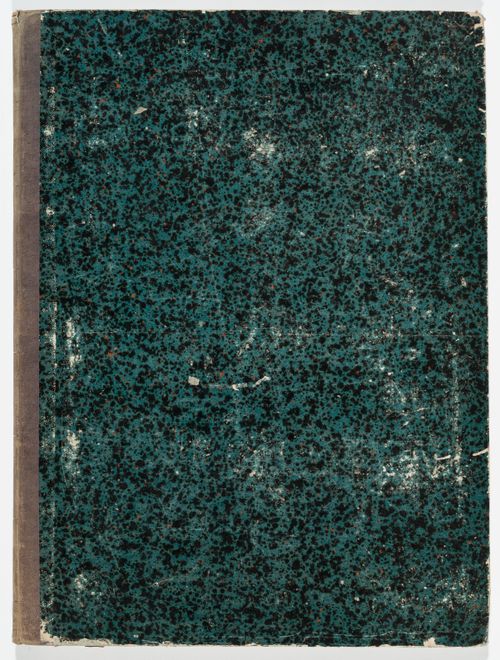
- This album contains mostly design development and presentation drawings for the conversion or renovation of several Parisan hôtel particuliers by Hubert Rohault de Fleury, and for the Rohault de Fleury family house, 12-14 rue d'Aguesseau, Paris. Also included are four prints of British country seats. The drawings - mostly plans - for hôtel particuliers include: alterations to the Hôtel du ministère de la Guerre, perhaps the initial conversion of the Hôtel du Maine into government offices (DR1974:0002:011:003 - DR1974:0002:011:005); alterations to Hôtel de Rothelin-Charolais (Hôtel de Conti) as offices for the Ministère de l'intérieur (DR1974:0002:011:006 - DR1974:0002:011:009); the conversion of Hôtel de Soyécourt into gendarmerie barracks (DR1974:0002:011:017 - DR1974:0002:011:027 and DR1974:0002:011:089); and the alterations to Hôtel de la Colonnade (Grand and Petit Hôtels de Wagram) as offices for the Ministère des affaires étrangères (DR1974:0002:011:028 - DR1974:0002:011:042). Letter DR1974:0002:011:037 R/V apparently concerns the alterations to Hôtel de la Colonnade. The album contains drawings for several other hôtels - Hôtel de Lorge, Petit hôtel de Nivernais, Hôtel de Bouillon, and an hôtel on rue des Quatre-Fils. The purpose of these drawings has not been determined. Drawings for the Rohault de Fleury family house include: 22 graphite design development drawings with dimensions, calculations and notes - mostly plans and elevations; seven finished watercolour presentation drawings - plans, sections and elevations; two interior perspectives; and one drawing for the roof structures (DR1974:0002:011:050 - DR1974:0002:011:083). The coloured sections and the interior perspective drawings show the Empire style interior decoration, including furnishings (DR1974:0002:011:080 - DR1974:0002:011:082 R and DR1974:0002:011:083 R). The four prints are part of a series of views of English country seats by William Henry Toms after Thomas Badeslade and William Winstanley printed during the mid 18th century: Hawarden Castle and the adjacent Broadlane Hall, Wales, seat of Sir John Glynne; Erddig (house), Wales, seat of Simon Yorke; Hather Thorpe (house), Lincolnshire, England, seat of Sir Michael Newton; and Rushton Hall, Northamptonshire, England, seat of Viscount Cullen (DR1974:0002:011:085 - DR1974:0002:011:088). The album also includes: three drawings for a château for M. le marquis de la Sainte-Aulaire, designed by Perrot, the first of which is possibly for proposed additions by Hubert Rohault de Fleury (DR1974:0002:011:013); an elevation for a temporary altar; a cost estimate for a country cottage; six drawings for an unidentified country house; and a site plan of the village [?] and vicinity of Chailly, France for Mr. Pierre Jacques Le Roy.
DR1974:0002:011:001-089
Description:
- This album contains mostly design development and presentation drawings for the conversion or renovation of several Parisan hôtel particuliers by Hubert Rohault de Fleury, and for the Rohault de Fleury family house, 12-14 rue d'Aguesseau, Paris. Also included are four prints of British country seats. The drawings - mostly plans - for hôtel particuliers include: alterations to the Hôtel du ministère de la Guerre, perhaps the initial conversion of the Hôtel du Maine into government offices (DR1974:0002:011:003 - DR1974:0002:011:005); alterations to Hôtel de Rothelin-Charolais (Hôtel de Conti) as offices for the Ministère de l'intérieur (DR1974:0002:011:006 - DR1974:0002:011:009); the conversion of Hôtel de Soyécourt into gendarmerie barracks (DR1974:0002:011:017 - DR1974:0002:011:027 and DR1974:0002:011:089); and the alterations to Hôtel de la Colonnade (Grand and Petit Hôtels de Wagram) as offices for the Ministère des affaires étrangères (DR1974:0002:011:028 - DR1974:0002:011:042). Letter DR1974:0002:011:037 R/V apparently concerns the alterations to Hôtel de la Colonnade. The album contains drawings for several other hôtels - Hôtel de Lorge, Petit hôtel de Nivernais, Hôtel de Bouillon, and an hôtel on rue des Quatre-Fils. The purpose of these drawings has not been determined. Drawings for the Rohault de Fleury family house include: 22 graphite design development drawings with dimensions, calculations and notes - mostly plans and elevations; seven finished watercolour presentation drawings - plans, sections and elevations; two interior perspectives; and one drawing for the roof structures (DR1974:0002:011:050 - DR1974:0002:011:083). The coloured sections and the interior perspective drawings show the Empire style interior decoration, including furnishings (DR1974:0002:011:080 - DR1974:0002:011:082 R and DR1974:0002:011:083 R). The four prints are part of a series of views of English country seats by William Henry Toms after Thomas Badeslade and William Winstanley printed during the mid 18th century: Hawarden Castle and the adjacent Broadlane Hall, Wales, seat of Sir John Glynne; Erddig (house), Wales, seat of Simon Yorke; Hather Thorpe (house), Lincolnshire, England, seat of Sir Michael Newton; and Rushton Hall, Northamptonshire, England, seat of Viscount Cullen (DR1974:0002:011:085 - DR1974:0002:011:088). The album also includes: three drawings for a château for M. le marquis de la Sainte-Aulaire, designed by Perrot, the first of which is possibly for proposed additions by Hubert Rohault de Fleury (DR1974:0002:011:013); an elevation for a temporary altar; a cost estimate for a country cottage; six drawings for an unidentified country house; and a site plan of the village [?] and vicinity of Chailly, France for Mr. Pierre Jacques Le Roy.
Personnes et institutions:
Sujet:
architecture, architecture de paysage, architecture temporaire, design d'intérieur, militaire, topographique
architecture, architecture de paysage, architecture temporaire, design d'intérieur, militaire, topographique
Date:
1755-1849, manuscripts written between 1792-1849, printed between ca. 1740-1849
1755-1849, manuscripts written between 1792-1849, printed between ca. 1740-1849
Titre:
Album of drawings for alterations to several Parisian hôtel particuliers and the Rohault de Fleury family house, rue d'Aguesseau, Paris, and of prints of English country seats
Actions:
DR1974:0002:011:001-089
Description:
- This album contains mostly design development and presentation drawings for the conversion or renovation of several Parisan hôtel particuliers by Hubert Rohault de Fleury, and for the Rohault de Fleury family house, 12-14 rue d'Aguesseau, Paris. Also included are four prints of British country seats. The drawings - mostly plans - for hôtel particuliers include: alterations to the Hôtel du ministère de la Guerre, perhaps the initial conversion of the Hôtel du Maine into government offices (DR1974:0002:011:003 - DR1974:0002:011:005); alterations to Hôtel de Rothelin-Charolais (Hôtel de Conti) as offices for the Ministère de l'intérieur (DR1974:0002:011:006 - DR1974:0002:011:009); the conversion of Hôtel de Soyécourt into gendarmerie barracks (DR1974:0002:011:017 - DR1974:0002:011:027 and DR1974:0002:011:089); and the alterations to Hôtel de la Colonnade (Grand and Petit Hôtels de Wagram) as offices for the Ministère des affaires étrangères (DR1974:0002:011:028 - DR1974:0002:011:042). Letter DR1974:0002:011:037 R/V apparently concerns the alterations to Hôtel de la Colonnade. The album contains drawings for several other hôtels - Hôtel de Lorge, Petit hôtel de Nivernais, Hôtel de Bouillon, and an hôtel on rue des Quatre-Fils. The purpose of these drawings has not been determined. Drawings for the Rohault de Fleury family house include: 22 graphite design development drawings with dimensions, calculations and notes - mostly plans and elevations; seven finished watercolour presentation drawings - plans, sections and elevations; two interior perspectives; and one drawing for the roof structures (DR1974:0002:011:050 - DR1974:0002:011:083). The coloured sections and the interior perspective drawings show the Empire style interior decoration, including furnishings (DR1974:0002:011:080 - DR1974:0002:011:082 R and DR1974:0002:011:083 R). The four prints are part of a series of views of English country seats by William Henry Toms after Thomas Badeslade and William Winstanley printed during the mid 18th century: Hawarden Castle and the adjacent Broadlane Hall, Wales, seat of Sir John Glynne; Erddig (house), Wales, seat of Simon Yorke; Hather Thorpe (house), Lincolnshire, England, seat of Sir Michael Newton; and Rushton Hall, Northamptonshire, England, seat of Viscount Cullen (DR1974:0002:011:085 - DR1974:0002:011:088). The album also includes: three drawings for a château for M. le marquis de la Sainte-Aulaire, designed by Perrot, the first of which is possibly for proposed additions by Hubert Rohault de Fleury (DR1974:0002:011:013); an elevation for a temporary altar; a cost estimate for a country cottage; six drawings for an unidentified country house; and a site plan of the village [?] and vicinity of Chailly, France for Mr. Pierre Jacques Le Roy.
Album of drawings for alterations to several Parisian hôtel particuliers and the Rohault de Fleury family house, rue d'Aguesseau, Paris, and of prints of English country seats
Actions:
DR1974:0002:011:001-089
Description:
- This album contains mostly design development and presentation drawings for the conversion or renovation of several Parisan hôtel particuliers by Hubert Rohault de Fleury, and for the Rohault de Fleury family house, 12-14 rue d'Aguesseau, Paris. Also included are four prints of British country seats. The drawings - mostly plans - for hôtel particuliers include: alterations to the Hôtel du ministère de la Guerre, perhaps the initial conversion of the Hôtel du Maine into government offices (DR1974:0002:011:003 - DR1974:0002:011:005); alterations to Hôtel de Rothelin-Charolais (Hôtel de Conti) as offices for the Ministère de l'intérieur (DR1974:0002:011:006 - DR1974:0002:011:009); the conversion of Hôtel de Soyécourt into gendarmerie barracks (DR1974:0002:011:017 - DR1974:0002:011:027 and DR1974:0002:011:089); and the alterations to Hôtel de la Colonnade (Grand and Petit Hôtels de Wagram) as offices for the Ministère des affaires étrangères (DR1974:0002:011:028 - DR1974:0002:011:042). Letter DR1974:0002:011:037 R/V apparently concerns the alterations to Hôtel de la Colonnade. The album contains drawings for several other hôtels - Hôtel de Lorge, Petit hôtel de Nivernais, Hôtel de Bouillon, and an hôtel on rue des Quatre-Fils. The purpose of these drawings has not been determined. Drawings for the Rohault de Fleury family house include: 22 graphite design development drawings with dimensions, calculations and notes - mostly plans and elevations; seven finished watercolour presentation drawings - plans, sections and elevations; two interior perspectives; and one drawing for the roof structures (DR1974:0002:011:050 - DR1974:0002:011:083). The coloured sections and the interior perspective drawings show the Empire style interior decoration, including furnishings (DR1974:0002:011:080 - DR1974:0002:011:082 R and DR1974:0002:011:083 R). The four prints are part of a series of views of English country seats by William Henry Toms after Thomas Badeslade and William Winstanley printed during the mid 18th century: Hawarden Castle and the adjacent Broadlane Hall, Wales, seat of Sir John Glynne; Erddig (house), Wales, seat of Simon Yorke; Hather Thorpe (house), Lincolnshire, England, seat of Sir Michael Newton; and Rushton Hall, Northamptonshire, England, seat of Viscount Cullen (DR1974:0002:011:085 - DR1974:0002:011:088). The album also includes: three drawings for a château for M. le marquis de la Sainte-Aulaire, designed by Perrot, the first of which is possibly for proposed additions by Hubert Rohault de Fleury (DR1974:0002:011:013); an elevation for a temporary altar; a cost estimate for a country cottage; six drawings for an unidentified country house; and a site plan of the village [?] and vicinity of Chailly, France for Mr. Pierre Jacques Le Roy.
Classification:
dessins, documents textuels, oeuvres d'art
dessins, documents textuels, oeuvres d'art
Date:
1755-1849, manuscripts written between 1792-1849, printed between ca. 1740-1849
1755-1849, manuscripts written between 1792-1849, printed between ca. 1740-1849
Personnes et institutions:
Sujet:
architecture, architecture de paysage, architecture temporaire, design d'intérieur, militaire, topographique
architecture, architecture de paysage, architecture temporaire, design d'intérieur, militaire, topographique


