


63518 Résultats
Niveau de description archivistique:
Projet
Projet
Numéro de référence:
AP056.S1.1994.PR14
Description:
This project series documents renovations to the Stratford Festival Theatre in Stratford, Ontario from 1994-1997. The office identified the project number as 9428. This project consisted of the major reimagining and renewal of the famous tent-shaped theatre, which had not previously been updated in the 40 years since its original construction. Conceived with Thomas Payne as the partner-in-charge, the project reconceptualised the existing front-of-house spaces, the performance auditorium and the formal arrival space. The auditorium, which contained a Greek-style thrust stage inspired by Shakespeare's Globe Theatre, saw an increase in comfort by eliminating some seats to make the remaining more spacious. With this, site lines to the stage and the theatre acoustics were also improved. A large expansion of the theatre's lobby, box office, festival shops and member spaces accommodated the theatre's growing number of patrons. On the outside, a large curved entrance drive was added with extensive landscaping and gardens to add to the grandeur of the formal arrival area. A marquee space was also added to the building, which housed a year-round terrace. Thomas Payne created this project's original master plan under a different project number in 1988, but it should be noted that some materials in both projects are overlapping (see project series AP056.S1.1988.PR03 in this fonds). The project is recorded through drawings, presentation paintings and some textual materials dating from 1988-1996. The drawings are mostly originals and include sketches, presentation drawings, drawings for the model, plans, elevations, sections, perspectives, details and drawings of new furnishings. The textual records, which describe the project's design concept, are part of a presentation book.
AP056.S1.1994.PR14
Description:
This project series documents renovations to the Stratford Festival Theatre in Stratford, Ontario from 1994-1997. The office identified the project number as 9428. This project consisted of the major reimagining and renewal of the famous tent-shaped theatre, which had not previously been updated in the 40 years since its original construction. Conceived with Thomas Payne as the partner-in-charge, the project reconceptualised the existing front-of-house spaces, the performance auditorium and the formal arrival space. The auditorium, which contained a Greek-style thrust stage inspired by Shakespeare's Globe Theatre, saw an increase in comfort by eliminating some seats to make the remaining more spacious. With this, site lines to the stage and the theatre acoustics were also improved. A large expansion of the theatre's lobby, box office, festival shops and member spaces accommodated the theatre's growing number of patrons. On the outside, a large curved entrance drive was added with extensive landscaping and gardens to add to the grandeur of the formal arrival area. A marquee space was also added to the building, which housed a year-round terrace. Thomas Payne created this project's original master plan under a different project number in 1988, but it should be noted that some materials in both projects are overlapping (see project series AP056.S1.1988.PR03 in this fonds). The project is recorded through drawings, presentation paintings and some textual materials dating from 1988-1996. The drawings are mostly originals and include sketches, presentation drawings, drawings for the model, plans, elevations, sections, perspectives, details and drawings of new furnishings. The textual records, which describe the project's design concept, are part of a presentation book.
Personnes et institutions:
Date:
1988-1996
1988-1996
Titre:
Stratford Festival Theatre, Renovations, Stratford, Ontario (1994-1997)
Actions:
AP056.S1.1994.PR14
Description:
This project series documents renovations to the Stratford Festival Theatre in Stratford, Ontario from 1994-1997. The office identified the project number as 9428. This project consisted of the major reimagining and renewal of the famous tent-shaped theatre, which had not previously been updated in the 40 years since its original construction. Conceived with Thomas Payne as the partner-in-charge, the project reconceptualised the existing front-of-house spaces, the performance auditorium and the formal arrival space. The auditorium, which contained a Greek-style thrust stage inspired by Shakespeare's Globe Theatre, saw an increase in comfort by eliminating some seats to make the remaining more spacious. With this, site lines to the stage and the theatre acoustics were also improved. A large expansion of the theatre's lobby, box office, festival shops and member spaces accommodated the theatre's growing number of patrons. On the outside, a large curved entrance drive was added with extensive landscaping and gardens to add to the grandeur of the formal arrival area. A marquee space was also added to the building, which housed a year-round terrace. Thomas Payne created this project's original master plan under a different project number in 1988, but it should be noted that some materials in both projects are overlapping (see project series AP056.S1.1988.PR03 in this fonds). The project is recorded through drawings, presentation paintings and some textual materials dating from 1988-1996. The drawings are mostly originals and include sketches, presentation drawings, drawings for the model, plans, elevations, sections, perspectives, details and drawings of new furnishings. The textual records, which describe the project's design concept, are part of a presentation book.
Stratford Festival Theatre, Renovations, Stratford, Ontario (1994-1997)
Actions:
AP056.S1.1994.PR14
Description:
This project series documents renovations to the Stratford Festival Theatre in Stratford, Ontario from 1994-1997. The office identified the project number as 9428. This project consisted of the major reimagining and renewal of the famous tent-shaped theatre, which had not previously been updated in the 40 years since its original construction. Conceived with Thomas Payne as the partner-in-charge, the project reconceptualised the existing front-of-house spaces, the performance auditorium and the formal arrival space. The auditorium, which contained a Greek-style thrust stage inspired by Shakespeare's Globe Theatre, saw an increase in comfort by eliminating some seats to make the remaining more spacious. With this, site lines to the stage and the theatre acoustics were also improved. A large expansion of the theatre's lobby, box office, festival shops and member spaces accommodated the theatre's growing number of patrons. On the outside, a large curved entrance drive was added with extensive landscaping and gardens to add to the grandeur of the formal arrival area. A marquee space was also added to the building, which housed a year-round terrace. Thomas Payne created this project's original master plan under a different project number in 1988, but it should be noted that some materials in both projects are overlapping (see project series AP056.S1.1988.PR03 in this fonds). The project is recorded through drawings, presentation paintings and some textual materials dating from 1988-1996. The drawings are mostly originals and include sketches, presentation drawings, drawings for the model, plans, elevations, sections, perspectives, details and drawings of new furnishings. The textual records, which describe the project's design concept, are part of a presentation book.
Niveau de description archivistique:
Project
Project
Date:
1988-1996
1988-1996
Personnes et institutions:
Niveau de description archivistique:
Série(s)
Série(s)
Numéro de référence:
AP112.S2
Description:
The series documents the design of Beaver Lake Pavilion, built for the City of Montréal between 1955 and 1959 as part of the redevelopment of Mount Royal Park. Sise worked with architect Guy Desbarats (1925-2003) on the project. The pavilion was built as part of a larger public works project directed by the City during the 1950s and 1960s during which time many park facilities were built. Beaver Lake Pavilion is recognized to have encouraged a renewal in the architectural forms of public facilities (1). The file contains 43 working drawings which depict every aspect of construction of the pavilion (location plan, floor plans, elevations and sections, as well as numerous detail drawings). Included with the drawings is documentation collected by Sise to support his design, including a topographical map of the park (Mount-Royal - Design Map - 1877), as well as a 1955 book published by the City Planning Department of the City of Montreal (Montreal Master Plan - Open Spaces). (1) "Pavillon-restaurant du Lac au Castors, 1955-1958", ARQ, no 91 (juin 1996), p. 21. _____________________ La série documente la conception du pavillon du Lac aux Castors construit pour la Ville de Montréal entre 1955 et 1958, dans le cadre du réaménagement du parc du Mont Royal. Ce pavillon s'insère dans un vaste chantier dirigé par la Ville de Montréal durant les années 1950 et 1960 alors que de nombreux équipements de parcs furent construits. Sise s'était associé pour l'occasion à l'architecte Guy Desbarats (1925-2003). Le pavillon du Lac aux Castors est reconnu pour avoir favorisé le renouvellement des formes architecturales des équipements publics (1). Le dossier comprend 43 dessins d'exécution réalisés à la mine de plomb sur toile concernant tous les aspects de la construction du pavillon (plan d'implantation, plans des étages, élévations et coupes, ainsi que des dessins de nombreux détails). De plus, il contient la documentation colligée par Sise pour l'appuyer dans sa tâche de conception, soit une reproduction d'une carte topographique du parc du Mont-Royal (Mount-Royal - Design Map - 1877), ainsi qu'une publication réalisée par le Département d'urbanisme de la Ville de Montréal en 1955 concernant les espaces publics (Montreal Master Plan - Open Spaces). (1) "Pavillon-restaurant du Lac au Castors, 1955-1958", ARQ, no 91 (juin 1996), p. 21.
AP112.S2
Description:
The series documents the design of Beaver Lake Pavilion, built for the City of Montréal between 1955 and 1959 as part of the redevelopment of Mount Royal Park. Sise worked with architect Guy Desbarats (1925-2003) on the project. The pavilion was built as part of a larger public works project directed by the City during the 1950s and 1960s during which time many park facilities were built. Beaver Lake Pavilion is recognized to have encouraged a renewal in the architectural forms of public facilities (1). The file contains 43 working drawings which depict every aspect of construction of the pavilion (location plan, floor plans, elevations and sections, as well as numerous detail drawings). Included with the drawings is documentation collected by Sise to support his design, including a topographical map of the park (Mount-Royal - Design Map - 1877), as well as a 1955 book published by the City Planning Department of the City of Montreal (Montreal Master Plan - Open Spaces). (1) "Pavillon-restaurant du Lac au Castors, 1955-1958", ARQ, no 91 (juin 1996), p. 21. _____________________ La série documente la conception du pavillon du Lac aux Castors construit pour la Ville de Montréal entre 1955 et 1958, dans le cadre du réaménagement du parc du Mont Royal. Ce pavillon s'insère dans un vaste chantier dirigé par la Ville de Montréal durant les années 1950 et 1960 alors que de nombreux équipements de parcs furent construits. Sise s'était associé pour l'occasion à l'architecte Guy Desbarats (1925-2003). Le pavillon du Lac aux Castors est reconnu pour avoir favorisé le renouvellement des formes architecturales des équipements publics (1). Le dossier comprend 43 dessins d'exécution réalisés à la mine de plomb sur toile concernant tous les aspects de la construction du pavillon (plan d'implantation, plans des étages, élévations et coupes, ainsi que des dessins de nombreux détails). De plus, il contient la documentation colligée par Sise pour l'appuyer dans sa tâche de conception, soit une reproduction d'une carte topographique du parc du Mont-Royal (Mount-Royal - Design Map - 1877), ainsi qu'une publication réalisée par le Département d'urbanisme de la Ville de Montréal en 1955 concernant les espaces publics (Montreal Master Plan - Open Spaces). (1) "Pavillon-restaurant du Lac au Castors, 1955-1958", ARQ, no 91 (juin 1996), p. 21.
Personnes et institutions:
Date:
1955-1959
1955-1959
Titre:
Beaver Lake Pavilion, Montréal, Québec
Actions:
AP112.S2
Description:
The series documents the design of Beaver Lake Pavilion, built for the City of Montréal between 1955 and 1959 as part of the redevelopment of Mount Royal Park. Sise worked with architect Guy Desbarats (1925-2003) on the project. The pavilion was built as part of a larger public works project directed by the City during the 1950s and 1960s during which time many park facilities were built. Beaver Lake Pavilion is recognized to have encouraged a renewal in the architectural forms of public facilities (1). The file contains 43 working drawings which depict every aspect of construction of the pavilion (location plan, floor plans, elevations and sections, as well as numerous detail drawings). Included with the drawings is documentation collected by Sise to support his design, including a topographical map of the park (Mount-Royal - Design Map - 1877), as well as a 1955 book published by the City Planning Department of the City of Montreal (Montreal Master Plan - Open Spaces). (1) "Pavillon-restaurant du Lac au Castors, 1955-1958", ARQ, no 91 (juin 1996), p. 21. _____________________ La série documente la conception du pavillon du Lac aux Castors construit pour la Ville de Montréal entre 1955 et 1958, dans le cadre du réaménagement du parc du Mont Royal. Ce pavillon s'insère dans un vaste chantier dirigé par la Ville de Montréal durant les années 1950 et 1960 alors que de nombreux équipements de parcs furent construits. Sise s'était associé pour l'occasion à l'architecte Guy Desbarats (1925-2003). Le pavillon du Lac aux Castors est reconnu pour avoir favorisé le renouvellement des formes architecturales des équipements publics (1). Le dossier comprend 43 dessins d'exécution réalisés à la mine de plomb sur toile concernant tous les aspects de la construction du pavillon (plan d'implantation, plans des étages, élévations et coupes, ainsi que des dessins de nombreux détails). De plus, il contient la documentation colligée par Sise pour l'appuyer dans sa tâche de conception, soit une reproduction d'une carte topographique du parc du Mont-Royal (Mount-Royal - Design Map - 1877), ainsi qu'une publication réalisée par le Département d'urbanisme de la Ville de Montréal en 1955 concernant les espaces publics (Montreal Master Plan - Open Spaces). (1) "Pavillon-restaurant du Lac au Castors, 1955-1958", ARQ, no 91 (juin 1996), p. 21.
Beaver Lake Pavilion, Montréal, Québec
Actions:
AP112.S2
Description:
The series documents the design of Beaver Lake Pavilion, built for the City of Montréal between 1955 and 1959 as part of the redevelopment of Mount Royal Park. Sise worked with architect Guy Desbarats (1925-2003) on the project. The pavilion was built as part of a larger public works project directed by the City during the 1950s and 1960s during which time many park facilities were built. Beaver Lake Pavilion is recognized to have encouraged a renewal in the architectural forms of public facilities (1). The file contains 43 working drawings which depict every aspect of construction of the pavilion (location plan, floor plans, elevations and sections, as well as numerous detail drawings). Included with the drawings is documentation collected by Sise to support his design, including a topographical map of the park (Mount-Royal - Design Map - 1877), as well as a 1955 book published by the City Planning Department of the City of Montreal (Montreal Master Plan - Open Spaces). (1) "Pavillon-restaurant du Lac au Castors, 1955-1958", ARQ, no 91 (juin 1996), p. 21. _____________________ La série documente la conception du pavillon du Lac aux Castors construit pour la Ville de Montréal entre 1955 et 1958, dans le cadre du réaménagement du parc du Mont Royal. Ce pavillon s'insère dans un vaste chantier dirigé par la Ville de Montréal durant les années 1950 et 1960 alors que de nombreux équipements de parcs furent construits. Sise s'était associé pour l'occasion à l'architecte Guy Desbarats (1925-2003). Le pavillon du Lac aux Castors est reconnu pour avoir favorisé le renouvellement des formes architecturales des équipements publics (1). Le dossier comprend 43 dessins d'exécution réalisés à la mine de plomb sur toile concernant tous les aspects de la construction du pavillon (plan d'implantation, plans des étages, élévations et coupes, ainsi que des dessins de nombreux détails). De plus, il contient la documentation colligée par Sise pour l'appuyer dans sa tâche de conception, soit une reproduction d'une carte topographique du parc du Mont-Royal (Mount-Royal - Design Map - 1877), ainsi qu'une publication réalisée par le Département d'urbanisme de la Ville de Montréal en 1955 concernant les espaces publics (Montreal Master Plan - Open Spaces). (1) "Pavillon-restaurant du Lac au Castors, 1955-1958", ARQ, no 91 (juin 1996), p. 21.
Niveau de description archivistique:
Series
Series
Date:
1955-1959
1955-1959
Personnes et institutions:
Niveau de description archivistique:
Projet
Projet
Numéro de référence:
AP018.S1.1973.PR03
Description:
This project series documents the design and construction of the Eaton’s store building at Dundas Square in Toronto from 1973-1977. The office identified the project number as 7303. This project, commissioned by The T. Eaton Co. Limited, consisted of a one million square foot department store with thirteen floors, ten above ground and three below. The building boasted nine floor of retail space, seamlessly connected through elevators and escalators. The remaining floors hosted office and storage spaces. Located at the corner of Yonge and Dundas streets, the Eaton’s store was connected to the Eaton Centre mall to its south. The mall, designed and built simultaneously with the Eaton’s store, was designed by the architecture firm Craig Zeidler Strong. For the Eaton’s store project, Parkin Architects Planners created a joint venture with architect C. Blakeway Millar, referred to as Parkin Millar in the documentation. Parkin Millar was the associate architects on this project, with the Eaton’s company architect, E.L. Hankinson, working as the primary architect. Each of the firms mentioned worked closely together to develop a cohesive design for the Eaton’s store and Eaton’s Centre mall, which is evident in the materials. The project is recorded through drawings, textual records, a book and presentation boards dating from 1973-1977. There are a large number of original drawings and sketches for the project. Most of the reprographic copies are arranged within the textual materials. There are presentation boards of the Vancouver Eaton's store in this project series that were likely used as reference by the architects. The textual records consist of correspondence, meeting minutes, site reports, change orders, consultancy records, inter-office letters, and specifications. Also in this project series is a special edition of the Eaton News, a monograph with in depth descriptions of the project.
AP018.S1.1973.PR03
Description:
This project series documents the design and construction of the Eaton’s store building at Dundas Square in Toronto from 1973-1977. The office identified the project number as 7303. This project, commissioned by The T. Eaton Co. Limited, consisted of a one million square foot department store with thirteen floors, ten above ground and three below. The building boasted nine floor of retail space, seamlessly connected through elevators and escalators. The remaining floors hosted office and storage spaces. Located at the corner of Yonge and Dundas streets, the Eaton’s store was connected to the Eaton Centre mall to its south. The mall, designed and built simultaneously with the Eaton’s store, was designed by the architecture firm Craig Zeidler Strong. For the Eaton’s store project, Parkin Architects Planners created a joint venture with architect C. Blakeway Millar, referred to as Parkin Millar in the documentation. Parkin Millar was the associate architects on this project, with the Eaton’s company architect, E.L. Hankinson, working as the primary architect. Each of the firms mentioned worked closely together to develop a cohesive design for the Eaton’s store and Eaton’s Centre mall, which is evident in the materials. The project is recorded through drawings, textual records, a book and presentation boards dating from 1973-1977. There are a large number of original drawings and sketches for the project. Most of the reprographic copies are arranged within the textual materials. There are presentation boards of the Vancouver Eaton's store in this project series that were likely used as reference by the architects. The textual records consist of correspondence, meeting minutes, site reports, change orders, consultancy records, inter-office letters, and specifications. Also in this project series is a special edition of the Eaton News, a monograph with in depth descriptions of the project.
Personnes et institutions:
Date:
1973-1977
1973-1977
Titre:
Eaton's Store Building, Dundas Square, Toronto (1973-1977)
Actions:
AP018.S1.1973.PR03
Description:
This project series documents the design and construction of the Eaton’s store building at Dundas Square in Toronto from 1973-1977. The office identified the project number as 7303. This project, commissioned by The T. Eaton Co. Limited, consisted of a one million square foot department store with thirteen floors, ten above ground and three below. The building boasted nine floor of retail space, seamlessly connected through elevators and escalators. The remaining floors hosted office and storage spaces. Located at the corner of Yonge and Dundas streets, the Eaton’s store was connected to the Eaton Centre mall to its south. The mall, designed and built simultaneously with the Eaton’s store, was designed by the architecture firm Craig Zeidler Strong. For the Eaton’s store project, Parkin Architects Planners created a joint venture with architect C. Blakeway Millar, referred to as Parkin Millar in the documentation. Parkin Millar was the associate architects on this project, with the Eaton’s company architect, E.L. Hankinson, working as the primary architect. Each of the firms mentioned worked closely together to develop a cohesive design for the Eaton’s store and Eaton’s Centre mall, which is evident in the materials. The project is recorded through drawings, textual records, a book and presentation boards dating from 1973-1977. There are a large number of original drawings and sketches for the project. Most of the reprographic copies are arranged within the textual materials. There are presentation boards of the Vancouver Eaton's store in this project series that were likely used as reference by the architects. The textual records consist of correspondence, meeting minutes, site reports, change orders, consultancy records, inter-office letters, and specifications. Also in this project series is a special edition of the Eaton News, a monograph with in depth descriptions of the project.
Eaton's Store Building, Dundas Square, Toronto (1973-1977)
Actions:
AP018.S1.1973.PR03
Description:
This project series documents the design and construction of the Eaton’s store building at Dundas Square in Toronto from 1973-1977. The office identified the project number as 7303. This project, commissioned by The T. Eaton Co. Limited, consisted of a one million square foot department store with thirteen floors, ten above ground and three below. The building boasted nine floor of retail space, seamlessly connected through elevators and escalators. The remaining floors hosted office and storage spaces. Located at the corner of Yonge and Dundas streets, the Eaton’s store was connected to the Eaton Centre mall to its south. The mall, designed and built simultaneously with the Eaton’s store, was designed by the architecture firm Craig Zeidler Strong. For the Eaton’s store project, Parkin Architects Planners created a joint venture with architect C. Blakeway Millar, referred to as Parkin Millar in the documentation. Parkin Millar was the associate architects on this project, with the Eaton’s company architect, E.L. Hankinson, working as the primary architect. Each of the firms mentioned worked closely together to develop a cohesive design for the Eaton’s store and Eaton’s Centre mall, which is evident in the materials. The project is recorded through drawings, textual records, a book and presentation boards dating from 1973-1977. There are a large number of original drawings and sketches for the project. Most of the reprographic copies are arranged within the textual materials. There are presentation boards of the Vancouver Eaton's store in this project series that were likely used as reference by the architects. The textual records consist of correspondence, meeting minutes, site reports, change orders, consultancy records, inter-office letters, and specifications. Also in this project series is a special edition of the Eaton News, a monograph with in depth descriptions of the project.
Niveau de description archivistique:
Project
Project
Date:
1973-1977
1973-1977
Personnes et institutions:
Classification:
documents textuels
documents textuels
Numéro de référence:
ARCH270977
Description:
The book is in English. It presents a curriculum and projects by the firm Abalos & Herreros from 1990 to 2006. It includes these projects: - Edificio administrativo por el Ministerio del interior, Madrid (AP164.S1.1990.D3); - Biblioteca Usera, Madrid (AP164.S1.1995.D1); - Centro universitario en Mérida (AP164.S1.1999.D4); - Plaza y torre Woermann, Las Palmas (AP164.S1.2001.D7); - Torres mixtas bioclimáticas en el Humedal de Salburua, Vitoria (AP164.S1.2002.D2); - Sociópolis I y II; Valencia (AP164.S1.2003.D2); - Sagüés, San Sebastián (AP164.S1.2003.D5); - Urbanización del sector La Lastra, León (AP164.S1.2003.D10); - Laboratorios de ciencias moleculares para la Universidad de Puerto Rico, San Juan (AP164.S1.2003.D13); - Tour TSR, Geneva (AP164.S1.2005.D1); - Dos edificios de oficinas en Aravaca y Valdemarín, Madrid; - 200 viviendas para jóvenes en la Sagrera; - Viviendas en quartier Massena chevaleret, París; - Oru Yves Farge - Terres Neuves: architectural and urban feasibility study, Bègles, Francia; - Health campus, Granada, Spain; - Housing in Perugia, Italy.
ARCH270977
Description:
The book is in English. It presents a curriculum and projects by the firm Abalos & Herreros from 1990 to 2006. It includes these projects: - Edificio administrativo por el Ministerio del interior, Madrid (AP164.S1.1990.D3); - Biblioteca Usera, Madrid (AP164.S1.1995.D1); - Centro universitario en Mérida (AP164.S1.1999.D4); - Plaza y torre Woermann, Las Palmas (AP164.S1.2001.D7); - Torres mixtas bioclimáticas en el Humedal de Salburua, Vitoria (AP164.S1.2002.D2); - Sociópolis I y II; Valencia (AP164.S1.2003.D2); - Sagüés, San Sebastián (AP164.S1.2003.D5); - Urbanización del sector La Lastra, León (AP164.S1.2003.D10); - Laboratorios de ciencias moleculares para la Universidad de Puerto Rico, San Juan (AP164.S1.2003.D13); - Tour TSR, Geneva (AP164.S1.2005.D1); - Dos edificios de oficinas en Aravaca y Valdemarín, Madrid; - 200 viviendas para jóvenes en la Sagrera; - Viviendas en quartier Massena chevaleret, París; - Oru Yves Farge - Terres Neuves: architectural and urban feasibility study, Bègles, Francia; - Health campus, Granada, Spain; - Housing in Perugia, Italy.
Personnes et institutions:
Date:
circa 2006
circa 2006
Titre:
Portfolio of projects
Actions:
ARCH270977
Description:
The book is in English. It presents a curriculum and projects by the firm Abalos & Herreros from 1990 to 2006. It includes these projects: - Edificio administrativo por el Ministerio del interior, Madrid (AP164.S1.1990.D3); - Biblioteca Usera, Madrid (AP164.S1.1995.D1); - Centro universitario en Mérida (AP164.S1.1999.D4); - Plaza y torre Woermann, Las Palmas (AP164.S1.2001.D7); - Torres mixtas bioclimáticas en el Humedal de Salburua, Vitoria (AP164.S1.2002.D2); - Sociópolis I y II; Valencia (AP164.S1.2003.D2); - Sagüés, San Sebastián (AP164.S1.2003.D5); - Urbanización del sector La Lastra, León (AP164.S1.2003.D10); - Laboratorios de ciencias moleculares para la Universidad de Puerto Rico, San Juan (AP164.S1.2003.D13); - Tour TSR, Geneva (AP164.S1.2005.D1); - Dos edificios de oficinas en Aravaca y Valdemarín, Madrid; - 200 viviendas para jóvenes en la Sagrera; - Viviendas en quartier Massena chevaleret, París; - Oru Yves Farge - Terres Neuves: architectural and urban feasibility study, Bègles, Francia; - Health campus, Granada, Spain; - Housing in Perugia, Italy.
Portfolio of projects
Actions:
ARCH270977
Description:
The book is in English. It presents a curriculum and projects by the firm Abalos & Herreros from 1990 to 2006. It includes these projects: - Edificio administrativo por el Ministerio del interior, Madrid (AP164.S1.1990.D3); - Biblioteca Usera, Madrid (AP164.S1.1995.D1); - Centro universitario en Mérida (AP164.S1.1999.D4); - Plaza y torre Woermann, Las Palmas (AP164.S1.2001.D7); - Torres mixtas bioclimáticas en el Humedal de Salburua, Vitoria (AP164.S1.2002.D2); - Sociópolis I y II; Valencia (AP164.S1.2003.D2); - Sagüés, San Sebastián (AP164.S1.2003.D5); - Urbanización del sector La Lastra, León (AP164.S1.2003.D10); - Laboratorios de ciencias moleculares para la Universidad de Puerto Rico, San Juan (AP164.S1.2003.D13); - Tour TSR, Geneva (AP164.S1.2005.D1); - Dos edificios de oficinas en Aravaca y Valdemarín, Madrid; - 200 viviendas para jóvenes en la Sagrera; - Viviendas en quartier Massena chevaleret, París; - Oru Yves Farge - Terres Neuves: architectural and urban feasibility study, Bègles, Francia; - Health campus, Granada, Spain; - Housing in Perugia, Italy.
Classification:
documents textuels
documents textuels
Date:
circa 2006
circa 2006
Personnes et institutions:
Classification:
archives
Niveau de description archivistique:
Fonds
archives
Niveau de description archivistique:
Fonds
Titre:
Fonds Peter Carter
Fonds Peter Carter
Numéro de référence:
AP047
Résumé:
The Peter Carter fonds, 1943-1996, documents the professional career of architect Peter Carter. The largest portion of the archive corresponds to projects Carter completed as principal of the office, Peter Carter Architect (1974-96). Materials in this fonds consist of 7263 drawings (including reprographic copies), 2007 photographic materials, approximately 65 panels, 3 l.m. of textual records, 26 models, 1 enclosing unit, 1 carpet sample, 1 graphic design layout for stationery letterhead, 1 brown oak sample, 1 window sample, 1 sign, 1 carioca stone, 1 travertine block and 1 grey carpet tile.
AP047
Résumé:
The Peter Carter fonds, 1943-1996, documents the professional career of architect Peter Carter. The largest portion of the archive corresponds to projects Carter completed as principal of the office, Peter Carter Architect (1974-96). Materials in this fonds consist of 7263 drawings (including reprographic copies), 2007 photographic materials, approximately 65 panels, 3 l.m. of textual records, 26 models, 1 enclosing unit, 1 carpet sample, 1 graphic design layout for stationery letterhead, 1 brown oak sample, 1 window sample, 1 sign, 1 carioca stone, 1 travertine block and 1 grey carpet tile.
Personnes et institutions:
Date:
1943-1996
1943-1996
Titre:
Fonds Peter Carter
Actions:
AP047
Résumé:
The Peter Carter fonds, 1943-1996, documents the professional career of architect Peter Carter. The largest portion of the archive corresponds to projects Carter completed as principal of the office, Peter Carter Architect (1974-96). Materials in this fonds consist of 7263 drawings (including reprographic copies), 2007 photographic materials, approximately 65 panels, 3 l.m. of textual records, 26 models, 1 enclosing unit, 1 carpet sample, 1 graphic design layout for stationery letterhead, 1 brown oak sample, 1 window sample, 1 sign, 1 carioca stone, 1 travertine block and 1 grey carpet tile.
Fonds Peter Carter
Actions:
AP047
Résumé:
The Peter Carter fonds, 1943-1996, documents the professional career of architect Peter Carter. The largest portion of the archive corresponds to projects Carter completed as principal of the office, Peter Carter Architect (1974-96). Materials in this fonds consist of 7263 drawings (including reprographic copies), 2007 photographic materials, approximately 65 panels, 3 l.m. of textual records, 26 models, 1 enclosing unit, 1 carpet sample, 1 graphic design layout for stationery letterhead, 1 brown oak sample, 1 window sample, 1 sign, 1 carioca stone, 1 travertine block and 1 grey carpet tile.
Classification:
archives
Niveau de description archivistique:
Fonds
archives
Niveau de description archivistique:
Fonds
Date:
1943-1996
1943-1996
Personnes et institutions:
Classification:
oeuvres d'art
oeuvres d'art
Actions:
Numéro de référence:
DR1987:0027
Description:
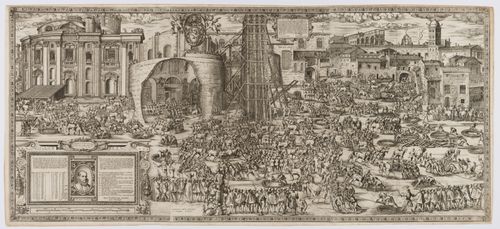
- During the moving of the obelisk, Fontana issued two prints, DR1987:0026 and DR1987:0027. The first (DR1987:0026), was published in March 1586 just prior to the lowering, and distributed with a companion tract by Filippo Pigafetta. It shows both the original and final positions of the obelisk as well as the device proposed by Fontana for its transportation. This involved the use of a twin timber tower (the castello, as it was called, is seen in the central portion of the print) that was erected on either side of the obelisk and was used for lowering and raising the monolith. The second (this print) appeared in August, during the raising, and showed the lowering of the obelisk, as it had occured in late April, with a detailed inventory of all the men and horses involved in the operation. The transportation was begun on 30 April and was completed on 10 September, according to Fontana's description of the process in his book, 'Della trasportione dell'obelisco vaticano' of 1590, a work illustrated by Bonifazio and Guerra, the two artists responsible for the execution of these prints.
DR1987:0027
Description:
- During the moving of the obelisk, Fontana issued two prints, DR1987:0026 and DR1987:0027. The first (DR1987:0026), was published in March 1586 just prior to the lowering, and distributed with a companion tract by Filippo Pigafetta. It shows both the original and final positions of the obelisk as well as the device proposed by Fontana for its transportation. This involved the use of a twin timber tower (the castello, as it was called, is seen in the central portion of the print) that was erected on either side of the obelisk and was used for lowering and raising the monolith. The second (this print) appeared in August, during the raising, and showed the lowering of the obelisk, as it had occured in late April, with a detailed inventory of all the men and horses involved in the operation. The transportation was begun on 30 April and was completed on 10 September, according to Fontana's description of the process in his book, 'Della trasportione dell'obelisco vaticano' of 1590, a work illustrated by Bonifazio and Guerra, the two artists responsible for the execution of these prints.
Personnes et institutions:
Sujet:
architecture, ingénierie
architecture, ingénierie
Date:
published August 1586
published August 1586
Titre:
The lowering of the Vatican obelisk
Actions:
DR1987:0027
Description:
- During the moving of the obelisk, Fontana issued two prints, DR1987:0026 and DR1987:0027. The first (DR1987:0026), was published in March 1586 just prior to the lowering, and distributed with a companion tract by Filippo Pigafetta. It shows both the original and final positions of the obelisk as well as the device proposed by Fontana for its transportation. This involved the use of a twin timber tower (the castello, as it was called, is seen in the central portion of the print) that was erected on either side of the obelisk and was used for lowering and raising the monolith. The second (this print) appeared in August, during the raising, and showed the lowering of the obelisk, as it had occured in late April, with a detailed inventory of all the men and horses involved in the operation. The transportation was begun on 30 April and was completed on 10 September, according to Fontana's description of the process in his book, 'Della trasportione dell'obelisco vaticano' of 1590, a work illustrated by Bonifazio and Guerra, the two artists responsible for the execution of these prints.
The lowering of the Vatican obelisk
Actions:
DR1987:0027
Description:
- During the moving of the obelisk, Fontana issued two prints, DR1987:0026 and DR1987:0027. The first (DR1987:0026), was published in March 1586 just prior to the lowering, and distributed with a companion tract by Filippo Pigafetta. It shows both the original and final positions of the obelisk as well as the device proposed by Fontana for its transportation. This involved the use of a twin timber tower (the castello, as it was called, is seen in the central portion of the print) that was erected on either side of the obelisk and was used for lowering and raising the monolith. The second (this print) appeared in August, during the raising, and showed the lowering of the obelisk, as it had occured in late April, with a detailed inventory of all the men and horses involved in the operation. The transportation was begun on 30 April and was completed on 10 September, according to Fontana's description of the process in his book, 'Della trasportione dell'obelisco vaticano' of 1590, a work illustrated by Bonifazio and Guerra, the two artists responsible for the execution of these prints.
Classification:
oeuvres d'art
oeuvres d'art
Date:
published August 1586
published August 1586
Personnes et institutions:
Sujet:
architecture, ingénierie
architecture, ingénierie
Classification:
dessins
dessins
Numéro de référence:
DR1980:0060:002
Description:
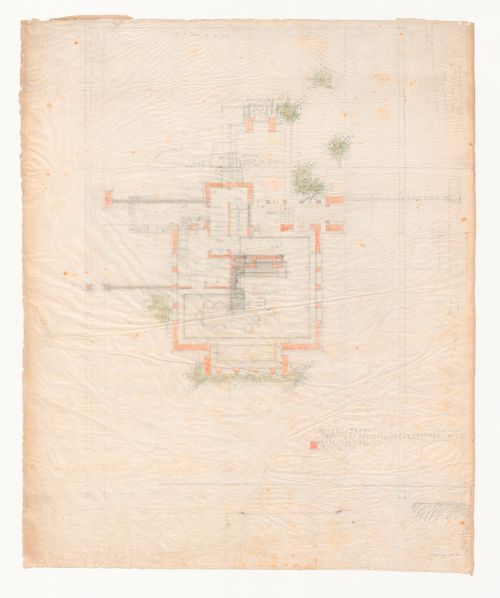
- This first floor plan, with the perspective (DR1980:0060:001) and the second floor plan (DR1980:0060:003) form a set of early presentation drawings. The scale is probably 1/4" = 1' (see object file, de Long report). This plan indicates reworking in the porch/stair and service entrance areas which appear in Hitchcock's book (plate 201) and were built as sketched. The fireplace and seat in the living room were shifted and subsequently built as sketched, as was the ice room. The wall added to the right was shifted back in the final Hitchcock plan. The entry behind the livingroom has sketched-in doors at the rear, as seen in the Hitchcock drawing -- other doors do not yet appear, nor does the garden court. The house became more private in the final adjustments to the site. Wright's further changes are: the wall extending left was crossed out; a freehand wall is roughed in to right; heavy masonry walls are roughed in to left over former wall. (There are other miscellaneous markings and crosshatchings in the reworking.)
DR1980:0060:002
Description:
- This first floor plan, with the perspective (DR1980:0060:001) and the second floor plan (DR1980:0060:003) form a set of early presentation drawings. The scale is probably 1/4" = 1' (see object file, de Long report). This plan indicates reworking in the porch/stair and service entrance areas which appear in Hitchcock's book (plate 201) and were built as sketched. The fireplace and seat in the living room were shifted and subsequently built as sketched, as was the ice room. The wall added to the right was shifted back in the final Hitchcock plan. The entry behind the livingroom has sketched-in doors at the rear, as seen in the Hitchcock drawing -- other doors do not yet appear, nor does the garden court. The house became more private in the final adjustments to the site. Wright's further changes are: the wall extending left was crossed out; a freehand wall is roughed in to right; heavy masonry walls are roughed in to left over former wall. (There are other miscellaneous markings and crosshatchings in the reworking.)
Personnes et institutions:
Sujet:
architecture
architecture
Date:
1915
1915
Titre:
First floor plan for Emil Bach House, Chicago, Illinois
Actions:
DR1980:0060:002
Description:
- This first floor plan, with the perspective (DR1980:0060:001) and the second floor plan (DR1980:0060:003) form a set of early presentation drawings. The scale is probably 1/4" = 1' (see object file, de Long report). This plan indicates reworking in the porch/stair and service entrance areas which appear in Hitchcock's book (plate 201) and were built as sketched. The fireplace and seat in the living room were shifted and subsequently built as sketched, as was the ice room. The wall added to the right was shifted back in the final Hitchcock plan. The entry behind the livingroom has sketched-in doors at the rear, as seen in the Hitchcock drawing -- other doors do not yet appear, nor does the garden court. The house became more private in the final adjustments to the site. Wright's further changes are: the wall extending left was crossed out; a freehand wall is roughed in to right; heavy masonry walls are roughed in to left over former wall. (There are other miscellaneous markings and crosshatchings in the reworking.)
First floor plan for Emil Bach House, Chicago, Illinois
Actions:
DR1980:0060:002
Description:
- This first floor plan, with the perspective (DR1980:0060:001) and the second floor plan (DR1980:0060:003) form a set of early presentation drawings. The scale is probably 1/4" = 1' (see object file, de Long report). This plan indicates reworking in the porch/stair and service entrance areas which appear in Hitchcock's book (plate 201) and were built as sketched. The fireplace and seat in the living room were shifted and subsequently built as sketched, as was the ice room. The wall added to the right was shifted back in the final Hitchcock plan. The entry behind the livingroom has sketched-in doors at the rear, as seen in the Hitchcock drawing -- other doors do not yet appear, nor does the garden court. The house became more private in the final adjustments to the site. Wright's further changes are: the wall extending left was crossed out; a freehand wall is roughed in to right; heavy masonry walls are roughed in to left over former wall. (There are other miscellaneous markings and crosshatchings in the reworking.)
Classification:
dessins
dessins
Date:
1915
1915
Personnes et institutions:
Sujet:
architecture
architecture
Classification:
livres, oeuvres d'art
livres, oeuvres d'art
Actions:
Numéro de référence:
DR1974:0002:004:001-022
Description:
- This book contains 8 pages of text primarily describing projects by Charles Rohault de Fleury for the Muséum national d'histoire naturelle. The text is followed by a lithograph after Lemaitre, which depicts the exterior of the "serres chaudes", and by 14 prints engraved/etched by Marlier depicting the buildings designed by Rohault de Fleury for the Muséum national d'histoire naturelle between 1833 and 1839. The "serres chaudes" are illustrated by 8 prints: interior perspectives, plans, elevations, sections and details of the prefabricated columns. Four prints are included for the Galerie de minéralogie et de géologie, the monkey house and the reservoirs - mostly elevations, plans and sections. Also included is a site plan of the Muséum national d'histoire naturelle and one print of comparative examples - mostly plans, sections and details - of English "serres chaudes", including the Warm House and the Temperate House at the Colosseum in London, the Temperate House at the Royal Botanic Gardens in Kew, Camellia House and Palm House at Loddiges Nursery in Hackney, and a glasshouse with a semidome, also in Hackney.
DR1974:0002:004:001-022
Description:
- This book contains 8 pages of text primarily describing projects by Charles Rohault de Fleury for the Muséum national d'histoire naturelle. The text is followed by a lithograph after Lemaitre, which depicts the exterior of the "serres chaudes", and by 14 prints engraved/etched by Marlier depicting the buildings designed by Rohault de Fleury for the Muséum national d'histoire naturelle between 1833 and 1839. The "serres chaudes" are illustrated by 8 prints: interior perspectives, plans, elevations, sections and details of the prefabricated columns. Four prints are included for the Galerie de minéralogie et de géologie, the monkey house and the reservoirs - mostly elevations, plans and sections. Also included is a site plan of the Muséum national d'histoire naturelle and one print of comparative examples - mostly plans, sections and details - of English "serres chaudes", including the Warm House and the Temperate House at the Colosseum in London, the Temperate House at the Royal Botanic Gardens in Kew, Camellia House and Palm House at Loddiges Nursery in Hackney, and a glasshouse with a semidome, also in Hackney.
Personnes et institutions:
Sujet:
architecture, architecture de paysage, ingénierie
architecture, architecture de paysage, ingénierie
Date:
published 1837
published 1837
Titre:
MUSÉUM / D'HISTOIRE NATURELLE / SERRES CHAUDES, / GALERIE DE MINÉRALOGIE, / ETC. ETC. / PAR. CH. ROHAULT FILS, / ARCHITECTE DU MUSÉUM, ANCIEN ÉLEVE DE L'ECOLE POLYTECHNIQUE
Actions:
DR1974:0002:004:001-022
Description:
- This book contains 8 pages of text primarily describing projects by Charles Rohault de Fleury for the Muséum national d'histoire naturelle. The text is followed by a lithograph after Lemaitre, which depicts the exterior of the "serres chaudes", and by 14 prints engraved/etched by Marlier depicting the buildings designed by Rohault de Fleury for the Muséum national d'histoire naturelle between 1833 and 1839. The "serres chaudes" are illustrated by 8 prints: interior perspectives, plans, elevations, sections and details of the prefabricated columns. Four prints are included for the Galerie de minéralogie et de géologie, the monkey house and the reservoirs - mostly elevations, plans and sections. Also included is a site plan of the Muséum national d'histoire naturelle and one print of comparative examples - mostly plans, sections and details - of English "serres chaudes", including the Warm House and the Temperate House at the Colosseum in London, the Temperate House at the Royal Botanic Gardens in Kew, Camellia House and Palm House at Loddiges Nursery in Hackney, and a glasshouse with a semidome, also in Hackney.
MUSÉUM / D'HISTOIRE NATURELLE / SERRES CHAUDES, / GALERIE DE MINÉRALOGIE, / ETC. ETC. / PAR. CH. ROHAULT FILS, / ARCHITECTE DU MUSÉUM, ANCIEN ÉLEVE DE L'ECOLE POLYTECHNIQUE
Actions:
DR1974:0002:004:001-022
Description:
- This book contains 8 pages of text primarily describing projects by Charles Rohault de Fleury for the Muséum national d'histoire naturelle. The text is followed by a lithograph after Lemaitre, which depicts the exterior of the "serres chaudes", and by 14 prints engraved/etched by Marlier depicting the buildings designed by Rohault de Fleury for the Muséum national d'histoire naturelle between 1833 and 1839. The "serres chaudes" are illustrated by 8 prints: interior perspectives, plans, elevations, sections and details of the prefabricated columns. Four prints are included for the Galerie de minéralogie et de géologie, the monkey house and the reservoirs - mostly elevations, plans and sections. Also included is a site plan of the Muséum national d'histoire naturelle and one print of comparative examples - mostly plans, sections and details - of English "serres chaudes", including the Warm House and the Temperate House at the Colosseum in London, the Temperate House at the Royal Botanic Gardens in Kew, Camellia House and Palm House at Loddiges Nursery in Hackney, and a glasshouse with a semidome, also in Hackney.
Classification:
livres, oeuvres d'art
livres, oeuvres d'art
Date:
published 1837
published 1837
Personnes et institutions:
Sujet:
architecture, architecture de paysage, ingénierie
architecture, architecture de paysage, ingénierie
Classification:
archives
Niveau de description archivistique:
Fonds
archives
Niveau de description archivistique:
Fonds
Titre:
Bernard Cache fonds
Bernard Cache fonds
Numéro de référence:
AP169
Résumé:
Bernard Cache, fonds, 1991-2011, document the development and design process for the Objectile firm and its decorative panels and furniture. The records focus mostly on daily activities of the firm, the collaboration of principal Bernard Cache with TopSolid software, and his parallel academic work. The records consist solely of original born-digital material.
AP169
Résumé:
Bernard Cache, fonds, 1991-2011, document the development and design process for the Objectile firm and its decorative panels and furniture. The records focus mostly on daily activities of the firm, the collaboration of principal Bernard Cache with TopSolid software, and his parallel academic work. The records consist solely of original born-digital material.
Personnes et institutions:
Date:
1992-2011
1992-2011
Titre:
Bernard Cache fonds
Actions:
AP169
Résumé:
Bernard Cache, fonds, 1991-2011, document the development and design process for the Objectile firm and its decorative panels and furniture. The records focus mostly on daily activities of the firm, the collaboration of principal Bernard Cache with TopSolid software, and his parallel academic work. The records consist solely of original born-digital material.
Bernard Cache fonds
Actions:
AP169
Résumé:
Bernard Cache, fonds, 1991-2011, document the development and design process for the Objectile firm and its decorative panels and furniture. The records focus mostly on daily activities of the firm, the collaboration of principal Bernard Cache with TopSolid software, and his parallel academic work. The records consist solely of original born-digital material.
Classification:
archives
Niveau de description archivistique:
Fonds
archives
Niveau de description archivistique:
Fonds
Date:
1992-2011
1992-2011
Personnes et institutions:
Niveau de description archivistique:
Sous-série
Sous-série
Titre:
Education
Education
Numéro de référence:
CI001.S1.D1
Description:
Hubert Rohault de Fleury studied under Jean-Nicolas-Louis Durand at the École polytechnique and with Julien-David Leroy at the École des beaux-arts. The confluence of their respective pedagogies is evident in albums DR1974:0002:012:001-049 and DR1974:0002:013:001-008 where Durand's` "rationalized" methodology of design is applied to Leroy's vocabulary of antiquity(1). Hubert's two albums of student drawings for the École des Beaux-Arts (DR1974:0002:012:001-049 and DR1974:0002:013:001-008) are complimentary. The former contains competition drawings and programmes for the monthly competitions (Concours d'emulation) as well as drawing, prints, and programmes for the 1800 (2e), 1801, and 1802 (1er) Grand Prix competitions, each of which trace the entire process from "Concours d'essai" and "esquisse", up to and including, studies for final renderings. The latter album contains large-scale final renderings for the 1800, 1801, and possibly the 1798 Grand prix competitions. As in Durand's "mecanisme de la composition", Hubert proceeds from the simple to the complex, often utilizing the graph paper or hand drawn grid particular to Durand's design methodology (codified in his book 'Precis des Lecons' 1802). This process is readily apparent in both Hubert's "Concours d'emulation" drawings, and, more completely, in the drawings for the Grand Prix competitions. The studies for Hubert's winning 1802 Grand Prix entry for a'Foire' indicate that he isolated and studied different building types before combining them into the unified complex evident in his final renderings. The original final renderings of the Grand Prix winners were kept by the École des beaux-arts. Album DR1974:0002:012:001-049 contains only the prints of the final renderings. The success of Hubert in the Grand Prix competitions is not surprising. His large wash final renderings for the 1800 and 1801 competitions (DR1974:0002:013:001-008) indicate that the neo-classical simplicity then favoured by the judges at the École des beaux-arts dovetailed with the notions of economy implicit in Durand's functionalist approach to design. (1) Barry Bergdoll, "Hubert Rohault de Fleury: Architectural Education", 'CCA Research Report', n.d.
CI001.S1.D1
Description:
Hubert Rohault de Fleury studied under Jean-Nicolas-Louis Durand at the École polytechnique and with Julien-David Leroy at the École des beaux-arts. The confluence of their respective pedagogies is evident in albums DR1974:0002:012:001-049 and DR1974:0002:013:001-008 where Durand's` "rationalized" methodology of design is applied to Leroy's vocabulary of antiquity(1). Hubert's two albums of student drawings for the École des Beaux-Arts (DR1974:0002:012:001-049 and DR1974:0002:013:001-008) are complimentary. The former contains competition drawings and programmes for the monthly competitions (Concours d'emulation) as well as drawing, prints, and programmes for the 1800 (2e), 1801, and 1802 (1er) Grand Prix competitions, each of which trace the entire process from "Concours d'essai" and "esquisse", up to and including, studies for final renderings. The latter album contains large-scale final renderings for the 1800, 1801, and possibly the 1798 Grand prix competitions. As in Durand's "mecanisme de la composition", Hubert proceeds from the simple to the complex, often utilizing the graph paper or hand drawn grid particular to Durand's design methodology (codified in his book 'Precis des Lecons' 1802). This process is readily apparent in both Hubert's "Concours d'emulation" drawings, and, more completely, in the drawings for the Grand Prix competitions. The studies for Hubert's winning 1802 Grand Prix entry for a'Foire' indicate that he isolated and studied different building types before combining them into the unified complex evident in his final renderings. The original final renderings of the Grand Prix winners were kept by the École des beaux-arts. Album DR1974:0002:012:001-049 contains only the prints of the final renderings. The success of Hubert in the Grand Prix competitions is not surprising. His large wash final renderings for the 1800 and 1801 competitions (DR1974:0002:013:001-008) indicate that the neo-classical simplicity then favoured by the judges at the École des beaux-arts dovetailed with the notions of economy implicit in Durand's functionalist approach to design. (1) Barry Bergdoll, "Hubert Rohault de Fleury: Architectural Education", 'CCA Research Report', n.d.
Personnes et institutions:
Date:
1800-1807
1800-1807
Titre:
Education
CI001.S1.D1
Description:
Hubert Rohault de Fleury studied under Jean-Nicolas-Louis Durand at the École polytechnique and with Julien-David Leroy at the École des beaux-arts. The confluence of their respective pedagogies is evident in albums DR1974:0002:012:001-049 and DR1974:0002:013:001-008 where Durand's` "rationalized" methodology of design is applied to Leroy's vocabulary of antiquity(1). Hubert's two albums of student drawings for the École des Beaux-Arts (DR1974:0002:012:001-049 and DR1974:0002:013:001-008) are complimentary. The former contains competition drawings and programmes for the monthly competitions (Concours d'emulation) as well as drawing, prints, and programmes for the 1800 (2e), 1801, and 1802 (1er) Grand Prix competitions, each of which trace the entire process from "Concours d'essai" and "esquisse", up to and including, studies for final renderings. The latter album contains large-scale final renderings for the 1800, 1801, and possibly the 1798 Grand prix competitions. As in Durand's "mecanisme de la composition", Hubert proceeds from the simple to the complex, often utilizing the graph paper or hand drawn grid particular to Durand's design methodology (codified in his book 'Precis des Lecons' 1802). This process is readily apparent in both Hubert's "Concours d'emulation" drawings, and, more completely, in the drawings for the Grand Prix competitions. The studies for Hubert's winning 1802 Grand Prix entry for a'Foire' indicate that he isolated and studied different building types before combining them into the unified complex evident in his final renderings. The original final renderings of the Grand Prix winners were kept by the École des beaux-arts. Album DR1974:0002:012:001-049 contains only the prints of the final renderings. The success of Hubert in the Grand Prix competitions is not surprising. His large wash final renderings for the 1800 and 1801 competitions (DR1974:0002:013:001-008) indicate that the neo-classical simplicity then favoured by the judges at the École des beaux-arts dovetailed with the notions of economy implicit in Durand's functionalist approach to design. (1) Barry Bergdoll, "Hubert Rohault de Fleury: Architectural Education", 'CCA Research Report', n.d.
Education
CI001.S1.D1
Description:
Hubert Rohault de Fleury studied under Jean-Nicolas-Louis Durand at the École polytechnique and with Julien-David Leroy at the École des beaux-arts. The confluence of their respective pedagogies is evident in albums DR1974:0002:012:001-049 and DR1974:0002:013:001-008 where Durand's` "rationalized" methodology of design is applied to Leroy's vocabulary of antiquity(1). Hubert's two albums of student drawings for the École des Beaux-Arts (DR1974:0002:012:001-049 and DR1974:0002:013:001-008) are complimentary. The former contains competition drawings and programmes for the monthly competitions (Concours d'emulation) as well as drawing, prints, and programmes for the 1800 (2e), 1801, and 1802 (1er) Grand Prix competitions, each of which trace the entire process from "Concours d'essai" and "esquisse", up to and including, studies for final renderings. The latter album contains large-scale final renderings for the 1800, 1801, and possibly the 1798 Grand prix competitions. As in Durand's "mecanisme de la composition", Hubert proceeds from the simple to the complex, often utilizing the graph paper or hand drawn grid particular to Durand's design methodology (codified in his book 'Precis des Lecons' 1802). This process is readily apparent in both Hubert's "Concours d'emulation" drawings, and, more completely, in the drawings for the Grand Prix competitions. The studies for Hubert's winning 1802 Grand Prix entry for a'Foire' indicate that he isolated and studied different building types before combining them into the unified complex evident in his final renderings. The original final renderings of the Grand Prix winners were kept by the École des beaux-arts. Album DR1974:0002:012:001-049 contains only the prints of the final renderings. The success of Hubert in the Grand Prix competitions is not surprising. His large wash final renderings for the 1800 and 1801 competitions (DR1974:0002:013:001-008) indicate that the neo-classical simplicity then favoured by the judges at the École des beaux-arts dovetailed with the notions of economy implicit in Durand's functionalist approach to design. (1) Barry Bergdoll, "Hubert Rohault de Fleury: Architectural Education", 'CCA Research Report', n.d.
Niveau de description archivistique:
File 1
File 1
Date:
1800-1807
1800-1807
Personnes et institutions:


