


2177 Résultats
Classification:
dessins
dessins
Actions:
Numéro de référence:
DR1978:0008:008
Description:
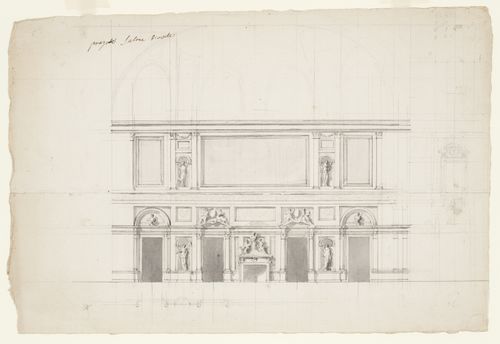
- Two stories of this interior elevation for Castello di Rivoli, Turin, are executed in pen and ink with wash. Further details, including the coved ceiling, are sketched in. The partial plan below the elevation shows the articulation of the wall. The lightly drawn sketch on the verso is possibly for a column capital.
DR1978:0008:008
Description:
- Two stories of this interior elevation for Castello di Rivoli, Turin, are executed in pen and ink with wash. Further details, including the coved ceiling, are sketched in. The partial plan below the elevation shows the articulation of the wall. The lightly drawn sketch on the verso is possibly for a column capital.
Personnes et institutions:
Sujet:
architecture
architecture
Date:
between 1714 and 1721
between 1714 and 1721
Titre:
Interior elevation for a room with a partial plan, Castello di Rivoli, Turin; verso: Sketch, possibly a capital
Actions:
DR1978:0008:008
Description:
- Two stories of this interior elevation for Castello di Rivoli, Turin, are executed in pen and ink with wash. Further details, including the coved ceiling, are sketched in. The partial plan below the elevation shows the articulation of the wall. The lightly drawn sketch on the verso is possibly for a column capital.
Interior elevation for a room with a partial plan, Castello di Rivoli, Turin; verso: Sketch, possibly a capital
Actions:
DR1978:0008:008
Description:
- Two stories of this interior elevation for Castello di Rivoli, Turin, are executed in pen and ink with wash. Further details, including the coved ceiling, are sketched in. The partial plan below the elevation shows the articulation of the wall. The lightly drawn sketch on the verso is possibly for a column capital.
Classification:
dessins
dessins
Date:
between 1714 and 1721
between 1714 and 1721
Personnes et institutions:
Sujet:
architecture
architecture
Classification:
dessins
dessins
Actions:
Numéro de référence:
DR1982:0020:013
Description:
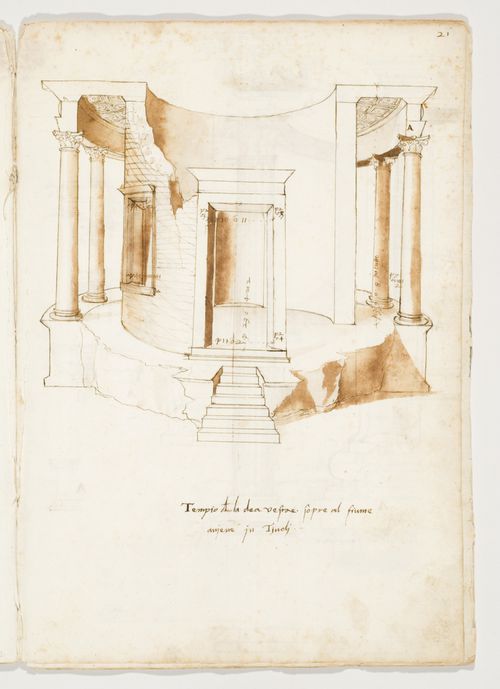
Detail drawings on the verso: window frame on the inside of the cella; the columnar order from podium to entablature; the entablature of the door frame; the cornice of the window frame on the outside of the cella; the lower part of the window frame on the outside of the cella; the base of the column.
DR1982:0020:013
Description:
Detail drawings on the verso: window frame on the inside of the cella; the columnar order from podium to entablature; the entablature of the door frame; the cornice of the window frame on the outside of the cella; the lower part of the window frame on the outside of the cella; the base of the column.
Personnes et institutions:
Date:
between 1520 and 1550?
between 1520 and 1550?
Titre:
Perspectival view and section of the so-called Temple of Vesta in Tivoli; verso: Six drawings of details of the so-called Temple of Vesta in Tivoli
Actions:
DR1982:0020:013
Description:
Detail drawings on the verso: window frame on the inside of the cella; the columnar order from podium to entablature; the entablature of the door frame; the cornice of the window frame on the outside of the cella; the lower part of the window frame on the outside of the cella; the base of the column.
Perspectival view and section of the so-called Temple of Vesta in Tivoli; verso: Six drawings of details of the so-called Temple of Vesta in Tivoli
Actions:
DR1982:0020:013
Description:
Detail drawings on the verso: window frame on the inside of the cella; the columnar order from podium to entablature; the entablature of the door frame; the cornice of the window frame on the outside of the cella; the lower part of the window frame on the outside of the cella; the base of the column.
Classification:
dessins
dessins
Date:
between 1520 and 1550?
between 1520 and 1550?
Personnes et institutions:
Classification:
expositions
expositions

Titre:
La preuve par l’architecture
La preuve par l’architecture
Actions:
Description:
La preuve par l’architecture présente une collection de pièces rassemblées dans le cadre d’une analyse technico-légale de l’architecture d’Auschwitz. L’exposition réunit des moulages en plâtre de bleus, de lettres, de factures d’entrepreneurs et de photographies, ainsi que deux reconstitutions de monuments (une colonne de gaz et une trappe étanche au gaz), qui, considérés(...)
La preuve par l’architecture présente une collection de pièces rassemblées dans le cadre d’une analyse technico-légale de l’architecture d’Auschwitz. L’exposition réunit des moulages en plâtre de bleus, de lettres, de factures d’entrepreneurs et de photographies, ainsi que deux reconstitutions de monuments (une colonne de gaz et une trappe étanche au gaz), qui, considérés(...)
Localisation:
Salle octogonale
Salle octogonale
Date:
16 juin 2016 au 11 septembre 2016
16 juin 2016 au 11 septembre 2016
Titre:
La preuve par l’architecture
Actions:
Description:
La preuve par l’architecture présente une collection de pièces rassemblées dans le cadre d’une analyse technico-légale de l’architecture d’Auschwitz. L’exposition réunit des moulages en plâtre de bleus, de lettres, de factures d’entrepreneurs et de photographies, ainsi que deux reconstitutions de monuments (une colonne de gaz et une trappe étanche au gaz), qui, considérés(...)
La preuve par l’architecture
Actions:
Description:
La preuve par l’architecture présente une collection de pièces rassemblées dans le cadre d’une analyse technico-légale de l’architecture d’Auschwitz. L’exposition réunit des moulages en plâtre de bleus, de lettres, de factures d’entrepreneurs et de photographies, ainsi que deux reconstitutions de monuments (une colonne de gaz et une trappe étanche au gaz), qui, considérés(...)
Classification:
expositions
expositions
Date:
16 juin 2016 au
11 septembre 2016
16 juin 2016 au
11 septembre 2016
Localisation:
Salle octogonale
Salle octogonale
Niveau de description archivistique:
Projet
Projet
Numéro de référence:
AP018.S1.1962.PR03
Description:
This project series documents the design and construction of Ottawa Union Station in Ottawa, Ontario from 1962-1966. The office identified the project number as 6253. This project consisted of a 96,000 square foot train station building, platforms, canopies and site services. The building had two levels, which included a basement and two-storey ground floor. Passengers connected to the station platforms through the basement from the ground floor via a helicoidal ramp in the centre of the building. The passenger concourse was sheltered by a great steel truss roof that had 8 massive columns supporting it. The ground floor included bedrooms, offices, storage, and food and beverage areas. The building, owned by CN Railways, was commissioned by the National Capital Commission, who are recorded as the primary architect on the project, with E.W. Thrift as general manager, and with John B. Parkin Associates acting as consulting architects. The firm of John B. Parkin Associates was presented with a Silver Massey Medal in Architecture in 1967 for the design of this building. The project is recorded through reprographic copies of architectural and structural drawings dating from 1965-1966.
AP018.S1.1962.PR03
Description:
This project series documents the design and construction of Ottawa Union Station in Ottawa, Ontario from 1962-1966. The office identified the project number as 6253. This project consisted of a 96,000 square foot train station building, platforms, canopies and site services. The building had two levels, which included a basement and two-storey ground floor. Passengers connected to the station platforms through the basement from the ground floor via a helicoidal ramp in the centre of the building. The passenger concourse was sheltered by a great steel truss roof that had 8 massive columns supporting it. The ground floor included bedrooms, offices, storage, and food and beverage areas. The building, owned by CN Railways, was commissioned by the National Capital Commission, who are recorded as the primary architect on the project, with E.W. Thrift as general manager, and with John B. Parkin Associates acting as consulting architects. The firm of John B. Parkin Associates was presented with a Silver Massey Medal in Architecture in 1967 for the design of this building. The project is recorded through reprographic copies of architectural and structural drawings dating from 1965-1966.
Personnes et institutions:
Date:
1965-1966
1965-1966
Titre:
Ottawa Union Station, Ottawa, Ontario (1962-1966)
Actions:
AP018.S1.1962.PR03
Description:
This project series documents the design and construction of Ottawa Union Station in Ottawa, Ontario from 1962-1966. The office identified the project number as 6253. This project consisted of a 96,000 square foot train station building, platforms, canopies and site services. The building had two levels, which included a basement and two-storey ground floor. Passengers connected to the station platforms through the basement from the ground floor via a helicoidal ramp in the centre of the building. The passenger concourse was sheltered by a great steel truss roof that had 8 massive columns supporting it. The ground floor included bedrooms, offices, storage, and food and beverage areas. The building, owned by CN Railways, was commissioned by the National Capital Commission, who are recorded as the primary architect on the project, with E.W. Thrift as general manager, and with John B. Parkin Associates acting as consulting architects. The firm of John B. Parkin Associates was presented with a Silver Massey Medal in Architecture in 1967 for the design of this building. The project is recorded through reprographic copies of architectural and structural drawings dating from 1965-1966.
Ottawa Union Station, Ottawa, Ontario (1962-1966)
Actions:
AP018.S1.1962.PR03
Description:
This project series documents the design and construction of Ottawa Union Station in Ottawa, Ontario from 1962-1966. The office identified the project number as 6253. This project consisted of a 96,000 square foot train station building, platforms, canopies and site services. The building had two levels, which included a basement and two-storey ground floor. Passengers connected to the station platforms through the basement from the ground floor via a helicoidal ramp in the centre of the building. The passenger concourse was sheltered by a great steel truss roof that had 8 massive columns supporting it. The ground floor included bedrooms, offices, storage, and food and beverage areas. The building, owned by CN Railways, was commissioned by the National Capital Commission, who are recorded as the primary architect on the project, with E.W. Thrift as general manager, and with John B. Parkin Associates acting as consulting architects. The firm of John B. Parkin Associates was presented with a Silver Massey Medal in Architecture in 1967 for the design of this building. The project is recorded through reprographic copies of architectural and structural drawings dating from 1965-1966.
Niveau de description archivistique:
Project
Project
Date:
1965-1966
1965-1966
Personnes et institutions:
Niveau de description archivistique:
Projet
Projet
Numéro de référence:
AP206.S1.1963.PR01
Description:
This project series documents the Punjab Agricultural University in Ludhiana, India from 1963-1968. With Prakash as the senior architect, this project consisted of the design of the entire campus, including the boys' hostel and mess, and the Agricultural Engineering College (AEC). Under this project, Prakash also designed campuses for the University in Hisar and Palampur. The boys' hostel, constructed first, consisted of a long, rectangular volume of exposed brick and concrete columns. Balconies lined its exterior, alternating on each floor so that every balcony had a view of the sky above. A covered walkway connected the hostel to the square mess, which was turned 45 degrees on its axis. The AEC, the campus's main building, was a long, single-storey building with a series of enclosed courtyards. Round exhaust openings were the only element that marked the building's façade. Prakash, developing his love of sculpture at this time, also crafted a large outdoor sculpture for the campus's main courtyard.[1] This project is recorded through a reprographic copy of a plan of the boys' hostel dating from around 1963. [1]Vikramaditya Prakash, One Continuous Line: Art, Architecture and Urbanism of Aditya Prakash (Ahmedabad, India: Mapin Publishing Pvt. Ltd., 2019), 107-132.
AP206.S1.1963.PR01
Description:
This project series documents the Punjab Agricultural University in Ludhiana, India from 1963-1968. With Prakash as the senior architect, this project consisted of the design of the entire campus, including the boys' hostel and mess, and the Agricultural Engineering College (AEC). Under this project, Prakash also designed campuses for the University in Hisar and Palampur. The boys' hostel, constructed first, consisted of a long, rectangular volume of exposed brick and concrete columns. Balconies lined its exterior, alternating on each floor so that every balcony had a view of the sky above. A covered walkway connected the hostel to the square mess, which was turned 45 degrees on its axis. The AEC, the campus's main building, was a long, single-storey building with a series of enclosed courtyards. Round exhaust openings were the only element that marked the building's façade. Prakash, developing his love of sculpture at this time, also crafted a large outdoor sculpture for the campus's main courtyard.[1] This project is recorded through a reprographic copy of a plan of the boys' hostel dating from around 1963. [1]Vikramaditya Prakash, One Continuous Line: Art, Architecture and Urbanism of Aditya Prakash (Ahmedabad, India: Mapin Publishing Pvt. Ltd., 2019), 107-132.
Personnes et institutions:
Date:
circa 1963
circa 1963
Titre:
Punjab Agricultural University, Ludhiana, India (1963-1968)
Actions:
AP206.S1.1963.PR01
Description:
This project series documents the Punjab Agricultural University in Ludhiana, India from 1963-1968. With Prakash as the senior architect, this project consisted of the design of the entire campus, including the boys' hostel and mess, and the Agricultural Engineering College (AEC). Under this project, Prakash also designed campuses for the University in Hisar and Palampur. The boys' hostel, constructed first, consisted of a long, rectangular volume of exposed brick and concrete columns. Balconies lined its exterior, alternating on each floor so that every balcony had a view of the sky above. A covered walkway connected the hostel to the square mess, which was turned 45 degrees on its axis. The AEC, the campus's main building, was a long, single-storey building with a series of enclosed courtyards. Round exhaust openings were the only element that marked the building's façade. Prakash, developing his love of sculpture at this time, also crafted a large outdoor sculpture for the campus's main courtyard.[1] This project is recorded through a reprographic copy of a plan of the boys' hostel dating from around 1963. [1]Vikramaditya Prakash, One Continuous Line: Art, Architecture and Urbanism of Aditya Prakash (Ahmedabad, India: Mapin Publishing Pvt. Ltd., 2019), 107-132.
Punjab Agricultural University, Ludhiana, India (1963-1968)
Actions:
AP206.S1.1963.PR01
Description:
This project series documents the Punjab Agricultural University in Ludhiana, India from 1963-1968. With Prakash as the senior architect, this project consisted of the design of the entire campus, including the boys' hostel and mess, and the Agricultural Engineering College (AEC). Under this project, Prakash also designed campuses for the University in Hisar and Palampur. The boys' hostel, constructed first, consisted of a long, rectangular volume of exposed brick and concrete columns. Balconies lined its exterior, alternating on each floor so that every balcony had a view of the sky above. A covered walkway connected the hostel to the square mess, which was turned 45 degrees on its axis. The AEC, the campus's main building, was a long, single-storey building with a series of enclosed courtyards. Round exhaust openings were the only element that marked the building's façade. Prakash, developing his love of sculpture at this time, also crafted a large outdoor sculpture for the campus's main courtyard.[1] This project is recorded through a reprographic copy of a plan of the boys' hostel dating from around 1963. [1]Vikramaditya Prakash, One Continuous Line: Art, Architecture and Urbanism of Aditya Prakash (Ahmedabad, India: Mapin Publishing Pvt. Ltd., 2019), 107-132.
Niveau de description archivistique:
Project
Project
Date:
circa 1963
circa 1963
Personnes et institutions:
Classification:
photographies
photographies
Actions:
Numéro de référence:
PH1985:0138
Description:
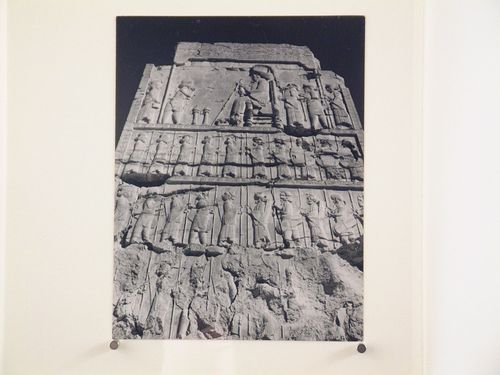
Relief on the on the east jamb, western doorway of the northern wall. The Throne Hall is sometimes referred to as the "Hall of 100 Columns" or the "Hundred-Columns Palace".
PH1985:0138
Description:
Relief on the on the east jamb, western doorway of the northern wall. The Throne Hall is sometimes referred to as the "Hall of 100 Columns" or the "Hundred-Columns Palace".
Personnes et institutions:
Titre:
Detail of doorway with relief depicting an audience scene, Throne Hall, Persepolis, Iran
Actions:
PH1985:0138
Description:
Relief on the on the east jamb, western doorway of the northern wall. The Throne Hall is sometimes referred to as the "Hall of 100 Columns" or the "Hundred-Columns Palace".
Detail of doorway with relief depicting an audience scene, Throne Hall, Persepolis, Iran
Actions:
PH1985:0138
Description:
Relief on the on the east jamb, western doorway of the northern wall. The Throne Hall is sometimes referred to as the "Hall of 100 Columns" or the "Hundred-Columns Palace".
Classification:
photographies
photographies
Personnes et institutions:
Classification:
dessins
dessins
Numéro de référence:
AP154.S1.1973.PR01.SS2.029
Description:
Drawings numbered 1-15, 17, 19, 20, 99-101, 103-109, 130-131, 135-136, 145. Includes skin details, extrusions, floor plans (cellar, 1st-38th), core plans, first floor and intermediate level core and details, roof bulkhead core, door and frame details, roof bulkheads (lower level and main floor, elevator machine room level), roof bulkhead sections and details, elevations (east and south), and column details.
AP154.S1.1973.PR01.SS2.029
Description:
Drawings numbered 1-15, 17, 19, 20, 99-101, 103-109, 130-131, 135-136, 145. Includes skin details, extrusions, floor plans (cellar, 1st-38th), core plans, first floor and intermediate level core and details, roof bulkhead core, door and frame details, roof bulkheads (lower level and main floor, elevator machine room level), roof bulkhead sections and details, elevations (east and south), and column details.
Personnes et institutions:
Date:
1955-1959
1955-1959
Titre:
Copies of drawings for the Seagram Building, 375 Park Avenue, New York, N.Y.
Actions:
AP154.S1.1973.PR01.SS2.029
Description:
Drawings numbered 1-15, 17, 19, 20, 99-101, 103-109, 130-131, 135-136, 145. Includes skin details, extrusions, floor plans (cellar, 1st-38th), core plans, first floor and intermediate level core and details, roof bulkhead core, door and frame details, roof bulkheads (lower level and main floor, elevator machine room level), roof bulkhead sections and details, elevations (east and south), and column details.
Copies of drawings for the Seagram Building, 375 Park Avenue, New York, N.Y.
Actions:
AP154.S1.1973.PR01.SS2.029
Description:
Drawings numbered 1-15, 17, 19, 20, 99-101, 103-109, 130-131, 135-136, 145. Includes skin details, extrusions, floor plans (cellar, 1st-38th), core plans, first floor and intermediate level core and details, roof bulkhead core, door and frame details, roof bulkheads (lower level and main floor, elevator machine room level), roof bulkhead sections and details, elevations (east and south), and column details.
Classification:
dessins
dessins
Date:
1955-1959
1955-1959
Personnes et institutions:
Classification:
articles
articles
Titre:
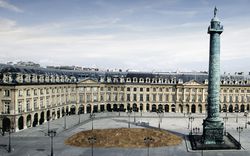
La vie radicale d’un paysage
La vie radicale d’un paysage
Actions:
Dossier:
Architecture de l’invocation
Architecture de l’invocation
Mot(s)-clé(s):
Vendôme, monticule de Vendôme, Commune de Paris, Paris, révolution, paysage, terre, sable, colonne, Napoléon, symboles urbains, destruction, imaginaire urbain
Vendôme, monticule de Vendôme, Commune de Paris, Paris, révolution, paysage, terre, sable, colonne, Napoléon, symboles urbains, destruction, imaginaire urbain
Publié:
28 février 2016
28 février 2016
Dossier:
Architecture de l’invocation
Architecture de l’invocation
Classification:
dessins
dessins
Actions:
Numéro de référence:
DR1964:0017:001-003
Description:
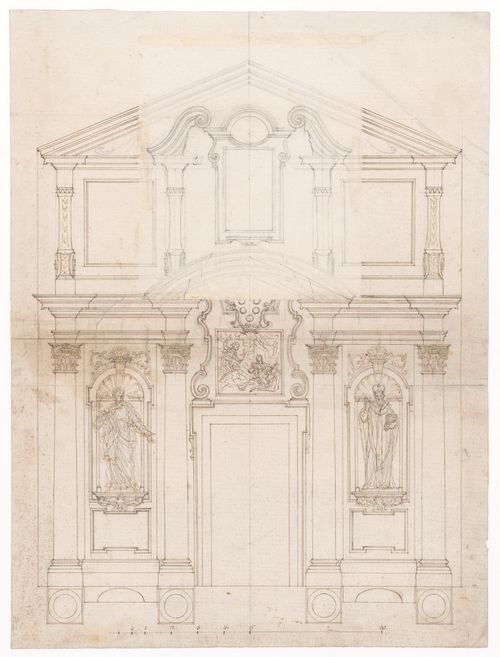
- Elevation of a facade (with plan of columns and niches), with two saints in niches between paired columns (field cut off, probably during record migration from INMAGIC to MINISIS, SB, 1995-04-28).
DR1964:0017:001-003
Description:
- Elevation of a facade (with plan of columns and niches), with two saints in niches between paired columns (field cut off, probably during record migration from INMAGIC to MINISIS, SB, 1995-04-28).
Personnes et institutions:
Sujet:
architecture
architecture
Date:
between ca. 1695 and ca. 1725
between ca. 1695 and ca. 1725
Titre:
Elevation of the façade of a church or an altar, with two flaps showing alternate ideas for the pediment
Actions:
DR1964:0017:001-003
Description:
- Elevation of a facade (with plan of columns and niches), with two saints in niches between paired columns (field cut off, probably during record migration from INMAGIC to MINISIS, SB, 1995-04-28).
Elevation of the façade of a church or an altar, with two flaps showing alternate ideas for the pediment
Actions:
DR1964:0017:001-003
Description:
- Elevation of a facade (with plan of columns and niches), with two saints in niches between paired columns (field cut off, probably during record migration from INMAGIC to MINISIS, SB, 1995-04-28).
Classification:
dessins
dessins
Date:
between ca. 1695 and ca. 1725
between ca. 1695 and ca. 1725
Personnes et institutions:
Sujet:
architecture
architecture
Classification:
dessins
Quantité:
20 File
dessins
Quantité:
20 File
Numéro de référence:
ARCH41278
Description:
assembly hall for Torpedo and Gunnery School, Combined Shops doors, Central Heating Plant doors, mastic and cement bases for hospital, Hospital galley and foyer, hospital x-ray room, windows and doors for Signal A.S.D.I.C. Building, hospital kitchen, galleys for General Office Building, Signal and A.S.D.I.C. Building conversion to barracks, changes to Barracks Building, counters and partitions, Hospital door, concrete column for General Offices, Hospital passage, pump house, fences and gates
ARCH41278
Description:
assembly hall for Torpedo and Gunnery School, Combined Shops doors, Central Heating Plant doors, mastic and cement bases for hospital, Hospital galley and foyer, hospital x-ray room, windows and doors for Signal A.S.D.I.C. Building, hospital kitchen, galleys for General Office Building, Signal and A.S.D.I.C. Building conversion to barracks, changes to Barracks Building, counters and partitions, Hospital door, concrete column for General Offices, Hospital passage, pump house, fences and gates
Personnes et institutions:
Titre:
Assembly hall for Torpedo and Gunnery School, Combined Shops doors
Actions:
ARCH41278
Description:
assembly hall for Torpedo and Gunnery School, Combined Shops doors, Central Heating Plant doors, mastic and cement bases for hospital, Hospital galley and foyer, hospital x-ray room, windows and doors for Signal A.S.D.I.C. Building, hospital kitchen, galleys for General Office Building, Signal and A.S.D.I.C. Building conversion to barracks, changes to Barracks Building, counters and partitions, Hospital door, concrete column for General Offices, Hospital passage, pump house, fences and gates
Assembly hall for Torpedo and Gunnery School, Combined Shops doors
Actions:
ARCH41278
Description:
assembly hall for Torpedo and Gunnery School, Combined Shops doors, Central Heating Plant doors, mastic and cement bases for hospital, Hospital galley and foyer, hospital x-ray room, windows and doors for Signal A.S.D.I.C. Building, hospital kitchen, galleys for General Office Building, Signal and A.S.D.I.C. Building conversion to barracks, changes to Barracks Building, counters and partitions, Hospital door, concrete column for General Offices, Hospital passage, pump house, fences and gates
Classification:
dessins
Quantité:
20 File
dessins
Quantité:
20 File
Personnes et institutions:


