


3779 Results
Form:
textual records
textual records
Reference number:
ARCH264464
Description:
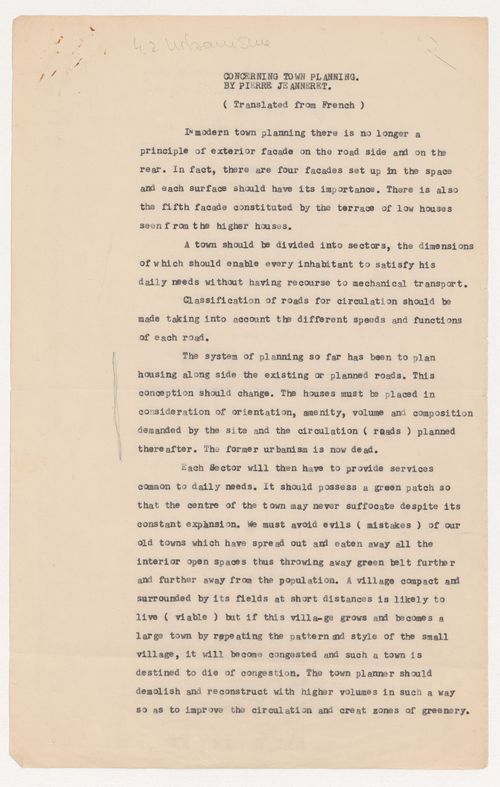
Le tapuscrit traite du développement de Chandigarh. Il contient, entre autres, de l'information sur la circulation, les logements, les espaces verts et la ceinture verte qui entoure la ville. Le texte a été écrit en français, puis a été traduit en anglais. This typescript is about the urban planning in Chandigarh. It deals, among other things, with information on road traffic, housing, green spaces, and the city green belt. The text was originally written in French and was translated into English.
ARCH264464
Description:
Le tapuscrit traite du développement de Chandigarh. Il contient, entre autres, de l'information sur la circulation, les logements, les espaces verts et la ceinture verte qui entoure la ville. Le texte a été écrit en français, puis a été traduit en anglais. This typescript is about the urban planning in Chandigarh. It deals, among other things, with information on road traffic, housing, green spaces, and the city green belt. The text was originally written in French and was translated into English.
People:
Date:
between 1951 and 1967
between 1951 and 1967
Title:
Text entitled "Concerning town planning"
Actions:
ARCH264464
Description:
Le tapuscrit traite du développement de Chandigarh. Il contient, entre autres, de l'information sur la circulation, les logements, les espaces verts et la ceinture verte qui entoure la ville. Le texte a été écrit en français, puis a été traduit en anglais. This typescript is about the urban planning in Chandigarh. It deals, among other things, with information on road traffic, housing, green spaces, and the city green belt. The text was originally written in French and was translated into English.
Text entitled "Concerning town planning"
Actions:
ARCH264464
Description:
Le tapuscrit traite du développement de Chandigarh. Il contient, entre autres, de l'information sur la circulation, les logements, les espaces verts et la ceinture verte qui entoure la ville. Le texte a été écrit en français, puis a été traduit en anglais. This typescript is about the urban planning in Chandigarh. It deals, among other things, with information on road traffic, housing, green spaces, and the city green belt. The text was originally written in French and was translated into English.
Form:
textual records
textual records
Date:
between 1951 and 1967
between 1951 and 1967
People:
Form:
archives
Level of archival description:
Fonds
archives
Level of archival description:
Fonds
Title:
Aditya Prakash fonds
Aditya Prakash fonds
Reference number:
AP206
Synopsis:
The Aditya Prakash fonds documents the professional practice of modernist Indian architect Aditya Prakash from his studies in London in 1947 to his death in 2008. His seminal work as a junior architect on the Chandigarh Capitol Project in the 1950s is recorded along with documentation from his solo career after 1960, including approximately 82 architectural projects. His professional work as an artist, photographer, writer, academic and theatre enthusiast are also well documented through drawings, photographic materials and textual records.
AP206
Synopsis:
The Aditya Prakash fonds documents the professional practice of modernist Indian architect Aditya Prakash from his studies in London in 1947 to his death in 2008. His seminal work as a junior architect on the Chandigarh Capitol Project in the 1950s is recorded along with documentation from his solo career after 1960, including approximately 82 architectural projects. His professional work as an artist, photographer, writer, academic and theatre enthusiast are also well documented through drawings, photographic materials and textual records.
People:
Date:
1947-2008
1947-2008
Title:
Aditya Prakash fonds
Actions:
AP206
Synopsis:
The Aditya Prakash fonds documents the professional practice of modernist Indian architect Aditya Prakash from his studies in London in 1947 to his death in 2008. His seminal work as a junior architect on the Chandigarh Capitol Project in the 1950s is recorded along with documentation from his solo career after 1960, including approximately 82 architectural projects. His professional work as an artist, photographer, writer, academic and theatre enthusiast are also well documented through drawings, photographic materials and textual records.
Aditya Prakash fonds
Actions:
AP206
Synopsis:
The Aditya Prakash fonds documents the professional practice of modernist Indian architect Aditya Prakash from his studies in London in 1947 to his death in 2008. His seminal work as a junior architect on the Chandigarh Capitol Project in the 1950s is recorded along with documentation from his solo career after 1960, including approximately 82 architectural projects. His professional work as an artist, photographer, writer, academic and theatre enthusiast are also well documented through drawings, photographic materials and textual records.
Form:
archives
Level of archival description:
Fonds
archives
Level of archival description:
Fonds
Date:
1947-2008
1947-2008
People:
Level of archival description:
Series
Series
Reference number:
AP175.S1
Description:
Series 1, Erasmus Bridge, Rotterdam, Netherlands, 1990-1996, documents the design, conception and construction of a third bridge for Rotterdam over the Nieuwe Maas River. The bridge connects the Kop van Zuid neighborhood, located on the south side of the river, to Willemsplein, located on the north side. The bridge is considered as a landmark in Rotterdam’s landscape. The Erasmus Bridge was a formative project in the thinking of UNStudio. It was originally supposed to be designed by architect Maarten Struijs who was the city of Rotterdam principal architect and who is responsible for the concept of the neighboring Willem Bridge. Ben van Berkel came later into the project and was hired as a designing consultant along with architect Wim Quist. Ben van Berkel proposed design was selected allowing him and his firm, which was called Van Berkel & Bos Architectuurbureau at that time, to supervise the conception and construction of the project, from the original concept to piers design to the selection of every item of bridge furniture such as traffic lights, bridge camera and handrails. The bridge was designed to fit the distinct character and industrial past of Rotterdam. The construction of this landmark was one component of a larger redevelopment project, coinciding with other major developments in the city of Rotterdam. The goal was to develop a dense urban intervention on the southern shore of the Nieuwe Maas, in the Kop van Zuid neighborhood. This explains the implication of UNStudio in the planning of urban configuration of the neighborhoods on both sides of the river and their work for Spido, a ferry company operating on the Nieuwe Maas, work spaces and parking garage. This commercial building was designed by the firm and also hosts The Grand Café and Jazz Café. This commercial building is integrated to one of the bridge pillar on the north shore of the river. For the design the firm used AutoCAD to work along with engineers and to conceptualize 3D models. They also used the software to evaluate the circulation flow of drivers, pedestrians and streetcars, measuring its impact on the structure and the urban configuration of the neighborhoods on both sides of the river. The records contain sketches for bridge and pier design, plans and sections for pier, Spido and bridge, architectural and construction details created by engineering companies for every component of the bridge, from drawbridge, to cable car system, to bridge furnitures such as traffic light, handrails and cameras and photographs documenting the research for precedent and the original configuration of the neighborhoods on both sides of the river. The record contains AutoCAD plans, details and sections for both the bridge and Spido parking garage. The records also contain one physical model: a small scale plastic, glass and metal model of the bridge.
AP175.S1
Description:
Series 1, Erasmus Bridge, Rotterdam, Netherlands, 1990-1996, documents the design, conception and construction of a third bridge for Rotterdam over the Nieuwe Maas River. The bridge connects the Kop van Zuid neighborhood, located on the south side of the river, to Willemsplein, located on the north side. The bridge is considered as a landmark in Rotterdam’s landscape. The Erasmus Bridge was a formative project in the thinking of UNStudio. It was originally supposed to be designed by architect Maarten Struijs who was the city of Rotterdam principal architect and who is responsible for the concept of the neighboring Willem Bridge. Ben van Berkel came later into the project and was hired as a designing consultant along with architect Wim Quist. Ben van Berkel proposed design was selected allowing him and his firm, which was called Van Berkel & Bos Architectuurbureau at that time, to supervise the conception and construction of the project, from the original concept to piers design to the selection of every item of bridge furniture such as traffic lights, bridge camera and handrails. The bridge was designed to fit the distinct character and industrial past of Rotterdam. The construction of this landmark was one component of a larger redevelopment project, coinciding with other major developments in the city of Rotterdam. The goal was to develop a dense urban intervention on the southern shore of the Nieuwe Maas, in the Kop van Zuid neighborhood. This explains the implication of UNStudio in the planning of urban configuration of the neighborhoods on both sides of the river and their work for Spido, a ferry company operating on the Nieuwe Maas, work spaces and parking garage. This commercial building was designed by the firm and also hosts The Grand Café and Jazz Café. This commercial building is integrated to one of the bridge pillar on the north shore of the river. For the design the firm used AutoCAD to work along with engineers and to conceptualize 3D models. They also used the software to evaluate the circulation flow of drivers, pedestrians and streetcars, measuring its impact on the structure and the urban configuration of the neighborhoods on both sides of the river. The records contain sketches for bridge and pier design, plans and sections for pier, Spido and bridge, architectural and construction details created by engineering companies for every component of the bridge, from drawbridge, to cable car system, to bridge furnitures such as traffic light, handrails and cameras and photographs documenting the research for precedent and the original configuration of the neighborhoods on both sides of the river. The record contains AutoCAD plans, details and sections for both the bridge and Spido parking garage. The records also contain one physical model: a small scale plastic, glass and metal model of the bridge.
People:
Date:
1990-1996
1990-1996
Title:
Erasmus Bridge, Rotterdam, Netherlands, 1990-1996
Actions:
AP175.S1
Description:
Series 1, Erasmus Bridge, Rotterdam, Netherlands, 1990-1996, documents the design, conception and construction of a third bridge for Rotterdam over the Nieuwe Maas River. The bridge connects the Kop van Zuid neighborhood, located on the south side of the river, to Willemsplein, located on the north side. The bridge is considered as a landmark in Rotterdam’s landscape. The Erasmus Bridge was a formative project in the thinking of UNStudio. It was originally supposed to be designed by architect Maarten Struijs who was the city of Rotterdam principal architect and who is responsible for the concept of the neighboring Willem Bridge. Ben van Berkel came later into the project and was hired as a designing consultant along with architect Wim Quist. Ben van Berkel proposed design was selected allowing him and his firm, which was called Van Berkel & Bos Architectuurbureau at that time, to supervise the conception and construction of the project, from the original concept to piers design to the selection of every item of bridge furniture such as traffic lights, bridge camera and handrails. The bridge was designed to fit the distinct character and industrial past of Rotterdam. The construction of this landmark was one component of a larger redevelopment project, coinciding with other major developments in the city of Rotterdam. The goal was to develop a dense urban intervention on the southern shore of the Nieuwe Maas, in the Kop van Zuid neighborhood. This explains the implication of UNStudio in the planning of urban configuration of the neighborhoods on both sides of the river and their work for Spido, a ferry company operating on the Nieuwe Maas, work spaces and parking garage. This commercial building was designed by the firm and also hosts The Grand Café and Jazz Café. This commercial building is integrated to one of the bridge pillar on the north shore of the river. For the design the firm used AutoCAD to work along with engineers and to conceptualize 3D models. They also used the software to evaluate the circulation flow of drivers, pedestrians and streetcars, measuring its impact on the structure and the urban configuration of the neighborhoods on both sides of the river. The records contain sketches for bridge and pier design, plans and sections for pier, Spido and bridge, architectural and construction details created by engineering companies for every component of the bridge, from drawbridge, to cable car system, to bridge furnitures such as traffic light, handrails and cameras and photographs documenting the research for precedent and the original configuration of the neighborhoods on both sides of the river. The record contains AutoCAD plans, details and sections for both the bridge and Spido parking garage. The records also contain one physical model: a small scale plastic, glass and metal model of the bridge.
Erasmus Bridge, Rotterdam, Netherlands, 1990-1996
Actions:
AP175.S1
Description:
Series 1, Erasmus Bridge, Rotterdam, Netherlands, 1990-1996, documents the design, conception and construction of a third bridge for Rotterdam over the Nieuwe Maas River. The bridge connects the Kop van Zuid neighborhood, located on the south side of the river, to Willemsplein, located on the north side. The bridge is considered as a landmark in Rotterdam’s landscape. The Erasmus Bridge was a formative project in the thinking of UNStudio. It was originally supposed to be designed by architect Maarten Struijs who was the city of Rotterdam principal architect and who is responsible for the concept of the neighboring Willem Bridge. Ben van Berkel came later into the project and was hired as a designing consultant along with architect Wim Quist. Ben van Berkel proposed design was selected allowing him and his firm, which was called Van Berkel & Bos Architectuurbureau at that time, to supervise the conception and construction of the project, from the original concept to piers design to the selection of every item of bridge furniture such as traffic lights, bridge camera and handrails. The bridge was designed to fit the distinct character and industrial past of Rotterdam. The construction of this landmark was one component of a larger redevelopment project, coinciding with other major developments in the city of Rotterdam. The goal was to develop a dense urban intervention on the southern shore of the Nieuwe Maas, in the Kop van Zuid neighborhood. This explains the implication of UNStudio in the planning of urban configuration of the neighborhoods on both sides of the river and their work for Spido, a ferry company operating on the Nieuwe Maas, work spaces and parking garage. This commercial building was designed by the firm and also hosts The Grand Café and Jazz Café. This commercial building is integrated to one of the bridge pillar on the north shore of the river. For the design the firm used AutoCAD to work along with engineers and to conceptualize 3D models. They also used the software to evaluate the circulation flow of drivers, pedestrians and streetcars, measuring its impact on the structure and the urban configuration of the neighborhoods on both sides of the river. The records contain sketches for bridge and pier design, plans and sections for pier, Spido and bridge, architectural and construction details created by engineering companies for every component of the bridge, from drawbridge, to cable car system, to bridge furnitures such as traffic light, handrails and cameras and photographs documenting the research for precedent and the original configuration of the neighborhoods on both sides of the river. The record contains AutoCAD plans, details and sections for both the bridge and Spido parking garage. The records also contain one physical model: a small scale plastic, glass and metal model of the bridge.
Level of archival description:
Series
Series
Date:
1990-1996
1990-1996
People:
Level of archival description:
Project
Project
Actions:
Reference number:
AP178.S1.2003.PR03
Description:
This project series documents a competition for the Ciudad del Flamenco de Jerez de la Frontera in Jerez de la Frontera, Spain. While the records were held in the office’s archives this project was assigned the number 56/00. The office assigned the date 2002 to this project. The competition for the Ciudad del Flamenco was part of an urban revitalization project for the historic center of Jerez. The competition was organized by the Ayuntamiento de Jerez. Six proposals were presented to the jury, including a design by Àlvaro Siza and Juan Miguel Hernández León. The project included the design of an auditorium, a museum, a documentation and research center, a school, and communal spaces. The buildings were to host The National Auditorium of Flamenco Art, the Museum and the Center for Investigation, and Documentation of the Art of Flamenco (CIDAF). The proposal was "a complex of prisms and courtyards wisely articulated between one another, rounded off by a sculptural trapezoidal and cantilevering piece'' (http://ciudaddelflamenco.jerez.es/flash/concurso.pdf p. 6). Jacques Herzog and Pierre de Meuron's proposal won the competition. Documenting this project are studies, competition drawings, and plans. Textual documentation includes correspondence with the client and competition documentation.
AP178.S1.2003.PR03
Description:
This project series documents a competition for the Ciudad del Flamenco de Jerez de la Frontera in Jerez de la Frontera, Spain. While the records were held in the office’s archives this project was assigned the number 56/00. The office assigned the date 2002 to this project. The competition for the Ciudad del Flamenco was part of an urban revitalization project for the historic center of Jerez. The competition was organized by the Ayuntamiento de Jerez. Six proposals were presented to the jury, including a design by Àlvaro Siza and Juan Miguel Hernández León. The project included the design of an auditorium, a museum, a documentation and research center, a school, and communal spaces. The buildings were to host The National Auditorium of Flamenco Art, the Museum and the Center for Investigation, and Documentation of the Art of Flamenco (CIDAF). The proposal was "a complex of prisms and courtyards wisely articulated between one another, rounded off by a sculptural trapezoidal and cantilevering piece'' (http://ciudaddelflamenco.jerez.es/flash/concurso.pdf p. 6). Jacques Herzog and Pierre de Meuron's proposal won the competition. Documenting this project are studies, competition drawings, and plans. Textual documentation includes correspondence with the client and competition documentation.
People:
Date:
circa 2003-2004
circa 2003-2004
Title:
Ciudad del Flamenco de Jerez de la Frontera, Jerez de la Frontera, Spain (2003)
Actions:
AP178.S1.2003.PR03
Description:
This project series documents a competition for the Ciudad del Flamenco de Jerez de la Frontera in Jerez de la Frontera, Spain. While the records were held in the office’s archives this project was assigned the number 56/00. The office assigned the date 2002 to this project. The competition for the Ciudad del Flamenco was part of an urban revitalization project for the historic center of Jerez. The competition was organized by the Ayuntamiento de Jerez. Six proposals were presented to the jury, including a design by Àlvaro Siza and Juan Miguel Hernández León. The project included the design of an auditorium, a museum, a documentation and research center, a school, and communal spaces. The buildings were to host The National Auditorium of Flamenco Art, the Museum and the Center for Investigation, and Documentation of the Art of Flamenco (CIDAF). The proposal was "a complex of prisms and courtyards wisely articulated between one another, rounded off by a sculptural trapezoidal and cantilevering piece'' (http://ciudaddelflamenco.jerez.es/flash/concurso.pdf p. 6). Jacques Herzog and Pierre de Meuron's proposal won the competition. Documenting this project are studies, competition drawings, and plans. Textual documentation includes correspondence with the client and competition documentation.
Ciudad del Flamenco de Jerez de la Frontera, Jerez de la Frontera, Spain (2003)
Actions:
AP178.S1.2003.PR03
Description:
This project series documents a competition for the Ciudad del Flamenco de Jerez de la Frontera in Jerez de la Frontera, Spain. While the records were held in the office’s archives this project was assigned the number 56/00. The office assigned the date 2002 to this project. The competition for the Ciudad del Flamenco was part of an urban revitalization project for the historic center of Jerez. The competition was organized by the Ayuntamiento de Jerez. Six proposals were presented to the jury, including a design by Àlvaro Siza and Juan Miguel Hernández León. The project included the design of an auditorium, a museum, a documentation and research center, a school, and communal spaces. The buildings were to host The National Auditorium of Flamenco Art, the Museum and the Center for Investigation, and Documentation of the Art of Flamenco (CIDAF). The proposal was "a complex of prisms and courtyards wisely articulated between one another, rounded off by a sculptural trapezoidal and cantilevering piece'' (http://ciudaddelflamenco.jerez.es/flash/concurso.pdf p. 6). Jacques Herzog and Pierre de Meuron's proposal won the competition. Documenting this project are studies, competition drawings, and plans. Textual documentation includes correspondence with the client and competition documentation.
Level of archival description:
Project
Project
Date:
circa 2003-2004
circa 2003-2004
People:
Form:
archives
Level of archival description:
Fonds
archives
Level of archival description:
Fonds
Reference number:
AP196
Synopsis:
Studio Gang Ford Calumet Environmental Center project records, 2003-2012, documents the design process for the Ford Calumet Environmental Center in Chicago, United-States. The records represent both phases during the competition and the full-term design, after the firm won the project. The records consist of born-digital material, sketches and drawings, textual records, photographs and seven models.
AP196
Synopsis:
Studio Gang Ford Calumet Environmental Center project records, 2003-2012, documents the design process for the Ford Calumet Environmental Center in Chicago, United-States. The records represent both phases during the competition and the full-term design, after the firm won the project. The records consist of born-digital material, sketches and drawings, textual records, photographs and seven models.
People:
Date:
2003-2011
2003-2011
Title:
Studio Gang Ford Calumet Environmental Center project records
Actions:
AP196
Synopsis:
Studio Gang Ford Calumet Environmental Center project records, 2003-2012, documents the design process for the Ford Calumet Environmental Center in Chicago, United-States. The records represent both phases during the competition and the full-term design, after the firm won the project. The records consist of born-digital material, sketches and drawings, textual records, photographs and seven models.
Studio Gang Ford Calumet Environmental Center project records
Actions:
AP196
Synopsis:
Studio Gang Ford Calumet Environmental Center project records, 2003-2012, documents the design process for the Ford Calumet Environmental Center in Chicago, United-States. The records represent both phases during the competition and the full-term design, after the firm won the project. The records consist of born-digital material, sketches and drawings, textual records, photographs and seven models.
Form:
archives
Level of archival description:
Fonds
archives
Level of archival description:
Fonds
Date:
2003-2011
2003-2011
People:
Form:
textual records
textual records
Actions:
Reference number:
ARCH260032
Description:
Proposals in the United States and Canada, including correspondence, concerning: Suffolk County Courthouse; North Carolina State University; Philadelphia World Forum Project (Harborplace Square); Pittsburgh evolving space project; Diker residence, Cannecticut; Rockville, Maryville Treatment Centres; Lincoln Performing Center for the Arts, New York; New York State Urban Development Corporation; 60 Wall Street, New York; New York Trump Tower; West Palm Beach, Florida, Center for the Performing Arts; Russell House, Tacoma Washington (includes colour photos); Tampa, Florida, University Library; Hotel, Vail, Colorado; Addition to Corcoran Gallery, Washington, DC; State Office Building, Columbus, Ohio. Canada: city of Oshawa interior design review; General Motors Head office, Oshawa; Robert McLaughlin Gallery, Oshawa; Roy Thompson Hall; Bank of Canada, Ottawa; National Museum of Man, Ottawa; Saudi Arabian Embassy, Ottawa; Saint Peter's Lutheran Church, Ottawa; Mosque (Saudi Embassy), Ottawa.
ARCH260032
Description:
Proposals in the United States and Canada, including correspondence, concerning: Suffolk County Courthouse; North Carolina State University; Philadelphia World Forum Project (Harborplace Square); Pittsburgh evolving space project; Diker residence, Cannecticut; Rockville, Maryville Treatment Centres; Lincoln Performing Center for the Arts, New York; New York State Urban Development Corporation; 60 Wall Street, New York; New York Trump Tower; West Palm Beach, Florida, Center for the Performing Arts; Russell House, Tacoma Washington (includes colour photos); Tampa, Florida, University Library; Hotel, Vail, Colorado; Addition to Corcoran Gallery, Washington, DC; State Office Building, Columbus, Ohio. Canada: city of Oshawa interior design review; General Motors Head office, Oshawa; Robert McLaughlin Gallery, Oshawa; Roy Thompson Hall; Bank of Canada, Ottawa; National Museum of Man, Ottawa; Saudi Arabian Embassy, Ottawa; Saint Peter's Lutheran Church, Ottawa; Mosque (Saudi Embassy), Ottawa.
People:
Date:
1980-1986
1980-1986
Title:
Proposals in the United States and Canada, including correspondence
Actions:
ARCH260032
Description:
Proposals in the United States and Canada, including correspondence, concerning: Suffolk County Courthouse; North Carolina State University; Philadelphia World Forum Project (Harborplace Square); Pittsburgh evolving space project; Diker residence, Cannecticut; Rockville, Maryville Treatment Centres; Lincoln Performing Center for the Arts, New York; New York State Urban Development Corporation; 60 Wall Street, New York; New York Trump Tower; West Palm Beach, Florida, Center for the Performing Arts; Russell House, Tacoma Washington (includes colour photos); Tampa, Florida, University Library; Hotel, Vail, Colorado; Addition to Corcoran Gallery, Washington, DC; State Office Building, Columbus, Ohio. Canada: city of Oshawa interior design review; General Motors Head office, Oshawa; Robert McLaughlin Gallery, Oshawa; Roy Thompson Hall; Bank of Canada, Ottawa; National Museum of Man, Ottawa; Saudi Arabian Embassy, Ottawa; Saint Peter's Lutheran Church, Ottawa; Mosque (Saudi Embassy), Ottawa.
Proposals in the United States and Canada, including correspondence
Actions:
ARCH260032
Description:
Proposals in the United States and Canada, including correspondence, concerning: Suffolk County Courthouse; North Carolina State University; Philadelphia World Forum Project (Harborplace Square); Pittsburgh evolving space project; Diker residence, Cannecticut; Rockville, Maryville Treatment Centres; Lincoln Performing Center for the Arts, New York; New York State Urban Development Corporation; 60 Wall Street, New York; New York Trump Tower; West Palm Beach, Florida, Center for the Performing Arts; Russell House, Tacoma Washington (includes colour photos); Tampa, Florida, University Library; Hotel, Vail, Colorado; Addition to Corcoran Gallery, Washington, DC; State Office Building, Columbus, Ohio. Canada: city of Oshawa interior design review; General Motors Head office, Oshawa; Robert McLaughlin Gallery, Oshawa; Roy Thompson Hall; Bank of Canada, Ottawa; National Museum of Man, Ottawa; Saudi Arabian Embassy, Ottawa; Saint Peter's Lutheran Church, Ottawa; Mosque (Saudi Embassy), Ottawa.
Form:
textual records
textual records
Date:
1980-1986
1980-1986
People:
Level of archival description:
Project
Project
Reference number:
AP178.S1.1983.PR04
Description:
The project series documents the 1983 design entry for the Kulturforum. While the records were held in the office’s archives this project was assigned the number 21/80. The office assigned the date 1983 for this project. This project was a competition entry for the International Architectural Exhibition Berlin competition (International Bauaustellung, IBA, circa 1979-1987), an urban renewal strategy for West Berlin, Germany. Siza also submitted five other entries to the IBA: Görtlitzer Bad swimming pool; Block 70 and 89 (Fränkelufer residential complex); Bonjour Tristesse (Block 121); Block 11-12; and Monument to Gestapo victims. The Kulturforum was a complex of cultural buildings. The site underwent many changes during Nazi Germany and post-war with the construction of the National Library of Staatsbibliothek, designed by Hans Scharoun. Two examples of features that the IBA asked participants to include in their design proposals were to exclude vehicle traffic between the library and national gallery, and to reinterpret the Forum space. Documenting this project are several sketches and studies. There are also plans, elevations, and axonometric drawings of site plans. Siza’s office has indicated on some of the studies that they were possibly not created by Siza. Where this is the case it has been noted with the physical material. Photographs and negatives document the competition site and model, and there are transparencies and slides of drawings. Also included is textual documentation on the competition site and a few letters from members of the Berlin Senate, two of which are from Brigitte Cassirer (later Brigitte Fleck).
AP178.S1.1983.PR04
Description:
The project series documents the 1983 design entry for the Kulturforum. While the records were held in the office’s archives this project was assigned the number 21/80. The office assigned the date 1983 for this project. This project was a competition entry for the International Architectural Exhibition Berlin competition (International Bauaustellung, IBA, circa 1979-1987), an urban renewal strategy for West Berlin, Germany. Siza also submitted five other entries to the IBA: Görtlitzer Bad swimming pool; Block 70 and 89 (Fränkelufer residential complex); Bonjour Tristesse (Block 121); Block 11-12; and Monument to Gestapo victims. The Kulturforum was a complex of cultural buildings. The site underwent many changes during Nazi Germany and post-war with the construction of the National Library of Staatsbibliothek, designed by Hans Scharoun. Two examples of features that the IBA asked participants to include in their design proposals were to exclude vehicle traffic between the library and national gallery, and to reinterpret the Forum space. Documenting this project are several sketches and studies. There are also plans, elevations, and axonometric drawings of site plans. Siza’s office has indicated on some of the studies that they were possibly not created by Siza. Where this is the case it has been noted with the physical material. Photographs and negatives document the competition site and model, and there are transparencies and slides of drawings. Also included is textual documentation on the competition site and a few letters from members of the Berlin Senate, two of which are from Brigitte Cassirer (later Brigitte Fleck).
People:
Date:
1982-2012
1982-2012
Title:
Kulturforum [Kulturforum], Berlin, Germany (1982-1986)
Actions:
AP178.S1.1983.PR04
Description:
The project series documents the 1983 design entry for the Kulturforum. While the records were held in the office’s archives this project was assigned the number 21/80. The office assigned the date 1983 for this project. This project was a competition entry for the International Architectural Exhibition Berlin competition (International Bauaustellung, IBA, circa 1979-1987), an urban renewal strategy for West Berlin, Germany. Siza also submitted five other entries to the IBA: Görtlitzer Bad swimming pool; Block 70 and 89 (Fränkelufer residential complex); Bonjour Tristesse (Block 121); Block 11-12; and Monument to Gestapo victims. The Kulturforum was a complex of cultural buildings. The site underwent many changes during Nazi Germany and post-war with the construction of the National Library of Staatsbibliothek, designed by Hans Scharoun. Two examples of features that the IBA asked participants to include in their design proposals were to exclude vehicle traffic between the library and national gallery, and to reinterpret the Forum space. Documenting this project are several sketches and studies. There are also plans, elevations, and axonometric drawings of site plans. Siza’s office has indicated on some of the studies that they were possibly not created by Siza. Where this is the case it has been noted with the physical material. Photographs and negatives document the competition site and model, and there are transparencies and slides of drawings. Also included is textual documentation on the competition site and a few letters from members of the Berlin Senate, two of which are from Brigitte Cassirer (later Brigitte Fleck).
Kulturforum [Kulturforum], Berlin, Germany (1982-1986)
Actions:
AP178.S1.1983.PR04
Description:
The project series documents the 1983 design entry for the Kulturforum. While the records were held in the office’s archives this project was assigned the number 21/80. The office assigned the date 1983 for this project. This project was a competition entry for the International Architectural Exhibition Berlin competition (International Bauaustellung, IBA, circa 1979-1987), an urban renewal strategy for West Berlin, Germany. Siza also submitted five other entries to the IBA: Görtlitzer Bad swimming pool; Block 70 and 89 (Fränkelufer residential complex); Bonjour Tristesse (Block 121); Block 11-12; and Monument to Gestapo victims. The Kulturforum was a complex of cultural buildings. The site underwent many changes during Nazi Germany and post-war with the construction of the National Library of Staatsbibliothek, designed by Hans Scharoun. Two examples of features that the IBA asked participants to include in their design proposals were to exclude vehicle traffic between the library and national gallery, and to reinterpret the Forum space. Documenting this project are several sketches and studies. There are also plans, elevations, and axonometric drawings of site plans. Siza’s office has indicated on some of the studies that they were possibly not created by Siza. Where this is the case it has been noted with the physical material. Photographs and negatives document the competition site and model, and there are transparencies and slides of drawings. Also included is textual documentation on the competition site and a few letters from members of the Berlin Senate, two of which are from Brigitte Cassirer (later Brigitte Fleck).
Level of archival description:
Project
Project
Date:
1982-2012
1982-2012
People:
Form:
archives
Level of archival description:
Fonds
archives
Level of archival description:
Fonds
Actions:
Reference number:
AP192
Synopsis:
The Morphosis Hypo Alpe-Adria Center project records, 1996 – 2016, consist of over 14,000 born-digital files that document the design and construction of the Austrian Hypo Alpe-Adria Bank group’s headquarters in Klagenfurt, Austria. Series 1, Competition and design, includes files showing early conceptualization of the project through the final design documentation. Series 2, Construction documentation, largely contains drawings and photographs which demonstrate the progress of the project in the built environment over time. Formats chiefly include CAD files (PowerCAD, PowerDraw, Microstation, DXF, AutoCAD, PLT), 3D models (Form*Z, STL), images, and text.
AP192
Synopsis:
The Morphosis Hypo Alpe-Adria Center project records, 1996 – 2016, consist of over 14,000 born-digital files that document the design and construction of the Austrian Hypo Alpe-Adria Bank group’s headquarters in Klagenfurt, Austria. Series 1, Competition and design, includes files showing early conceptualization of the project through the final design documentation. Series 2, Construction documentation, largely contains drawings and photographs which demonstrate the progress of the project in the built environment over time. Formats chiefly include CAD files (PowerCAD, PowerDraw, Microstation, DXF, AutoCAD, PLT), 3D models (Form*Z, STL), images, and text.
People:
Date:
1996 - 2016
1996 - 2016
Title:
Morphosis Hypo Alpe-Adria Center project records
Actions:
AP192
Synopsis:
The Morphosis Hypo Alpe-Adria Center project records, 1996 – 2016, consist of over 14,000 born-digital files that document the design and construction of the Austrian Hypo Alpe-Adria Bank group’s headquarters in Klagenfurt, Austria. Series 1, Competition and design, includes files showing early conceptualization of the project through the final design documentation. Series 2, Construction documentation, largely contains drawings and photographs which demonstrate the progress of the project in the built environment over time. Formats chiefly include CAD files (PowerCAD, PowerDraw, Microstation, DXF, AutoCAD, PLT), 3D models (Form*Z, STL), images, and text.
Morphosis Hypo Alpe-Adria Center project records
Actions:
AP192
Synopsis:
The Morphosis Hypo Alpe-Adria Center project records, 1996 – 2016, consist of over 14,000 born-digital files that document the design and construction of the Austrian Hypo Alpe-Adria Bank group’s headquarters in Klagenfurt, Austria. Series 1, Competition and design, includes files showing early conceptualization of the project through the final design documentation. Series 2, Construction documentation, largely contains drawings and photographs which demonstrate the progress of the project in the built environment over time. Formats chiefly include CAD files (PowerCAD, PowerDraw, Microstation, DXF, AutoCAD, PLT), 3D models (Form*Z, STL), images, and text.
Form:
archives
Level of archival description:
Fonds
archives
Level of archival description:
Fonds
Date:
1996 - 2016
1996 - 2016
People:
Level of archival description:
Project
Project
Reference number:
AP178.S1.1965.PR06
Description:
This project series documents the Plano Urbanistico para a Marginal de Leça e Zona da Boa Nova in Matosinhos, Portugal. While the records were held in the office’s archives this project was assigned the number 22/60. In the past the office identified the project as number 113. The office assigned the dates 1965-1974 for this project. This project was part of an urban renewal program of Matosinhos. Originally, the Avenida Marginal de Leça da Palmeira was a ring road mainly used to access the beaches but it later became a central road to access north and east parts of the city. Traffic and lack of parking spaces became problematic. The project consisted of an urbanization plan for Leça da Palmeira and Boa Nova, a new design for the layout of the pipelines between the Port of Leixões and SACOR Refinery, and a new design for da Marginal street that improve access to the Ocean swimming pool and others facilities of the area. Drawings include topographic surveys, studies, sketches, plans and profiles. Textual materials include a building program, notes and correspondence between Siza, the city of Matosinhos, and SACOR. Photographic materials and slides document the project site and model. It is also important to note that several Siza's projects were built in this area and are present in some sketches of this project, including the Casa de Chá, Restaurante da Boa Nova, Ocean swimming pool, and Monumento ao poeta António Nobre.
AP178.S1.1965.PR06
Description:
This project series documents the Plano Urbanistico para a Marginal de Leça e Zona da Boa Nova in Matosinhos, Portugal. While the records were held in the office’s archives this project was assigned the number 22/60. In the past the office identified the project as number 113. The office assigned the dates 1965-1974 for this project. This project was part of an urban renewal program of Matosinhos. Originally, the Avenida Marginal de Leça da Palmeira was a ring road mainly used to access the beaches but it later became a central road to access north and east parts of the city. Traffic and lack of parking spaces became problematic. The project consisted of an urbanization plan for Leça da Palmeira and Boa Nova, a new design for the layout of the pipelines between the Port of Leixões and SACOR Refinery, and a new design for da Marginal street that improve access to the Ocean swimming pool and others facilities of the area. Drawings include topographic surveys, studies, sketches, plans and profiles. Textual materials include a building program, notes and correspondence between Siza, the city of Matosinhos, and SACOR. Photographic materials and slides document the project site and model. It is also important to note that several Siza's projects were built in this area and are present in some sketches of this project, including the Casa de Chá, Restaurante da Boa Nova, Ocean swimming pool, and Monumento ao poeta António Nobre.
People:
Date:
1960-1984
1960-1984
Title:
Plano Urbanístico para a Marginal de Leça e Zona da Boa Nova [Leça and Boa Nova coastal development plan], Leça da Palmeira, Matosinhos, Portugal (1966)
Actions:
AP178.S1.1965.PR06
Description:
This project series documents the Plano Urbanistico para a Marginal de Leça e Zona da Boa Nova in Matosinhos, Portugal. While the records were held in the office’s archives this project was assigned the number 22/60. In the past the office identified the project as number 113. The office assigned the dates 1965-1974 for this project. This project was part of an urban renewal program of Matosinhos. Originally, the Avenida Marginal de Leça da Palmeira was a ring road mainly used to access the beaches but it later became a central road to access north and east parts of the city. Traffic and lack of parking spaces became problematic. The project consisted of an urbanization plan for Leça da Palmeira and Boa Nova, a new design for the layout of the pipelines between the Port of Leixões and SACOR Refinery, and a new design for da Marginal street that improve access to the Ocean swimming pool and others facilities of the area. Drawings include topographic surveys, studies, sketches, plans and profiles. Textual materials include a building program, notes and correspondence between Siza, the city of Matosinhos, and SACOR. Photographic materials and slides document the project site and model. It is also important to note that several Siza's projects were built in this area and are present in some sketches of this project, including the Casa de Chá, Restaurante da Boa Nova, Ocean swimming pool, and Monumento ao poeta António Nobre.
Plano Urbanístico para a Marginal de Leça e Zona da Boa Nova [Leça and Boa Nova coastal development plan], Leça da Palmeira, Matosinhos, Portugal (1966)
Actions:
AP178.S1.1965.PR06
Description:
This project series documents the Plano Urbanistico para a Marginal de Leça e Zona da Boa Nova in Matosinhos, Portugal. While the records were held in the office’s archives this project was assigned the number 22/60. In the past the office identified the project as number 113. The office assigned the dates 1965-1974 for this project. This project was part of an urban renewal program of Matosinhos. Originally, the Avenida Marginal de Leça da Palmeira was a ring road mainly used to access the beaches but it later became a central road to access north and east parts of the city. Traffic and lack of parking spaces became problematic. The project consisted of an urbanization plan for Leça da Palmeira and Boa Nova, a new design for the layout of the pipelines between the Port of Leixões and SACOR Refinery, and a new design for da Marginal street that improve access to the Ocean swimming pool and others facilities of the area. Drawings include topographic surveys, studies, sketches, plans and profiles. Textual materials include a building program, notes and correspondence between Siza, the city of Matosinhos, and SACOR. Photographic materials and slides document the project site and model. It is also important to note that several Siza's projects were built in this area and are present in some sketches of this project, including the Casa de Chá, Restaurante da Boa Nova, Ocean swimming pool, and Monumento ao poeta António Nobre.
Level of archival description:
Project
Project
Date:
1960-1984
1960-1984
People:
Level of archival description:
Project
Project
Reference number:
AP164.S1.2000.D9
Description:
The project series documents the competition entry and infrastructure development of the northeast coast park (Parque litoral nord-est, Barcelona Forum 2004, Sant Adrià de Besòs) and adjoining recycling plant (Edificio de oficinas y planta integral de RSU) in Santa Adriá de Besòs, Barcelona, Spain. The firm identified this project as number 133. The competition was organized by the Barcelona City Council and was part of a larger plan to develop new infrastructure for Barcelona, as the Host City for the International Forum of Cultures held in 2004. A number of architects and firms were involved in other projects related to the infrastructure plan, like the South East Coastal Park & Auditoriums by the Foreign Office Architects (See AP171.S1.2000.D6). The park included several other features, like the design of urban furniture (Pep and Xurret benches, and a fence), an artificial mountain, a youth hostel, a small security building and a pier. Only the park, the artificial mountain and the benches were built. The firm arranged work for this project with the following numbers: 133-1, 133-2, 133-6 to 133-8, and 133-10. The CCA did not receive materials classified under numbers 133-9 and 133-11. The recycling plant includes, among other things, office space, an ecomuseum, and a garden. Abalos and Herreros won the competition for design, construction and exploitation of the plant. The firm worked in collaboration with the firm Tersa, S.A. The firm assigned numbers 133-3 to 133-5 to identify this work. Documenting the project are design development and working drawings, correspondence, invoices, minutes, project descriptions, studies, budgets, contracts, reference, photographic and digital materials, and a videocassette.
AP164.S1.2000.D9
Description:
The project series documents the competition entry and infrastructure development of the northeast coast park (Parque litoral nord-est, Barcelona Forum 2004, Sant Adrià de Besòs) and adjoining recycling plant (Edificio de oficinas y planta integral de RSU) in Santa Adriá de Besòs, Barcelona, Spain. The firm identified this project as number 133. The competition was organized by the Barcelona City Council and was part of a larger plan to develop new infrastructure for Barcelona, as the Host City for the International Forum of Cultures held in 2004. A number of architects and firms were involved in other projects related to the infrastructure plan, like the South East Coastal Park & Auditoriums by the Foreign Office Architects (See AP171.S1.2000.D6). The park included several other features, like the design of urban furniture (Pep and Xurret benches, and a fence), an artificial mountain, a youth hostel, a small security building and a pier. Only the park, the artificial mountain and the benches were built. The firm arranged work for this project with the following numbers: 133-1, 133-2, 133-6 to 133-8, and 133-10. The CCA did not receive materials classified under numbers 133-9 and 133-11. The recycling plant includes, among other things, office space, an ecomuseum, and a garden. Abalos and Herreros won the competition for design, construction and exploitation of the plant. The firm worked in collaboration with the firm Tersa, S.A. The firm assigned numbers 133-3 to 133-5 to identify this work. Documenting the project are design development and working drawings, correspondence, invoices, minutes, project descriptions, studies, budgets, contracts, reference, photographic and digital materials, and a videocassette.
People:
Date:
1994-2007
1994-2007
Title:
Barcelona Forum 2004, Santa Adrià de Besòs, Barcelona, Spain (2000)
Actions:
AP164.S1.2000.D9
Description:
The project series documents the competition entry and infrastructure development of the northeast coast park (Parque litoral nord-est, Barcelona Forum 2004, Sant Adrià de Besòs) and adjoining recycling plant (Edificio de oficinas y planta integral de RSU) in Santa Adriá de Besòs, Barcelona, Spain. The firm identified this project as number 133. The competition was organized by the Barcelona City Council and was part of a larger plan to develop new infrastructure for Barcelona, as the Host City for the International Forum of Cultures held in 2004. A number of architects and firms were involved in other projects related to the infrastructure plan, like the South East Coastal Park & Auditoriums by the Foreign Office Architects (See AP171.S1.2000.D6). The park included several other features, like the design of urban furniture (Pep and Xurret benches, and a fence), an artificial mountain, a youth hostel, a small security building and a pier. Only the park, the artificial mountain and the benches were built. The firm arranged work for this project with the following numbers: 133-1, 133-2, 133-6 to 133-8, and 133-10. The CCA did not receive materials classified under numbers 133-9 and 133-11. The recycling plant includes, among other things, office space, an ecomuseum, and a garden. Abalos and Herreros won the competition for design, construction and exploitation of the plant. The firm worked in collaboration with the firm Tersa, S.A. The firm assigned numbers 133-3 to 133-5 to identify this work. Documenting the project are design development and working drawings, correspondence, invoices, minutes, project descriptions, studies, budgets, contracts, reference, photographic and digital materials, and a videocassette.
Barcelona Forum 2004, Santa Adrià de Besòs, Barcelona, Spain (2000)
Actions:
AP164.S1.2000.D9
Description:
The project series documents the competition entry and infrastructure development of the northeast coast park (Parque litoral nord-est, Barcelona Forum 2004, Sant Adrià de Besòs) and adjoining recycling plant (Edificio de oficinas y planta integral de RSU) in Santa Adriá de Besòs, Barcelona, Spain. The firm identified this project as number 133. The competition was organized by the Barcelona City Council and was part of a larger plan to develop new infrastructure for Barcelona, as the Host City for the International Forum of Cultures held in 2004. A number of architects and firms were involved in other projects related to the infrastructure plan, like the South East Coastal Park & Auditoriums by the Foreign Office Architects (See AP171.S1.2000.D6). The park included several other features, like the design of urban furniture (Pep and Xurret benches, and a fence), an artificial mountain, a youth hostel, a small security building and a pier. Only the park, the artificial mountain and the benches were built. The firm arranged work for this project with the following numbers: 133-1, 133-2, 133-6 to 133-8, and 133-10. The CCA did not receive materials classified under numbers 133-9 and 133-11. The recycling plant includes, among other things, office space, an ecomuseum, and a garden. Abalos and Herreros won the competition for design, construction and exploitation of the plant. The firm worked in collaboration with the firm Tersa, S.A. The firm assigned numbers 133-3 to 133-5 to identify this work. Documenting the project are design development and working drawings, correspondence, invoices, minutes, project descriptions, studies, budgets, contracts, reference, photographic and digital materials, and a videocassette.
Level of archival description:
Project
Project
Date:
1994-2007
1994-2007
People:


