


9148 Résultats
Classification:
dessins
dessins
Numéro de référence:
AP178.S2.1997.003
Description:
This sketchbook includes sketches for the Portuguese pavillion for the Expo '98 in Lisbon, Portugal, the Ceramic Terrain housing and offices in Maastricht, The Netherlands, the restoration and extension of Stedelijk Museum in Amsterdam, the Serralves Gardens in Porto, as well as for the Manzana dei Revellin Cultural Centre in Ceuta, Spain. It also contains sketches of babies, sculptures, furniture, and crucifixes.
AP178.S2.1997.003
Description:
This sketchbook includes sketches for the Portuguese pavillion for the Expo '98 in Lisbon, Portugal, the Ceramic Terrain housing and offices in Maastricht, The Netherlands, the restoration and extension of Stedelijk Museum in Amsterdam, the Serralves Gardens in Porto, as well as for the Manzana dei Revellin Cultural Centre in Ceuta, Spain. It also contains sketches of babies, sculptures, furniture, and crucifixes.
Personnes et institutions:
Date:
May 1997
May 1997
Titre:
Sketchbook 434: Fonte Jardim- Matosinhos-Ceuta-Evora:programa -Terraços Brag-Mobiliario - Expo
Actions:
AP178.S2.1997.003
Description:
This sketchbook includes sketches for the Portuguese pavillion for the Expo '98 in Lisbon, Portugal, the Ceramic Terrain housing and offices in Maastricht, The Netherlands, the restoration and extension of Stedelijk Museum in Amsterdam, the Serralves Gardens in Porto, as well as for the Manzana dei Revellin Cultural Centre in Ceuta, Spain. It also contains sketches of babies, sculptures, furniture, and crucifixes.
Sketchbook 434: Fonte Jardim- Matosinhos-Ceuta-Evora:programa -Terraços Brag-Mobiliario - Expo
Actions:
AP178.S2.1997.003
Description:
This sketchbook includes sketches for the Portuguese pavillion for the Expo '98 in Lisbon, Portugal, the Ceramic Terrain housing and offices in Maastricht, The Netherlands, the restoration and extension of Stedelijk Museum in Amsterdam, the Serralves Gardens in Porto, as well as for the Manzana dei Revellin Cultural Centre in Ceuta, Spain. It also contains sketches of babies, sculptures, furniture, and crucifixes.
Classification:
dessins
dessins
Date:
May 1997
May 1997
Personnes et institutions:
Classification:
dessins
dessins
Actions:
Numéro de référence:
DR1962:0006
Description:
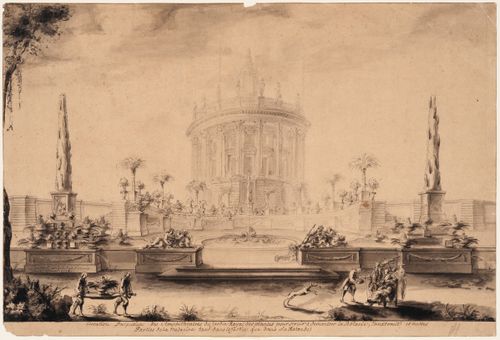
- DR1962:0006 shows a perspective view of a portion of a formal garden terrace laid out symmetrically before a three-storey circular structure. The terrace, which is approached on axis by two steps flanked by sculpted river allegories, is centred on a circular basin and backed by a wall surmounted by potted plants, mostly palm trees and pineapple plants; the middle section of the rear wall curves back concentric to the terrace basin. Beyond the terrace wall and on line with the steps and basin rises the circular structure. With its Corinthian peristyle, this structure has the form of an antique circular temple, such as the so-called "Temple of Vesta" at Tivoli (first century B.C.). Unlike such classical models, however, the columns of the peristyle are set on tall rusticated pedestals that flare outward as they descend to the ground, the entablature carries a balustrade topped by a series of sculpted figures, and the whole is crowned by a tall, slender lantern (although no dome is visible). Within the peristyle, the inner wall is opened regularly by two storeys of windows, each with its own frame and pediment. The overall effect of this structure is not dissimilar to that of James Gibb's Radcliffe Camera, Oxford (1739-49). - In the foreground of DR1962:0006 appear two groups of figures: that on the left consisting of two gardeners carrying a potted pineapple plant, and that on the right consisting of a seated woman attended by a man, a woman (the latter shading her mistress with a parasol), and a figure, apparently a physician, who offers the seated woman a bowl of fruit.
DR1962:0006
Description:
- DR1962:0006 shows a perspective view of a portion of a formal garden terrace laid out symmetrically before a three-storey circular structure. The terrace, which is approached on axis by two steps flanked by sculpted river allegories, is centred on a circular basin and backed by a wall surmounted by potted plants, mostly palm trees and pineapple plants; the middle section of the rear wall curves back concentric to the terrace basin. Beyond the terrace wall and on line with the steps and basin rises the circular structure. With its Corinthian peristyle, this structure has the form of an antique circular temple, such as the so-called "Temple of Vesta" at Tivoli (first century B.C.). Unlike such classical models, however, the columns of the peristyle are set on tall rusticated pedestals that flare outward as they descend to the ground, the entablature carries a balustrade topped by a series of sculpted figures, and the whole is crowned by a tall, slender lantern (although no dome is visible). Within the peristyle, the inner wall is opened regularly by two storeys of windows, each with its own frame and pediment. The overall effect of this structure is not dissimilar to that of James Gibb's Radcliffe Camera, Oxford (1739-49). - In the foreground of DR1962:0006 appear two groups of figures: that on the left consisting of two gardeners carrying a potted pineapple plant, and that on the right consisting of a seated woman attended by a man, a woman (the latter shading her mistress with a parasol), and a figure, apparently a physician, who offers the seated woman a bowl of fruit.
Personnes et institutions:
Sujet:
architecture, architecture de paysage
architecture, architecture de paysage
Date:
ca. 1744
ca. 1744
Titre:
Project for a medical amphitheatre in the Jardin royal des plantes, Paris
Actions:
DR1962:0006
Description:
- DR1962:0006 shows a perspective view of a portion of a formal garden terrace laid out symmetrically before a three-storey circular structure. The terrace, which is approached on axis by two steps flanked by sculpted river allegories, is centred on a circular basin and backed by a wall surmounted by potted plants, mostly palm trees and pineapple plants; the middle section of the rear wall curves back concentric to the terrace basin. Beyond the terrace wall and on line with the steps and basin rises the circular structure. With its Corinthian peristyle, this structure has the form of an antique circular temple, such as the so-called "Temple of Vesta" at Tivoli (first century B.C.). Unlike such classical models, however, the columns of the peristyle are set on tall rusticated pedestals that flare outward as they descend to the ground, the entablature carries a balustrade topped by a series of sculpted figures, and the whole is crowned by a tall, slender lantern (although no dome is visible). Within the peristyle, the inner wall is opened regularly by two storeys of windows, each with its own frame and pediment. The overall effect of this structure is not dissimilar to that of James Gibb's Radcliffe Camera, Oxford (1739-49). - In the foreground of DR1962:0006 appear two groups of figures: that on the left consisting of two gardeners carrying a potted pineapple plant, and that on the right consisting of a seated woman attended by a man, a woman (the latter shading her mistress with a parasol), and a figure, apparently a physician, who offers the seated woman a bowl of fruit.
Project for a medical amphitheatre in the Jardin royal des plantes, Paris
Actions:
DR1962:0006
Description:
- DR1962:0006 shows a perspective view of a portion of a formal garden terrace laid out symmetrically before a three-storey circular structure. The terrace, which is approached on axis by two steps flanked by sculpted river allegories, is centred on a circular basin and backed by a wall surmounted by potted plants, mostly palm trees and pineapple plants; the middle section of the rear wall curves back concentric to the terrace basin. Beyond the terrace wall and on line with the steps and basin rises the circular structure. With its Corinthian peristyle, this structure has the form of an antique circular temple, such as the so-called "Temple of Vesta" at Tivoli (first century B.C.). Unlike such classical models, however, the columns of the peristyle are set on tall rusticated pedestals that flare outward as they descend to the ground, the entablature carries a balustrade topped by a series of sculpted figures, and the whole is crowned by a tall, slender lantern (although no dome is visible). Within the peristyle, the inner wall is opened regularly by two storeys of windows, each with its own frame and pediment. The overall effect of this structure is not dissimilar to that of James Gibb's Radcliffe Camera, Oxford (1739-49). - In the foreground of DR1962:0006 appear two groups of figures: that on the left consisting of two gardeners carrying a potted pineapple plant, and that on the right consisting of a seated woman attended by a man, a woman (the latter shading her mistress with a parasol), and a figure, apparently a physician, who offers the seated woman a bowl of fruit.
Classification:
dessins
dessins
Date:
ca. 1744
ca. 1744
Personnes et institutions:
Sujet:
architecture, architecture de paysage
architecture, architecture de paysage
Classification:
dessins
dessins
Numéro de référence:
DR1980:0060:002
Description:
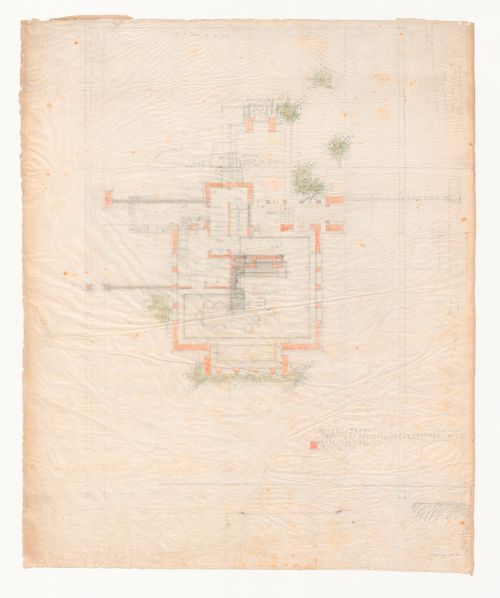
- This first floor plan, with the perspective (DR1980:0060:001) and the second floor plan (DR1980:0060:003) form a set of early presentation drawings. The scale is probably 1/4" = 1' (see object file, de Long report). This plan indicates reworking in the porch/stair and service entrance areas which appear in Hitchcock's book (plate 201) and were built as sketched. The fireplace and seat in the living room were shifted and subsequently built as sketched, as was the ice room. The wall added to the right was shifted back in the final Hitchcock plan. The entry behind the livingroom has sketched-in doors at the rear, as seen in the Hitchcock drawing -- other doors do not yet appear, nor does the garden court. The house became more private in the final adjustments to the site. Wright's further changes are: the wall extending left was crossed out; a freehand wall is roughed in to right; heavy masonry walls are roughed in to left over former wall. (There are other miscellaneous markings and crosshatchings in the reworking.)
DR1980:0060:002
Description:
- This first floor plan, with the perspective (DR1980:0060:001) and the second floor plan (DR1980:0060:003) form a set of early presentation drawings. The scale is probably 1/4" = 1' (see object file, de Long report). This plan indicates reworking in the porch/stair and service entrance areas which appear in Hitchcock's book (plate 201) and were built as sketched. The fireplace and seat in the living room were shifted and subsequently built as sketched, as was the ice room. The wall added to the right was shifted back in the final Hitchcock plan. The entry behind the livingroom has sketched-in doors at the rear, as seen in the Hitchcock drawing -- other doors do not yet appear, nor does the garden court. The house became more private in the final adjustments to the site. Wright's further changes are: the wall extending left was crossed out; a freehand wall is roughed in to right; heavy masonry walls are roughed in to left over former wall. (There are other miscellaneous markings and crosshatchings in the reworking.)
Personnes et institutions:
Sujet:
architecture
architecture
Date:
1915
1915
Titre:
First floor plan for Emil Bach House, Chicago, Illinois
Actions:
DR1980:0060:002
Description:
- This first floor plan, with the perspective (DR1980:0060:001) and the second floor plan (DR1980:0060:003) form a set of early presentation drawings. The scale is probably 1/4" = 1' (see object file, de Long report). This plan indicates reworking in the porch/stair and service entrance areas which appear in Hitchcock's book (plate 201) and were built as sketched. The fireplace and seat in the living room were shifted and subsequently built as sketched, as was the ice room. The wall added to the right was shifted back in the final Hitchcock plan. The entry behind the livingroom has sketched-in doors at the rear, as seen in the Hitchcock drawing -- other doors do not yet appear, nor does the garden court. The house became more private in the final adjustments to the site. Wright's further changes are: the wall extending left was crossed out; a freehand wall is roughed in to right; heavy masonry walls are roughed in to left over former wall. (There are other miscellaneous markings and crosshatchings in the reworking.)
First floor plan for Emil Bach House, Chicago, Illinois
Actions:
DR1980:0060:002
Description:
- This first floor plan, with the perspective (DR1980:0060:001) and the second floor plan (DR1980:0060:003) form a set of early presentation drawings. The scale is probably 1/4" = 1' (see object file, de Long report). This plan indicates reworking in the porch/stair and service entrance areas which appear in Hitchcock's book (plate 201) and were built as sketched. The fireplace and seat in the living room were shifted and subsequently built as sketched, as was the ice room. The wall added to the right was shifted back in the final Hitchcock plan. The entry behind the livingroom has sketched-in doors at the rear, as seen in the Hitchcock drawing -- other doors do not yet appear, nor does the garden court. The house became more private in the final adjustments to the site. Wright's further changes are: the wall extending left was crossed out; a freehand wall is roughed in to right; heavy masonry walls are roughed in to left over former wall. (There are other miscellaneous markings and crosshatchings in the reworking.)
Classification:
dessins
dessins
Date:
1915
1915
Personnes et institutions:
Sujet:
architecture
architecture
Classification:
documents textuels
documents textuels
Numéro de référence:
ARCH274173
Description:
9 files- correspondence related to Dunbar Residence, Yerba Buena Gardens, Magaf Competition Kuwait, The Jewish Museum San Francisco, Switzerland/Germany and China/Japan correspondence (1984-1987), transmittals, invoices, copyright release forms, general working files (ca. 1995-1997). Records primarily relate to the activities of Arthur Erickson Architects, Nick Milkovich Architects and Arthur Erickson Architectutal Corporation.
ARCH274173
Description:
9 files- correspondence related to Dunbar Residence, Yerba Buena Gardens, Magaf Competition Kuwait, The Jewish Museum San Francisco, Switzerland/Germany and China/Japan correspondence (1984-1987), transmittals, invoices, copyright release forms, general working files (ca. 1995-1997). Records primarily relate to the activities of Arthur Erickson Architects, Nick Milkovich Architects and Arthur Erickson Architectutal Corporation.
Personnes et institutions:
Date:
circa 1990-1997
circa 1990-1997
Titre:
Correspondence related to various projects, transmittals, invoices, and general working files
Actions:
ARCH274173
Description:
9 files- correspondence related to Dunbar Residence, Yerba Buena Gardens, Magaf Competition Kuwait, The Jewish Museum San Francisco, Switzerland/Germany and China/Japan correspondence (1984-1987), transmittals, invoices, copyright release forms, general working files (ca. 1995-1997). Records primarily relate to the activities of Arthur Erickson Architects, Nick Milkovich Architects and Arthur Erickson Architectutal Corporation.
Correspondence related to various projects, transmittals, invoices, and general working files
Actions:
ARCH274173
Description:
9 files- correspondence related to Dunbar Residence, Yerba Buena Gardens, Magaf Competition Kuwait, The Jewish Museum San Francisco, Switzerland/Germany and China/Japan correspondence (1984-1987), transmittals, invoices, copyright release forms, general working files (ca. 1995-1997). Records primarily relate to the activities of Arthur Erickson Architects, Nick Milkovich Architects and Arthur Erickson Architectutal Corporation.
Classification:
documents textuels
documents textuels
Date:
circa 1990-1997
circa 1990-1997
Personnes et institutions:
Classification:
dessins, oeuvres d'art
Quantité:
32 drawing(s)
dessins, oeuvres d'art
Quantité:
32 drawing(s)
Numéro de référence:
DR1986:0379-0413
Description:
- This group of drawings and prints for Château de Marcoussis (designed by Charles Rohault de Fleury in 1862-1863), and for later additions to the château by Rohault de Fleury and other architects, is composed mostly of design development and presentation drawings and transfer lithographs - mainly plans and elevations. Three wash drawings and 13 transfer lithographs, some coloured with wash, are for the château as constructed and are mostly dated June 1863 (drawings: DR1986:0380, DR1986:0382, DR1986:0383; transfer lithographs: DR1986:0387 - DR1986:0389, DR1986:0397 - DR1986:0407). Drawings for two unexecuted designs for the château are included: the first is dated 3 May 1862, and possibly 23 May 1862 (DR1986:0379, DR1986:0393, DR1986:394), and the second 15 May 1862 (DR1986:0395 and DR1986:0396). Three untitled drawings may also be designs for Château Marcoussis, although the inscription "1er projet" in conjunction with the later date of April 1863, suggests that they are perhaps for a different unidentified project (DR1986:0390 - DR1986:0392). A proposal for a tower addition by Rohault de Fleury is dated 1 April 1864 (DR1986:0381). This tower also appears on a plan of Château Marcoussis by an unknown hand (DR1986:0408). A land survey for part of the château's park is signed and stamped by the landscape architect, L.L. Le Breton, whose stamp also appears on a drainage plan for the château (DR1986:0409 and DR1986:0397 R). Also included are a proposal for a winter garden for Château Marcoussis designed by Geriche (DR1986:0384), an unattributed project for modifications to the winter garden (DR1986:0385), and plans for an unidentified house (DR1986:0412 and DR1986:0413). Folder DR1986:0386 and mounts DR1986:0410 and DR1986:0411 were acquired with this group. All three objects are inscribed with titles, and those on the mounts indicate the existence of two drawings that were not acquired with the group: "Marcoussis / Mr le Mis de la Baume" (DR1986:0410) and "Escalier au tourelle / (projet) / 1900" (DR1986:0411). The inscribed title which figures on the verso of mount DR1986:0410 indicates that it was at one time used as a folder: "Château de Marcoussis / projets d'agrandissement / et de constructions".
DR1986:0379-0413
Description:
- This group of drawings and prints for Château de Marcoussis (designed by Charles Rohault de Fleury in 1862-1863), and for later additions to the château by Rohault de Fleury and other architects, is composed mostly of design development and presentation drawings and transfer lithographs - mainly plans and elevations. Three wash drawings and 13 transfer lithographs, some coloured with wash, are for the château as constructed and are mostly dated June 1863 (drawings: DR1986:0380, DR1986:0382, DR1986:0383; transfer lithographs: DR1986:0387 - DR1986:0389, DR1986:0397 - DR1986:0407). Drawings for two unexecuted designs for the château are included: the first is dated 3 May 1862, and possibly 23 May 1862 (DR1986:0379, DR1986:0393, DR1986:394), and the second 15 May 1862 (DR1986:0395 and DR1986:0396). Three untitled drawings may also be designs for Château Marcoussis, although the inscription "1er projet" in conjunction with the later date of April 1863, suggests that they are perhaps for a different unidentified project (DR1986:0390 - DR1986:0392). A proposal for a tower addition by Rohault de Fleury is dated 1 April 1864 (DR1986:0381). This tower also appears on a plan of Château Marcoussis by an unknown hand (DR1986:0408). A land survey for part of the château's park is signed and stamped by the landscape architect, L.L. Le Breton, whose stamp also appears on a drainage plan for the château (DR1986:0409 and DR1986:0397 R). Also included are a proposal for a winter garden for Château Marcoussis designed by Geriche (DR1986:0384), an unattributed project for modifications to the winter garden (DR1986:0385), and plans for an unidentified house (DR1986:0412 and DR1986:0413). Folder DR1986:0386 and mounts DR1986:0410 and DR1986:0411 were acquired with this group. All three objects are inscribed with titles, and those on the mounts indicate the existence of two drawings that were not acquired with the group: "Marcoussis / Mr le Mis de la Baume" (DR1986:0410) and "Escalier au tourelle / (projet) / 1900" (DR1986:0411). The inscribed title which figures on the verso of mount DR1986:0410 indicates that it was at one time used as a folder: "Château de Marcoussis / projets d'agrandissement / et de constructions".
Personnes et institutions:
Sujet:
architecture, architecture de paysage, design d'intérieur
architecture, architecture de paysage, design d'intérieur
Date:
prints executed in 1863
prints executed in 1863
Titre:
Drawings and prints for Château de Marcoussis, France
Actions:
DR1986:0379-0413
Description:
- This group of drawings and prints for Château de Marcoussis (designed by Charles Rohault de Fleury in 1862-1863), and for later additions to the château by Rohault de Fleury and other architects, is composed mostly of design development and presentation drawings and transfer lithographs - mainly plans and elevations. Three wash drawings and 13 transfer lithographs, some coloured with wash, are for the château as constructed and are mostly dated June 1863 (drawings: DR1986:0380, DR1986:0382, DR1986:0383; transfer lithographs: DR1986:0387 - DR1986:0389, DR1986:0397 - DR1986:0407). Drawings for two unexecuted designs for the château are included: the first is dated 3 May 1862, and possibly 23 May 1862 (DR1986:0379, DR1986:0393, DR1986:394), and the second 15 May 1862 (DR1986:0395 and DR1986:0396). Three untitled drawings may also be designs for Château Marcoussis, although the inscription "1er projet" in conjunction with the later date of April 1863, suggests that they are perhaps for a different unidentified project (DR1986:0390 - DR1986:0392). A proposal for a tower addition by Rohault de Fleury is dated 1 April 1864 (DR1986:0381). This tower also appears on a plan of Château Marcoussis by an unknown hand (DR1986:0408). A land survey for part of the château's park is signed and stamped by the landscape architect, L.L. Le Breton, whose stamp also appears on a drainage plan for the château (DR1986:0409 and DR1986:0397 R). Also included are a proposal for a winter garden for Château Marcoussis designed by Geriche (DR1986:0384), an unattributed project for modifications to the winter garden (DR1986:0385), and plans for an unidentified house (DR1986:0412 and DR1986:0413). Folder DR1986:0386 and mounts DR1986:0410 and DR1986:0411 were acquired with this group. All three objects are inscribed with titles, and those on the mounts indicate the existence of two drawings that were not acquired with the group: "Marcoussis / Mr le Mis de la Baume" (DR1986:0410) and "Escalier au tourelle / (projet) / 1900" (DR1986:0411). The inscribed title which figures on the verso of mount DR1986:0410 indicates that it was at one time used as a folder: "Château de Marcoussis / projets d'agrandissement / et de constructions".
Drawings and prints for Château de Marcoussis, France
Actions:
DR1986:0379-0413
Description:
- This group of drawings and prints for Château de Marcoussis (designed by Charles Rohault de Fleury in 1862-1863), and for later additions to the château by Rohault de Fleury and other architects, is composed mostly of design development and presentation drawings and transfer lithographs - mainly plans and elevations. Three wash drawings and 13 transfer lithographs, some coloured with wash, are for the château as constructed and are mostly dated June 1863 (drawings: DR1986:0380, DR1986:0382, DR1986:0383; transfer lithographs: DR1986:0387 - DR1986:0389, DR1986:0397 - DR1986:0407). Drawings for two unexecuted designs for the château are included: the first is dated 3 May 1862, and possibly 23 May 1862 (DR1986:0379, DR1986:0393, DR1986:394), and the second 15 May 1862 (DR1986:0395 and DR1986:0396). Three untitled drawings may also be designs for Château Marcoussis, although the inscription "1er projet" in conjunction with the later date of April 1863, suggests that they are perhaps for a different unidentified project (DR1986:0390 - DR1986:0392). A proposal for a tower addition by Rohault de Fleury is dated 1 April 1864 (DR1986:0381). This tower also appears on a plan of Château Marcoussis by an unknown hand (DR1986:0408). A land survey for part of the château's park is signed and stamped by the landscape architect, L.L. Le Breton, whose stamp also appears on a drainage plan for the château (DR1986:0409 and DR1986:0397 R). Also included are a proposal for a winter garden for Château Marcoussis designed by Geriche (DR1986:0384), an unattributed project for modifications to the winter garden (DR1986:0385), and plans for an unidentified house (DR1986:0412 and DR1986:0413). Folder DR1986:0386 and mounts DR1986:0410 and DR1986:0411 were acquired with this group. All three objects are inscribed with titles, and those on the mounts indicate the existence of two drawings that were not acquired with the group: "Marcoussis / Mr le Mis de la Baume" (DR1986:0410) and "Escalier au tourelle / (projet) / 1900" (DR1986:0411). The inscribed title which figures on the verso of mount DR1986:0410 indicates that it was at one time used as a folder: "Château de Marcoussis / projets d'agrandissement / et de constructions".
Classification:
dessins, oeuvres d'art
Quantité:
32 drawing(s)
dessins, oeuvres d'art
Quantité:
32 drawing(s)
Date:
prints executed in 1863
prints executed in 1863
Personnes et institutions:
Sujet:
architecture, architecture de paysage, design d'intérieur
architecture, architecture de paysage, design d'intérieur
Classification:
photographies
photographies
Numéro de référence:
ARCH268881
Description:
Contains photographic materials on 3 projects by Abalos & Herreros: - Amberes, exposición, AP164.S2.SS1.D12 (8 slides: interior views of the exhibition); - Es Pil•larí, zonas verdes?, AP164.S1.2000.D5 (30 slides: views of graphics, flowers and gardens); - Pabellón de gimnasia en el parque del Retiro, AP164.S1.2000.D3 (169 slides: site plans, maps, reference materials and aerial views).
ARCH268881
Description:
Contains photographic materials on 3 projects by Abalos & Herreros: - Amberes, exposición, AP164.S2.SS1.D12 (8 slides: interior views of the exhibition); - Es Pil•larí, zonas verdes?, AP164.S1.2000.D5 (30 slides: views of graphics, flowers and gardens); - Pabellón de gimnasia en el parque del Retiro, AP164.S1.2000.D3 (169 slides: site plans, maps, reference materials and aerial views).
Personnes et institutions:
Date:
between 1993 and 2004
between 1993 and 2004
Titre:
Ring binder with photographic materials related to three projects by Abalos & Herreros
Actions:
ARCH268881
Description:
Contains photographic materials on 3 projects by Abalos & Herreros: - Amberes, exposición, AP164.S2.SS1.D12 (8 slides: interior views of the exhibition); - Es Pil•larí, zonas verdes?, AP164.S1.2000.D5 (30 slides: views of graphics, flowers and gardens); - Pabellón de gimnasia en el parque del Retiro, AP164.S1.2000.D3 (169 slides: site plans, maps, reference materials and aerial views).
Ring binder with photographic materials related to three projects by Abalos & Herreros
Actions:
ARCH268881
Description:
Contains photographic materials on 3 projects by Abalos & Herreros: - Amberes, exposición, AP164.S2.SS1.D12 (8 slides: interior views of the exhibition); - Es Pil•larí, zonas verdes?, AP164.S1.2000.D5 (30 slides: views of graphics, flowers and gardens); - Pabellón de gimnasia en el parque del Retiro, AP164.S1.2000.D3 (169 slides: site plans, maps, reference materials and aerial views).
Classification:
photographies
photographies
Date:
between 1993 and 2004
between 1993 and 2004
Personnes et institutions:
Niveau de description archivistique:
Sous-série
Sous-série
Titre:
Domestic Commissions
Domestic Commissions
Numéro de référence:
CI001.S2.D2
Description:
Hubert and Charles Rohault de Fleury received domestic commissions for both urban housing -hôtel particuliers and apartment houses- and rural dwellings -châteaux, country houses and estates. Hubert also executed designs for furniture and garden pavilions. Hubert' work is characterized by restrained classical exteriors and luxurious Empire style interiors; both Charles' exteriors and interiors, especially those for Hôtels Sauvage and Soltykoff, reflect the exuberance of the Second Empire. The CCA albums include drawings from all stages of the design process but with an emphasis on design development drawings. Hubert's albums contain cost calculations and estimates, notes and letters. In general, the drawings by Charles are from a more developed phase of design than Hubert's; Hubert's commissions are more varied than Charles'. Charles' Hôtel Soltykoff (1854)(DR1974:0002:003:001-105) is exemplary of the Second Empire not only in its architectural language, programme and interior decoration, but also its use of mixed stone and iron construction. The album for Hôtel Soltykoff is one of the most comprehensive in the CCA collection. The drawings incorporate several phases of the design process from conceptual ideas to post-construction revisions. Numerous drawings for the structure and exterior ornamentation are included as well as drawings for the embellishment of the interior spaces. The interior drawings are especially interesting for evidence they provide of the palette of colours and ornamental motifs utilized in the Second Empire. Several prints (plates XIX - XXIII) in 'Oeuvre de C. Rohault de Fleury, architecte', which include general plans and elevations (few of which are included in the Hôtel Solytkoff album), are a useful complement to more specific drawings in the album. The Hôtel Sauvage (ca. 1862) album (DR1974:0002:006:001-024) - a set of 24 contract drawings- consists exclusively general plans, sections and elevations. This group of drawings give a good overall sense of both the interior and exterior. Hôtel Sauvage, like Hôtel Soltykoff is also typical of the Second Empire in style and programme. Château de Marcoussis (ca. 1861), for which a group of drawings were acquired in 1986, diverges somewhat in character from the other examples of Charles' domestic works represented in the CCA collection (DR1986:0379 - DR1986:0413). While most of the other houses are strictly classical in planning and design, for Château de Marcoussis, Charles adopted a more romantic asymmetrical château style design. The domestic commissions (1838-1856) in album, DR1974:0002:002:001-094, roughly fall into two categories. The first category consists of single residences - both town and country. The regimentation of plans and façades in the hôtel particular and country houses manifests the continued influence of Durand, yet Charles was also clearly affected by the Second Empire propensity for elaborate façade treatments with decoratively-shaped windows, complex mouldings and extensive rustication. The second category consists of urban apartment building with stores or occasionally offices on the ground floor, apartments, generally two per floor, above and often servants' rooms in the attic. These buildings are articulated in a restrained manner with mouldings, decorative ironwork and some stone ornament.
CI001.S2.D2
Description:
Hubert and Charles Rohault de Fleury received domestic commissions for both urban housing -hôtel particuliers and apartment houses- and rural dwellings -châteaux, country houses and estates. Hubert also executed designs for furniture and garden pavilions. Hubert' work is characterized by restrained classical exteriors and luxurious Empire style interiors; both Charles' exteriors and interiors, especially those for Hôtels Sauvage and Soltykoff, reflect the exuberance of the Second Empire. The CCA albums include drawings from all stages of the design process but with an emphasis on design development drawings. Hubert's albums contain cost calculations and estimates, notes and letters. In general, the drawings by Charles are from a more developed phase of design than Hubert's; Hubert's commissions are more varied than Charles'. Charles' Hôtel Soltykoff (1854)(DR1974:0002:003:001-105) is exemplary of the Second Empire not only in its architectural language, programme and interior decoration, but also its use of mixed stone and iron construction. The album for Hôtel Soltykoff is one of the most comprehensive in the CCA collection. The drawings incorporate several phases of the design process from conceptual ideas to post-construction revisions. Numerous drawings for the structure and exterior ornamentation are included as well as drawings for the embellishment of the interior spaces. The interior drawings are especially interesting for evidence they provide of the palette of colours and ornamental motifs utilized in the Second Empire. Several prints (plates XIX - XXIII) in 'Oeuvre de C. Rohault de Fleury, architecte', which include general plans and elevations (few of which are included in the Hôtel Solytkoff album), are a useful complement to more specific drawings in the album. The Hôtel Sauvage (ca. 1862) album (DR1974:0002:006:001-024) - a set of 24 contract drawings- consists exclusively general plans, sections and elevations. This group of drawings give a good overall sense of both the interior and exterior. Hôtel Sauvage, like Hôtel Soltykoff is also typical of the Second Empire in style and programme. Château de Marcoussis (ca. 1861), for which a group of drawings were acquired in 1986, diverges somewhat in character from the other examples of Charles' domestic works represented in the CCA collection (DR1986:0379 - DR1986:0413). While most of the other houses are strictly classical in planning and design, for Château de Marcoussis, Charles adopted a more romantic asymmetrical château style design. The domestic commissions (1838-1856) in album, DR1974:0002:002:001-094, roughly fall into two categories. The first category consists of single residences - both town and country. The regimentation of plans and façades in the hôtel particular and country houses manifests the continued influence of Durand, yet Charles was also clearly affected by the Second Empire propensity for elaborate façade treatments with decoratively-shaped windows, complex mouldings and extensive rustication. The second category consists of urban apartment building with stores or occasionally offices on the ground floor, apartments, generally two per floor, above and often servants' rooms in the attic. These buildings are articulated in a restrained manner with mouldings, decorative ironwork and some stone ornament.
Personnes et institutions:
Date:
[between 1838 and 1861]
[between 1838 and 1861]
Titre:
Domestic Commissions
CI001.S2.D2
Description:
Hubert and Charles Rohault de Fleury received domestic commissions for both urban housing -hôtel particuliers and apartment houses- and rural dwellings -châteaux, country houses and estates. Hubert also executed designs for furniture and garden pavilions. Hubert' work is characterized by restrained classical exteriors and luxurious Empire style interiors; both Charles' exteriors and interiors, especially those for Hôtels Sauvage and Soltykoff, reflect the exuberance of the Second Empire. The CCA albums include drawings from all stages of the design process but with an emphasis on design development drawings. Hubert's albums contain cost calculations and estimates, notes and letters. In general, the drawings by Charles are from a more developed phase of design than Hubert's; Hubert's commissions are more varied than Charles'. Charles' Hôtel Soltykoff (1854)(DR1974:0002:003:001-105) is exemplary of the Second Empire not only in its architectural language, programme and interior decoration, but also its use of mixed stone and iron construction. The album for Hôtel Soltykoff is one of the most comprehensive in the CCA collection. The drawings incorporate several phases of the design process from conceptual ideas to post-construction revisions. Numerous drawings for the structure and exterior ornamentation are included as well as drawings for the embellishment of the interior spaces. The interior drawings are especially interesting for evidence they provide of the palette of colours and ornamental motifs utilized in the Second Empire. Several prints (plates XIX - XXIII) in 'Oeuvre de C. Rohault de Fleury, architecte', which include general plans and elevations (few of which are included in the Hôtel Solytkoff album), are a useful complement to more specific drawings in the album. The Hôtel Sauvage (ca. 1862) album (DR1974:0002:006:001-024) - a set of 24 contract drawings- consists exclusively general plans, sections and elevations. This group of drawings give a good overall sense of both the interior and exterior. Hôtel Sauvage, like Hôtel Soltykoff is also typical of the Second Empire in style and programme. Château de Marcoussis (ca. 1861), for which a group of drawings were acquired in 1986, diverges somewhat in character from the other examples of Charles' domestic works represented in the CCA collection (DR1986:0379 - DR1986:0413). While most of the other houses are strictly classical in planning and design, for Château de Marcoussis, Charles adopted a more romantic asymmetrical château style design. The domestic commissions (1838-1856) in album, DR1974:0002:002:001-094, roughly fall into two categories. The first category consists of single residences - both town and country. The regimentation of plans and façades in the hôtel particular and country houses manifests the continued influence of Durand, yet Charles was also clearly affected by the Second Empire propensity for elaborate façade treatments with decoratively-shaped windows, complex mouldings and extensive rustication. The second category consists of urban apartment building with stores or occasionally offices on the ground floor, apartments, generally two per floor, above and often servants' rooms in the attic. These buildings are articulated in a restrained manner with mouldings, decorative ironwork and some stone ornament.
Domestic Commissions
CI001.S2.D2
Description:
Hubert and Charles Rohault de Fleury received domestic commissions for both urban housing -hôtel particuliers and apartment houses- and rural dwellings -châteaux, country houses and estates. Hubert also executed designs for furniture and garden pavilions. Hubert' work is characterized by restrained classical exteriors and luxurious Empire style interiors; both Charles' exteriors and interiors, especially those for Hôtels Sauvage and Soltykoff, reflect the exuberance of the Second Empire. The CCA albums include drawings from all stages of the design process but with an emphasis on design development drawings. Hubert's albums contain cost calculations and estimates, notes and letters. In general, the drawings by Charles are from a more developed phase of design than Hubert's; Hubert's commissions are more varied than Charles'. Charles' Hôtel Soltykoff (1854)(DR1974:0002:003:001-105) is exemplary of the Second Empire not only in its architectural language, programme and interior decoration, but also its use of mixed stone and iron construction. The album for Hôtel Soltykoff is one of the most comprehensive in the CCA collection. The drawings incorporate several phases of the design process from conceptual ideas to post-construction revisions. Numerous drawings for the structure and exterior ornamentation are included as well as drawings for the embellishment of the interior spaces. The interior drawings are especially interesting for evidence they provide of the palette of colours and ornamental motifs utilized in the Second Empire. Several prints (plates XIX - XXIII) in 'Oeuvre de C. Rohault de Fleury, architecte', which include general plans and elevations (few of which are included in the Hôtel Solytkoff album), are a useful complement to more specific drawings in the album. The Hôtel Sauvage (ca. 1862) album (DR1974:0002:006:001-024) - a set of 24 contract drawings- consists exclusively general plans, sections and elevations. This group of drawings give a good overall sense of both the interior and exterior. Hôtel Sauvage, like Hôtel Soltykoff is also typical of the Second Empire in style and programme. Château de Marcoussis (ca. 1861), for which a group of drawings were acquired in 1986, diverges somewhat in character from the other examples of Charles' domestic works represented in the CCA collection (DR1986:0379 - DR1986:0413). While most of the other houses are strictly classical in planning and design, for Château de Marcoussis, Charles adopted a more romantic asymmetrical château style design. The domestic commissions (1838-1856) in album, DR1974:0002:002:001-094, roughly fall into two categories. The first category consists of single residences - both town and country. The regimentation of plans and façades in the hôtel particular and country houses manifests the continued influence of Durand, yet Charles was also clearly affected by the Second Empire propensity for elaborate façade treatments with decoratively-shaped windows, complex mouldings and extensive rustication. The second category consists of urban apartment building with stores or occasionally offices on the ground floor, apartments, generally two per floor, above and often servants' rooms in the attic. These buildings are articulated in a restrained manner with mouldings, decorative ironwork and some stone ornament.
Niveau de description archivistique:
File 2
File 2
Date:
[between 1838 and 1861]
[between 1838 and 1861]
Personnes et institutions:
Classification:
dessins, photographies
dessins, photographies
Numéro de référence:
DR2012:0011:032
Description:
Ring binder containing drawings, photographs, reprographic copies, stats of architectural, art, and graphic design work, and a watercolour related to Melvin Charney's activities as a student at McGill University, and include the following early projects: - Kitchen details for Mr. and Mrs. A. Zion (1 stat); - Design of vol. 2, no. 2 of YES: A Creative Quarterly (1 copy); - Small weekend house (3 stats); - Curb-service restaurant, for summer use only, on a Laurentian road (2 stat); - Studio-house in the Laurentian mountains (2 stats); - Apartment house to complete an existing pattern of older garden apartments (3 stats); - Community library for the Town of Mount Royal (6 stats); - Motel near the St. Lawrence River (2 stats); - Child centre (3 stats); - Building for the Province of Quebec Architects Association (4 stats); - Cloverdale shopping centre (1 stat); - Morse Jewellers (4 stats); - Steinberg's supermarket, Montreal North; - Reinforced concrete canopy, Molson Stadium (1 sketch, 1 photograph, 1 stat); - Town of Dorval subdivision proposal (1 stat); - Ottawa City Hall, study of lighting of areas in the building (1 stat); - Entrance vestibule, 1552 St. Matthew Street, Montreal (1 stat).
DR2012:0011:032
Description:
Ring binder containing drawings, photographs, reprographic copies, stats of architectural, art, and graphic design work, and a watercolour related to Melvin Charney's activities as a student at McGill University, and include the following early projects: - Kitchen details for Mr. and Mrs. A. Zion (1 stat); - Design of vol. 2, no. 2 of YES: A Creative Quarterly (1 copy); - Small weekend house (3 stats); - Curb-service restaurant, for summer use only, on a Laurentian road (2 stat); - Studio-house in the Laurentian mountains (2 stats); - Apartment house to complete an existing pattern of older garden apartments (3 stats); - Community library for the Town of Mount Royal (6 stats); - Motel near the St. Lawrence River (2 stats); - Child centre (3 stats); - Building for the Province of Quebec Architects Association (4 stats); - Cloverdale shopping centre (1 stat); - Morse Jewellers (4 stats); - Steinberg's supermarket, Montreal North; - Reinforced concrete canopy, Molson Stadium (1 sketch, 1 photograph, 1 stat); - Town of Dorval subdivision proposal (1 stat); - Ottawa City Hall, study of lighting of areas in the building (1 stat); - Entrance vestibule, 1552 St. Matthew Street, Montreal (1 stat).
Personnes et institutions:
Date:
1955-1957
1955-1957
Titre:
Portfolio for application to the graduate program at Yale University
Actions:
DR2012:0011:032
Description:
Ring binder containing drawings, photographs, reprographic copies, stats of architectural, art, and graphic design work, and a watercolour related to Melvin Charney's activities as a student at McGill University, and include the following early projects: - Kitchen details for Mr. and Mrs. A. Zion (1 stat); - Design of vol. 2, no. 2 of YES: A Creative Quarterly (1 copy); - Small weekend house (3 stats); - Curb-service restaurant, for summer use only, on a Laurentian road (2 stat); - Studio-house in the Laurentian mountains (2 stats); - Apartment house to complete an existing pattern of older garden apartments (3 stats); - Community library for the Town of Mount Royal (6 stats); - Motel near the St. Lawrence River (2 stats); - Child centre (3 stats); - Building for the Province of Quebec Architects Association (4 stats); - Cloverdale shopping centre (1 stat); - Morse Jewellers (4 stats); - Steinberg's supermarket, Montreal North; - Reinforced concrete canopy, Molson Stadium (1 sketch, 1 photograph, 1 stat); - Town of Dorval subdivision proposal (1 stat); - Ottawa City Hall, study of lighting of areas in the building (1 stat); - Entrance vestibule, 1552 St. Matthew Street, Montreal (1 stat).
Portfolio for application to the graduate program at Yale University
Actions:
DR2012:0011:032
Description:
Ring binder containing drawings, photographs, reprographic copies, stats of architectural, art, and graphic design work, and a watercolour related to Melvin Charney's activities as a student at McGill University, and include the following early projects: - Kitchen details for Mr. and Mrs. A. Zion (1 stat); - Design of vol. 2, no. 2 of YES: A Creative Quarterly (1 copy); - Small weekend house (3 stats); - Curb-service restaurant, for summer use only, on a Laurentian road (2 stat); - Studio-house in the Laurentian mountains (2 stats); - Apartment house to complete an existing pattern of older garden apartments (3 stats); - Community library for the Town of Mount Royal (6 stats); - Motel near the St. Lawrence River (2 stats); - Child centre (3 stats); - Building for the Province of Quebec Architects Association (4 stats); - Cloverdale shopping centre (1 stat); - Morse Jewellers (4 stats); - Steinberg's supermarket, Montreal North; - Reinforced concrete canopy, Molson Stadium (1 sketch, 1 photograph, 1 stat); - Town of Dorval subdivision proposal (1 stat); - Ottawa City Hall, study of lighting of areas in the building (1 stat); - Entrance vestibule, 1552 St. Matthew Street, Montreal (1 stat).
Classification:
dessins, photographies
dessins, photographies
Date:
1955-1957
1955-1957
Personnes et institutions:
Niveau de description archivistique:
Projet
Projet
Titre:
University Art Museum
University Art Museum
Numéro de référence:
AP143.S4.D65
Description:
File documents the unexecuted project for the University Art Museum, Long Beach, California. Material in this file was produced between 1986 and 1988. California State University, Long Beach (CSULB), commissioned Eisenman/Robertson Architects to design an art museum adjacent to the main campus entrance. The 67,500-square-foot building was to comprise four galleries, a black-box theater, an auditorium, a cafe, conference rooms, a library, offices, preparation spaces, and storage vaults. The project, sited on a 23-acre arboretum, included landscaping; terraced sculpture courtyards, botanical gardens, and a two-acre pond. Eisenman linked the northern and southern parts of the arboretum by an elevated public walkway through the museum. Sets of drawings were presented on 8 and 30 April, 2 June, and 5 Aug. In the first design phase Eisenman explores the cartographic figures which form the basis of his artificial excavation when superposed: a series of sketches establishes the analogical relationships which fix the relative scales of the plans and produce the superpositions; another series contextualizes the superposed figures by placing them within the museum site (DR1987:0859:087-090). The second phase concerns the building; the working model shows the building carved out of a square pit, from which spring an oil derrick and a reconstruction of a recreational pier (Rainbow Pier, 1920s) used here as circulatory bridge (DR1987:0859:160). In the third phase the architect systematizes his archeological procedure by using five significant cartographic dates - 1849, 1889, 1949, 1989, 2049 - each corresponding to a specific superposition (see DR1987:0859:274-277). In the fourth phase, Eisenman simplifies the superposition of 2049 to a few iconic colour-coded forms: ranch (green), ranch house (blue), campus site (red), and water forms (river and pond) (gold). Material for the fourth phase includes three relief models, four presentation drawings, and a model (property of the CSULB) (relief models: DR1987:0859:001-003; drawings: DR1987:0859:004-008). Eisenman "inhabits" his artifical archeology by detailed planning of interior spaces, and gives substance to the cartographic traces in a series of sketch sections, perspectives, and working models. Working models reveal how the central "canal" area gradually became the museum's access point (DR1987:0859:484-490); the museum, galleries, offices, and preparation areas are on one side of this deep cut, while the cafeteria and black-box theater are on the other. The upper level was to house offices, meeting rooms, and the library. File contains audiovisual material, conceptual drawings, design development drawings, presentation drawings, reference drawings, working drawings, photographic materials, and textual records.
AP143.S4.D65
Description:
File documents the unexecuted project for the University Art Museum, Long Beach, California. Material in this file was produced between 1986 and 1988. California State University, Long Beach (CSULB), commissioned Eisenman/Robertson Architects to design an art museum adjacent to the main campus entrance. The 67,500-square-foot building was to comprise four galleries, a black-box theater, an auditorium, a cafe, conference rooms, a library, offices, preparation spaces, and storage vaults. The project, sited on a 23-acre arboretum, included landscaping; terraced sculpture courtyards, botanical gardens, and a two-acre pond. Eisenman linked the northern and southern parts of the arboretum by an elevated public walkway through the museum. Sets of drawings were presented on 8 and 30 April, 2 June, and 5 Aug. In the first design phase Eisenman explores the cartographic figures which form the basis of his artificial excavation when superposed: a series of sketches establishes the analogical relationships which fix the relative scales of the plans and produce the superpositions; another series contextualizes the superposed figures by placing them within the museum site (DR1987:0859:087-090). The second phase concerns the building; the working model shows the building carved out of a square pit, from which spring an oil derrick and a reconstruction of a recreational pier (Rainbow Pier, 1920s) used here as circulatory bridge (DR1987:0859:160). In the third phase the architect systematizes his archeological procedure by using five significant cartographic dates - 1849, 1889, 1949, 1989, 2049 - each corresponding to a specific superposition (see DR1987:0859:274-277). In the fourth phase, Eisenman simplifies the superposition of 2049 to a few iconic colour-coded forms: ranch (green), ranch house (blue), campus site (red), and water forms (river and pond) (gold). Material for the fourth phase includes three relief models, four presentation drawings, and a model (property of the CSULB) (relief models: DR1987:0859:001-003; drawings: DR1987:0859:004-008). Eisenman "inhabits" his artifical archeology by detailed planning of interior spaces, and gives substance to the cartographic traces in a series of sketch sections, perspectives, and working models. Working models reveal how the central "canal" area gradually became the museum's access point (DR1987:0859:484-490); the museum, galleries, offices, and preparation areas are on one side of this deep cut, while the cafeteria and black-box theater are on the other. The upper level was to house offices, meeting rooms, and the library. File contains audiovisual material, conceptual drawings, design development drawings, presentation drawings, reference drawings, working drawings, photographic materials, and textual records.
Personnes et institutions:
Date:
1986-1988
1986-1988
Titre:
University Art Museum
Actions:
AP143.S4.D65
Description:
File documents the unexecuted project for the University Art Museum, Long Beach, California. Material in this file was produced between 1986 and 1988. California State University, Long Beach (CSULB), commissioned Eisenman/Robertson Architects to design an art museum adjacent to the main campus entrance. The 67,500-square-foot building was to comprise four galleries, a black-box theater, an auditorium, a cafe, conference rooms, a library, offices, preparation spaces, and storage vaults. The project, sited on a 23-acre arboretum, included landscaping; terraced sculpture courtyards, botanical gardens, and a two-acre pond. Eisenman linked the northern and southern parts of the arboretum by an elevated public walkway through the museum. Sets of drawings were presented on 8 and 30 April, 2 June, and 5 Aug. In the first design phase Eisenman explores the cartographic figures which form the basis of his artificial excavation when superposed: a series of sketches establishes the analogical relationships which fix the relative scales of the plans and produce the superpositions; another series contextualizes the superposed figures by placing them within the museum site (DR1987:0859:087-090). The second phase concerns the building; the working model shows the building carved out of a square pit, from which spring an oil derrick and a reconstruction of a recreational pier (Rainbow Pier, 1920s) used here as circulatory bridge (DR1987:0859:160). In the third phase the architect systematizes his archeological procedure by using five significant cartographic dates - 1849, 1889, 1949, 1989, 2049 - each corresponding to a specific superposition (see DR1987:0859:274-277). In the fourth phase, Eisenman simplifies the superposition of 2049 to a few iconic colour-coded forms: ranch (green), ranch house (blue), campus site (red), and water forms (river and pond) (gold). Material for the fourth phase includes three relief models, four presentation drawings, and a model (property of the CSULB) (relief models: DR1987:0859:001-003; drawings: DR1987:0859:004-008). Eisenman "inhabits" his artifical archeology by detailed planning of interior spaces, and gives substance to the cartographic traces in a series of sketch sections, perspectives, and working models. Working models reveal how the central "canal" area gradually became the museum's access point (DR1987:0859:484-490); the museum, galleries, offices, and preparation areas are on one side of this deep cut, while the cafeteria and black-box theater are on the other. The upper level was to house offices, meeting rooms, and the library. File contains audiovisual material, conceptual drawings, design development drawings, presentation drawings, reference drawings, working drawings, photographic materials, and textual records.
University Art Museum
Actions:
AP143.S4.D65
Description:
File documents the unexecuted project for the University Art Museum, Long Beach, California. Material in this file was produced between 1986 and 1988. California State University, Long Beach (CSULB), commissioned Eisenman/Robertson Architects to design an art museum adjacent to the main campus entrance. The 67,500-square-foot building was to comprise four galleries, a black-box theater, an auditorium, a cafe, conference rooms, a library, offices, preparation spaces, and storage vaults. The project, sited on a 23-acre arboretum, included landscaping; terraced sculpture courtyards, botanical gardens, and a two-acre pond. Eisenman linked the northern and southern parts of the arboretum by an elevated public walkway through the museum. Sets of drawings were presented on 8 and 30 April, 2 June, and 5 Aug. In the first design phase Eisenman explores the cartographic figures which form the basis of his artificial excavation when superposed: a series of sketches establishes the analogical relationships which fix the relative scales of the plans and produce the superpositions; another series contextualizes the superposed figures by placing them within the museum site (DR1987:0859:087-090). The second phase concerns the building; the working model shows the building carved out of a square pit, from which spring an oil derrick and a reconstruction of a recreational pier (Rainbow Pier, 1920s) used here as circulatory bridge (DR1987:0859:160). In the third phase the architect systematizes his archeological procedure by using five significant cartographic dates - 1849, 1889, 1949, 1989, 2049 - each corresponding to a specific superposition (see DR1987:0859:274-277). In the fourth phase, Eisenman simplifies the superposition of 2049 to a few iconic colour-coded forms: ranch (green), ranch house (blue), campus site (red), and water forms (river and pond) (gold). Material for the fourth phase includes three relief models, four presentation drawings, and a model (property of the CSULB) (relief models: DR1987:0859:001-003; drawings: DR1987:0859:004-008). Eisenman "inhabits" his artifical archeology by detailed planning of interior spaces, and gives substance to the cartographic traces in a series of sketch sections, perspectives, and working models. Working models reveal how the central "canal" area gradually became the museum's access point (DR1987:0859:484-490); the museum, galleries, offices, and preparation areas are on one side of this deep cut, while the cafeteria and black-box theater are on the other. The upper level was to house offices, meeting rooms, and the library. File contains audiovisual material, conceptual drawings, design development drawings, presentation drawings, reference drawings, working drawings, photographic materials, and textual records.
Niveau de description archivistique:
File 65
File 65
Date:
1986-1988
1986-1988
Personnes et institutions:
Niveau de description archivistique:
Projet
Projet
Numéro de référence:
AP056.S1.1991.PR01
Description:
This project series documents a competition entry for the Vancouver Public Library in Vancouver from 1991-1992. The office identified the project number as 69112. The competition entry, submitted in 1991, consisted of the design of Vancouver's new public library, to be situated on the block between Homer, Georgia, Hamilton and Robson Streets. The project design included a seven-floor library connected by a walkway to an adjacent twenty-floor office tower that would house Public Works Canada. Both buildings had V shaped canopies on their roofs that looked like open books when viewed at an elevation. To the front of the library at ground level was the two-storey Library Concourse; a large hall made of glass windows and stone. The Concourse connected to the Robson Street entrance, and the Library Hall entrance at the corner of Homer and Georgia Streets. The architects described this as a porch-like space to be used for gatherings, public events, exhibits and displays. Moving into the heart of the library, patrons would pass through a cylindrical rotunda which extended upwards through every floor and above the roof terrace. The library would also have 2 levels of underground parking and a basement level with a circular theatre, concession areas and staff work areas. The ground floor would primarily consist of library stacks and tables but also included would be a gift shop, children's area, daycare, staff spaces, and an outdoor play area. The remaining floors were designated for library stacks, staff work areas and services. The top floor would hold administrative offices, built in a U shape around a large terrace. The terrace, complete with gardens, could be used for library events. This building would largely be made of glass windows at its exterior, with a round glass rotunda piercing through its rectangular shape. This project was never built. Although Kuwabara, Payne, McKenna, Blumberg Architects were finalists in this competition, the contract was eventually won and built by architect Moshe Safdie. The project is recorded through drawings, presentation panels, paintings, photographs and a model dating from 1991-1992. The drawings, which are mostly originals, include sketches, plans, sections, elevations, perspectives and isometrics. There are a number of watercolours (some mounted) and drawing panels used as presentation materials which have small texts about the project's design intention. The aquisition records for the 1993 donation of these project materials identify Michael McCann as the artist of 7 paintings in this project series; however it is not clear which 7 paintings were completed by this artist. The photographs show the completed project model, which is also contained in this project series.
AP056.S1.1991.PR01
Description:
This project series documents a competition entry for the Vancouver Public Library in Vancouver from 1991-1992. The office identified the project number as 69112. The competition entry, submitted in 1991, consisted of the design of Vancouver's new public library, to be situated on the block between Homer, Georgia, Hamilton and Robson Streets. The project design included a seven-floor library connected by a walkway to an adjacent twenty-floor office tower that would house Public Works Canada. Both buildings had V shaped canopies on their roofs that looked like open books when viewed at an elevation. To the front of the library at ground level was the two-storey Library Concourse; a large hall made of glass windows and stone. The Concourse connected to the Robson Street entrance, and the Library Hall entrance at the corner of Homer and Georgia Streets. The architects described this as a porch-like space to be used for gatherings, public events, exhibits and displays. Moving into the heart of the library, patrons would pass through a cylindrical rotunda which extended upwards through every floor and above the roof terrace. The library would also have 2 levels of underground parking and a basement level with a circular theatre, concession areas and staff work areas. The ground floor would primarily consist of library stacks and tables but also included would be a gift shop, children's area, daycare, staff spaces, and an outdoor play area. The remaining floors were designated for library stacks, staff work areas and services. The top floor would hold administrative offices, built in a U shape around a large terrace. The terrace, complete with gardens, could be used for library events. This building would largely be made of glass windows at its exterior, with a round glass rotunda piercing through its rectangular shape. This project was never built. Although Kuwabara, Payne, McKenna, Blumberg Architects were finalists in this competition, the contract was eventually won and built by architect Moshe Safdie. The project is recorded through drawings, presentation panels, paintings, photographs and a model dating from 1991-1992. The drawings, which are mostly originals, include sketches, plans, sections, elevations, perspectives and isometrics. There are a number of watercolours (some mounted) and drawing panels used as presentation materials which have small texts about the project's design intention. The aquisition records for the 1993 donation of these project materials identify Michael McCann as the artist of 7 paintings in this project series; however it is not clear which 7 paintings were completed by this artist. The photographs show the completed project model, which is also contained in this project series.
Personnes et institutions:
Date:
1991-1992
1991-1992
Titre:
Vancouver Public Library Competition, British Columbia (1991)
Actions:
AP056.S1.1991.PR01
Description:
This project series documents a competition entry for the Vancouver Public Library in Vancouver from 1991-1992. The office identified the project number as 69112. The competition entry, submitted in 1991, consisted of the design of Vancouver's new public library, to be situated on the block between Homer, Georgia, Hamilton and Robson Streets. The project design included a seven-floor library connected by a walkway to an adjacent twenty-floor office tower that would house Public Works Canada. Both buildings had V shaped canopies on their roofs that looked like open books when viewed at an elevation. To the front of the library at ground level was the two-storey Library Concourse; a large hall made of glass windows and stone. The Concourse connected to the Robson Street entrance, and the Library Hall entrance at the corner of Homer and Georgia Streets. The architects described this as a porch-like space to be used for gatherings, public events, exhibits and displays. Moving into the heart of the library, patrons would pass through a cylindrical rotunda which extended upwards through every floor and above the roof terrace. The library would also have 2 levels of underground parking and a basement level with a circular theatre, concession areas and staff work areas. The ground floor would primarily consist of library stacks and tables but also included would be a gift shop, children's area, daycare, staff spaces, and an outdoor play area. The remaining floors were designated for library stacks, staff work areas and services. The top floor would hold administrative offices, built in a U shape around a large terrace. The terrace, complete with gardens, could be used for library events. This building would largely be made of glass windows at its exterior, with a round glass rotunda piercing through its rectangular shape. This project was never built. Although Kuwabara, Payne, McKenna, Blumberg Architects were finalists in this competition, the contract was eventually won and built by architect Moshe Safdie. The project is recorded through drawings, presentation panels, paintings, photographs and a model dating from 1991-1992. The drawings, which are mostly originals, include sketches, plans, sections, elevations, perspectives and isometrics. There are a number of watercolours (some mounted) and drawing panels used as presentation materials which have small texts about the project's design intention. The aquisition records for the 1993 donation of these project materials identify Michael McCann as the artist of 7 paintings in this project series; however it is not clear which 7 paintings were completed by this artist. The photographs show the completed project model, which is also contained in this project series.
Vancouver Public Library Competition, British Columbia (1991)
Actions:
AP056.S1.1991.PR01
Description:
This project series documents a competition entry for the Vancouver Public Library in Vancouver from 1991-1992. The office identified the project number as 69112. The competition entry, submitted in 1991, consisted of the design of Vancouver's new public library, to be situated on the block between Homer, Georgia, Hamilton and Robson Streets. The project design included a seven-floor library connected by a walkway to an adjacent twenty-floor office tower that would house Public Works Canada. Both buildings had V shaped canopies on their roofs that looked like open books when viewed at an elevation. To the front of the library at ground level was the two-storey Library Concourse; a large hall made of glass windows and stone. The Concourse connected to the Robson Street entrance, and the Library Hall entrance at the corner of Homer and Georgia Streets. The architects described this as a porch-like space to be used for gatherings, public events, exhibits and displays. Moving into the heart of the library, patrons would pass through a cylindrical rotunda which extended upwards through every floor and above the roof terrace. The library would also have 2 levels of underground parking and a basement level with a circular theatre, concession areas and staff work areas. The ground floor would primarily consist of library stacks and tables but also included would be a gift shop, children's area, daycare, staff spaces, and an outdoor play area. The remaining floors were designated for library stacks, staff work areas and services. The top floor would hold administrative offices, built in a U shape around a large terrace. The terrace, complete with gardens, could be used for library events. This building would largely be made of glass windows at its exterior, with a round glass rotunda piercing through its rectangular shape. This project was never built. Although Kuwabara, Payne, McKenna, Blumberg Architects were finalists in this competition, the contract was eventually won and built by architect Moshe Safdie. The project is recorded through drawings, presentation panels, paintings, photographs and a model dating from 1991-1992. The drawings, which are mostly originals, include sketches, plans, sections, elevations, perspectives and isometrics. There are a number of watercolours (some mounted) and drawing panels used as presentation materials which have small texts about the project's design intention. The aquisition records for the 1993 donation of these project materials identify Michael McCann as the artist of 7 paintings in this project series; however it is not clear which 7 paintings were completed by this artist. The photographs show the completed project model, which is also contained in this project series.
Niveau de description archivistique:
Project
Project
Date:
1991-1992
1991-1992
Personnes et institutions:


