


20486 Résultats
Classification:
archives
Niveau de description archivistique:
Collection
archives
Niveau de description archivistique:
Collection
Numéro de référence:
AP162
Résumé:
The Die gläserne Kette CCA Collection documents the chain of correspondence exchanged between German architects Hermann Finsterlin, Paul Goesch, Wenzel Hablik, Hans Hansen, Carl Krayl, Hans and Wassili Luckhardt, Hans Scharoun, and Bruno and Max Taut between 1919 and 1920 on the subject of utopian architecture and society. This CCA collection features original copies and reproductions of the correspondence, as well as a limited number of drawings by the members of the group.
AP162
Résumé:
The Die gläserne Kette CCA Collection documents the chain of correspondence exchanged between German architects Hermann Finsterlin, Paul Goesch, Wenzel Hablik, Hans Hansen, Carl Krayl, Hans and Wassili Luckhardt, Hans Scharoun, and Bruno and Max Taut between 1919 and 1920 on the subject of utopian architecture and society. This CCA collection features original copies and reproductions of the correspondence, as well as a limited number of drawings by the members of the group.
Personnes et institutions:
Date:
1911-1977
1911-1977
Titre:
Collection Die gläserne Kette
Actions:
AP162
Résumé:
The Die gläserne Kette CCA Collection documents the chain of correspondence exchanged between German architects Hermann Finsterlin, Paul Goesch, Wenzel Hablik, Hans Hansen, Carl Krayl, Hans and Wassili Luckhardt, Hans Scharoun, and Bruno and Max Taut between 1919 and 1920 on the subject of utopian architecture and society. This CCA collection features original copies and reproductions of the correspondence, as well as a limited number of drawings by the members of the group.
Collection Die gläserne Kette
Actions:
AP162
Résumé:
The Die gläserne Kette CCA Collection documents the chain of correspondence exchanged between German architects Hermann Finsterlin, Paul Goesch, Wenzel Hablik, Hans Hansen, Carl Krayl, Hans and Wassili Luckhardt, Hans Scharoun, and Bruno and Max Taut between 1919 and 1920 on the subject of utopian architecture and society. This CCA collection features original copies and reproductions of the correspondence, as well as a limited number of drawings by the members of the group.
Classification:
archives
Niveau de description archivistique:
Collection AP162
archives
Niveau de description archivistique:
Collection AP162
Date:
1911-1977
1911-1977
Personnes et institutions:
Classification:
dessins
dessins
Numéro de référence:
AP178.S1.1979.PR06.001
Description:
Original file title: Concurso Block 70 und 89. The file also includes sketches of Evora, Portugal, and portraits of people.
AP178.S1.1979.PR06.001
Description:
Original file title: Concurso Block 70 und 89. The file also includes sketches of Evora, Portugal, and portraits of people.
Personnes et institutions:
Date:
circa 1979-1982
circa 1979-1982
Titre:
Sketches, Blocke 70 und 89, Kreuzberg, Fränkelufer, Berlin
Actions:
AP178.S1.1979.PR06.001
Description:
Original file title: Concurso Block 70 und 89. The file also includes sketches of Evora, Portugal, and portraits of people.
Sketches, Blocke 70 und 89, Kreuzberg, Fränkelufer, Berlin
Actions:
AP178.S1.1979.PR06.001
Description:
Original file title: Concurso Block 70 und 89. The file also includes sketches of Evora, Portugal, and portraits of people.
Classification:
dessins
dessins
Date:
circa 1979-1982
circa 1979-1982
Personnes et institutions:
Classification:
dessins
dessins
Numéro de référence:
AP148.S1.1968.PR02.003
Description:
Most of the sketches are done in brighly coloured pencil with notes, typography and portraits. One drawing has an insert done on cardstock.
AP148.S1.1968.PR02.003
Description:
Most of the sketches are done in brighly coloured pencil with notes, typography and portraits. One drawing has an insert done on cardstock.
Personnes et institutions:
Date:
1968
1968
Titre:
Project drawing and sketches, Design shop, Montecatini
Actions:
AP148.S1.1968.PR02.003
Description:
Most of the sketches are done in brighly coloured pencil with notes, typography and portraits. One drawing has an insert done on cardstock.
Project drawing and sketches, Design shop, Montecatini
Actions:
AP148.S1.1968.PR02.003
Description:
Most of the sketches are done in brighly coloured pencil with notes, typography and portraits. One drawing has an insert done on cardstock.
Classification:
dessins
dessins
Date:
1968
1968
Personnes et institutions:
Classification:
archives
Niveau de description archivistique:
Fonds
archives
Niveau de description archivistique:
Fonds
Numéro de référence:
AP084
Résumé:
The Gardiner & Thornton architects fonds, 1924-1987, documents the built projects of Vancouver-based firm, Gardiner & Thornton, architects, and its successive firms. Over 300 architectural projects are represented in this fonds. Materials in this fonds include approximately 3925 drawings (including reprographic copies), 908 photographic materials and 3.06 l.m. of textual records.
AP084
Résumé:
The Gardiner & Thornton architects fonds, 1924-1987, documents the built projects of Vancouver-based firm, Gardiner & Thornton, architects, and its successive firms. Over 300 architectural projects are represented in this fonds. Materials in this fonds include approximately 3925 drawings (including reprographic copies), 908 photographic materials and 3.06 l.m. of textual records.
Personnes et institutions:
Date:
1924-1987
1924-1987
Titre:
Fonds Gardiner & Thornton architects
Actions:
AP084
Résumé:
The Gardiner & Thornton architects fonds, 1924-1987, documents the built projects of Vancouver-based firm, Gardiner & Thornton, architects, and its successive firms. Over 300 architectural projects are represented in this fonds. Materials in this fonds include approximately 3925 drawings (including reprographic copies), 908 photographic materials and 3.06 l.m. of textual records.
Fonds Gardiner & Thornton architects
Actions:
AP084
Résumé:
The Gardiner & Thornton architects fonds, 1924-1987, documents the built projects of Vancouver-based firm, Gardiner & Thornton, architects, and its successive firms. Over 300 architectural projects are represented in this fonds. Materials in this fonds include approximately 3925 drawings (including reprographic copies), 908 photographic materials and 3.06 l.m. of textual records.
Classification:
archives
Niveau de description archivistique:
Fonds
archives
Niveau de description archivistique:
Fonds
Date:
1924-1987
1924-1987
Personnes et institutions:
Classification:
photographies
Quantité:
96 file
photographies
Quantité:
96 file
Titre:
Anymore Photos
Anymore Photos
Numéro de référence:
ARCH240163
Description:
Anymore Photos - 26 colour photographs Anymore Conference, 21 photos - by Dominique Delaunay Anymore Portraits - 47 b&w photographs by Dominique Delaunay
ARCH240163
Description:
Anymore Photos - 26 colour photographs Anymore Conference, 21 photos - by Dominique Delaunay Anymore Portraits - 47 b&w photographs by Dominique Delaunay
Personnes et institutions:
Titre:
Anymore Photos
Actions:
ARCH240163
Description:
Anymore Photos - 26 colour photographs Anymore Conference, 21 photos - by Dominique Delaunay Anymore Portraits - 47 b&w photographs by Dominique Delaunay
Anymore Photos
Actions:
ARCH240163
Description:
Anymore Photos - 26 colour photographs Anymore Conference, 21 photos - by Dominique Delaunay Anymore Portraits - 47 b&w photographs by Dominique Delaunay
Classification:
photographies
Quantité:
96 file
photographies
Quantité:
96 file
Personnes et institutions:
Classification:
photographies
photographies
Numéro de référence:
ARCH268472
Description:
Contains images of drawings and views of buildings and projects by or associated with Ludwig Mies van der Rohe. Includes as well a few portraits.
ARCH268472
Description:
Contains images of drawings and views of buildings and projects by or associated with Ludwig Mies van der Rohe. Includes as well a few portraits.
Personnes et institutions:
Titre:
Images of drawings and views of buildings and projects by or associated with Ludwig Mies van der Rohe
Actions:
ARCH268472
Description:
Contains images of drawings and views of buildings and projects by or associated with Ludwig Mies van der Rohe. Includes as well a few portraits.
Images of drawings and views of buildings and projects by or associated with Ludwig Mies van der Rohe
Actions:
ARCH268472
Description:
Contains images of drawings and views of buildings and projects by or associated with Ludwig Mies van der Rohe. Includes as well a few portraits.
Classification:
photographies
photographies
Personnes et institutions:
Classification:
dessins
dessins
Actions:
Numéro de référence:
DR1967:0012
Description:
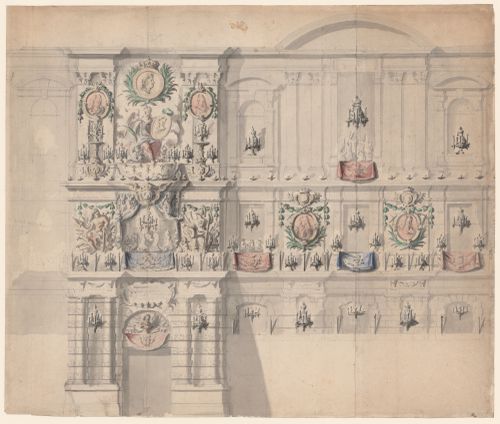
The drawing shows an elevation of the Porte Jean Goujon (now known as the Porte Barbet de Jouy) on the southern, quai-side façade of the Louvre, as well as part of the façade to the east of the portal. On the ground floor, candelabras line the windows and niches. The entry portal features a sculptural bust – likely a representation of Louis XIV – and a red banner with the king’s coat of arms. Above the portal’s tympanum is a large ovoid cartouche with faint script in black chalk that may read « Plate pour l’inscription, » indicating that the text had not yet been finalized at the time of the drawing’s creation. The heavily-decorated middle register features two over-life-size mythical and allegorical figures on either side of a balcony. To the left is Hercules, with his club, and to the right is an allegorical representation of Bellona. The balcony is hung with a blue tapestry woven with the king’s interlocking L monogram. Blue curtains with fleurs-de-lys hang over the balcony, revealing the revelers inside the building. These ornamental elements continue along the façade, which is hung with two large, circular portrait reliefs that likely show Louis XIV’s son, Grand Dauphin Louis, and grandson, Louis, the Duke of Burgundy, who was the father of the Duke of Brittany whose birth was being celebrated. Green watercolor paint is used to highlight the foliage festoons and palms that frame the portraits. On the top register of the portal is a seated allegorical figure holding a palm and a portrait, perhaps of the infant Louis, Duke of Brittany. Above her is a large, crowned medallion with the profile of Louis XIV in the guise of a Roman emperor surrounded by green palms. On either side of this central scene are large candelabras and circular portraits of the Grand Dauphin and the Duke of Burgundy. The architectural elements of the façade are carefully drawn in black chalk and faithfully render the architecture of the Louvre in the early eighteenth century.
DR1967:0012
Description:
The drawing shows an elevation of the Porte Jean Goujon (now known as the Porte Barbet de Jouy) on the southern, quai-side façade of the Louvre, as well as part of the façade to the east of the portal. On the ground floor, candelabras line the windows and niches. The entry portal features a sculptural bust – likely a representation of Louis XIV – and a red banner with the king’s coat of arms. Above the portal’s tympanum is a large ovoid cartouche with faint script in black chalk that may read « Plate pour l’inscription, » indicating that the text had not yet been finalized at the time of the drawing’s creation. The heavily-decorated middle register features two over-life-size mythical and allegorical figures on either side of a balcony. To the left is Hercules, with his club, and to the right is an allegorical representation of Bellona. The balcony is hung with a blue tapestry woven with the king’s interlocking L monogram. Blue curtains with fleurs-de-lys hang over the balcony, revealing the revelers inside the building. These ornamental elements continue along the façade, which is hung with two large, circular portrait reliefs that likely show Louis XIV’s son, Grand Dauphin Louis, and grandson, Louis, the Duke of Burgundy, who was the father of the Duke of Brittany whose birth was being celebrated. Green watercolor paint is used to highlight the foliage festoons and palms that frame the portraits. On the top register of the portal is a seated allegorical figure holding a palm and a portrait, perhaps of the infant Louis, Duke of Brittany. Above her is a large, crowned medallion with the profile of Louis XIV in the guise of a Roman emperor surrounded by green palms. On either side of this central scene are large candelabras and circular portraits of the Grand Dauphin and the Duke of Burgundy. The architectural elements of the façade are carefully drawn in black chalk and faithfully render the architecture of the Louvre in the early eighteenth century.
Personnes et institutions:
Sujet:
architecture temporaire
architecture temporaire
Date:
circa 1704
circa 1704
Titre:
Design for ceremonial decorations at the Louvre
Actions:
DR1967:0012
Description:
The drawing shows an elevation of the Porte Jean Goujon (now known as the Porte Barbet de Jouy) on the southern, quai-side façade of the Louvre, as well as part of the façade to the east of the portal. On the ground floor, candelabras line the windows and niches. The entry portal features a sculptural bust – likely a representation of Louis XIV – and a red banner with the king’s coat of arms. Above the portal’s tympanum is a large ovoid cartouche with faint script in black chalk that may read « Plate pour l’inscription, » indicating that the text had not yet been finalized at the time of the drawing’s creation. The heavily-decorated middle register features two over-life-size mythical and allegorical figures on either side of a balcony. To the left is Hercules, with his club, and to the right is an allegorical representation of Bellona. The balcony is hung with a blue tapestry woven with the king’s interlocking L monogram. Blue curtains with fleurs-de-lys hang over the balcony, revealing the revelers inside the building. These ornamental elements continue along the façade, which is hung with two large, circular portrait reliefs that likely show Louis XIV’s son, Grand Dauphin Louis, and grandson, Louis, the Duke of Burgundy, who was the father of the Duke of Brittany whose birth was being celebrated. Green watercolor paint is used to highlight the foliage festoons and palms that frame the portraits. On the top register of the portal is a seated allegorical figure holding a palm and a portrait, perhaps of the infant Louis, Duke of Brittany. Above her is a large, crowned medallion with the profile of Louis XIV in the guise of a Roman emperor surrounded by green palms. On either side of this central scene are large candelabras and circular portraits of the Grand Dauphin and the Duke of Burgundy. The architectural elements of the façade are carefully drawn in black chalk and faithfully render the architecture of the Louvre in the early eighteenth century.
Design for ceremonial decorations at the Louvre
Actions:
DR1967:0012
Description:
The drawing shows an elevation of the Porte Jean Goujon (now known as the Porte Barbet de Jouy) on the southern, quai-side façade of the Louvre, as well as part of the façade to the east of the portal. On the ground floor, candelabras line the windows and niches. The entry portal features a sculptural bust – likely a representation of Louis XIV – and a red banner with the king’s coat of arms. Above the portal’s tympanum is a large ovoid cartouche with faint script in black chalk that may read « Plate pour l’inscription, » indicating that the text had not yet been finalized at the time of the drawing’s creation. The heavily-decorated middle register features two over-life-size mythical and allegorical figures on either side of a balcony. To the left is Hercules, with his club, and to the right is an allegorical representation of Bellona. The balcony is hung with a blue tapestry woven with the king’s interlocking L monogram. Blue curtains with fleurs-de-lys hang over the balcony, revealing the revelers inside the building. These ornamental elements continue along the façade, which is hung with two large, circular portrait reliefs that likely show Louis XIV’s son, Grand Dauphin Louis, and grandson, Louis, the Duke of Burgundy, who was the father of the Duke of Brittany whose birth was being celebrated. Green watercolor paint is used to highlight the foliage festoons and palms that frame the portraits. On the top register of the portal is a seated allegorical figure holding a palm and a portrait, perhaps of the infant Louis, Duke of Brittany. Above her is a large, crowned medallion with the profile of Louis XIV in the guise of a Roman emperor surrounded by green palms. On either side of this central scene are large candelabras and circular portraits of the Grand Dauphin and the Duke of Burgundy. The architectural elements of the façade are carefully drawn in black chalk and faithfully render the architecture of the Louvre in the early eighteenth century.
Classification:
dessins
dessins
Date:
circa 1704
circa 1704
Personnes et institutions:
Sujet:
architecture temporaire
architecture temporaire
Classification:
oeuvres d'art
oeuvres d'art
Actions:
Numéro de référence:
DR1982:0245
Description:
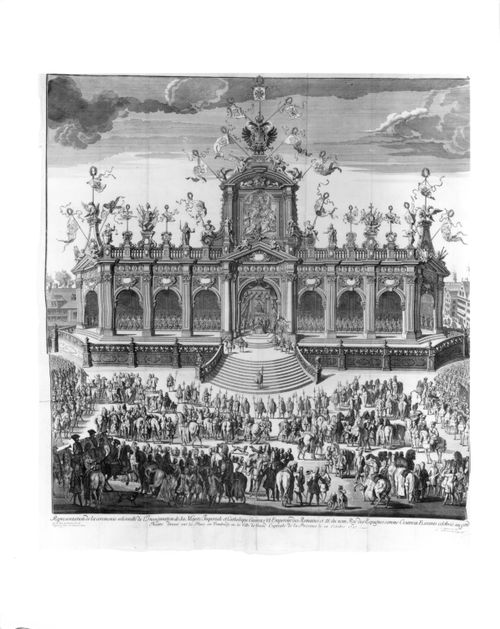
- To manifest the consolidation of his power over the Low Countries, the Emperor Charles VI of Austria staged triumphal entries for his representative into Brussels and Ghent in 1717. During six days of ceremonies and festivities, the main market place was transformed several times. This print (DR1982:0245), shows the events in the Marché or Place au Vendredi on 18 October. A large temporary "theatre" with a raised loggia and central ædicule, had been erected and embellished with rich tapestries , trophies, statuary, and a portrait of the Emperor. Dwarfing the adjacent buildings, it reflected the heavy, High Baroque style of stage-set then popular.
DR1982:0245
Description:
- To manifest the consolidation of his power over the Low Countries, the Emperor Charles VI of Austria staged triumphal entries for his representative into Brussels and Ghent in 1717. During six days of ceremonies and festivities, the main market place was transformed several times. This print (DR1982:0245), shows the events in the Marché or Place au Vendredi on 18 October. A large temporary "theatre" with a raised loggia and central ædicule, had been erected and embellished with rich tapestries , trophies, statuary, and a portrait of the Emperor. Dwarfing the adjacent buildings, it reflected the heavy, High Baroque style of stage-set then popular.
Personnes et institutions:
Sujet:
design de théâtre
design de théâtre
Date:
printed between 1717 and 1719
printed between 1717 and 1719
Titre:
The Inauguration Ceremony in a Theatre Erected on the Place au Vendredi on October 18th
Actions:
DR1982:0245
Description:
- To manifest the consolidation of his power over the Low Countries, the Emperor Charles VI of Austria staged triumphal entries for his representative into Brussels and Ghent in 1717. During six days of ceremonies and festivities, the main market place was transformed several times. This print (DR1982:0245), shows the events in the Marché or Place au Vendredi on 18 October. A large temporary "theatre" with a raised loggia and central ædicule, had been erected and embellished with rich tapestries , trophies, statuary, and a portrait of the Emperor. Dwarfing the adjacent buildings, it reflected the heavy, High Baroque style of stage-set then popular.
The Inauguration Ceremony in a Theatre Erected on the Place au Vendredi on October 18th
Actions:
DR1982:0245
Description:
- To manifest the consolidation of his power over the Low Countries, the Emperor Charles VI of Austria staged triumphal entries for his representative into Brussels and Ghent in 1717. During six days of ceremonies and festivities, the main market place was transformed several times. This print (DR1982:0245), shows the events in the Marché or Place au Vendredi on 18 October. A large temporary "theatre" with a raised loggia and central ædicule, had been erected and embellished with rich tapestries , trophies, statuary, and a portrait of the Emperor. Dwarfing the adjacent buildings, it reflected the heavy, High Baroque style of stage-set then popular.
Classification:
oeuvres d'art
oeuvres d'art
Date:
printed between 1717 and 1719
printed between 1717 and 1719
Personnes et institutions:
Sujet:
design de théâtre
design de théâtre
Classification:
photographies
photographies
Numéro de référence:
ARCH158420
Description:
Contient deux photographies, noir et blanc, de Frank Lloyd Wright avec deux apprentis dans l'atelier de dessin à Taliesin, ca. 1953, et des portraits de Roger D'Astous.
ARCH158420
Description:
Contient deux photographies, noir et blanc, de Frank Lloyd Wright avec deux apprentis dans l'atelier de dessin à Taliesin, ca. 1953, et des portraits de Roger D'Astous.
Personnes et institutions:
Date:
ca. 1953
ca. 1953
Titre:
Photographies, noir et blanc, de Frank Lloyd Wright
Actions:
ARCH158420
Description:
Contient deux photographies, noir et blanc, de Frank Lloyd Wright avec deux apprentis dans l'atelier de dessin à Taliesin, ca. 1953, et des portraits de Roger D'Astous.
Photographies, noir et blanc, de Frank Lloyd Wright
Actions:
ARCH158420
Description:
Contient deux photographies, noir et blanc, de Frank Lloyd Wright avec deux apprentis dans l'atelier de dessin à Taliesin, ca. 1953, et des portraits de Roger D'Astous.
Classification:
photographies
photographies
Date:
ca. 1953
ca. 1953
Personnes et institutions:
Classification:
archives
Niveau de description archivistique:
Fonds
archives
Niveau de description archivistique:
Fonds
Titre:
Fonds Roland Dumais
Fonds Roland Dumais
Numéro de référence:
AP005
Résumé:
The Roland Dumais fonds, 1930-1975, documents architect Roland Dumais’s design and construction of over 500 built projects in Québec. In addition to documenting Dumais’s professional career (1935-1971), the fonds includes materials relating to the everyday administration of Dumais’s architectural firm (1941-1977) as well as materials pertaining to his personal life (1932-1982). Materials in this fonds consist of approximately 12 400 drawings (including reprographic copies), 126 photographic materials, 10.33 l.m. of textual records, 5 models, and 3 reels of 16 mm film.
AP005
Résumé:
The Roland Dumais fonds, 1930-1975, documents architect Roland Dumais’s design and construction of over 500 built projects in Québec. In addition to documenting Dumais’s professional career (1935-1971), the fonds includes materials relating to the everyday administration of Dumais’s architectural firm (1941-1977) as well as materials pertaining to his personal life (1932-1982). Materials in this fonds consist of approximately 12 400 drawings (including reprographic copies), 126 photographic materials, 10.33 l.m. of textual records, 5 models, and 3 reels of 16 mm film.
Personnes et institutions:
Date:
1930-1975
1930-1975
Titre:
Fonds Roland Dumais
Actions:
AP005
Résumé:
The Roland Dumais fonds, 1930-1975, documents architect Roland Dumais’s design and construction of over 500 built projects in Québec. In addition to documenting Dumais’s professional career (1935-1971), the fonds includes materials relating to the everyday administration of Dumais’s architectural firm (1941-1977) as well as materials pertaining to his personal life (1932-1982). Materials in this fonds consist of approximately 12 400 drawings (including reprographic copies), 126 photographic materials, 10.33 l.m. of textual records, 5 models, and 3 reels of 16 mm film.
Fonds Roland Dumais
Actions:
AP005
Résumé:
The Roland Dumais fonds, 1930-1975, documents architect Roland Dumais’s design and construction of over 500 built projects in Québec. In addition to documenting Dumais’s professional career (1935-1971), the fonds includes materials relating to the everyday administration of Dumais’s architectural firm (1941-1977) as well as materials pertaining to his personal life (1932-1982). Materials in this fonds consist of approximately 12 400 drawings (including reprographic copies), 126 photographic materials, 10.33 l.m. of textual records, 5 models, and 3 reels of 16 mm film.
Classification:
archives
Niveau de description archivistique:
Fonds
archives
Niveau de description archivistique:
Fonds
Date:
1930-1975
1930-1975
Personnes et institutions:


